Another puzzle from Dragoslav Andric’s 1981 book “Matni Udar”.
In yesterday’s puzzle, what did both players miss?

Sveshnikov v Sushchikh, USSR 1975
Solution
The moves given yesterday were
1 Qc4 Nc4
2 Rff7+ Ke8
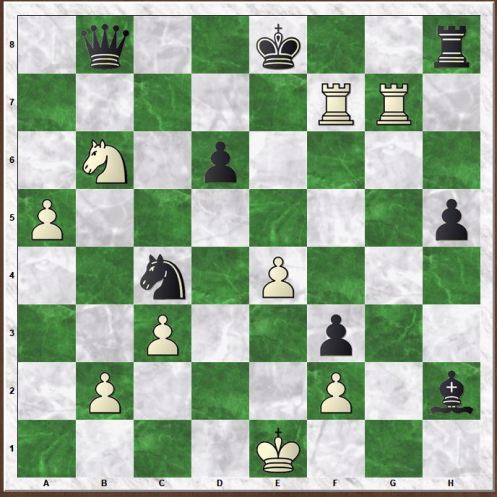
3 Re7+ Kd8
4 Rd7+ Ke8
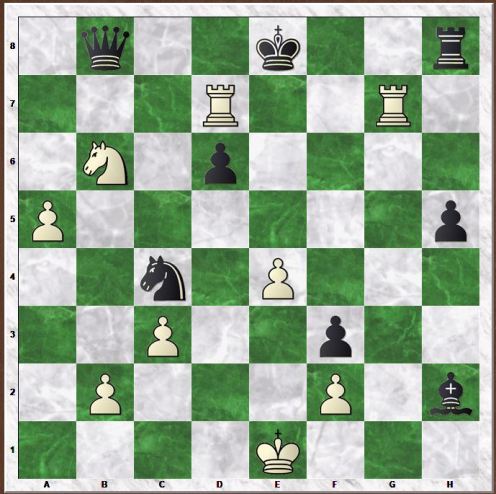
5 Nc4 Be5
6 Ne5 de 7 Rb7 Qd6 8 a6 etc 1-0
A really astute reader (such as my friend Komodo, in my case) will note that 5 Nc4?? threw all the advantage away: the engine switches from +3 to 0.0 instantly. 5…Qc8!
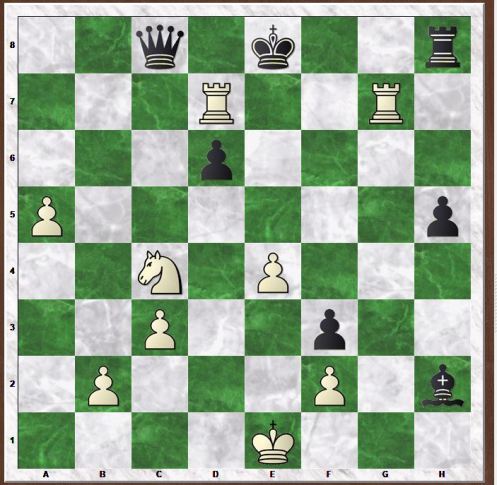
The point is that Black’s queen gets to either a6 or e6 next move, after which either mate on e2 or entry on e4 is threatened. White has to suffice with perpetual check.
Instead, 5 Nd5!! is Komodo’s only winning move.
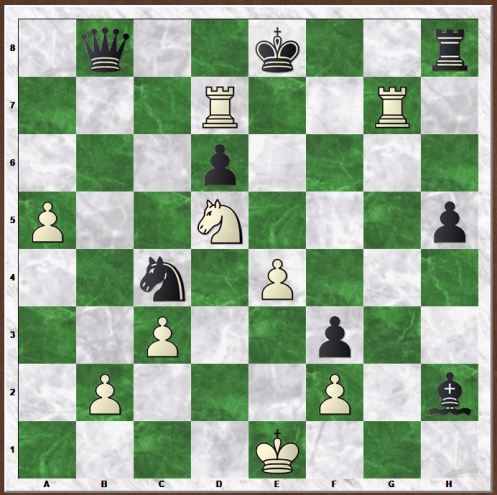
As soon as you see it (as soon as the engine pings) you see why: Nf6+ and Rf7 mate follows): but so unnatural not to take the N.
Chess is a hard game.
FEN
1q5r/4kpR1/1N1p4/P3nR1p/2b1P3/1QP2p2/1P3P1b/4K3 w – – 0 35 (original diagram)
2q1k2r/3R2R1/3p4/P6p/2N1P3/2P2p2/1P3P1b/4K3 w – – 0 40 (after 5…Qc8)
Another puzzle from Dragoslav Andric’s 1981 book “Matni Udar”.
This one has a twist. And a PS.
White to play and mate Black
Sveshnikov v Sushchikh, USSR 1975
Solution
Since 1 Re5?? is a blunder (1…Be5 and then 2…Bg7 is unfortunate) and whilst 1 Nd5 is good and safe (and Komodo tells me it gives White some advantage), since this is a puzzle book position, the first move has to be 1 Qc4!
1…Nc4[] (1…Qb6?? 2 Re5+! and 3 ab) 2 Rff7+ Ke8 (2…Ke6 3 Re7+ and 4 Nd5 mate)
Now, White checks and checks, in order to keep Black’s Queen at bay: 3 Nc4? Qc8 throws away all the advantage, and White has to bale out with perpetual.
So 3 Re7+ Kd8[] 4 Rd7+ Ke8 5 Nc4 Be5 6 Ne5 de 7 Rb7
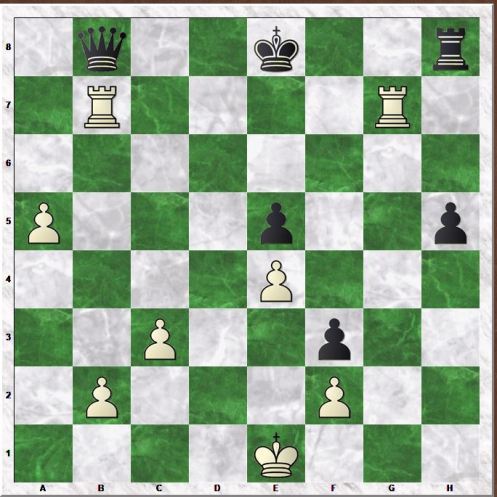
and the a pawn advances: if e.g. 7…Qa8 8 a6 Qa6?? then 9 Rb8 mate.
In the game Black resigned after 7..Qd6 8 a6 Kf8 9 Rgc7.

The twist
What did both players miss? There is something wrong in my analysis, and one of the playeer’s play could have been improved. Answer tomorrow.
PS
In this game, Sveshnikov’s opponent played the Sveshnikov Sicilian against him. The game was from the USSR army championship, so not a training game.
FEN
1q5r/4kpR1/1N1p4/P3nR1p/2b1P3/1QP2p2/1P3P1b/4K3 w – – 0 35
Another puzzle from Dragoslav Andric’s 1981 book “Matni Udar”.
White to play and mate Black
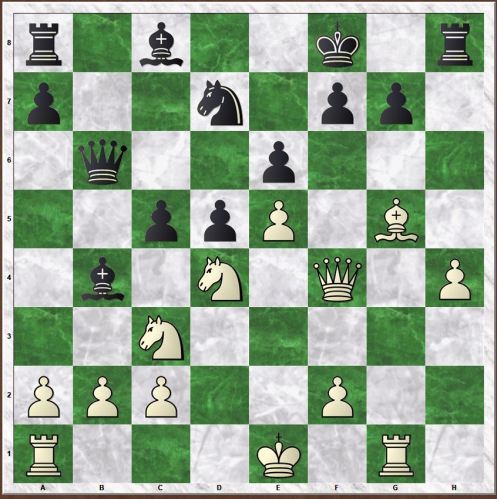
Urzica v Ghinda, Bucharest 1975
Solution
It took me a short while to see that the way to break through was by deflecting the queen: examine all biffs again: 1 Bd8!
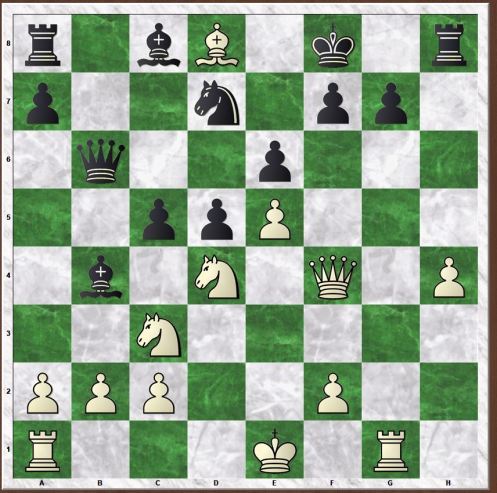
Black must move his Q to a6, to continue guarding e6, when 2 Rg7 breaks through. 2…Kg7[] 3 Qg5+
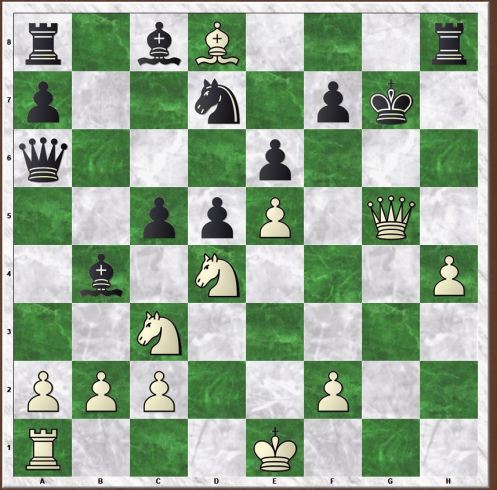
Kf8 (3…Kh7 4 Bf6 and if 4..Rg8, 5 Qh5 is mate) 4 Be7+ and 5 Bd6 and 1-0

FEN
r1b2k1r/p2n1pp1/1q2p3/2ppP1B1/1b1N1Q1P/2N5/PPP2P2/R3K1R1 w Q – 0 17
Another puzzle from Dragoslav Andric’s 1981 book “Matni Udar”.
White to play and mate Black
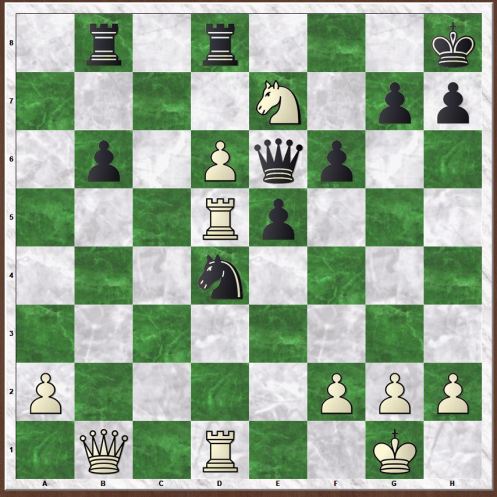
Ambrosimov v Ambajnes, 1975
Solution
A nice variation of a standard motif.
1 R1d4! ed[]

2 Qh7+! Kh8[] 3 Rh5 mate.
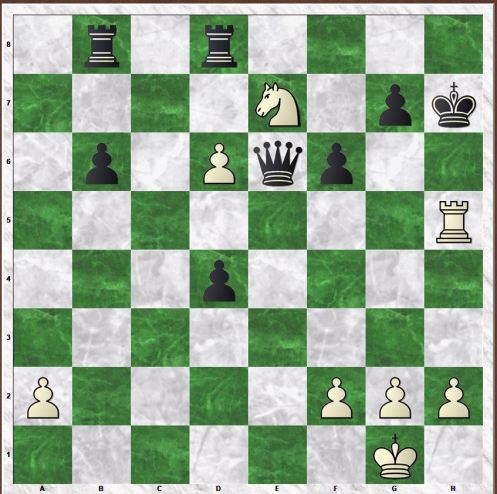
FEN
1r1r3k/4N1pp/1p1Pqp2/3Rp3/3n4/8/P4PPP/1Q1R2K1 w – – 0 1
Another puzzle from Dragoslav Andric’s 1981 book “Matni Udar”.
Black to play and mate White

Solution
A pure trip down memory lane. I clearly remember this position, and the joy as a twelve year old seeing it, possibly for the first time in the February 1975 British Chess Magazine (BCM): I say possibly, because, oddly, the game isn’t given much profile in that magazine, which I had a look at in writing this posting.


A really liked Rafael Vaganian, who to my pre teenage eyes was (i) Russian [I suspect he was Armenian] and (ii) stylish; and the fact that he lost to someone I had not heard of, in fine style, with Na1!! was really notable. It has been nice to see Rafael playing in Biel last month, the first I have seen of him for many years.
So, 43 years later, the ‘solution’ came to me instantly. 1..Bf5

2 Qa8 Qd6+

3 Kc1 Na1

4 Qb7 Qc7+!! – the final joyful coup.

Vaganian resigned, rather than permitting 5 Qc7 Nb3 mate.

Postscript
However, there is a spoiler.

4 Qb7?? is a mistake. 4 Bc4! is considerably stronger, and my engine says is 0.0

After 4 Bc4! Qc7 5 Nc3 Qc4 6 Qd8 just about holds the balance. I have played a few variations out with my engine: White’s king is checked into the open board, so in human chess terms Black is having all the fun, but the engine regards the line as equal.

Also, 3 Kc3 is just about playable, though I think Black is better and White would have a tough time holding on. The real mistake was therefore 4 Qb7??
FEN
r1b1Q3/pp3ppk/1q5p/8/8/P3P3/1PnK1PPP/3N1B1R b – – 0 19
Another puzzle from Dragoslav Andric’s 1981 book “Matni Udar”.
Black to play and mate White
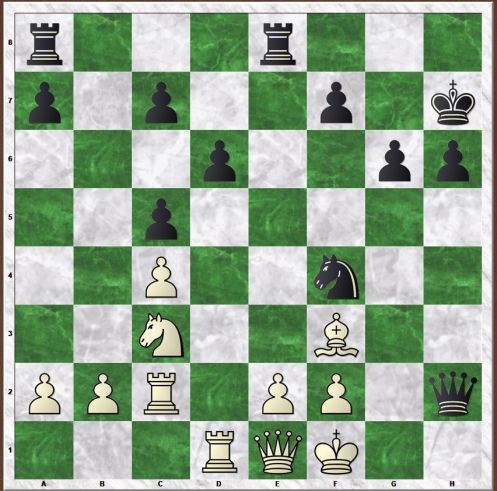
Solution
A miffed this one, choosing what I thought was the convincing 1..Re2??, seeing that most captures won for Black, but missing that 2 Ne2! wins: 2…Qh3+ 3 Kg1[] Qf3 is met by 4 Nf4, and the game is over (I also missed that 2 Ba8 is equal).
Alas, 1…Re3!! is the lovely winning move, and White resigned.
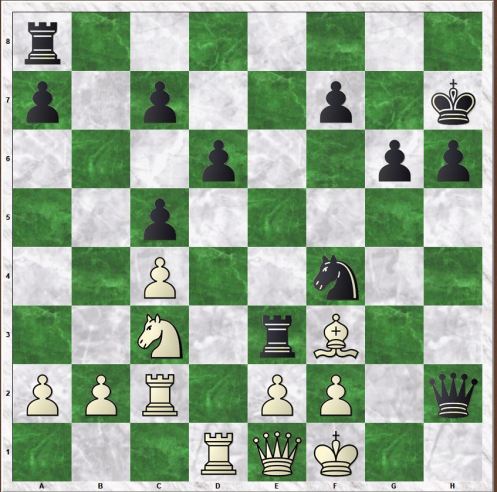
If 2 fe Nh3 and mate.
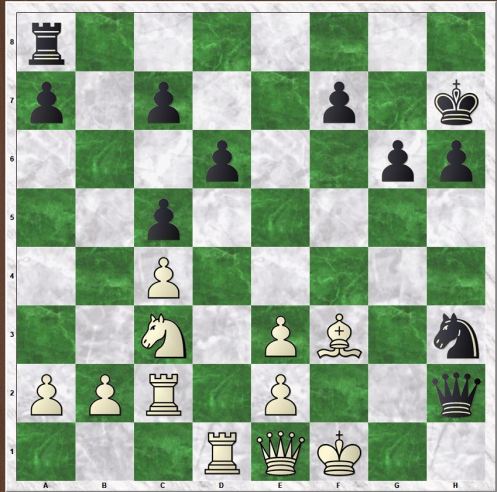
I fear that I could very well have played 1…Re2 in a game, expecting plaudits and praise, and then being devastated: chess can be a cruel game.
Finally, Komodo says that the rook life 1…Re5 is also winning.
FEN
r3r3/p1p2p1k/3p2pp/2p5/2P2n2/2N2B2/PPR1PP1q/3RQK2 b – – 0 26
Another puzzle from Dragoslav Andric’s 1981 book “Matni Udar”.
Black to play and mate White
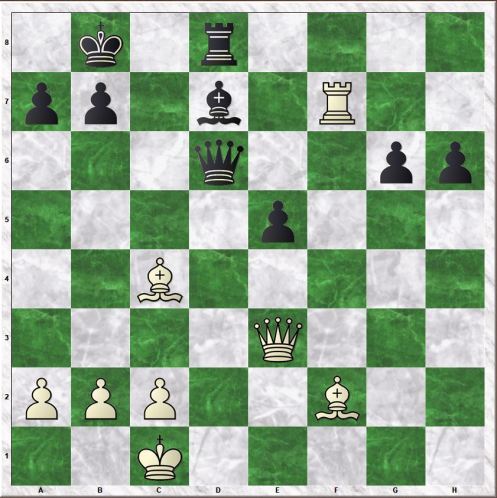
Andersson v Knutsson, Stockholm 1974
Solution
Not too hard today, the position being a variation of the motif often seen in puzzle books, but with White playing 1 Qd8+, Bg5+ or Ba5+ and Rd8 mate.
Here, 1…Qd1+ 2 Kd1 Bg4++ 3 K moves Rd1 mate.
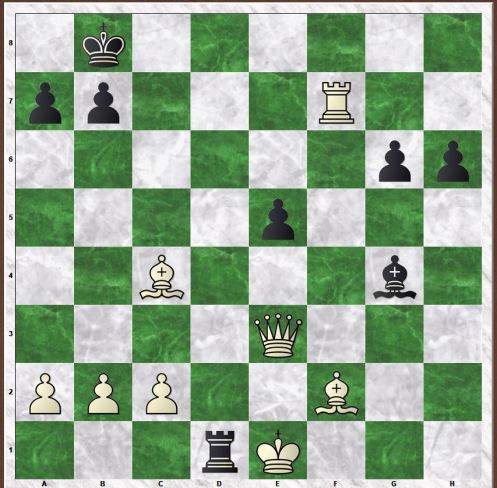
FEN
1k1r4/pp1b1R2/3q2pp/4p3/2B5/4Q3/PPP2B2/2K5 b – – 0 1
Another puzzle from Dragoslav Andric’s 1981 book “Matni Udar”.
Black to play and mate White
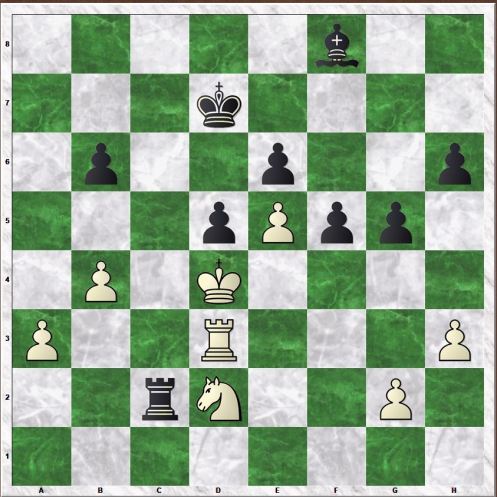
Westerinen v Hubner, Oslo 1974
Solution
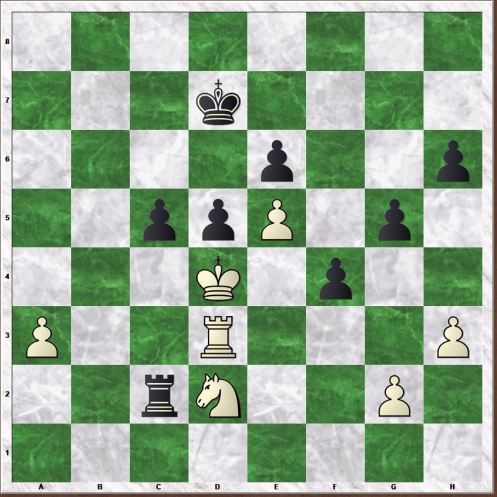
Quite an elegant solution, a one move one: 1…f4 and White is powerless to meet the threat of 2…Bc5+ and 3..bc mate. The position below is after 2 (null move) Bc5+ and 3…bc mate.
Alas, my eyesight is poor, and I actually solved a different problem, but with the same solution:
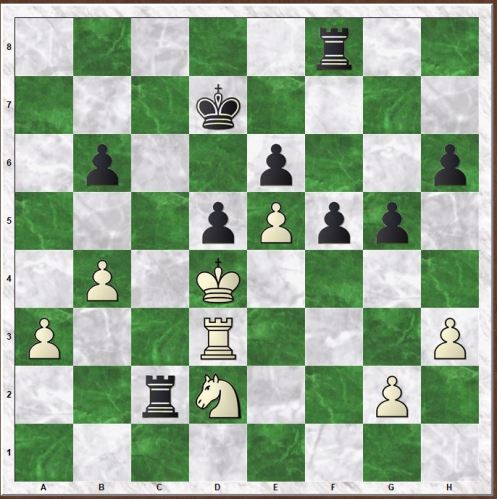
Here, 1…f4! is again the solution, and threatens 2…Rfc8-c4 and mate, which can only be stopped by losing the N.
FEN
5b2/3k4/1p2p2p/3pPpp1/1P1K4/P2R3P/2rN2P1/8 b – – 0 50
Another puzzle from Dragoslav Andric’s 1981 book “Matni Udar”.
Black to play and mate White
Solution
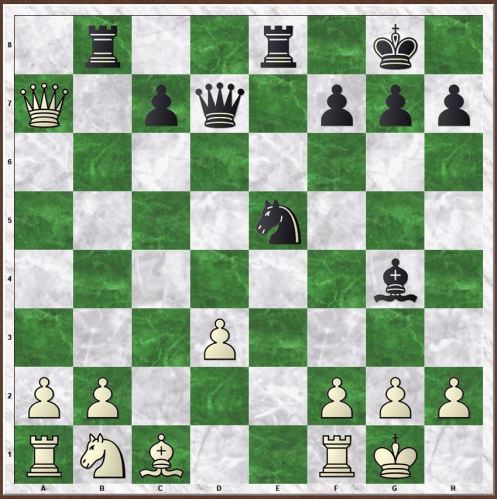
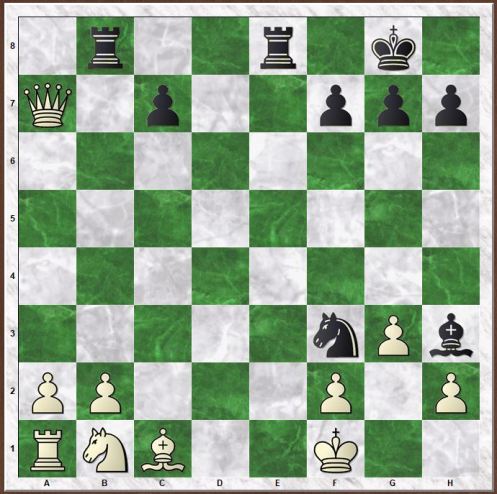
Fairly easy today. The first move to consider is 1…Nf3+, and it is overpowering. If 2 Kh1 then 2…Qd3 wins, but nicer is 2…Qd6 as played in the game, 3 g3 Qd3 4 Kg2
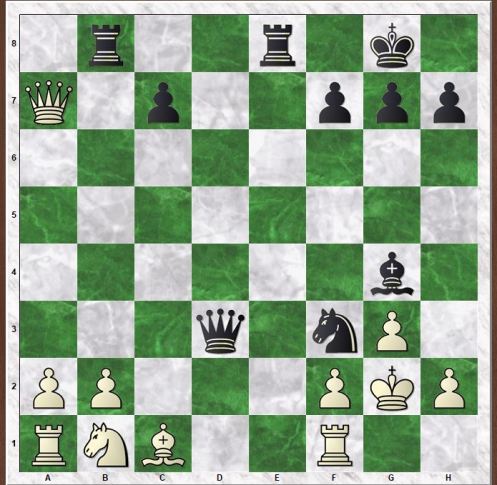
4…Qf1+! 5 Kf1[] Bh3 mate (in the game, Black played 5..Re1+ and 6…Rg1 mate)
FEN
1r2r1k1/Q1pq1ppp/8/4n3/6b1/3P4/PP3PPP/RNB2RK1 b – – 0 1
Another puzzle from Dragoslav Andric’s 1981 book “Matni Udar”.
White to play and mate Black
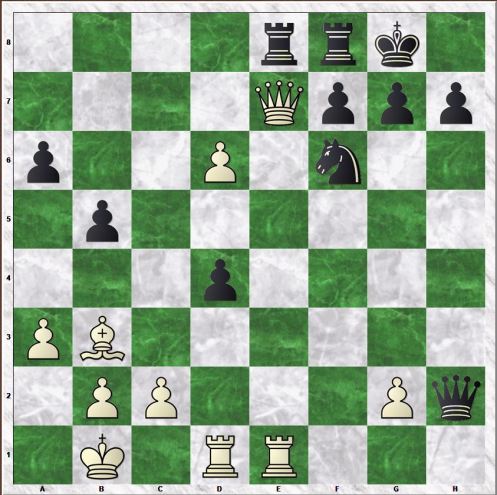
Velimirovic v Csom, Amsterdam 1974
Solution
Not too hard: 1 Bf7+! Rf7 2 Qe8+ Ne8 3 Re8+ Rf7 4 d7 is a double “attack”: d8(Q) or de(Q) follows.
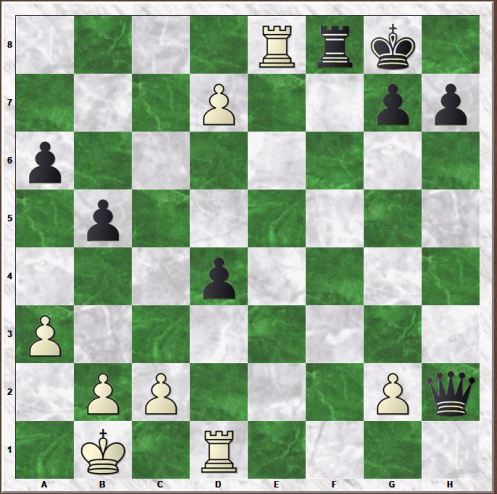
Black’s only move is 4…Qd6 when 5 Rf1 wins.
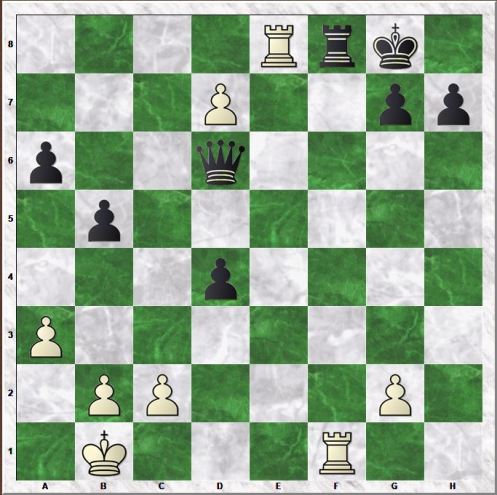
The opening was a Sicilian, Velimirovic attack, which I studied in quite some detail as a teenager, enthralled by Velimirovic’s games. I don’t recall this game against Csom, but quite probably I did look at it some time in the 1970s.
FEN
4rrk1/4Qppp/p2P1n2/1p6/3p4/PB6/1PP3Pq/1K1RR3 w – – 0 22
 allanbeardsworth