Test your chess: daily chess puzzle # 233
Black to play and win
White played 1 Ke2 here:
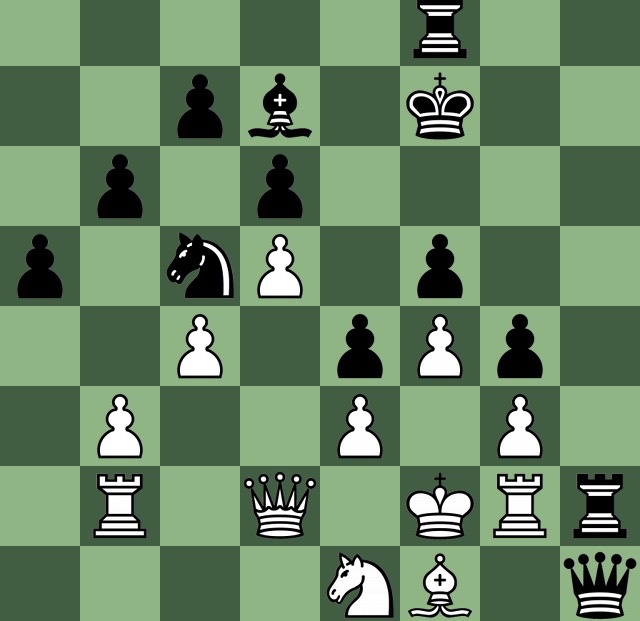
J Wolpert v W Heidenfeld 1955
Solution
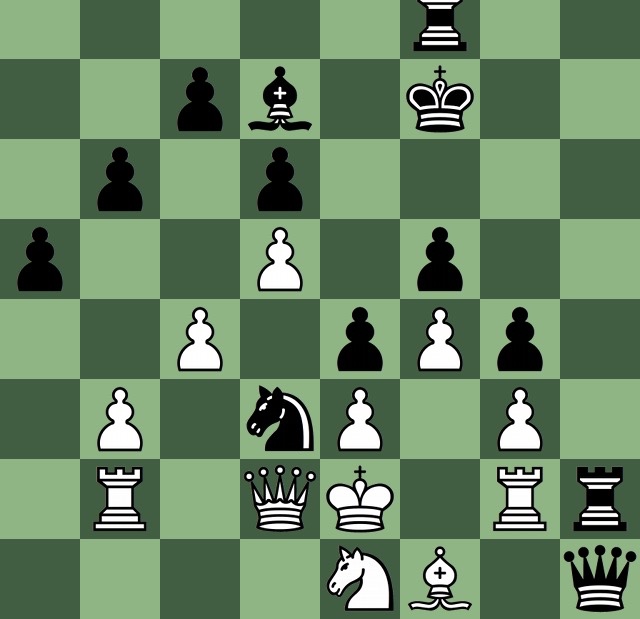
Not much of a puzzle today: 1…Nd3 throws white into disorder; he has various moves, but all lead to a loss of a piece, one way or another.
 Posted with Blogsy
 allanbeardsworth
I don’t think so. No need to move the king when the knight can be taken by white’s bishop or knight and still have the king providing secondary support where he is against RxR.
Perhaps my comments were too cryptic. If for instance 2 Kd1 (after 1…Nd3), then 2..Rg2 3 Bg2 Nb2+ and Black is the exchange up, and later plays Qh2. Then if white defends the Pg3 with Qf2 he is tethered up: Rf8-h8, and the threat of Rh3 (the Qf2 is LPDO) forces Kf2, when Pa4 breaks through.
If instead 2 Rb2, to avoid losing the exchange, then 2…Rfh8 improves one more piece, and there is a nice line after 3 Kd1: now the Rh2 is defended, so that 3…Qf1! is possible: 4 Rh2 Rh2 5 Qh2 is mated by 5..Qe1+ 6 Kc2 Qc1 mate.
I’m sorry. I was thinking the first board, as presented, was ready for “Black to play and win” and I did not take into account the “White played 1 Ke2 here:”. It would have been clearer if I had seen the second board image with the “Black to play and win”.
It was the Ke2 move on the first board that I was questioning.