Another puzzle from Dragoslav Andric’s 1981 book “Matni Udar”.
Black to play and mate White
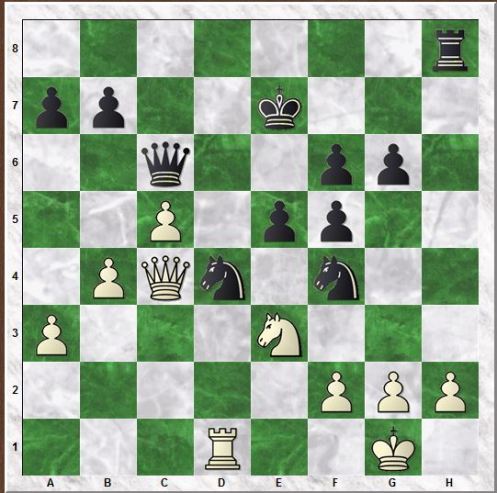
Durth v Koch, Germany 1971
Solution
Quite nice today: just at my limit of vision, with Knight’s harder to imagine a few moves deep.
1…Qg2+! 2 Ng2 Nf3_ 3 Kf1 (3 Kh1 ? Rh2 mate) 3..Nh2+ 4 K-either Nf3+ 5 Kf1[] Rh3 mate.
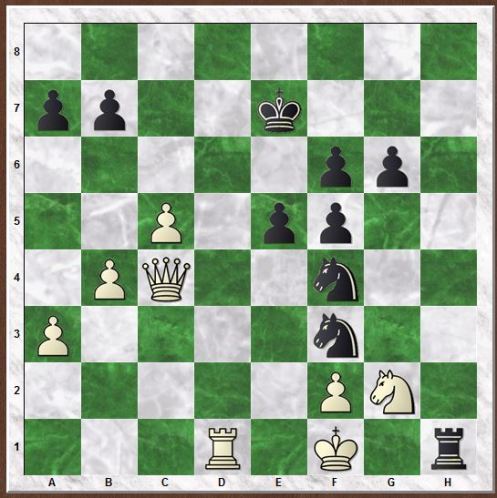
FEN
7r/pp2k3/2q2pp1/2P1pp2/1PQn1n2/P3N3/5PPP/3R2K1 b – – 0 1
Another puzzle from Dragoslav Andric’s 1981 book “Matni Udar”.
Black to play and mate White
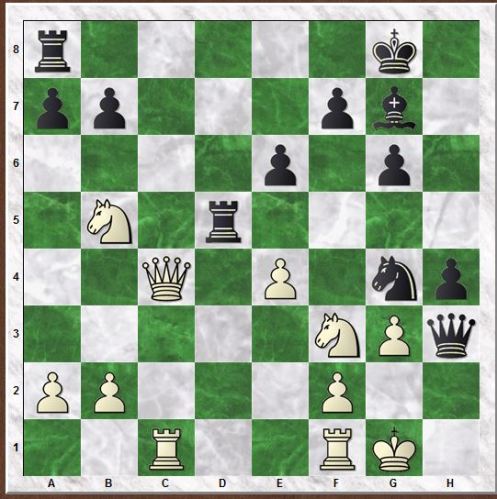
Nevole v Gonszor, 1970
Solution
I chose 1…Rd2! which Komodo gives as -11; but Komodo gives slightly higher to the move played in the game, 1..Rb5!: 2 Qb5 Bd4.
I also tried to make 1…h4 work, but it doesn’t: the engine’s assessment plummets to 0.0.
FEN
r5k1/pp3pb1/4p1p1/1N1r3p/2Q1P1n1/5NPq/PP3P2/2R2RK1 b – – 0 1
A break for a day from Dragoslav Andric’s 1981 book “Matni Udar”.
A special puzzle on my birthday (the only thing I share with Donald Trump)
Instead, a puzzle I really struggled with from Jon Speelman’s Agony Column on Chessbase.
White to play and find a strong continuation
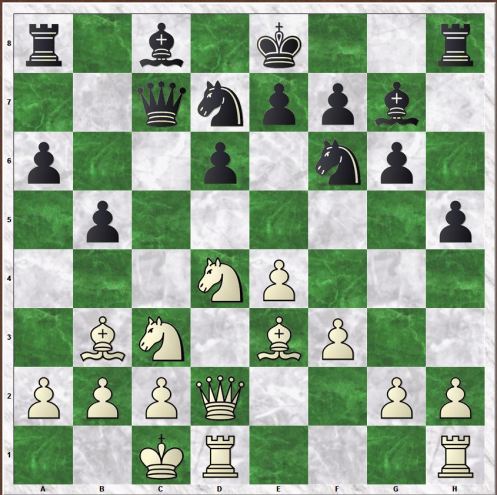
Hiban v Harley, 2016, shown on Chessbase.com
Solution
I would never have found the combination in a game, and neither did White. As it was, something about the puzzle intrigued and interested me, and I spent a lot of time on it, culminating in setting up the pieces on one of my big sets, carrying on studying it, then resorting to moving the pieces round. Then giving up, and, as I gave up, finding the solution. That is how it is sometimes, isn’t it?- the answer comes from nowhere.
1 Nd5! Nd5 2 Nb5!!
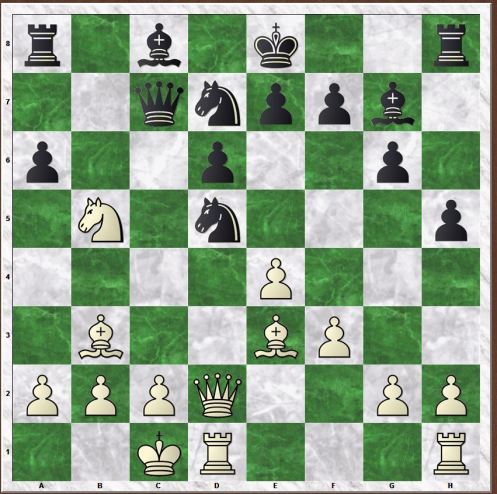
White wins at least a pawn.
That’s the only line Jon gives, but I worried more about 1..Qb7, after which I found (eventually) 2 Qa5! which Komodo tells me is +2: as I saw, the bind is really strong.
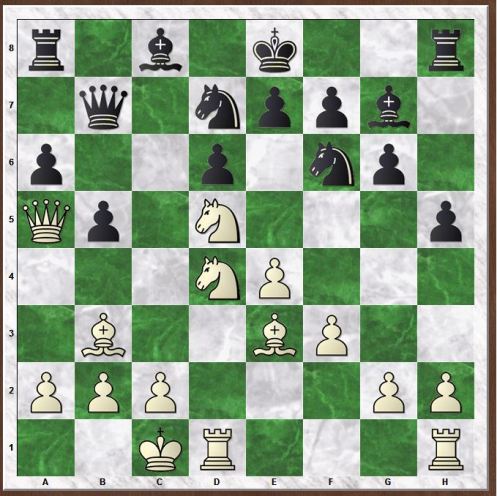
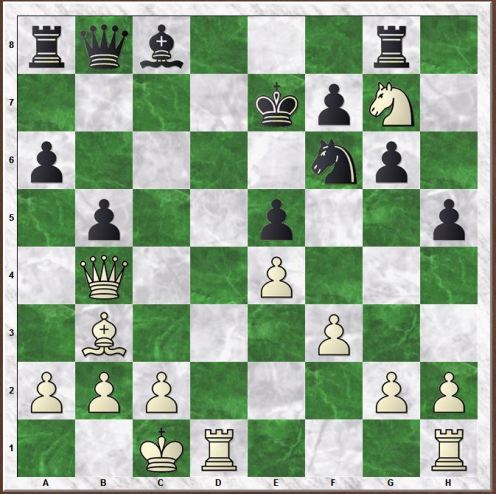
However, Komodo finds 2 Ne7!!
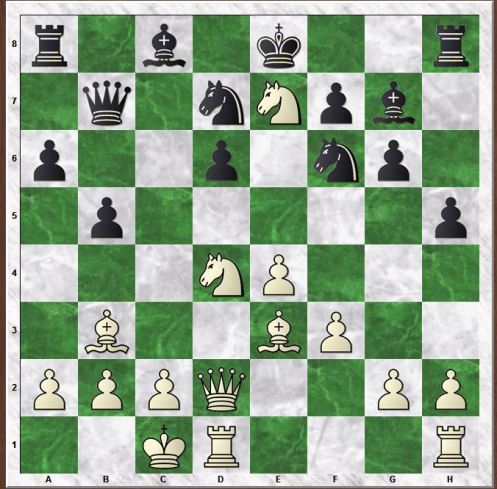
2…Ke7[] 3 Ne6!!
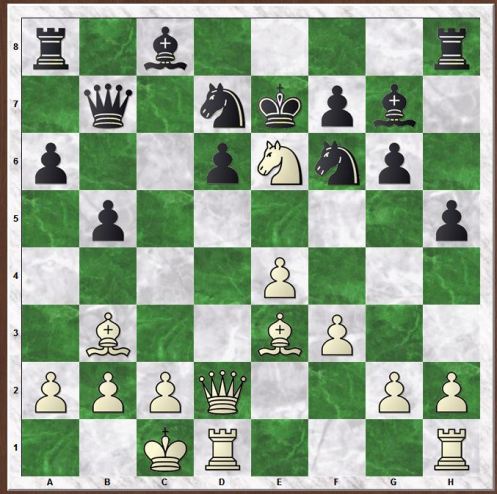
A truly ridiculously good computer line. 3…Qb8 (or 3…Qc6) 4 Ng7 takes the LPDO Bg7. The tactics continue to roll. The line I looked at was 4…Rg8 (trying to capture the Ng7) 5 Bf4 (hitting d6) 5…Ne5 (blocking the bishop) 6 Be5! (intending to…) 6..de 7 Qb4+ (the point of Be5)
FEN
r1b1k2r/2qnppb1/p2p1np1/1p5p/3NP3/1BN1BP2/PPPQ2PP/2KR3R w kq – 0 12
Another puzzle from Dragoslav Andric’s 1981 book “Matni Udar”.
White to play and mate Black

Csom v Ghitescu, Siegen 1970
Solution
Either of two moves wins: 1 Be7 and 1Ne8+ followed by 2 Be7: the N is tied to defending d8, and so the Bishop can’t be captured.
I prefer 1 Ne8+, since there are then fewer variations.

FEN
8/3P1pkp/2n2Np1/8/5b2/B6P/5PP1/6K1 w – – 0 53
Another puzzle from Dragoslav Andric’s 1981 book “Matni Udar”.
White to play and mate Black
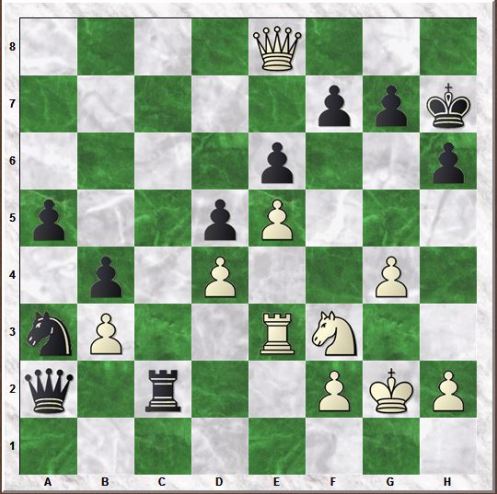
Toljcov v Mojsejev, 1970
Solution
Nice, but it is a motif I have seen before; though I don’t think I have seen the actual position before.
1 Ng5+! hg 2 Rh3+ Kg6[]
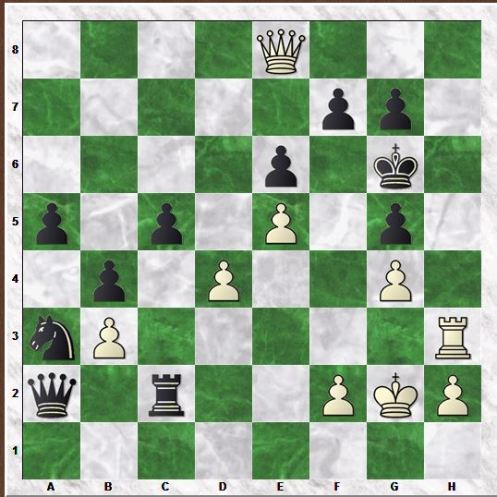
3 Rh6+! and if 3…gh, 4 Qg8 mate, so 3…Kh6, when 4 Qh8+ Kg6[] 5 Qg6 mate.
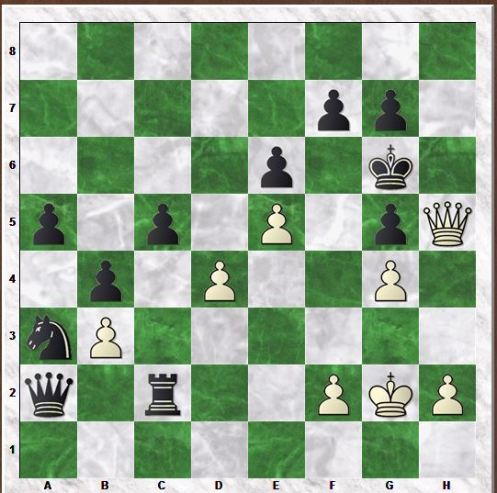
FEN
4Q3/5ppk/4p2p/p2pP3/1p1P2P1/nP2RN2/q1r2PKP/8 b – – 0 1
Another puzzle from Dragoslav Andric’s 1981 book “Matni Udar”.
White to play and win
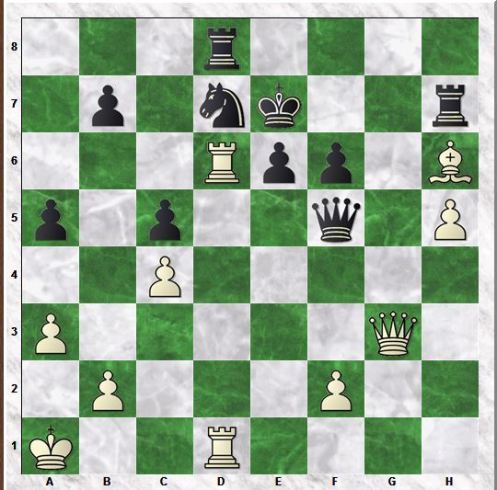
Dukic v Tomasevic, 1969
Solution
Quite an unusual, and pretty way to win: 1 Qg8! hits the LPDO Rh7, and exploits the fact that the Rd8 is tied to the Nd7, because the Black king is in a net. The words in bold are all CJS Purdy’s language.
Black is forced to play 1…Rf7, when exchanging twice on d7 wins the rook.
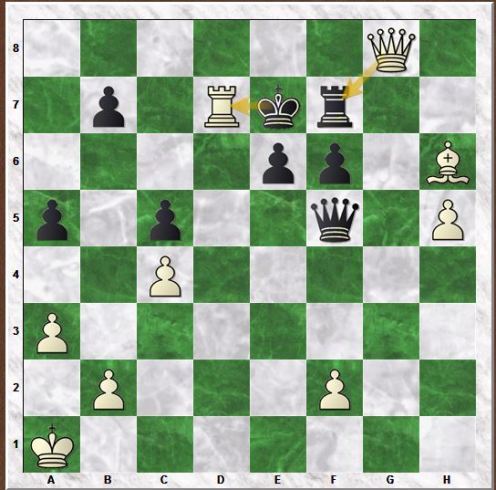
Black doesn’t have a perpetual, so White will consolidate and win.
FEN
3r4/1p1nk2r/3Rpp1B/p1p2q1P/2P5/P5Q1/1P3P2/K2R4 w – – 0 1
Another puzzle from Dragoslav Andric’s 1981 book “Matni Udar”.
Black to play and mate White
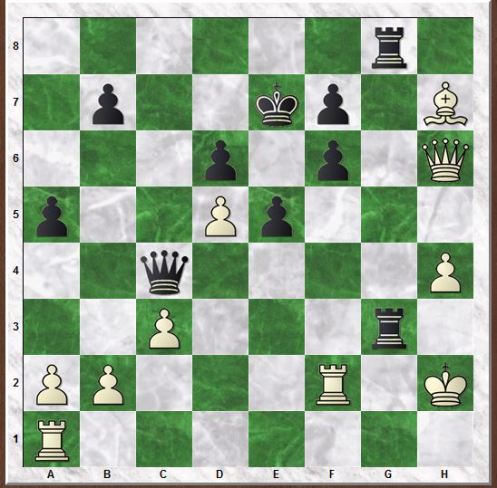
Vasiukov v Damjanovic, Amsterdam 1969
Solution
Black missed the idea in the game, but since it is a puzzle from a book, it is none too hard.
1…Rh3+! deflects the King to h3, when 2…Qg4+! mates in a couple of moves. In the game, Black won more prosaically.
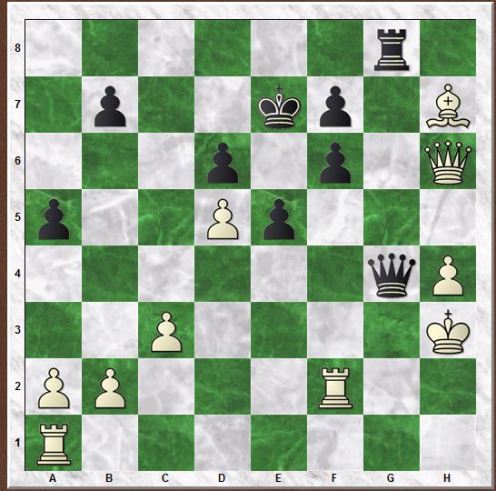
FEN
6r1/1p2kp1B/3p1p1Q/p2Pp3/2q4P/2P3r1/PP3R1K/R7 b – – 0 28
A day’s break from the daily posting from “Matni Udar”, to give a puzzle from one of my 3-0 blitz games.
Black to play and win

“Estebandel” vs allanbeard, Chess.com, 3-0 blitz, 22/4/17 {posted now because I draft blogs week’s ahead, especially when, as recently, we have a holiday period, before which I need to get ahead}
Solution
I was pleased to find 1..Rd1+! 2 Rd1[] Nf2!, and even more pleased to see that, when drafting this blog, Komodo 10 approves.

All the pieces are in the “right position” for the combination to work. If 3 Kf2, 3…Ng4+ discovers on the LPDO Bf4, and also on the Qc3 (which had just moved from d2 in the puzzle diagram position).
Quite satisfying.
FEN
3rr1k1/ppq2pbp/2p3p1/4n3/2P2Bn1/2Q2NN1/PP3PPP/2RR2K1 b – – 0 19
Another puzzle from Dragoslav Andric’s 1981 book “Matni Udar”.
White to play and mate Black
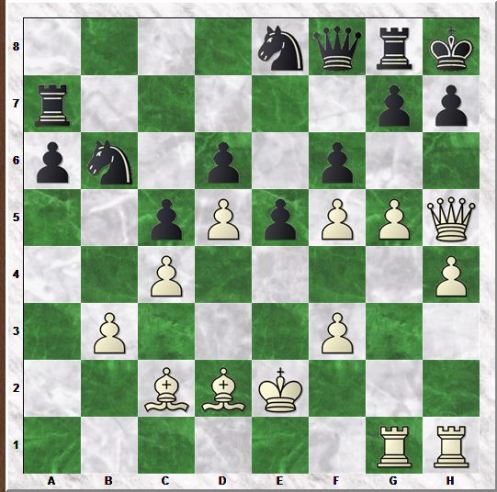
Borisenko, Valentina v Nahimovskaja, Zara, Riga 1969
Solution
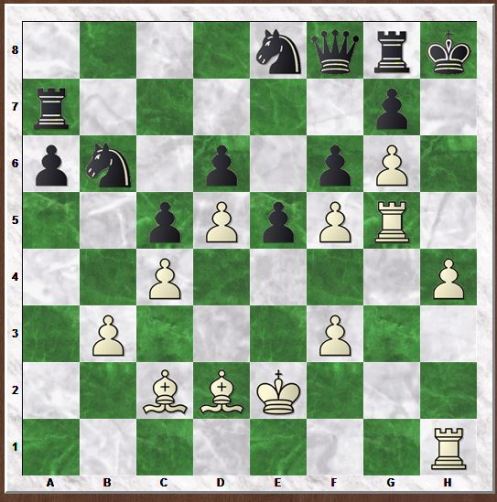
Fairly easy today, all that is needed is to check that 1 Qh7+! works, which it does: 1…Kh7[] 2 g6+ Kh8[] 3 Rg5 1-0.
FEN
4nqrk/r5pp/pn1p1p2/2pPpPPQ/2P4P/1P3P2/2BBK3/6RR w – – 0 37
Another puzzle from Dragoslav Andric’s 1981 book “Matni Udar”.
Black to play and mate White
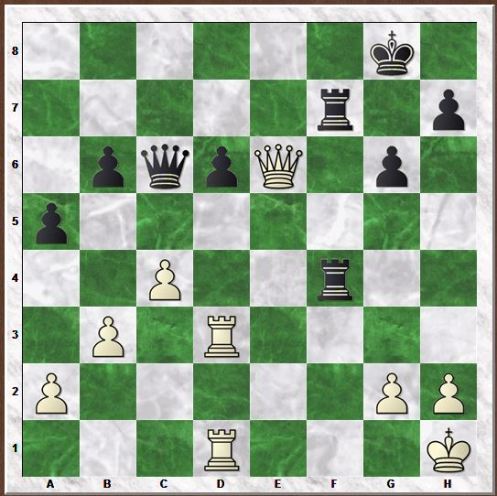
Geller, Efim v Ostojic, Preadrag, Belgrade 1969
Solution
A standard deflection, due to the threat of back rank mate: 1..Qe4, 0-1. The fact that the Qe6 is LPDO is part of the rationale of why the solution works.
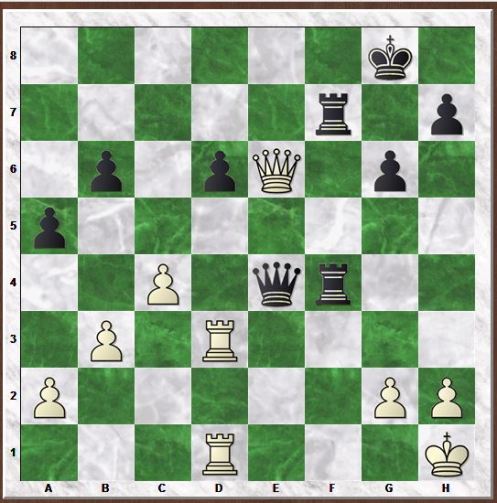
I’ve not heard of the player of the Black side: his brief Wikipedia entry:
https://en.wikipedia.org/wiki/Predrag_Ostoji%C4%87
FEN
6k1/5r1p/1pqpQ1p1/p7/2P2r2/1P1R4/P5PP/3R3K b – – 0 28
 allanbeardsworth