White to play and win
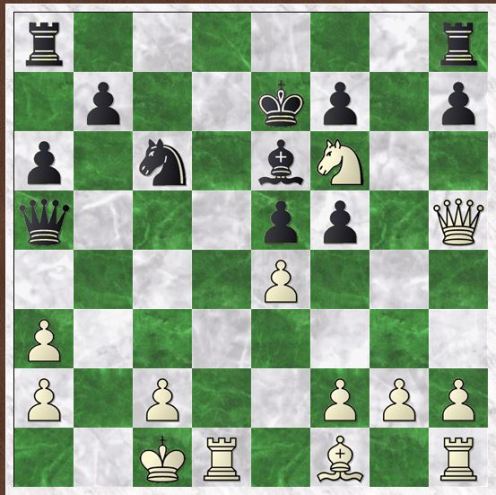
(cooked, so only spend some time on this puzzle)
Doney v Weinhold, England 1974
Solution
Ouch: this problem is slightly cooked, which means part of the considerable time I put into it was ‘wasted’ – if studying time is ever wasted. In a game, I might have played a poor move such as 1 Nd5+, but knowing it was a puzzle, I looked at 1 Bc4! met by 1…Qa3+ 2 Kb1 Qb4+ 3 Bb3 Kf6 4 Rd7:
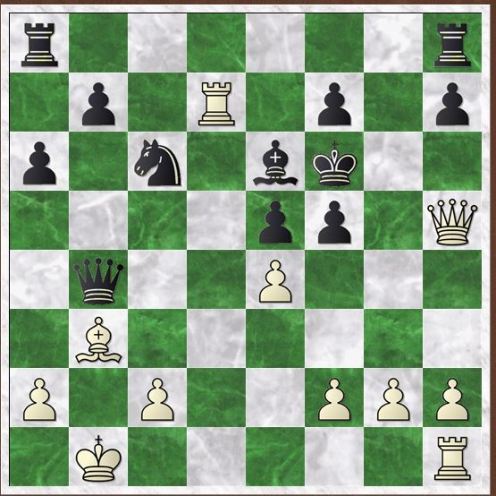
But 4.. Rg8! provides a tough defence, and even after leaving Fritz ponder for ten minutes, it gives a resolute 0.0.
Now, perhaps, deeper analysis, or a different engine will suddenly produce +-, but to a human player, 4…Rg8 was obvious (at least to me) and is a fighting defence.
 Posted with Blogsy
White to play and win
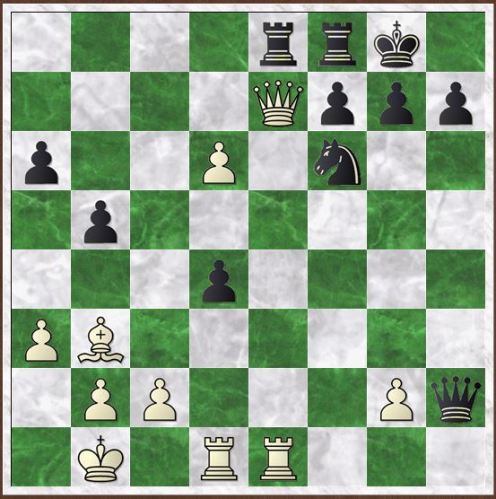
Velimirovic v Csom, Amsterdam 1974
Solution
Not too hard today: 1 Bf7+!Rf7 2 Qe8+ Ne8 3 Re8+ Rf8 4d7 Qd6 5 Rf1 1-0.
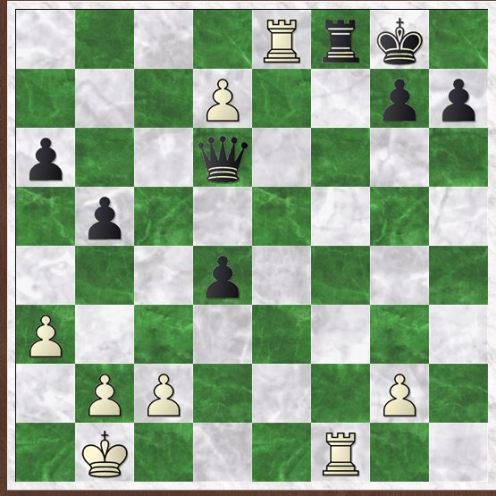
The flashier 1 Qf7+? loses: at the end of the similar line, Black can play Qh2-b8 defending both d8(Q) and d7*e8(Q).
White to play and win
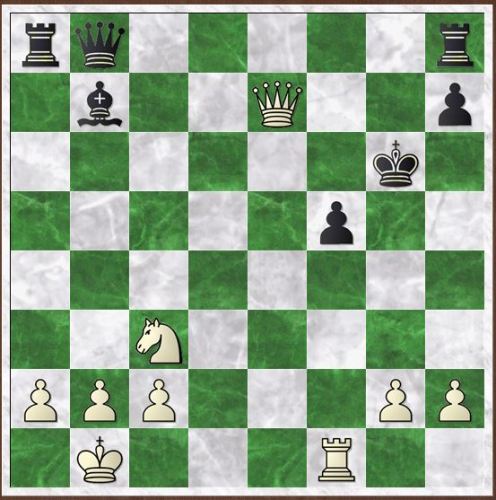
Tal v Stean, Hastings 1973-74
Solution
Tal magic again: less mortals would draw by perpetual check now, but not Tal. I wonder how much earlier he saw the win, saw that even his reduced amount of material would be sufficient?
Here, knowing it is a puzzle leading to 1-0, “bringing more pieces to the party” is more or less all White can do, so 1 h4! is “obvious”. It gives White an anchor on g5 if needed, or a lever h4-h5 dependent on Black’s reply.
Too many variations to consider: Black played 1…h5, followed by 2 h5+ and Qf7+ Qf6+ Qg5+ Qh4+ before mating with Rf2+ and Ne2+.
Magician.
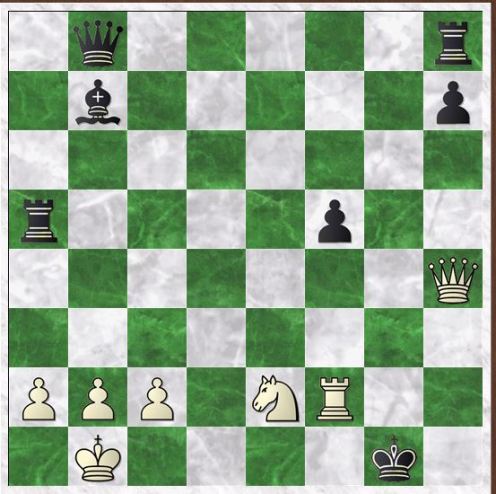
Black to play and win
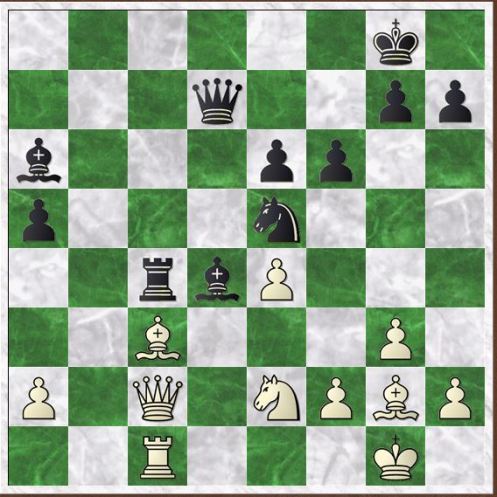
Adorjan v Basman, Hastings 1973
Solution
I played the straightforward 1…Nd3! which Fritz says is marginally stronger than the move played, 1..Bf2+. After 1…Nd3:
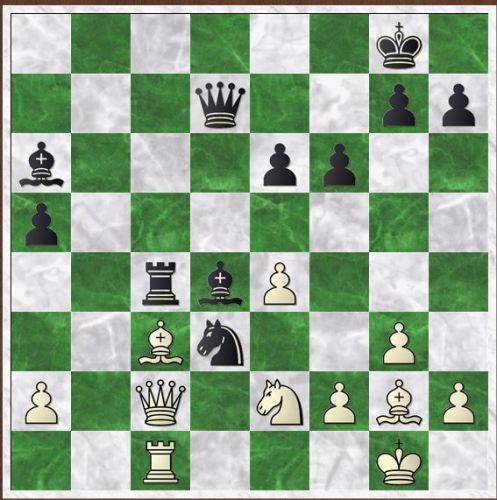
2 Rd1 Bf2+ 3 Kf1
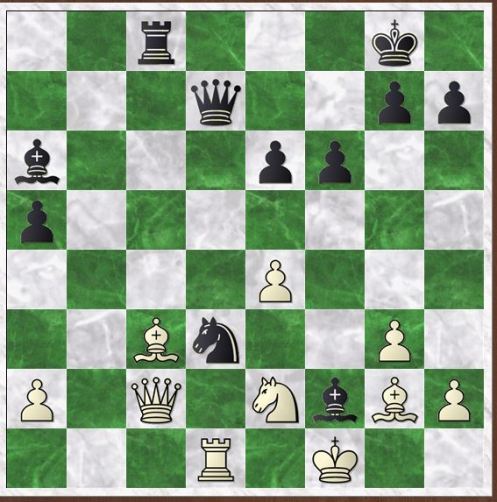
White is trussed up: Black can unpin his Queen by Qb5, and then will win eventually.
Basman’s 1…Bf2+! is a tougher piece of calculation, and I admire his ability: 2 Kf2[] Qa7+ 3 Ke1 Ng4 and if 4 Nd4 Rd4 5 Bd4 Qd4:
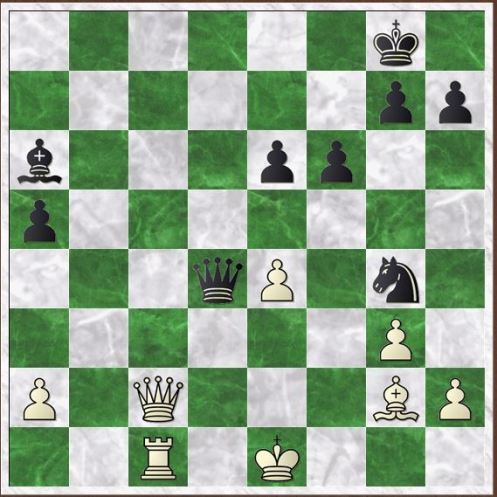
and Black is winning: his pieces combine together so well.
Black to play and win
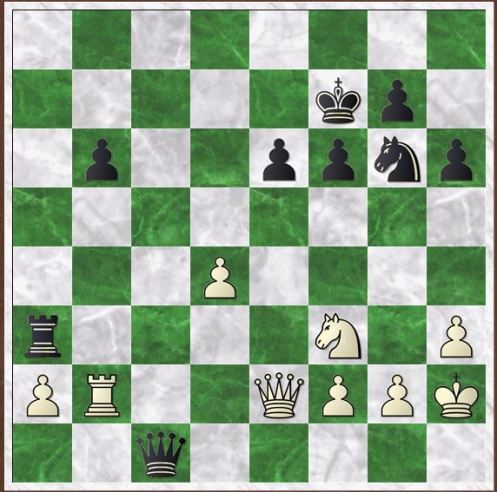
Taimanov v Karpov, Moscow 1973
Solution
If it weren’t a puzzle, I would easily imagine a long drawn out game. I could similarly imagine a long drawn out battle, Carlsen black, ekeing out an eventually 0-1 from the small advantage of Black’s better pawn structure.
But no, this is a puzzle book, so 1…Rf3! is the only move to look at, 2 gf[] being forced because White’s Queen is tied to defending the Rb2 (and 2 Rc2 fails to 2…Qf4+). Surprisingly, 2…Nh4 is over-poweringly strong.
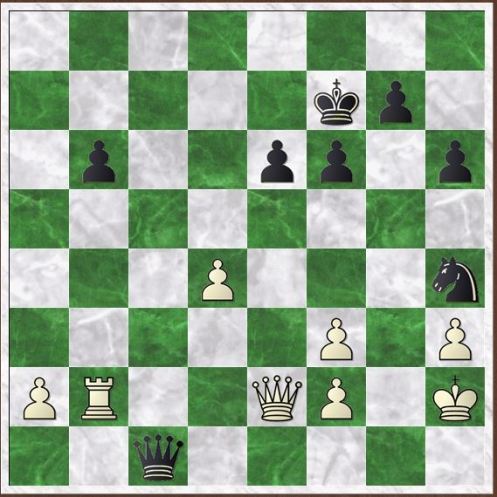
It is, at least to, strange and beautiful that Black’s Q and N combine so well, and how White is helpless. One lime is 3 Rb3, protecting the Pf3, but this is met by 3…Qg5! (threatening 4…Qg2), only met by 4 Qf1[], when 4…Qf4+ 5 Kh1 Nf3 is decisive.
If 6 Qg2[] (to defend against 6…Qh2mate) then 6…Qc1+ picks up the Q with mate next move.
Very nice,p.
White to play and win

Romm v Tatai, Netanya 1973
Solution
So: it’s a puzzle, so you know that 1 Qh6+! has to be the answer: rule #1 of chess puzzles.
Then, it is easy to see that 1..Kg8 is trivial- 2 Nf3-3 Ng5, if nothing else (my engine says 2 Nf3 is +29, whatever that means, but 2 Ng6 is mate in 9); so 1…Kh6[] 2 Nf5+ and it is not too hard to see that 2…Kg5! is best.
What next? 3 f4+ Kf5 4 Kf3 doesn’t seem enough – and isn’t- 4…Qg8 wins for Black.
So, what do I do? Of course, go back to the start, and look at alternatives to 1 Qh6+, such as 1 Nf5 (which loses to 1..Nf5) 1 Bg6 (loses to 1…Ng6, but is appealing, and therefore took time: 2 Qh6+ Kh6 3 Nf3+ but 3…Nh4 0-1); switch back to 1 Qh6…iterate, iterate.
…and eventually find 3 Nd6!

..which looks very good; the lines are then at the periphery of my vision, but satisfy me.
…check the solution, and it is correct! – since as Teschner says, 3 Ng7 instead loses to 3…Qg8!.
Engine on: 3 Ng7!!

3…Qg8 doesn’t win for Black, for the fairly simple (once Fritz has told you) reason: 4 f4+ Kh6 5 Ne6! threatens a bishop discovered check and mate (quite nicely, the Ne6 controls two of Black’s king’s escape squares, so has to be taken, but being on a White square, the Queen is then en pris to the bishop discovery). As played in the game (isn’t it strange, or perhaps it isn’t, that the human plays the “safer” 3 Nd6, putting the N on a solid foundation), after 3 Nd6 Ng6 4 Nc8 Rc8[] 5 f4+ Nf4+[] 6 gf+ Kf4+[] 7 Kf2 we reach the game position:

where Black played 7…Rcg8, when the evaluation swings up to +- in White’s favour, whereas 7..Rf8 is just a “Carlsen would win” +0.8 after 8 Bf3 Ne5 9 de Ke5 which looks like a bit of a grind.

Engines have changed chess, haven’t they?
White to play and win
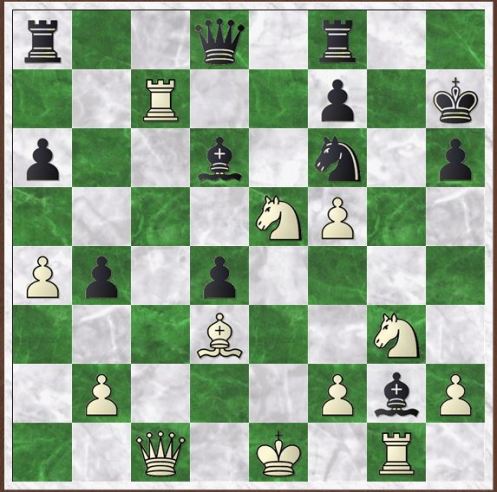
Ribli v Hennings, Leipzig 1973
Solution
A complete mess on the board: in blitz, you would instantly play 1 Nh5!; or maybe 1 Nf7…and in fact they both win, with 1 Nh5! being the cleanest since the N can’t be taken, due to f6+ dis +.
After both moves, Black has various captures or defences, too many to consider, and I’ll leave it to my readers to delve as far as they wish, if at all.
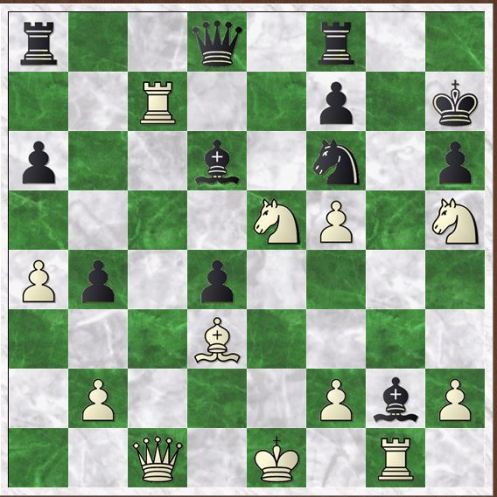
White to play and win
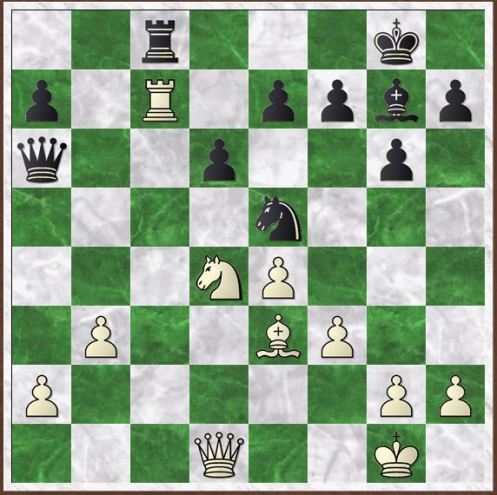
Radulov v Quinteros, Leningrad Interzonal 1973
Solution
Fairly straightforward today: the Qa6 is tied to the Rc8, so 1 Qe2! overloads it: 1…Qe2 2 Rc8+ wins the LPDO Rook.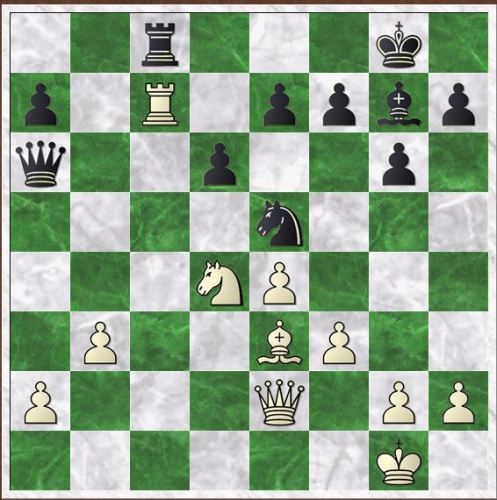
White to play and win
Spend some time on this, but note that the problem is cooked- so try to see the idea, but then try to find Black’s best defence.
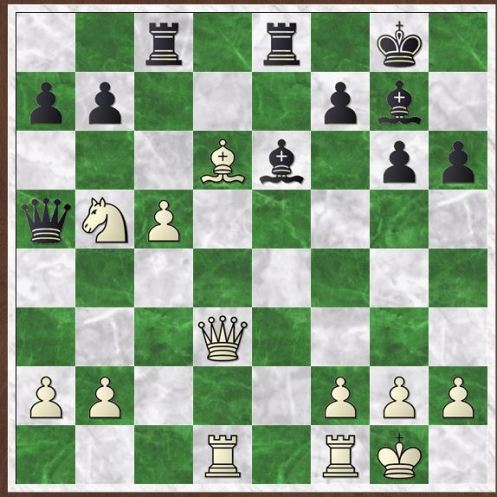
Uhlmann v Damjanovic, Cienfuegos 1073
Solution
This too me a while, many attempts, until I found the key idea.
1 Bc7!
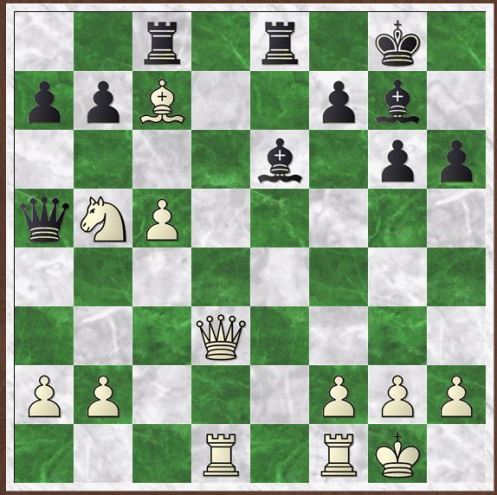
with the idea 1…Rc7 2 b4! : that’s the point. And if 2…Qb4 3 Rc7.
Instead, though, Black can play 2..Rd7! when things are more or less equal. There is a fairly forcing line 3 ba Rd3[] 4 Rd3[] Bc4 5 Nd6 Bd3[] 6 Re8[] Bf1[] 7 Kf1 “winning” per Teschner but the simple 7…Be5 is likely plain equal.
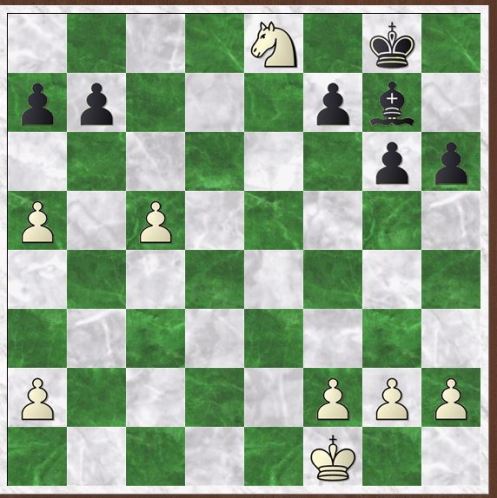
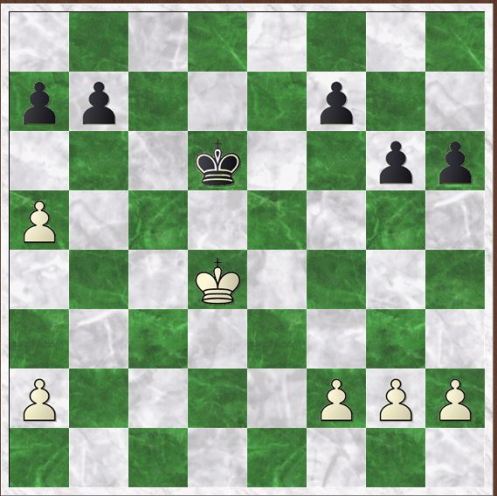
The line can be extended to the pawn ending resulting after Kf8/Nd6/Bd6…and if it is winning, it is only by pure calculation. Fritz, left for a few minutes, gives the following end position as 0.0:
Worst still, in the sense that the puzzle is cooked, is that Black can instead play 1…Qa4 when 2 Nd6? is bad (losing two pieces for the rook) whilst 2 b3 Qa2 3 Nd6 Bb3 is just the exchange for two pawns, so not convincing.
White to play and win
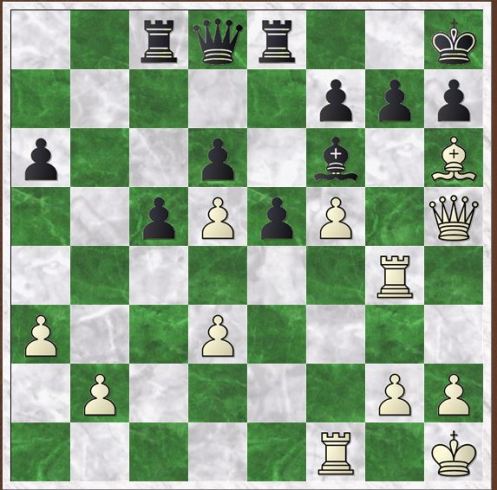
Miles v Dake, Lone Pine 1973
Solution
Nice, forcing line: 1 Bg7+! Bg7[] 2 f6!!
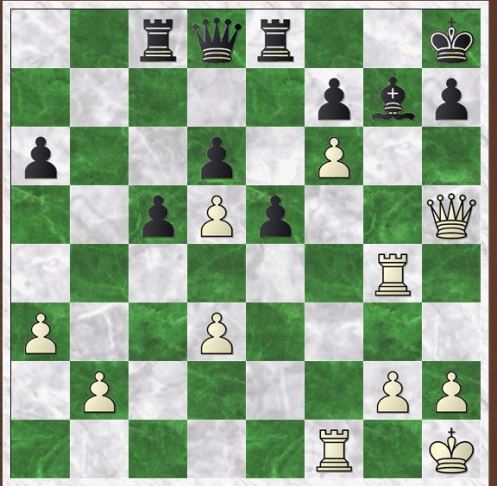
2..Bf6 3 Rh4! Bh4[] 4 Rf7 and mate on h7. In the game, Black bailed out with 2…Qf6 3 Rf6 Bf6 but resigned after 4 Qh6.
 allanbeardsworth