White to play and win
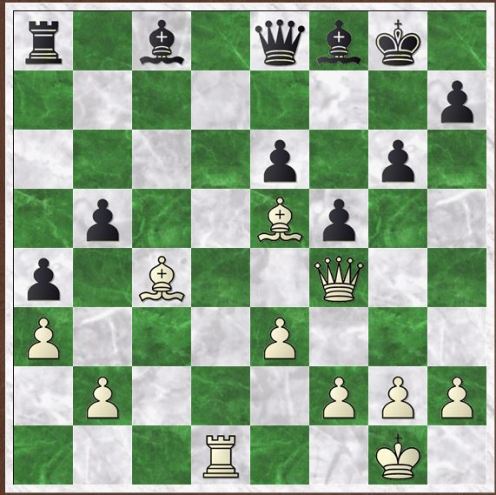
Bagirov v Holmov, Riga 1970
Solution
As Purdy tells us, as part of a player’s thinking process, he should spend some time ignoring threats, as if they could not possibly happen: what does the player want to do, ignoring the threat?
Here, the long diagonal beckons: 1 Bc3! threatens 2 Qe5 mating. So 1…Bg7 but then 2 Qc7 is a double attack on g7 and also threatening Rd8 winning the queen. 1-0.

White to play and win

Tukmakov v Korchnoi, Riga 1970
Solution
One move begs to be played: 1 Qg7.
The main line which needs to be calculated is 1…gh. Then 2 Bh6+ Kg8[] 3 Be4+ Kh8[] 4 Bg7+ Kg8[] 5 Bf6+ Kf8[] and now first 6 Nd5 before taking the Queen: White has a winning advantage, his h-pawn being a runner.
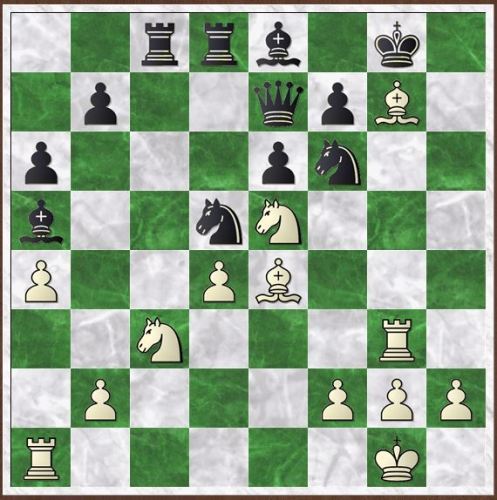
In the game, Viktor played 1…Qb4 and after 2 Qh8+ Kg7 3 Qg7 Qd4 lost- but to my mind, despite the engines being +2, at my level it is still messy- or, at least, there is scope to go wrong. Also, the machines say that 3 Bf7! is even stronger, and a quick check shows why: 3…Bf7 4 Qg7 Rf8 5 Bh6! piles on the pressure: the Qb4 is tied to the Rf8 because of the threat of Ng6+.
Black to play and win
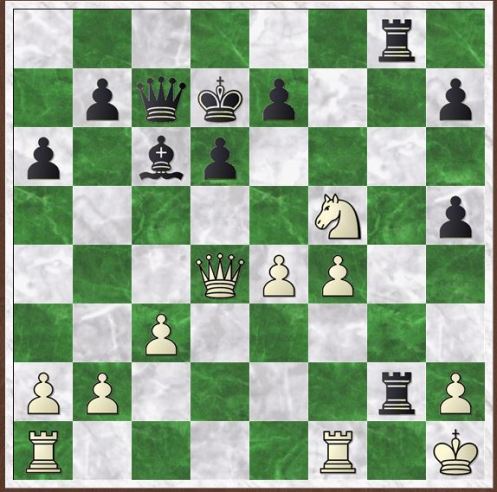
Martius- Dueball, Kassel 1970
Solution
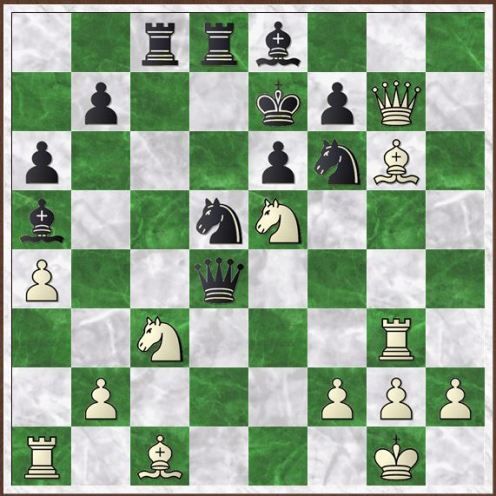
“Improve the worst placed piece”: 1…Qb6! and the Queen can’t be taken because of 2…Be4.
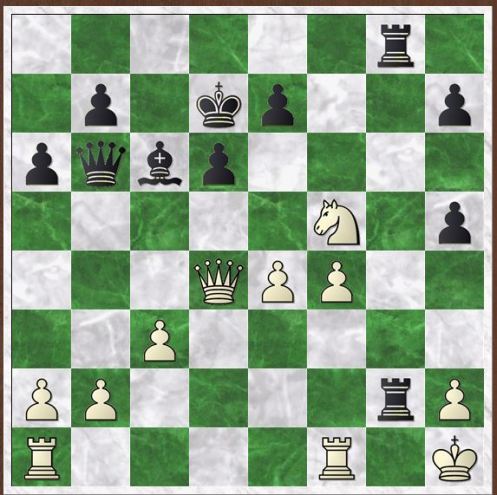
Black threatens 2..Qb2, so say 2 b3, when 2…Qb5! is another double attack, threatening either 3…Qf5! or 3…Qe2: 0-1
Examine 1…Qd5 2 Bc4
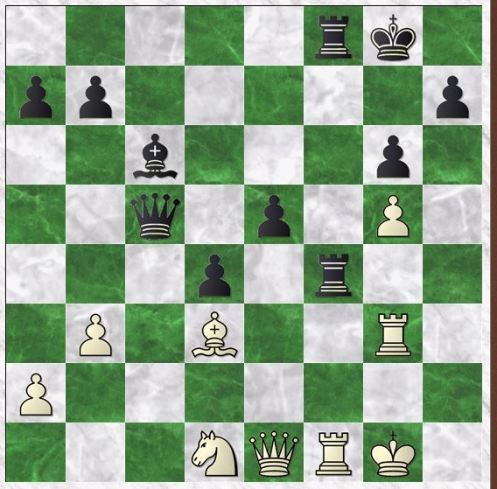
Soos- Teschner, Kassel 1970
Solution
Not too hard: exchange twice on f1, and afterwards (1…Rf1+ 2 Qf1 Rf1+ 3 Kf1) 3…Bb5 pins the Bishop: 0-1
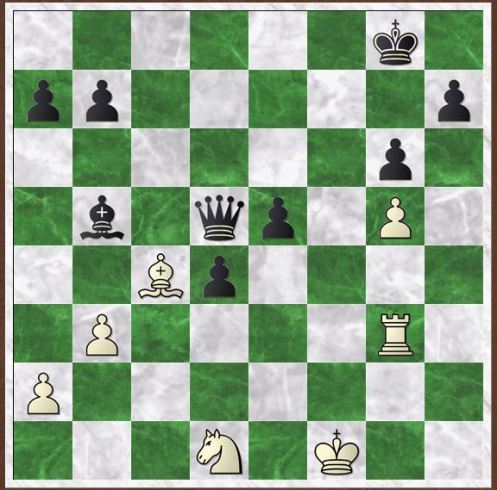
White to play and win: examine 1 Bf6
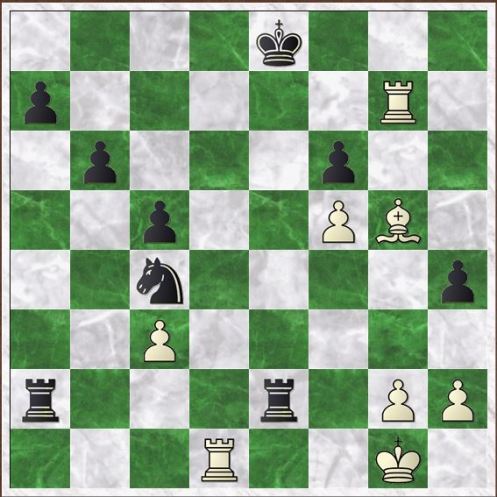
Taimanov v Hubner, Palma 1970
Solution
White played 1 Bh6?, apparently because he feared after 1 Bf6! Rg2+. But after 2 Rg2[] Rg2+[] 3 Kg2[] Ne3+ 4 Kf3 Nd1[]
White has 5 c4! and the N is trapped.
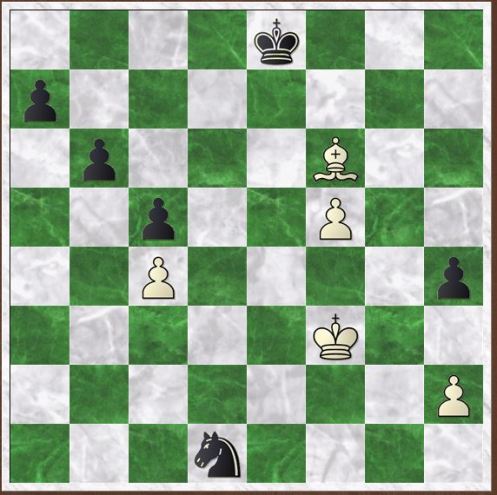
However, engines show a different light on the game. Teschner says that after the move in the game, all there is a draw after 1…h3, as played, but my engines show 1…Nd6! as winning. If White checks and checks, 2 Rg8+ Ke7 3 Rg7+ then 3…Nf7 and White’s pieces are un-coordinated and Black’s pawns can run: 4 Bf4 Kf8 puts a difficult question to White’s rook, which remains misplaced.
In fact, the starting position is just “and the game goes on”: 1 Bf6 Nd6 or 1…Rad2 are both unclear.
White to play and win
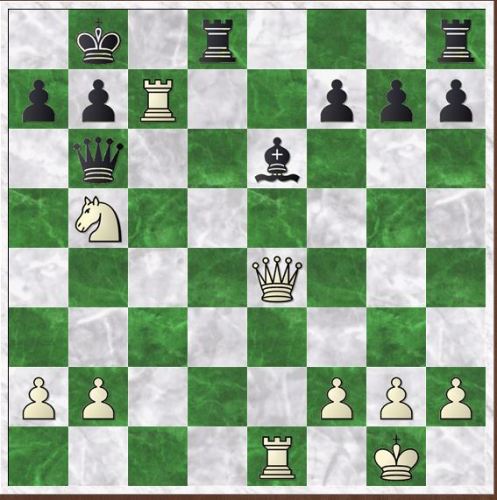
Schmid v Kinzel, Siegen Olympaid 1970
Solution
Not too hard today. 1 Rb7+! is a natural biff, after which 1…Qb7[] 2 Qe5+ Black has the choice of 2…Kc8 3 Rc1+ Kd7 4 Nc5+ forking king and queen, as in the game:
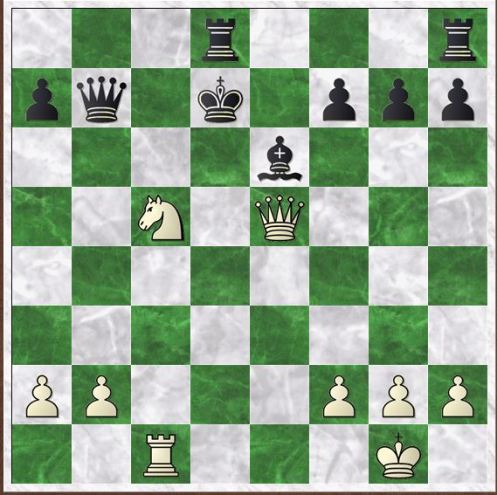
Or 2..Ka8 3 Nc7+ Kb8 4 Ne6+ and 5 Nd8 with a dominant position.
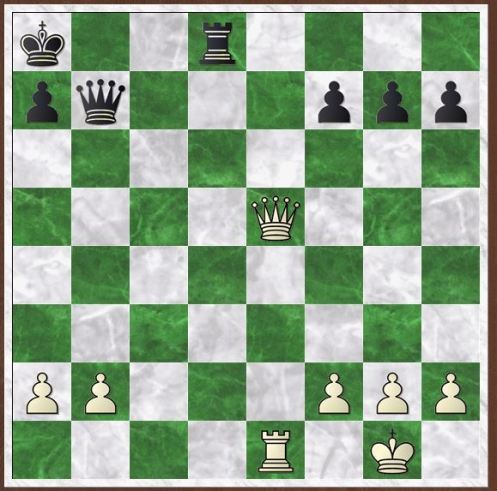
White to play: 1 Kh1 or 1 Kh2?
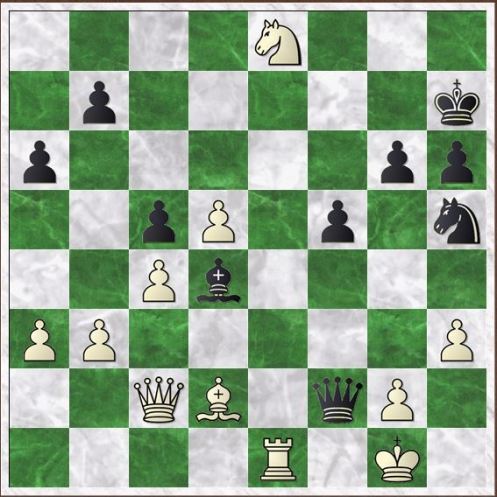
Uhlmann v Fischer, Siegen Olympiad 1970
Solution
This problem is solved by “ruling the other option out”. White played 1 Kh2! which is the better move, after White has some advantage, but the game was drawn after 1…Nf4! 2 Bf4! Qe1!
Instead, 1 Kh1? loses. 1…Ng3+ 2 Kh2[] Nf1+
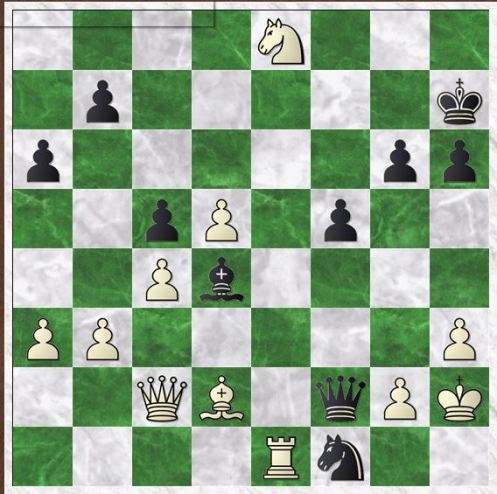
White is forced to capture, else 3 Kh1 Qg1mate. But 3 Rf1 Be5+ and mates anyway.
I have played around with the lines after 1…Nf4, using my engine, and think Uhlmann let the advantage slip away: but some of the lines aren’t human, and the draw which occurred seems the natural result.
Black to play and win
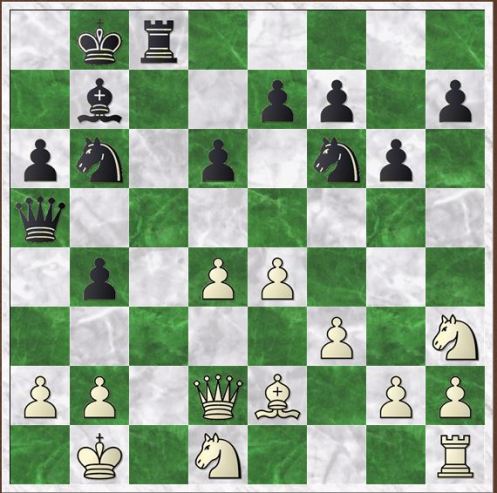
Pfiel v Vogt, Zinnowitz 1970
Solution
After first trying 1…Be4+ 2 fe Ne4, and finding it wanting, I reversed the order of the moves and played the correct 1…Ne4! 2 fe Be4+ when Black is winning.
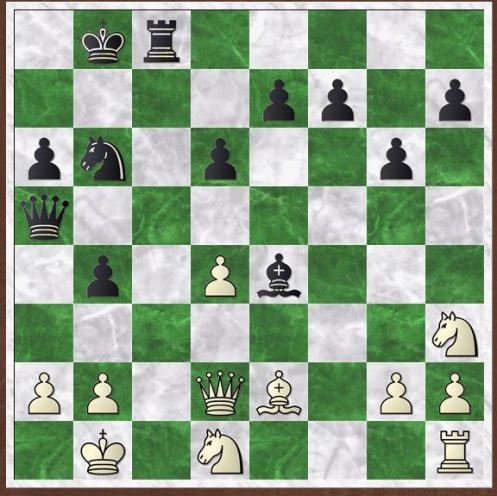
After 3 Bd3 my line was 3…b3! when White collapses (4 Nc3 Rc3!) whlst the computer tells me that 3…Qh5! is even stronger – in the sense of -4 compared with -3. The idea of Qh5 is to overload the White Queen; the end result being after pieces are swapped off Bg2 forks the Nh3 and Rh1. But 3…b3! is human, playing to the main theme.
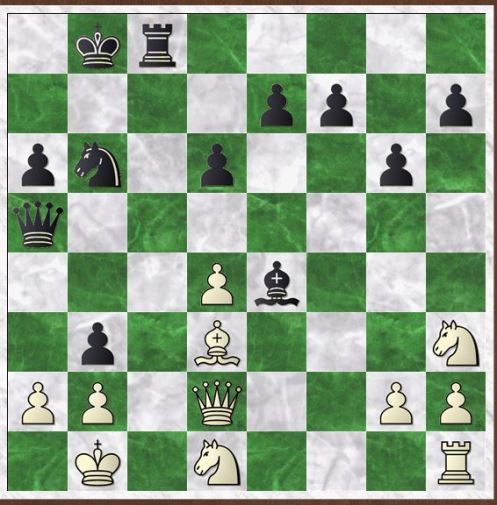
Evaluate 1 Rd1 Ba4
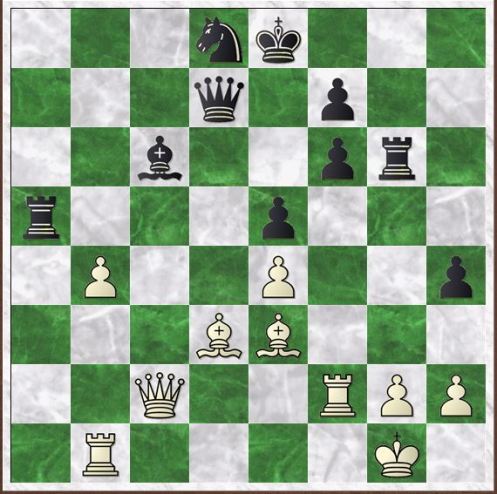
Calvo- Csom, Siegen 1970
Solution
Visually hard, with all the opposing pieces, but once focussed, not too hard to see 2 Bb5! and White wins.
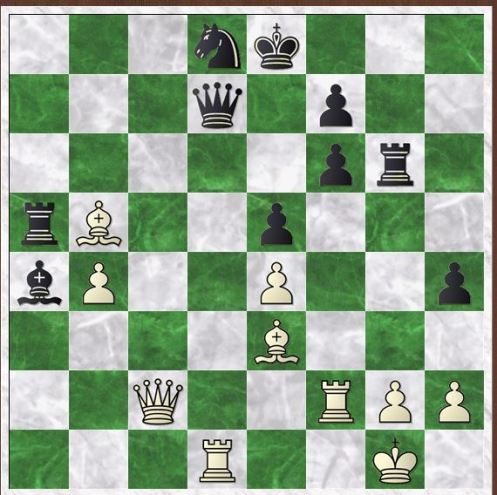
In the game, I am sure there was a time scramble, because after (2 Bb5) 2..Bb5 3 Rd7 Bd7, White played the ridiculous 4 Rd2 (actually, 39Rd2) rather than the obvious 4 ba.
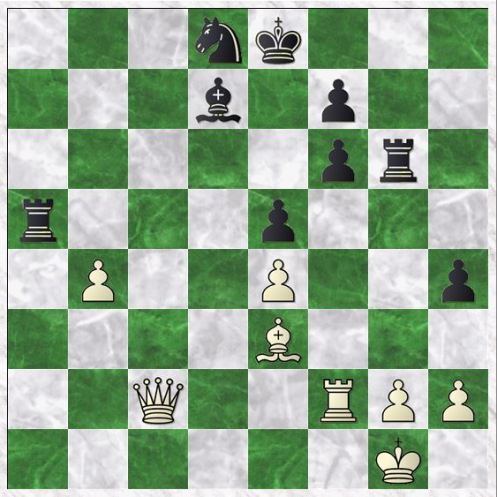
Perhaps though the Megabase game position is wrong, though what is odd is that there was logic in how the R got to a5 (it biffed an unprotected N on c5, White later played Pc3*b4) whilst Teschner’s book has the R on a3 in its problem position.
Most odd.
White to play and win
Black has just played …h6, aiming to trap the B if it captures on e7
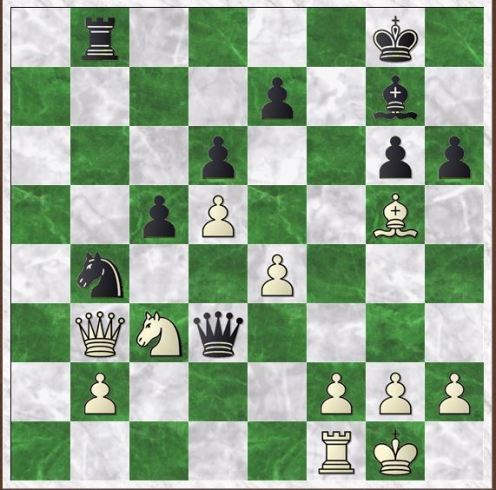
Vranesic v del Corral, Siegen 1970
Solution
A nice puzzle: when you see that Black’s Queen is almost in a net, using CJS Purdy’s terms, the solution isn’t too hard.
- Be7! Nc6 2 Qa4 Ne7 3 Rd1 traps the queen.
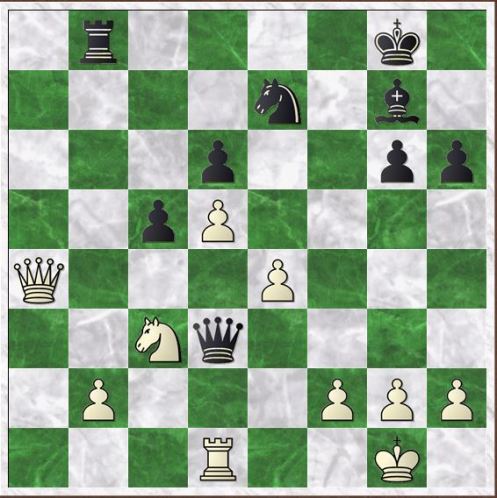
Black can grovel on, but the game is in the technical phase of winning a won game.
 allanbeardsworth