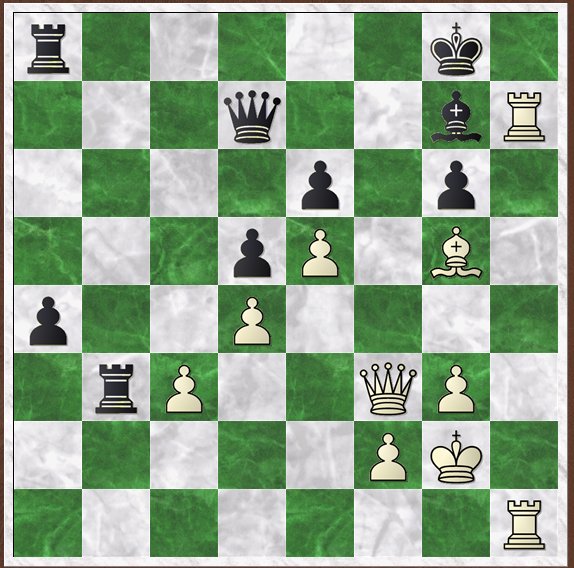
White to play and win
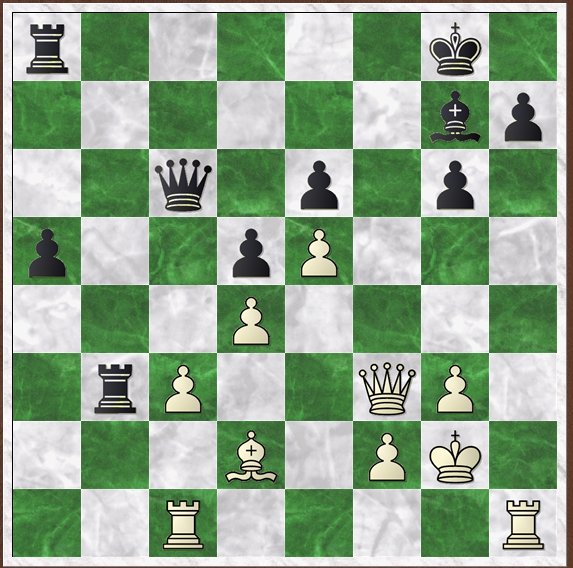
Bilek v Szilagyi, Budapest 1964
Solution
One key move, 1 Rh7!, is pretty obvious (and is one of only two biffs on the board, the other (Qd5) being ridiculous) so that if 1..Kh7, 2 Qf7! is a standard bank rank mater motif (or back file…).
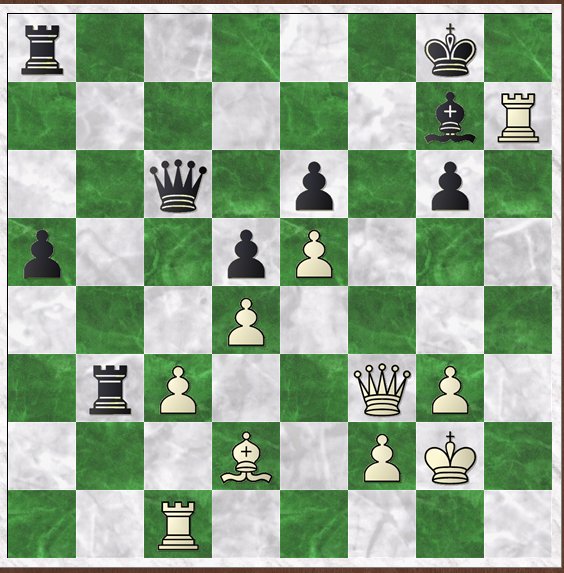
Black has other defences, but non sufficient.
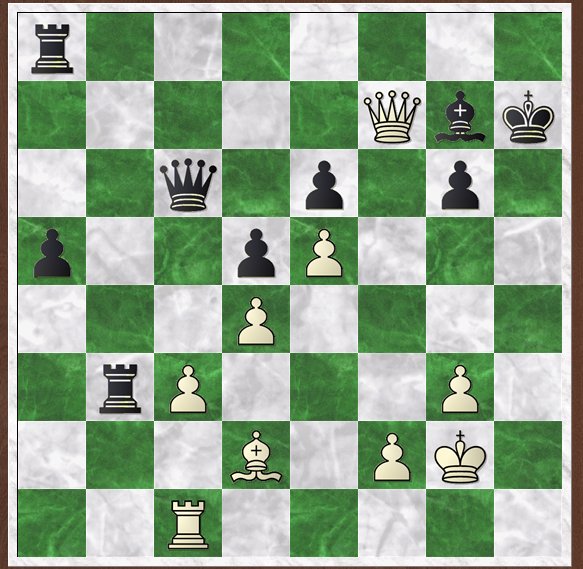
If 1..Rf8, 2 Rg7+! Kg7 3 Bh6+ picks up the rook with check, and mates soon.
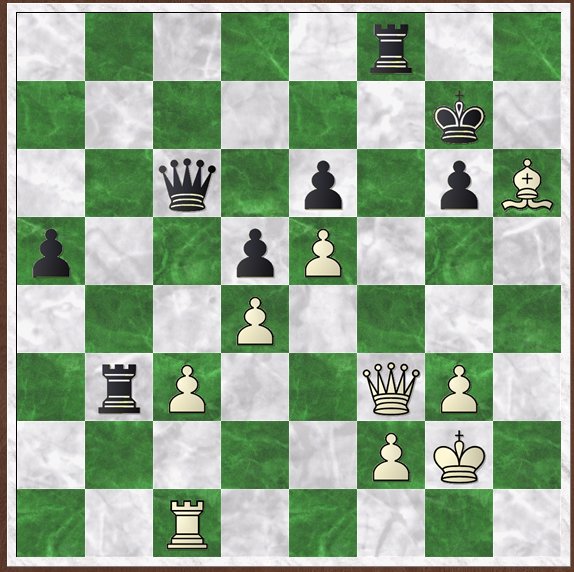
If 1…Qd7 (say), White just brings up his forces (2 Rdh1) and, depending on how Black responds, at some stage sacs on g7. For instance 2…a4 3 Bg5 with the idea of 4 Rg7+ and 5 Bf6.
Black to play and win
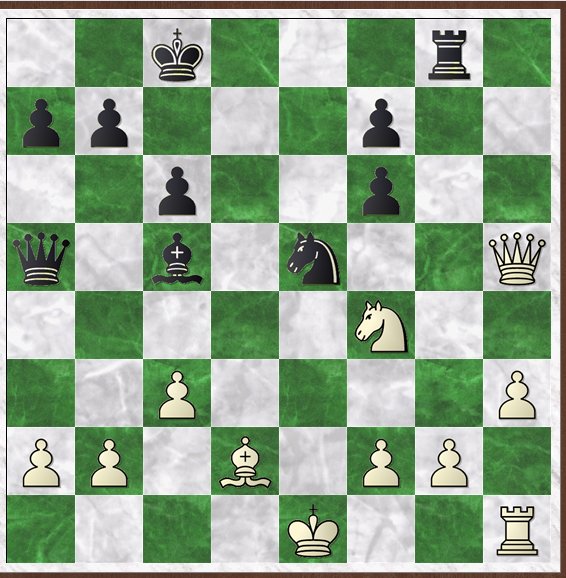
S Garcia v Smyslov, Havana 1964
Solution
Not too hard today: examine all biffs, combined with Purdy’s concept of jump-biffs (Qa5*h5) results in 1..Nd3+! and if 2 Nd3, Bf2+ wins the Queen, or if 2 K moves, 2…Nf2 wreaks havoc.
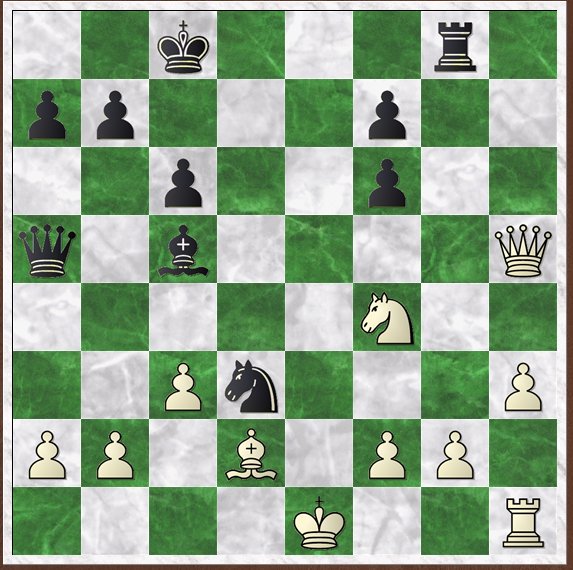
White to play and win
Nonnenmacher v Schneider, Ingolstadt 1964
Solution
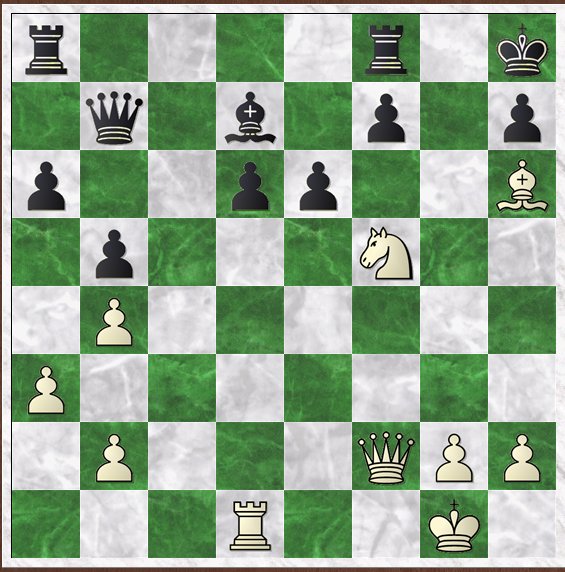
Not too hard today, but a nice puzzle nevertheless. Black has several replies to White’s biff 1 Nf5!.
If for instance 1…ef, then 2 Qg3, threatens both Qg7 mate and (if 2…Rg8) 3 Qc3+ and mates; if 1..f6, then 2 Qg3 and too many pieces gun down on g7.
Finally, cute moves like 1…Qg2+ with the idea of 2…Rg8 just lose: if nothing else, 2 Qg2 and 3 Ng3.
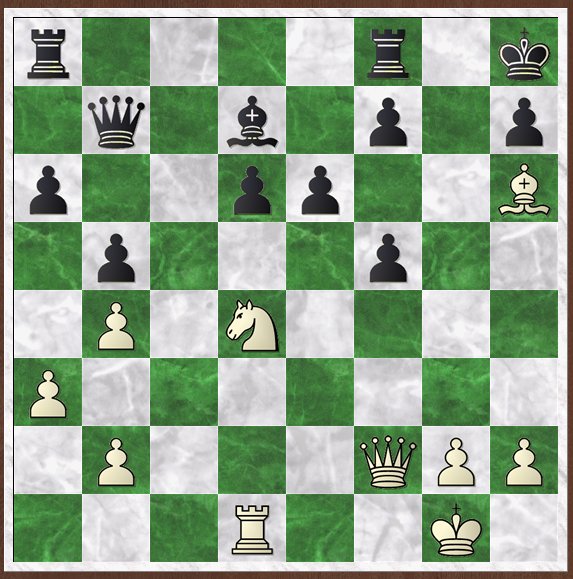
White to play and win
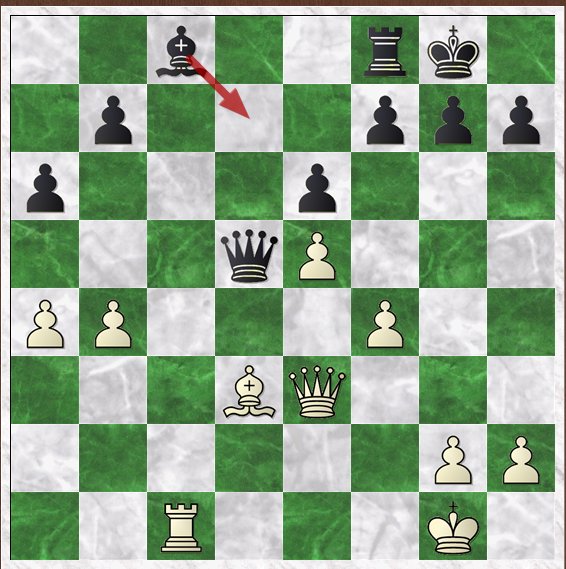
Black plays 1…Bc8-d7
Liersch v Plesse, 1964
Solution
As Purdy exhorts, examine all pins, nets and ties. Here, the Black queen is in a net, and it is not too hard, after first rejecting 1 Be4, to find 1 Bc4! Qc6[] 2 Bb3 and the Queen is trapped.
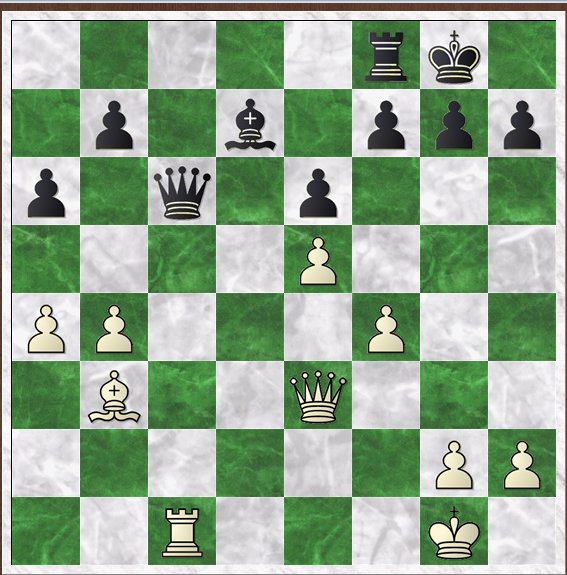
(Whilst not hard in a puzzle, I think in a game I could easily have missed it).
White to play and win
A great exercise: work hard on this one, unless it comes to you easily (for me, it didn’t, but I got there eventually)
Uitumen v Savon, Krakow 1964
Solution
Difficulty level: one and a half dog walks. I just couldn’t get this one, but knew I should, and having failed on one long dog walk in my local park, left the puzzle for another day, and then tried it again on my next day’s walk. Eventually I got there, and, maybe, it is simple ?! I just couldn’t get the order right.
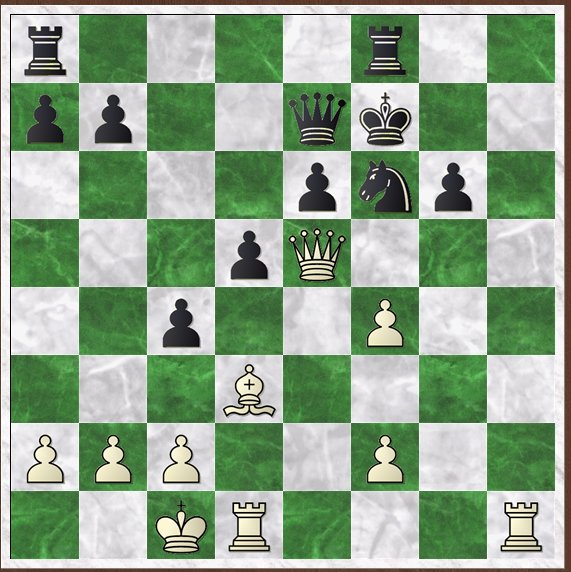
I tried many things: 1 Bg6+ Kg6 2 Rh6+; 2 f5+; 2 Rdg1+; without success; before stumbling on 1 Rh7+1? Nh7 2 Bg6+ Kg6 3 Rg1+, but not being able to break 3…Kh6!. In fact, checking now with my engine, 3..Kh6 is just a perpetual, as is 3…Ng5.
Eventually I reversed the move order.
1 Bg6+! Kg6 2 Rdg1+ Kf7
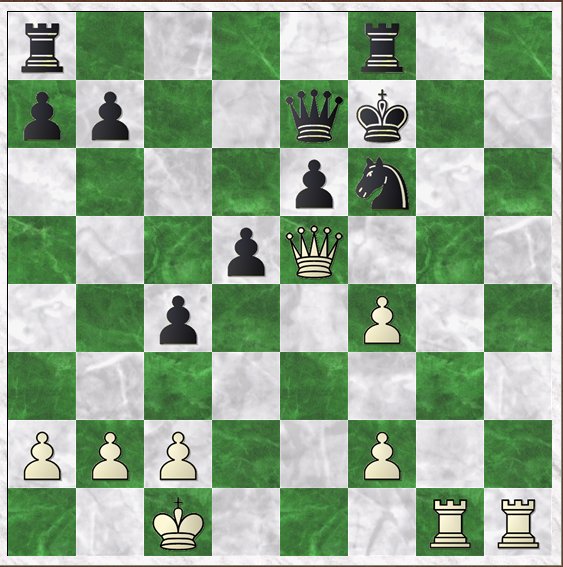
3 Rh7+!!
3…Nh7 and now not the line I had originally planned, 4 Rg7+ Kmoves 5 Re7+ Ke7 6 Qc7+ skewering the Nh7, since 7…Rh8 is perhaps near equal, but
4 Qh5+! Kf6 5 Qg6 mate.
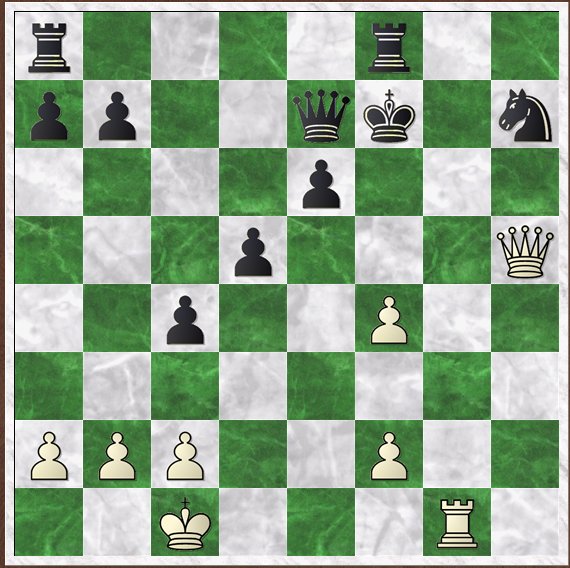
Lovely. Full credit to White for finding this line in the actual game.
White to play and win
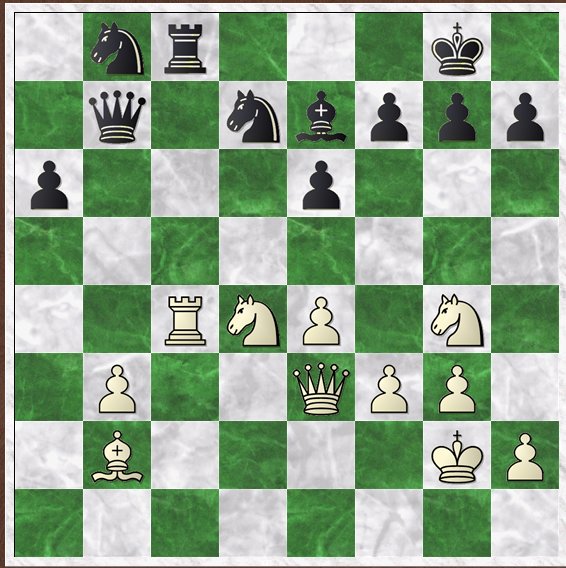
Larsen v Matanovic, Zagreb 1965
Solution
This is a nice puzzle, including some of the side lines. 1 Nf5! is fairly obvious, and I saw instantly, the idea being a double attack with 2 Qc3:
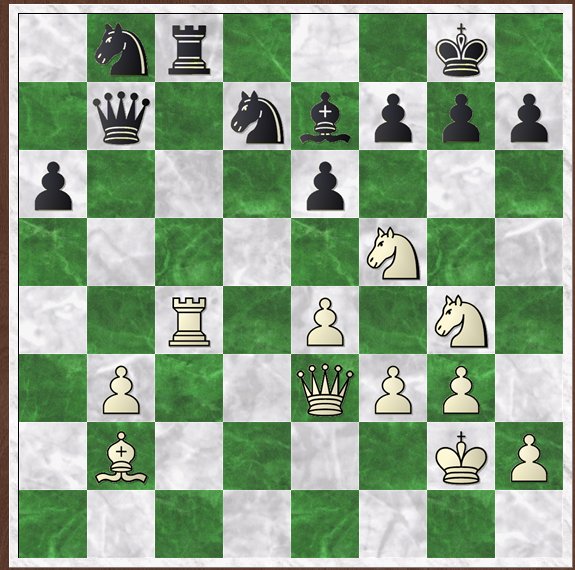
If 1…ef 2 Qc3 hits both g7 and the Rc8, 1-0. Chess is double attack.
If 1…Bf8 then 2 Ngh6+ and if 2…gh, 3 Qc3 again, or if 2…Kh8, 3 Nf7+ and 4 Nd6.
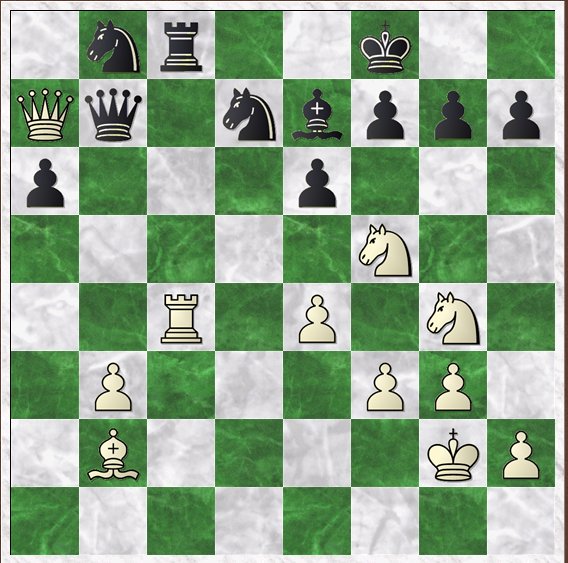
What though against 1…Kf8?
White to play and win
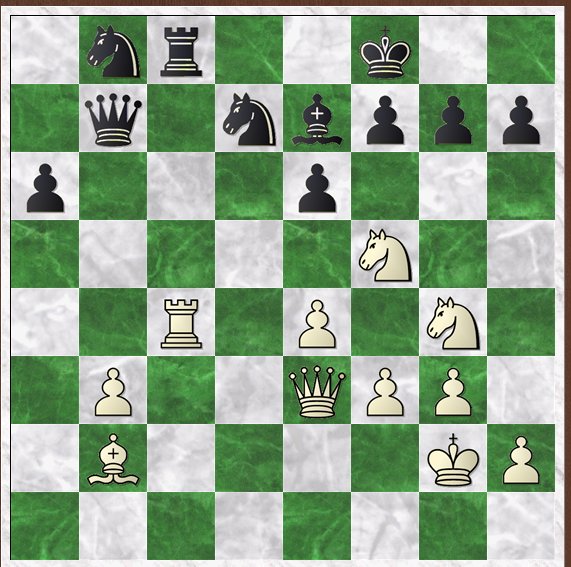
I planned 2 Bg7+ Ke8 3 Ne7, which is fine, but White has far better: 2 Qa7!!
White to play and win
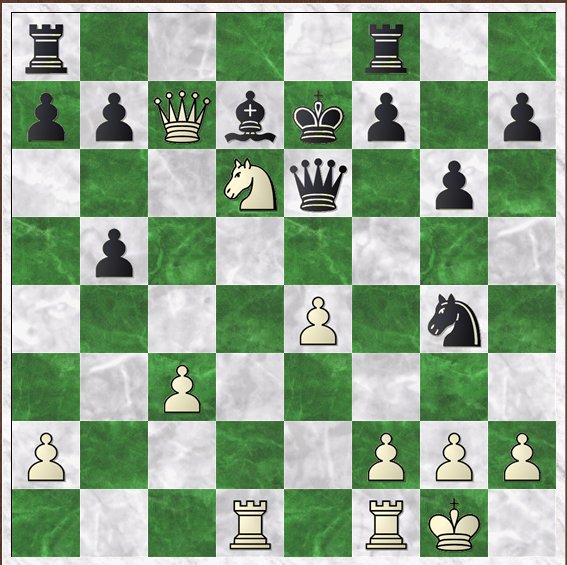
Fischer v Celle, clock simul, 1964
Solution
The first move is fairly obvious, but the follow up requires precision. Fischer plays it perfectly, and I am pleased to say that the game, despite being a simul, is in Chessbase’s Megabase, It is a beautifully played Evans’ Gambit; how Fischer got to this position is well worth seeing.
1 Nf5+! forces 1…gf; 1…Kg7? 2 Ng7+ forks the king and queen; and 1…Kf6 drops the Bd7 and then the Q is pnned by Rd6..
So 2 ef Qf5
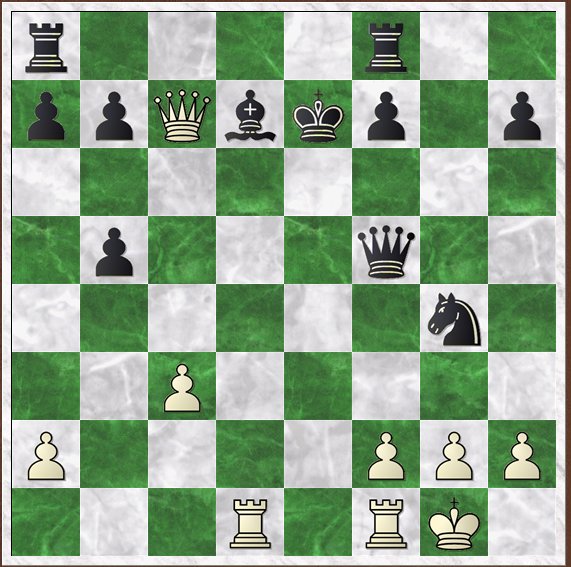
and now not 3 Ref1+ nor 3 Rd7+ but 3 Qd6+!. (If 3 Rd7+ Qd7 4 Re1+ Ne5 5 Re5+ Kf6 6 Qd7 Re5, White is winning, but Black can grovel on)
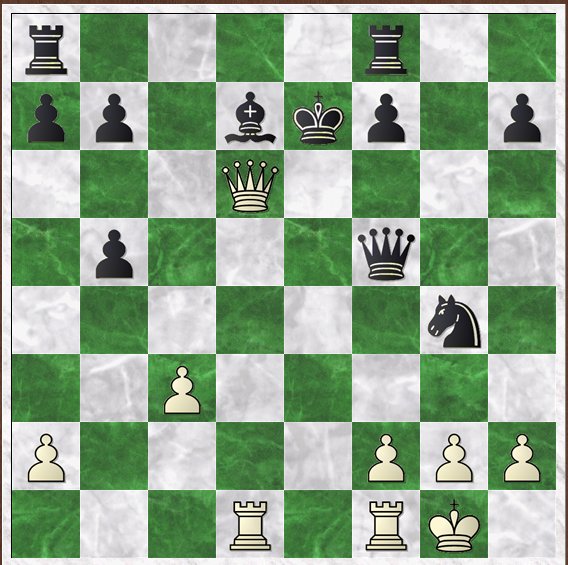
3…Ke8 4 Rfe1+ Be6 (say) 5 Qd7 mate.
Black could try 2…Rfc8, when 3 Rd7+ Qd7 4 Re1+ Ne5 5 Re5+ Kf6 6 Qd7 Ke5 7 Qf7, when White is simply winning since 7…Rc3 fails to 8 Qg7+ skewering: some times, the tactics just work.
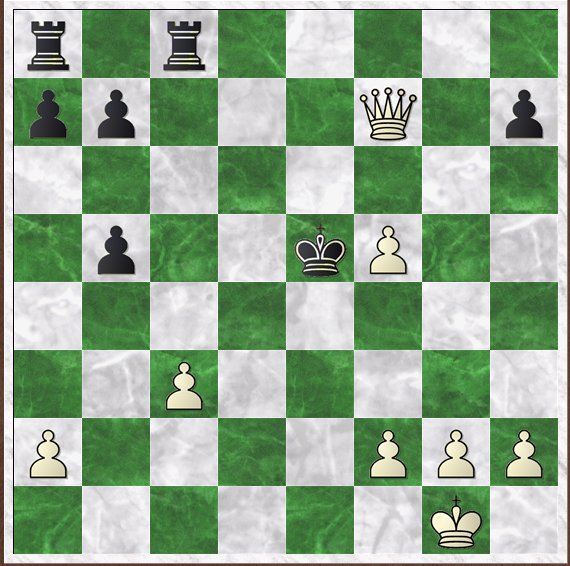
Black to play: is 1…Rg3+ merely a draw?
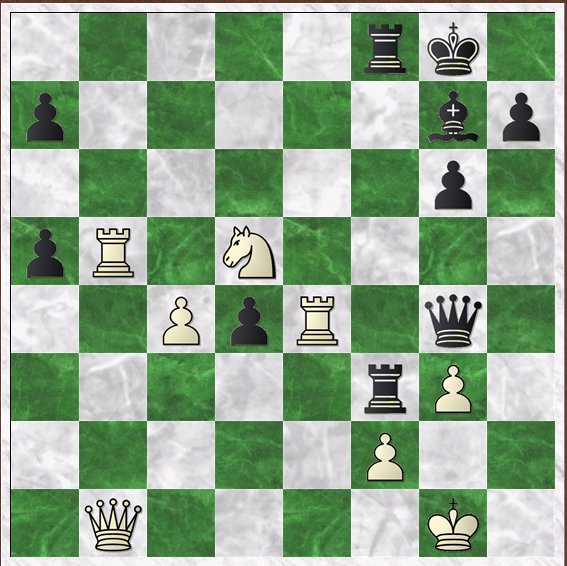
Aloni v Botvinnik, Tel Aviv 1964
Solution
The answer to the question, is it merely a draw?, is clearly ‘no’, given who the two players are. But how? By comparison with the last two days’ puzzles, this one was tough, and took me a while to solve. Eventually I saw the ‘trick’, the ‘idea’, and most of the variations.
1…Rg3+ 2 fg[] Qg3+ 3 Kh1[] d3!
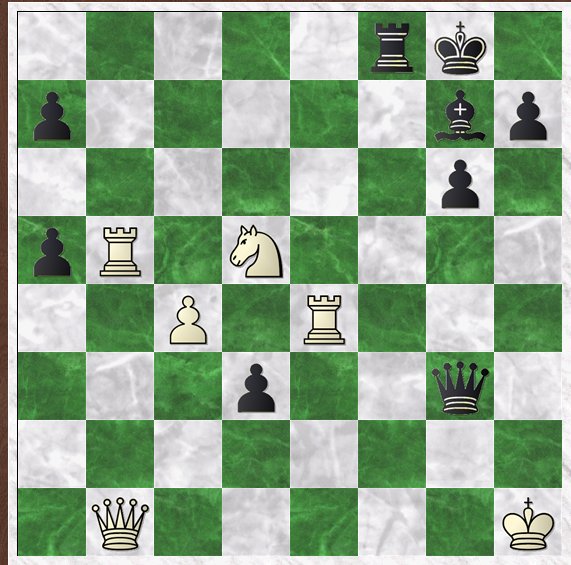
This has the twin idea of removing the coordination between white’s Qb1 and Re4 (which is now a LPDO) and threatening to push on and promote the pawn, or cause mischief with it.
4 Qe1 (White has other tries, but they are similar) Qh3+ 5 Kh1[] d2!
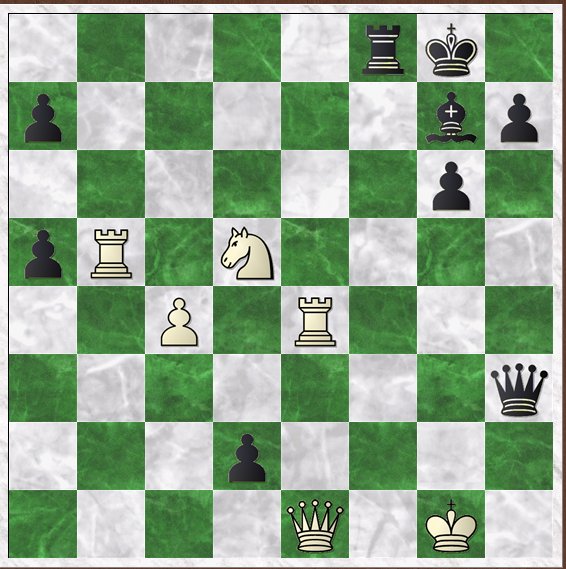
6 Qd1 (6 Ne7+ Kh8 7 Ng6+ is a nice try, but 7…hg[] 8 Rh4+ Kg8! prevails)
Black to play and win
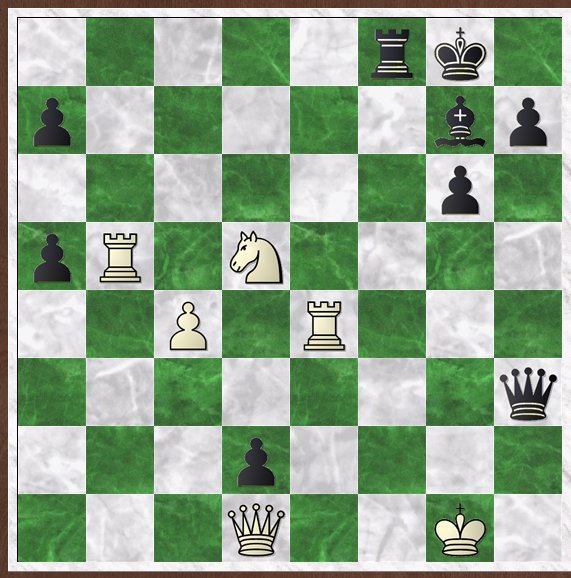
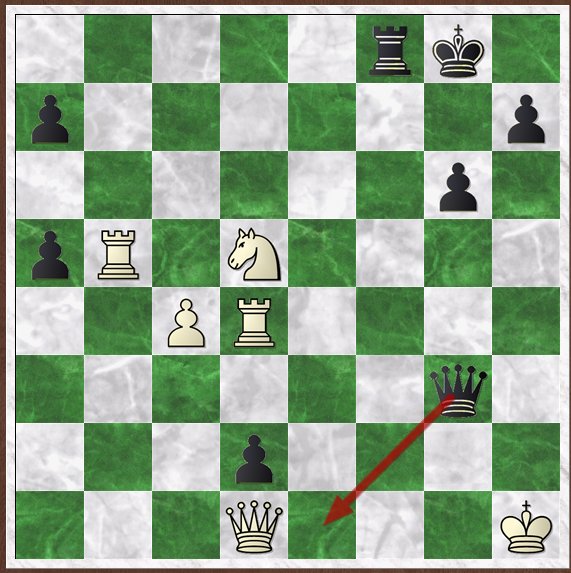
I saw this far (it is more or less a forced line) and had envisioned 6..Rf1+! 7 Qf1[] Qf1+ 8 Kf1 d1(Q)+ and felt that Black might be winning (and Houdini says that he is, though there is plenty of room for mistakes). However, Black has better.
Solution
6…Bd4+!! 7 Rd4 Qg3+ 8 Kh1[] Qe1+ and promotes. Lovely.
 Posted with Blogsy
White to play and win
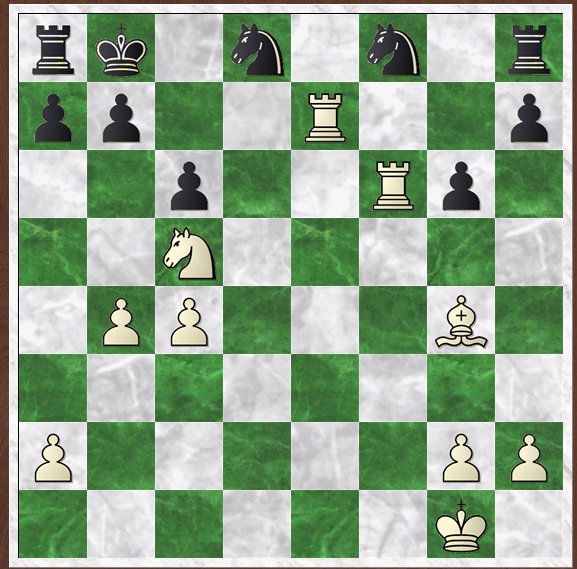
Pfleger v Domnitz, Tel Aviv 1964
Solution
Another rest day: 1 Rb7+ Nb7[] 2 Na6.
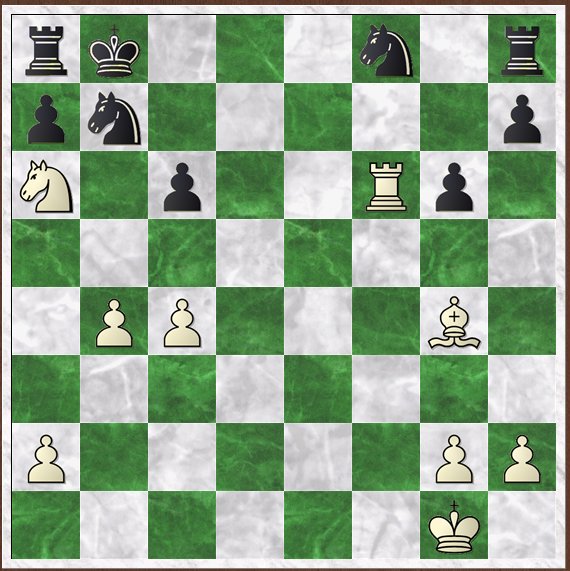
White to play and win
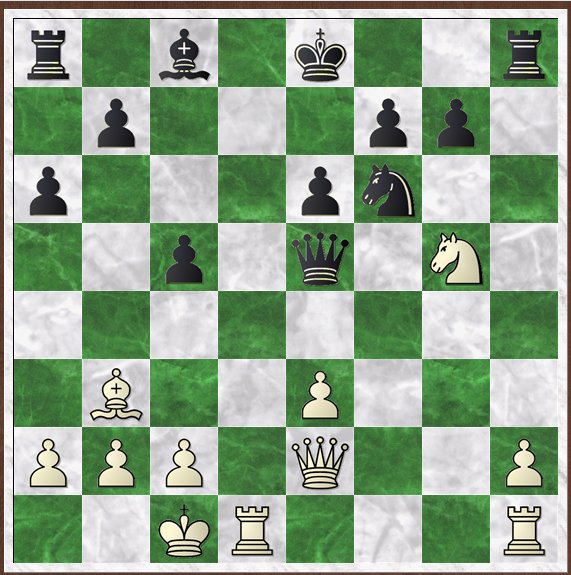
Tal v Benko, Amsterdam 1964
Solution
A rest day today: 1 Rd8+ picks up either the LPDO rook, if 1…Ke7, or the Q, if the R is taken.
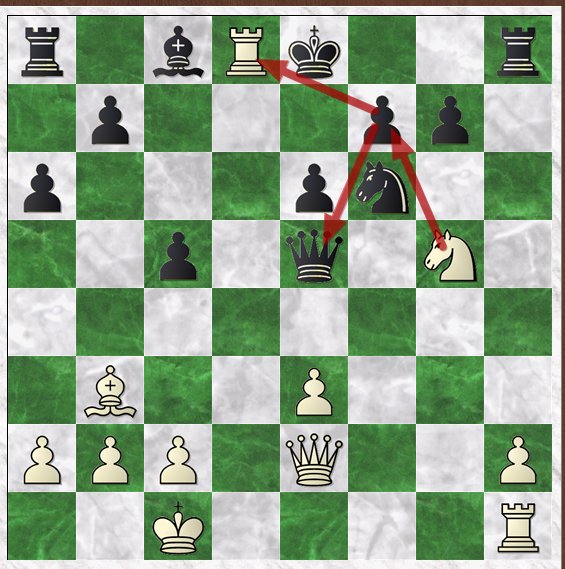
The problem was so easy that it caused me to look at the game in Megabase, to see what Black's last move was. As expected, it was Qc5*Pe5; my engine says that even if Black hadn't captured, white was winning.
 allanbeardsworth