This is an occasional series of postings inspired by a brief discussion on the flight home from Turkey this summer. The flight attendant saw I was reading a chess book (quelle surprise) and, just making polite small talk, said she also liked playing chess, saying that depending on whether other crew members played, she would play on stopovers. Later in the flight she asked me if I had a chess set at home…and that set me thinking. How many chess sets do I have? And since then number is, well, shall we say, quite high, I thought I would blog about them especially those which ‘mean something to me’.
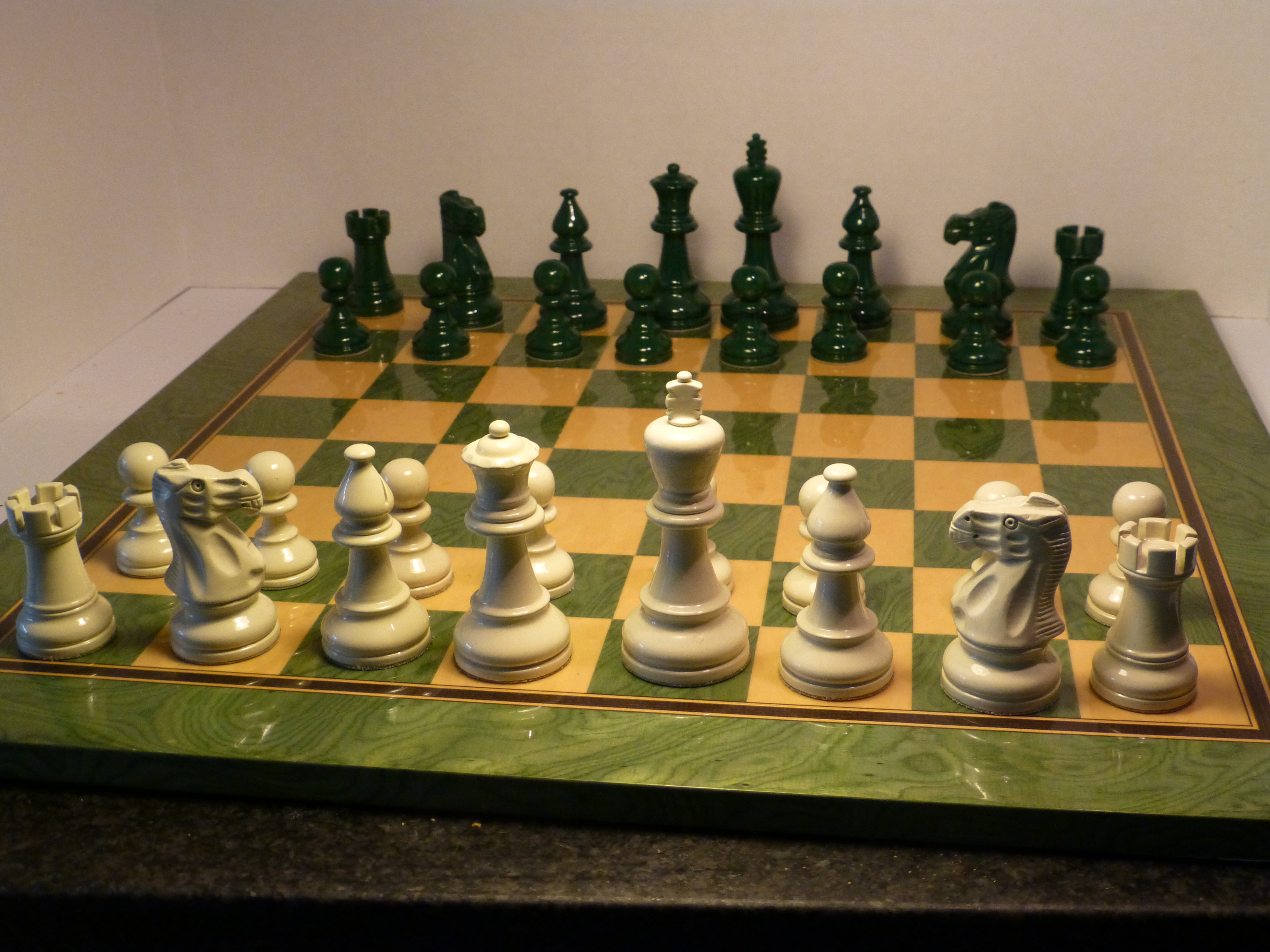
My most used set, always set up in the lounge (if ever our house was on “Through the Keyhole” even the least observant viewer would suspect someone in the house is interested in chess).
Jane bought me this for my fortieth birthday. It is beautiful; and has aged extremely well (better than me). The board is just the right size, and the pieces lovely to hold, heavy, reliable.
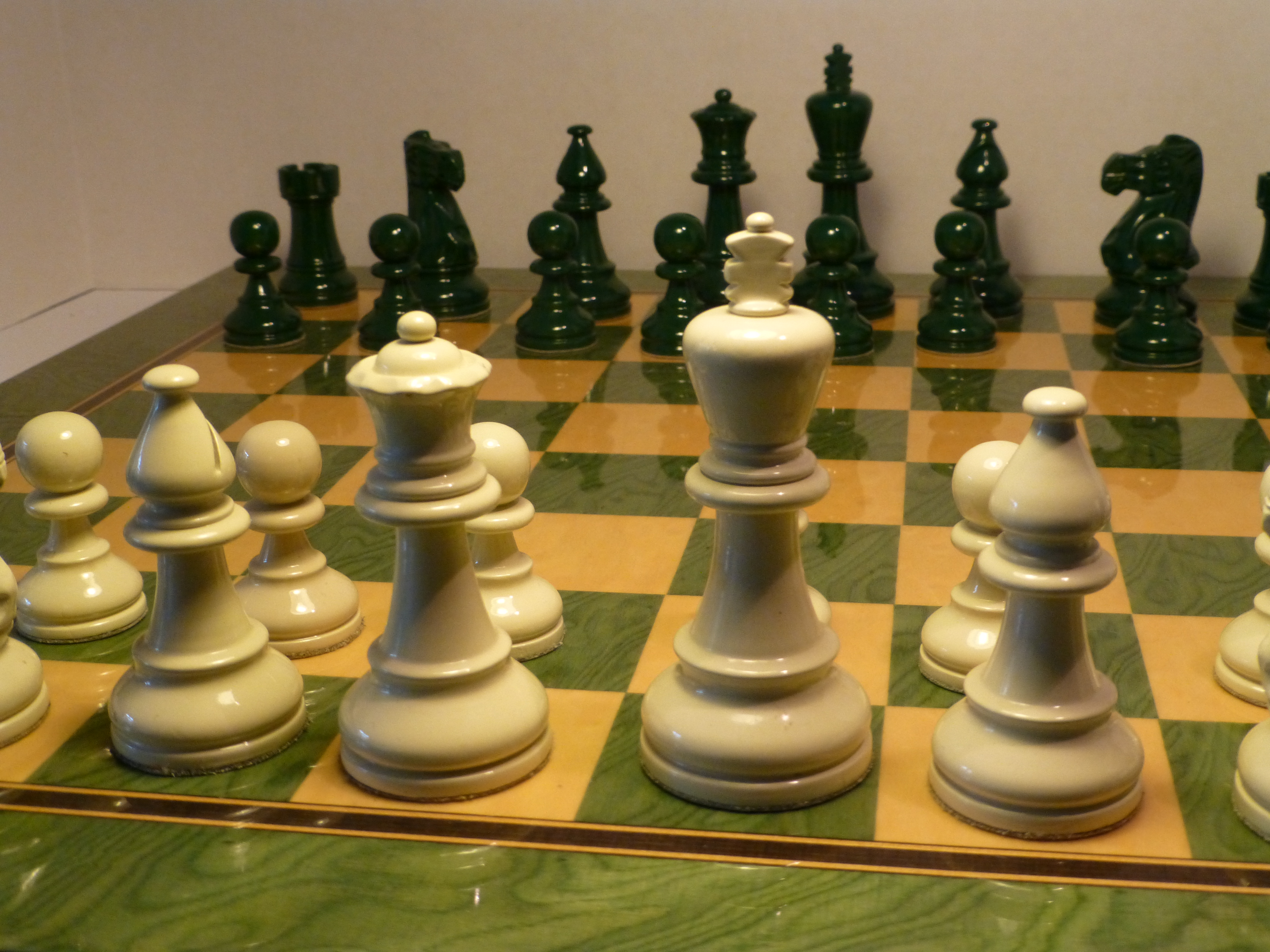
Whenever I wish to play through a game over the board, or for instance when one of my daily chess puzzles has stumped me, this is the set I use for analysis.
Rating
10/10: my favourite set
A while ago, my friend Paresh asked me if I knew when chess boards became coloured. I didn't know, but his enquiry sent me first on a Google journey, and then to buying and browsing HJR Murray's 1913 'a History of Chess'.
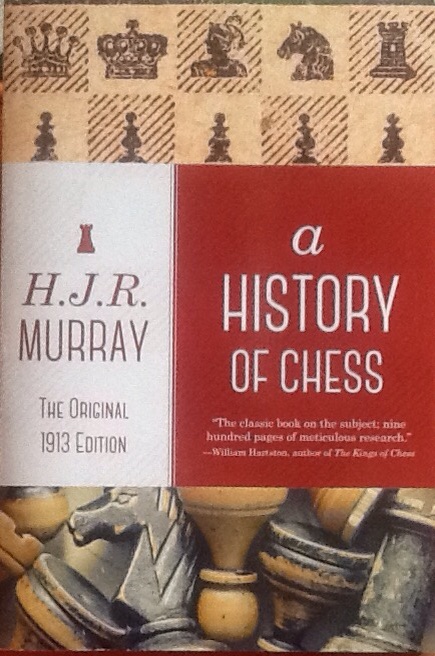
All 900 pages of it. And the index didn't help. So, into the book (but fortunately I had a good idea of the likely period).
Eventually I found the section, p452:
At a very early date it became usual in Europe to use a chequered or parti-coloured board. This is no necessity of the game, but as the Einsielden Poem (c1100) remarks, it simplifies the calculation of the moves, and is a ready means for the preventing the occurrence of false moves. Exactly when or where the change was introduced is not known. The Einsielden Poem mentions it as an improvement which some players had adopted, as if it were not usual in the writer's own circle. Three of the other poems described the board as chequered, generally white and red.
Later, Murray mentions a 1283 Spanish work compiled by Alfonso X of Castile in 1283 which prescribes the use of a chequered board. He mentions another book, not referenced but I infer from the same era, The Innocent Morality which alludes to the squares being black and white, drawing a parallel between death and life, blame and favour. The 1283 work also invariably has a white square in the right hand corner, but Murray says other MSS don't, and the norm was not established in medieval periods. I also infer from Murray that the king and queen piece placement became the norm in the thirteenth century too, but without full uniformity.
My friend's question has given me much pleasure, browsing, thinking, piecing things together. One picture I came across was Lucas van Leyden's (1494-1533) The Chessplayer's:
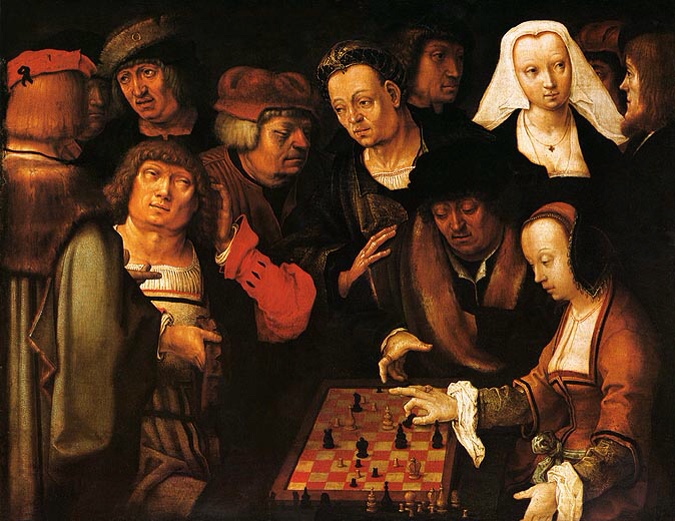
Full marks for 'white in the right hand corner' but the board is 12*8; an art historian might know whether this is typical of lack of realism/issues with perspective?
I have been drafting this blog piecemeal over the last few days; then, on Twitter, I came across this:
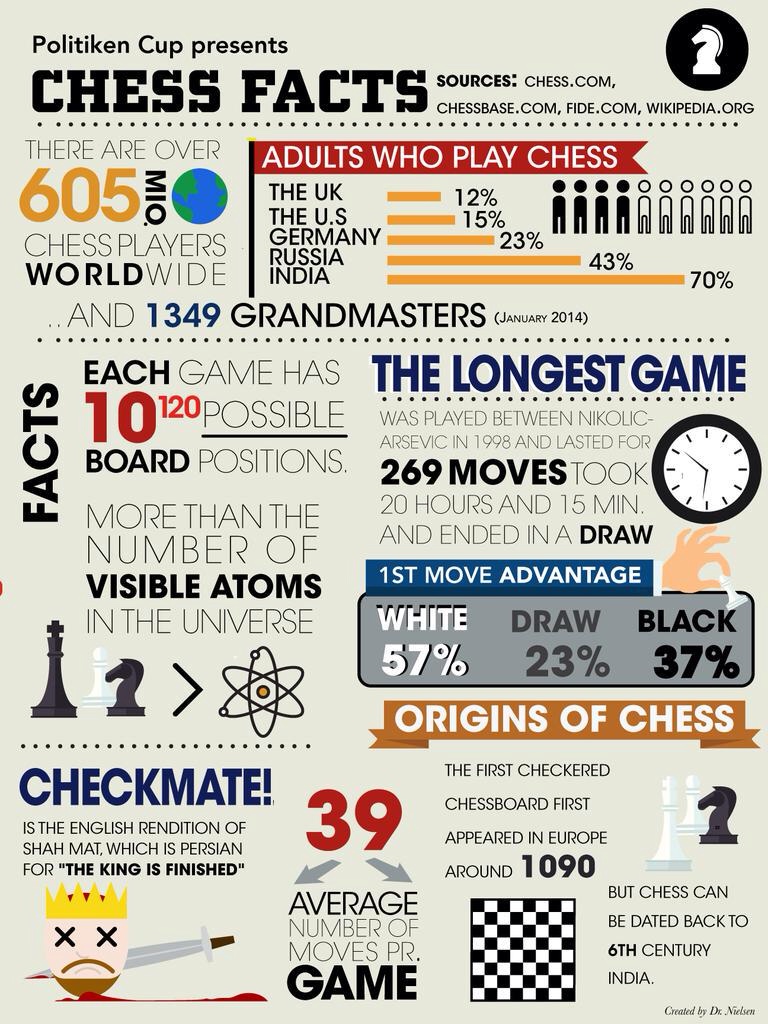
The 1090 reference must or might be a reference to Einsiedlen Poem, which Murray says was c 1100, but on googling, I have found either 'tenth century' '997’ or '998’, for instance here.
Tentative conclusions: I suspect, despite what the colourful poster says, and despite Murray's c 1100, that the chequering of chessboards was introduced around the end of the 10th century. I am presuming that the dating of the Einsiedeln Poem's has refined over the decades, making them c 100 years earlier than previous estimates. Maybe, just maybe, a suitably qualified scholar will be able to shed some further light.
So. Red and White, end tenth century, Black and White (and white in the right hand corner) by the thirteenth.
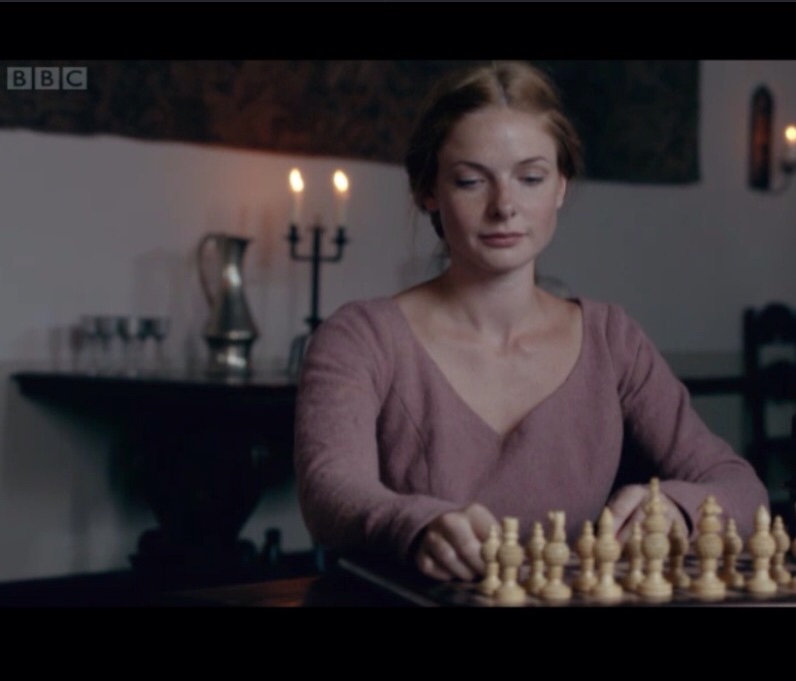
Looking back to a previous posting in which I commented on the chess aspects of the BBC series the White Queen, apart from the the fact that the BBC set up the board incorrectly (black in right hand corner) (why do we pay a licence fee?) and apart from (as I see now-see both pictures on my previous posting) the fact that Rebbecca is aiming her hand at her opponent's pieces, I now see that the squares are brown and white, like many modern boards, and not black and white.
 Posted with Blogsy
Black to play and win
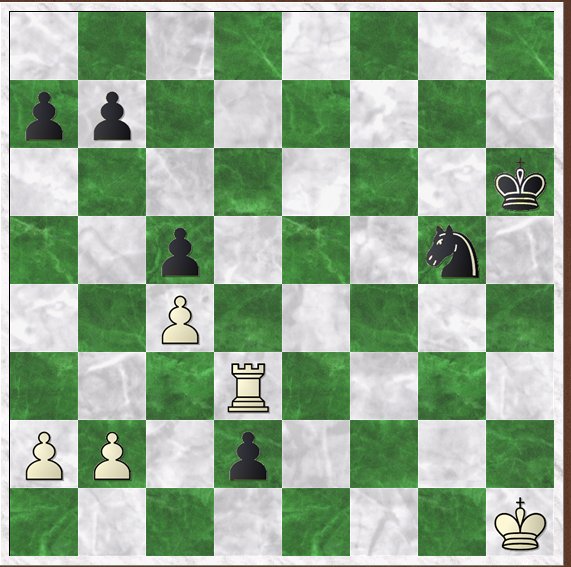
Sternberg v Pawelczak, Berlin 1964
Solution
Not too hard, because one of the two only moves to defend the Pd2 wins. 1…Nf3!, for if 2 Kg2, 2…Ne1+ forks the king and rook; whilst if White checks first, to move his rook away from the mined square, then Black plays Nd4, blocking white’s rook sight of the d2 pawn.
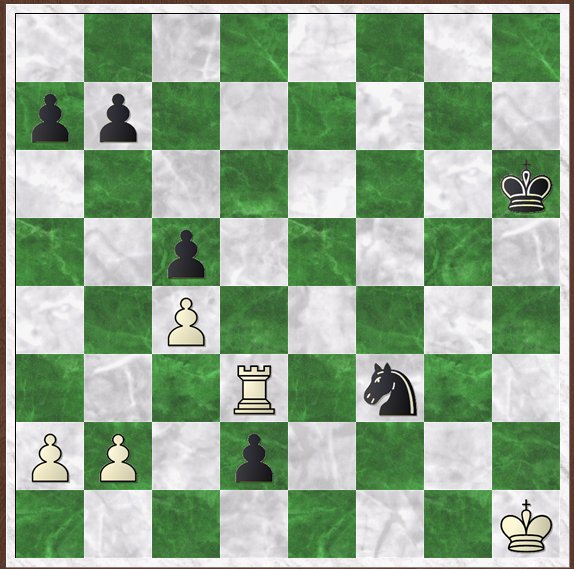
White to play: evaluate 1 Kd8, heading for g6
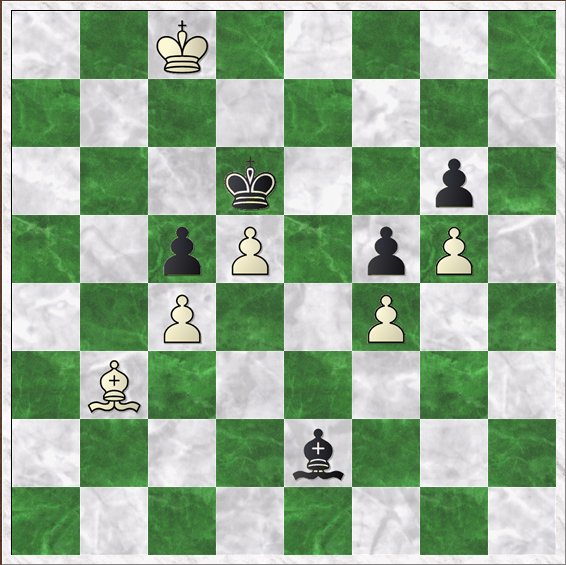
Darga-Spassky, Amsterdam Interzonal 1964
Solution
1 Kd8? throws away the advantage: …Bc4!! forces 2 Bc4, when it is stalemate. In the game, white managed to avoid playing this move, regrouped, and beat Spassky after a further thirty moves.
The ending is very interesting, and readers may wish, as I did, to explore it further for themselves, before reading on. It took me a while to find the winning steps.
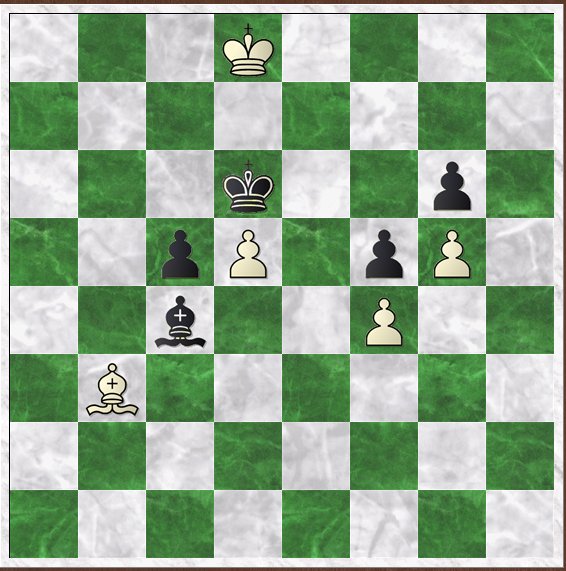
I haven’t heard of Darga (who won in the games of puzzles 60 and 61; being able to draw against Spassky indicates he was a really strong player). Wikipedia tells me he tied first for World Junior Champion in 1953, became a GM, before retiring and becoming an IBM programmer. This victory over Spassky is given as his best game, and some analysis of it can be found here http://www.chessgames.com/perl/chessgame?gid=1128596.
The winning line is instructive: take your time, improve your pieces, zugzwang and principle of two weaknesses all come into play. (On the principle of two weaknesses, the two are the weak pawn on g6, and white’s passer, which forces Black’s king to defend the d6-d8 sqaures.
Step 1: improve the king
The king is re-routed to c3, to protect the c4 pawn, to release the Bb3 from its defensive duty.
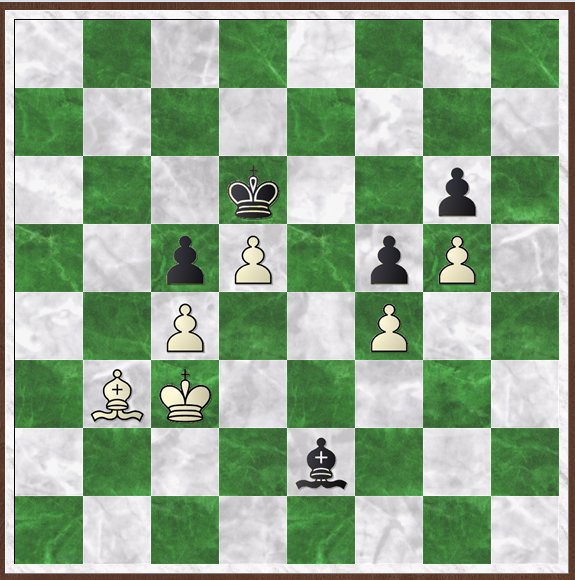
Step 2: improve the bishop
The bishop is rerouted to b5, from where it resumes control of c4, but also threatens to come to e8, biffing the g6 pawn.
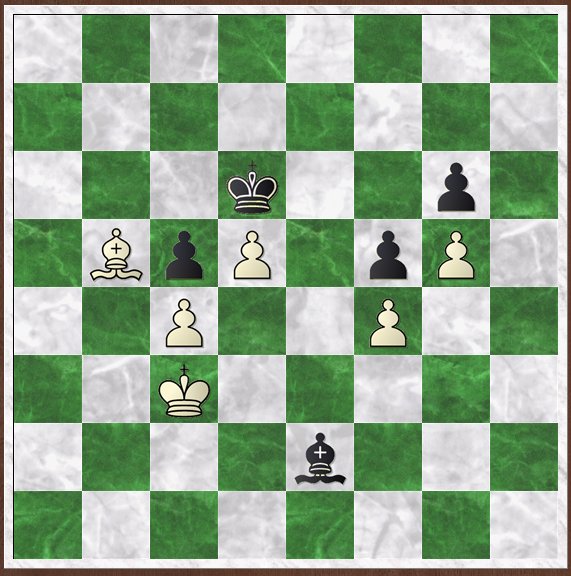
Step 3: add to the strain on Black

This is one typical position. Sometimes White has to fiddle around with waiting moves, such as Kc3-b2, to get the right pressure, but eventually Black gets into zugzwang or similar difficulties.
Exchange one advantage for another
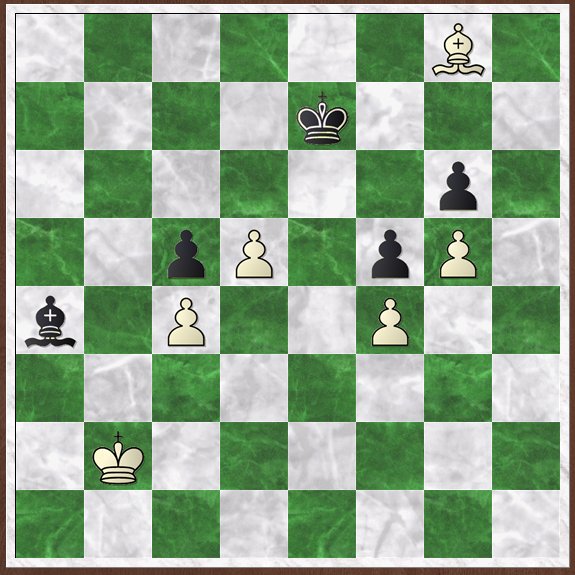
The above is a key type of position. White plays d6+ Kd6 Bf5, exchanging the d passer for a g passer: the resultant ending is won, partly because the g pawn is less central, straining both Black’s pieces.
Darga actually won in a different, but similar way, of eventual zugzwang, but also with the key exchange of d for g pawn tactic. I have lightly annotated the whole game here. It is a very interesting game, throughout its stages, and some of my comments are more in the nature of queries. My readers might wish to analyse this game, and the ending, and maybe post their conclusions by replying to this blog post.
This is an occasional series of postings inspired by a brief discussion on the flight home from Turkey this summer. The flight attendant saw I was reading a chess book (quelle surprise) and, just making polite small talk, said she also liked playing chess, saying that depending on whether other crew members played, she would play on stopovers. Later in the flight she asked me if I had a chess set at home…and that set me thinking. How many chess sets do I have? And since then number is, well, shall we say, quite high, I thought I would blog about them especially those which ‘mean something to me’.
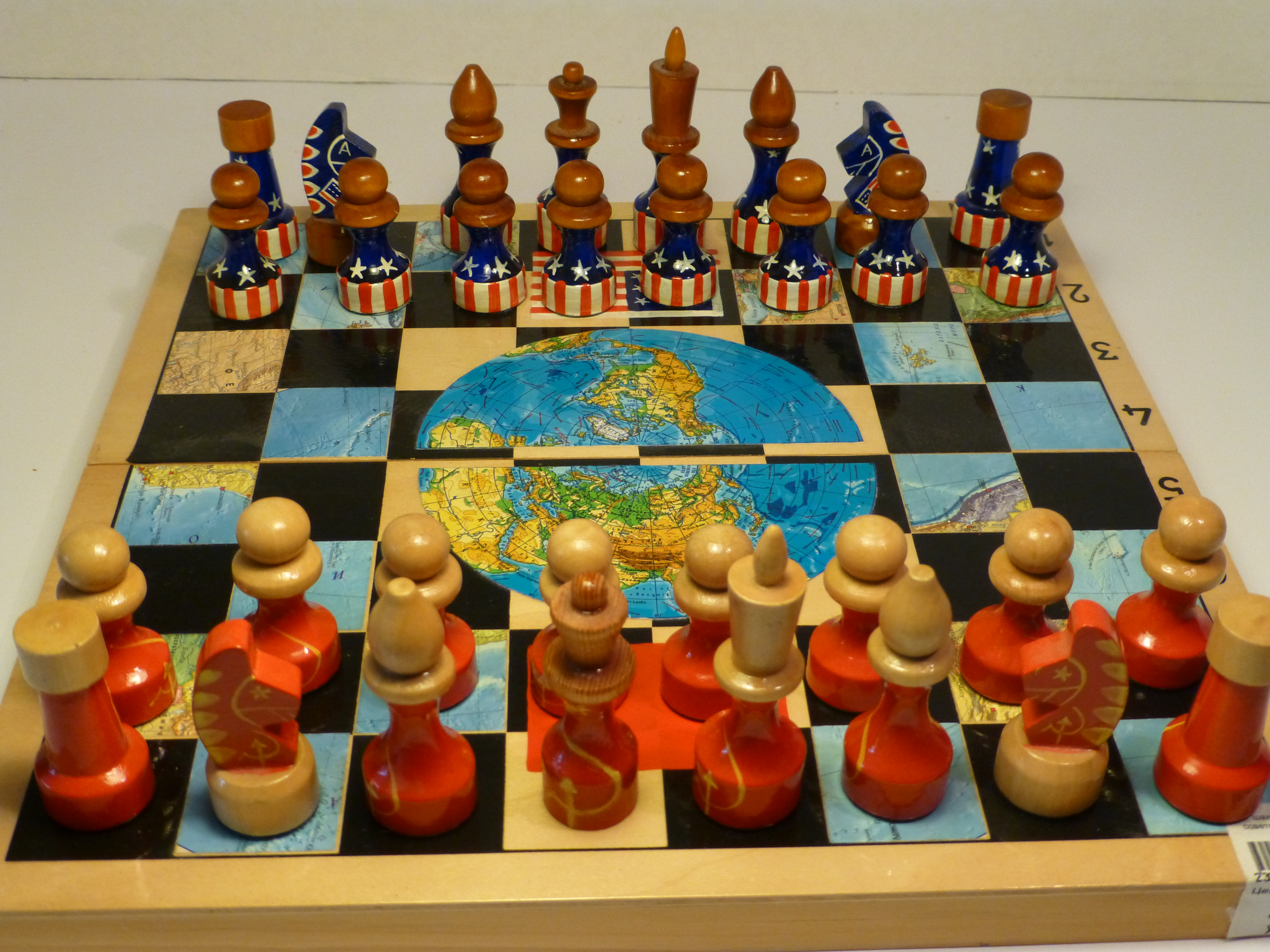
Whenever a member of our family goes away on holiday, he or she has to bring back presents for the rest of the family. I am always the easiest to buy presents for: a chess set. In this case, my son Tom visited St Petersburg on a sixth form school trip and he came back with this beautiful United States v Russia set.
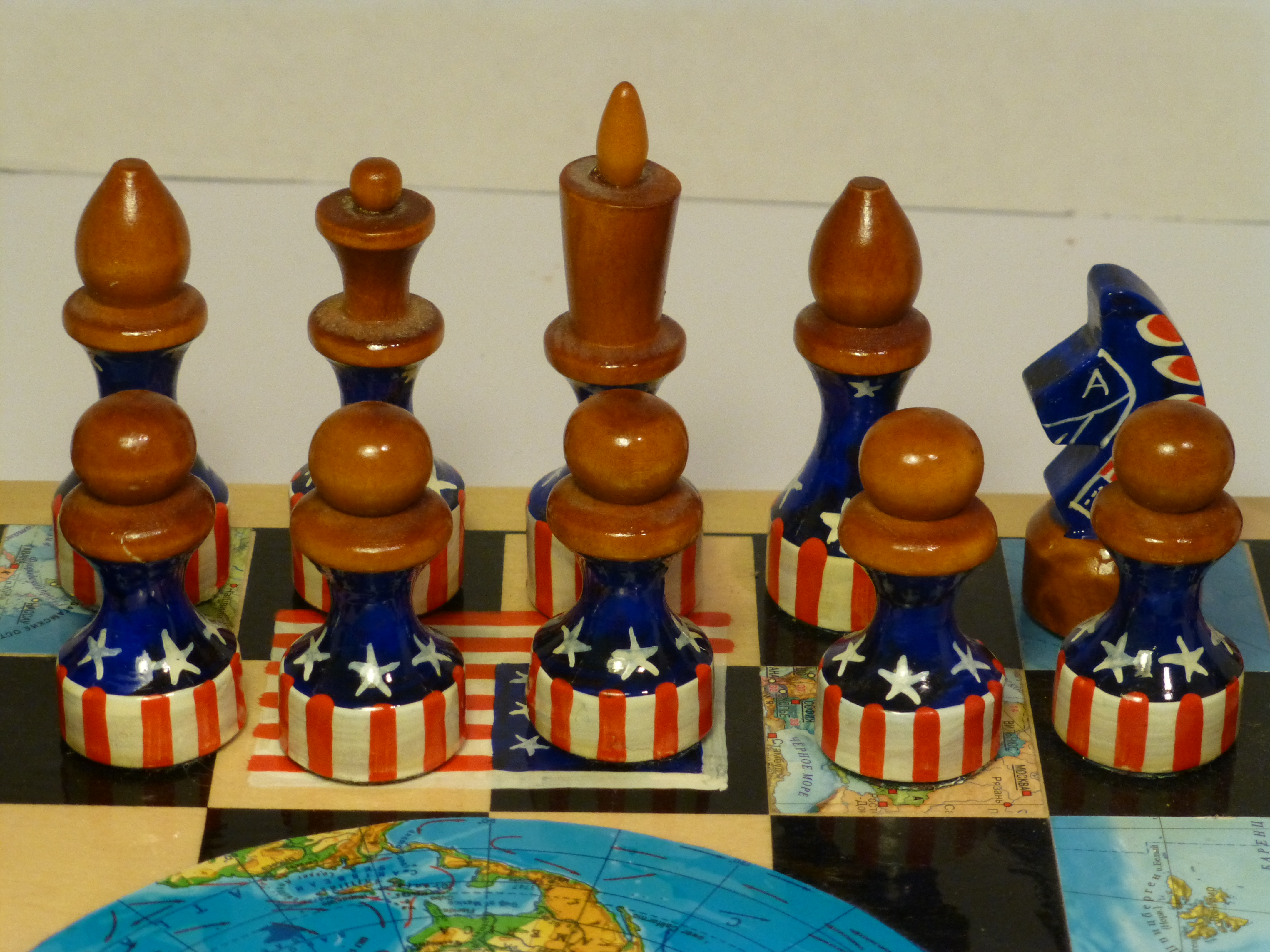
I have used it a few times, but it is mainly ornamental, and will always be treasured.
Rating
8/10: not a good set to play with, but a lovely memento of the first trip by a member of my family to Russia.
This is an occasional series of postings inspired by a brief discussion on the flight home from Turkey this summer. The flight attendant saw I was reading a chess book (quelle surprise) and, just making polite small talk, said she also liked playing chess, saying that depending on whether other crew members played, she would play on stopovers. Later in the flight she asked me if I had a chess set at home…and that set me thinking. How many chess sets do I have? And since then number is, well, shall we say, quite high, I thought I would blog about them especially those which ‘mean something to me’.
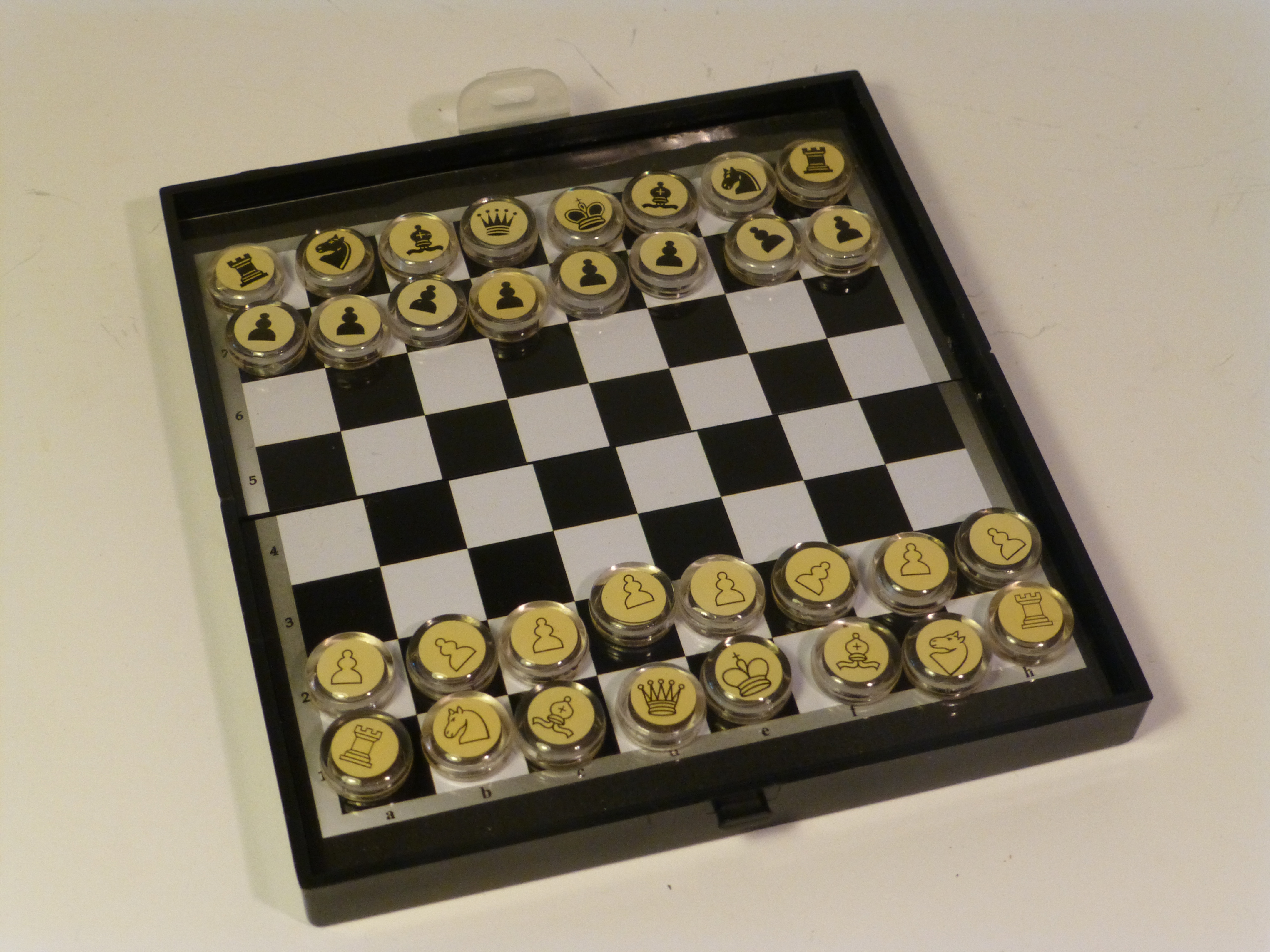
Quite a nice variation of the magnetic travelling set. The pieces are nicely heavy, have a good feel about them, and the set is well made.
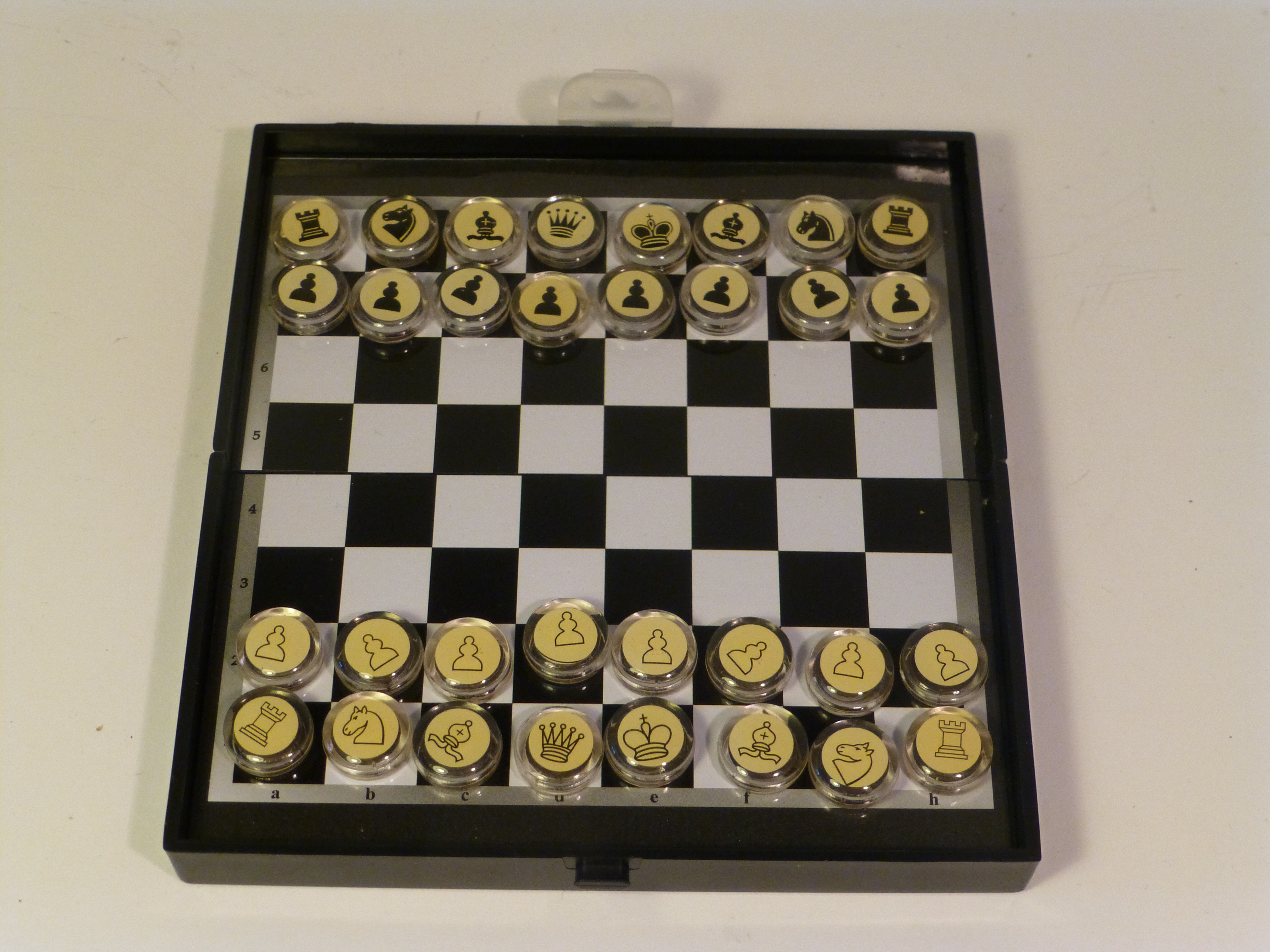
Rating
4/10: a good variation on a theme
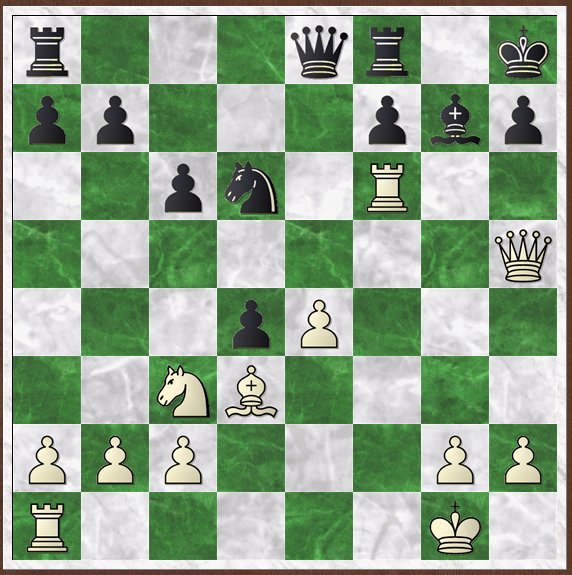
White to play and win

Fischer- Benko, 1963-64
Solution
This position is part of any strong player’s education; or maybe the education of anyone brought up in the 1970s/1980s. It is a famous Fischer win, so 1 Bd4! ed[] 2 Rf6!! is ‘known’.
White to play and win
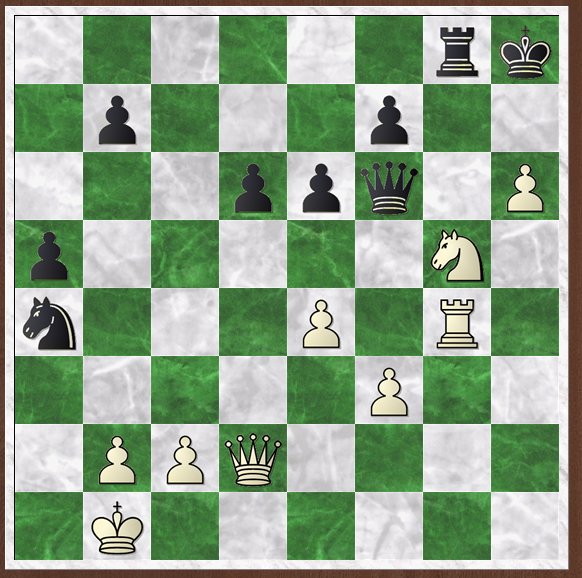
Teschner v Gereben, Reggio Emilia, 1963-64
Solution
Black threatens mate on b2, so force is needed, and it is not hard to see the first move, 1 e5 (examine all biffs) after which 1…de is forced (1…Qe5 drops the queen to 2 Nf7+ forking). 1e5 has the additional point of revealing the previous jump-biff Rg4-a4.
After 1…de, there are two ways to win. I chose 2 Ne4, the idea being 2…Qe7 3 Rg8+ Kg8[] 4 Qg2+ mating up promoting the queen (noting that there is no rescue mate or perpetual for black- the Ne4 does a good defensive job too); or if 2…Qf5, rooks are exchanged and then Qa5 picks up the trapped LPDO Na4; again, noting the cute point that after 3 Qa5 Qf3?? is impossible because of Q checks and Ng5+ forking.
In the game, White played 2 h7, when 2..Rg5 grovels on hopelessly, or 2…Rg7 3 Ne4 Qe7 4 Rg7 Kg7[] 5 h8(Q)+! Kh8[] 6 Qh6+ and 7 Nf6+; or 3…Qf5 4 Ra4 wins the N.
This is an occasional series of postings inspired by a brief discussion on the flight home from Turkey this summer. The flight attendant saw I was reading a chess book (quelle surprise) and, just making polite small talk, said she also liked playing chess, saying that depending on whether other crew members played, she would play on stopovers. Later in the flight she asked me if I had a chess set at home…and that set me thinking. How many chess sets do I have? And since then number is, well, shall we say, quite high, I thought I would blog about them especially those which ‘mean something to me’.
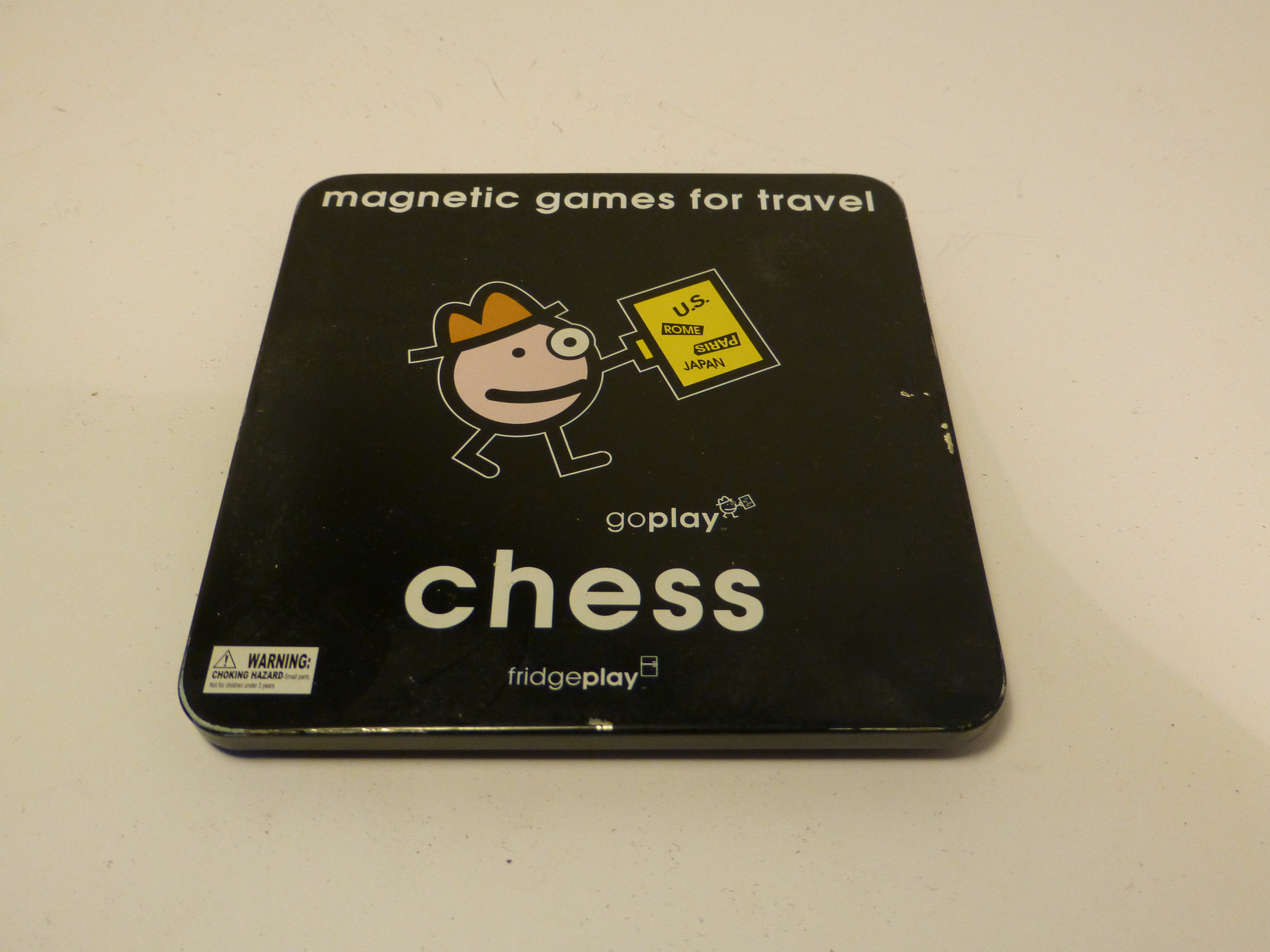
Another cheap set
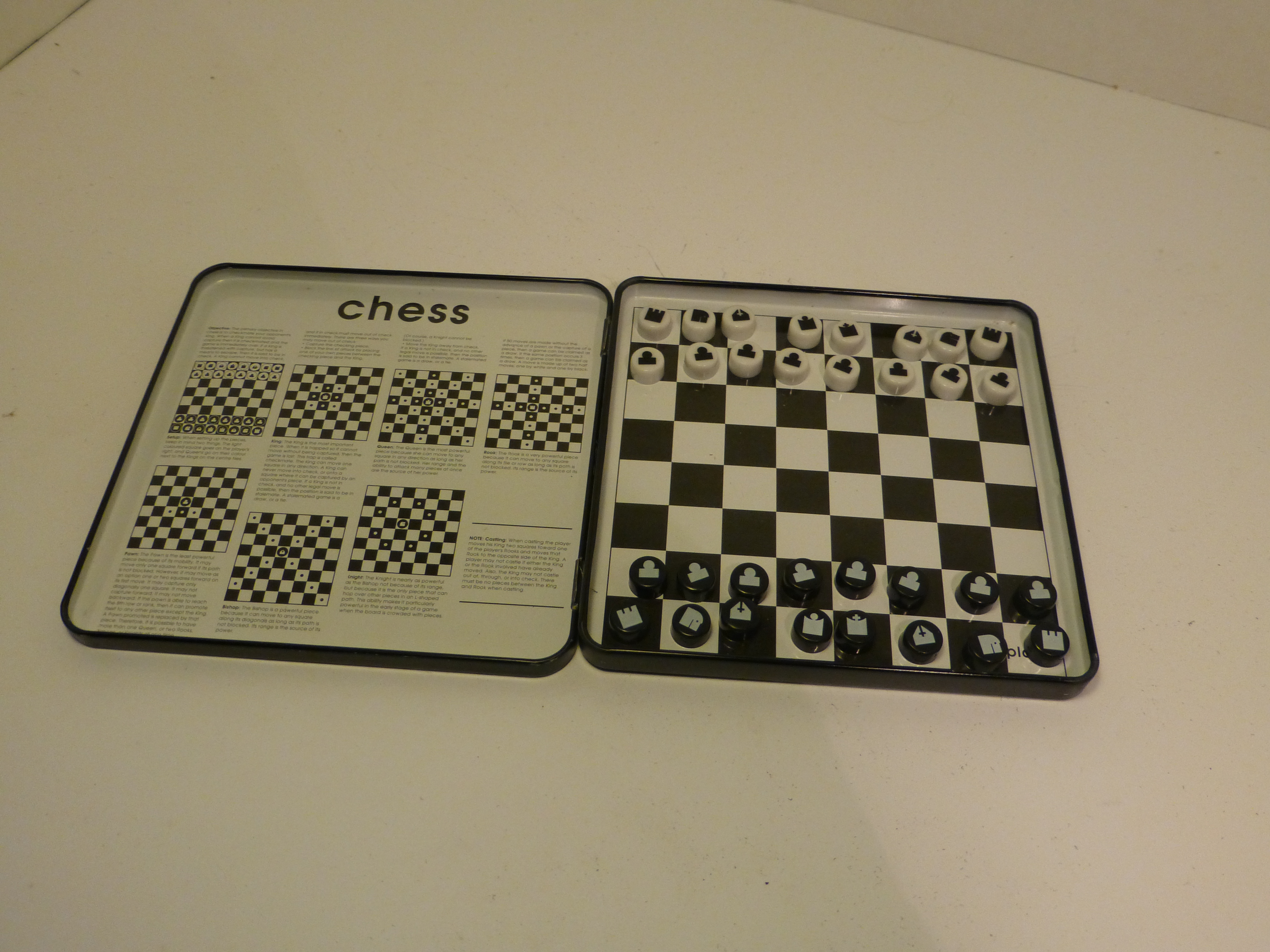
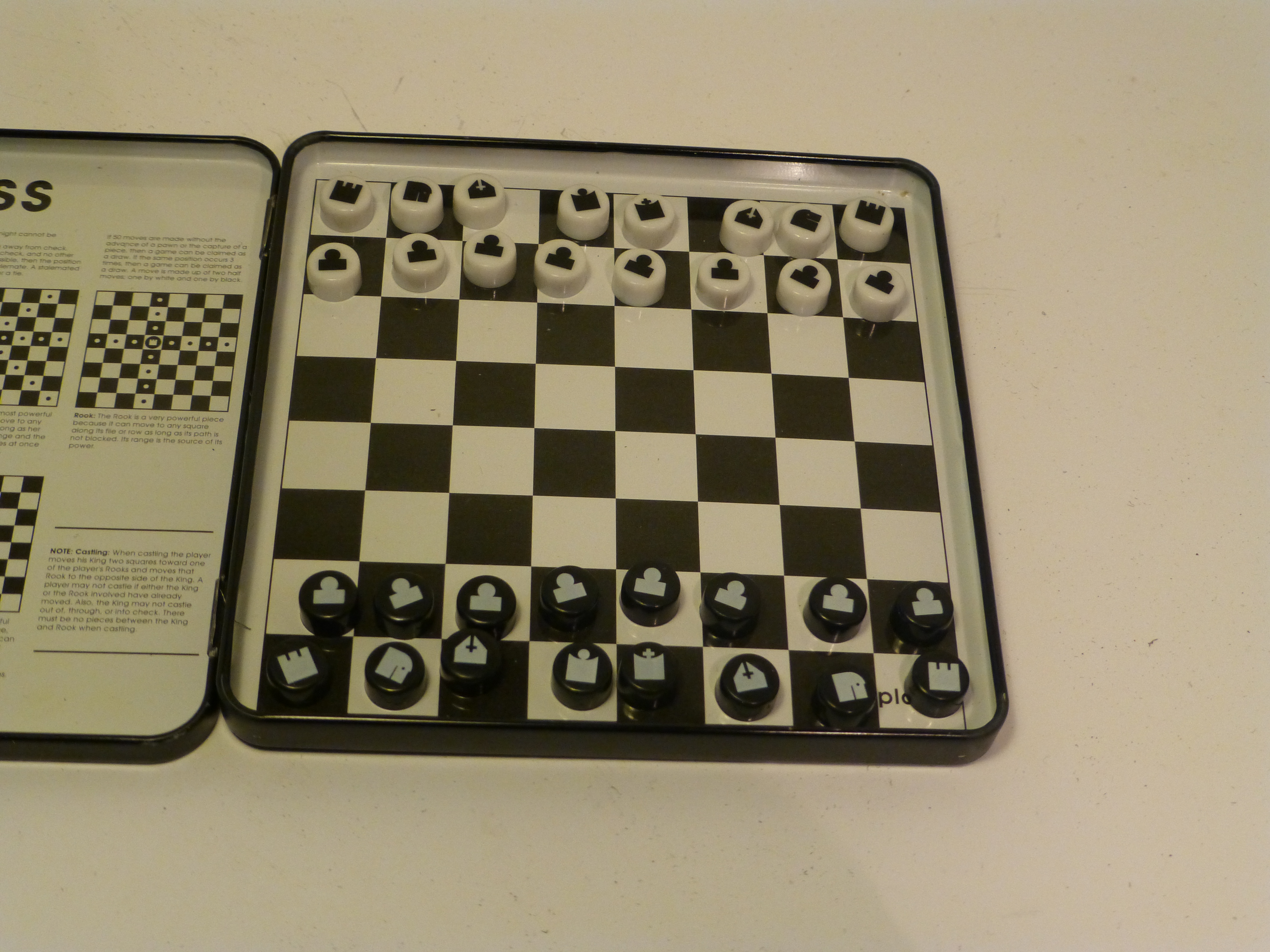
I’ve hardly used it, and am not really likely to do so. Quite functional in design, but not pleasant to the touch.
Rating
3/10: an interesting version of a portable magnetic set.
White to play and win
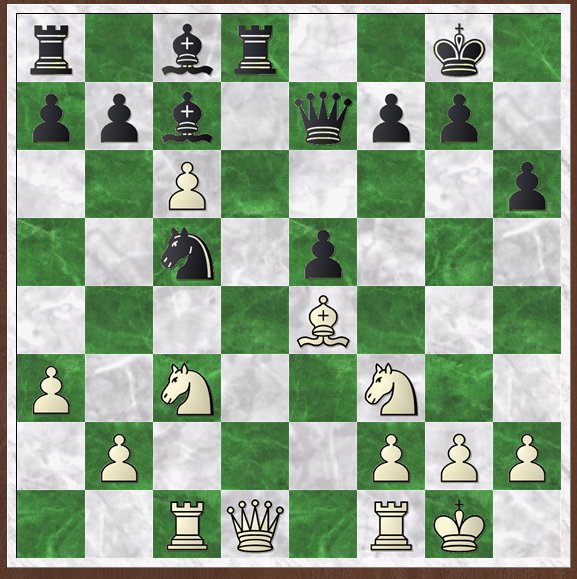
(problem slightly flawed: Black can defend; but a good work-out to see the line played in the game, and then find the better defence)
Korchnoi v Robatsch, Havana 1963
Solution
First the game continuation, which I only got part correct, and not the main part (i.e., I failed) 1 Nd5 is obvious, as is 1….Qd6 (but it isn’t best, and, to my credit, I found the better defence, 1…Qf8, see below) and afer 2 Nc7 Qc7[]:
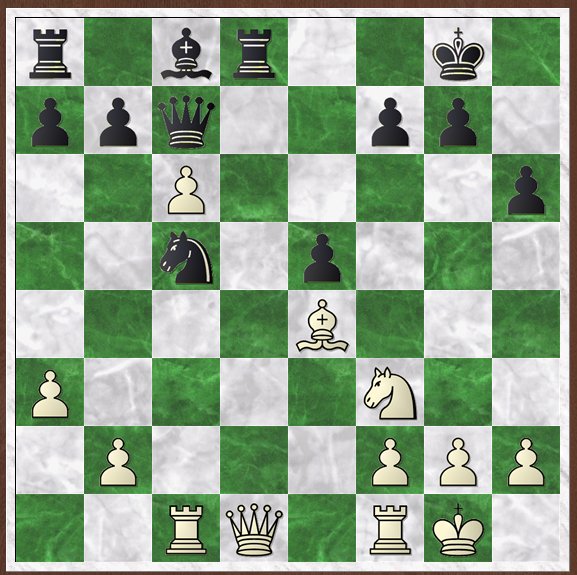
Here, I gave up (in fact, being confused by too many pieces in the centre of the board, too many possibilities, including 3 cb, which is just dead equal), missing after 3 Rc5! Rd1 4 cb!!
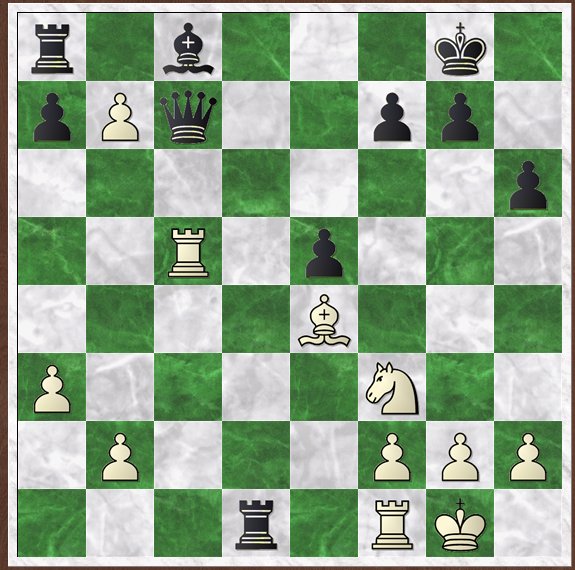
I suspect Robatsch missed this, else he would have probably found 1…Qf8. Now after everything is exchanged the following position is reached:
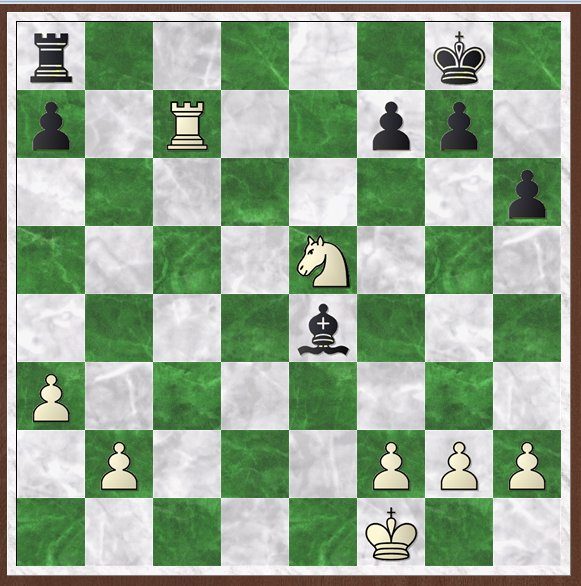
and the ending is won, with the outside potential passed pawn.
Better defence
I couldn’t see my way through 1…Qd6, and chose instead 1…Qf8, which proves to be better.
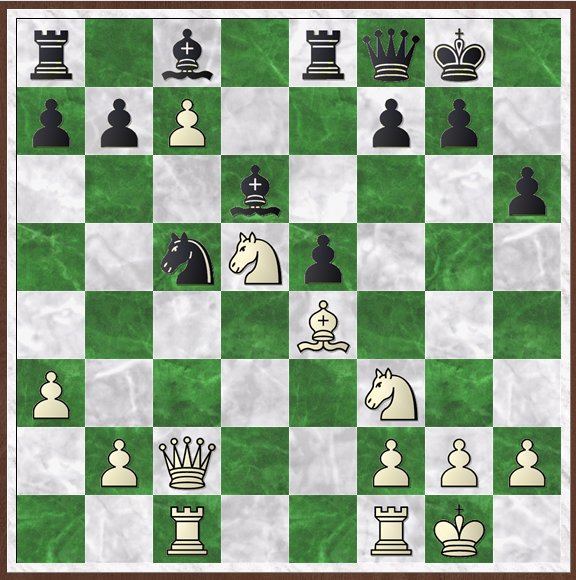
2 Qc2 is followed by the logical exchange and develop sequence 2…Ne4 3 Qe4[] f5 4 Qc4 (or Qa4) Be6
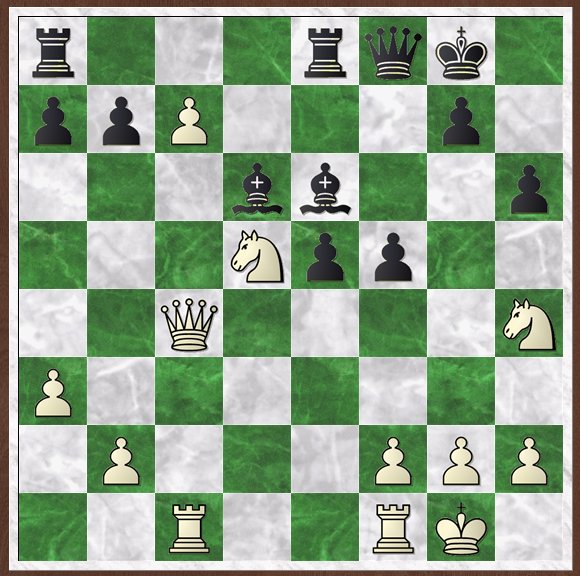
Given the choice, which side would you pick to play? I don’t know which the GMs would pick; I would prefer to play Black, fearful, if I were White, of ..g5 and being pushed back, the two bishops, centre and potentially my Pc7 being rounded up. My engine says the position is near equal.
 allanbeardsworth