Whilst watching the end of the World Championships, and also the short match in St Louis between Levon Aronian and Hikaru Nakamura, I also had a peek at other games.
The GM invitational at St Louis has already provided a new GM, Samuel Sevian- born this millennium, 26/12/2000, so not yet fourteen. I have downloaded a few of his games from St Louis and will analyse any which interest me, and add them to my Chessbase 13 blog cloud.
White to play and win
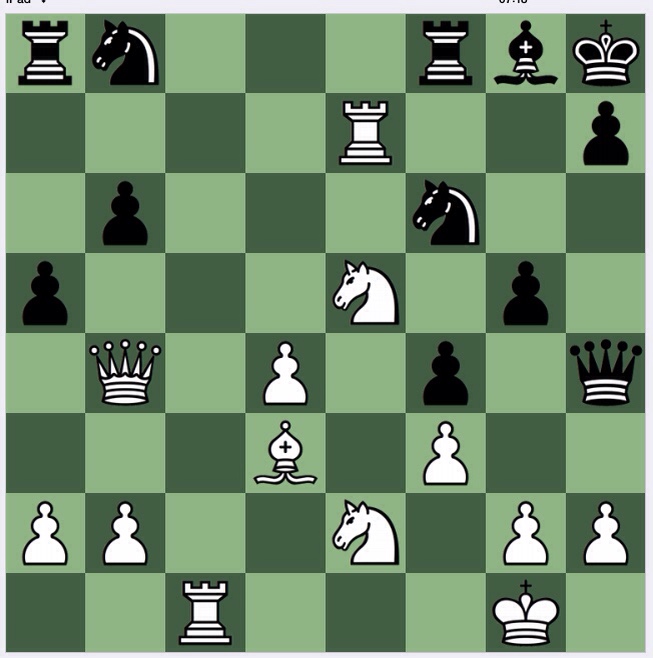
CC De Villiers v T Gannholm 1974
Solution
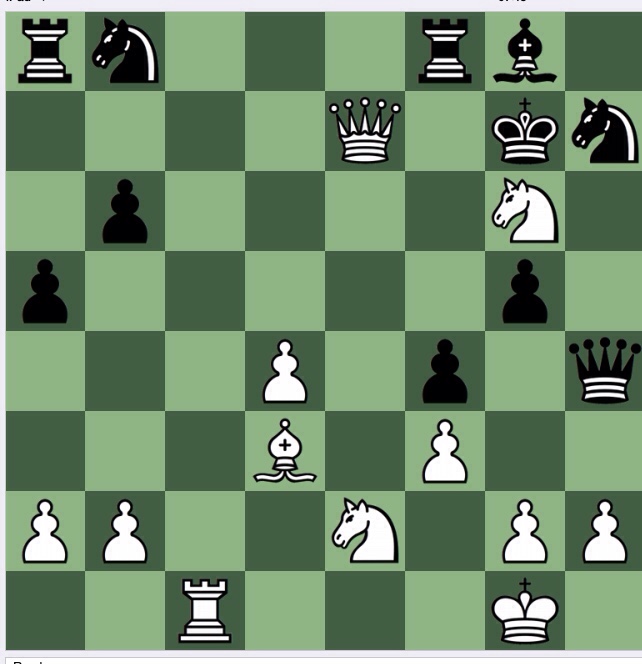
Since the position is 'messy', a bit of work is needed to find the answer, though it isn't too hard. 1 Rh7+! and only one recapture, 1..Nh7, makes sense (though 1…Qh7 2 Qf8 needs a glance: white wins because 3 Ng6+ is coming, with the Ne5 also defending the Bd3). Then after 1…Nh7, 2 Ng6+ Kg7[] 3 Qe7+, the point is that next (after 3…Rf7) white plays 4 Qe5+, removing his queen from attack, after which black's queen can be taken, and the rest is a mop up.
 Posted with Blogsy
White to play and win
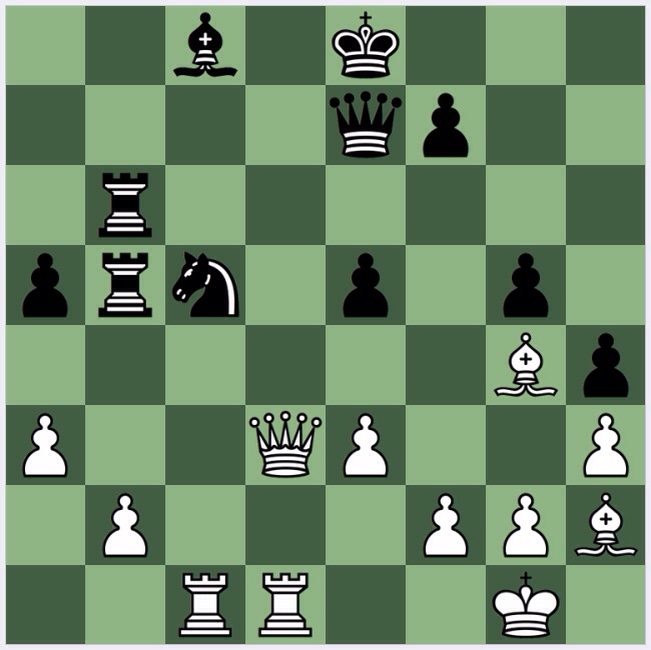
D Isaacson v KR Claudius 1954
Solution
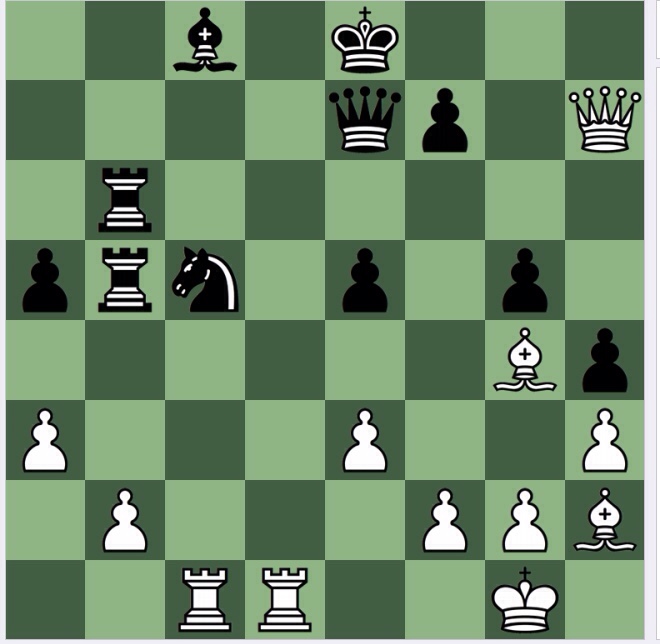
First of all, following Purdy's advice to firstly ignore threats, imagining what you would want to do if they could not possibly be implemented, you look to see if the Q didn't move. But if say 1 Kh1 (or any other pass move) 1..Nd3 2 Rd8+ there is no mate, and after 2…Qd8[] 3 Rd8+ Kd8 4 Rd3+ all there is an unbalanced ending. So, rather than a pass move, you look for something better, and on finding nothing, it is clear the Q has to move.
To me, 1 Qh7! was obvious, seen on initial inspection, but as a process, one should also examine all biffs and look at (and reject) each of Qb5+, Rc5, Bc8, Be5. But after 1 Qh7 it is all over. If say 1…Bg4 2 Qg8+ Qf8[] 3 Rd8+!, picks up the queen, then the Bg4; and if 1…Ne6, aiming to interpose Nf8, then 2 Rc8+: there was a jump check threatened in the initial position, so again it is game over.
I upgraded from CB12 to CB13, mainly out of curiosity to see what the new features are like, or more particularly, their relevance to how I use the program, as a keen amateur and blogger.
First impressions are fairly positive: I like the new annotation panel, though wish the 'frequently used symbols' could be user defined, since for instance I often use the 'better is' half moon and 'only move' square, and even having on the panel the 'insert text' 'insert diagram' would be good. I think the splitting into two of repertoires, one for white, one for black, must be good, and after forty some years of playing chess I really ought to start work on creating a repertoire (I never have, I play what I feel like). The cloud database concept looks good, and this morning I chose to see how it works. 'Fairly' positive because I don't see the changes as mind-blowing or that significant, but I am only a few hours into using it, so I might be commenting without knowledge.
Maybe soon Albert Silver or another correspondent will explain how to use cloud databases (note to Chessbase: better user guides published on release of new software) but this morning I got up early, and decided to spend time on last night's Aronian-Nakamura game which intrigued me.
I have written up my notes, in which I wrote that I hoped Chessbase would have some GM commentary on the game, since it hadn't at the time I finished my analysis. However, by the time I had worked out how to publish the blog database, a news item had come out. From a quick glance, I got most of the main points more or less right, but the article as always gives me food for further investigation.
To give access to a blog database, click on the cloud database tab, and open a new database in the normal way, and copy/paste whatever you want to put on your blog into your blog database. Then right click on the database icon, click on Database Sharing, tick the check box Make Public in Web, Click on Open Web Site (note to Chessbase: for a future release, let users copy and paste the URL and PGN links which are set out but at present can't be copied), click on the address box, and copy/paste the line. As far as I can see, but I could well be wrong, it is not possible to copy and paste the pgn line.
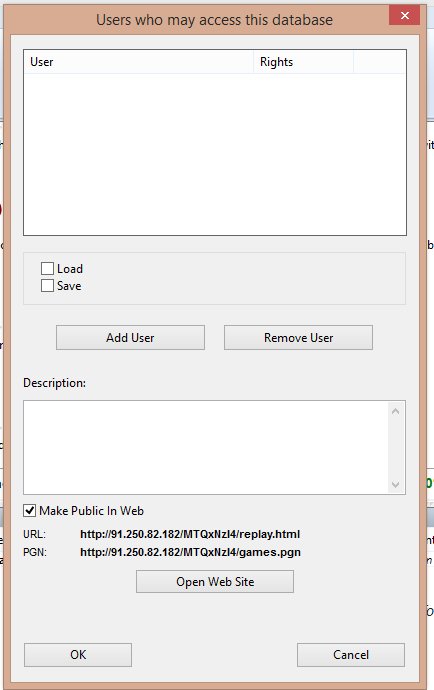
My blog database, which at present only contain Aronian-Nakamura, is here.
White to play and win
Black played here 1…Na5-c4 here, met with by what?
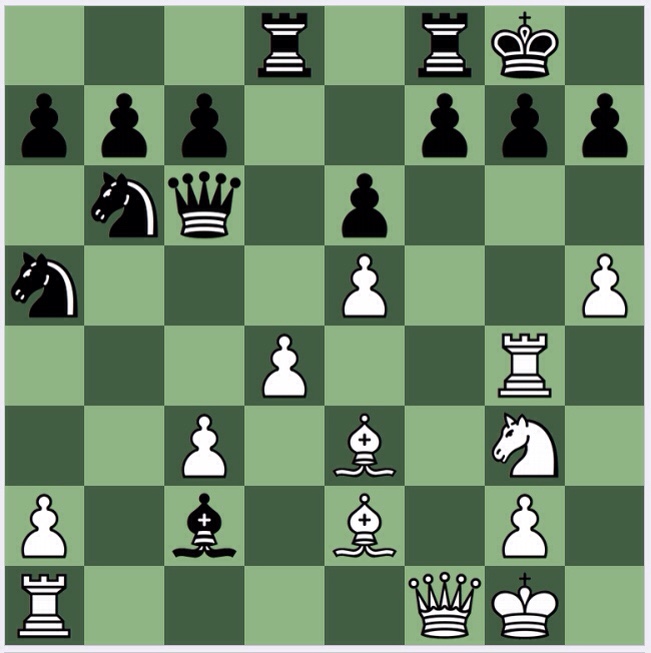
W Kobese v L Bouah 2003
Solution
Fairly straightforward, since the 1 Rg7+! biff has to be tried, and if 1…Kg7, 2 Qf6+ and 3 Bh6 is mating. If instead 1…Kh8, then 2 Rf7 is sufficient to win: 2…Rf7 3 Qf7 Ne3 fails to 4 Qf6+ forking the K and LPDO Rd8.
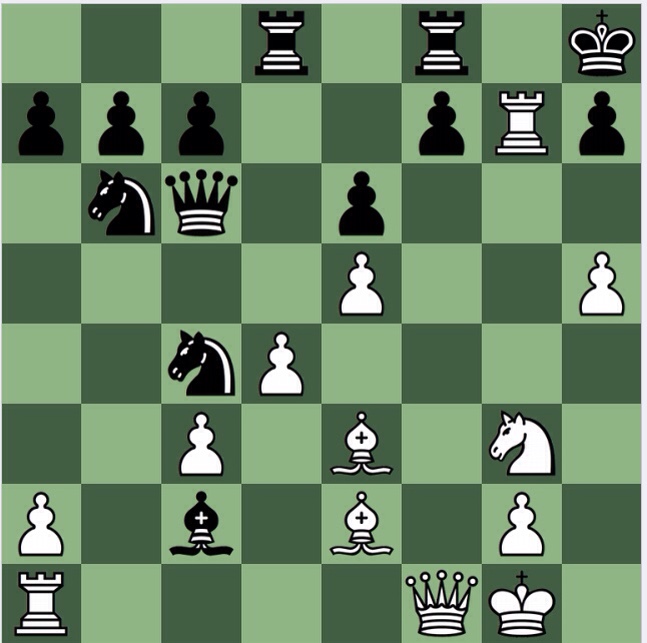
A far tougher puzzle is: how should black have defended instead? Reitsein gives as best 1…Nd5, and he may be correct, but also 1…Qc3 has its merits. However the analysis I have done to date, aided by Stockfish, suggests white has a clear advantage against all defences. (The problem with 1…Nd5 is 2 Bh6 g6, when white doesn't need to fake the exchange but can proceed with 3 c4)
Black to play and win
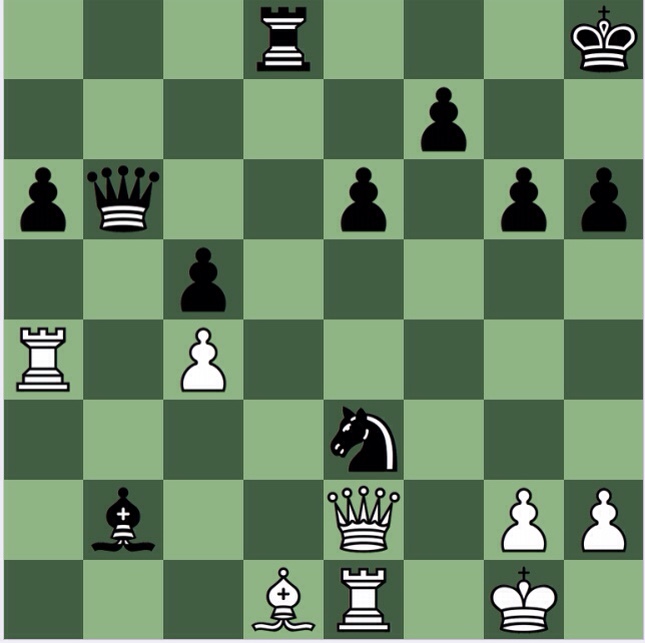
J Wolpert v CH Van der Meyden 1963
Solution
(From the same game as yesterday's puzzle: white avoided Rf6 in yesterday's position.
The first move is obvious, and it weren't, examine all biffs, 1…Bc3!. Reitstein says that white resigned after the move, and it is fair enough, though maybe he should have let black show the forcing line – 2 Rf1 Rd2 3 Qf3 Bd4! 4 Kh1 Nf1 5 Qf1 Qb1. A long line, but forced.
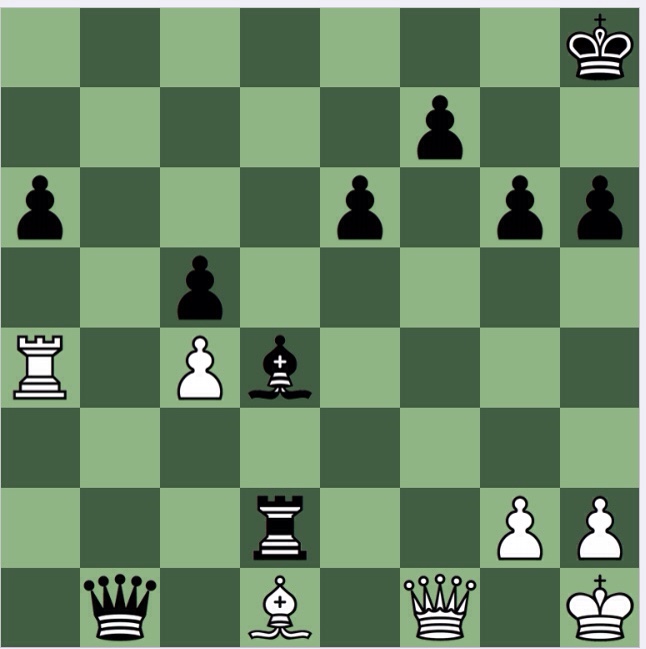
Black to play and win
White plays Rf6 in this position: then what?
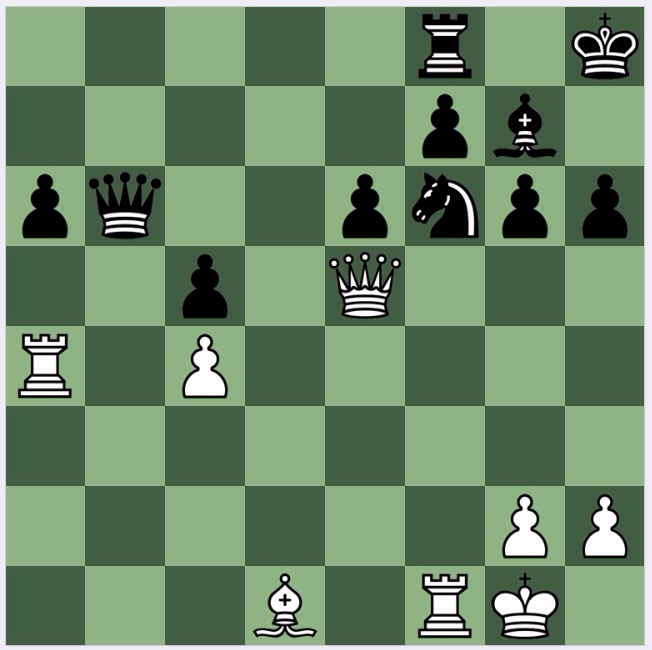
J Wolpert v CH Van der Meyden 1963
Solution
Fairly easy today, black plays 1…Qd8! winning the exchange. The double attack on the pinned Rf6 and LPDO Bd1 win. For further good measure, if after say 2 Bf3 Bf6 white were to play 3 Qc5??, then 3…Bd4+ is kaput.
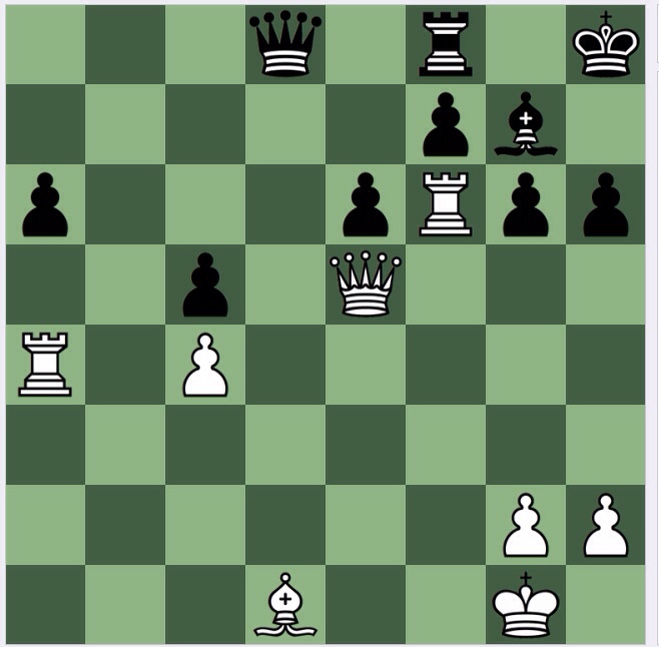
White to play: how to defend?
Which of the three ways to meet the check is best?
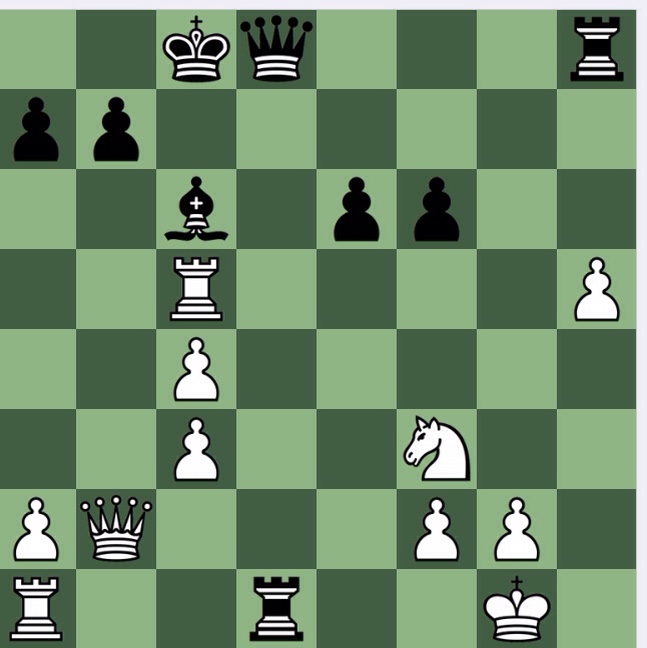
D Sprenkle v M Hentinnen 1982
Solution
This is fairly easily, being a process of elimination.
Taking the rook is easiest and most horrible: 1 Rd1 Qd1+ 2 Kh2 Qd6+ and the LPDOS Rc5 drops off. Next, and almost as bad, is to play 1 Kh2, when 1…Qd6+ followed by Ra1 at least wins the exchange – white can sacrifice it on c6: though maybe if 2 Kh3, Qc5 could well be a mating attack.
So, by reduction, 1 Ne1 is best, and hope that the game goes on, but black is better.
Black to play and win
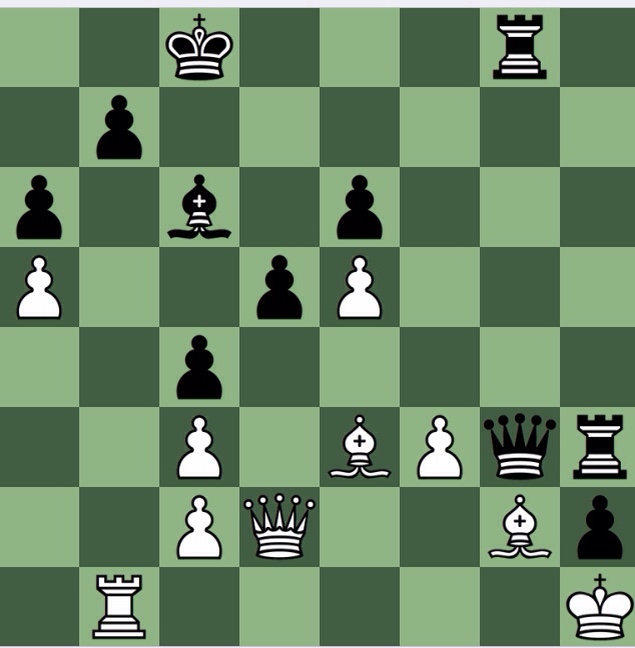
CH Van der Meyden v R Schackis 1974
Solution
Black played 1…Rh7, missing what I think is fairly obvious 1…d4 (maybe it is obvious because I am a blitz player: why wouldn't you sacrifice a pawn to improve the bishop considerably, hoping or expecting the pressure on f3 and g2 to prevail).
A bit of analysis shows white has no defence. 1…d4 is of course a double attack: on the Be3 and the Pf3. A quick check suffices to show white hasn't got any cheapos on the black king, so 0-1.
Black to play: can he safely play 1…Qc1?
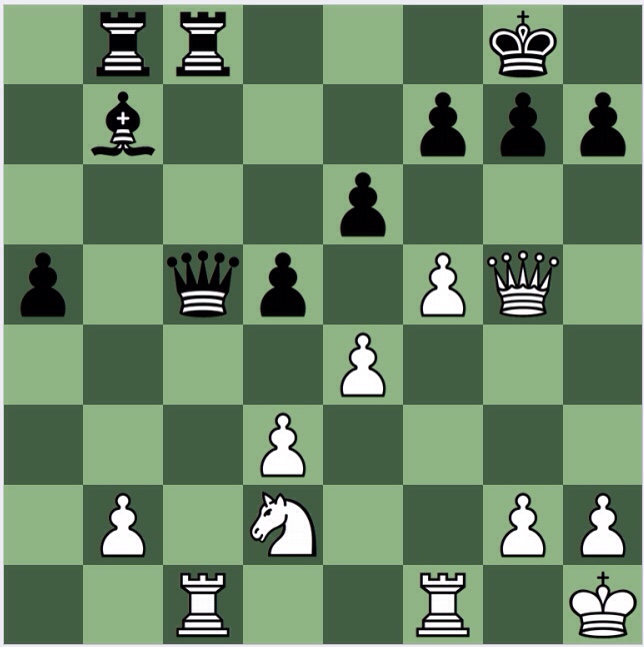
J Broster v D Alexander 1995
Solution
It might just be me, but when I see questions framed this way, I know the answer is 'no, he can't do that'. Unless of course it is a trick question.
So, with this in mind, you look at 1…Qc1, and realise white's only try, which was played in the game, is the zwischenzug 2 f6!
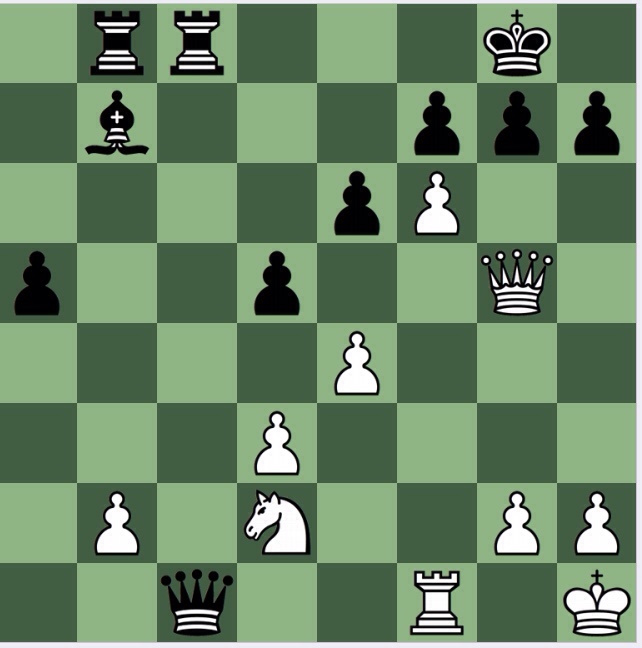
I enjoyed the calculation exercise, though it showed my limitations. My judgment was correct, that 1…Qf1+ is relatively best, but it still loses: 2 Nf1 Kf8 and Reitstein in his solutions says 3 fg+ Kg8[] 4 Ng3, noting that the Qg5 watches c1 (and if black plays f6 trying to distract the queen, then Qh6), and then Nh5 spying f6: 1-0. Stockfish prefers 3 Qg7+ and then checks, checks, checks and checks, not mating, but obtaining a dominant position. I prefer the human fg+.
I got the above right, but only part marks on what I thought was black's best defence, which Reitstein doesn't cover. 1..Kf8 when 2 Qg7+[] Ke8[] 3 Qg8+[] Kd7[] 4 Qf7+[] Kd6 5 Qe7+[] Ke5. That was my horizon, except to the extent that I saw 6 Nf3+ Kf4[] 7 Qd6+ but couldn't see a mate after 7…Qe3.
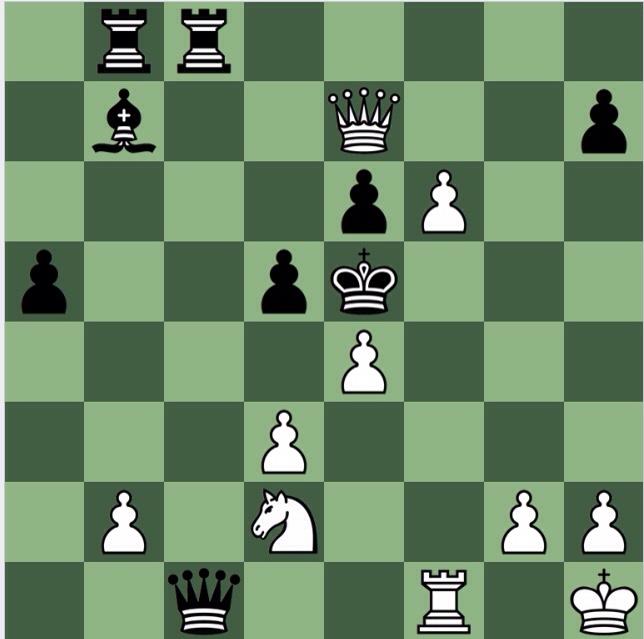
Alas, and as soon as you see the above position, you notice that the precise geometry creates a different tictac: 6 d4+! forces 6…Kd4 when 7 Nb3+ forks king and queen. Game over.
 allanbeardsworth