Black to play
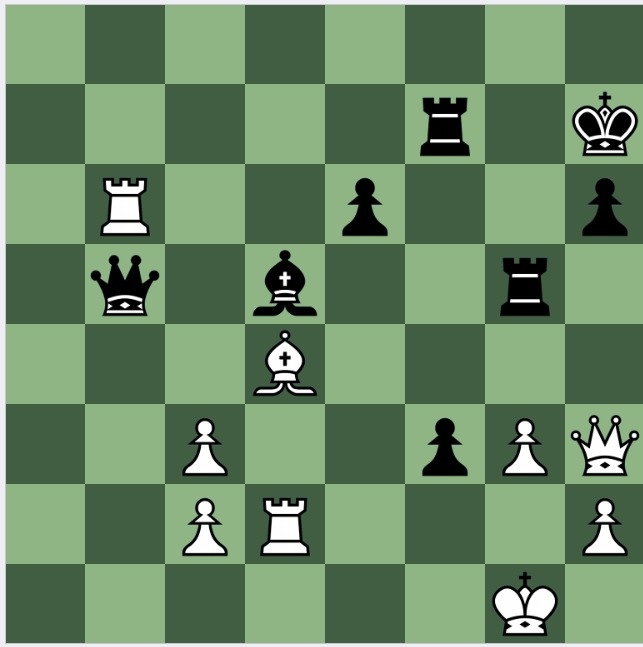
MC Rubery v D Gluckman 1990
Solution
As a problem, where you know there is a solution, this is solvable. In a game I might well have missed 1…Qe2! and gone for a safe receipt.
The queen has to be taken, and then (2 Re2 fe) white has 3 Bf2 when 3…Rgf5 forces 4 Qf5+, with a level ending. White is in time to play Rb4, preventing the improvement of the Bd5, and I think he can hold.
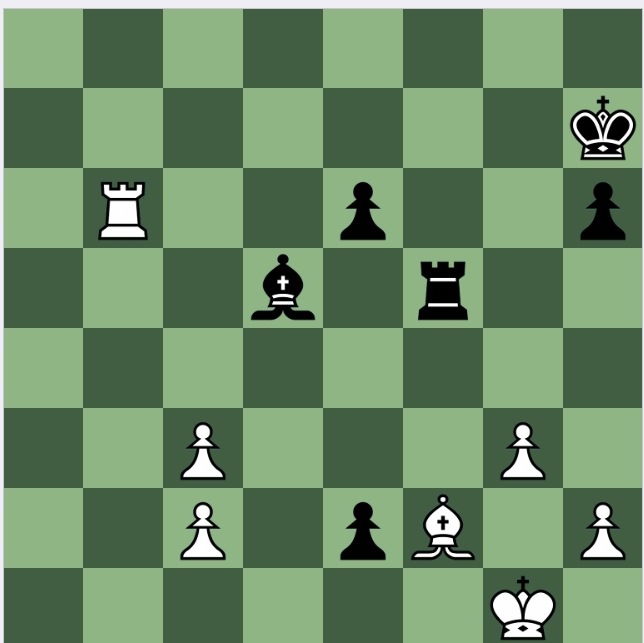
Position before Rb4
Cook
I knew Qe2 had to be the answer, but this looks like a draw. So, intrigued, I spent more time on it. Instead of finding anything better for black, I found better for white: 1…Qe2 2 Rd2 fe 3 Rb1 Rgf5 4 g4! not fearing 4…Rf1+ ( 4…Rf3 5 Qg2 forces Rf1+ because otherwise the e2 will fall, or if 5…Bc4 6 Bf2 shores things up, and then white slowly regroups with h3, Be1) 5 Rf1 Rf1+ 6 Qf1[] ef+ 7 Kf1 reaching an opposite colour bishop ending.
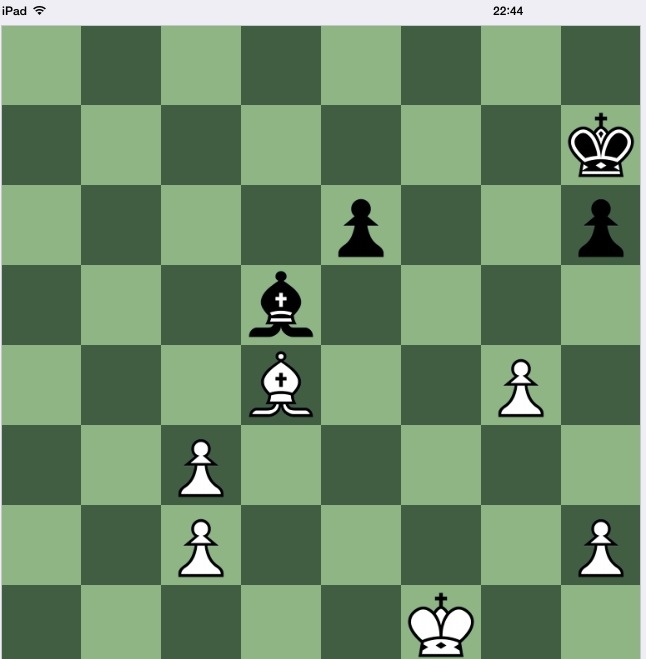
I wouldn't be too surprised if this were winning for white. It probably doesn't matter but the h pawn's promotion square is the right colour, though I suspect the king side pawns will simply to a passer on g5.
I am writing this from the verandah of our holiday home in Kas, Antalya, Turkey. (available to rent, discount offered for readers of this blog)

Better than the view from my office
A couple of days ago we had our habitual pummelling, bending, squashing, pressing, tickling (my feet are ticklish), dousing with hot water, sluicing with freezing cold water… hamam, or Turkish bath. No holiday here is complete without one.
For the last several years, we have always had the same couple of masseurs at the Hera Hotel by the sea front. My son (when he is here) and I used to get Mehmet, an older, bulky, bear of a man, who took delight in our screams and scrunched us. The hamam has changed hands, and this year I (Tom isn't here) got the new man, Ali, a very fit, active, muscular, person in his mid twenties. What he lacked in bulk he more than replaced with strength, and no relief was afforded by him to my more than half a century old body. The high point was when he insisted I relax when he climbed on me and put all his weight on bending my back. It was hard enough to breathe, let alone relax.
But I wouldn't miss the hamam for a moment. In fact, as we left the hotel, my thought was 'should we have another one before the end of the holiday'?
Black to play and win
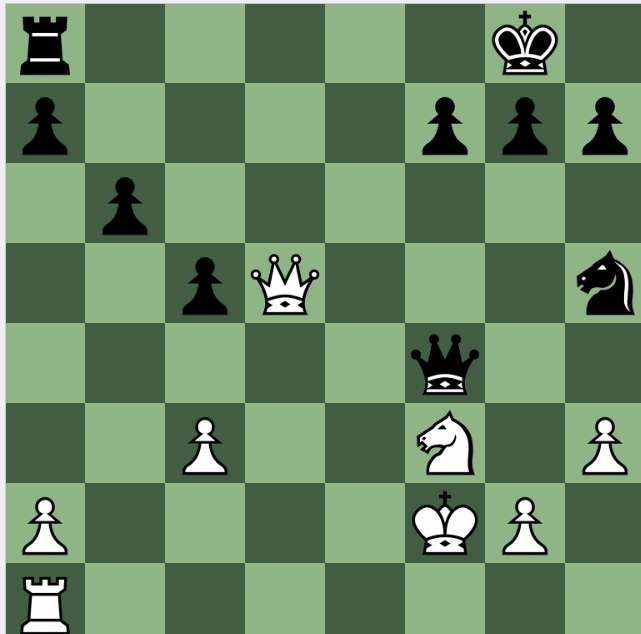
J Tsalicolgou v T Gannholm 1975
Solution
Again, not too hard today. 1..Qg3+ 2 Kf1 Qg2+! and if 3 Kg2 Nf4+ and wins the queen, so the simplification is to a winning rook and knight ending with three healthy extra pawns. So 3 Ke1 and 3…Re8+ and black dominates.
So, after 1…Qg3+ instead white must move his king to the e3 (not 2 Ke1 Nf4+ again) then 2…Re1+ and similar play. White doesn't survive: the N comes into f4, and black has three well placed attackers. In some lines. The LPDO Qd5 is important, for instance when the Black Q is on g2, the Nf3 is pinned.
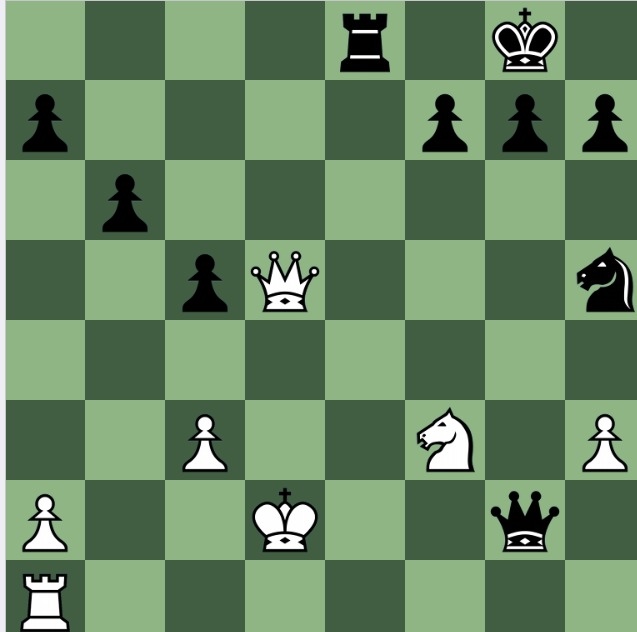
If here Kc1, Re1+ wins since the N is pinned, so the LPDO Q drops off.
 Posted with Blogsy
White to play and win
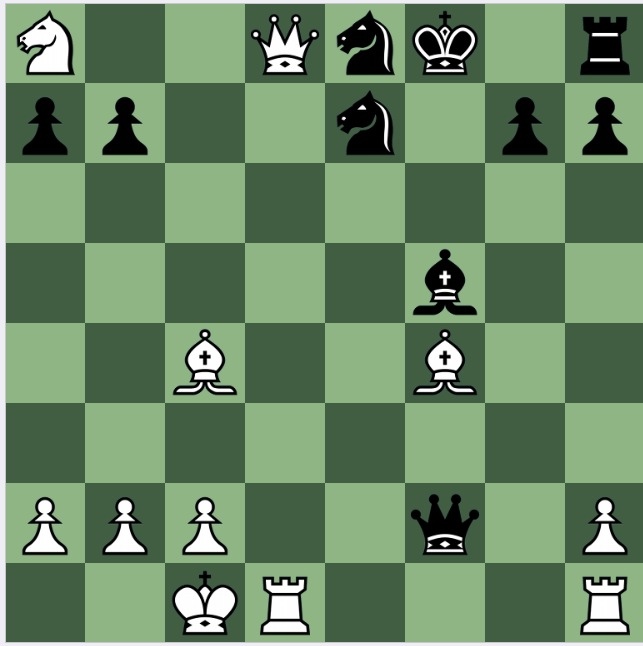
JC Archer v EC Hooper 1931
Solution
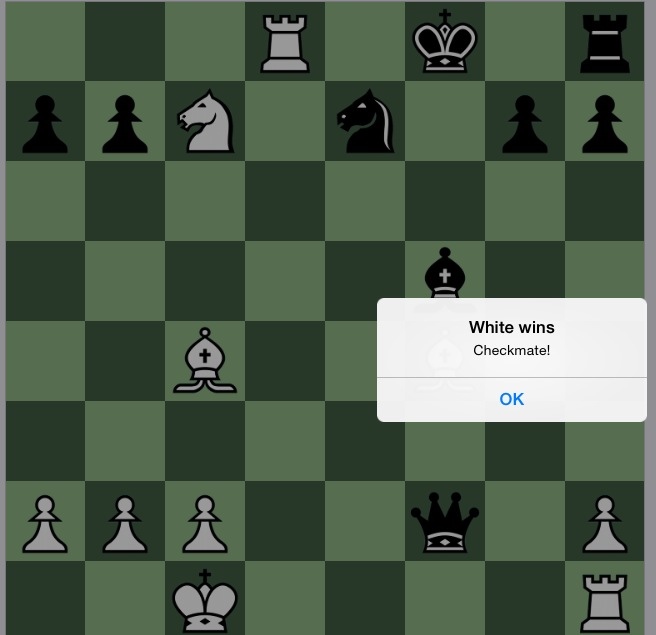
A rest day today, after a week or so of good daily puzzles. 1 Qe8+! Ke8[] 2 Nc7+ Kf8[] 3 Rd8 mate is a single track line.
Today is a rest day in the Tromsø Olympiad after yesterday's fifth round. England is in the bunch of teams around where our players' rating would suggest, but it is early days yet, and a lot will change as the event continues.
Mickey Adams is on fine form, with +2 from his three games, all against +2700 players. I loved his classic Mickey play against Alexei Shirov but yesterday's combination against Quang Liem Le of Vietnam was a classic.
We were at the beach yesterday during the round, so I could only catch snippets. A Catalan, I thought it was heading to a draw when I first logged in.
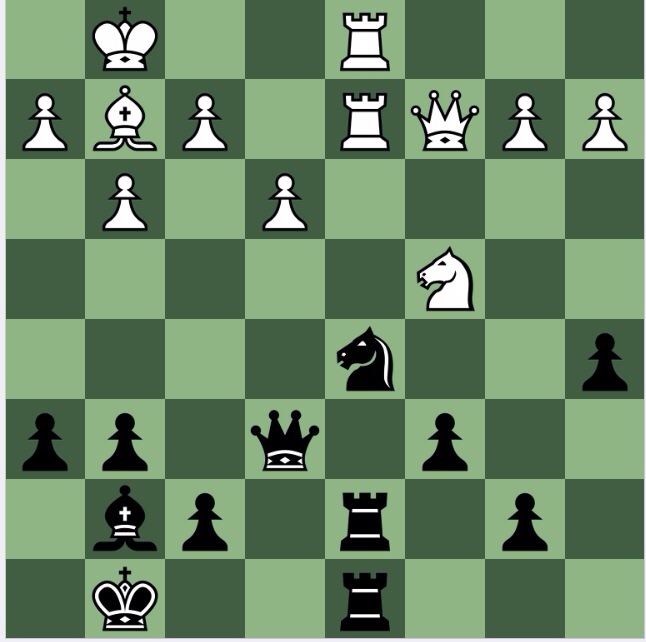
White to play: position after 23...Qd6-e6
Indeed, Stockfish tells me white has the better of a more or less level game here. I suspected the a pawns to come off, and a natural continuation is 24 Na5 Nb4 25 Rd7 Rd7 26 Qe2 Rd1+ 27 Qd1 Qa2 27 Nb7 Bb2 reaching this position:

White has some advantage, but not a winning one, even if the Pc6 falls.
However, Le didn't play this, instead choosing 24 Bd5. I assume white thought this would be pretty similar after 24…Rd5 25 Na5: the rooks come off, and the a, b and c pawns, and then white has the better of the position. However, Mickey played 24…cd !? which keeps the rooks on, and after 25 Na5 d4! he is down a pawn, but with compensation. (What I don't know is if in fact it is all still level, with white no option but to return the pawn).
After a few more moves, the following position was reached.

Position after 32...Rdc7
White has one or two ways to untangle, and several ways to make a mess of his position. 33 Qa5 is probably best, getting away from the unpleasant pin on the c file, and after 33…Qe7, the game goes on. White however played 33 Rc2?!.
At first, I thought Mickey's 32…Qe8 inspired, but on second glance Rdc2 has the effect of offering to exchange queens: so Qe8 is somewhat forced, or at least it is just a choice between Qe7 and Qe8, and e8 carries some tactical motifs. After 33 Rc4?? (33 Qe3[] and the game goes on, but black is better after 33..Qc6+! 34 Qf3 Rd4!)we reach the following position:
Black to play and win

33…b5! 34 Rb4 Rc5! 35 Qc5[]
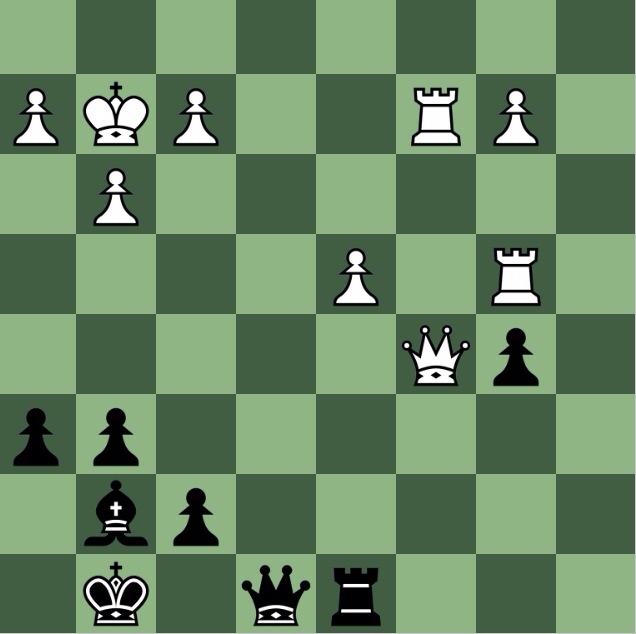
Bf8! 36 Qb5 Qe2+! and black is winning.

Mickey obviously saw- I suspect instantly- the geometry of the chess board. Not only were there pins on the c file, there was also a fork, with LPDO possibilities.

A lovely combination: how quickly a level position turned into 0-1.
White to play and win

C Wolpe v P Kunne 1985
Solution
The first moves are obvious: 1 Re4! has to be played, and if 1…fe, 2 Qe4+. Then it depends on where black moves his king to. First, if 1…Bd5, 2 ce fe[] 3 Qe4+ with essentially the same problem: it is white's c3 bishop which matters most. I will take 1..fe as the main line.
Then 2 Qe4+ and whether black plays 2…Kh8 or 2…Kg7 ( 2…Kg8?? 3 Qg6+ drops the bishop) white plays 3 Rf6! with decisive entry.

If instead black plays 1…Bd5 then after 2 cd the game can either proceed the same way: the rook enters, and h6 drops off, or, white has a new line: exchange rooks on f8 and (after Rf8 Rf8) play Bb4, and simplify into a own queen and pawn ending, with two extra passed central pawns.

The Bb4 line was shown to me by Stockfish: I just played on the king side, not the whole board. It puzzled me why after Rf8 it strongly preferred Rdf8 to Qe7f8: the reason turns out to be that from e7, the queen looks along the seventh rank, and so can if necessary play Qh7, stopping Qg6+ and Qh8+ depending on the line played. From f8, the queen csn't stop a white queen entry.

I am writing this blog in the café at Nuri beach, Limangazi, Kas, having just had lunch.

The salt cellar interested me, in that the salt had yellow bits in it, which the waiter confirmed to be piliç, rice.
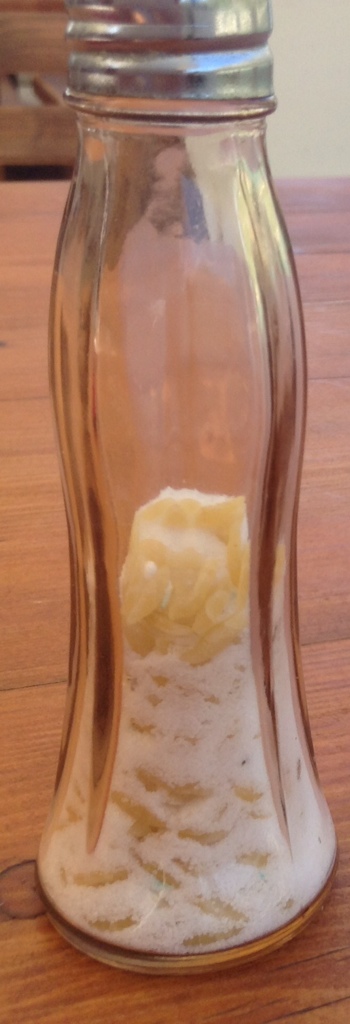
The salt poured perfectly, the rice grains being too large for the cellar's holes. Clearly, rice is being used as a desiccant stopping the salt from drying up. Clever.
Googling, I found lots of references to using rice as a rescue for when phones or tablet are dropped in or have water spilt over them. Same principle.
You live and learn.
Below is a nice puzzle, nice being defined if you like maths or logic puzzles, like readers of my blog know that I do. And my family, to their expense, know that I do.
Suppose a man sets out to climb a mountain at sunrise, arriving at the top at sunset. He sleeps at the top and descends the following day, also from sunrise, travelling more quickly downhill. Prove that there's a point on the path that he will pass at the same time on both days.
I gave this problem to my (long suffering) daughter #2 and (even longer suffering) wife during a recent hike up the wonderful Walla Crag, a walk from Keswick into Borrowdale, near our home in Rosthwaite.

View over Borrowdale from Walla Crag
After the initial usual (I) moan (II) clarification/ recalibration of the question, and after some thought my wife said 'course not', and when I said there was, a brief discussion ensured (basically, said wife saying 'rubbish') until daughter #2 agreed to listen to the explanation. And then once explained, one final exchange (said wife saying 'no more puzzles today‘) and on with our walk.
I solved the puzzle in two ways, but there is a third, pretty way which is the solution given in the book where I found it, Futliity Closet by Greg Ross. My son gave me the book last Christmas and it has been a joy to read. As the hyperlink shows, it stems from a website whose webmaster turned some of his best contributions into a book published at the start of 2014, and my son guessed that I would like it: I do, it is a perfect last thing at night read, short snippets, some funny, some quirky, some history, some maths, some word plays…all the that I like.

Solution
Newton's Laws of Motion approach
Having tried to solve it intuitively, and failed, I first used algebra. Remembering 'v equals u plus a t' and the other equations of motion, I realised the way to solve this puzzle was 's equals u t plus half a t squared'.
Here, the acceleration is nil, so the equation simplifies considerably to s equal u t. If you assume Walla Crag has a height of h, then the height at time, the meeting point m, is m=ut, with u being the upward speed. On the way down, with speed d, the height at time t is also m, where m= h-dt.
So, if there is a meeting point, the equations are solvable, so that ut=h-dt. A simple rearrangement shows that the meeting time t= h/(u+d) which says that the meeting time is dependent on the sum of the up and down speeds. This led me on to my next solution, discussed below.
Substituting for t in the initial s=ut equation gives the final result that the meeting point m=h * u/(u+d). Again, this solution is revealing. The faster the upward speed, the higher up the mountain where the meeting point is, which in hindsight is obvious; and the faster the downward speed, the lower down; and finally the taller the mountain, the higher up the meeting point. All sensible, once you think about it.
Rationalisation
Armed with the solution, and there was no point in trying Newton's laws on either GCSE-result-expectant daughter or wife, I found this way to explain it.
Imagine a zip wire was installed, taking climbers instantly down from the summit to the starting point. Then at sunrise the next day, the descender would be at the starting point. When the response was that zip wires aren't instantaneous, I almost gave up, but persevered. Is is not easy being a mathematician.
Or, imagine that the fell walker died at the summit (perhaps his wife murdered him for asking too many maths questions) then the two walkers meet at the summit (speed of descent is zero, d standing for death).
So, at the two extremes of speed, there is a meeting point. From this the inference can be drawn that there is always a meeting point, the place depending on the ratio of upwards and downwards speed: descend twice as fast, meet 1/3 the way up, for instance.
Extending the logic, it can now be seen that the simplification of assuming no acceleration was unnecessary: the walkers still meet if there are sandwich and catching breath breaks.
Logical solution
The book has a prettier solution.
Imagine rather than there being one walker, there are two twins, Flora and Iona (twins we know). Iona walks up the hill whilst Flora sets off from the summit at the same moment, same day. Clearly they must meet somewhere: twins reunited.
Of course, my wife would say 'they might descend by different routes' and, by doing so, she would, as ever, win the argument. She also wins, of course, by just admiring the view.

View of Derwentwater and Bassenthwaite from Walla Crag
(The two pictures are from googling, not of our family; but when we last walked up Walla Crag, a couple of weeks ago, the weather was every bit as good).
White to play and win
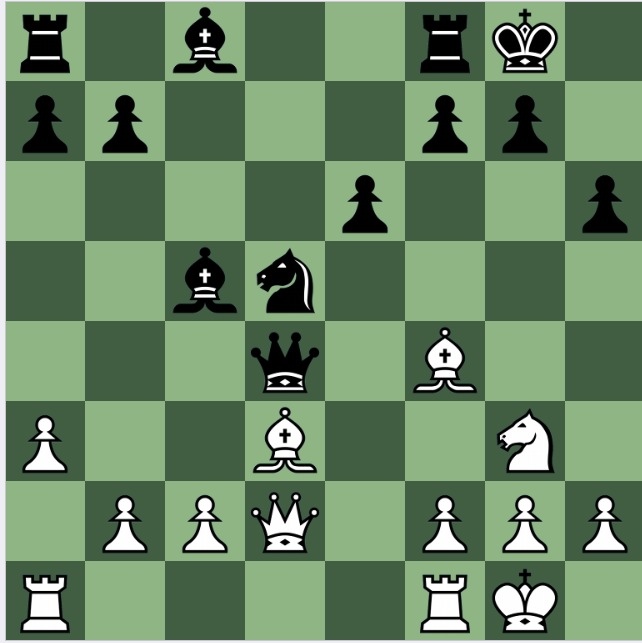
DA Walker v NJ de Jongh 1976
Solution
It took me a while to see this: I wouldn't have seen this in a game, unless I had been disciplined enough to be a Purdy player and remember:
Purdy on nets, pins and ties, Fine Art, vol 2, pg 205
Some things are hooey,
and most others lies;
But forks you mustn't miss,
nor pins, nets, ties
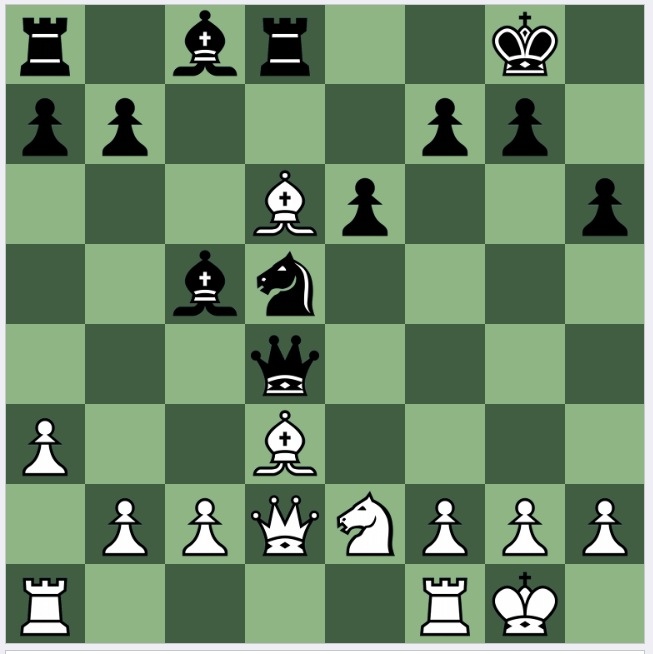
Here, the Bc5 is tied to the Qd4 because of the jump biff Qd2-d4 with the Bh7+ idea. So, examine all biffs and 1 Bd6! is a try. If 1…Rd8 2 Ne2 wins a piece (2 c3 does too, but at the cost of a pawn or two: 2…Nc3+). Black's best is to give up the exchange with 1…Bb6 or 1..Pb6 and fight on.
Chess fans like me look forward to various tournaments: the super tournaments, the London Chess Classic, World Championship matches and, in some ways greatest of all, the biennial Olympiads.

I haven't seen confirmed statistics yet, but understand that there are teams from around 180 countries present. One of the world's greatest sporting events, for sure.
I am on holiday in Turkey now, without PC, so my viewing is an iPad experience, and therefore somewhat limited, but now after four rounds, the tournament is in full flow.
Round 4, England 3-1 Latvia
Yesterday England had a great result, 3-1 vs Latvia, and all our three winners deserved full credit: Mickey Adams for a typical Mickey-style tour de force against Alexei Shirov ( in the early middle game, when the players avoided a Qd6/Qc5/Qd6 repetition, and when a few moves later Mickey got a stable passed a pawn and his type of position, I was willing him on to victory- the game was one where Alexei had no chance to put his fire on board); David Howell, who very quickly got a strong edge, and his conversion of the technical phase was excellent, and Matthew Sadler who I have the greatest admiration of, returning to top flight chess after a professional career, and showing great class in converting an advantageous position. And, alas, our sole loser, Nigel Short, put up magnificent resistance after a poor opening, but ultimately succumbing (he tweeted last night that he missed one sole drawing chance, late in the game).
 allanbeardsworth