Black to play and win
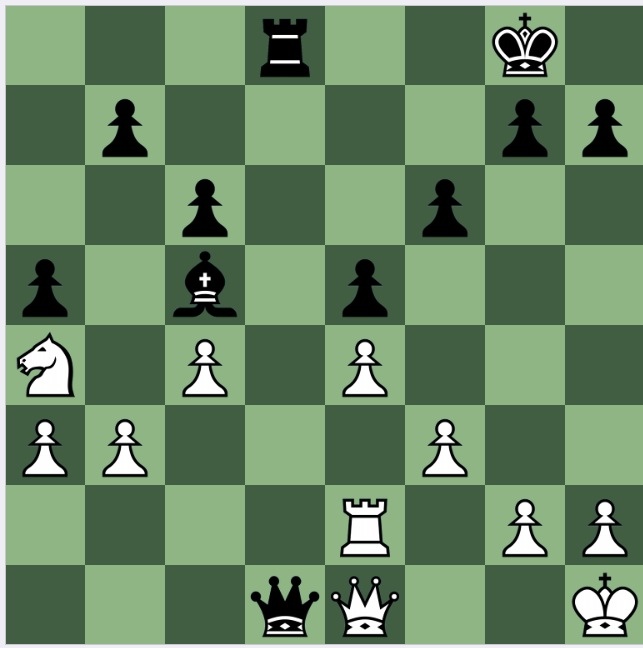
IM Peenz v PE van der Walt 1989
Solution
In the game, black played 1…Ba3 and eventually won, but knowing it is a problem with a solution, 1…Bf2! is not too hard to see: the Qe1 is pinned on the first rank, and the Re2 is tied to defending the Qe1, so white is lost.
 Posted with Blogsy
Black to play and win
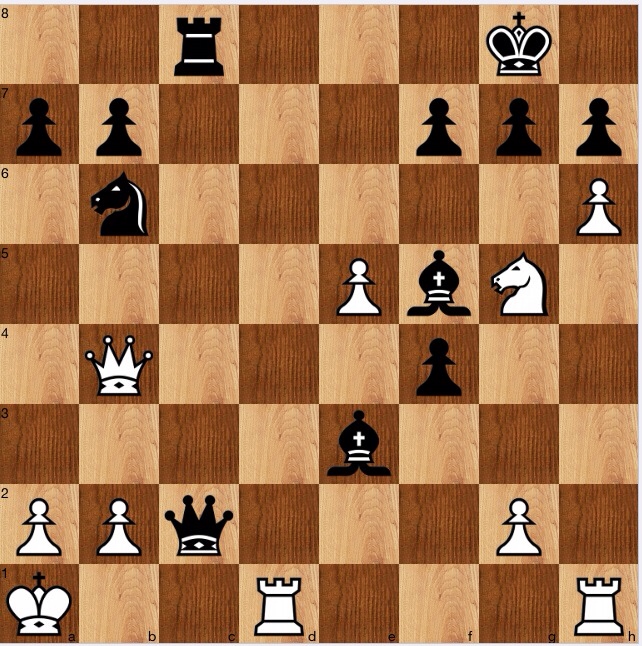
C Wolpe v M Henning 1984
Solution
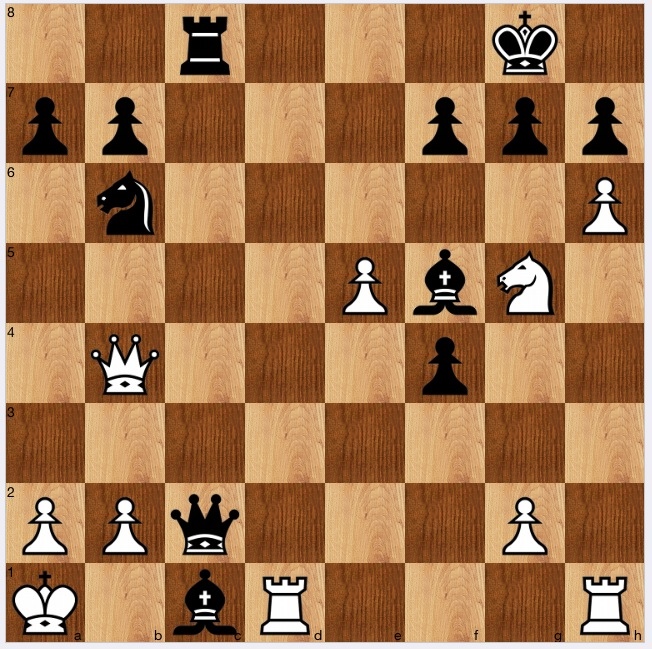
I think this is one of those problems that is easy if you see it, and not if you don't. 1…Bc1! came to my mind more or less instantly, once I saw that white had c1 twice covered, and also seeing the Bf5 Qc2 battery in b1.
Oddly, I can't think which of Purdy's mantras best suits here. Maybe the motif is to identify nets, and here the threat of back rank mate makes one look for ways to disrupt white's defence of c1 and b1.
White to play and win
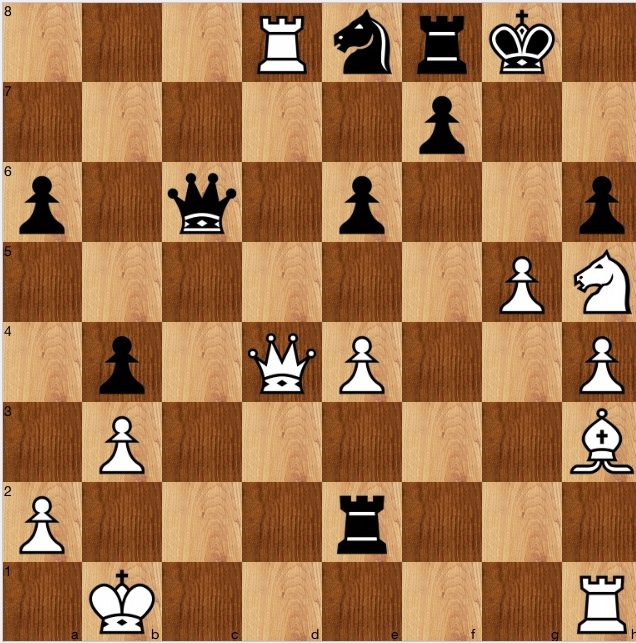
H Abrahams v P Pretorius 1988
Solution
For the second day running, fairly straightforward. Today's is harder than yesterday's, but if you examine all biffs the sacrifice 1 Qg7+! Is not too hard to see nor to evaluate. 1…Ng7[] 2 Nf6+ Kh8[] 3 Rf8 mate.
White to play and win
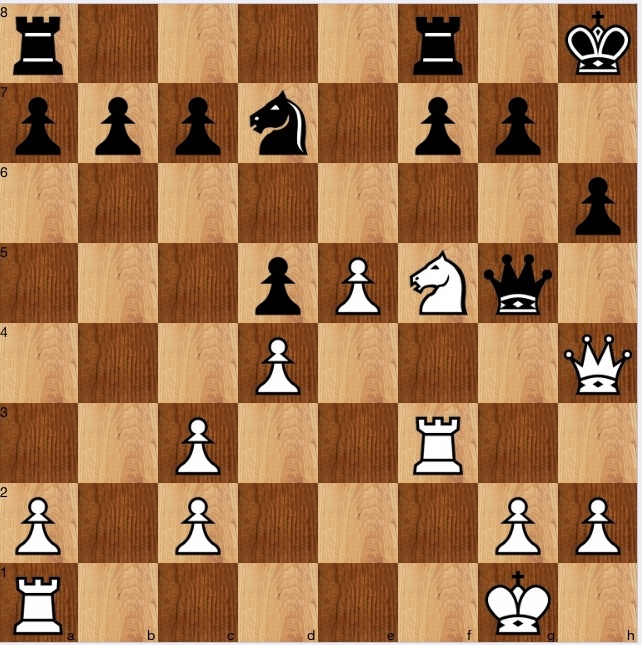
W Heidenfeld v WEA McBride 1947, position after Qg6-g5
Solution
Simplicity itself today: 1 Qg5 hg 2 Rh3+ Kg8[] 3 Ne7mate.
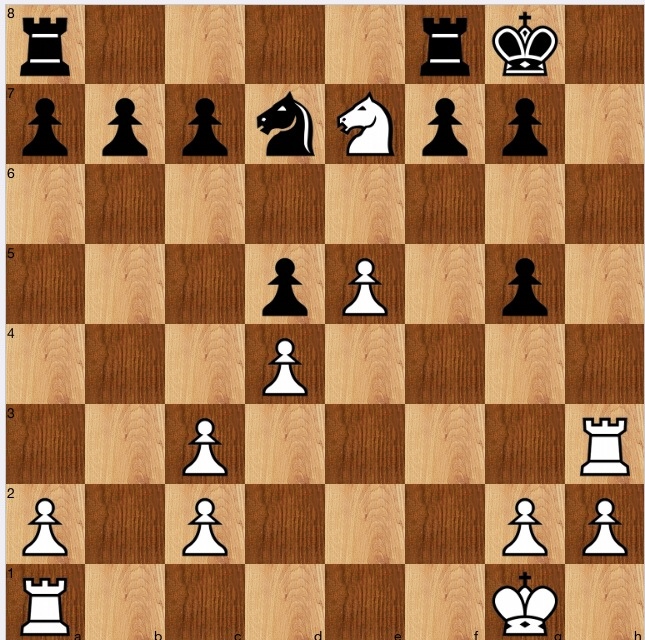
Black to play: 1…Kd8 or 1…Kf8?
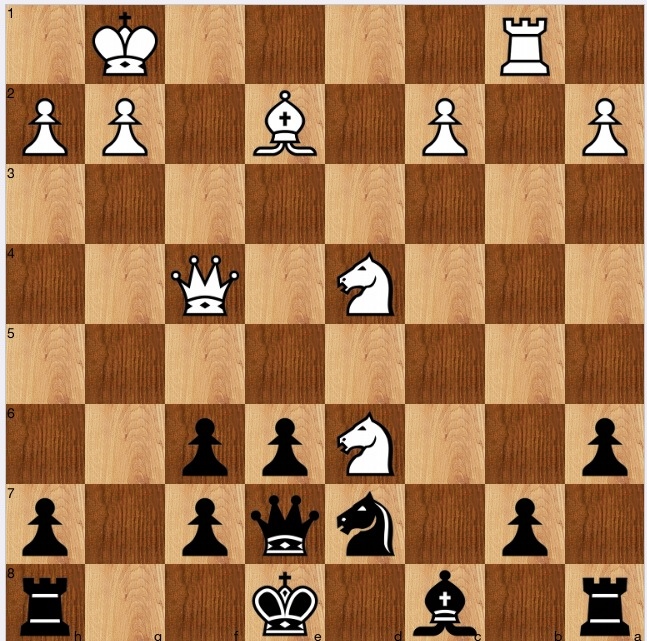
TJ Kett v MC Rubery 1984
Today's puzzle is, I think, especially good, and is worth taking time on. Intuition may or may not guide you correctly, and there are many lines to calculate. I thought I did a good job myself, but when writing this blog up with the aid of Stockfish, the engine had a surprise in store.
So, for readers with the available time, I would recommend:
I) making a decision as if in a game, analysing and deciding as best you can;
2) setting up the pieces and having a further look;
before reading on.
The easy question is: which opening was the game from?
Solution
Which opening?
Starting with the easy question, I would put good money on the opening having been the Poisoned Pawn variation of the 6Bg5 Sicilian Najdorf. I don't know for sure, but from the few Mark Rubery games on chessgames.com he is or was a Najdorf player; none of the games on that site were 6Bg5, but the hallmarks are still there.
White to play and win
PJ Foley v D Orbach 1985
Solution
A rest day today: 1 Qe8+ and 1…Be8[] 2 Rd8 mate. Nothing more to say: Purdy's examine all biffs and examine all jump biffs would help, if the solution weren't obvious on inspection.
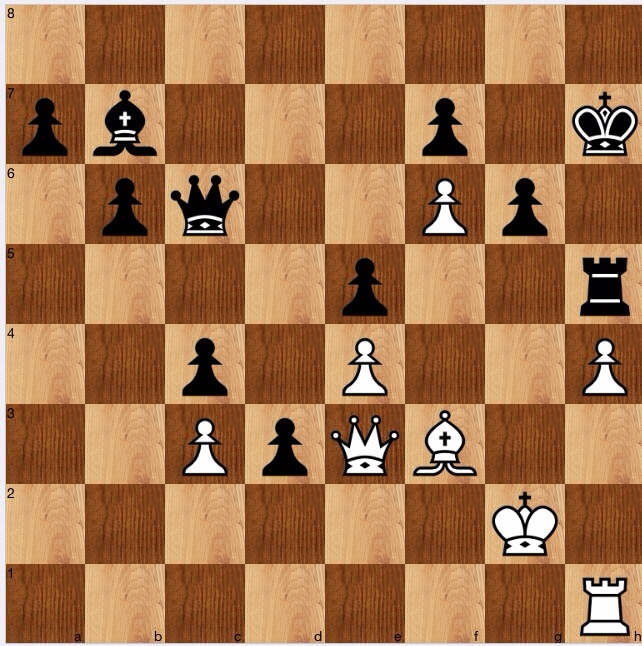
Black to play and win
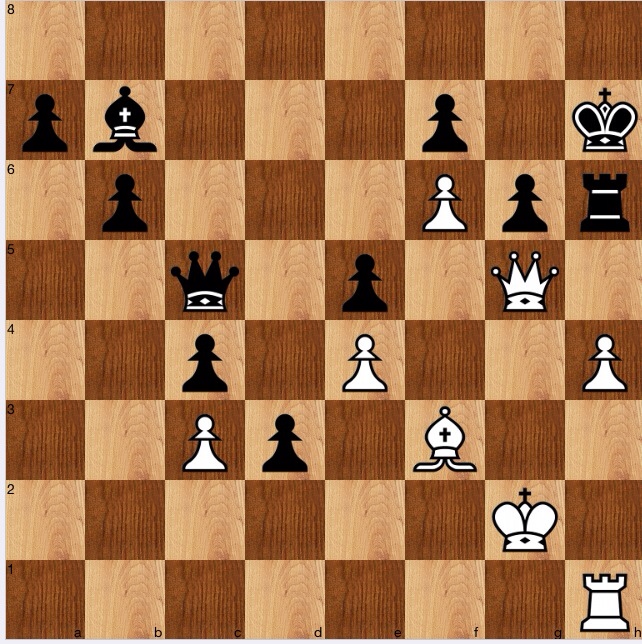
M Kolnik v M Bleiden 1949
Solution
Black looks in a bit of a mess, with the threat of h5; however, he has his pluses, mainly the a8-h1 diagonal- the white king is potentially open, and the Rh1 sits behind the Kg2.
So, 1…Rh5! (examine all biffs) 2 Qd2 Rf5! exploits the pin, and if the rook isn't taken, it can improve itself to f4, from where the pressure on e4 is overbearing.
When I looked at the solution, I was disappointed with myself, since I had missed white's best defence: 2 Qc1, defending the Rh1, so that 2…Rf5? doesn't work, though Stockfish says it is even then more or less equal- black's dominant central pawns compensate for the material. However, after 2 Qc1 Qc6! 3 Qe3! Qf6 is surprisingly strong for black: if the Rh5 is captured, black's pawns and pressure on e4 are too much for white.
Yesterday was my second birthday : will fifty second actually, but the joy I got from an hour or so yesterday was like the joy of a small child's birthday.
Siegbert Tarrasch, one of the strongest chess players in the late nineteenth century, said:
Chess, like love, like music, has the power to make men happy.
It certainly made me happy yesterday, since my birthday coincided with the Deloitte North West office's annual family fun day held at Lymm Rugby Club. It is one of the best things we do, or at least in my view it is, since it shows partners and colleagues as what we are: and what can be nicer than to meet colleagues' children and other halves, and for them to meet people their spouses and partners work with?
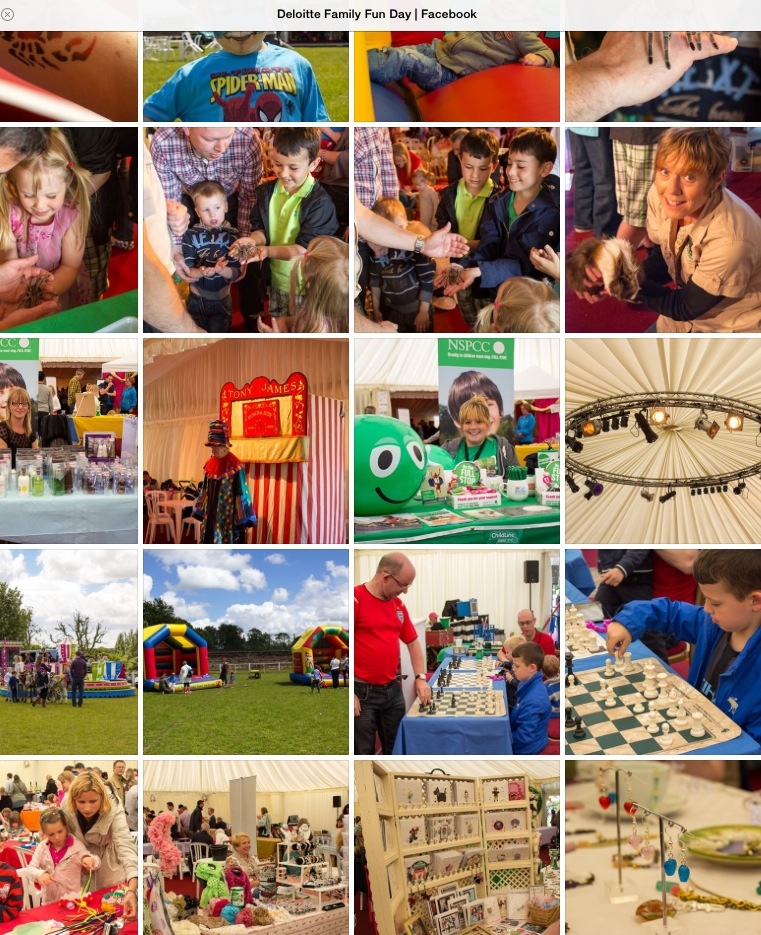
Picture from 2013 family fun day
As well as my work principles, which have stood me in good stead all these years since being a partner, in chess I live by FIDE's underlying motto, gens una sumus, we are all one people. (It can mean many things, but to me is all about sharing my love of chess, and the friendships I have gained over forty years in chess…including some I have had for forty years). (Pity that FIDE, like other international sports bodies such as FIFA, appears to be rife with corruption).
I have been lucky enough to meet and get to know many of the world's top players; but just as lucky to share my interest in chess with local players, and with beginners and children. Last year I gave a morning assembly talk to my children's primary school, about my life in chess/working hard at your sport or hobby, which was a real pleasure (though an ordeal in its preparation…how do you talk to a primary school assembly??). Yesterday, as I have done for the last many years, I played all comers at chess. (My record remains + several hundreds, = 0, -1, and the one loss still hurts, despite it being a him 5 min, me 2 min, game against one of my Deloitte partners (I won't cite his name, though he didn't forget to mention his victory at the following partners' meeting, omitting the 5-2 handicap and the fact that I was playing two other games simultaneously: as the reader might be able to tell, losses hurt in chess).
Anyway, yesterday's was great, partly because I made a point of inflicting several heavy defeats to get my revenge on said partner, partly because despite the brilliant weather which kept most people outside the marquee, there was yet again more or less non stop challenges, but mainly due to Annie (not her real name) the ten year old daughter of one of my colleagues. Annie made my day.
Shy at first, she stood by watching me playing some other games, until I noticed her, and asked if she wanted a game, so as soon as there was an empty board, I invited her to take a seat, we shook hands (shaking hands before and after every game is an essential part of chess…even when I lost my above mentioned game: it is never personal, gens una sumus).
I could quickly tell Annie was different, being so thoughtful and studious. So after we had played a few games, and having spoken to her mum, I spent an hour or so giving her a lesson, whilst also playing others; and at times, one or two others listened into the lesson.

(Alas, isn't it a shame that there is a need to be careful with images of children)i
I gave Annie various tasks, such as seeing how she approached/whether she could beat with R+K v K, Q+Kv K, PPP+Kv K, to gauge her level, and see how she thought, and used the insight to give her other tasks. The above diagram was from RR+K v K, in which , alas, Annie stalemated me. Her look of bewilderment, wonderment, amazement was the moment of my birthday . She had never seen stalemate before; she had read about it, but never seen it, and the picture shows Annie working out why the position was stalemate and what went wrong.
And this morning, I got this email (extract) from her mum:

I got some nice cards and presents yesterday, and Jane, Sophie and I went our for a lovely dinner with one of our closest friends, but teaching Annie, and her mum's note, were my best presents.
Black to play and win
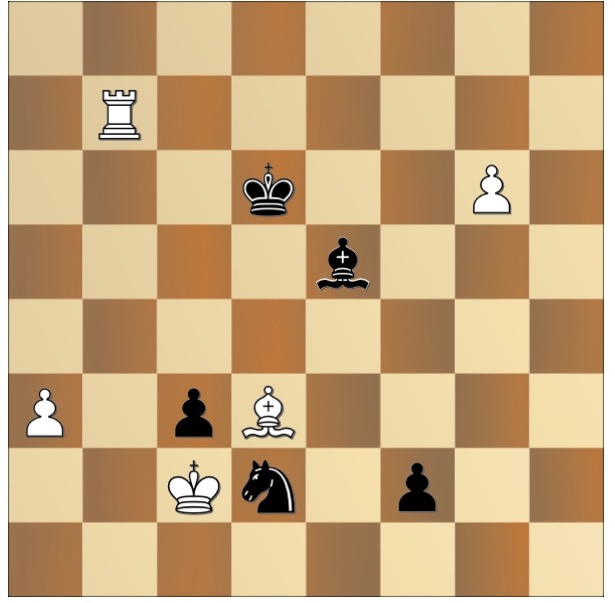
Szabo, Laszlo v Kholmov, Ratmir; 1967 October Revolution USSR Chess Championship, Kharkov, 12/67
Solution
The position looks dire for black, with seemingly no way to promote the f pawn, and the likelihood of having to exchange one of the minor pieces for the g pawn.
Having first tried and failed to find a way to distract the Bd3 from the a6-f1 diagonal- for instance, 1…Ne4 fails simply to 2 g7 Nf6 3 Rf7 Ng8 4 Rf8- I knew it had to be some knight trickery, and before too long found 1…Ne3! threatening Ne1+ forking K and B, and, moreover, winning the B. It took a moment or two to see how strong Nf3 actually was.
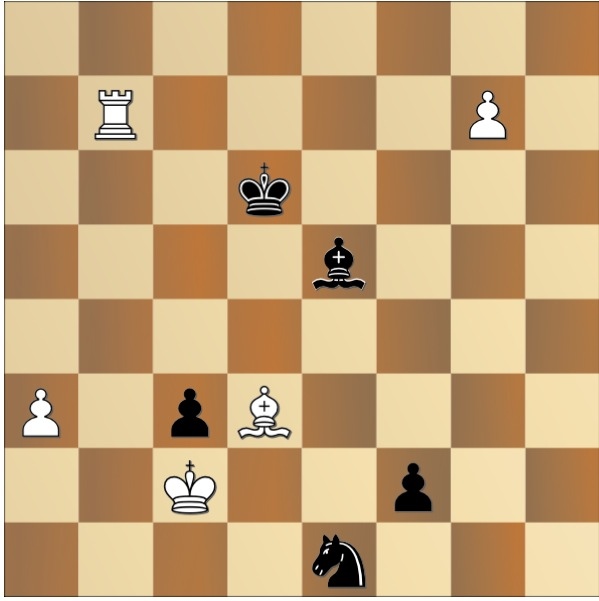
The move has the second point that from e3 it enables c2: so, 1…Nf3 2 Bf1 Ne1+! 3 Kd1 (say) c2+ 4 Kc1 Bf4+ 0-1: black's pieces coordinate superbly.
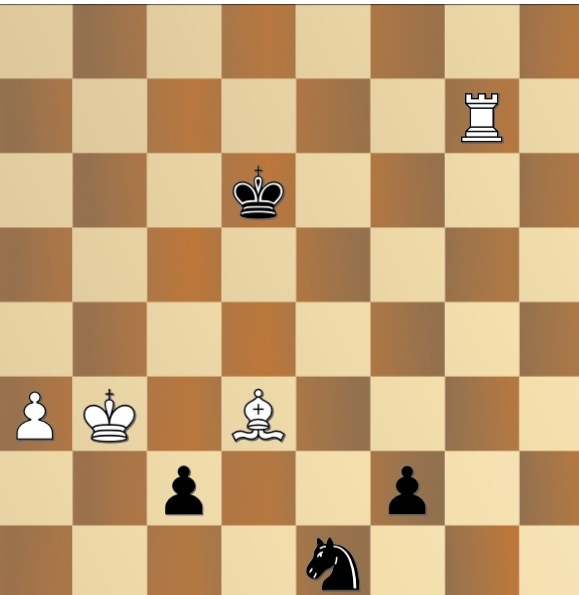
In the game, white played 2 g7, and the game ended 2..Ne1+ 3 Kd1 Bg7 4 Rg7 c2+! and one of the pawns queens.
White to play and win
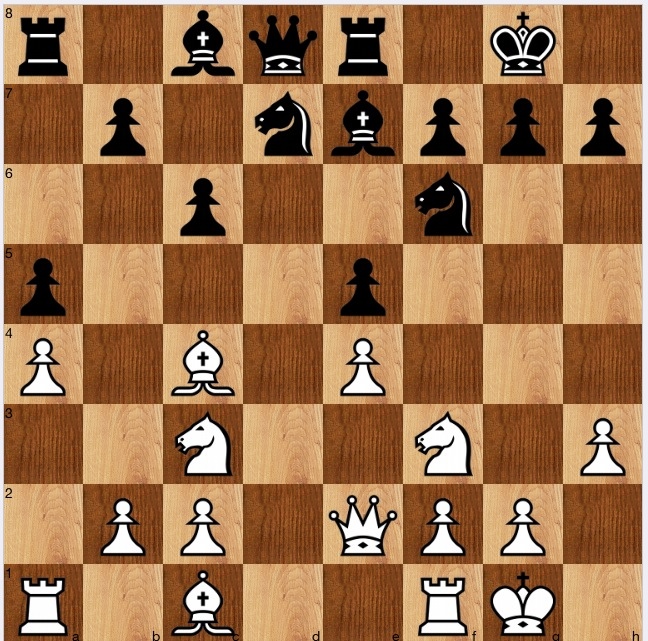
Allan Beardsworth (allanbeard) v Brutaldeluxe, ICC 3-0, 21/5/14
Solution
It is nice when you find crisp tactics in your own games: gives you hope that you are learning from the daily Reitstein exercises. Here, I was barely out of the opening, a Philidor, black having blundered with 10…de5.
1 Bf7+! and after 1…Kf7 2 Qc4+ black has the choice between 2…Kg6 3 Nh4 mate (a nice twist on a standard motif) or 2…Kf8 3 Ng5 when black's best is to lose the queen by 3…Nd5 4 Ne6+, but it is hopeless.
 allanbeardsworth