White to play and win
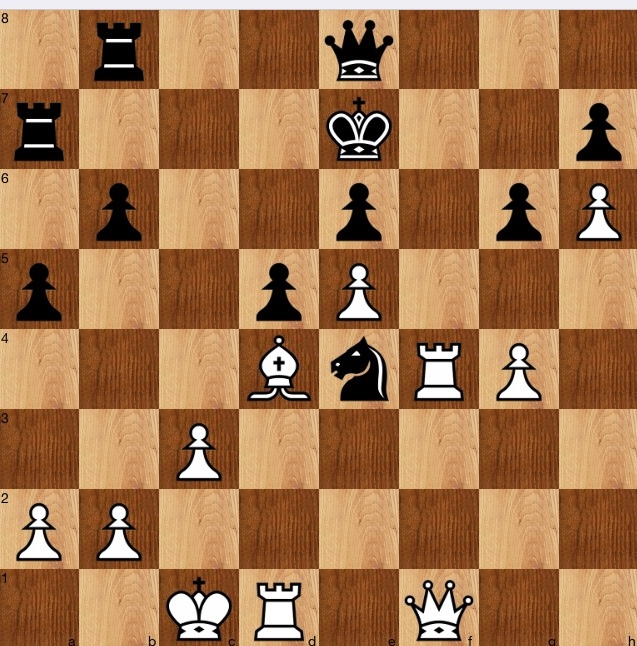
PE van der Walt v AA Ponelis 1990
Solution
Examine all biffs leads to looking at 1 Rf7+, 1…Rf8, 1 Bb6, 1 Bc5 and even 1 b4 and 1 c4; but 1 Re4! is the most obvious biff to explore, and is clearly strong, giving white the entry into f5 and also opening the d file after 1…de[]. So 2 Qf6+ Kd7[] 3 Bb6+ and 1-0. In fact, white has even better: 2 Bc5+! bc[] 3 Qf6 mate.
 Posted with Blogsy
Black to play and win
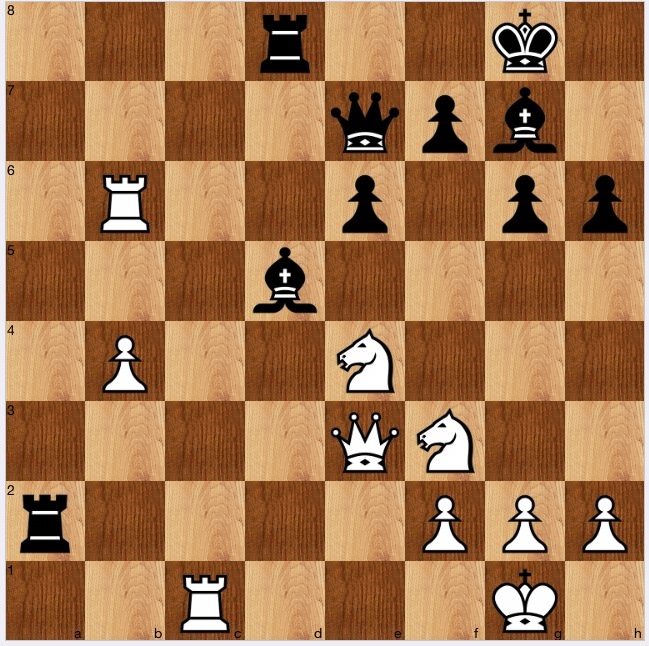
S Ernst v PH Nielsen 2005
Solution
I failed with this one, or at least didn't find the very best solution. I chose 1…Qa7! with the point being that once the rook moves, the queens are exchanged, and the Ne4 is then LPDO. However, I missed the defence 2 Rd6 (I shouldn't have, but was bamboozled by the difficulty of the position) when in fact black is still winning, 2…Rb8 3 Qa7 Ra7 and mops up, slowly. But in the game, black played the far stronger, similar idea, 1…Be4! when everything works: I had missed that from a7 the queen also looks at f2- so 2 Qe4[] Qa7! 3 Qc6 Ra1 and the queen is overloaded: it can't defend both rooks, and given that there is a back rank threat, the Rb6 drops off.
White to play and win

D Andreikin v S Sjugirov Moscow 2012
Solution
It is truly incredible how well the GMs can calculate. This puzzle was at the very limit of my abilities- too messy, too many things to juggle in my head.
Knowing it is a puzzle, and having first tried 1 Rg7+ and found if insufficient, 1 Bh6! is the natural next try; and after 1…Ne8 2 Bg7! Ng7 3 Rg7+ the following position is reached.

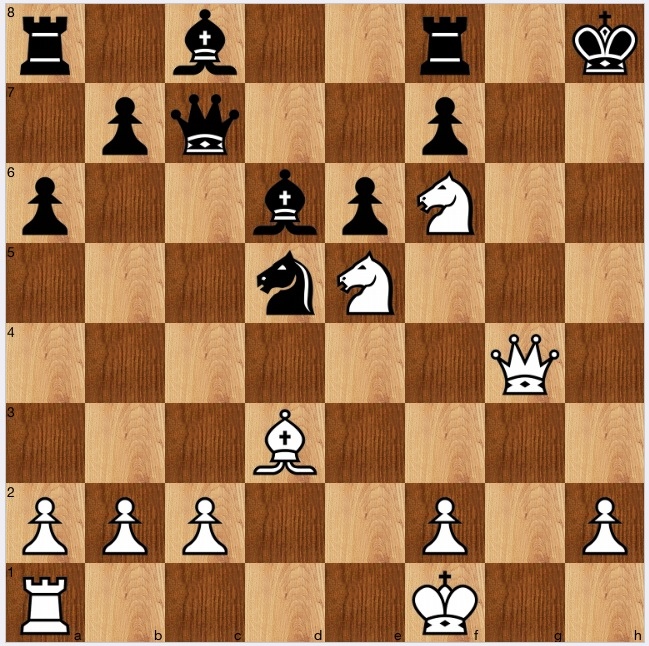
Black resigned here, and in my head I saw there was likely to be a 'staircase' or 'zigzag' mate, and once you can visualise the above position, it isn't too hard to find: after the Nf6 is captured, white checks Qh4+ Qg5+ and then captures, with check, the Nf6. Then he checks again and again bringing his Q to h6; and then he mates on h7.
Very nice.
Is it safe for white to play 1 Ra6 here?
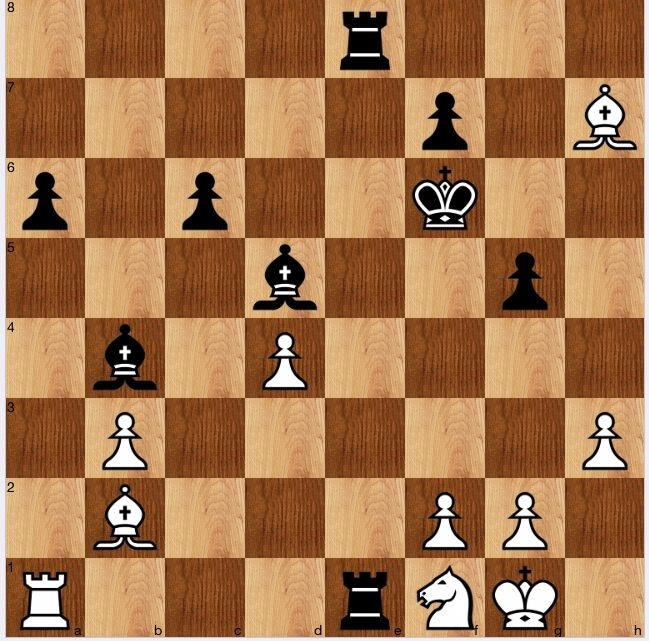
M Levy v B Shipley 1968
Solution
Clearly not, unless the puzzle compiler is tricking his reader. It doesn't take long to see (1 Ra6) 1…Rf1+ and if 2 Kf1, 2…Re1mate, and if not, white is not only even more material down, but in a mating net, with Bd6+ f4 Bf4+ g3 Rh1mate.
Thanks to John Saunders for pointing the incredible move in the position below out. In his Chessbase posting about the recent 4NCL weekend, he shows this variation from one of Gawain Jones' games.
White to play and win
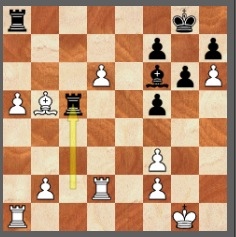
Try to find a beautiful finish. Worth setting the pieces out, pouring a glass of wine or your favourite tipple, and delving into the position.
Solution
John writes that his engine found 1 Ba6!! I actually think several more exclamation marks are needed, or maybe a mixture of !! and hearts, because the move is truly beautiful. He quite rightly doesn't give variations, instead writing 'I leave the reader to look in wonder upon on it'. Well done, John.
I have just had a lovely hour or so working through the position, gaining an understanding of it. Now that I do, I could make it into a really hard puzzle:
How many bishop moves in the above positon win?
Solution
The answer is, I think, four:
1 Ba6!!!! which is sheer beauty: its point is profound. The Ra8 is tied to the back rank, because of the mating possibilities caused by the Ph6.
1 Be8!!! which to me is slightly less aesthetically pleasing, since its point- to gain a tempo after 1…Re8 by 2 d7, biffing the R, with the pawn on d7 not actually threatening to queen, but more importantly controlling c8, so preventing Rc5-c8;
1 Bd7!! which is still pretty, its point being to stay on the a4-e8 diagonal, so that after the Pa5 and a pair of rooks come off (1…Rca5 2 Ra5 Ra5), white can play 3 Bc6! controlling a8, so the rook can't retreat.
1 Bf1, which is the move I would play ten times out of time, but is prosaic. Analysis shows that, with some care, white dominates, though when I first played the line, I messed up by order of moves (thinking white should be playing Rc8 to try to dominate the positon, but in fact he should control d7 with Bb5, and play for an additional threat with Re2).
The other bishop moves are weaker: Ba4 self pins after Rca5; Bc4?? loses a piece, Bd3? loses control over the d file and self pins (Rd5), whilst Be2? blocks the e file- a file which I would not have guessed was important in the initial position.
In some ways, the position is an example of the principle of two weaknesses: one being the threat to promote, the second being the threat to mate. My analysis is attached, as a game file generated by Chessbase12's one click publish feature.
Introduction
A year or two back, my younger daughter gave me a present, 'Dear Dad, from you to me' , one of those gift shop gifts which are very well intentionedy, but, alas, time is so short that they can often gather dust and never be completed. I decided a while ago that I wouldn't let this happen, and would aim to complete it for Sophie, Alice and Tom, so whenever they want to, they could find out a bit more about their Dad. So, I have set up a private blog, to which only family have access, and have been posting to it during our summer 2013 holidays and subsequently. Many of these postings are personal, and best kept private for the family only, but those which are less private will also be posted on my main blog.
Introduction
A year or two back, my younger daughter gave me a present, 'Dear Dad, from you to me' , one of those gift shop gifts which are very well intentionedy, but, alas, time is so short that they can often gather dust and never be completed. I decided a while ago that I wouldn't let this happen, and would aim to complete it for Sophie, Alice and Tom, so whenever they want to, they could find out a bit more about their Dad. So, I have set up a private blog, to which only family have access, and have been posting to it during our summer 2013 holidays and subsequently. Many of these postings are personal, and best kept private for the family only, but those which are less private will also be posted on my main blog.
White to play and win
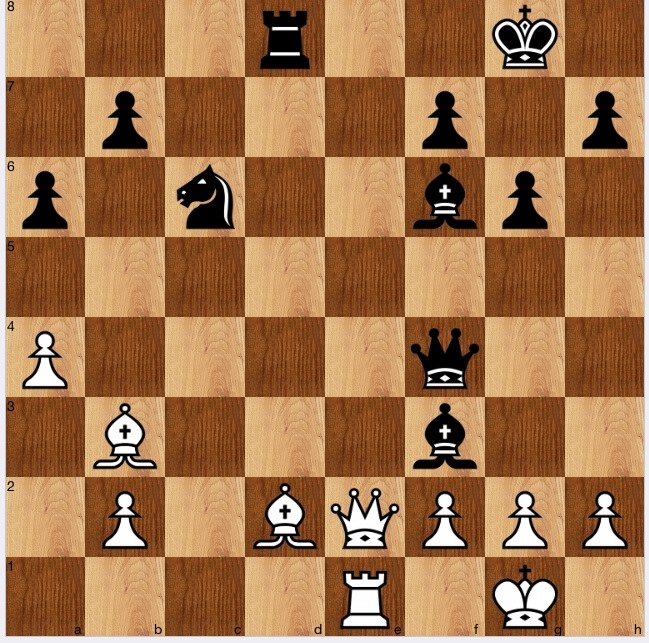
Today for a change, I also give the position as in Reitstein's book, together with his commentary.

Hangelbroek played 1 Bd2! here, setting a subtle trap into which Donnellty fell. After 1…Bf3 2 Bf4 Be2 3 Re2 Black had seen that 3…Nd4 would win for him. That is why he chose not to move his queen away after 1 Bd2. Why was 1…Bf3 a serious mistake?
P Hangelbroek v BP Donnelly 1967
Solution
One of the problems inherent in puzzle books is that the rubric can give clues. Here, it was obvious to me that there must be a surprise move, and 2 Qe8+! came immediately to mind: and it is not hard to see that it is decisive. In a game, the standard Purdy technique of considering all biffs would have shown it too.
White to play and win

H Liebeck v LR Reitstein 1949
Solution
Not too hard, knowing it is a puzzle with a solution: examine all biffs requires you to look at Rg6, noting that the Bc2 is is jump check away.
So, 1 Rg6 Kg6 and now either 2 Nd6+ or 2 Ng5+ win. I first found the former, so 2 Nd6+ Kh5[] 3 Qf3+ and if 3..Kg5, 4 Rg1+ etc, and if 3…Kh4, 4 Qg3+ Kh5 5 Bg6 is mate. 2 Ng5+ is similar.

2…Kh5[] 3 Qh3+ Kg5[] 4 Rg1+ and mate next move.
Slightly less clear unless you are an engine, is 1…Kh8. I played the move played in the game 2 Rh6+, which wins but black can shudder on with 2….Kg8. Stockfish, my iPad app, immediately suggests bringing more pieces to the party by 3 Rg1!! which turns out to be incredibly strong, often threatening 4 Qh6+!! which either mates if taken by Rh6, or if not adds a further piece on g7: very instructive how once again, bringing another piece in can be so strong.
To my wife's despair, I can barely remember important things like what I did last weekend, when we last saw particular friends, but I can recall useful things like tax cases and tax legislation, useless things like chess games and totally useless things like when I first came across the Monty Hall problem.
It was in Philadelphia science museum, in February or March 1993. In the maths hall. First alcove.
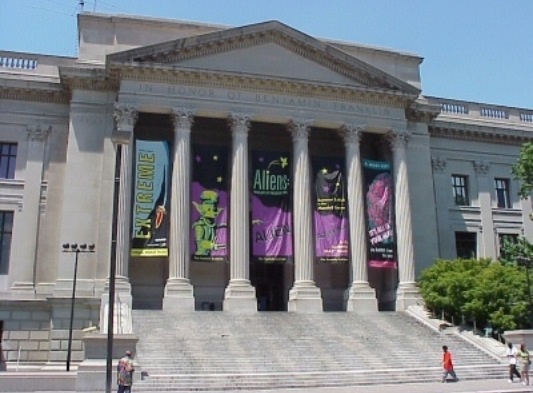
The problem is very well known in mathematics, and googling results in thousands of hits.
Imagine you are in a game show (the name comes from the compère of an American game show, Deal or No Deal). You are through to the final round, and are faced with three doors. Monty explains that behind two of them are goats, behind one a Chevrolet. You pick one. Monty opens one of the other two doors, revealing a goat. Now the problem: Monty gives you the option of sticking with your initial choice, or switching to the remaining door. What do you do: stick or switch?
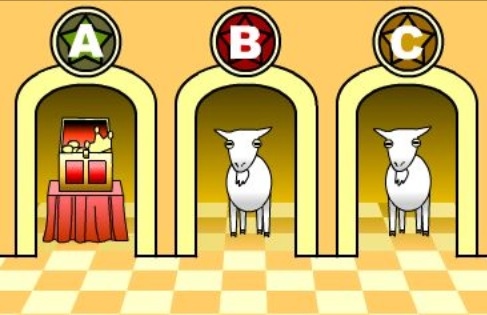
In the museum at Philadelphia, I thought 'it doesn't matter'. I then looked at the explanatory notice, and I was reading it, a teenager came up to the display, took a quick glance, took a quick glance at the answer, muttered 'obvious' and walked on, leaving me puzzled: the answer is that you should switch.
On the train back to NYC that night, I solved the problem , long hand, and indeed you should switch: you double your chances by doing so.
I have thought about this problem now and then over the last twenty one years, on occasion posing it to anyone who dares to be interested; and to Jane, who frankly dismisses it as nonsense. Last weekend I listened to one of my favourite podcasts, of Radio 4’s More or Less and in their latest edition, the Monty Hall problem was discussed.
My interest re-sparked I had a flash of brilliance (or not, we shall see) this weekend. Today I gave a lunch time talk and decided to steal the first few minutes to try the problem on the audience, asking everyone in the room to pair up, and try the problem on each other. I hoped to have empirical evidence that switching doubles your chances.
The results
In total, I got 36 unspoilt results (and 2 spoilt ones: I think the problem with talking to a group of accountants is that try to analyse a problem, rather than just doing it). The 36 good ones were:
Stuck and won: 7
Stuck and lost: 10
Switched, won: 7
Switched,lost: 12
In short, this test suggests switching makes no difference whatsoever. Now I know this is incorrect; I would have been delighted to have had a broadly 66:34 split; now I have no option but to extend the trial: if at first you don't succeed, try again; and try again and again until you get the answer you want.
 allanbeardsworth