The ‘No Logo’ Norway chess tournament in Stavanger has got off to a great start, with three good rounds so far. I am writing this whilst watching round 4, where the games have been in progress for about an hour, so early stages yet. The most interesting games look like being Topalov-Carlsen, where black has eaten a pawn (on a2) so I await to see if it is poisoned; and maybe Karjakin-Grischuk, a Gruenfeld; with Aronian-Svidler being another Gruenfeld where lots of pieces have come off in a well known line- I assume both players are still in their preparation.
Since it is early stages, I have time to blog and do other things.
Some people will really go to great lengths to try to prove that accountancy isn't boring. (I should say that I have had, and continue to have, a totally fulfilling career in this profession, with boredom never have been a problem in thirty years). In terms of lengths, two take the biscuit, one old, one new.
The present award winner for desperate measures to make accountants not boring is 'Mad Mike Hoare' who is a mercenary: his Wikipedia entry (see the link) is fun to read.
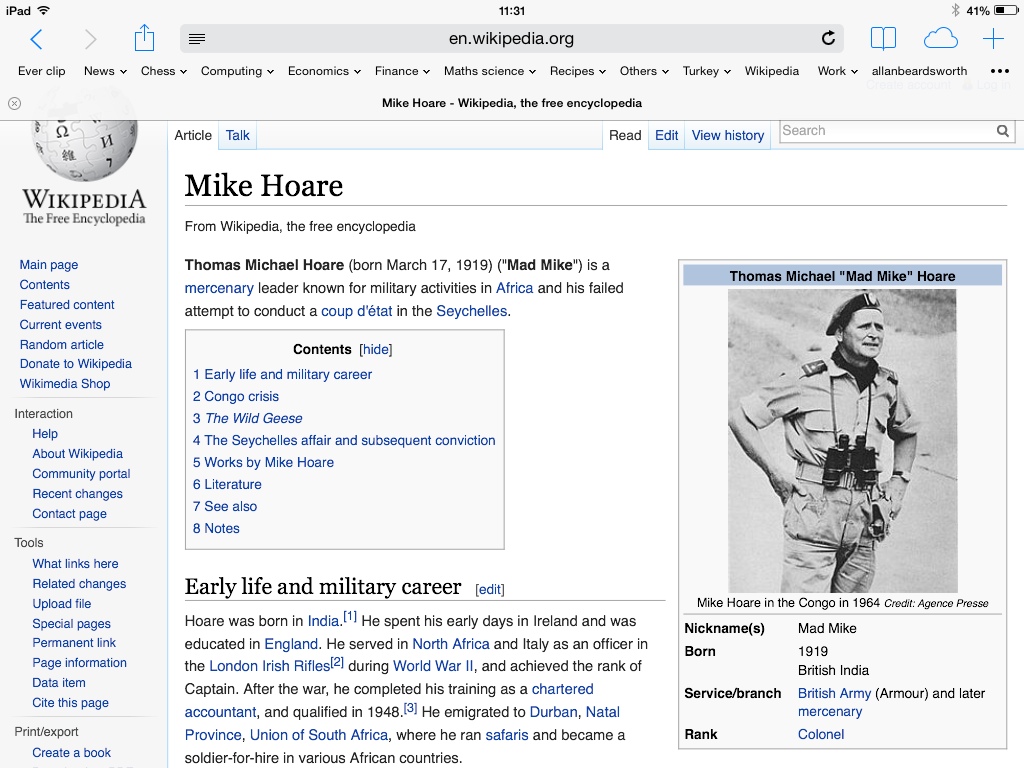
Throughout his military career he meticulously paid his Institute of Chartered Accountants in England and Wales dues, making it impossible for the ICAEW to exclude him, since he had done nothing wrong in terms of accountancy qualifications. When, though, he was imprisoned, the Council found sufficient cause to expel him for conduct unbecoming of an accountant. As my 19 year old daughter says, 'true dat'.
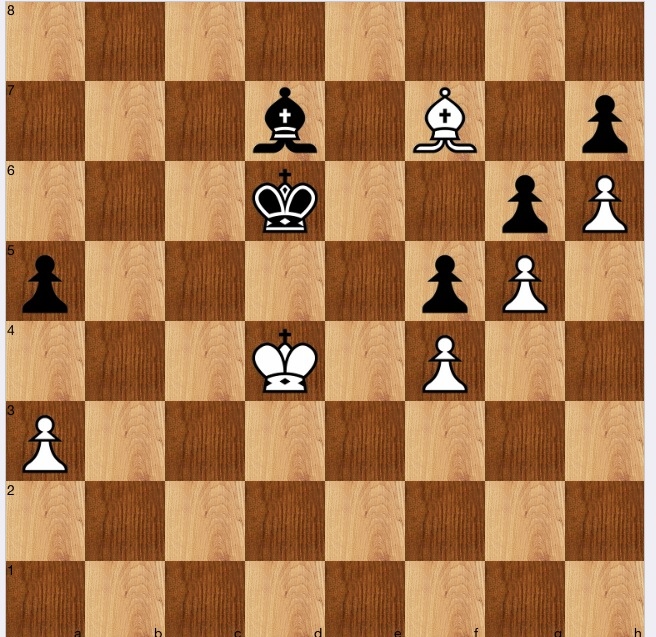
One of my regular readers, Ben Aoufa, has made an excellent comment on yesterday's puzzle. I thought 1 g5! was simply drawing, but Ben correctly points out a great attempt by black. It is insufficient, and the game is still a draw, but in practice as Ben says, it would be scary for white.
Black to play: what is his best defence?
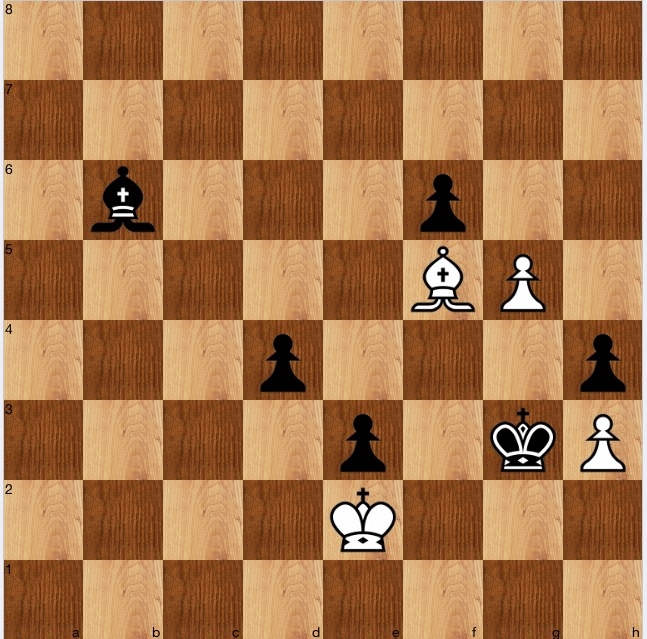
White has just played g5.
Solution
Ben suggests 1…Kf4! which is a great try. Firstly, moving the bishop somewhere is hopeless: 2…Kg5 and the active king and three central pawns will defeat white: white's king will be a bit like King Canute and despite what he and his bishop might think, the wave of pawns will come to shore.
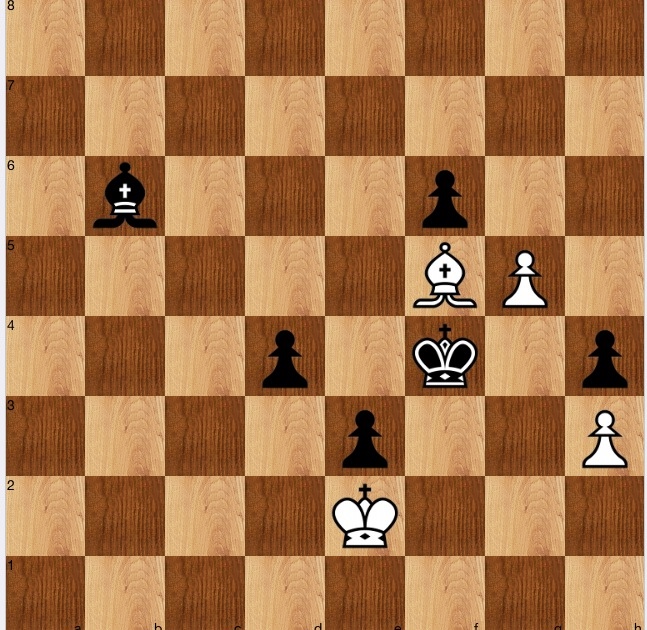
So, Ben's line is forced. 2 g6 Kf5 3 g7 Ke4
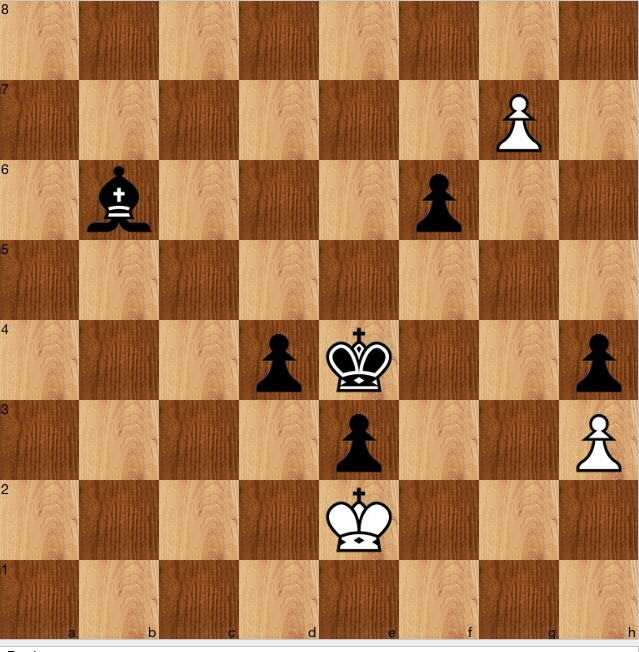
4 g8(Q) d3+ 5 Kf1[] (imagine what your nerves would be like now as white) e2+ (5…Kf3?? 6 Qg4#) 6 Kg2[] (again, who could remain calm?)
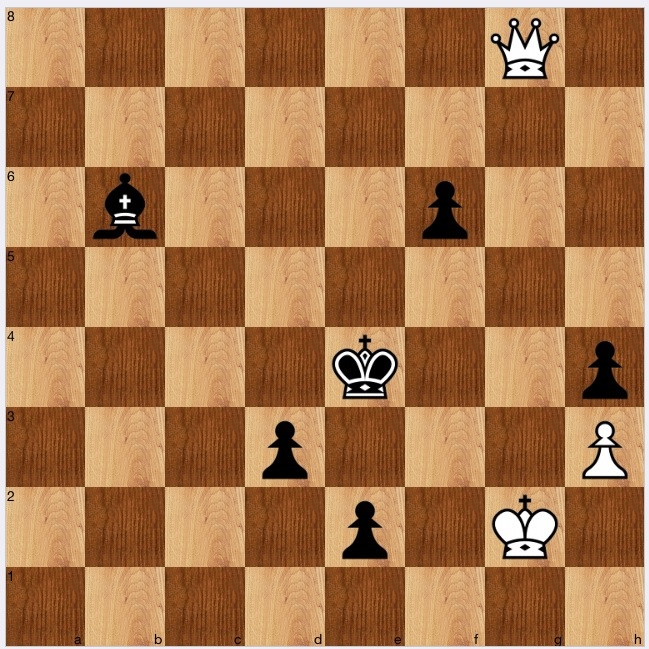
As white, I would be thankful for the skewer which prevents the e pawn from promoting ( 6…e1(Q)?? 7 Qe8+ 1-0; the skewer motif repeats). [I should add that 6..e1(N)+ is insufficient, but only because after 7 Kf1 black has two LPDOs, and as we all know, loose pieces drop off: 7…Ba5 8 Qa8+ forks the king and bishop! as does 7…Nf3 8 Qa6+]
So, 6…Ke3 7 Qe6+ and 'is there a perpetual?’
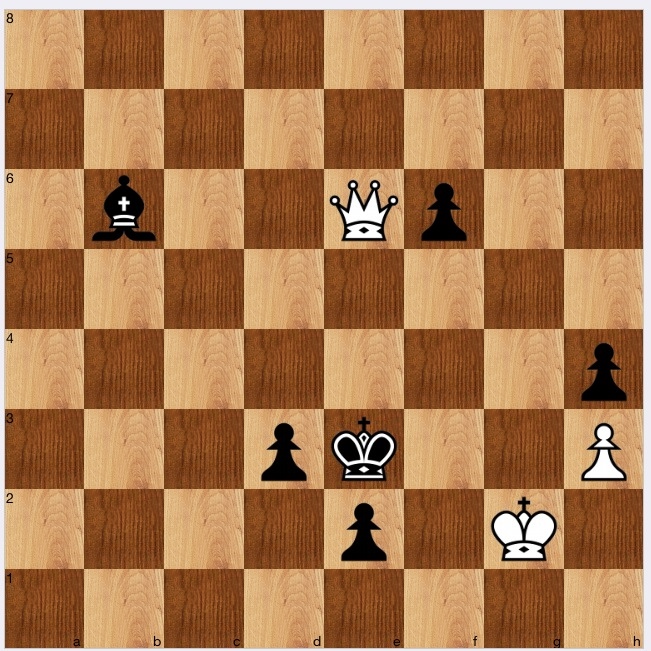
Fortunately, there is. Black's king has three tries: 7…Kd4?? which is hopeless after 8 Qb6+ and after n further checks, the advanced pawns will drop off; 7..Kf4?? is similarly hopeless, white takes the f6 pawn and then the bishop (8 Qf6+ Ke4 (8…Ke3 9 Qb6+) 9 Qb6! and if 9…e1(Q) then 10 Qe6+ skewers). So 7…Kd2[] is forced, 8 Qa2+ Ke3 and it is a draw.
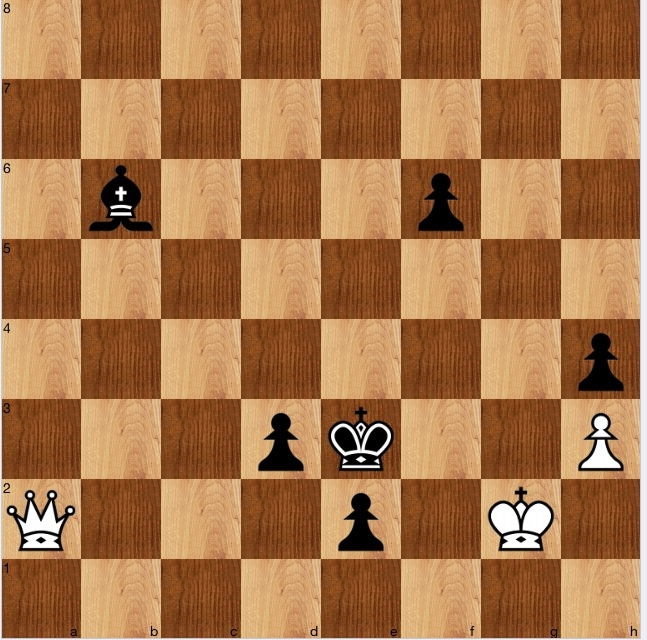
In the above 'final' position, I think I would play 9 Qe6+ 'without thought' and when black accepted the draw offer, I hope that we would be both relieved and friends having had a good tussle. However, when I loaded the game into Stockfish, in order to produce the screenshots for this blog, it suggests 9 Qa1!? which is sneaky.
It gives white the 'better of the draw' or 'draw honours' since black now has an only move to draw. 9…Kd2: which of course black would find, but black would first have the disappointment of seeing that 9…d2 loses to 10 Qc3+ picking off the pawns.
 Posted with Blogsy
Black to play and win
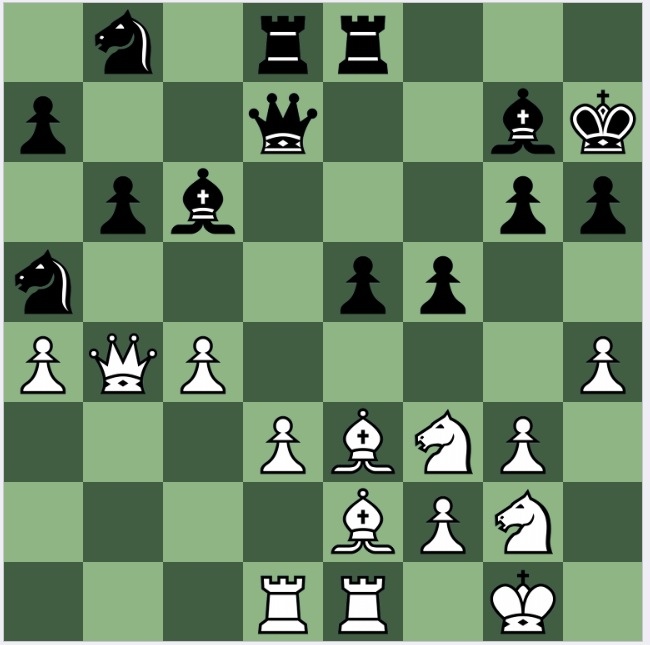
White has just played 1 Qd2*Pb4
T Buttress v M Levitt 1985
Solution
A nice puzzle. Had I been playing black in a game, I might not have noticed that there was a tactic on; though if I had been true to CJS Purdy and examined all biffs I would have: 1..Qb7! and black wins a piece, since if the Nf3 moves, the Ng2 is en prise.
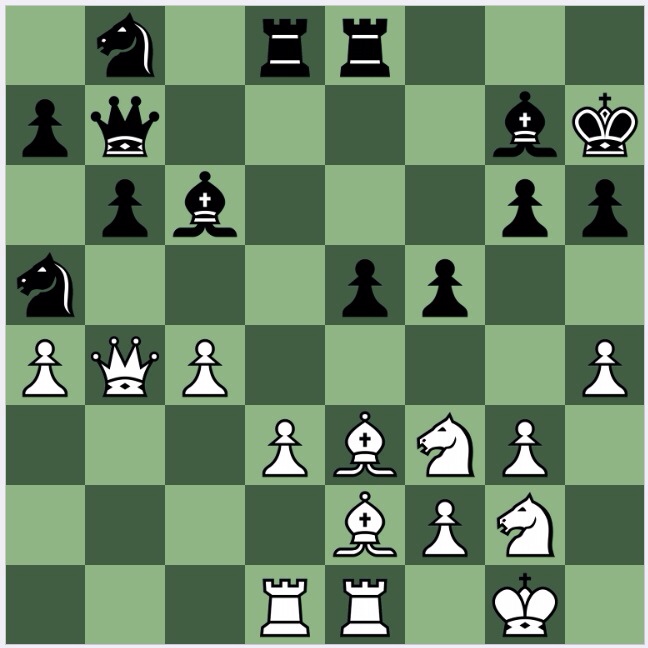
When checking the position with Stockfish, it tells me that 1…f4! is even better: if white takes 2 gf ef 3 Bf4, then 3…Qh3 is a ruinous entry, with the Nf3 pinned against the Ng2.
White to play and draw
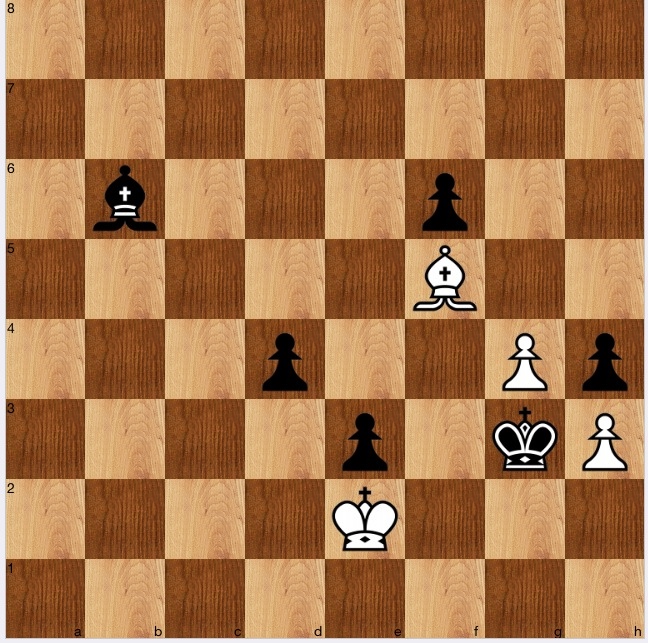
V Strugo v A van Rooyen 1988
Solution
Another trivial day: 1 g5, protects the h3 pawn, and it is a drawn opposite bishop ending.
White to play and win
(I found this difficult: before I give the solution, I also give below the 'hint' in the book in which I found this one, not that the hint made it any easier for me. But good to try first without the hint, and then if not solved, try again with the hint. It is worth spending a good amount of time, but not a great deal of time, on this one).
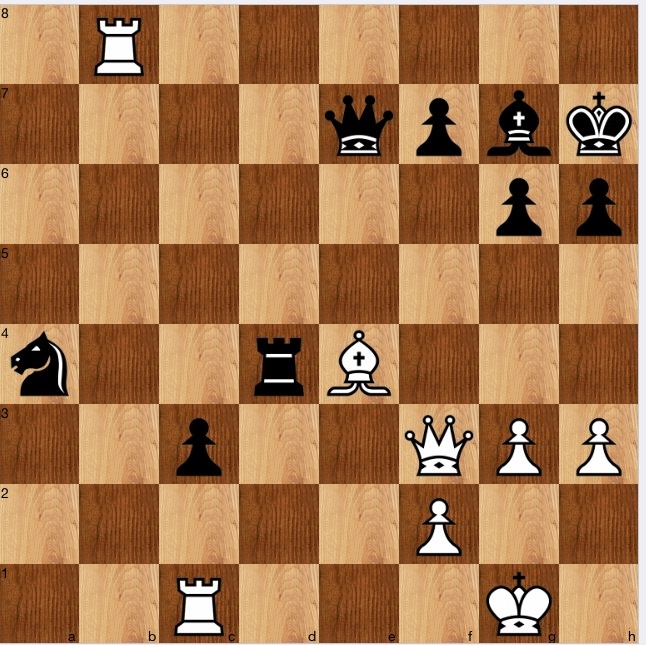
Viktor Korchnoi v Yuri Saharov, USSR championships, Kiev, 1964
Hint
The hint in the book in which I found this puzzle was as follows. 'Black's passed pawn on c3 seems to give him good chances, but he is destroyed by a steam of combinations'.
Solution
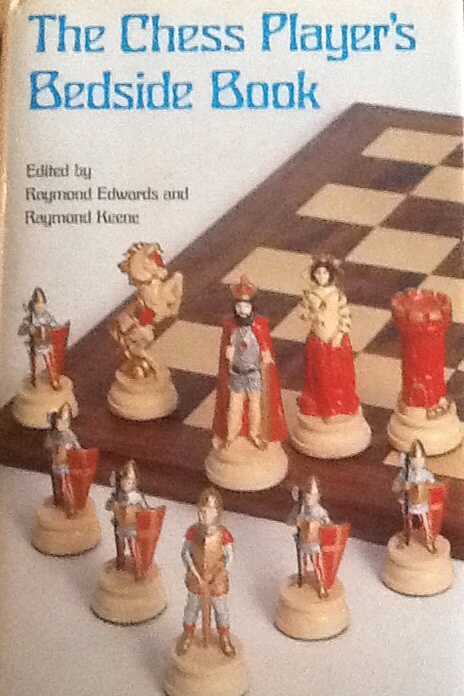
This was another puzzle in the chapter about Viktor Korchnoi in Raymond Edward's and Raymond Keene's 'The Chess Player's Bedside book', a lovely old book, a pot pourri of things for chess lovers.
I found this puzzle hard. In fact, the hint didn't help, and probably wasted my time, since it made me look for things that weren't there.
First of all, I tried various biffs, such as 1 Bg6+?? and threats to biff like 1 Re1, in that case trying to make something out of 1…f5 2 Rb7, to no avail. Before too long, I found 1 Rb7, but this is when my troubles began.
Firstly, I quickly saw 1…Qe4? 2 Qf7 when 2…Qe5 is forced, and 3 Re7 forces black to take the rook, and see if he can cobble together a defence. I suspected, but wasn't sure that white might have enough, with the combination of a weakness on g6 and a misplaced Na4, but with the worry of an advanced passer. However, on balance I felt this was the solution,
However, I couldn't solve 1…Rd7! trying 2 Re1?? (2…Rb7 3 Bg6+ fg 4 Re7 Re7, and black has too much booty: 0-1), 2 Bc6?, 2 Bg6+?? before quickly seeing that the line had to be 2 Rd7 Qd7 3 Bc6 Qa7 (or, Qd4) 4 Ba4 Qa4 5 Qf7.
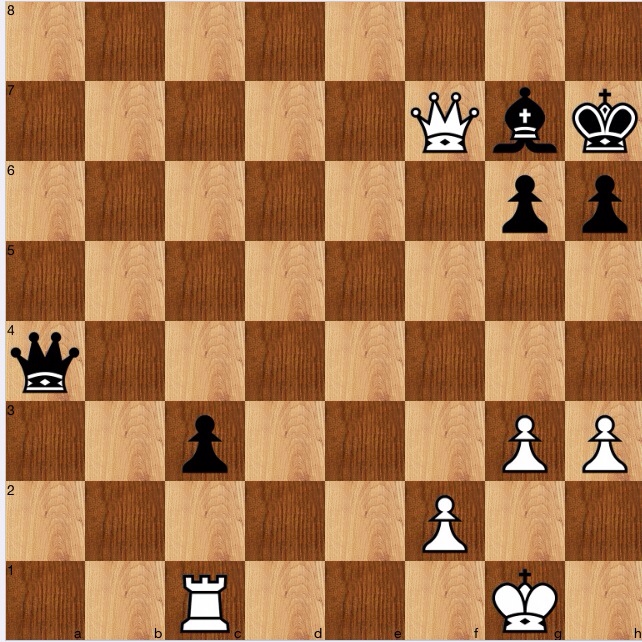
Problem was, I couldn't properly assess this position. I wasn't sure if the strength of the c pawn gave black sufficient to hold. Since (with some effort) I could hold this position in my mind, I was able to feel that eventually I could rearrange my pieces to give the Q the responsibility of guarding c2, so that the rook can be activated, but wasn't sure if that would be sufficient, with black always playing h5 to give luft and to prevent white from playing h4-h5. Now that I have played through the line with an engine, I see that the position is winning, with engine like accuracy by white, and, also, there is no need to proceed slowly: by clever heavy piece play, hitting the weakness on g6 and/or doubling on the seventh, eventually there is a zugzwang, forcing c3-c2, after which the pawn can be rounded up, some piece play to get back to zugzwang, and then it is game over. But this insight took me time with an engine to get confident about. (Of course, in a practical game, I would play the line down to Qf7 and then play on for two results.
Similarly, the moved played in the game, 1…Re4, is similar after 2 Re7 Re7 3 Qc6! Nb2, though it takes a Korchnok to then play 4 Rc3! Bc3 5 Qc3 and know it is winning. In practice, if I were white in such a position, it would be 50:50 that I could win, and it wouldn't take many less than perfect moves by me as white to fritter away the advantage- partly because I would be scared of releasing the rook by eg Rc1-a1-a6 up in case the c pawn were freed, but in the lines I have looked at the speed of white's double attack on g6 is overwhelming.
A game file, generated with Chessbase 12, with annotations, is here.
White to play and win
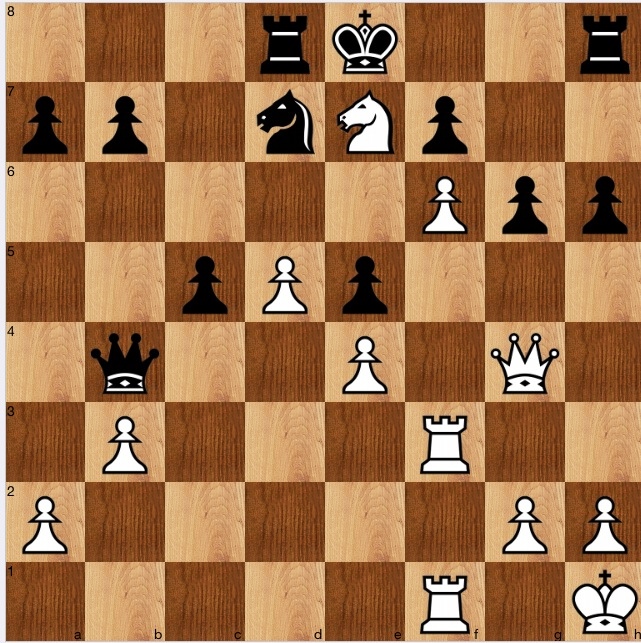
R Schackis v N Bloch 1977
Solution
1 Ng6! is a natural first try, and if 1…fg 2 Qe6+ mates after 3 Qe7+ and 4 Qg7+. If instead black say plays 1…Rg8 then 2 Qe6+! is pretty: 2…fe[] 3 f7 mate. Nice.
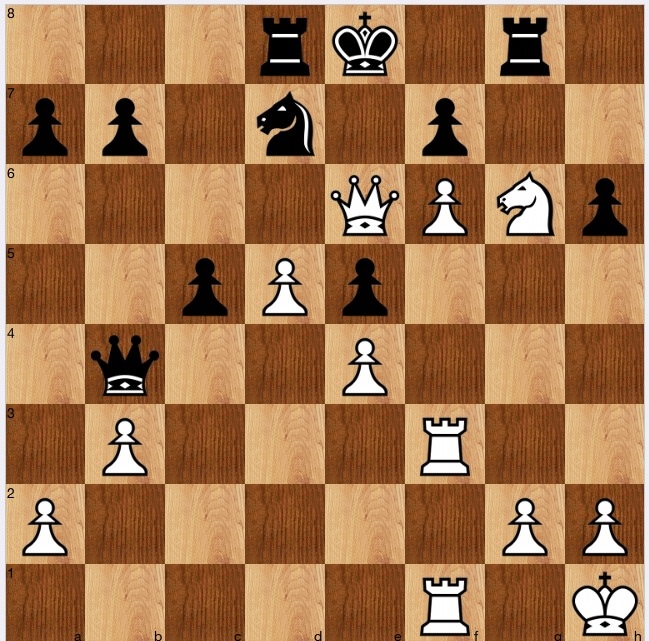
White to play and win
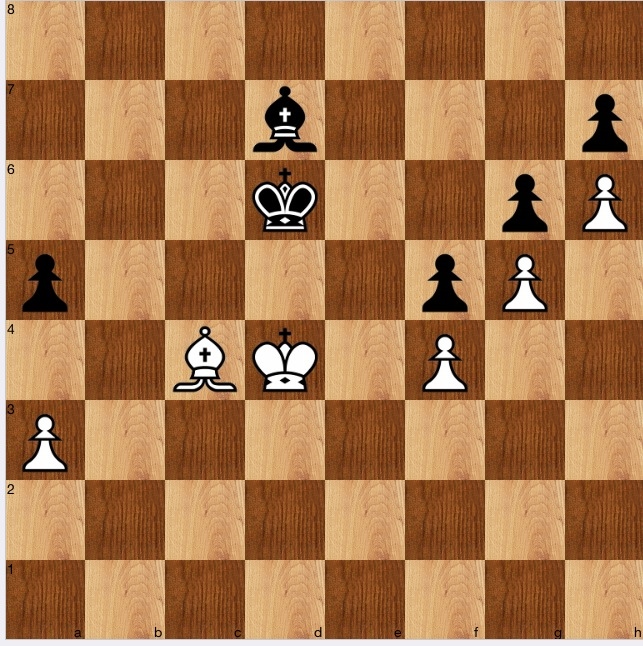
DA Walker v L Mellech 1982; black has just played Be6…d7
Solution
Whilst 1 Bg8 is the natural move, it loses if white then captures the h7 pawn. 1…Be8 2 Bh7?? Bf7 and white is a piece down. However, 1 Bf7! and the threat of 2 Bg6! can't be prevented. If the Bg6 is taken, the h6 pawn promotes.
Black to play and win
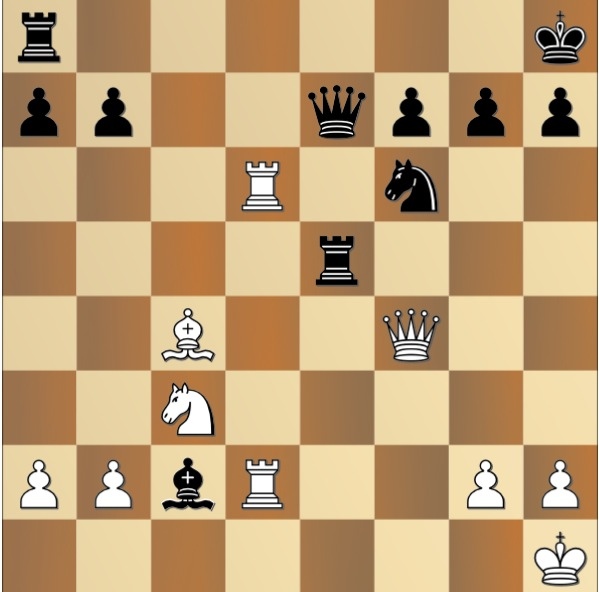
Reinhart Fuchs v Viktor Korchnoi, Yerevan 1965
Solution
I came across this position in the lovely 1975 book by Raymond Edwards and Raymond Keene 'The Chess Player's Bedside Book'.
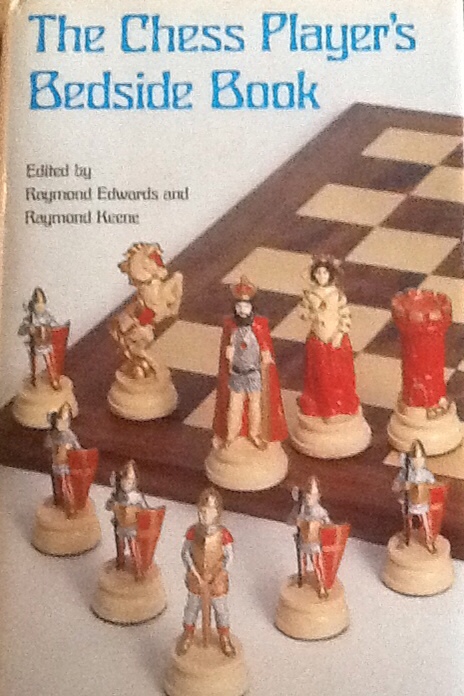
This is one of the puzzles in the chapter 'Korchnoi at work', being four difficult puzzles from Viktor's games.
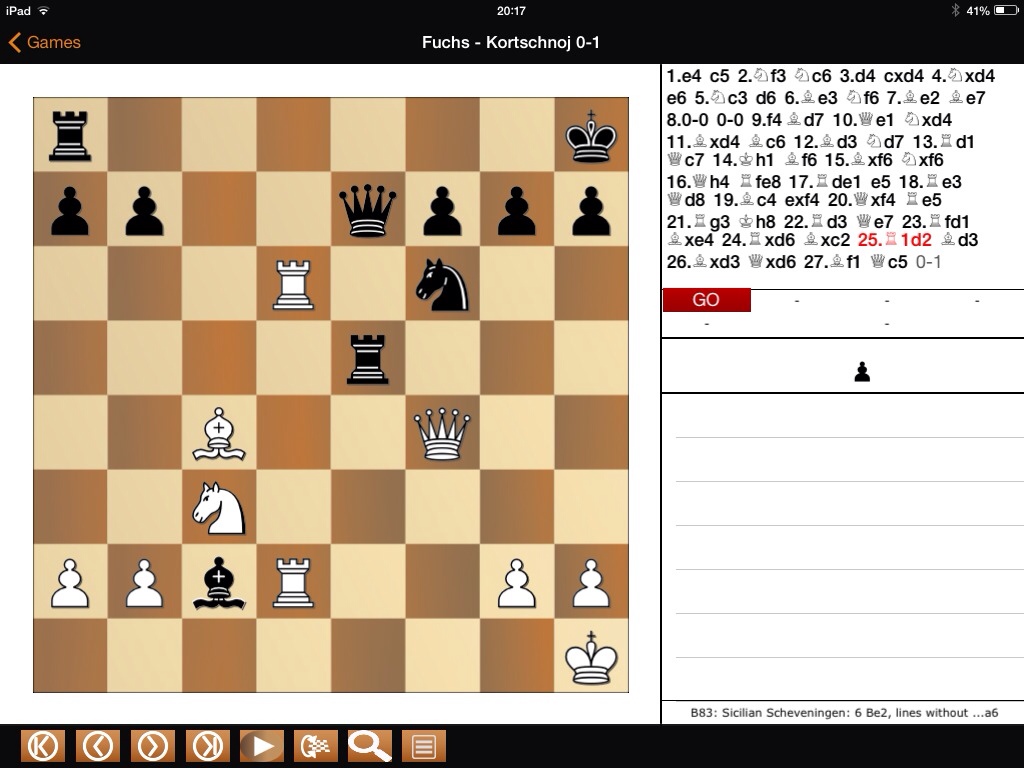
The solution came to me fairly easily, but probably only because of the hint given: ' White apparently has a strong position, but one move wrecks the coordination of his pieces'. With this hint, the solution, 1..Bd3!, is not too hard to see. If 2 Bd3, the now LPDO Rd6 drops off (2…Qd6), and if a rook takes on d3, then the Bc4‘s sight of f1 is blocked, so that 2…Re1+ mates after 3 Qf1 Rf1 mate.
The full game score is below (screenprint from Chessbase's iOS online app).
White to play and win
Black long castled in the position below; how does white win?
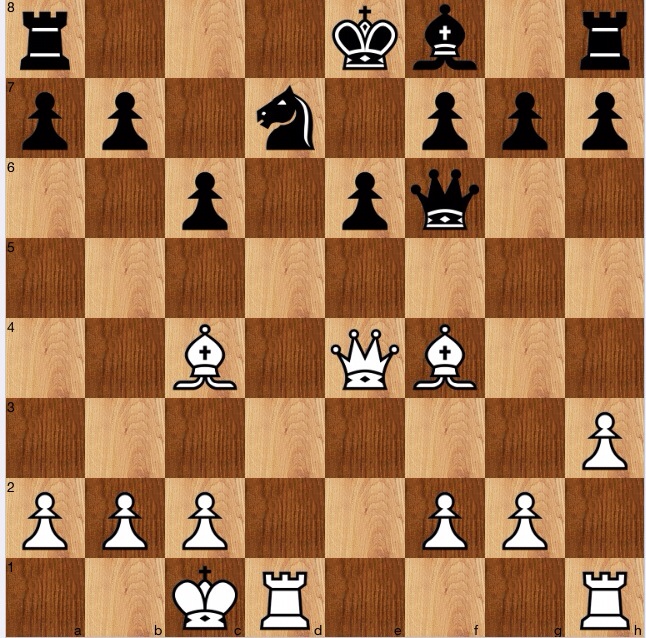
G de Marigny v E Feilmayr 1984
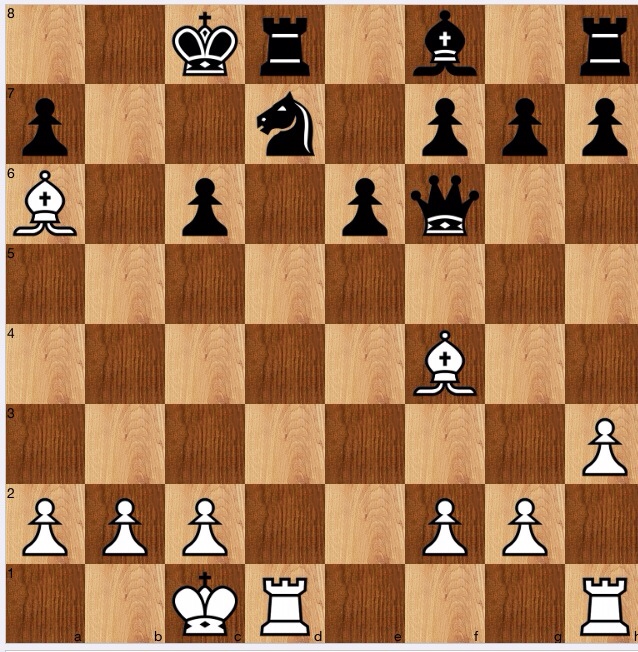
Oh dear, a rest day today. 1 Qc6+! bc[] 2 Ba6 mate is standard.
 allanbeardsworth