How does white win after each of black's four possible queen moves?
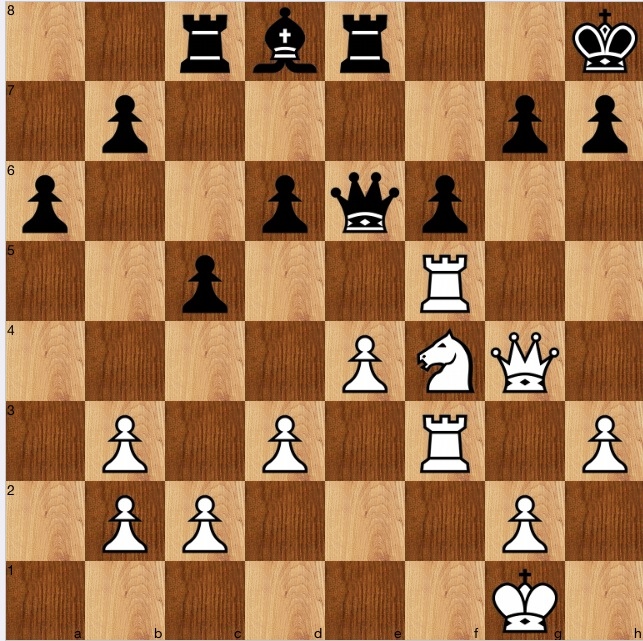
J Flenieg v K Janovsky 1979
Solution
Not too hard, but the variety makes this a good exercise.
1..Qg8 2 Rh5 and the double threat of Ng6mate and Qc8 wins.
1..Qf7 2 Rh5 Rc7 (say, the rook is again threatened by Qg4) 3 Ng6+ Kg8[] 4 Rh7! (nice, but straightforward) and if 4…Kh7 5 Qh5+ and 6 Qh8 mate, or if 4..Qmoves, 5 Qh5 is 1-0.
1..Qe7 is similar to Qf7, except Ng6+ forks the queen.
1…Qd7 2 Ng6+! Kg8 (2…hg 3 Rh5+ and Qd7) 3 Rf6! is pretty, with 3..Qg4 being mated after 4 Rf8+ Rf8 5 Rf8 mate.
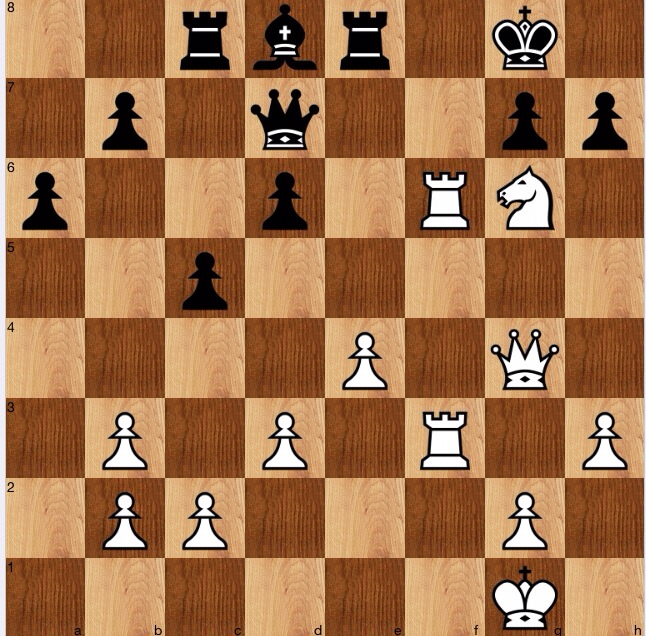
However, whilst Ng6+ and Rf6 was the line I found, and the line played in the game, Stockfish immediately shows an even better move: 1 Re5!.
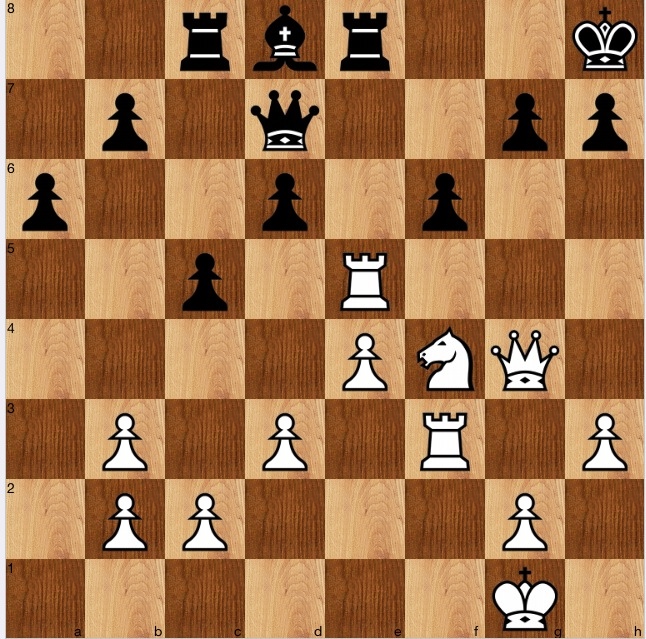
Once again, the engines find something special.
 Posted with Blogsy
White to play and win
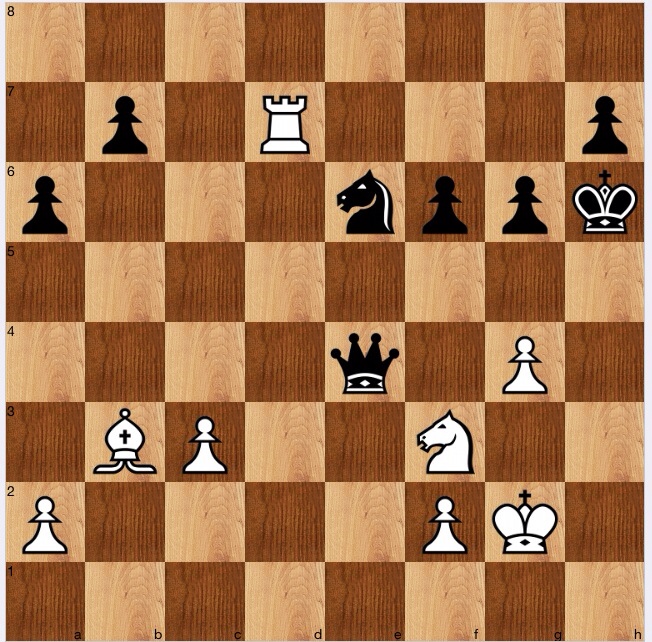
AA Ponelis v B Kerr 1977
Solution
Yet again, Purdy's instruction to examine all biffs turns up trumps. 1 Be6 Qe6 (1…Qc6!? 2 g5+! and 3 Bh3 keeps all the booty) 2 g5+!.
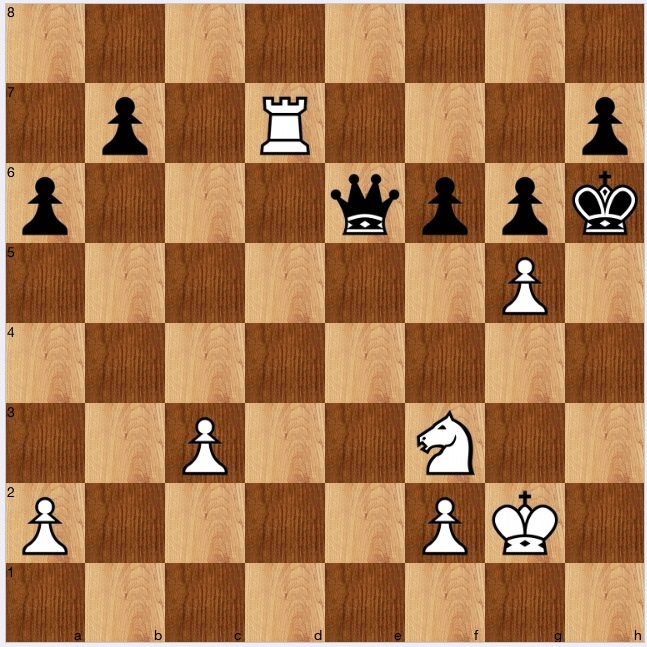
Black then has two moves: 2…fg 3 Rh7+! sets up a winning fork, 3…Kh7[] 4 Ng5+ and 1-0. So 2…Kh5 3 Rh7+ Kg4[] 4 Rh4+ Kf5[]
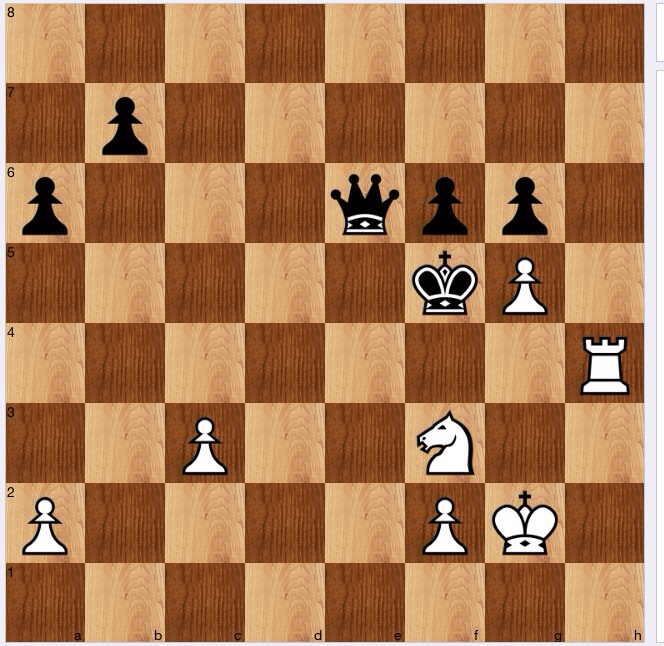
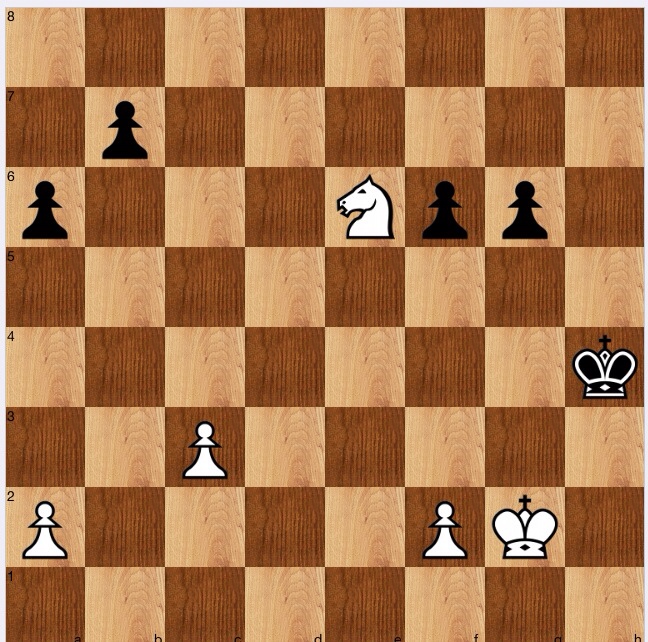
5 Nd4+ Kg5 6 Ne6 Kh4 and white wins.
Black to play and win
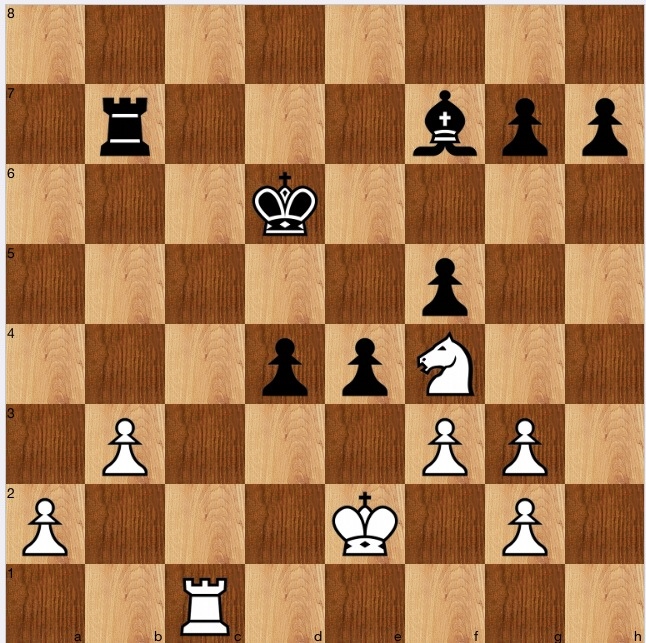
KF Kirby v D Morschel 1966
Position after 1 Kf2-e2?
Solution
Not too hard today: 1…Ra8 threatens to take on a2, and if Rc2, d3+ (or, best preceded by g5); or if 2 a4 Bb3; and 2 Ra1 Bb3. So, black wins both queen side pawns, and then mops eventually without trouble.
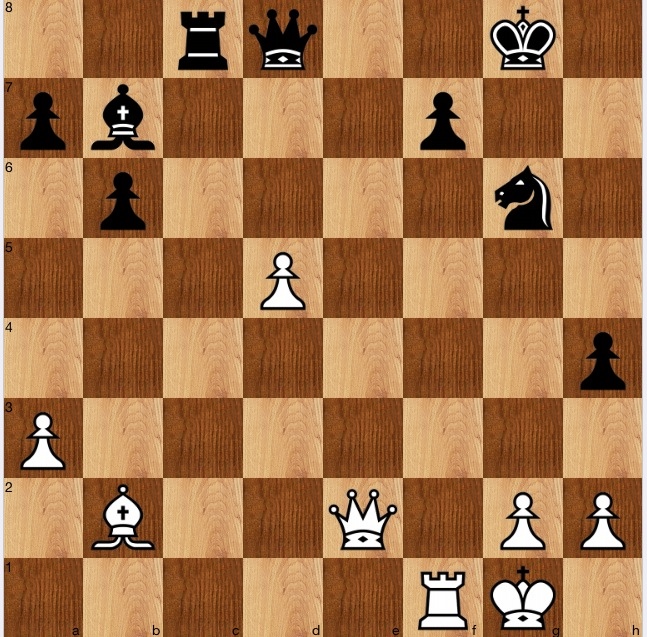
White to play and win (worth digging into)
M Levitt v J Gluckman 1987
Solution
Examine all biffs means look at 1 Rf7! when the first line that needs to be looked at is 1…Kf7 2 Qe6+ Kf8[]. For a moment, this stumped me, since obvious tries don't succeed, but as soon as I saw 3 Qf5+!, I knew the problem had been solved: the knight is taken with check, and then the Q and B mate, no matter where the king runs. For instance, 3…Ke8 4 Qg6+ Kd7 5 Qe6+ Kc7[] 6 Be5mate- so the king can't run away to the queenside.
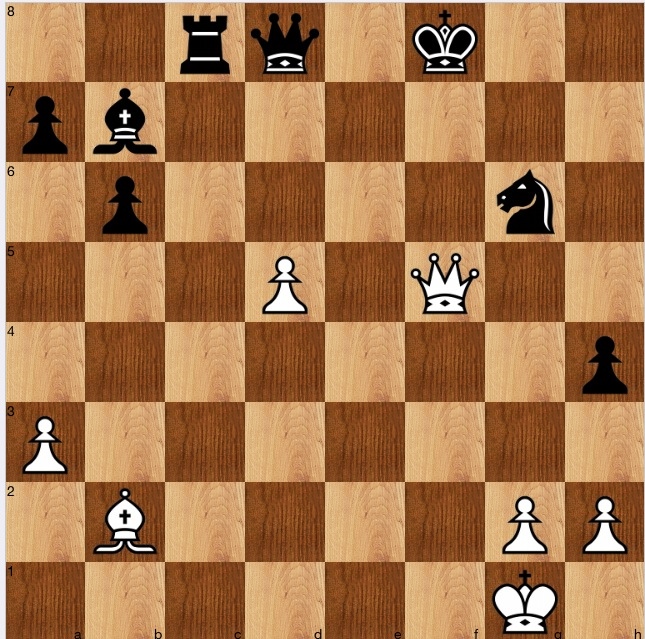
Reitstein indeed gives this as the solution, and says that black saw through the above line, and so instead played 1…Rc7, but still lost after 2 Rf6 Qd5 3 Qe8+.
Introduction
A year or two back, my younger daughter gave me a present, 'Dear Dad, from you to me' , one of those gift shop gifts which are very well intentionedy, but, alas, time is so short that they can often gather dust and never be completed. I decided a while ago that I wouldn't let this happen, and would aim to complete it for Sophie, Alice and Tom, so whenever they want to, they could find out a bit more about their Dad. So, I have set up a private blog, to which only family have access, and have been posting to it during our summer 2013 holidays and subsequently.
Many of these postings are personal, and best kept private for the family only, but those which are less private will also be posted on my main blog.
We recently had our annual family gathering of Jane's brothers and their families. They are always at our house, since two of her brothers live in London, and one in Edinburgh. They are one of the best weekends of year, always looked forward to, always remembered.
This year I finally saw 1001 Pelargoniums.

The book is available on Amazon.
This puzzle emanates from the tweet below by my friend GM Stuart Conquest, the organiser for the last several years behind the world's best open, the Gibraltar congress.

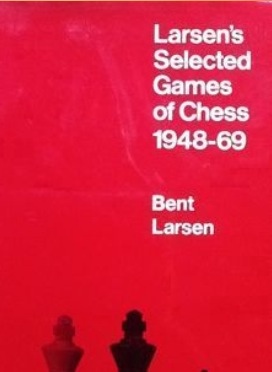
This was intriguing, so I wrote to Stuart and asked him which Larsen book he was reading: it was the old edition of his games published by Bell; fortunately, I had it in my collection (I think the number of chess books I have counts as a collection, but the number is withheld in case my wife reads this blog).
Puzzle: find the error in the analysis below
Positon before 28…a5
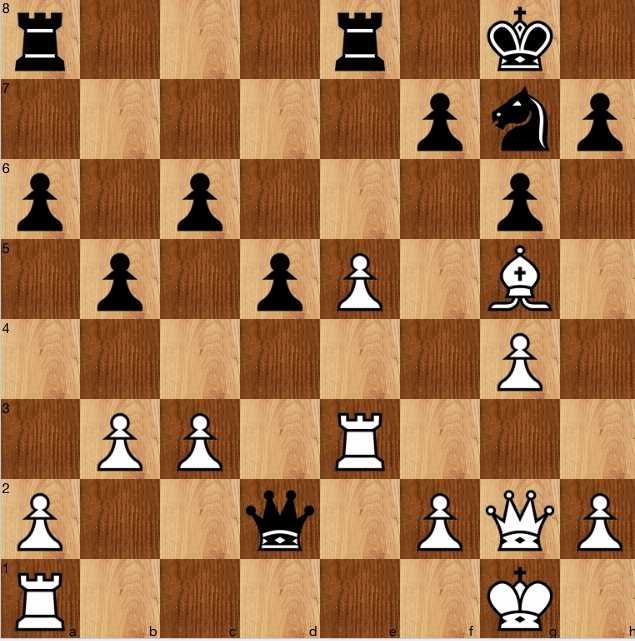
(To make it more enjoyable, consider solving it as I did, and how Stuart did, with a board and pieces).
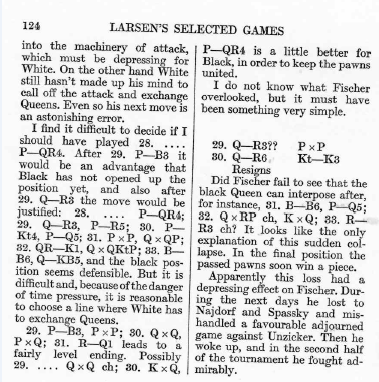
Solution
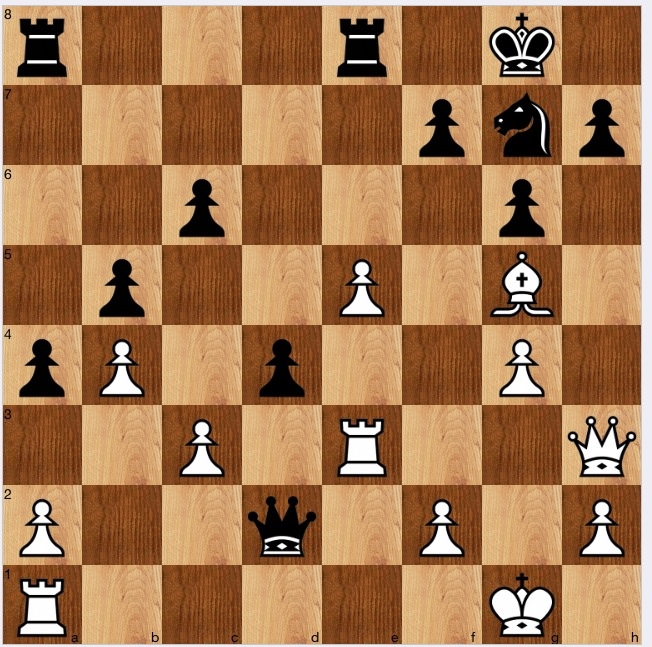
In the above positon, black has just played 1…d5-d4, and Larsen plays the natural recapture, 2 cd. However, and I wouldn't have spotted it hadn't Stuart tweeted, a Purdy player would alway examine all biffs and look for jump biffs. Here, there is a jump biff Bg5-d2, and there is a biff Qh7, so 2 Qh7+! Kh7[] (2…Kf8 3 Qh8 mate) 3 Rh3+ and 4 Bd2. The position is roughly level, as it is in the line Larsen gives, which is why Stuart says it is a small error.
White to play and win
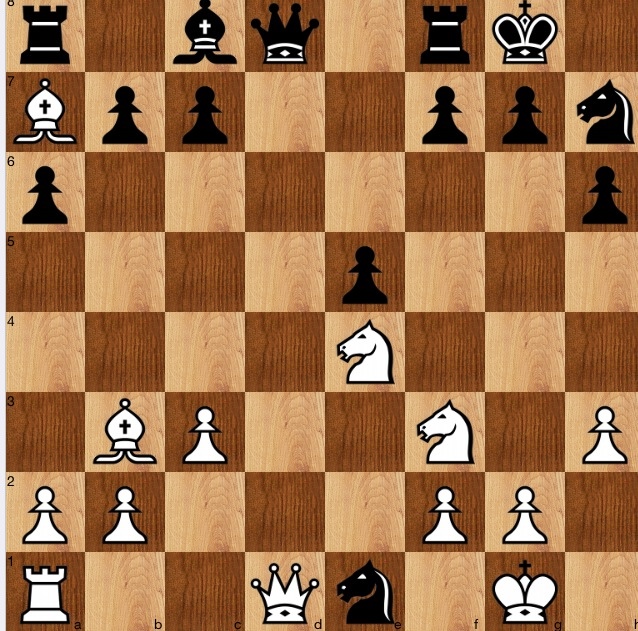
I Saric v T Nabaty Warsaw 2013
Seen in Chess magazine
Solution
At first, I was bemused by the odd constellation of pieces, with the B somehow on a7, and the N on e1: I thought the position was simply winning for white, a piece up in a variety of ways, before realising that black was the exchange and a pawn up. Poor of me. Less poor was that despite my mis-counting, I immediately saw 1 Bf7+!, knowing that the Rf8 was tied to defending the Q, so that black's only two alternatives are 1…Kh8 and 1…Kf7.
If 1…Kh8, 2 Ne5 is crushing with black's only try being 2…g5 to give luft to the king, but then 3 Bd4 is horrible.
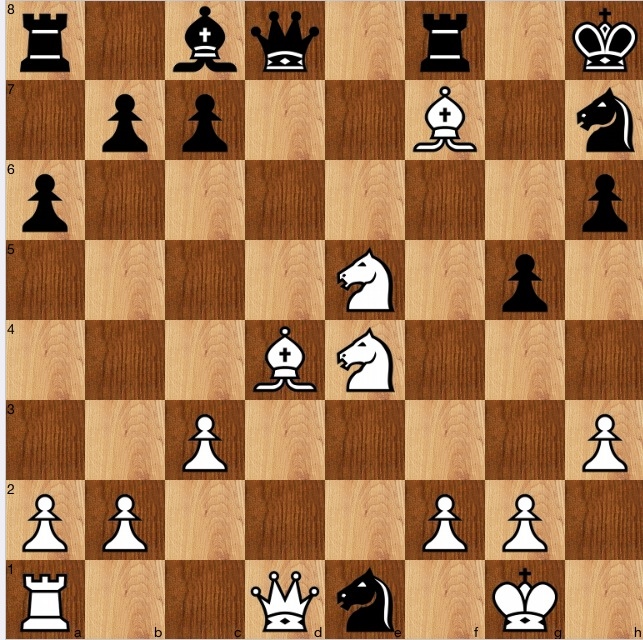
So, 1…Kf7 2 Ne5+ Ke6[] (2…Ke7 just invites white to improve his bishop, 3 Bc5+ Ke6[]) 3 Qg4+ Ke5 4 Qg7+ Ke6.
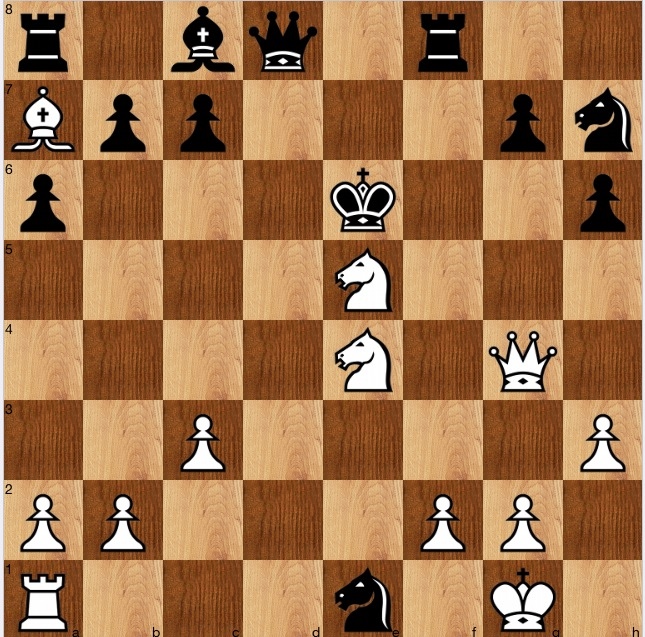
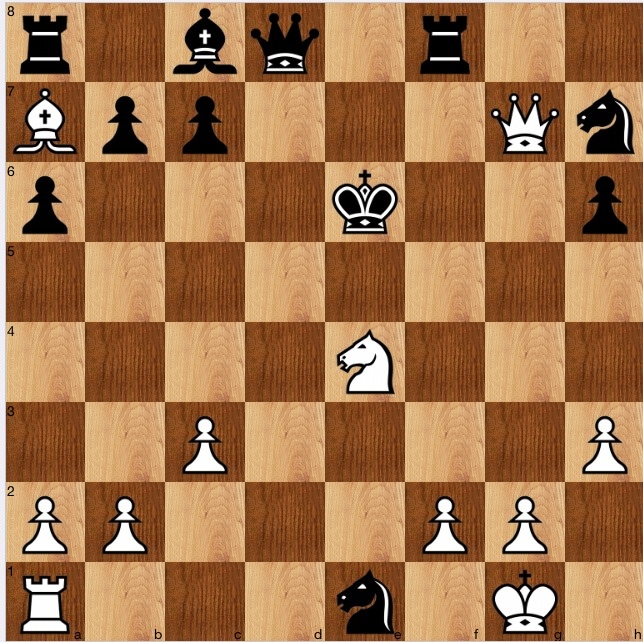
Here, my analysis ended, appraising the situation as clearly winning, and I think that is right. I would always play 5 Re1 here, but for some reason, which I can't fathom, Stockfish strongly prefers 5. Qg6+ first! suggesting that 5…Ke5 6 Re1 is a far improved version as compared with 5 Re1. Personally, I don't see it (and if readers can explain why, perhaps they would like to comment).
White to play and win

C Cruywagen v P Gems 1985
Solution
Fairly straightforward. 1 Nh7+ and depending on what black replies with, black is either mated or suffers ruinous loss.
Alice, my elder daughter, has just passed the assessment day and will be spending the summer in Malawi doing voluntary work. Shame to admit it, but after being delighted for her, my second thought was 'where's Malawi'?

My third thought was to find out about it (thank you, CIA factbook), and my fourth thought was 'do they play chess in Malawi' (yes they do, including having played in the Olympiad, but I would have a good chance of being the strongest player there: maybe I will suggest to Jane that we should go there on holiday?). Maybe I have got my priorities wrong, but why should I bother about safety, flights, money, etc etc when Alice and Jane can do a better job on such things.
I received this email today from Dell. I have not bought a Dell computer for a decade, to my recollection.

Readers of this blog will know I dislike insincere emails or letters starting 'Hope you are well'; recently, it received a mail shot from a local firm of estate agents, 'Dear Owner, first and foremost I hope you see really well'. Straight in the bin.
I suspect Dell aren't being entirely sincere in thinking of me every day; and similarly I doubt that their birthday wishes are heart-felt. Nor are they well received: it isn't my birthday.
Am I becoming a grumpy old man?
 allanbeardsworth