White to play and win
in the diagram below, white threatens Nf6+ winning at least a piece, so black played Ne5.

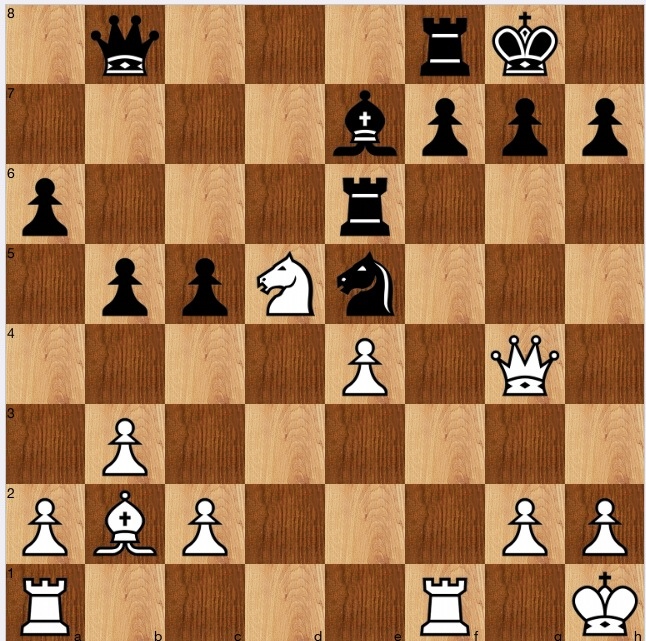
K Dreyer v A Friedman 1961
Solution
This puzzle took longer than it should, because in the key line, I had the order of moves wrong in one line, and didn't try until too late to reverse the moves; so, instead, I tried other lines.
The move I wanted to play was 1 Qe6!, but at first I couldn't make it work, so instead I tried 1 Rf7?, but it fails after 1…Kf7[] 2 Qf5+ Bf6: black's king doesn't need to unprotect the Re6. I tried and tried to make 1 Rf7 work, before eventually swinging back to 1 Qe6…and solving it instantly; and then being puzzled about my prior difficulty, until it dawned on me by mistake. I wonder if GMs think linearly and cleanly all the time, or so they get confused too?
So, 1 Qe6! fe[] 2 Ne7+ Kh8 3 Be5! wins since 3…Rf1+ 4 Rf1 Qe8 5 Bd6 protects everything, and there is (not that it is necessary) there is also then the unstoppable threat of 6 Rf8+! 7 Ng6+ 8 Bf8 1-0. In my prior analysis, I played 3 Rf8+? Qf8 4 Be5 but after 4…Qe7, the game goes on.
 Posted with Blogsy
White to play and win: the solution
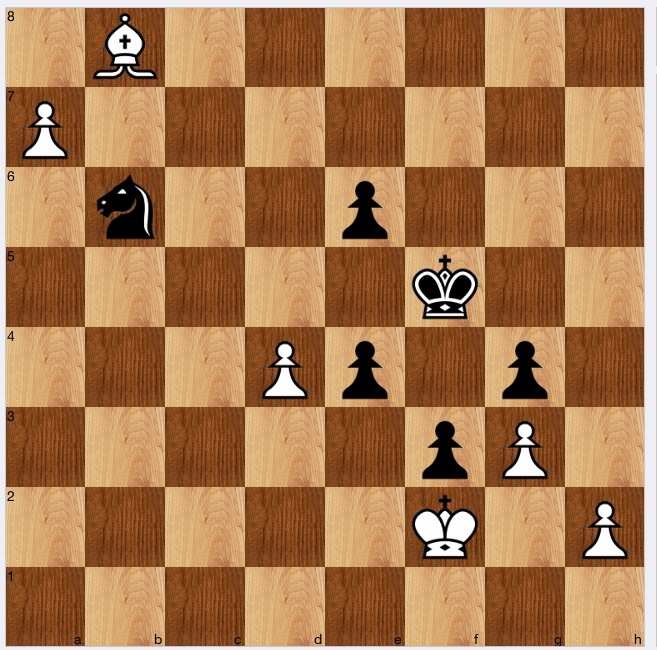
This ending would be well worth studying and trying to solve: it defeated me when playing it out against Stockfish on my iPad. Later, when playing black against Houdini on my PC, eventually Houdini found how to win. But Reitstein is wrong to state that white could have won quickly: or, if not precisely wrong, it takes imagination and precision to win.
Whilst Houdini prefers 1 Bd6, which was my move too, it is in fact weaker than 1 Bf4!. The win happens on stages:
Bring the Bishop round to a5 and block in black's knight on a8
1 Bf4! Na8 (say, or the king can oscillate: and the same for many of the following moves) 2 Bd2! Nb6 3 Ba5! Na8[].
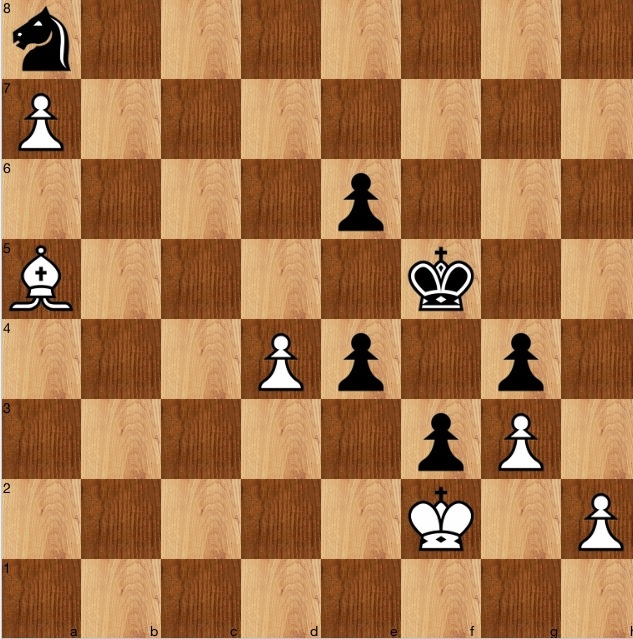
Improve the king
4 Ke3 Kg6[] (4….e5? 5 d5)

This sort of position is easy to get to: but now the problem emerges, that Ke4 is impossible due to f2 and the pawn queens. So, and thanks to Houdini:
Re-route the bishop to f2
5 Be1! Kf5[] 6 Bf2!
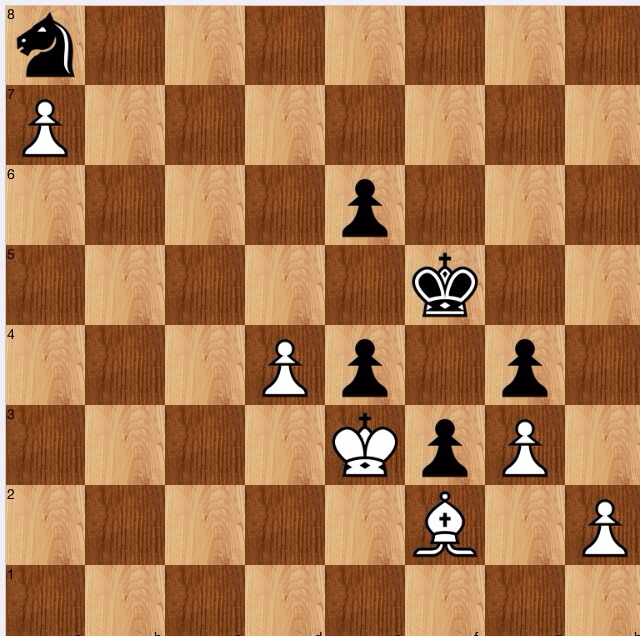
6…Nb6 (or 6…Nb7)
Sacrifice the d pawn to improve the king
7 d5!! ed (7…Nd5+ 8 Kd4 Nb6 7 Kc5 etc; 7…e5 8 Kd2! Na6 9 Bc5! prepares to defend the d pawn when on d6, so that Ke3-e4 can pick up the e4 pawn, the f2 square still being watched by the Bc5. 7…Ke5!? 8 Kd2!:

and not (after 7 d5 Ke5!? 8 de?? since:

Is mate!
After 7 d5 ed, white's king can come forward:

There is one final neat point: 8 Kd4 Ke6[] 9 Kc5 Na8:
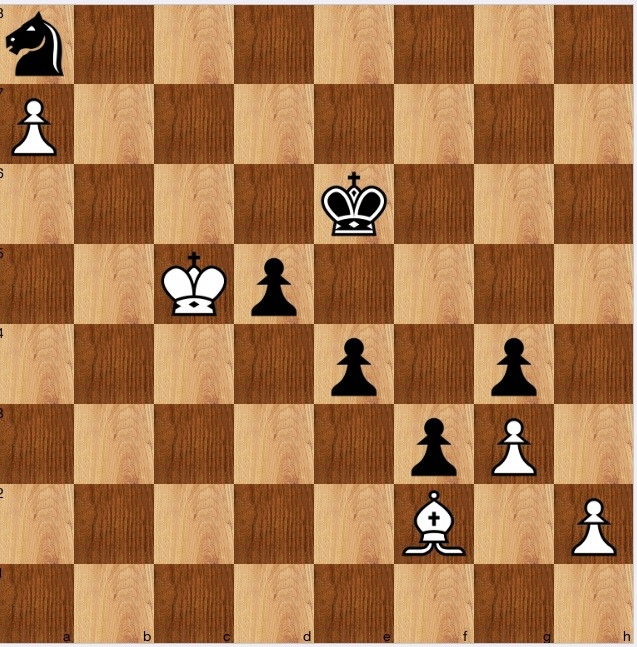
White's best is 10 Be3!! losing a tempo (not a concept I have seen much of before) so that if 10…Ke5, white can biff the king back with 11 Bd4+! before advancing with the King. If instead the hasty (and easily played) 10 Kc6?? then 10…Ke5 is either a draw or better for black: 11 Kb7 d4 12 Ka8 e3 13 Be3 de 14 Kb7 f2 15 a8(Q) f1(Q) and since white hasn't got a check skewering the white king and queen, the only question is whether black can get his king to shelter and promote the e pawn. But 10 Be3!! very elegantly slows down black just enough.
Alternative
It is probably not necessary to sac the d pawn: 7 Kd2 may (probably does) also win: the king is improved Ke3-d2-c3-c4 and beyond always watching for black's e3 break, and also watching out for a good time to play d5! if necessary.
Conclusion
The stage by stage re-routing to f2 via a5 wins: but I don't think it is easy to see!
Black to play and win
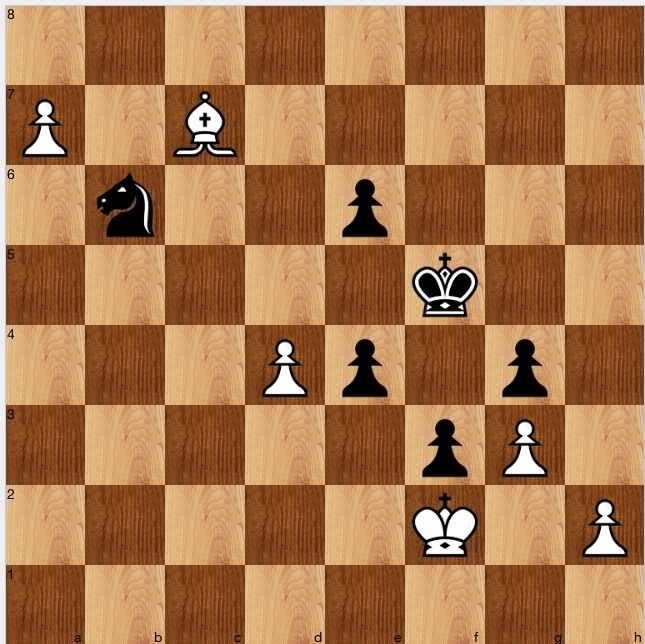
W Heidenfeld v M Kolnik 1947
White has just played Bb8-c7, missing the move which was the 'solution' to this morning's previous posting. How could black have won (he missed the win, in fact)
Solution
Not too hard: examine all biffs means that 1…e3+ has to be considered, when if 2 Ke3, Nd5+ forks the Ke3 and LPDO Bc7. And if white doesn't take on e3, black wins after 2…Na8 and 3 Ke4.
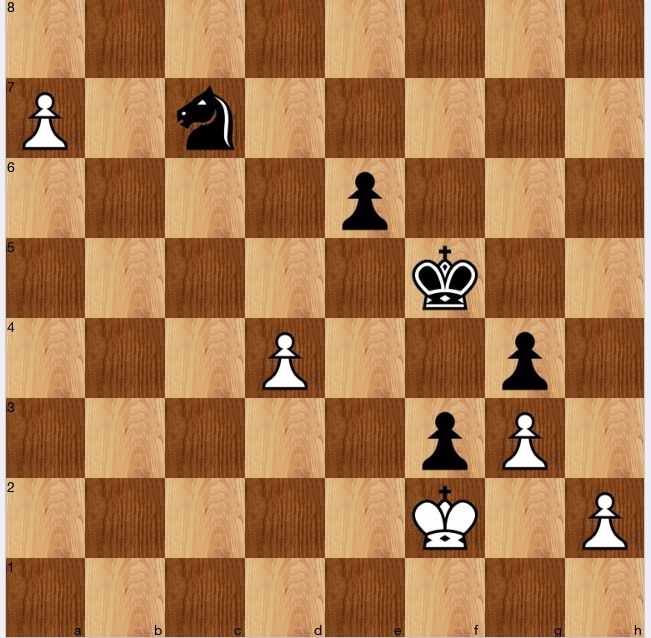
White to play
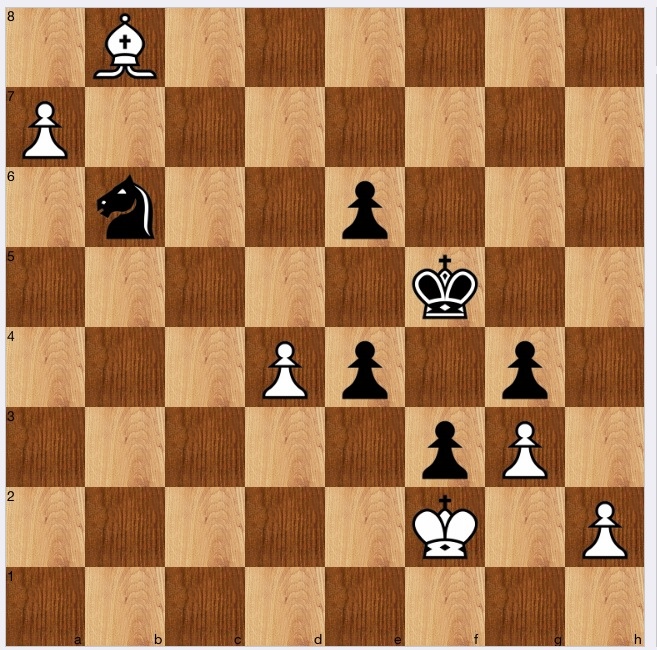
W Heidenfeld v M Kolnik 1947
Today's puzzle is in two parts (two blog postings). Reitstein's rubric was:
This is a case of an amazing double oversight. Heidenfeld could have won very quickly from the diagrammed position had he found the right move. What move did he miss?
The rubric continues with the move white played, and black's subsequent oversight.
This posting asks 'what should white have played'?
This one is worth thinking about.
Solution
Reitstein's solution says: Heidenfeld should have played 1 Bf4! leaving black with no good move. After blundering with 1 Bc7 Kolnik could have won by 1…e3+! 2 Ke3 Nd5+. Instead Kolnik played 1…Na8 and after 2 Ba5 White won after a protracted struggle.
I am not sure about all this. My 'solution' was 1 Bd6, which I think is 'as good as' 2 Bf4, but I am not sure that white is winning in either case. Firstly, in my line 1..e3+ 2 Ke3 Nc4+ still forks the LPDO bishop but after say 3 Ke2 Nd6, the knight doesn't protect a8, so 4 a8(Q) wins. Instead, though, after either 2 Bf4 or 2 Bd6 (or indeed after the game continuation 1 Bc7 Na8 2 Ba5, are such positions winning? I think black might be able to oscillate with his king ad nauseam, since if the B doesn't protect f2, white can never take on e4: and if the B is on the g1-a7 diagonal, then black can keep his king on f5 and oscillate with his N between a8 and c7.
I am intrigued as to how Heidenfeld won, suspecting it might be a subsequent bad blunder by Kolnik. I will look at this position another time, but for now think that the problem is cooked. If I subsequently see why white is winning, I will append to this blog.
Today's FT had an article talking about Warren Buffett's plain, folksy, speaking style, his use of metaphors and stories which make him a captivating person to listen to, or fascinating person to read. (Memo to colleagues wanting to learn about business: read Warren's letters to shareholders, in Berkshire Hathaway's annual reports, available online).

The article mentions his talk to MBA students in 1998 at the University of Florida, which I had not heard of before, but I have just spent a very happy hour or so listening to them on YouTube. Brilliantly for such a speech, the actual prepared element of it is very brief, a few minutes, since, as Warren says, he is more interested in talking about what is on the students' minds, so nine tenths of the talk is him doing a Q&A session. As a committed Buffetite/Grahamite, much of what he said wasn't new to me, but wonderful to listen to.
The initial talk, about integrity, intelligence and energy, was something I had not seen him write about, and was wonderful. He asks the audience to buy 10% of one of their colleagues future careers; and go 10% short on another of their contemporaries; and the same for competitors in business, too. Very insightful.
A tour de force.
Black to play and win
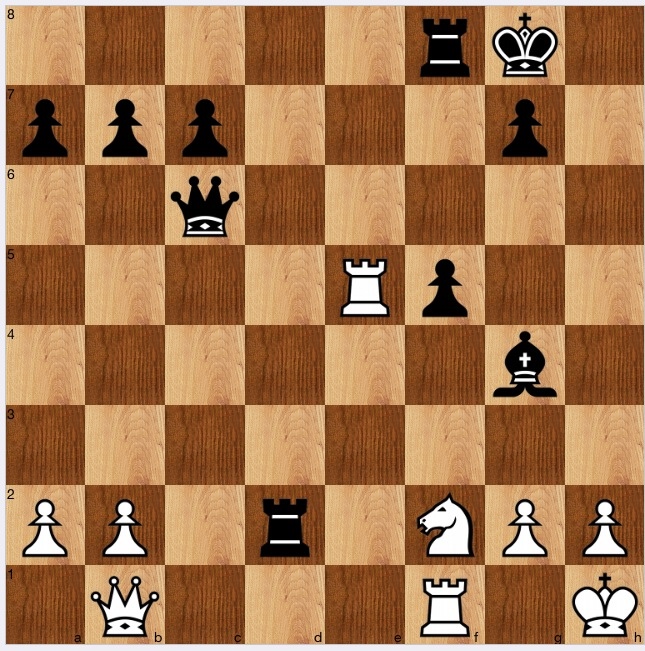
M Levy v RF Griffiths 1966
Solution
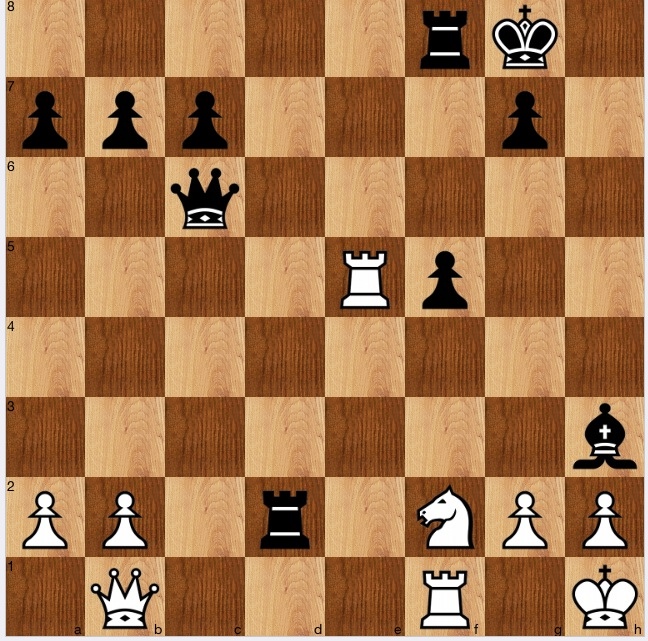
CJS Purdy's concept of jump biffs helps here. Or, his admonition to always look for 'pins, nets and ties'. Here the Nf2 is pinned, blocking the Rd2’s sight of g2, which is also in the eye of the Qc6. So 1…Bh3! and it is game over.
White to play and win
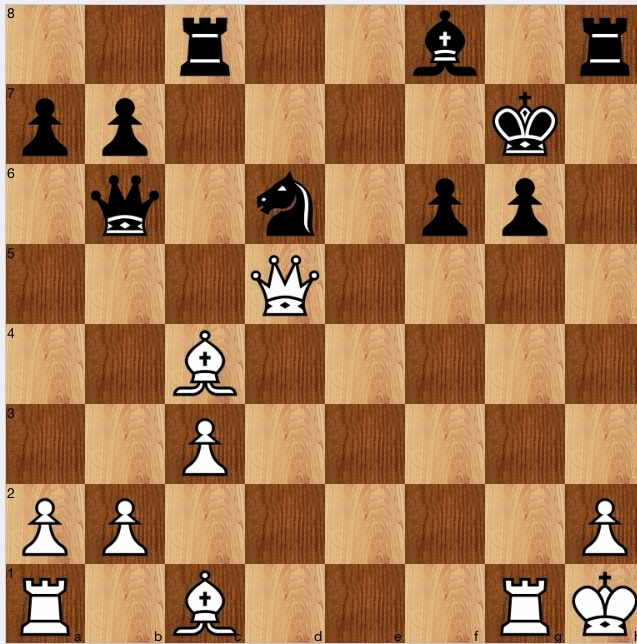
Solution
A thoroughly enjoyable puzzle.
I keep photocopies of 'stinkers'- hard problems- ready to take with me when walking the dog, or on family walks; on the latter, sometimes we walk in groups, sometimes we stretch out in a line, sometimes there is waiting time. And a beauty of chess is that, if you can memorise a position AND work on it at the same time, which I can (as most strong amateurs and I am sure all pros can) one can work on problems without anyone knowing.
Unless people can tell from your expressions. Such as my delight when I solved this one, right to the end.
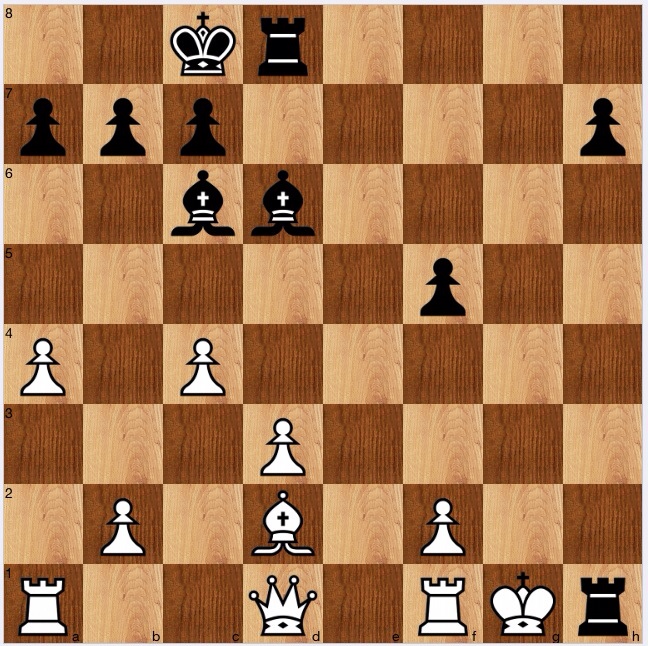
Black to play and win
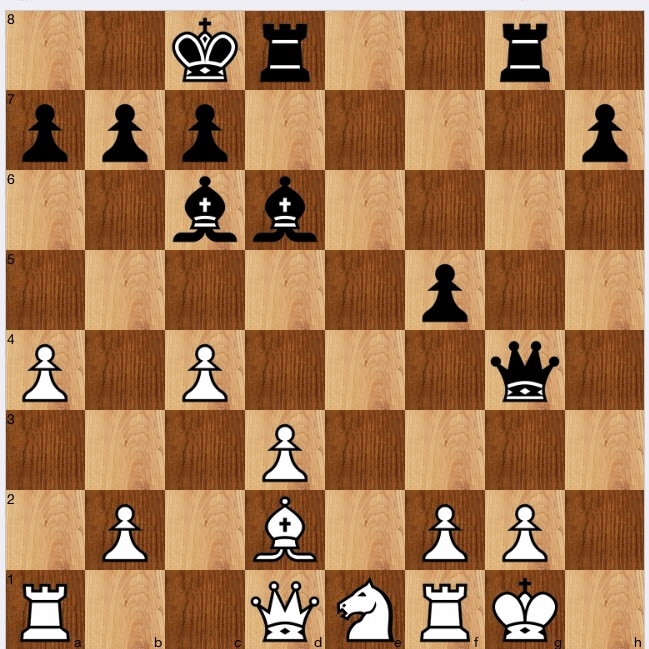
B Dembo v L Reitstein 1946
Solution
Straightforward. 1…Qg2+ is obvious, when there is only one line. 2 Ng2[] Rg2+ 3 Kh1[] Rh2+ 4 Kg1 Rh1 mate.
Black to play and draw
White played 1 g2-g4 in the positon below
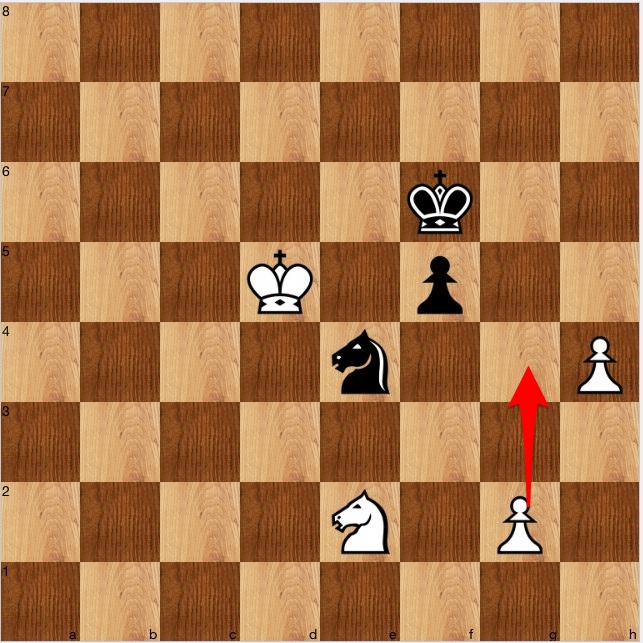
MC Rubery v P Gems 1985
Solution
An interesting problem. I got to the solution by the process of elimination, and, even when I found the saving move, 1…Ng5!, it wasn't 'obvious' why it was so good, though I could tell that it was: quite an inarticulate way of saying that the positon is strange. Anyway, by analysis rather than any other means, it can be seen that white can't prevent both pawns being taken: game drawn.
As I post this blog, round six of the Gashimov memorial is underway. The games are two and a half hours in, and thanks to the best suggestion I received last year, I can be busy doing useful/necessary things whilst also keeping an eye on the chess.
The best suggestion was simply to have two screens on my home PC: I have had a PC for nearly two decades now, but was a slow convert to having two screens, but having upgraded my PC last year, I took a friend's advice, and haven't looked back. So today I have been able to do my wife's tax return, a family trust's tax return, and other necessary financial things, catching up on a backlog of emails, all whilst keeping an eye on the chess. Perfect.
Mamedyarov-Carlsen will of course be the game of the day: and at the time of writing, move 17, it is building up to be an interesting game. Caruana-Nakamura is an interesting Open Spanish, now at move 25, and the board has simplified: I can't really assess if white has a significant enough advantage, or whether it will be a draw.
The 'dullest' game of the day is Radjabov-Karjakin. Sergey seems to have sucked the life out of the game from the start/kept everything under control as you prefer, and after 25 moves, it is a one rook plus symmetrical pawns ending, close to a draw, unless Teimour can exploit whatever slight advantage he has (better rook, black's being passive, and better pawn structure.
If Radjabov-Karjakin ends in a draw as I suspect it will do, it will probably be regarded as not a game to remember. There was one interesting hidden tactic a few moves back.
White to move: should he play 1 Re4?
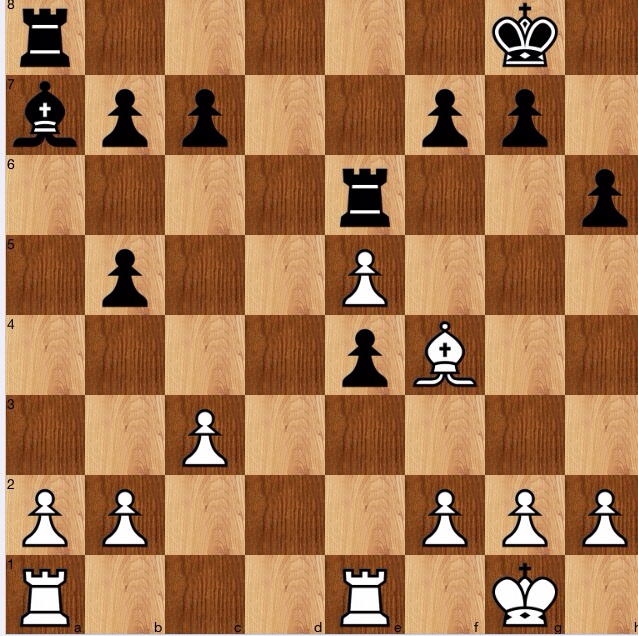
Solution
White actually played 20 h4!, a move which at first blush I thought was showing black he could take on e4 at any time. I noted that if (after 20h4) 20…f5, trying to protect e4, then after 21 ef gf, the c7 pawn is en prise.
Then I noticed why white can't take on e4.
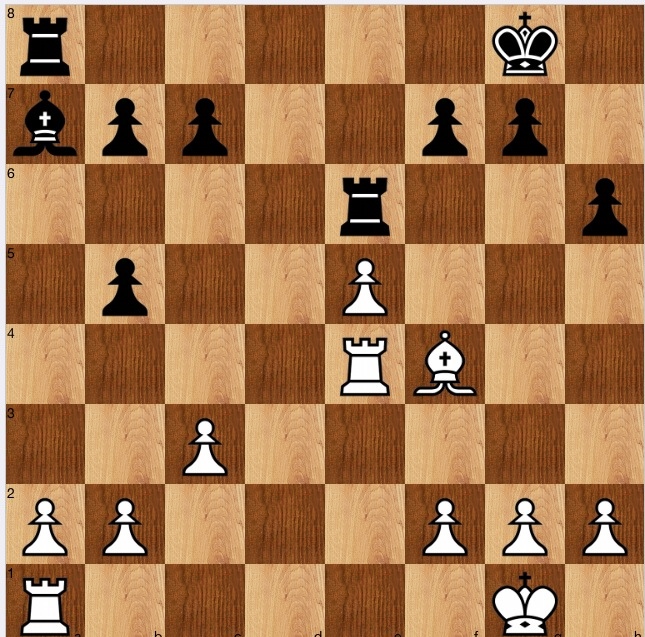
Position after Re4
Black plays 1…g5! biffing the Bishop, which has no good square to go. The place it would like go to is g3, from where it protects the e5 pawn, but (2 Bg3??) 2…f5! wins: the Re4 is LPDO so taking en passant is not possible, so the rook must move, and the bishop is in a net and is lost after 3…f4.
Secondly, the bishop's next best square, e3, is also unavailable for a similar reason: 2 Be3? f5! and here the B is not lost, but white's structure is ruined after 3 Rb4[] Be3 4 fe[] Re5: black is somewhat better.
So,white must retreat to say d2, when 2…f5! again upsets white: the e pawn will fall, and white is not better. (Or, maybe, instead biff the bishop, 2…Rd8!, which also improves the rook, and then perhaps play 3…f6 getting the pawn back immediately).
What happens after 20 h4?
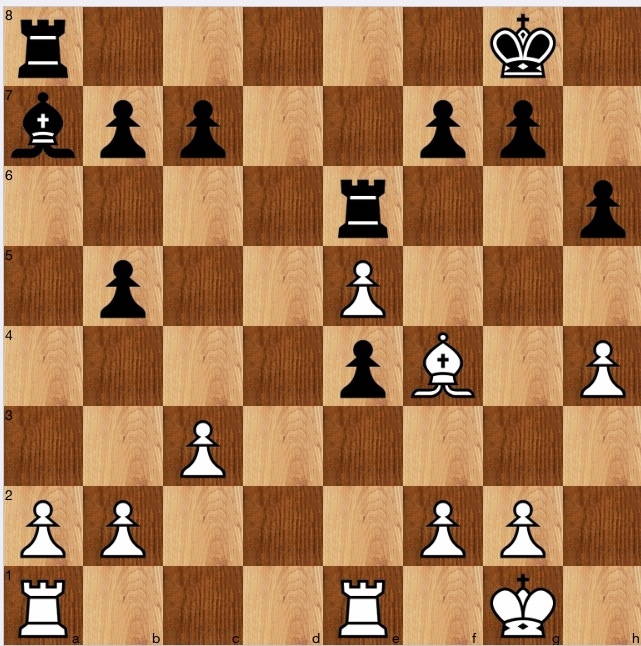
Sergey played the nice, and not obvious, tactic, 20…e3!, not losing a pawn, and simplifying down to an endgame. It just shows how there a little tactics everywhere, and how great these players really all are.
 allanbeardsworth