Black to play and win
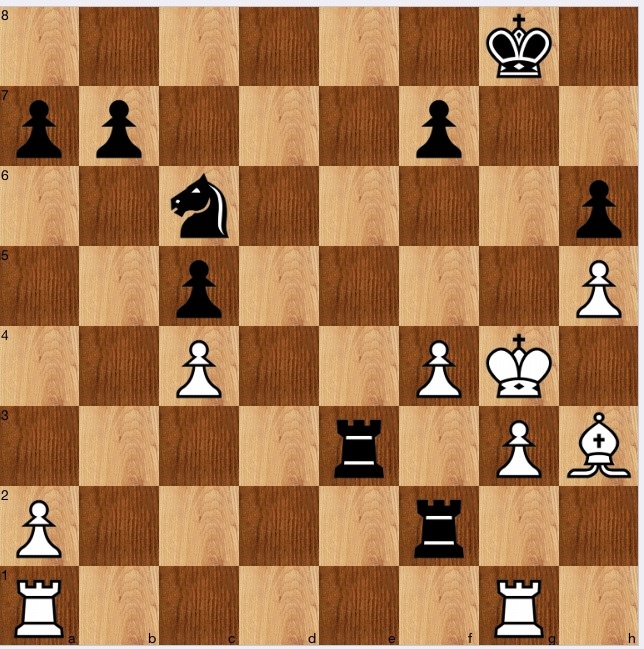
C Wolpe v J Tsalicolgou 1979
Solution
White's king is in a net, the question is whether it can be caught. After trying the various biffs, Ne5+, Re5+, f5+ and even Rg3+, and not making them work, I then tried bringing more pieces to the party and quickly saw 1…Nd4! and appreciated its strength. The threat is 2…f5+ 3 Kh4 Nf3mate. White can try various things, such as 2 Bg2 f5+ and 3…Ne2.
 Posted with Blogsy
White to play (and win)
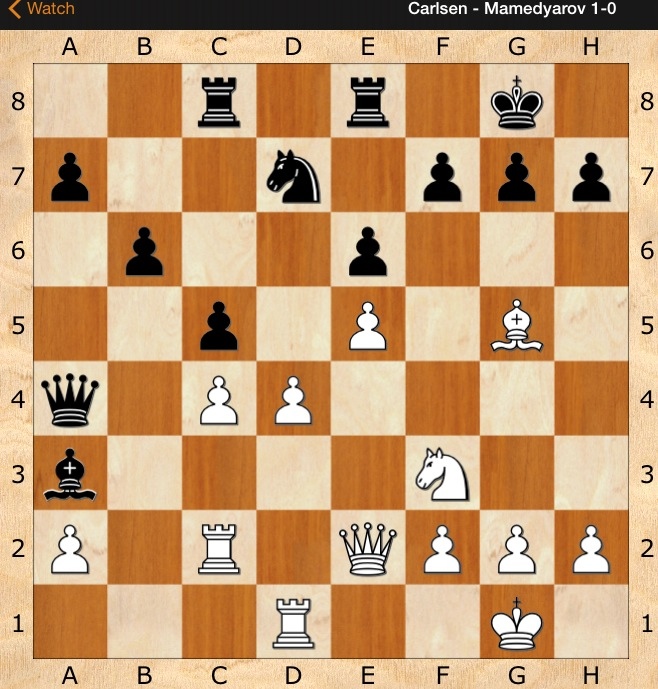
Shak has just played the perfectly plausible 1…c6-c5. I am writing this from our cottage in Borrowdale, having just finished a lovely Easter Sunday walk around Derwentwater. Boots off/kettle on/Playchess.com…to find the result, and lo and behold!, Magnus has won in Magnus-style.
At the time of writing, neither Chessbase.com nor Chessvibes.com have posted any analysis, but Jonathan Rowson has tweeted https://twitter.com/jonathan_rowson/status/457913464028401664 summed the game up as being elegant, accurate and brutal; and better than Karpovian.
I suspect we will find that c6-c5 is a 'bad' move. After Magnus's reply 2 d5 (obvious) ed (equally obvious) the move of the day is 3 Rd5!!
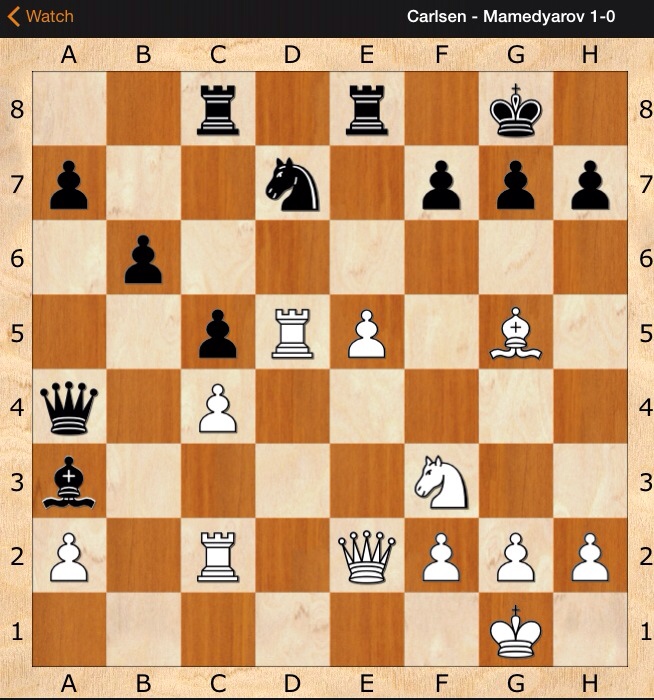
I presume mere mortals, which includes many GMs, would play 3cd, by rote, and we would then have a typical unbalanced position, the question being whether white can break through on the king side before black's queen side pawns can roll.
But after Magnus's 3 Rd5!! the simple fact- simple once Magnus has played Rd5-is that white is nearly a piece up. Black's bishop is out of play, and in the rest of the game Magnus keeps it that way, with the next key move being Rd3 in the diagram below.
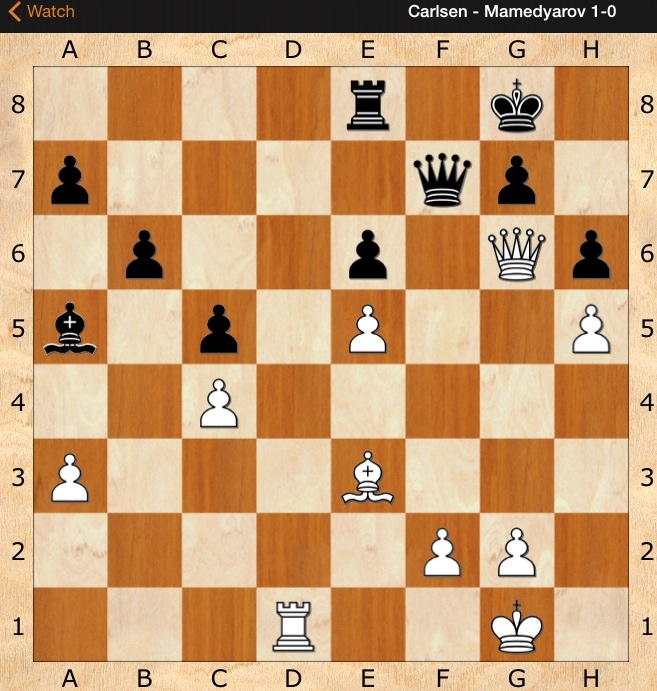
Jonathan's reference to Karpovian is because he keeps things simple or, rather, gives the appearance of simplicity. There are minor tactics throughout the game, and the simplicity belies the maintenance of the initiative and pressure.
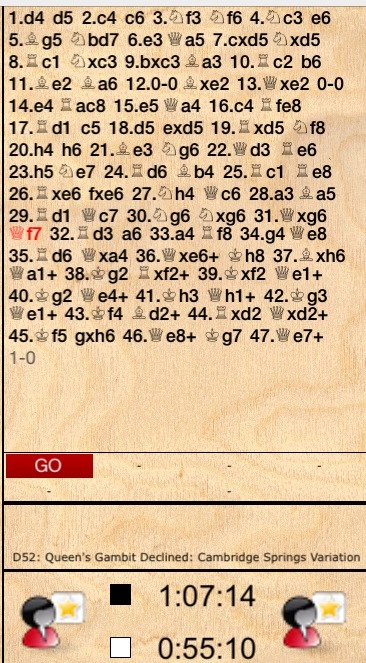
It will be interesting to see what the GM commentators say. There is a risk in blogging too soon that I have missed the point, but Jonathan's tweet reassures me. My suspicion is that 17…c5 will be considered to be a mistake, with 17…Be7 being preferable. Also, after 19 Rd5!! white's bishop hasn't got many squares to go to (it didn't want to go to e3, but had to: on f4 the black knight could biff it, and make it retreat to the even worse square g3). My suspicion is that Shak's Nf8-g6-e7 was the wrong routing for the N, which instead should have gone Nf8-e6, supporting the c5 pawn, so that a7-a6 and b6-b5 stand a chance of releasing the Ba3.
But I have not much confidence in Nf8-e6.
A bravura performance by Magnus.
Introduction
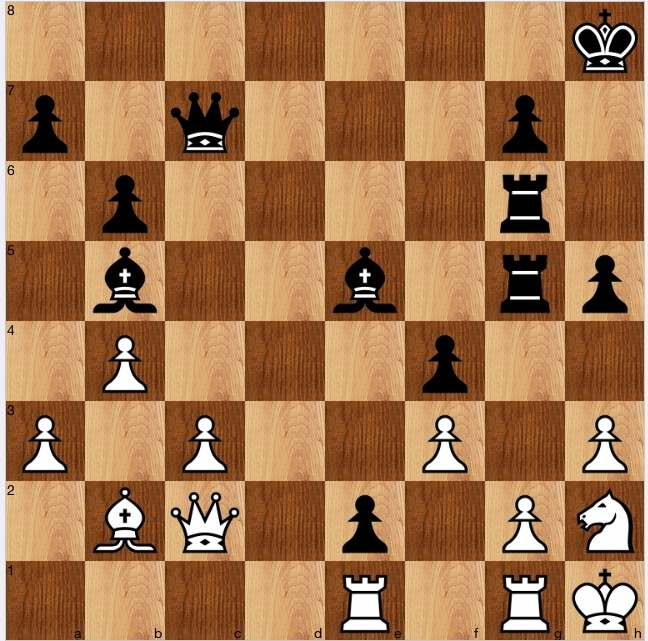
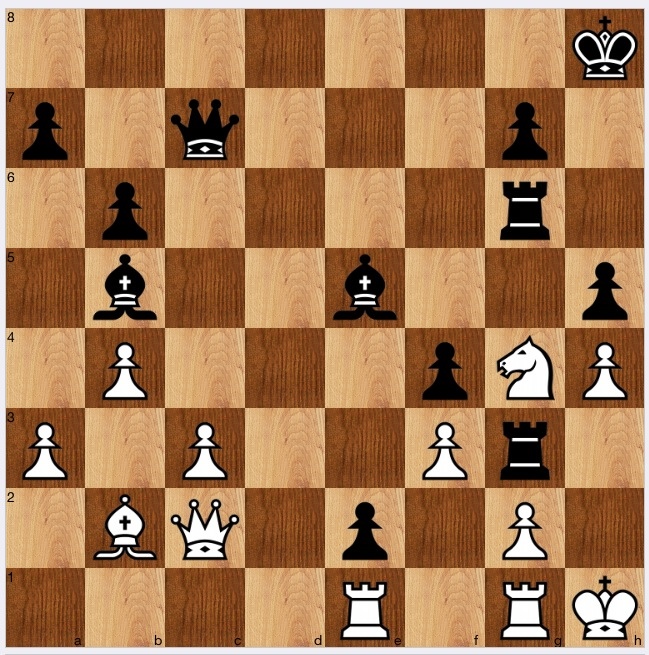
Reitstein's rubric says that white tried the swindle 1 h4 ‘a move not without poison' whereupon black played the expected 1…Rg3, whereupon Wolpert immediately replied 2 Ng4, the point being that the Rg6 is now undefended. Reitstein then says that Black's reply was both pretty and lethal. The puzzle position in the book is as above, but I have shown the position after 2 Ng4 below.
Black to play and win
J Wolpert v AA Ponelis 1969
Solution
Reitstein gives the solution as 1…Bd3!!, a move I never even considered. The idea is that after 2 Qd3 R6g4, the f3 pawn is pinned: so, another example, if one is needed, of examine all biffs.
Whilst 1…Bd3!! is indeed startling and strong, even stronger is the 'normal' 1…R6g4, the first move I thought of (and, of course, it is also an examine all biffs move). After 2 fg[] Rg4, 3 g3 is forced, when after 3…fg white can only struggle on. For instance, 4 Rg2 Rh4+ 5 Kg1 Bd4+! wins, since the Qc2 is LPDO: the tactic works, or can be more easily seen, by using Purdy's notion of jump-checks: Qc7*Qc2 is a jump biff so that the c3 pawn is pinned.
White to play and win
WP Hirst v I Low 1957
Solution
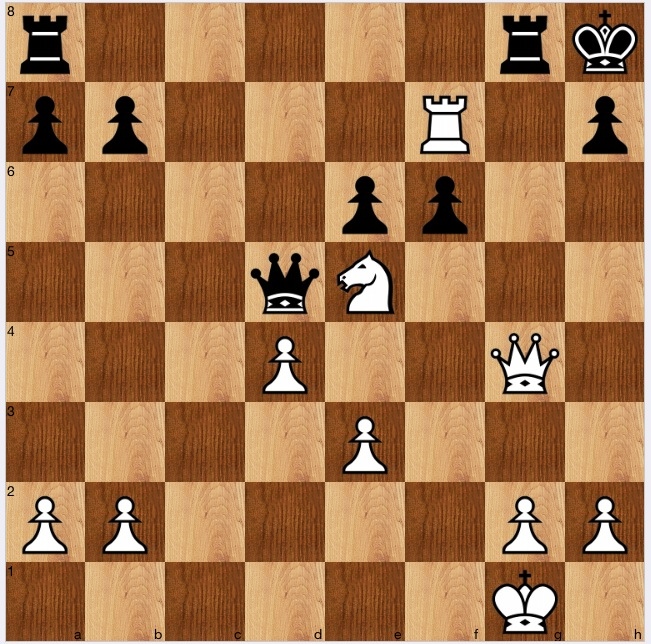
Reitstein's notes say that in the game, white blundered with 1 Qh4?? Qg2mate; but examine all biffs means you have to examine 1 Rh7+ when 1…Kh7[] 2 Qh5+ Kg7, and only a bit of imagination is needed to see 3 Qg6+ mating next move after 3…Kf8 4 Qf7mate, or 3…Kh8 4 Qh6 mate.
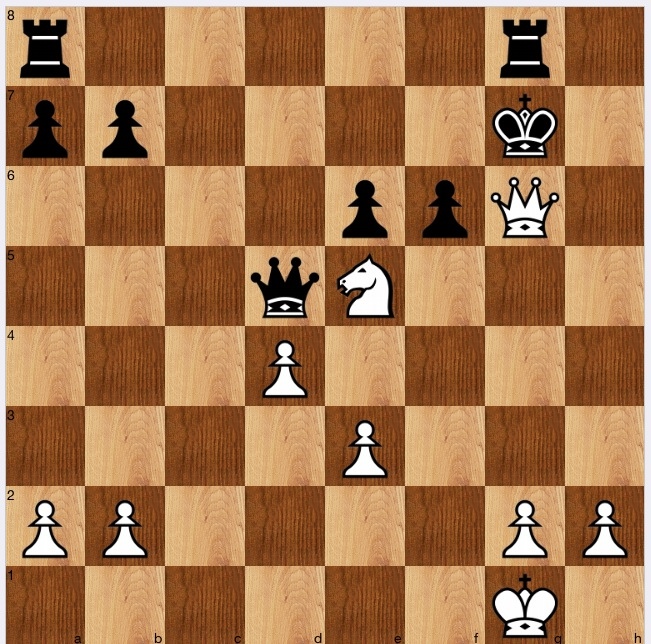
Black to play and win
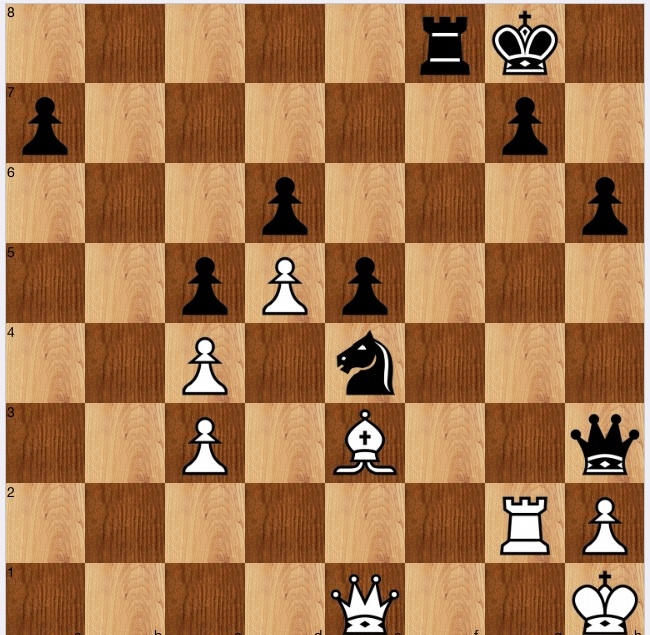
M Bleiden v BE Slegheim 1912
Solution
I saw this one on inspection, 1…Rf1+! noting that after the forced 2 Qf1 (2 Rg1? 3 Qf3mate) the Qf1 is LPDO so that 2…Ng3+ wins it after 3 Rg3 Qf1+, or if 3 Kg1 Nf1 the bishop is en prise. There is a sweet point that if then say 4 Bc1, 4…Ne3 5 Rg3 (forking the N and R) is met by 5…Qf1 mate.
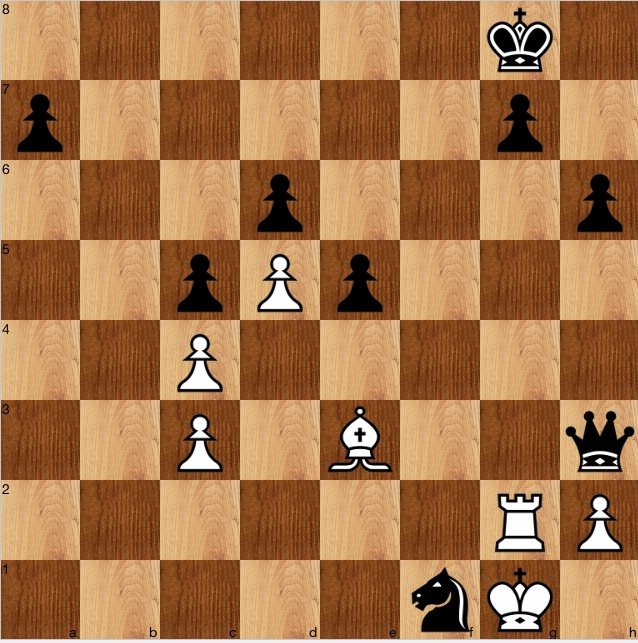
Black to play and win
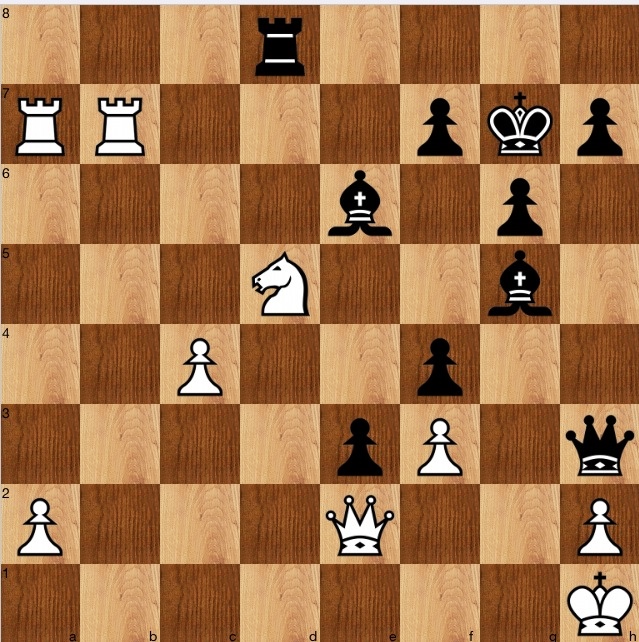
FN Barnett v G Dean 1961
Solution
On one level, fairly straightforward, and Reitstein doesn't give much detail in the answer: 1…Rd5! (examine all biffs) has to be looked at, and after the move played in the game, 2 cd, 2…Bd5 is decisive, and simply so.
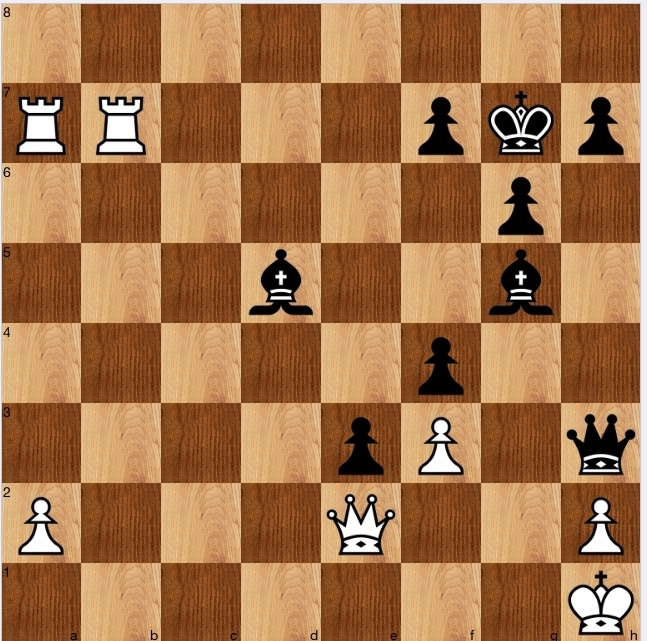
White loses his queen, and there is no perpetual check.
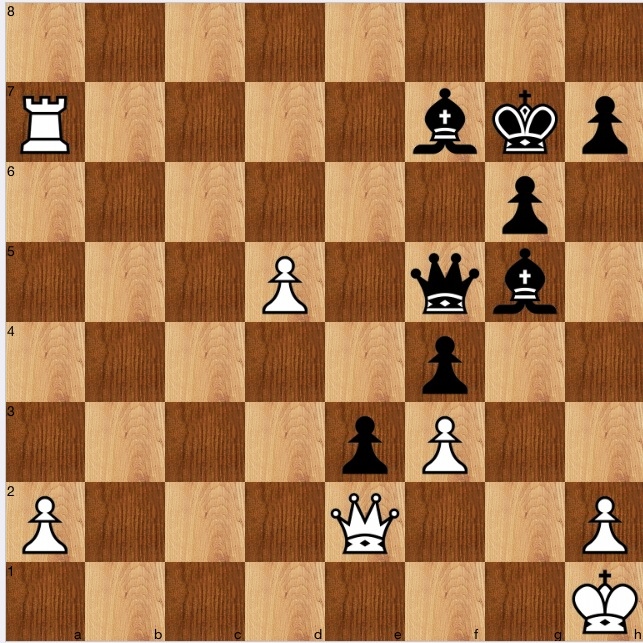
A better defence is to decline the rook by 1 Rf7+! Then, 1…Kg8?, pretending to be safe, is a blunder, with equality after 2 Rg7+ Kf8 (2…Kh8?? 3 Rh7 and white wins) 3Rh7 Rd2![] with equality. Instead, black must play 1…Bf7! when 2 cd Qf5 is, according to the engines, -6 or so, but it looks more uncertain to me: plenty of scope to mess up if playing black against Carlsen. I can too why it is stated to be winning (3 d6 Qc5) but some scope to mess up.
Black to play (after 1 Be8)
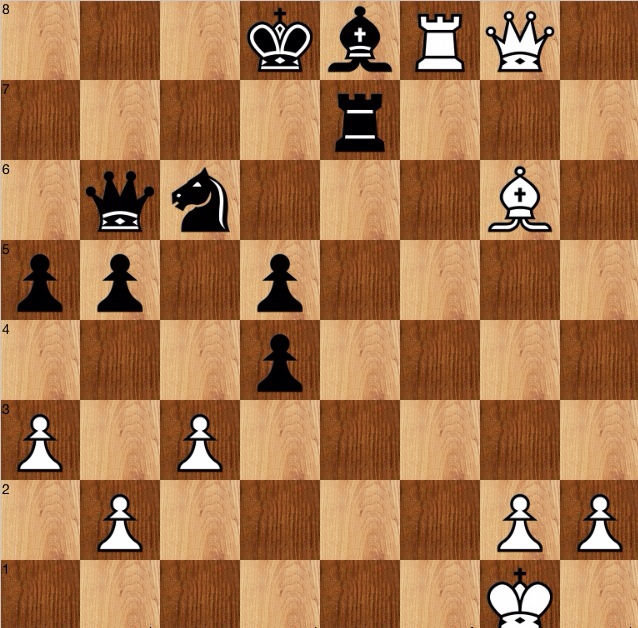
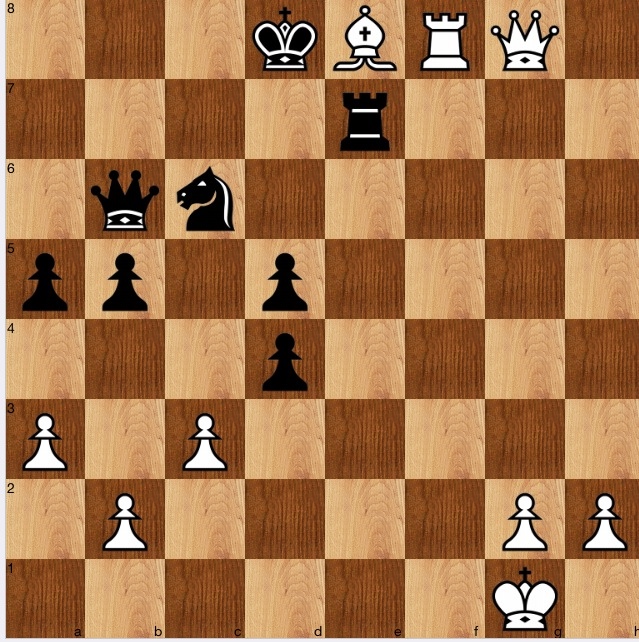
Reitstein says 'Gannholm sacrificed a piece to reach this position. He can regain it now with 1 Re8+ or the move he played, 1 Be8. Did he make the right choice?
After 1 Be8
T Gannholm v DP Laurie. 1977
Solution
Alas, I failed with this one, thinking that 1…d3+ was the solution, the idea being that after 2 Kf1[] Re1+ 3 Ke1[] Qe3+ 'there might be something': high quality thinking, as you can see. I saw 4 Kd1?? Qe2mating, and only briefly looked at 4 Kf1[] Qe2+ 5 Kg1[] and lazily thought there was a draw by 5…Qe3+, but in fact after a bit of dancing with queen and rook, white wins: 6 Rf2 Qe1+ 7 Rf1[] Qe3+ and the king scurries away to safety with 8 Kh1, and the d3 pawn doesn't promote. This was poor of me, and I should have been able to try harder and see 1…dc+! 2 Kf1[] Re1+ 3 Ke1[] Qg1+! 4 Ke2 (4 Rf1 Qe3+ 5 Kd2[] Qe2+ and mates) Nd4+ (the point) 5 Kd3[] Qd1+ 6 Kc3 (6 Ke3 Qd2 mate) Ne2 mate.
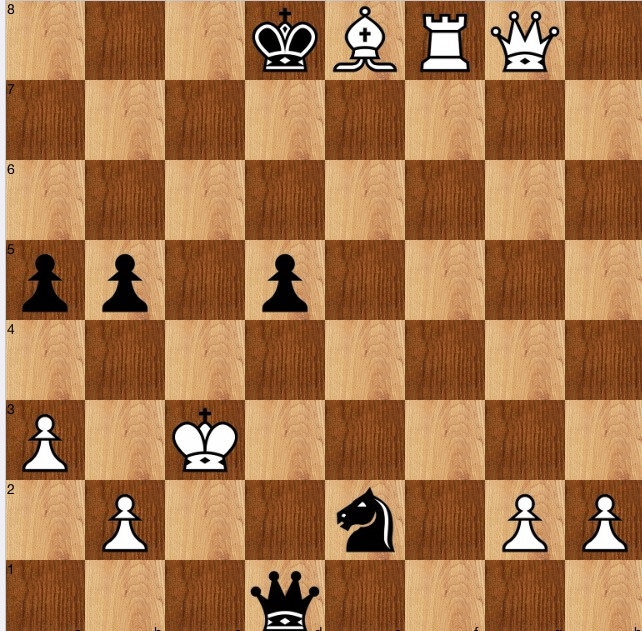
Whilst quite long, most of white's moves are forced, so my school report for this puzzle is 'should try harder'.
White to play
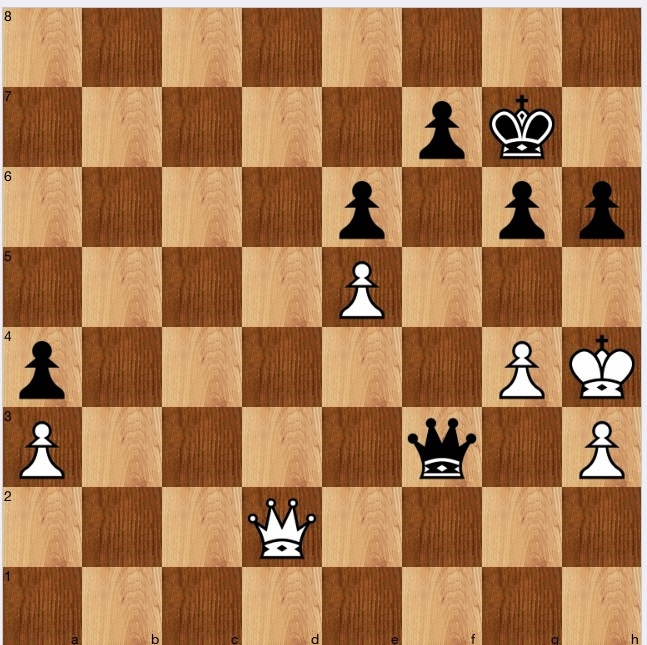
A Friedmanm v AW Paterson 1962
Solution
The purported solution is fairly straightforward, knowing it is a puzzle (provided readers noted the heading wasn't '…and win'.
1 Qh6+! Kh6 2 g5+ K any 3 Stalemate.
However, 1…Kg8 is considerably better. If 2 Qd2, then 2…Qa3, and black is probably winning, whilst if 2 Qc1, Qf2+ 3 Kg5[] Qd4 and one of the pawns drops off.
Reitstein's solution says that Friedmann has his moment of glory as a result of the stalemate: alas, that lasted fifty years, or so it seems.
White to play and win
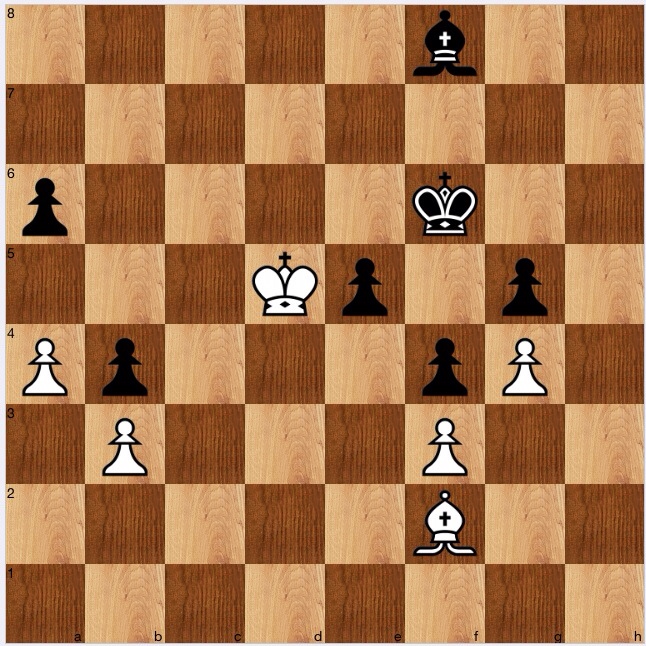
D Macfarlane v F Koronstenski 1979
Solution
Reitstein says that black offered a draw in this position, and white accepted. But 1 Bb6! isn't too hard to find, and black's pawns drop off. Making it (the acceptance of the draw) worse, 1 Ba7 wins similarly. The idea of both moves is to move the b8-h2 diagonal, biffing the e5 pawn.
White to play and win
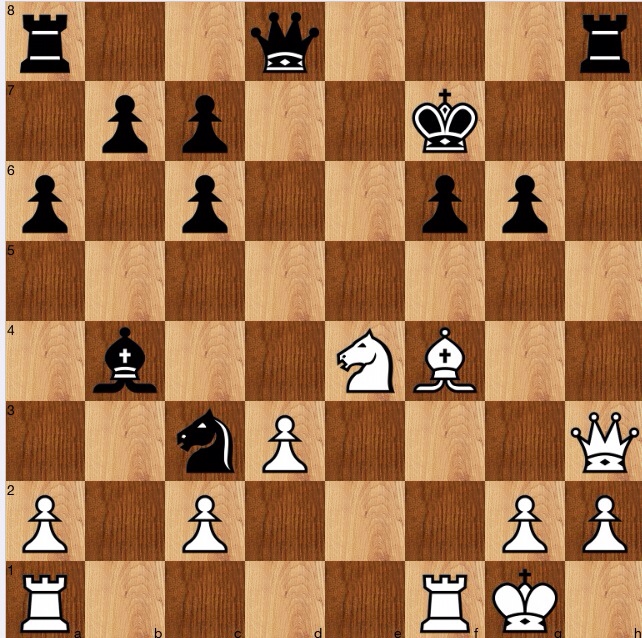
D Friedgood v A Haller 1970
Solution
Consider all biffs leads to 1 Ng5+!, when if the knight is captured, the best move is 2 Be5+ winning the house. Also, 1…Kg8 lets the queen in with check, 2 Qe6+, and mate follows, so 1…Kg7[] 2 Ne6+ Kg8[] 3 Qg4!, a slow move but one which overwhelms black.
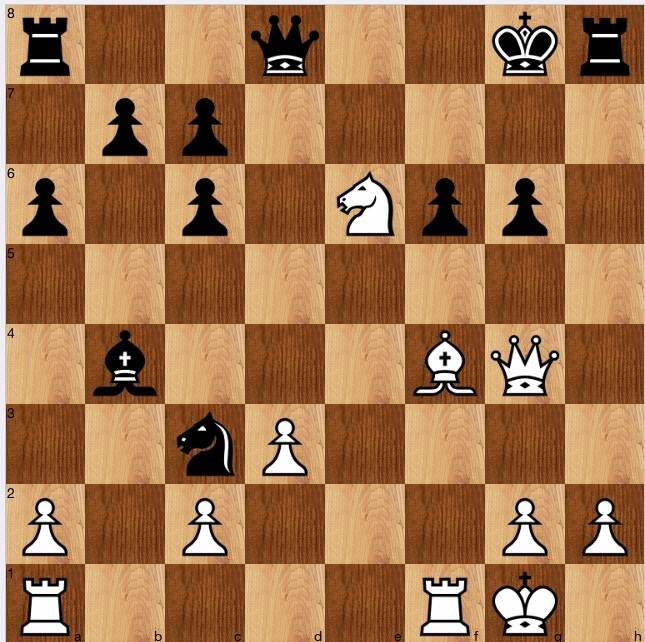
3…Qe8 is forced, to defend g6, when 4 Nc7 Qf7[] (again, to defend g6) 5 Be5 1-0.
 allanbeardsworth