It's the annual Bookbinder family weekend at our house, where Jane's three brothers and their families descend on our house: one of our nicest weekends of the year, since we all get on so well.
It is also normally the one football match I watch each year, since the Bookbinder males are avid soccer fans; and I don't want to appear too unmanly by not watching it. (Though truth be told, and between you and me, I spend most of the match (i) reading the newspaper; (ii) using my iPad; (iii) resting since the Bookbinder DNA includes a late night drinking gene. I should also add that the thing which most attracted Jane to me was my total disinterest in sport in general and soccer in particular: her mother had also been, in modern parlance, a 24/7 sports watching fan.
From time to time I look back at YouTube videos which appeal to me: mostly those which have home viral.
Here are a few that I can remember, starting with a very recent one. The links work at the time of posting this blog.
Vicar signs Hallejulah at wedding
My god daughter and her sister and brother singing and dancing to Singing in the Rain, at our cottage in Rosthwaite, Borrowdale. Particularly apt since the neighbouring hamlet is the wettest inhabited place in Britain, and Rosthwaite can't fall far short.
Chris Hadfield singing David Bowie's Space Oddity from the International Space Station.
Cinnamon challenge: really weird.
Dog eats bacon, or doesn't eat bacon.
President Obama plays basketball.
Ella Henderson X Factor Cher: do you believe in love. My favourite X Factor moment.
Paul Potts first audition.
Little Becky rings the demolition company wanting to blow up her school.
And finally, since Arsenal and Wigan are now 1-1 in extra time, this football penalty.
 Posted with Blogsy
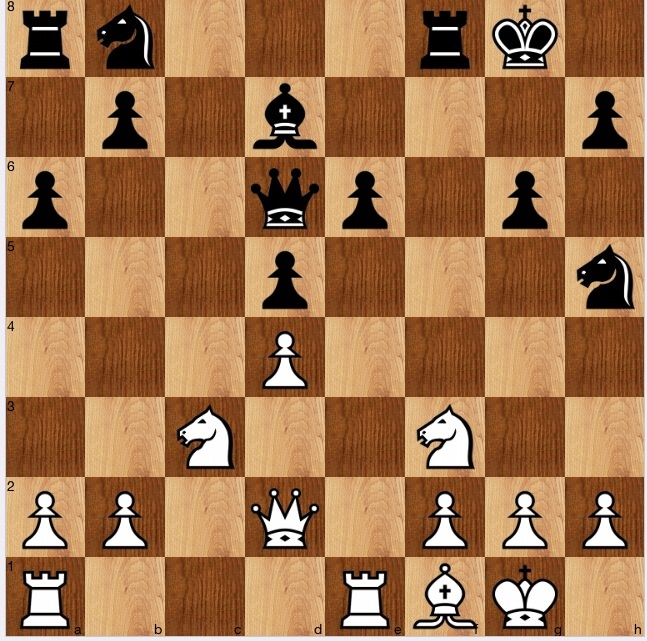
I always enjoy Mickey Adams' Daily Telegraph column. Time and again there are little, priceless, snippets in his game commentary. Today's article, featuring a nice positional won by Lawrence Trent against M Colpe in Hamburg this year, was particularly good.
He criticised black's next move in the position below. Alas, if I were black, I too might have played it.
Black to play: what would you play?
Solution
If I were black, I would probably the move Mickey recommends, 18…Nc6, to develop a piece and connect the rooks. I would though consider the move black played, 1…b5?, which Mickey says is 'the shot in the dark is a serious positional error, weakening squares on the queenside for no reason'.
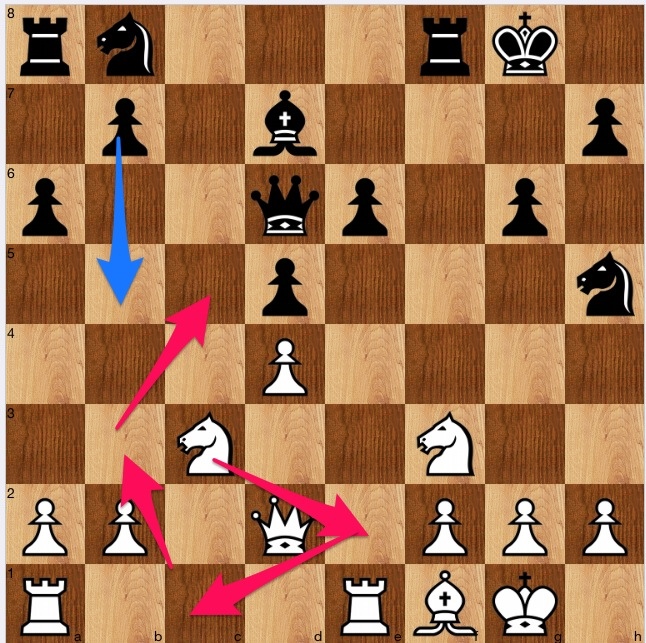
Alas, it wasn't obvious to me why Mickey so criticised the move: I can see why now, having played through the game and understood it, but prior to that, I would think it had some sense to it, expanding on the queenside and preparing to biff the Nc3. However, the Nc3 is not well placed, and biffing it probably just moves it to a better square.
In fact, the reason 18…b5? is bad is that it weakens c5: and white's knight can go on the circuit Nc3-e2-c1-d3 (or b3)- c5 from where it is impregnable, due to b7-b5. And if, as in the game, the black B moves to c4 to swap off the N when it reaches either b3 or d3, then all that has happened is a black piece, the B, which had a role of defending the Pe6, is swapped off for a white piece, the Nc3, which didn't have a function on that square: net effect, an advantageous exchange for white.
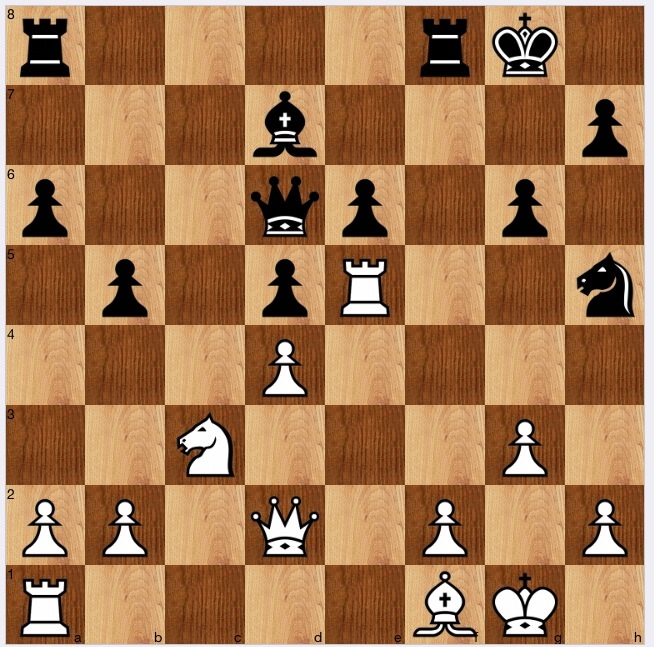
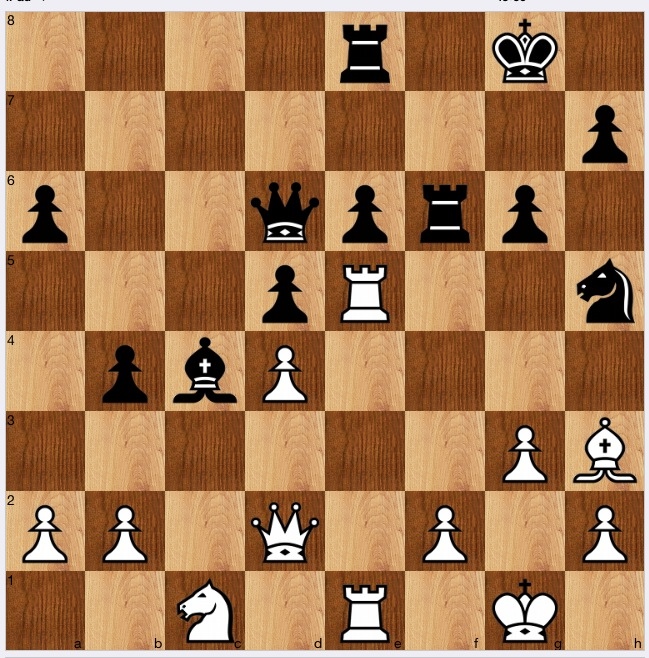
The game finishes with some tactics: a typical conclusion after the slow build up of pressure.
Black to play and win
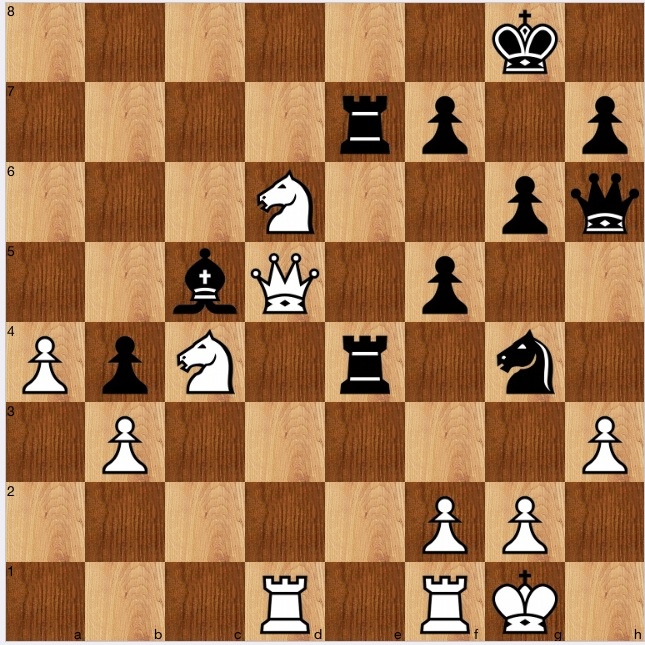
Miles-Hodgson, Zaragoza 1993
Solution
I found this one hard to spot, but applying the mantra consider all threats to biff and biffs includes checks) then 1…Qf4!! was found. White's only try is 2 hg (2 g3 Qg3+, and the f pawn is pinned) when 2…Bf2+ 3 Rf2 (3 Kh1 Qh6 mate is an unusual version of back rank mate) 3…Re1+ and 4 Rf1 Qf1+ 0-1
White to play and win
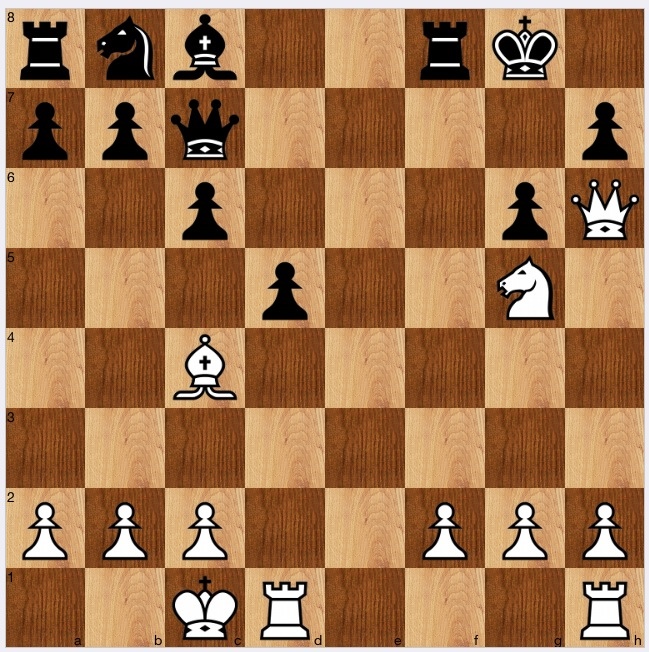
GS Miller v J Wolpert 1958
Solution
Fairly easy today: 1 Rd5! is a natural biff, and it is fairly straightforward seeing that it works: 1…cd 2 Bd5+ Kh8 3 Qf8mate. Black's last move before the diagram was Qd8-c7??: far better would have been Qe7, protecting the Rf8.
I have read the Daily Telegraph chess column for the best part of forty years. Of course, I don't get the newspaper every day without fail, but I have rarely missed a Mon-Fri edition in the last twenty or so. Nowadays written by my friend Malcolm Pein, it is the reason I get the newspaper.
On rare occasion, such as today, I am mentioned in the article. Malcolm analyses a brevity which I drew to his attention through this blog.
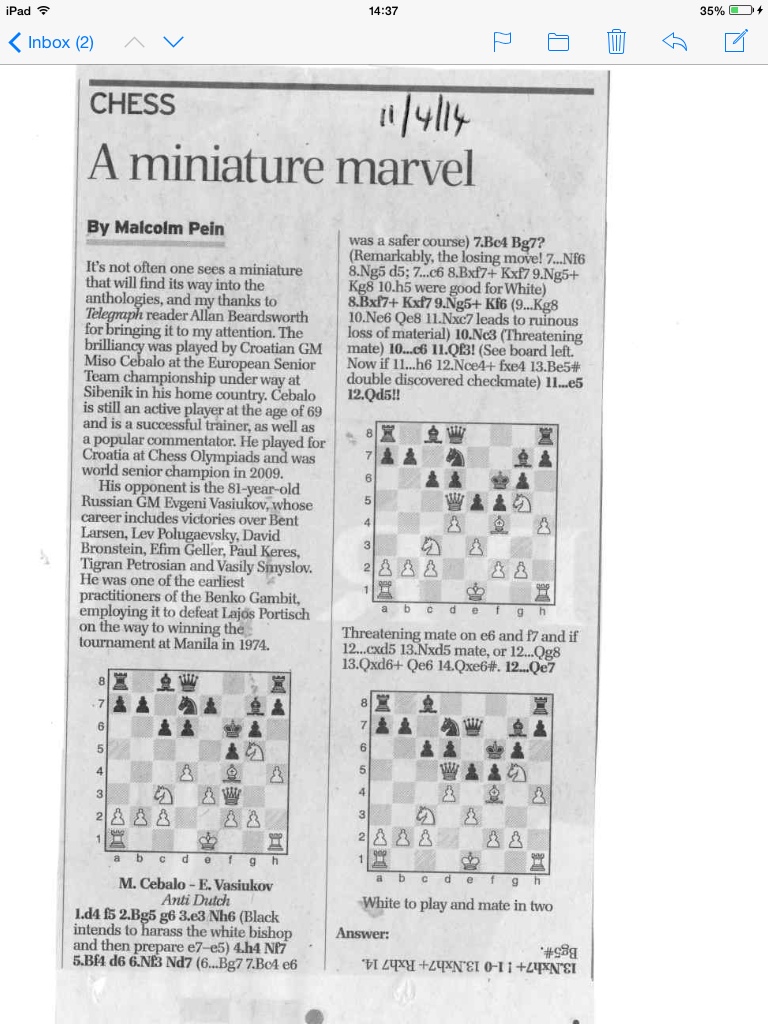
White to play and win
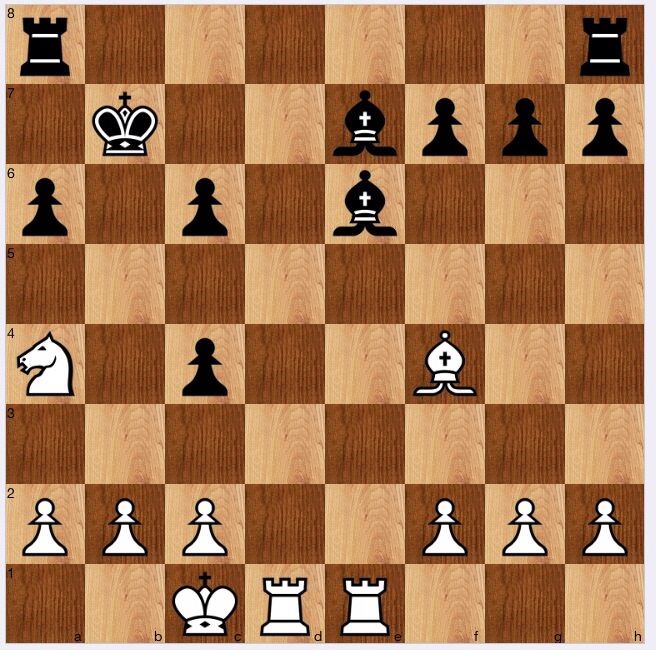
S Lewis v I Bekerman 1956
Solution
A rest day today, 1 Re6! is an obvious try, to clear the defence of d7, so that 1…fe 2 Rd7+ at least is a fork of the king and the LPDO Be7: but then it is noticed that after 2…Kc8[] 3 Nb6 is mate.
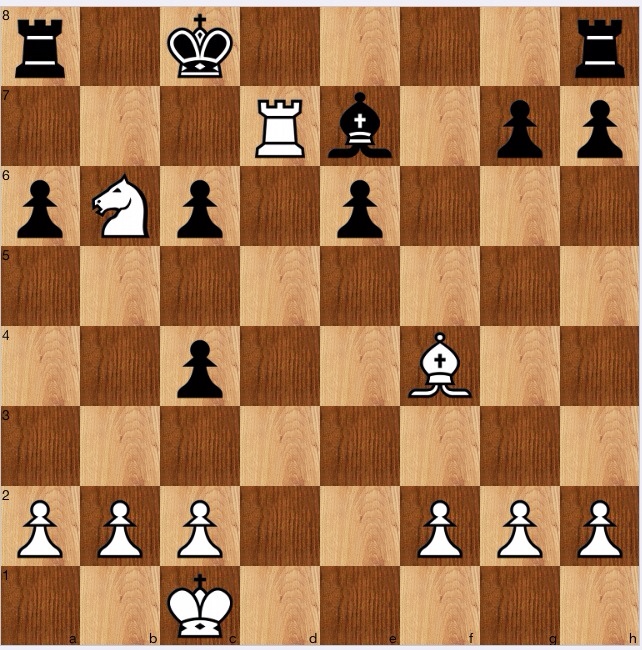
Black to play and win
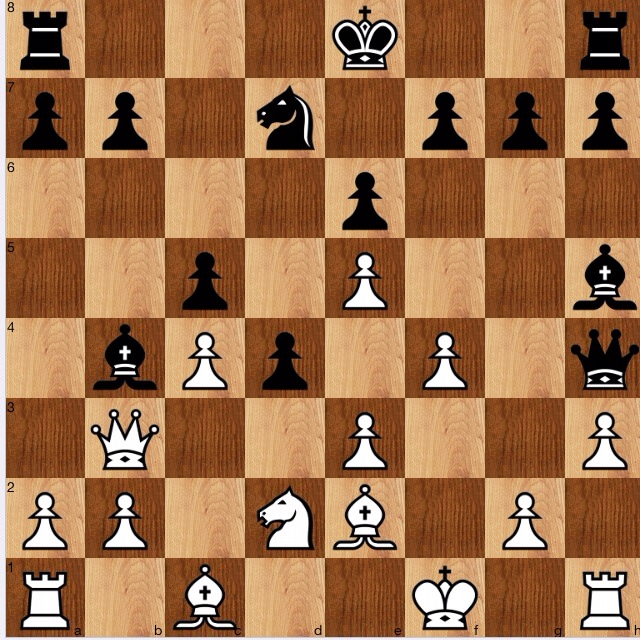
M Bileden v A Chavkin 1920
Solution
I didn't solve this one, and certainly wouldn't have found the solution had I being playing black in a game.
The clue given by Reitstein said that white had overlooked black's brilliant reply which made me look for something special. After trying various moves, I landed on 1…Bc3!, which isn't bad, and after 2 ed! Bd4 at least black's bishop is improved, but black certainly isn't winning after 3 g3 pushing black back. I didn't do well on this puzzle, being pleased with myself that the 'main' line, 2 bc? is poor, being met with by 2…de 3 Ne4[] Qf4+ and black has a good advantage. I lazily assumed that 2 ed Bd4 was a bale out solution.
Alas, I never even considered 1…Qg3!, its point being 2 Bh5 de, when the Qg3 defends the e3 pawn, so it is game over: 3 Ne4 Qe1 mate. If instead 2 ed, then Be2+ and the LPDO Rh1 drops off.
I wonder if any of my readers solved this one, and if so, by what process or reasoning did they find the move?
I am over fifty, so my answer is yes. As a mathematician cum engineer, who I am to say this (I once had a client who owned and ran one of the UK's premier writers' magazines: writing to him was sheer terror; I do not know my gerunds from my subjunctives, and he preferred the active to the passive, as he would often, but politely, remind me). But getting some of the basics right is still useful.

My late mother was for ever spotting typos in shop windows, and whenever I see them (all the time) I think of her: I think I have genetic pedantic syndrome. This blog explains some of the symptoms.
Reminder: the problem (and there is a catch) was White to play and win
But does he?

After 1 fg, can black defend?
Solution
Yes, he can! As I normally do, I wrote the earlier blog up before checking with an engine, and then, when solved, entered the position into Stockfish, my engine of choice on the iPad. Immediately, it showed 1…e4!! assessing the position as somewhat better for black.
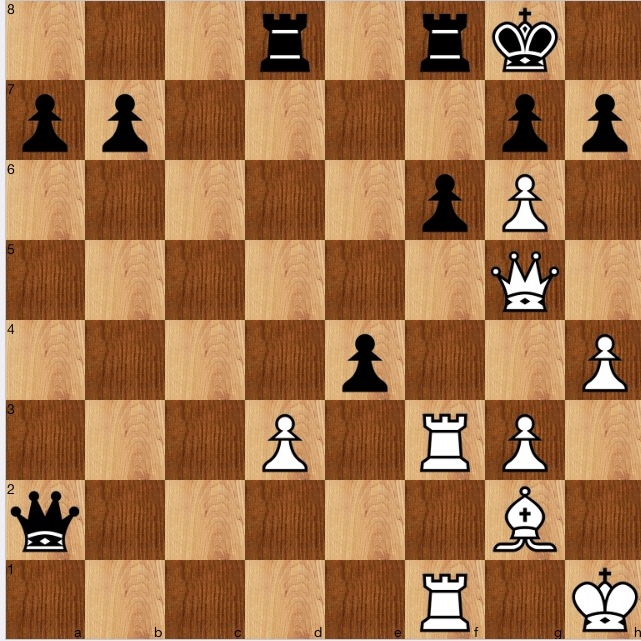
This is a telling example for me. Examine all biffs and ignoring threats isn't just for attackers, they are Purdy mantras which can be used in defence too.
In 1969, black of course missed 1…e4!!, playing 1…fg?? as I would have done, no doubt, and Reitstein didn't spot the magical defence, as neither would I.
The annoying, perplexing, amazing thing about chess is that as soon as 1…e4 is revealed, it becomes obvious. White's queen and rook are both biffed, and if 2 gh+ Kh8; 2 Qh5 hg; and the Qa2 (as well as the Rd8) defend the square d5, so white has no escape check.
The point of 1…e4!! is very deep, and lovely. 2 de fg! 3 Rf8+ Rf8 4 Rf8+ Kf8 5 gh no longer wins:

With the pawn no longer on e5, black has 5…Qa1+! 6 Kh2 g6! defending h8. Beautiful.
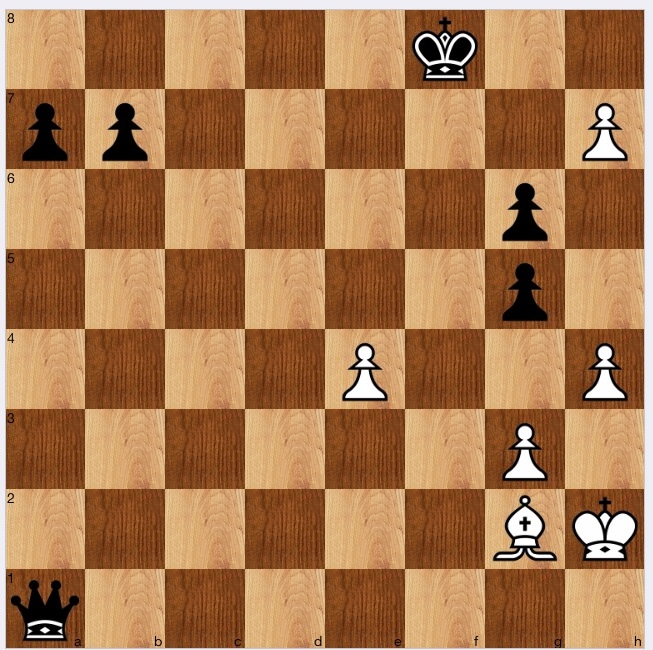
The time to give up chess is when seeing this doesn't cause you to smile.
White to play and win

(There'll be more to say about this puzzle- see my next blog, but for the moment, look at this one carefully)
I Glenn v AA Ponelis 1969
Solution
Not too hard today, at least if you know, as we do, that it is a problem with a solution. In a game it would be natural to simply move Q-somewhere, but knowing it is a problem, sacrificing with 1 fg! is a move that has to be thought of.
A Purdy player would examine fg anyway: examine all biffs, or ignoring threats, being two of his mantras.
So, 1 fg! gf[] 2 Rf8+ Rf8[] 3 Rf8+ Kf8[] 4 gh and the pawn queens. Black has just one spite check.
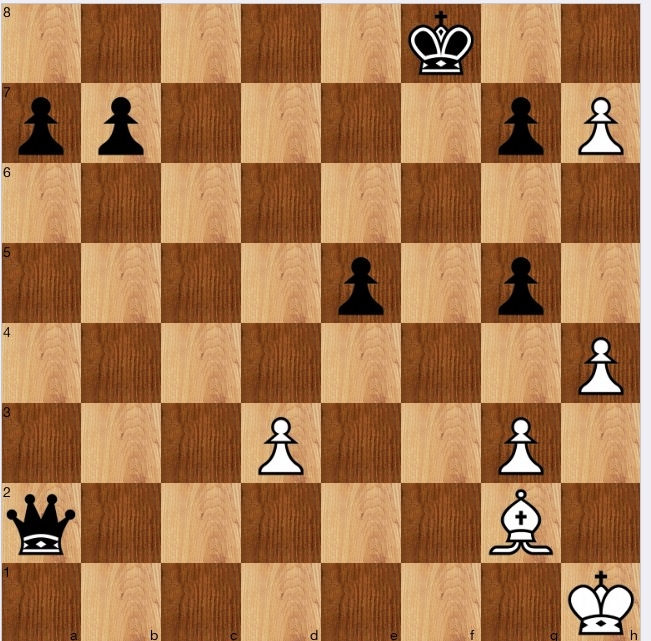
As noted above, though, there is more to say about this puzzle….
 allanbeardsworth