I saw a colleague today who is thinking of leaving my firm.
If I had one more chess book for every time over the last twenty or so years that I have had such discussions, I would be a very happy man (a man can never have enough chess books, even when he has over 500). But today's was different, memorable and special. For the colleague, who I like a lot, didn't seem to have a good reason to leave us and yet possibly, perhaps probably, will.
I would like to say I followed a firm approved methodology, perhaps learnt from an HR or similar course; but I didn't: I just talked to her, or, rather, we just talked to each other. That was a few hours ago, and since then I have hardly thought of anything else, and had to blog to try to sort out in my own mind what I am thinking.
Black to play: what result?
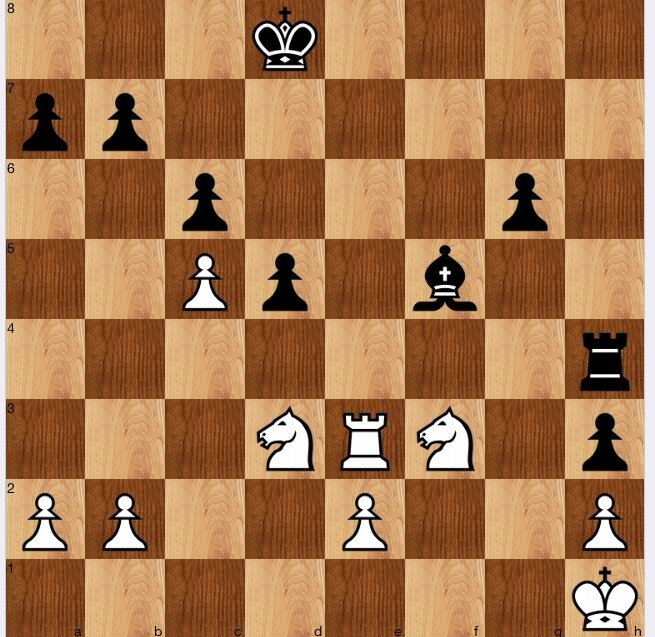
G Dean v GS Wallis. 1962
Solution
White's last move was Nd2-f3, no doubt expecting the rook to retreat, but 1…Re4! is not too hard to see, when white is forced to play 2 Re4 de, forking the two knights: an unusual occurrence of Purdy's potassium cyanide which I have blogged about previously.
Not too hard today: even if Re4 weren't seen on inspection, it would be seen by employing Purdy's examine all biffs mantra.
 Posted with Blogsy
Black to play and win
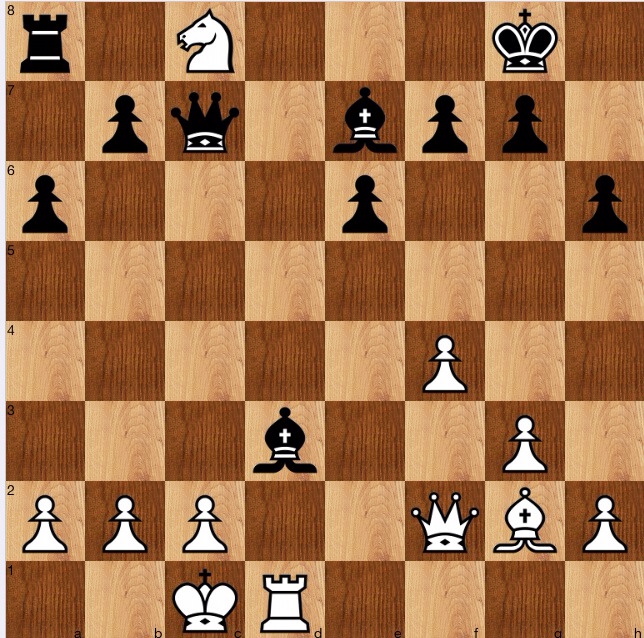
H Pfeiffer v A de Olivieira Dias 1960
Solution
Having seen that 1…Rc8 2 Rd3 is nothing, and tried 1…Bc2?? 2 Ne7+ 1-0, something else has to be found. Because of the threat of Ne7+, a bishop move is obvious, and so 1…Ba3??, 1…Bf6 were considered before seeing 1…Bc5, hitting the queen, which I then saw had the key function of defending c2: so 2 Qd2 Be3! and the pin decides the game.
Just returned to our cottage in Borrowdale, in the Lake District.

This is where we walked today: a view from near Derwentwater towards Grange, a neighbouring village to ours.
However, it didn't look like this today, and in fact we couldn't see Grange in the torrential rain and mist. Seathwaite, a mile or so away, is official the wettest inhabited place in Britain, and today was one day why. Still, we are home and dry now, recovering, which for me includes looking on Playchess for today's chess.
One game struck out: a thirteen move crush by Miso Cebalo against Evgeny Vasiukov in the European Senior's Team Championship. The position below is a nice puzzle: previously (and will be shown in the solution below) there was a standard Bf7+ sacrifice, pulling out the black king with a subsequent Ng5+ and a threat then of Ne6 biffing the queen, but the finish is unusual, and pretty.
White to play and win

Solution
The solution is very pretty,vans unusual: 1 Nd5+ would be pretty standard, and indeed wins, but white played 1 Qd5!! which threatens both Qe6 mate and Qf7 mate, so that black must either play Qe8 or Qe7, both being met the same way- black played 1…Qe7 when 2 Nh7+! and black resigned: 2…Rh7[] 3 Bg5 mate. (There is only an absolutely trivial difference between 1 Nd5+ and 1 Qd5! – with the former, after 1…cd 2 Qd5 black can drag the game out with 2..Qa5+: so the puzzle is easy, but full marks to Cebalo for finding the accurate finish).
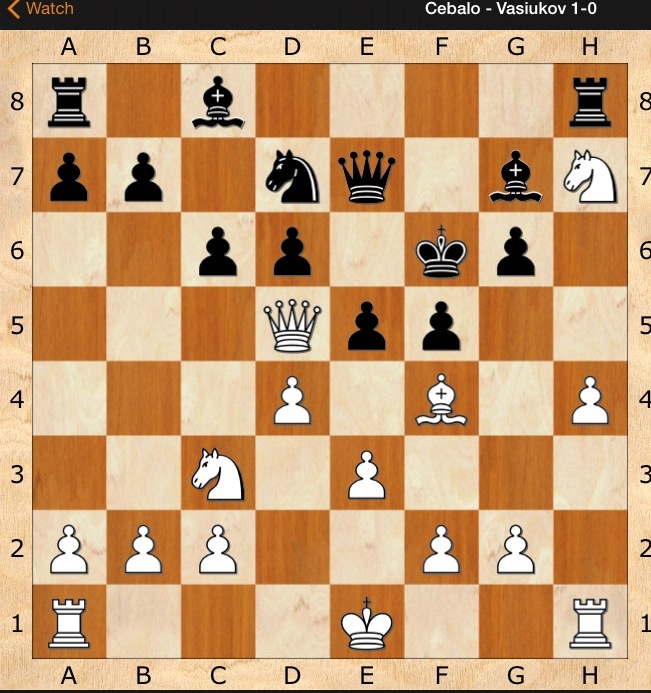
The full game score, and position after the blunder 7…Bg7?? is shown below.

Desert island Discs came up in two conversations recently. Firstly, this is not surprising, since in my case I only have n things to talk about, where n is not a very large number.

(There is an attempt at humour here, though Jane will use this, if she sees this blog, against me, to explain the suffering she endures)
One: I gave an internal talk at work recently and in passing mentioned Desert Island Discs, my favourite programme on Radio 4. A colleague who will remain unnamed asked 'is that the channel with no music on?' and I gave the correct but incorrect answer 'yes': incorrect of course because of the very said programme. (For colleagues who read this blog, the said colleague is (i) the life and soul of the tax department (ii) former deputy head girl at the girls' division of my school (iii) Greek Cypriot. Those clues might help her be identified)). Thank you, Théa Gibson, for making me feel old.
Two: A very close friend of Jane and mine happened to tell me recently that one of her favourite programmes was also Desert Island Discs. She asked me which my favourite episodes were, and this has set me thinking, and was the ultimate trigger for this blog posting.
White to play and win
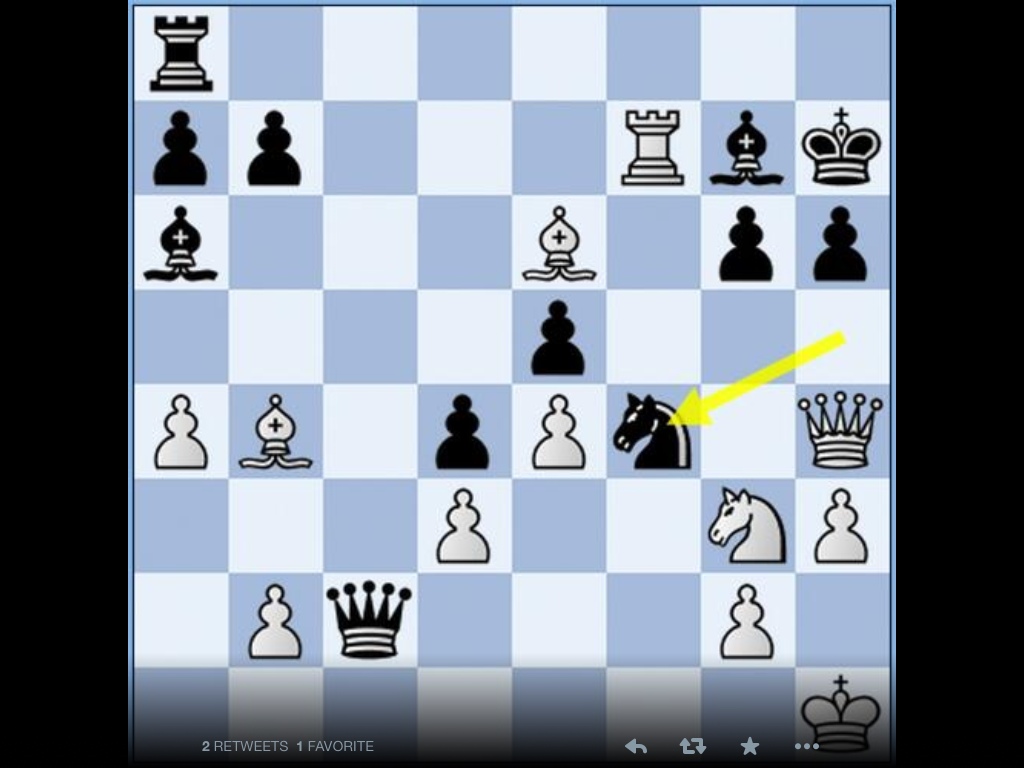
Simon Williams v Alina Ami 2014
Solution
Simon played 1 Rg7+ Kg7[] but then missed the glorious 2 Bf8+!! when 2..Rf8 3 Qe7+, takes the rook! and mates. Or if the bishop isn't taken, Qh6+ mates simply.
Yet another example of Purdy's consider all biffs.
White to play and win
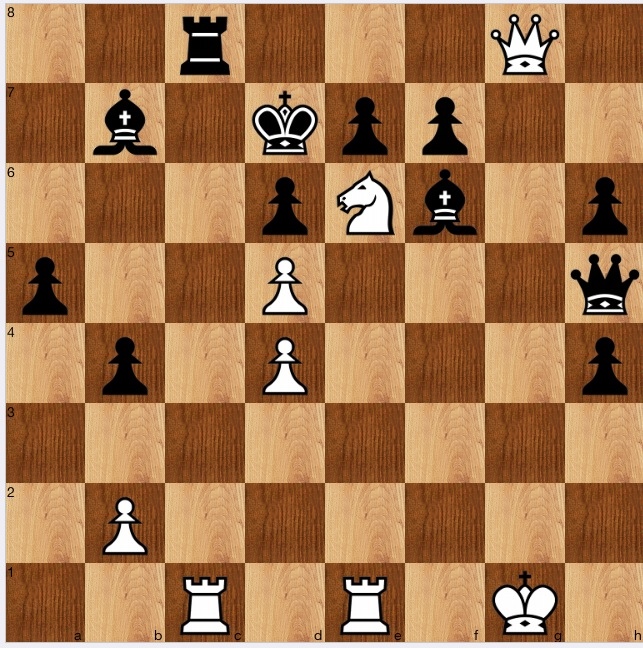
PJS Robbertse v P Hangelbroek 1979
Solution
Another trivial one today: 1 Rc7+! forces 1…Rc7 when 2 Qd8 is mate.
Black to play and win
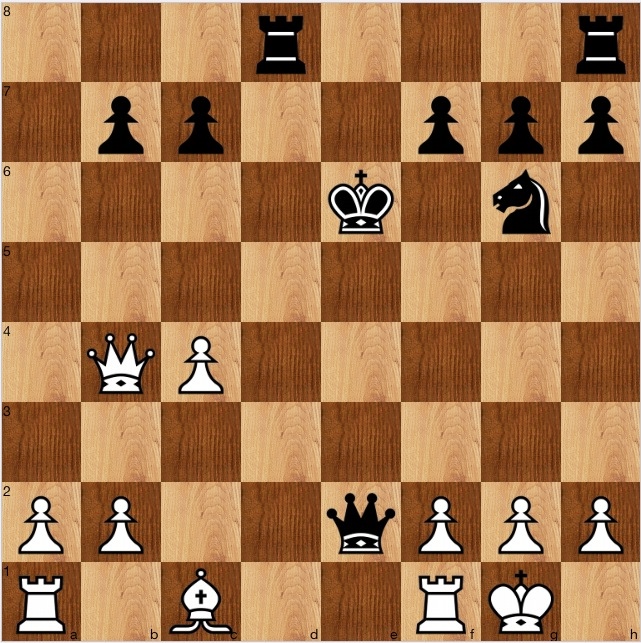
M Wright v F Korostenski 1977
Solution
The easiest problem in the book so far: 1…Rd1, and mate in a move or two.
White to play and win

M Hebden v T Andersson 2013
Solution
This took me longer than it should. I knew that the solution couldn't be 1 Bd5- too simple for someone to select it as a puzzle- and yet tried to make it work, then tried bad moves like 1 Rf3, and moves such as 1 Rg3.
Fairly random process really, shame to say.
Eventually I refocused, and applied Purdy principles. Examine all biffs means 1 Rc3+, 1 Rh8+, 1 Bd5 and 1 Bf5+! As soon as I saw the latter, I knew the problem was cracked, with 1…Kd8! being black's best, to prevent 2 Re8 mate, but, then examine all biffs again 2 Rd7+!, which is visually hard to see, but wins of course with 2…Kc8[] 3 Re8 mate.
White to play and win
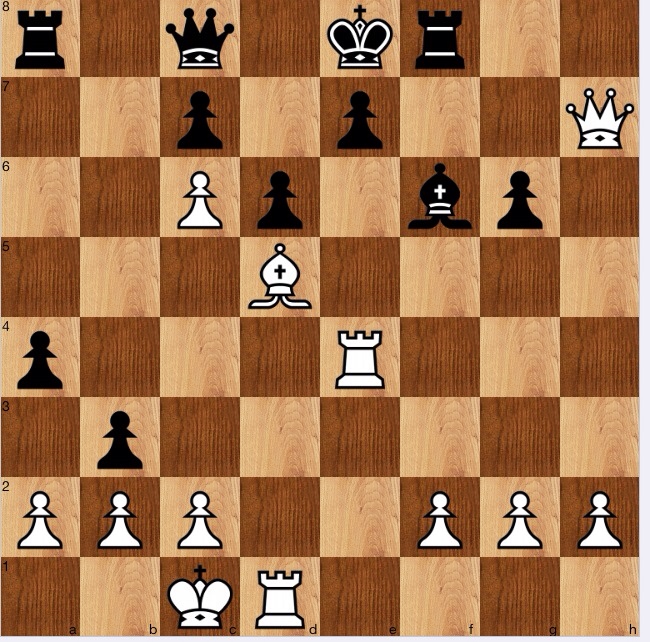
J Tsalicolgou v J Sadan 1980
Solution
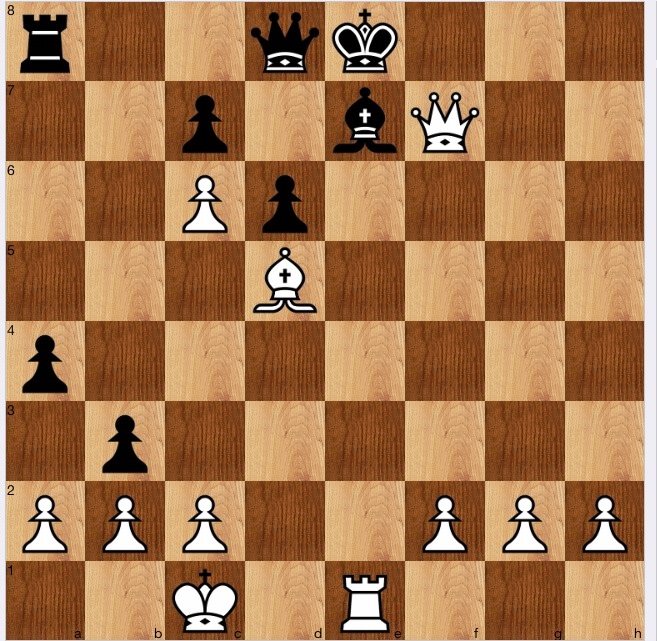
Consider all biffs means that 1 Re7+ is virtually the first move that I thought of, when 1…Be7[] 2 Re1 Qd8[] 3 Qg6+ Rf7[] 4 Qf7 mate.
Not much more to say, except to say that there is a certain falseness in solving these puzzles, especially with Reitstein's background comments. Here, he said that white played 1 Rde1 and won eventually, but missed a way to end the game immediately. This points to the different between real play and problem solving: the former is far harder, and the latter is mere pseudo-practice for it.
 allanbeardsworth