White to play and win
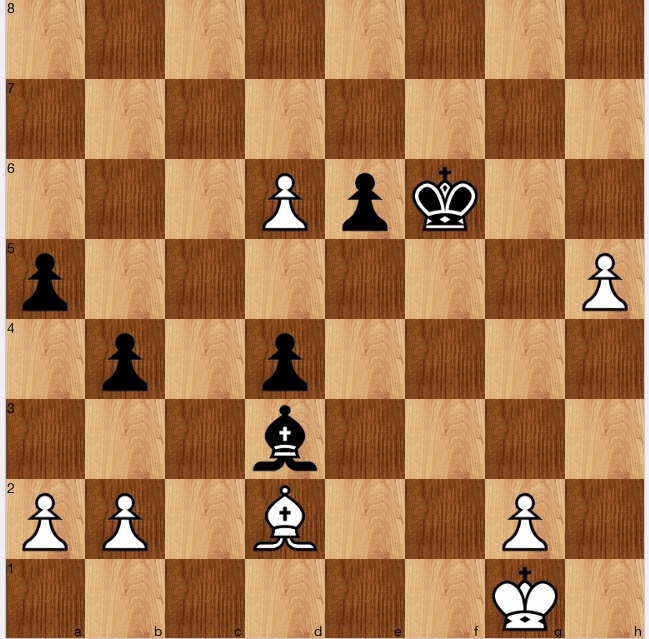
AN Rubinsztein v RT Spencer 1964
Solution
I am not sure if Purdy's maxims apply in the endgame, but of course they can be help. Here, with the passed d pawn, 1 Bg5+! was immediately obvious to me, deflecting the King. The bishop is poisoned, if it captured the d pawn advances, but after 1…Kf7 this still happens, 2 d7, and the pawn promotes.
 Posted with Blogsy
Today is a rest day in this year's Candidates tournament.
Of course, chess fans are served brilliantly nowadays with several sites to watch it live (my preference is Playchess.com) and then GM analysis posted within hours of the games having been played (again, my favourite of favorites is Chessbase.com.
When I have time, I also like to look at the game of the day videos on the Internet Chess Club, ICC, and this morning, before the family were up, I watched the videos for the GOTDs of the first three rounds.
I am largely indifferent as to who wins the tournament. I would like it to be Lev Aronian, but he has got of to a shaky start; Vladimir Kramnik, whose energetic play I find a joy to watch; Peter Svidler or Veselin Topalov too; and of course Vishy Anand, who has got off to a superb start, but somehow I can't see him winning, or, if he did, of defeating Magnus Carlsen afterwards.
Two of the three GOTD videos were by my favourite present, Alex Yermolinsky. Alex's commentaries are always deeply instructive, and his video of Svidler-Andreikin was particularly so (as was his explanation of the use of the bishop pair in Anand-Aronian).
I watched parts of Svidler-Andreikin live, and didn't really understand it: Alex has helped me understand some of the subtleties and the great energy and precision of Peter's play. After watching the video, I set the pieces up and looked a bit more into something that had puzzled me, which Alex covers briefly, namely what would have happened if black had taken on e4 after white's Qg3. My analysis shows that it would have been a better defence.
In the position below, white has just played Qd3-g3, unorotecting the Pe4, met by Qg5*g3.
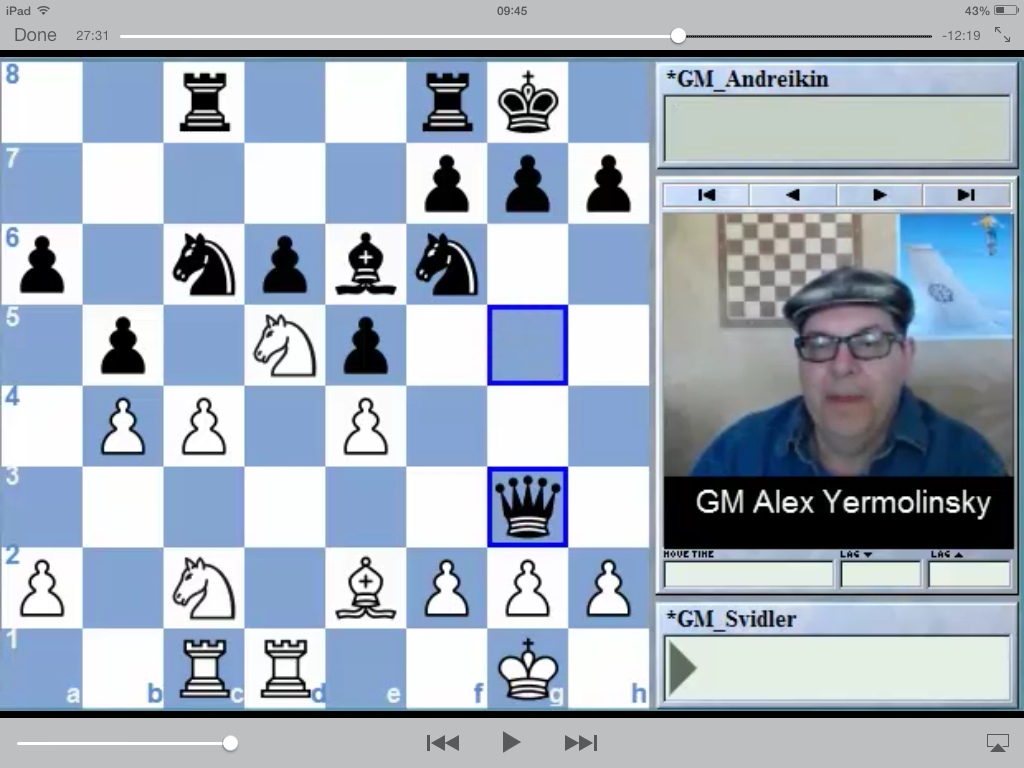
I would have played 1…Ne4 on general principles, not wanting my pawns doubled (white replied Nf6+! in the above position, though the exclam is excessive, since it must be best to break black's pawns). All I would have needed to do is see that the N can't be encircled when on g5.
Of course, chess is always, move by move, a game of choices. Alex's comments are included in the attached game file in which I some analysis of my own to this great game. Had I been playing white there is no chance whatsoever that I would not have frittered the game away: Peter by contrast played a series of great machine-best moves. I hope he does well in the remaining rounds.
http://www.viewchess.com/cbreader/2014/3/16/Game584194906.html
For me, the game of kings is chess (and of queens, bishops, knights and others). The sport of kings is said to be horse racing and I was lucky enough to go to my first Cheltenham Festivsl this year as a guest of Betfred.
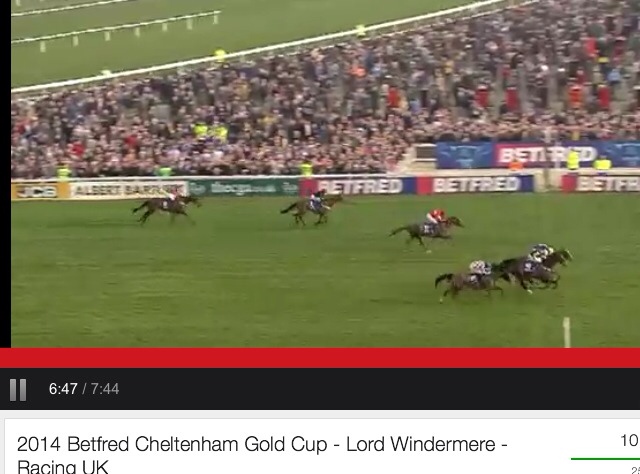
The race of kings was the Gold Cup, won by a neck by Lord Windermere, after a thrilling race, which thanks to YouTube I have watched many times. It is worth watching: http://m.youtube.com/watch?v=PrydSESZnCw
Lord Windermere, whose jockey is in a blue shirt and yellow cap, came from the back of the field to win in the last two fences.
White to play and win
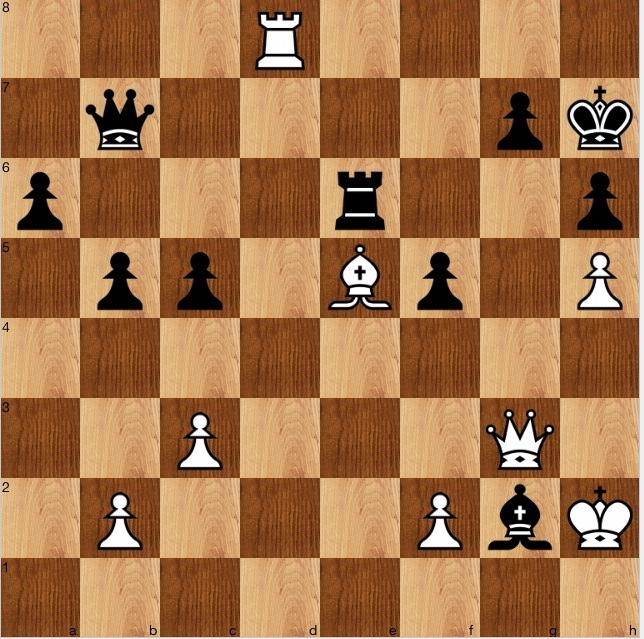
AO Lewinberg v M Euwe 1955
Solution
White missed the chance to beat Max Euwe: 1 Rb8, and the queen is overloaded. If 1…Qa7, 1…Qd7, 1…Qe7, 1…Qf7, then 2 Qg2 or 2 Kg2 wins a piece, since 2…Re5?? 3 Qg6 mate. So 1…f4 2 Qg4 Qf7 3 Bg7! wins the exchange. Or 1…f4 2 Qd3+ and if Qe4 or Be4, Qd8 mates. All the above as in Reitstein's book.
When I entered the position into Stockfish in order to write up the blog, the engine showed 1 Re8! as even better. Probably it is right, its point being 1…Re8 2 Qg6+ and Qe8+, the Re8 being LPDO; then Qg6+ and Qg2: it is 'simpler'.
White to play and win
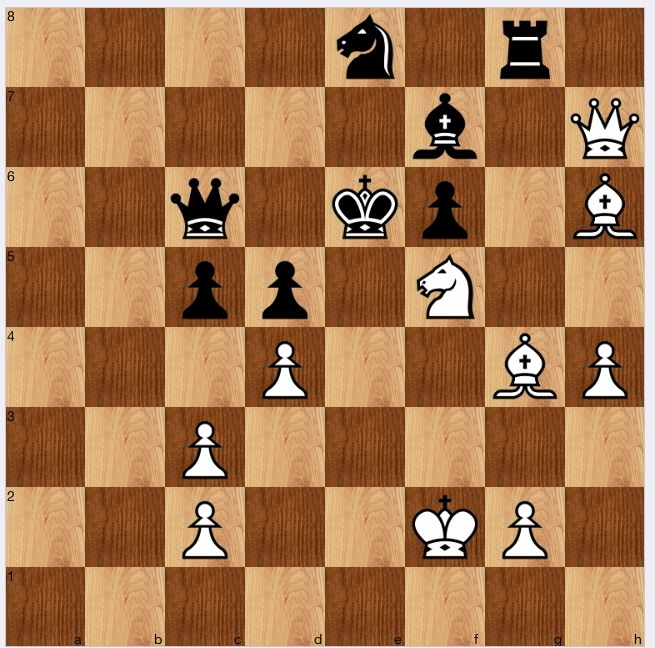
J Glyn v A van Tets 1973
Solution
In the actual game, Reitstein tells us that white missed the win, and I can well understand why: it took me a long time to find the solution, which is optically hidden.
My solving process was something like:
-try to make 1 Qf7+ work
-see if Qg8 works
-see if Ng7+ or Ne3+ are any good
-repeat: -try to make 1 Qf7+ work
-look at Bh3; look at c4
-look if there is a clever place to move the bishops, perhaps h3 or f8
-repeat: -try to make 1 Qf7+ work
Alas, a typical but process for me, but not professional. A true professional Purdy player would look at Nd6+ as part of the process of examining all biffs. D6 is the key square, since knight then is hitting the Bf7.
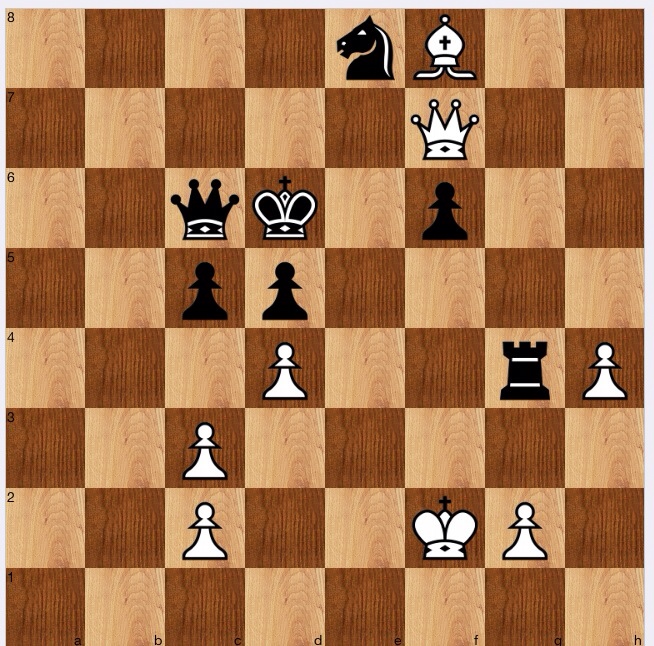
Then, I put the problem aside for a while, looked at it for a second, and saw 1 Nd6+!, seeing instantly it was the solution. One nice line is 1…Kd6 2 Qf7 Rg4 3 Bf8 mate!
Black to play and win
Mate in 5
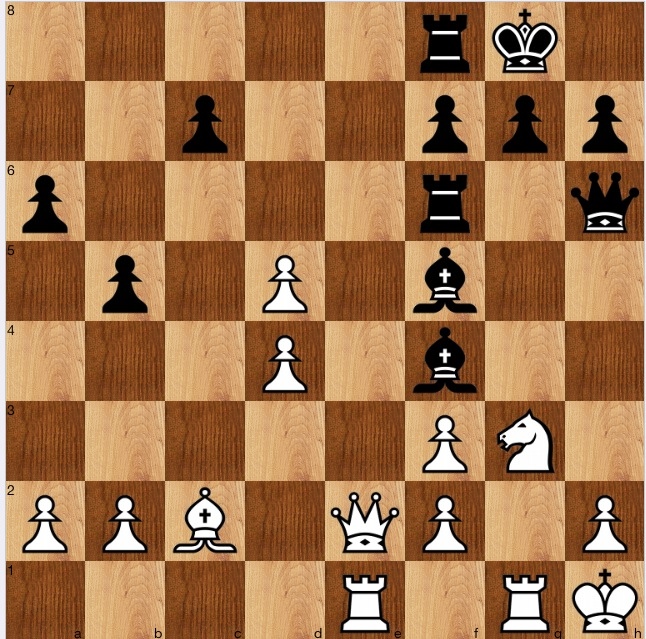
M Kolnik v KF Kirby 1953
Solution
The hardest thing for me on this problem was to find why it was mate in five, not four, but it is. 1…Qh2+ 2 Kh2[] Rh6+ 3 Kg2 Bh3+ 4 Kh1! (4 Kh2 Bf1 mate is what I thought) Bf1+ 5 Nh5 Rh5 mate.
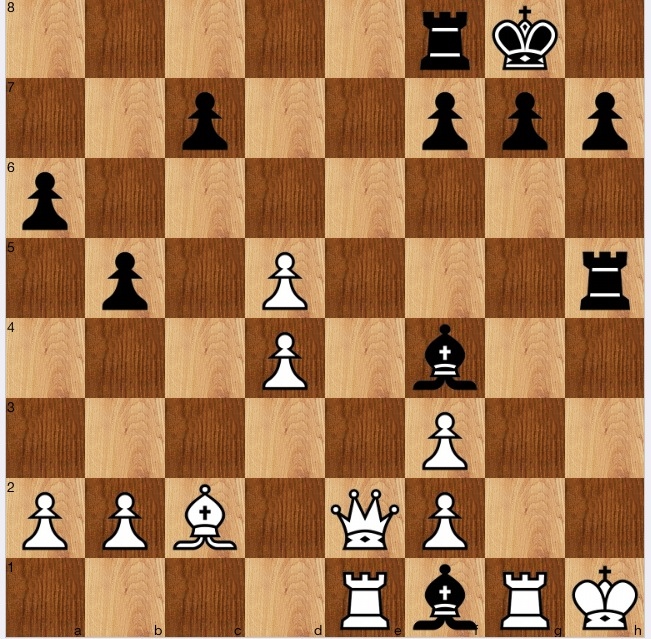
White to play and win
Reitstein's book has 'hints' for each problem. I don't normally give them in this blog, but for reasons explained in the solution, I do here:
White has a beautiful forced win in the offing here. If you can find his first two moves, the rest will not be too difficult.
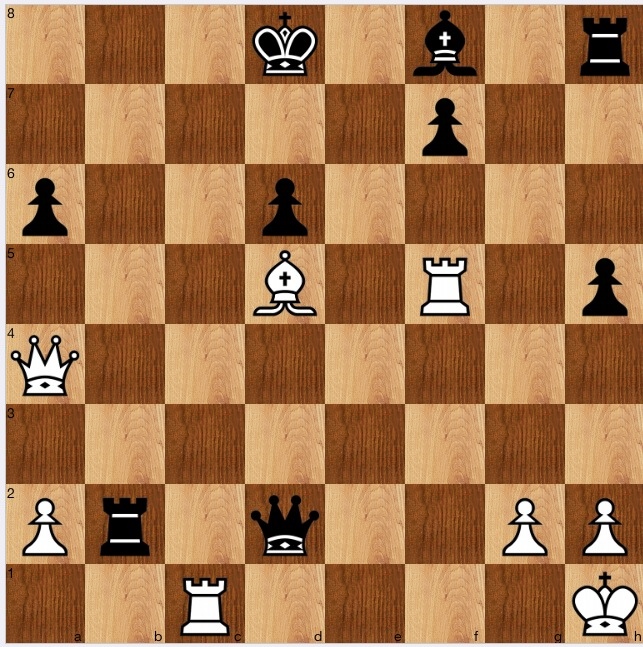
S Lewis v P Kroon 1965
Solution
The first move is obvious, 1 Rc8+! Kc8[] (1…Ke7 2 Rf7 mate), but then what? In the game, white played the move I kept wanting to make work, 2 Qc6+, which only draws. Eventually I saw 2 Qa6+!- there is a strange geometry in chess, or at least in my chess, where I have a tendency to prefer the near check to the further one: here a6 is slightly, and is optically further than c6.
Then depending on black's response, white checks until the king moves to the seventh rank, when Rf7+ follows.
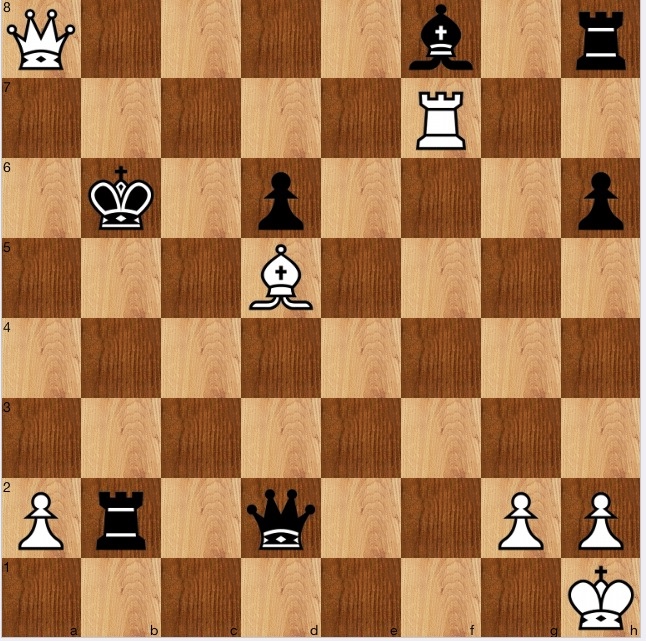
Here, again, is saw the optically closely check, Qc6+, which mates after Ka5 Ra7+ Kb4 Ra4 mate; to the optically further Qa7+! Kb5 Rb7 mate.
Black to play and win
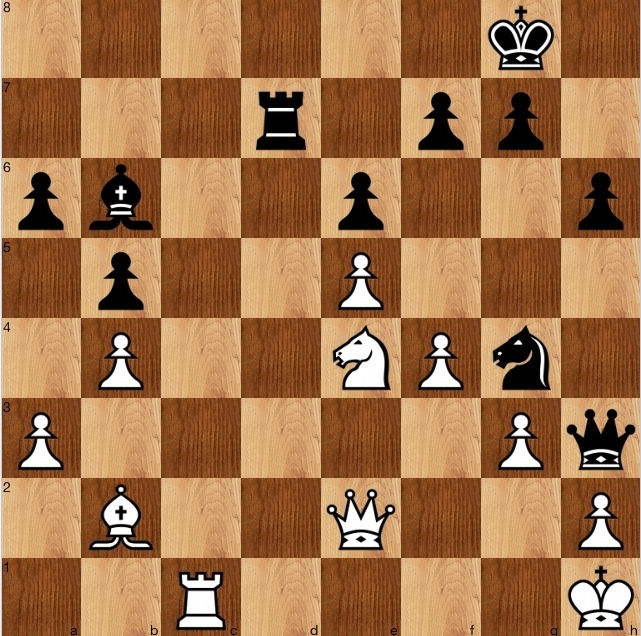
H Durhan v H Meihuizen 1910
Solution
It is clear that a way is needed to remove white's queen's defence of h2, or a way to find a back rank mate. After trying various alternatives, I found the solution without too much difficulty: 1..Bf2! and 2 Nf2 Qh2 mate, or 2 Rc8+ Kh7 3 Nf6+ gf 4 Qe4+ f5 0-1.
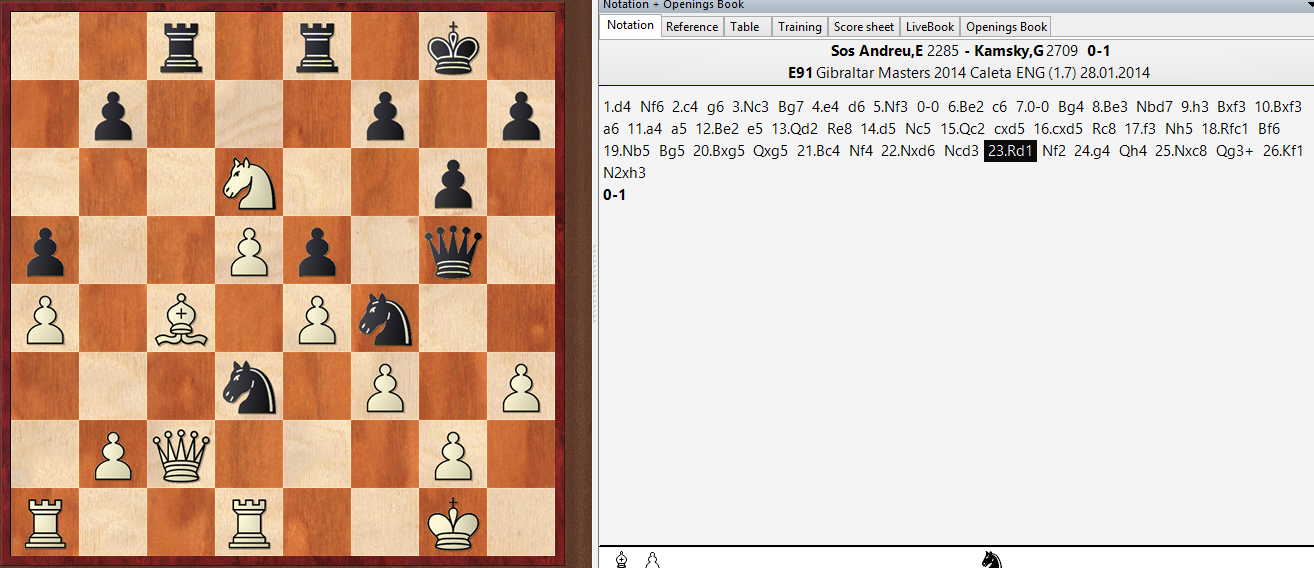
Gata Kamsky would have found the solution in a split second. Why? Because as soon as I had solved the problem, I remembered his recent game from Gibraltar.
23…Nf2! is the same interference theme.
White to play: what result?
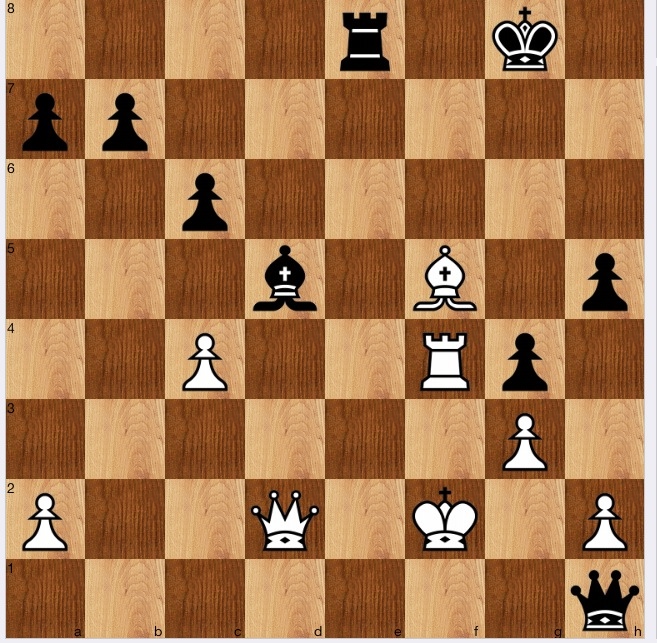
FH Nel v LR Reitstein 1953-54
Solution
Black is Leonard Reitstein, the compiler of the book. The game was a correspondence one, and in his hint, he said after playing Qa1-h1 he expected white to resign, but was shocked by white's next move.
I think you have to play 1 Rg4+! almost out of desperation. White has to check, and 1 Be6?? is clearly hopeless, whilst 1 Bh7+ looks intuitively less good than 1 Rg4- in the sense that g5 looks a better square to get to than checking on say d3 (after 1 Bh7+ Kh7).
Firstly, black has to take: 1….Kf8 gets mated after 2 Qh6+ Ke7 3 Rg7+ Bf7 4 Qe6+ etc.
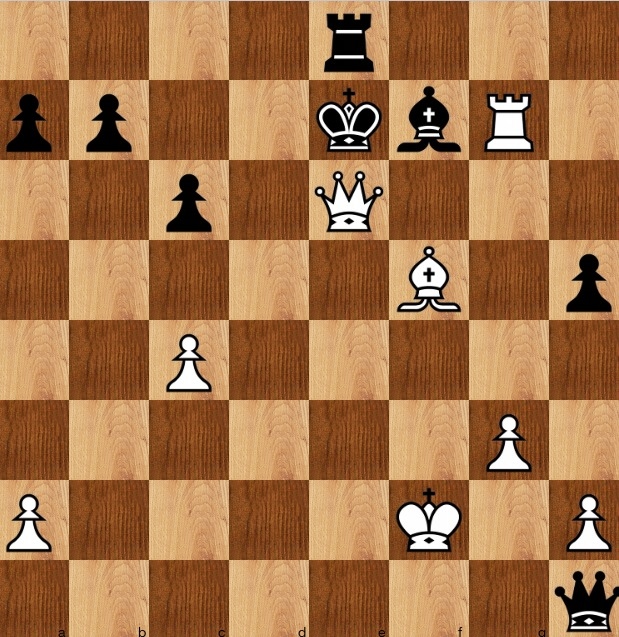
I should say that I found the variations hard to fathom, and had to set the pieces up on the board to spend the time focussing on the problem. So, what after 1…hg 2 Qg5+? (Question mark for the question, not for the move). 2…Kf8 looks best (2…Kf7 3 Bg6+)
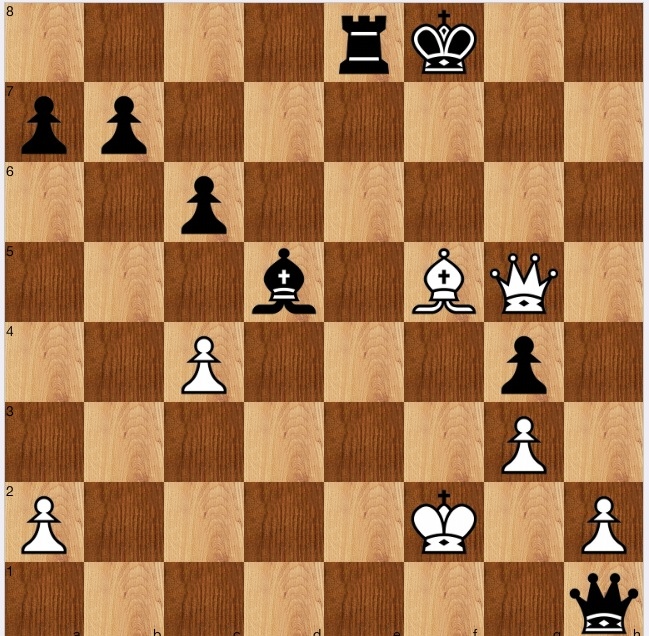
I don't know why, but I found visualising the consequences of this position hard (from the initial position). For a while I couldn't see that 3 Qf6+ draws: 3…Bf7 4 Qh8+! (I kept looking at Qd6+ and Qh6+) Ke7 5 Qe5+!. Once I saw that 5…Kd8?? gets mated by Qd6+, I knew that the king was locked into the king side endless checking, and the problem had been solved. But my analysis wasn't clean or confident, and I also wasted time on 3 Qh6+?? before seeing that the king escapes, and black wins.
White to play and win (hard, worth spending time on to solve)
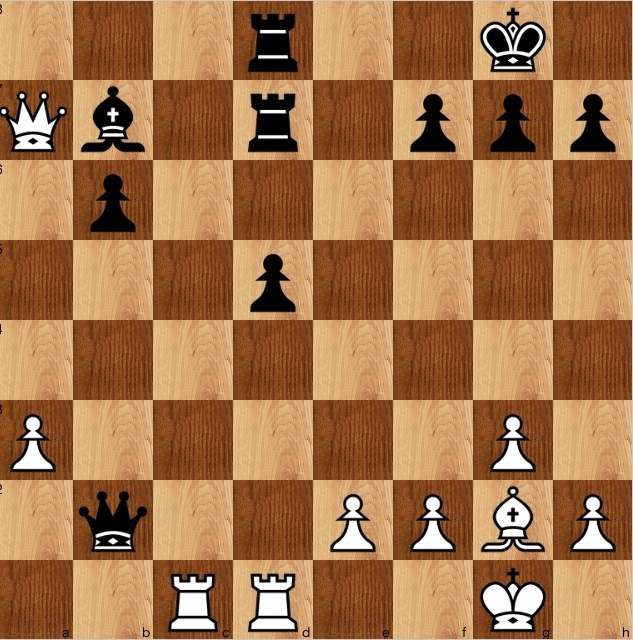
B Cheng v Sukander, ch-AUS(6) Melbourne, 5/1/14: seen in Chess Today, issue 4810
Solution
A corker.
It took me a good while to solve, but when I did, it gave me a lot of pleasure.
There are several motifs at play here. The Qa7 is in a net, but (if it were black to move) then 1…Ra8 2 Qa8+ Ba8 3 Rc8+ and mate: there is a back rank motif. This can also be seen with the threat of a jump biff Rd7 Rd7 and Qb8 mating. Meanwhile, white's e2 pawn is LPDO. There are threats to biff like 1 Rb1: for a while, I thought the solution was 1 Bf3 or 1 e3, seeking to win the b6 pawn (by 2 Rb1) and that may be good, but wanting more, I looked for other lines.
Eventually I saw 1 Bh3! with the point that the Rd7 is tied to defending the Bb7, so must move to e7, when it is a LPDO, so that 2 Bc8!! then wins at least the exchange.
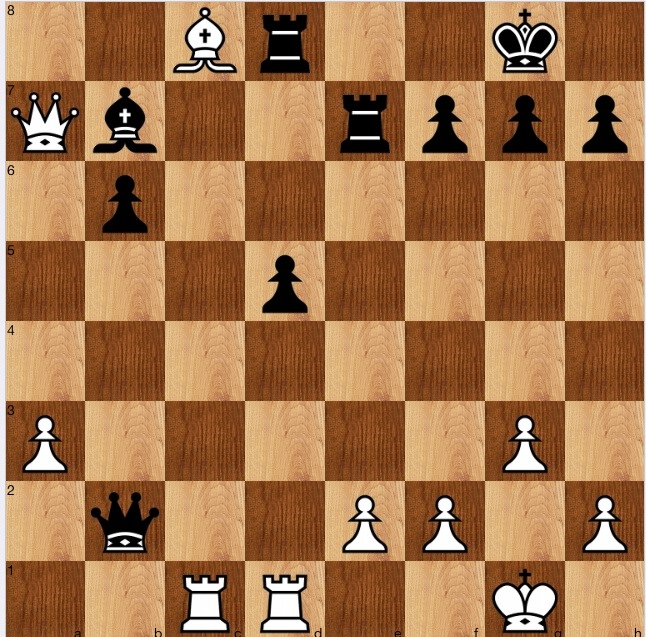
Beautiful. Perhaps if I had considered all biffs earlier, I would have found Bh3 faster; and likewise, Purdy exhorts players to consider all nets and ties, and, then too, the tied Rd7 would have been revealed.
 allanbeardsworth