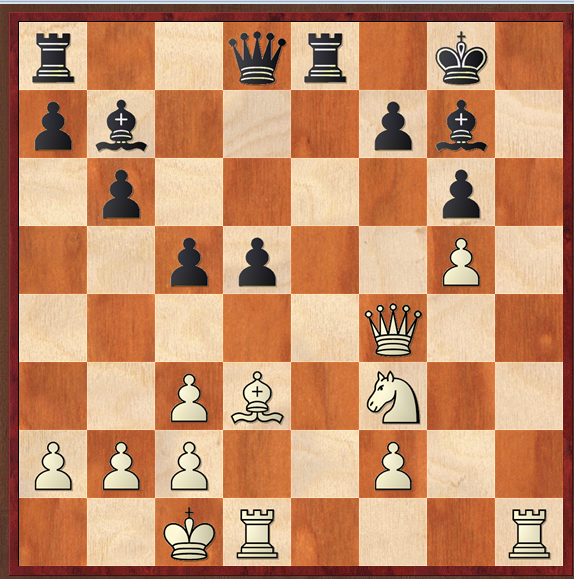
The current round of the Wijk aan Zee Masters is turning out to be really interesting. Harikrishna has just beaten Nakamura with an attack that I don’t yet fully understand; Caruana 1-0 Rapport, where black’s unusual play met its comeuppance by steady play by white, who took the offered pawns and then was resolute. Lev Aronian gave me a lesson in how to defend a difficult rook and pawn ending with ease, drawing with Giri. Two games remain in play, but the game that has just finished confounded me.
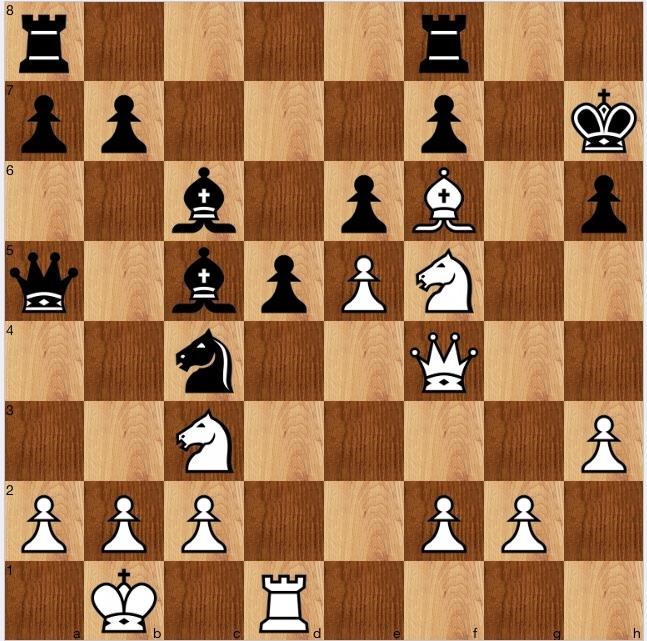
The diagram position, with white to play, looked like a fairly standard Petroff. Because I was more interested in seeing how Lev survived, I only gave the position a cursory glance, appraising it as equal, in the sense that I thought black had enough resources, and white not enough fuel in the tank.
However, white’s next move changed the assessment, and made me take notice.
White to play
(have a look at the diagram for a while before reading on)
Solution
1 Rh7!! was the stunning move: once seen, its reason becomes obvious: to seek to back rank mate black on the h file (1…Rh7 2 Qf7 and 3 Rh1+). Black replied 1…d4and after 2 Bc4 whilst I was trying to decide what to do next, thinking of 2…Bf3 (with the idea of pulling back to h5 if permitted, and of taking on g5 if not- if white plays Qf3), So played 2..Qe7 , and then resigned as soon as 3 Qh4 was played. The attached game file shows my present analysis. It appears, but no doubt better analysis will emerge, that 2..Bf3 could have at least struggled on, and might even have maintained equality.
http://www.viewchess.com/cbreader/2014/1/21/Game327521406.html
However, the concept of h4-h5-hg; Qf4; Rh7 is one to remember. Beautifully played by white.
White to play and win

Black's last move, 1..Rac8, was a blunder: 2 Na4! wins the exchange, for instance after 2…Kd8 3 Bd7 Kd7 4 Nb6+. Nothing more to say on today's problem.
 Posted with Blogsy
White to play and win
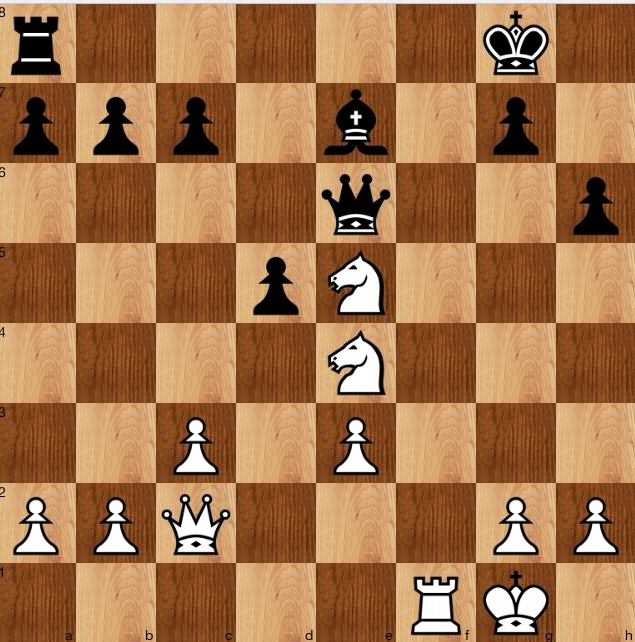
CAL Bull v PG van Breda 1899
Solution
This one took me a while, partly because the solution is a bit of an optical illusion. Many elements come together: the fact that the black queen is LPDO, and the fact that if white moves Qb3 then the queen is protected by the a2 pawn, mean that in a key line, a zwischenschach wins.
So, 1 Ng6! and if 1…Qg6 2 Nf6+ Qf6 3 Rf6 Bf6 wins; 2…Kf7 3 Nd7+ and Ne5+; 1…Qe4 2 Qe4 de 3 Ne7+; and finally 1…de 2 Qb3! Qb3 and now the zwischenschach 3 Ne7+ and wins.
White to play and win
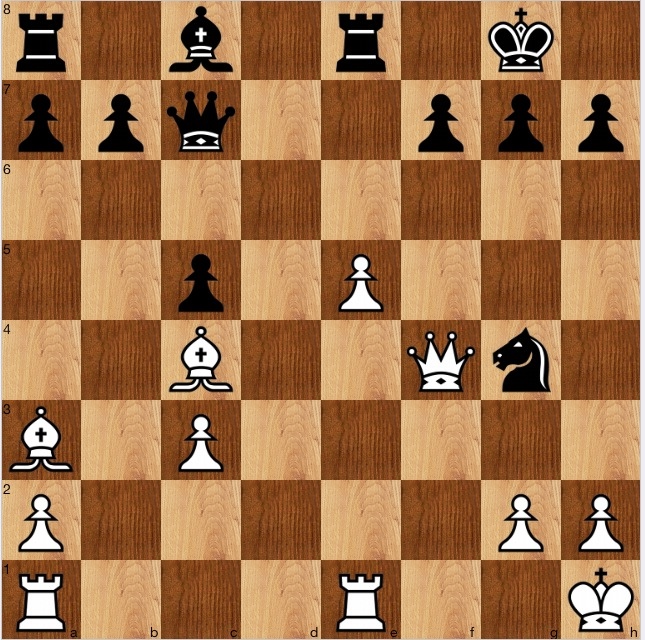
AA Ponelis v P van Dyk, 1967
Solution
Straightforward, this one: especially when you know it is a puzzle. 1 e6! exploits the LPDO Qc7 by threatening also ef+ and then taking on e8: no lines to explore, really.
White to play and win (find the first few moves)
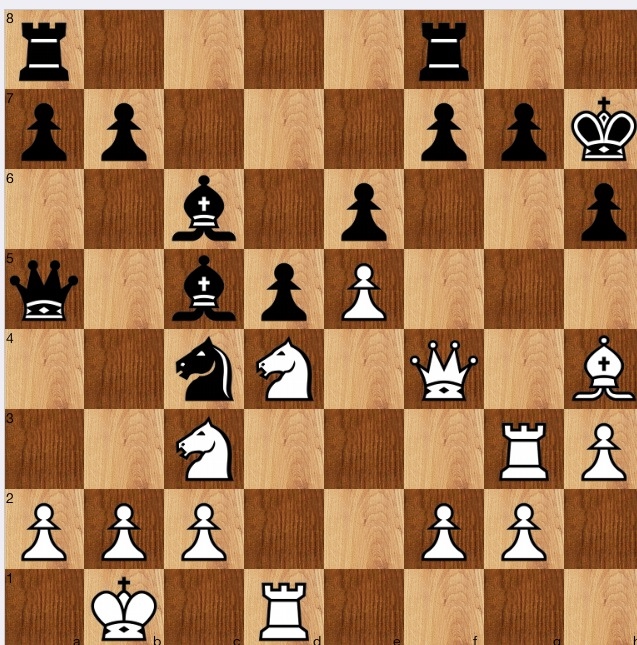
P Aalbersberg v RF Griffiths
Solution
A nice exercise. It is immediately obvious that 1 Rg7+ is a must look-at; but immediately obvious what the follow up is. After a bit of time, I saw the idea: bring more pieces to the party with Nf5.
I prefer 1 Rg7+! Kg7[] 2 Bf6+ Kh7[] (2…Kg8 is trite: 3 Qg3+ mating) 3 Nf5! and if 3…ef 4 Qf5+ Kg8[] 5 Qg4+ and mates. If black doesn't take the N, he is mated by Qh6+, perhaps deferred a few moves by spite checks, but it can easily be seen that they come to nought.
Reitstein's solution is the move played in the game, 2 Nf5, which is more or less equivalent, but gives another line to calculate- the king coming up to g6. It does though win all the same, of course.
Today’s Wijk aan Zee Masters game between Richard Rapport (2691) and Leinier Dominguez Perez (2754) was fantastic. Rapport played an outlandish opening, with an early g4, and it was very instructive to see how Leinier responded: quietly, but soon seeking to exploit the luft on the king side caused by white’s pawns advances.
However, what made the game special was black’s move in the position below.
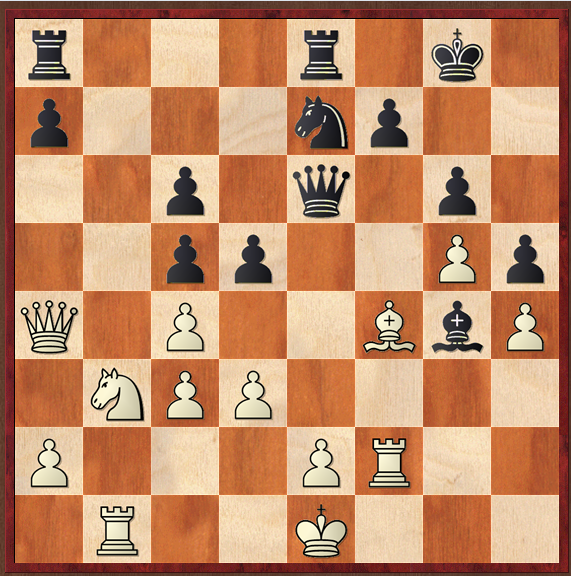
CJS Purdy tells his readers to examine all biffs, and so I would have seen Be2; but chickened out from playing it, not being able to fathom the uncertainty. Leinier could, and my brief analysis, in the attached game file, shows that he was right to do so.
Humbling, really, how good the elite players are.
http://www.viewchess.com/cbreader/2014/1/17/Game1201605875.html
Black to play and win
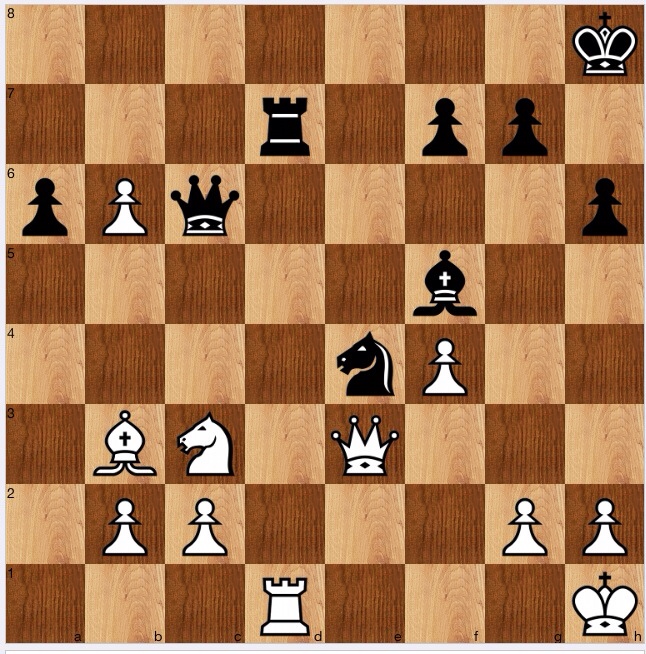
Solution
Fairly straightforward, a standard motif of back rank mate results in 1…Qc3!: not much more to say on this.
White to play and win
(Try to look for the very best line, a few moves deep)
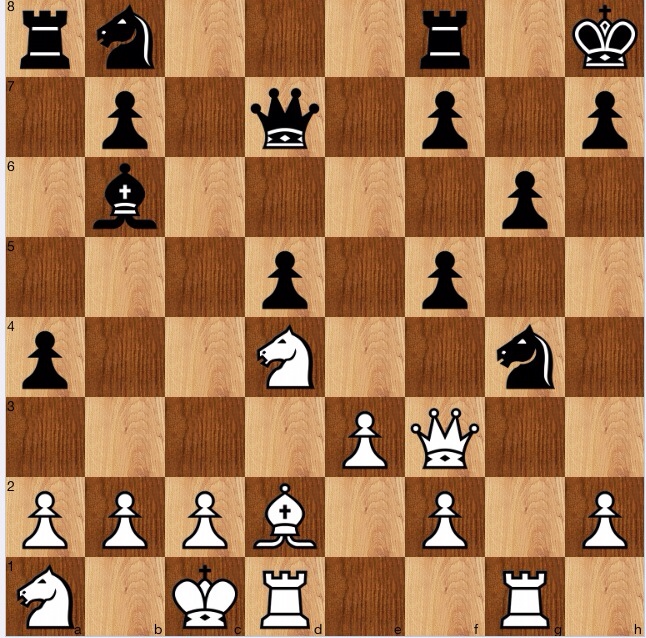
Solution
The first few moves are fairly easy: 1 Rg4 fg 2 Qf6+ Kg8[], especially when there is the option of taking the LPDO Bb6.
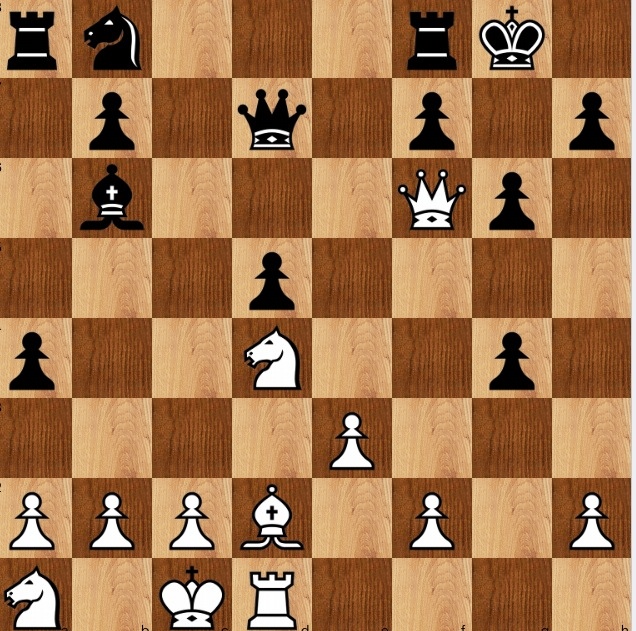
However, white has better, 3 Bc3!
There is a pretty (but standard) threat: say 3…Nc6 4 Qg7+! Kg7 5 Nf5+ Kg8 6 Nh6 mate. Against other defences, there are more prosaic wins.
Black to play and win
T Gannholm v DA Walker
Solution
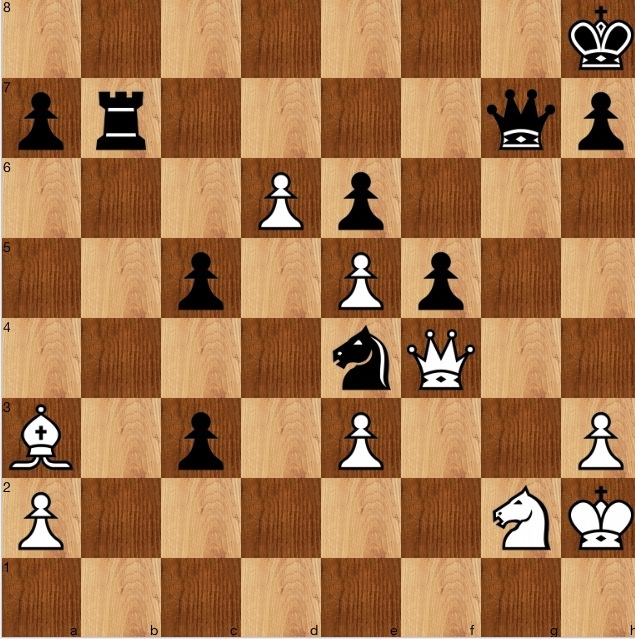
1..Rb2! is fairly natural, and the only line needing to be calculated is 2 Bb2 cb 3 Qf1, but then after 3…Nd2 the pawn queens.
Black to play and win
H Saadien v D Friedgood, 1960
Solution
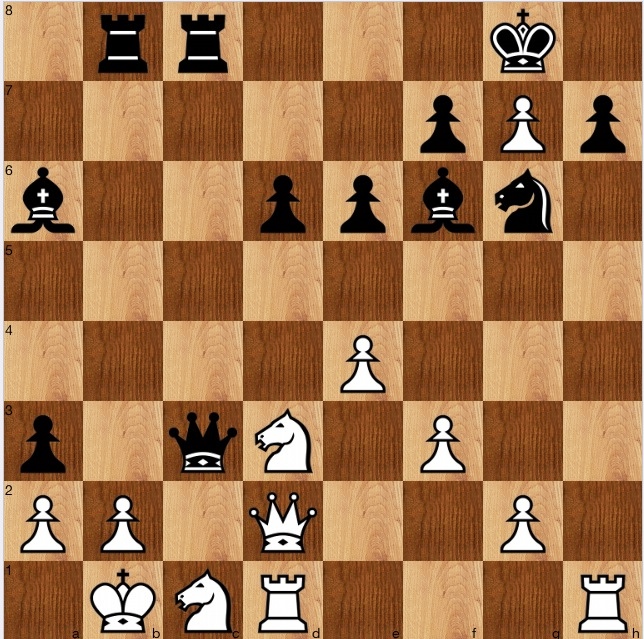
A nice, fairly straightforward puzzle. The idea of getting through to b2 is fairly obvious, and the main difficulty is to view the resultant position and decide if there is a killer blow, and there is, with Rb4! So, the solution is 1…Bd3+ 2 Nd3 Qd3+! 3 Qd3 Rb2+ 4 Ka1.
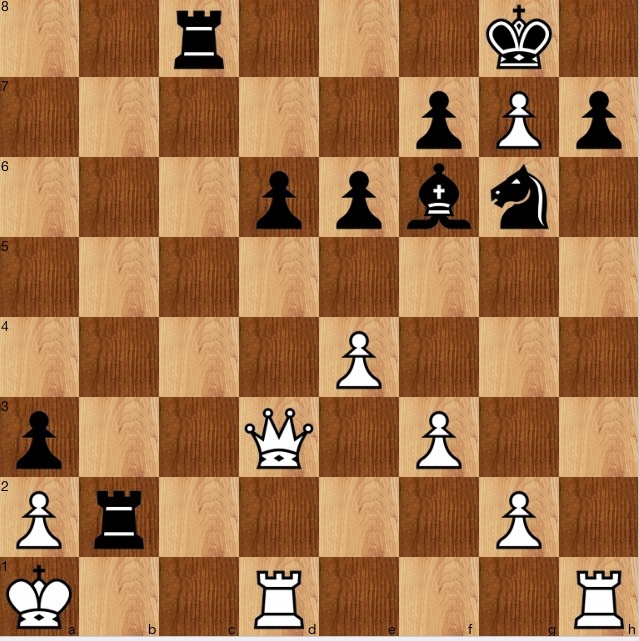
From the above position, 4…Rb4+ is natural, controlling d4, with the pretty point that 5 Qd4 is met by 5…Rc1+, 0-1.
 allanbeardsworth