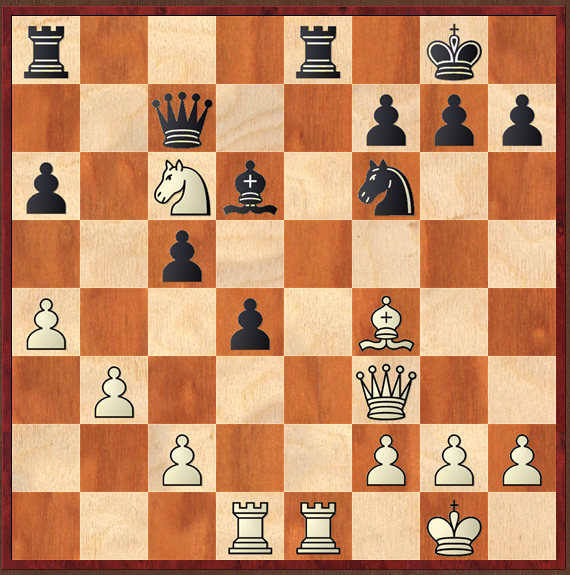
White to play and win
Source: Chess Today
Solution
I just couldn't get this one, and was annoyed at myself when I looked at the solution, having given up. It should have been within my capabilities. In this blog posting I explain why- just by following Purdy's rules.
Alas, and I suspect I am not untypical, my thinking is not structured. Despite the fact that I know it is a problem, that there is a solution, and if I wanted I could spend endless time on any puzzle. But no, I see the back rank mate motif, I see the x-ray attack on the Ra8, I see the surprise 1 Ne7+…get captivated by it! and then go round the houses trying to make it work after either Kf8 or Kh8. When I can't make it work, I try to readjust my thinking, but unsuccessfully. I eventually plumped for 1 Bg5 as being a worthwhile try.
CJS Purdy would be unhappy with me. Maybe I should read one or two of his articles again as a penance- they are so well written, they are always worth re-reading. But, know, I know his mantras off by heart and inside out, I just don't apply them:
Look for checks: Re8+, nothing; Ne7+, something, but on examination nothing;
Look for jump checks: Qf7+, nothing;
Look for biffs: Bd6, Nd4, Na5, Rd4….all nothing; but more on this later;
Look for jump biffs: the Qf3 is hitting the Ra8; something; Qf6 nothing; Bf4 is hitting the Qc7; something;
Look for ties: the Re8 is tied to defending the Ra8;something;
Look for pins: the Bd6 is pinned by the Bf4;
Look for nets: nothing- none of black's pieces look restricted.
Imagine that the opponent's threats can't possibly be executed, what would you want to do?; so, ignore the threat of Bf4: clearly, back rank mating is what should be looked for;
Whilst not Purdy mantras, I would also add:
Look for retreats: nothing (I include it because my Cordingley experience has shown that I often overlook retreads, both when attacking and defending);
Look at geometry: nothing- this test is probably no more than looking of jump checks and biffs, but nice to look for diagonals, ranks and files, to look for alignment, and to ensure the full breadth of each piece's powers are examined. I often fail to look wide enough.
If I could follow this regimen, in the way a professional golfer always goes through the same mental process of preparation, visualisation and thinking before playing each and every shot, maybe I would improve my ability.
Writing this blog has been interesting: the sheer number of biffs, checks and jumps is quite illuminating: it would be a good training exercise to count them all, to try to ensure none are overlooked. Here, in my above notes I omitted one biff, 1 Re7!! which I didn't even consider, but as soon as I saw the move in the solution, I saw its effect- and realised I couldhaveshouldhave seen it.
We know from the Purdy analysis that the Bd6 can't take it; and if the Re8 takes it, the Ra8 is LPDO do a jump biff. So all that is needed is to examine 1…Re7 when 2 Bd6! Qd6 3 Ne7+ wins the exchange.
So is 1 Re7 simple? In a way yes, which makes it all the more galling that I didn't see it. It is a surprising, daresay shocking move, and that is why I didn't see it- and I suspect that is how most chess players think, at least amateurs. But playing by Purdy rules would have enabled it to have been found.
 Posted with Blogsy
Black to play and win

BP Donnelly v P Sarnak, SA Championship 1970
Solution
Fairly trivial today, with either 1…Ng4! or 1..Nd5! exploding open the Dragon bishop. Not really necessary for me to give lines or a preference between the two moves.
Black to play and win

D Yellin v A Savinson, Johannesburg 1967
Solution
Fairly straightforward, or probably easy. There is a clear back rank motif in play, and biffs 1…Qe2 or 1…Qd5 come to mind more or less immediately.
Both win. In the game, black played 1…Qd5; perhaps slightly stronger is 1…Qe2 since white's best (2 Rf1) loses him a whole queen: but really they are equivalent, both overwhelming.
One of my holiday reading books was the delightful The Chess Players Bedside Book, a compilation of articles by Raymond Edwards and Raymond Keene; published by Batsford in 1975. It comprises a couple of dozens articles on a number of different chess subjects. The fact that it is dated adds to it appeal. The article by David Levy on computer chess, for instance, can still be read with interest and amusement. And most articles had things which greatly interested me.
One position struck particularly.

Black to play. What is his best move?
Alas, a lot of what I learnt at university and at school is lost. (One of Jane's occasional sayings is that one of her tutors said that education is what you retain after you have forgotten everything that you have learnt). I got an A at A level physics (note to my children: this was when A grades meant something) and then a top first in engineering science at Cambridge.
I think all this meant was at the time I had a great capacity for soaking up information, regurgitating it, applying it but without really understanding it. You get told a definition of two or three, shown some equations or principles, and then learn how to apply them.
Take, for instance, one of Newton's laws: F=ma. [note re predictive text: my iPad knows I am an accountant, and unhelpfully wants to change ma to M&A]. I can still apply it, and equations such as v=u+at, so am useful to daughter #2 with help with her physics homework. I have got a good understanding, at least on Earth, of acceleration, but do I really understand Force and mass? On the latter, can I clearly distinguish it from weight, and am I really clear about force and energy? Being sensible, of course I have some understanding, and can apply the separate concepts: but being honest, not fully.
The case of the falling coconut
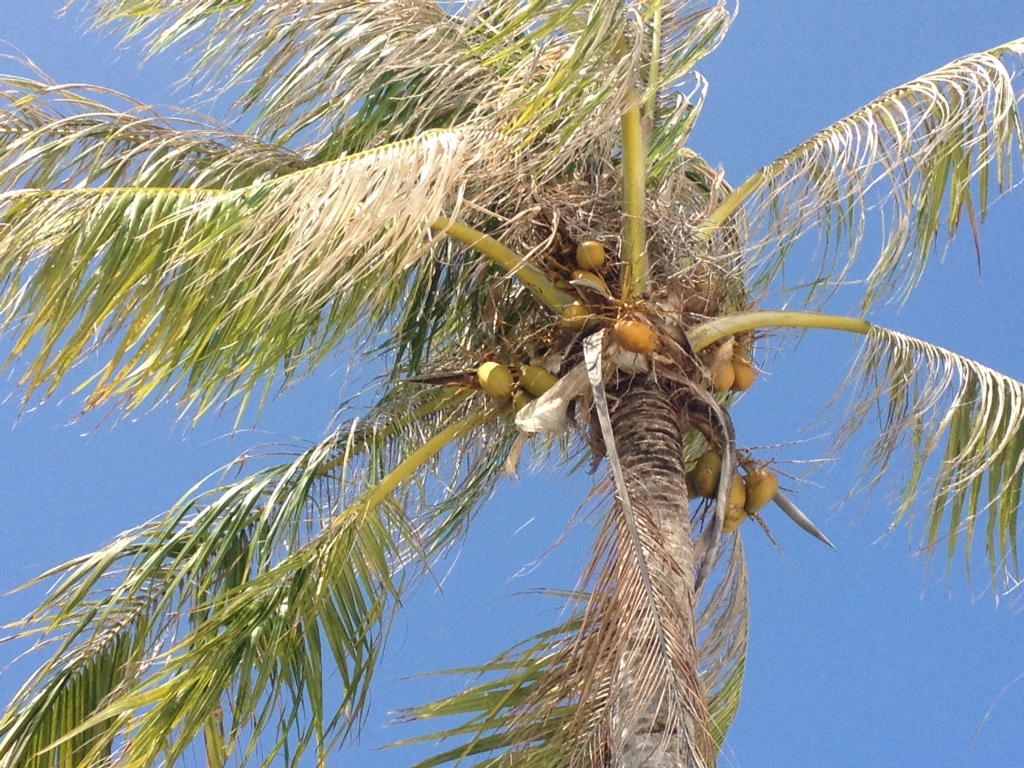
Which would you rather be hit on the head by? A coconut falling from a tree height 3m, or from one with height 6m? Clearly, the former: but how strong is your preference? Does the 6m coconut hurt twice as much, or some other difference?

Each day, during our recent holiday in Maafushivaru, Maldives, we had to walk past or under several such trees. And one such bend, coconut corner, there was a 6m tree which shed four coconuts during our stay: once when we were walking past, landing in the sandy pathway with a distinctly firm thud.
Daughter #2 is returning to school on Monday for her mock exams week: so it seemed fair, to ask her problems about falling coconuts. True to form, daughter #2 moaned at her father, but then was interested in the discussion.
So, at what speed does a coconut fall at coconut corner? V^2=u^2+2as, where u, the initial velocity is 0, and a, acceleration is g, gravity. We can ignore drag and buoyancy. So, the square of the thudding (final) velocity is v^2=2*g*6=120, or approximately 11m/s [again, note of sadness- it is a rare colleague who can estimate root 120, which should be easy, being a bit less than root 121, which number is eleven squared].
The thud speed from a lesser, 3m, tree, is v^2=2*g*3, or somewhat less than 8 m/s.
Let us say that a coconut hit a less than happy holidaymaker. By what proportion does he wish it were not from coconut corner? Firstly, I am ignoring the 1m or so height of the person, so the speeds are less, but note in passing that life isn't fair, and the child would be hit harder than the parent. I think the hurt would be a matter of the energy in the coconut, the kinetic energy, given by 1/2 mv^2, so that the coconut corner one would hurt twice as much.
I am not sure though that I am right, and this is where my lack of deep understanding of force and energy come into play; and my lack of understanding, fortunately, of falling coconuts. But I think the coconut's kinetic energy is dissipated as sound (the thud, not the ow!), probably kinetic energy- unless the coconut hits mid page, I presume the holidaymaker is toppled a bit, if not knocked off their feet; probably kinetic energy into the ground too, and also perhaps into heat-the head will get somewhat hotter. Against that supposition, the coconut must come to rest, so must decelerate: to the extent it bounces off I am not sure what happens, but simplifying to it coming to rest atop, then the head exerts a breaking force ma, and the coconut exerts an equivalent force on the head. I suspect, but am guessing, that here we are dealing with the linear velocity, not its square, so 11/8, or, more precisely, root 2: 1.4 times.
White to play and win
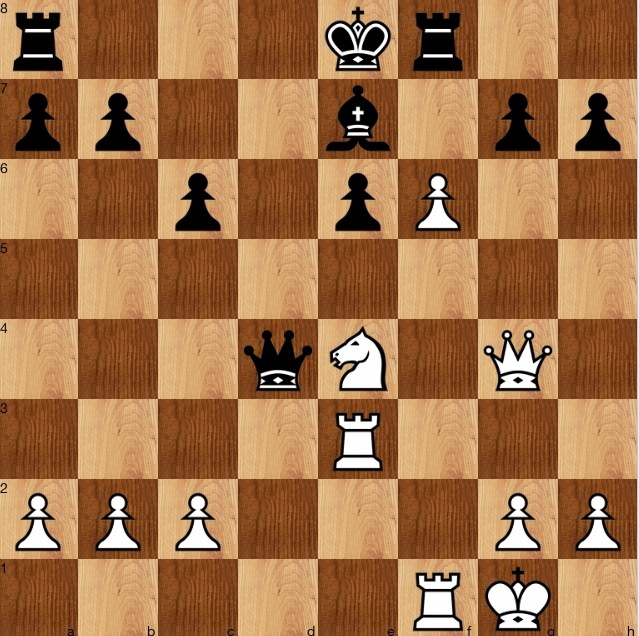
DP Laurie v DF Dekenah, 1970
Solution
I found the move in the game, I think partly knowing it was a problem and therefore looking for flashiness: 1 Qe6! and if 1…Qe3+ 2 Kh1, black is lost, because of the twin threats of 3 Qe7 mate and Nf6+/Nd6+ discovering an attack on the LPDO queen: so 1-0.
However, whilst Stockfish agrees this is winning, it prefers the more prosaic 1 Qh5+!! g6 2 Qh3! when black is similarly helpless. White threatens Qe6+, if the bishop moves, or fe if it doesn't.
One of the patterns of life at my firm is the birthday email: cakes or chocolate brought in to celebrate an event such as a birthday, or return from holiday, etc.
Most of such emails are routine: and sent to the people in the department or grouping. Occasionally, they are sent to 'UK firm all' which would be a morsel per person; even more rarely the emails themselves are interesting.
One such was received last September from a mathematically minded colleague.
On Sunday I advanced another year more
To the sum of all quarters from nought til 4
Come over and enjoy a nice slice of cake
(though I admit it is one that I did not make)
I sent my colleague a happy birthday note, and also asked whether my calculation of her age was correct (amongst mathematicians, this can't be rude?). Disappointingly, I was the only person who gave her the correct answer: not good for a firm of accountants?!
How old is she?
Black to play and win
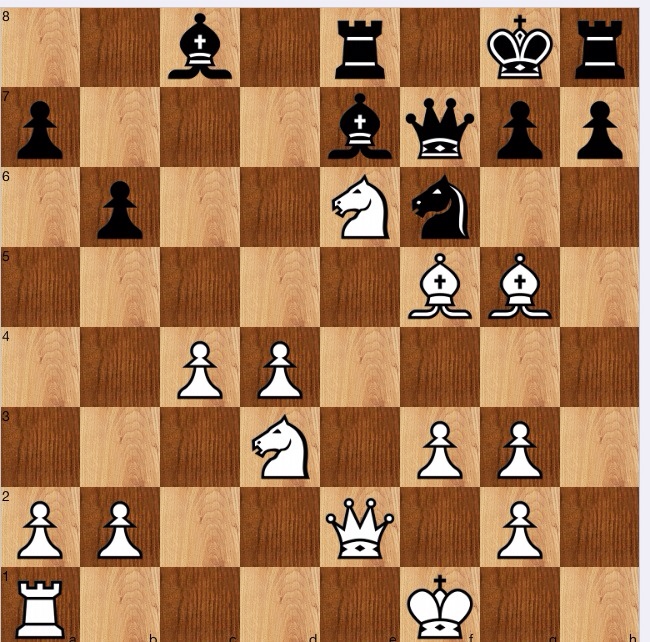
P Kroon v M Rubery, Johannesburg 1990
Solution
It took me a bit of a while to see this one: not too long, but not immediate either. But I eventually found the move played in the game 1…Nh5! which has the double threat of Ng3+, forking king and queen! and Qf5, winning the LPDO Bf5.
If I had done a reconnaissance for LPDOs I might have found it earlier: or if I had followed Purdy's advice to look for jump checks and jump biffs, then likewise I might have found it earlier.
When I loaded the position into Stockfish, so I could post the diagram into this blog, Stockfish initially flashed 1..Nh5, which it gives as winning, before a moment later switching to 1…Bd6, which it assesses as stronger still. I am not quite clear what the point is: perhaps it is just less fussy. If white protects the Ne6 by 2 d5, then maybe 2…Nh5 is just a slightly stronger version of the game continuation (1…Nh5 2 Qe5 Qf5!)
White to play and win
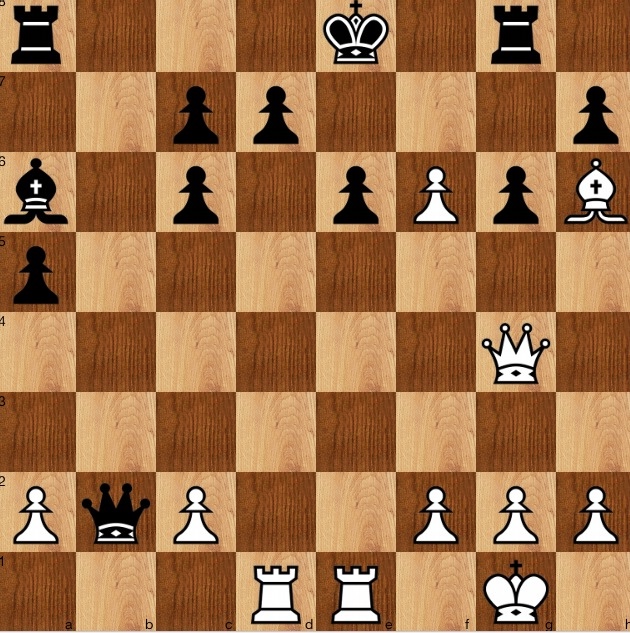
AJA Cameron v EC Hooper, SA Championship Cape Town 1906
Solution
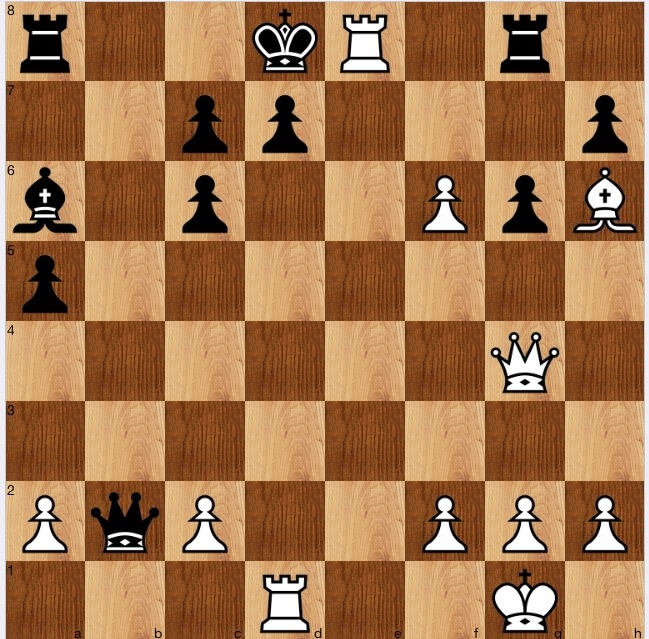
Fairly straightforward. If you look for ways to crash through, you will see either 1 f7+!, which mates in 4 ( the line I immediately saw) or 1 Re6+! (which I then saw, and which mates one move faster). Or, 1 Rd7 which is also decisive, though black can stumble on with 1..Bc4- hopeless of course.
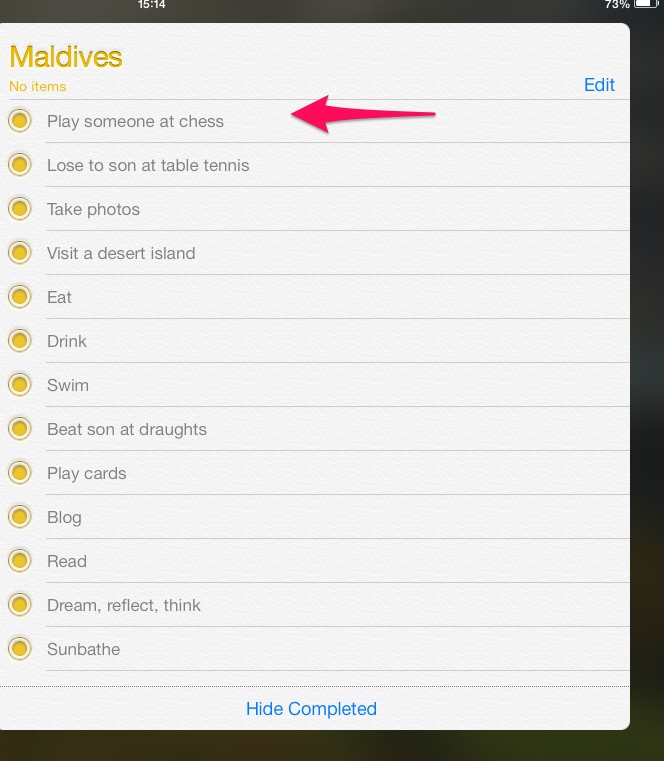
Ticking the last item off from a to do list.
I have just had a lovely afternoon (posting of this blog will be hit and miss, and might well be delayed: the internet seems pretty lousy today; the post will come when it comes).
I asked Didi, the head of food and beverages at our resort, what this particular plant was.
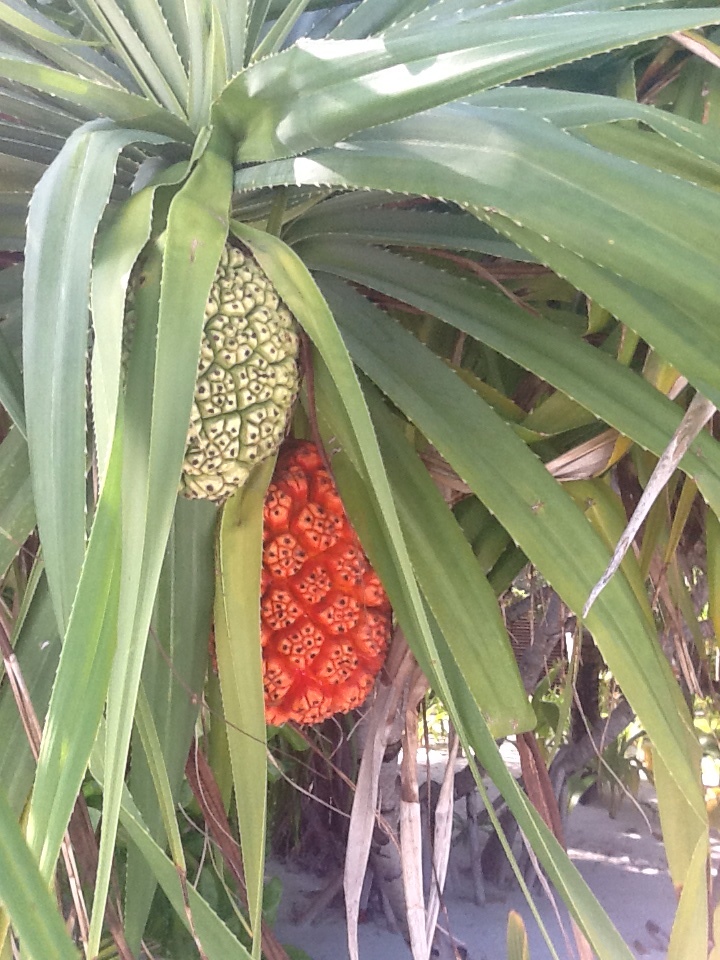
It is from the Pandanus, screw plant family. Wikipedia tells me there are over six hundred varieties. Didi told me that they use the pineapple like flower for food, including eating the visible pods, when red, raw. One of the waiters came over to join us, and they showed me some other Pandanus family plants, and the waiter said the fateful statement: please ask us any other questions, we like it when guests show an interest.
Well, I didn't need to hesitate: I mentioned that on the island back tour I had seen a chess set in a prominent position in the staff cafė: 'do many people play chess here'. 'We all do'. When I told him I loved the game, he asked if I wanted a game there and then, so Didi and I went to the bar and set up the pieces.
 allanbeardsworth