As our family holiday to Maafushivaru, Maldives, draws to a close, time for a reflection.

It has been a taste of paradise, as my holiday to-do (#) list shows:
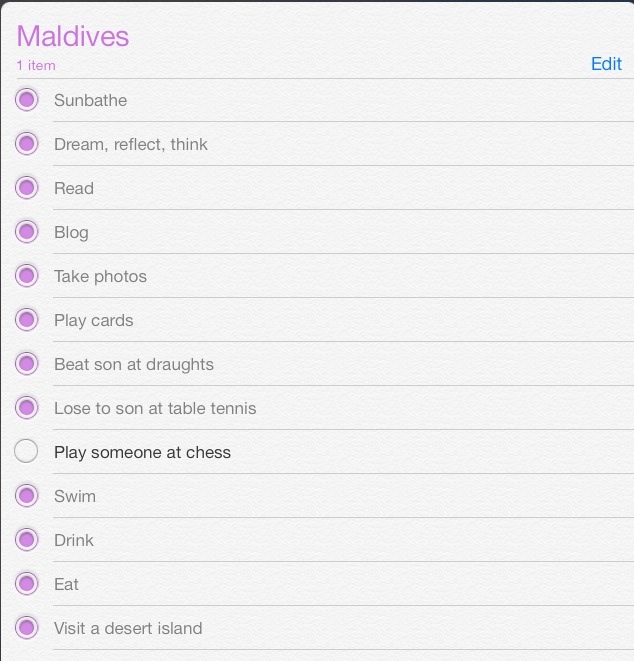
It's my blog, and I can lie if I want to, can't I? All the above are true, but some are more true than others. For 'sunbathe' read 'as little as possible': 'enough to keep Jane happy/tolerant': fortunately daughter #1 and to a lesser extent daughter #2 like to lie and roast, so I can sit in the shade most of the time. For swim, read 'of a fashion' because alas, I totally lack confidence, and the littlest thing freaks me out. I know it is stupid, but I can't get into the right state of mind about deep water.
For lose to son at table tennis read be thrashed, be humiliated. Alas, the time when I could beat him are now a long distant memory.
For play someone at chess read the only disappointment- but a trivial one. The bar has a couple of sets, which are quite well used by other families and couples, but not la famille Beardsworth.
Black to play and win
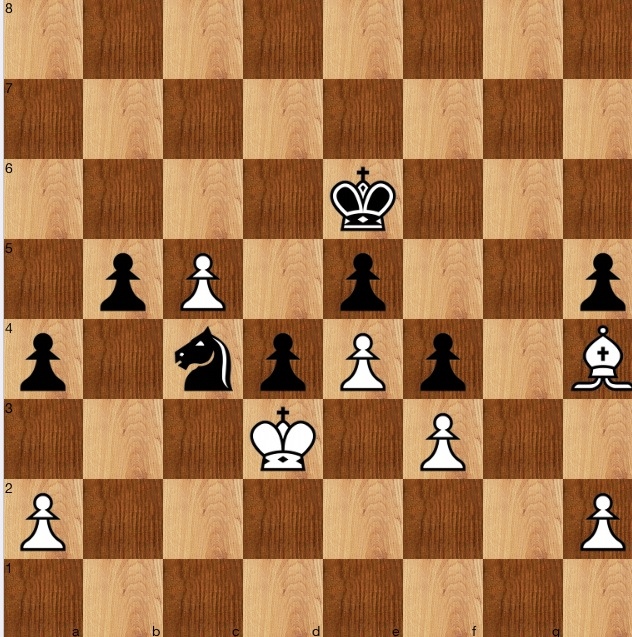
CC Pretorius v A Martin, Port Elizabeth 1968
Solution
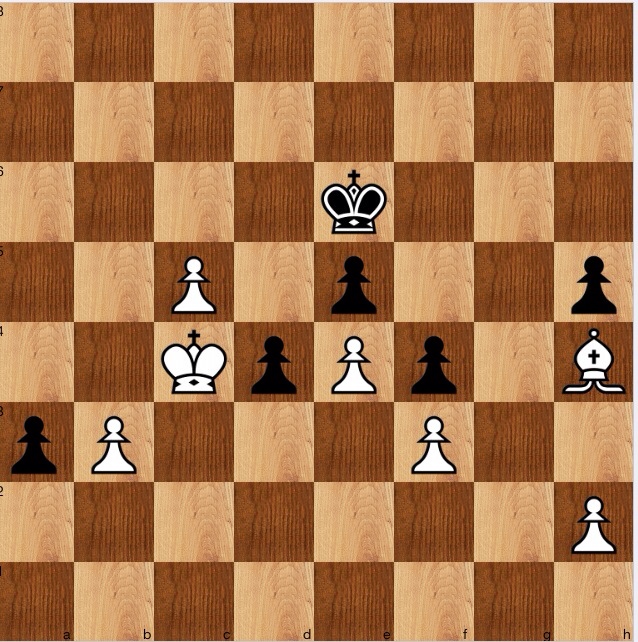
A decent exercise. I intuitively saw the solution, of playing a bit like a rugby try, passing the ball to the winger: push b5-b4-b3, and when ab, cleverly swerve and play a3! rather than ab, perhaps using the d pawn as a diversionary player if needed.
Having 'felt' the solution, I did though skip round to the more prosaic plan of Ke6-d7-c6, aiming to capture on c5, but readily saw that Bh4-e1-b4 shores everything up; and there didn't seem any point of trying to hit the h2 pawn, which can always move forwarded if biffed by Nc4-e3-f1. So, back to calculation, and 1…b4! 2 Kc2 d3+! or 2 Kc4 b3! 3 ab a3! and a try is scored-sorry, the pawn promotes.
 Posted with Blogsy
Black to play and win
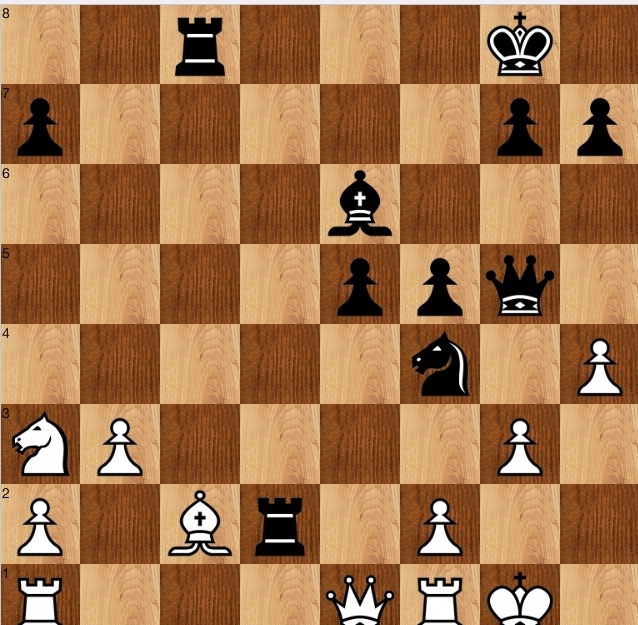
(Need to calculate a few lines in, not just the first move)
M Serfontein v P Samak, Roodeport 1974
Solution
A somewhat more interesting problem: actually, a bit of an exercise, but not too hard. 1. Qg3+! is obvious, and after 2 fg[] Nh3+![] – only move, since 2…Rg1+, the move I first looked at loses after 3 Kh1[] Bd5 4 Rf4 (or 4 Be4) 4…Re2+ 5 Be4 Be4+ 6 Re4 Re1+ 7 Re1 1-0. But after 2…Nh3+ 3 Kh1[] then 3…Rdc2! ends the game: 3…Rdc2 is not too hard to see since 3…Bd5+? is met by Be4, and then black can't double on the second rank, because the Na3 covers c2: so Rdc2 is a straightforward decoy.
No, not how to say these names, but it makes me glad that England's two leading players are Short and Adams. This puzzle, given in Chess Today issue 4775, from the World Team Championships which were recently held in Antalya, really puzzled me.
I eventually got my pocket set out, and after ten minutes or so of hard thinking, got most of the solution. 'Most' being a flexible word: alas, I didn't get it fully correct, and if I were being honest with myself, I would give me 4/10 and no more.
See if you can do better.
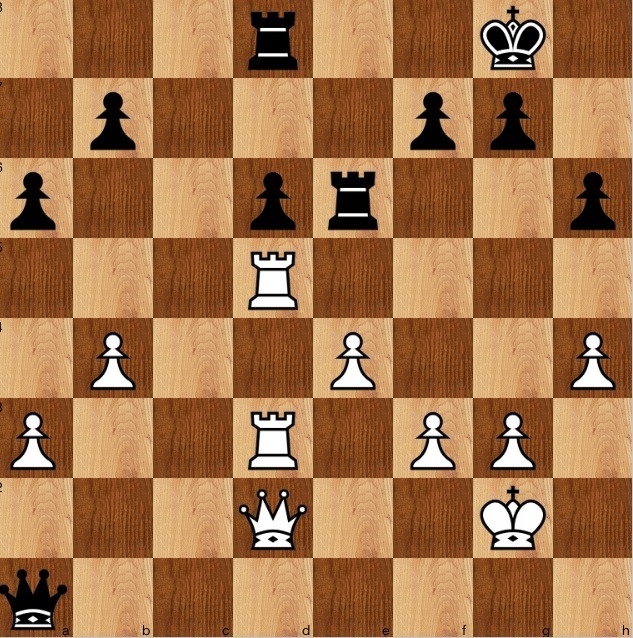
White to play and win
Solution
The key thing to spot is that black's queen is in a net, to use one of Purdy's terms. This, combined with pressure on d6 and the prospect of a pin on the d file (again, Purdy would exhort us to spot jump biffs: here, obvious, R*d8 is a jump biff, which means that the d6 pawn is pinned: hence Pe5 has to be kept in mind.
So, eventually I got 1 Rc3! but thought that black gets out by 1…Qb1, until I saw 2 Rd3!, when the cage is closed, and 3 Rc1! wins the queen.
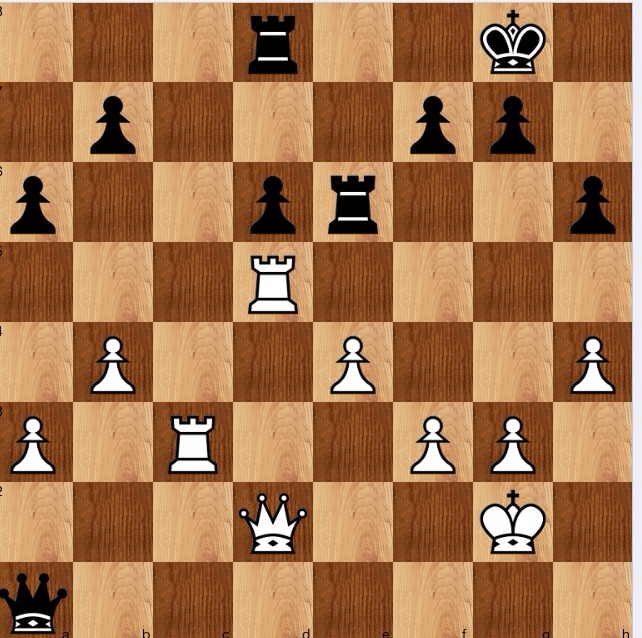
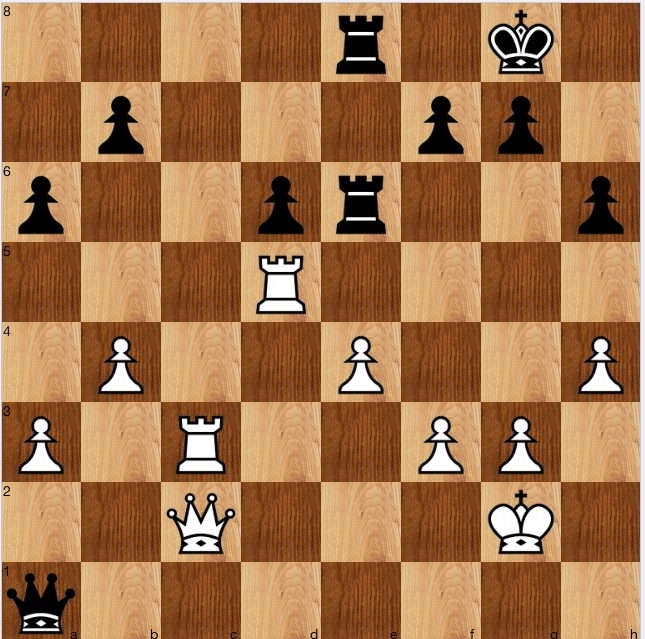
However, black has better. He could grovel, playing 1…a5, and the queen does escape, but at ruinous loss, or he could play 1…Rde8, when 2 Qc2!! is the sly little move which wins: and which I missed. I wrongly presumed 2 Rd3 again, with some notion of 3 e5! 4 Rc1! but 2..a5! or maybe 2…f5!?
Another defence is 1…Ree8, the idea being to then play 2…Rc8, but then either 3 e5(the move I saw) (an effect or Rc3 is to close black's queen's vision of e5, so that Pe5 wins the d6 pawn, or 3 Qc2!! which is both stronger and nicer: nicer because it is prophylactic, stronger because the black queen is again lost.
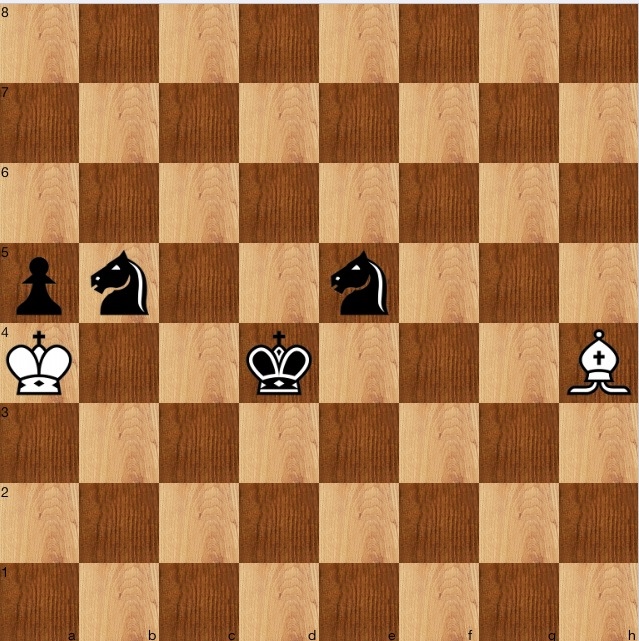
White to play and draw
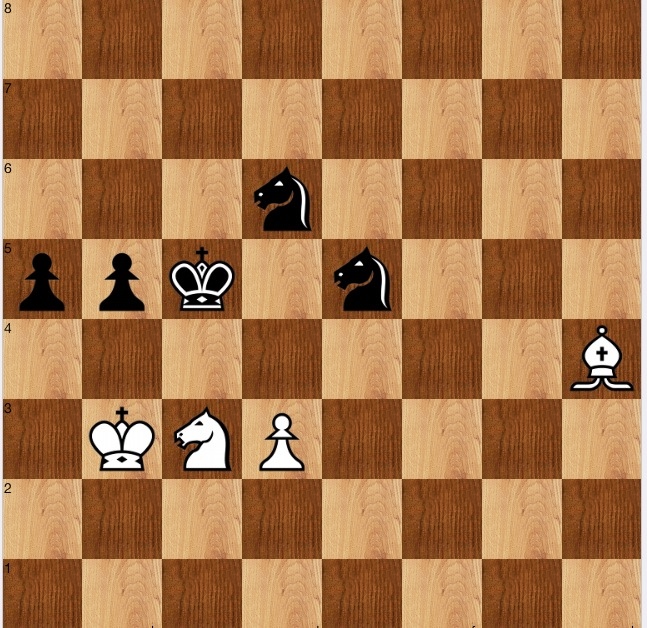
R Hillman v DA Walker, SA Championship, East London 1975
Solution
Yet another trivial one (the book is worth sticking with: I am a few ahead now, and they do get harder). A fairly obvious try is 1 d4+! Kd4[] 2 Nb5+! Nb5[] 3 Ka4 when all that needs to be seen is that black can't protect both the Pa5 or Nb5, so one must fall, and it is a draw.
This posting continues my occasional commenting on games in Wolfgang Heidenfeld’s Lacking the Master Touch. The only reason for blogging about certain games or positions is because they interest me. In fact, what better reason is there is blog? I hope my readers also find them of interest.
Game 12 CH Roele v W Heidenfeld, Amsterdam 1954
I wonder if I am the first person in the world to know the truth about one key aspect of this game? I might be, especially if Stockfish is not a person, because, what I have found was computer assisted. Or computer done, to be honest.
What follows clearly was not known to Heidenfeld, despite the fact that he got close to the idea, nor was it found by Max Euwe, who commented on the game in the post mortem.
Also, one aspect of what follows made me truly Laugh Out Loud. There is a truly spectacular mate in one line. My appreciation of Heidenfeld goes up enormously since he found the concept but couldn’t quite deliver it. I didn’t find the concept, Stockfish of course did too.
I hope people enjoy the following as much as I did in finding and understanding it. I will take it in stages, building up to the main points, and also posing a series of questions which I think are worth solving, or at least thinkng about.
The analysis also includes my award for the move of the year.
White to play and win
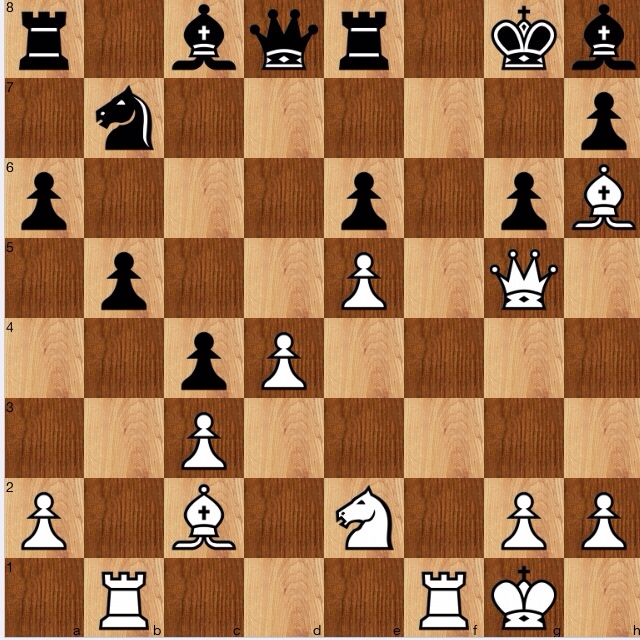
Black has just played Pe6.
P Hangelbroek v P Kunne, Transvaal League 1982
Solution
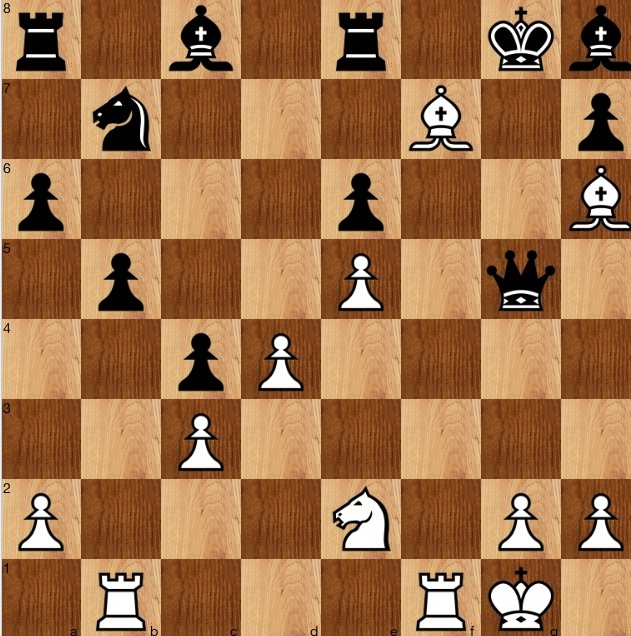
Straightforward again today. 1 Bg6! with the point being 1…Qg5 2 Bf7 mate.
This posting continues my occasional commenting on games in Wolfgang Heidenfeld's Lacking the Master Touch. The only reason for blogging about certain games or positions is because they interest me. In fact, what better reason is there is blog?
I hope my readers also find them of interest.
One of the books I have brought with me on holiday is Wolfgang Heidenfeld's 1970 book Lacking the Master Touch, fifty of his selected games.
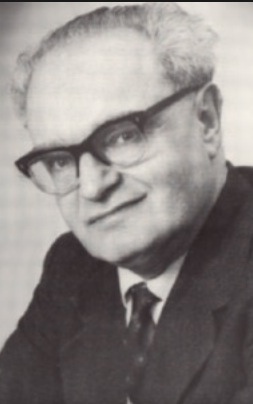
I am writing this post when only a dozen games into it, but it is already clear that it is a gem of a book. His level of annotation is just right, and he makes insightful comments. The fact (which is arguable) that he wasn't a GM is more a boon for the book than a limitation: he is human, like I am, and makes mistakes. I would though say that I suspect he very much was a master player. Certainly he would be an IM or a GM had he been playing in the 1990s or later, after the title proliferation of the late 1980s (or whenever it was). Born in Germany in 1911, as a Jew he had to emigrate, to South Africa; moved to Ireland in the 1970s before returning to South Africa where he died in 1981.
His style is great for a book: in the first dozen games, there have been several super attacking games, several messes, some created from what appeared to be flat positions.
I have found some interesting further lines in some of the games, and in this and subsequent blogs I will write about some that I think merit it.
White to play and win
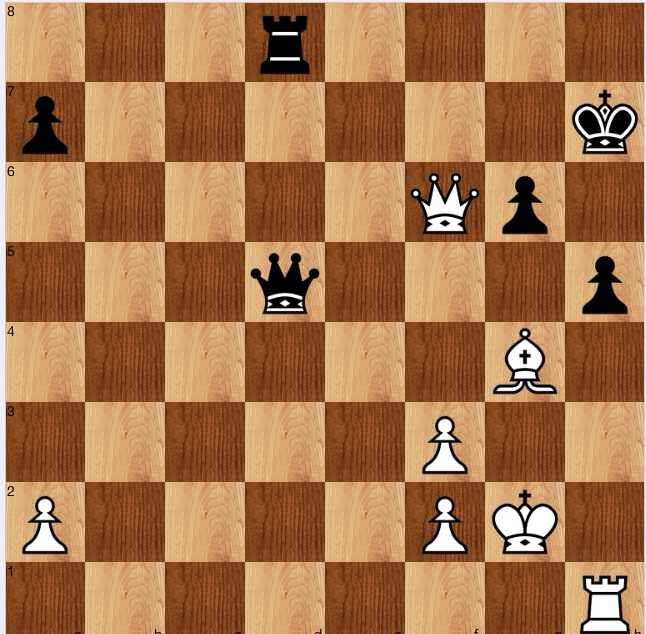
J Wolpert v FL Petzall, S A Championship, Johannesburg 1959
Solution
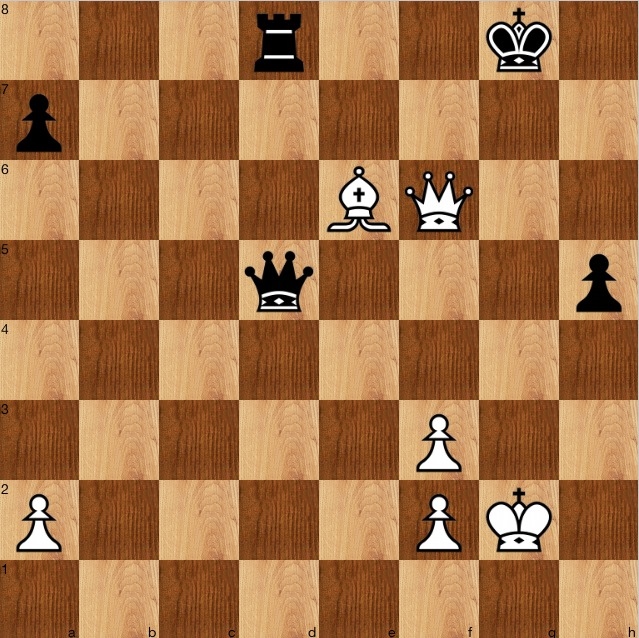
Fairly trivial, 1 Rh5+! is a natural first try, and all that remains to be seen is if the Q and B win, but once you see that (after 1…gh 2 Bf5+) 2…Kg8[] 3 Be6+ forks the king and queen, it is game over.
 allanbeardsworth