No, I haven't been on my favourite BBC Radio 4 programme, and no, Kirsty Young
isn't here with me in Maafushivaru, Maldives (I've gone one, no, three, better– my wife and daughters (plus son) are here with me), but since today I have been on the genuine deserted neighbouring island of Lunobo, it is the one and only time in my life, or at least the first so far, in which I have the undoubted right to pick my desert island discs.

I suspect Kirsty's guests have weeks, if not months, to decide which records to choose. And selection criteria vary, including the desire to impress, the desire to appear cultured, and even, in the recent case of Ed Milliband, to send the right political messages.
I, though, don't have that much time to choose, have no one to impress, am not musically cultured, and don't mind embarrassing myself. So, here are my Lenubo island discs.
Abba, I have a dream
My musical tastes didn't develop much beyond Abba: their peak years coincided with my childhood, and I could choose any one of countless of their songs. Googling 'Abba songs' brings me back happy memories of Chiquitita, Fernando, The day before you came, and countless others, including the record which started it all for me, Waterloo, but my first selection is I have a dream. It came out in 1979, when I was sixteen or seventeen; most boys had moved on to rock, but for me it was still Agnetha Fältskog.

Olivia Newton-John, Hopelessly devoted to you

This blog isn't all about blondes, though with Grease (1978) being the first film I ever saw at a cinema, whilst the girls fell for John Travolta, the teenage boys' hearts were on 'Sandy'. I could have chosen 'I honestly love you', but instead have chosen 'Hopelessly'.
Queen, We are the Champions

My next choice is this 1977 song. Queen were about as rebellious as I got (which is to mean not very, or more precisely not all). When I won a chess tournament or something similar, feeling on top of the world, this was my anthem.
In opting for Queen, I ousted Debbie Harry/Blondie: 'Denis' or 'Picture This' were two long listed choices.
Lady in Red, Chris de Burgh

This 1986 song was Jane and my first dance at our wedding reception in 1992. It will always be one of my firmest favourites.
Streets of Philadelphia, Bruce Springsteen
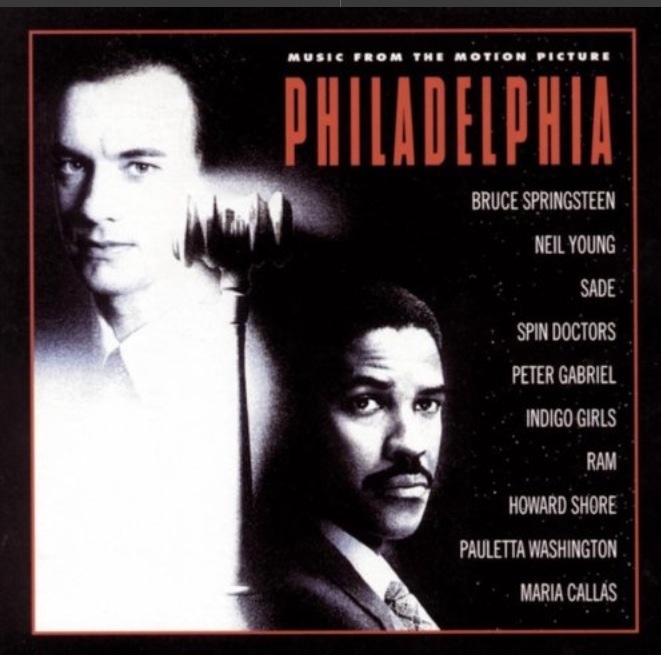
I never got into Bruce Springstein as a teenager, but one of the films of 1993 was Philadephia, of which this was the soundtrack. It is hard to perceive now, but I think I was genuinely scared for the World at that time because of the AIDS/HIV epidemic, which at that time seemed uncontrollable and its breadth worrying. However, Streets of Philadelphia has also been chosen for my desert island because it was the song I played, over and over again, dancing around the lounge trying to get our first child, Tom, to fall asleep to. I should ask him sometime whether he likes this song, but it will always remind me of happy times.
Michael Jackson, She's out of my life

I don't particularly know why, or what the song means to me, but this is my favourite Michael Jackson song. It is about lost love, not death, but it was one song which gave me some solace after the death of my mother, however illogical: maybe I just needed sad songs at the time.
On another day, I might have chosen Chicago's if you you leave me now
James Blunt, You're Beautiful

One to remind me of my daughters.
Stevie Wonder, I just called to say I love you

Another one for Jane. I chose it in preference to 'Unchained Melody', the theme tune from Ghost, which came out in 1990 when Jane and I first met: it is one of 'our' films.
The one record to take with me
In the programme, the castaway then has to decide which of the eight records to take to the island, if the other seven are lost at sea.
In fact, choosing eight records is impossible. I could have had Sad Café's Love Hurts, Elton John's Candle in the Wind, Yazoo's Only You; any number of Bee Gees, such as Masschusetts. I could have had The Circle of Life from the Lion King (for the family), or Nkosi Sikelel (to give me hope) or Nessum Dorma; or others which I am sure I could think of. But I have to choose one of the eight, and I think it would be Abba's I have a dream, to be back with the family before too long.
Book and luxury
The castaways are always given a book (as well as the bible and the complete works of Shakespeare), and a luxury. I think my luxury would be a pair of nail clippers– as with many eczema sufferers, my nails are weak, and break all too easily. I could always carve a chess set out of shoreline timbers or from beach trees. And my luxury would be the complete set of Garry Kasparov's My Great Predecessors: who knows, I might not want to be rescued?
 Posted with Blogsy
White to play and win
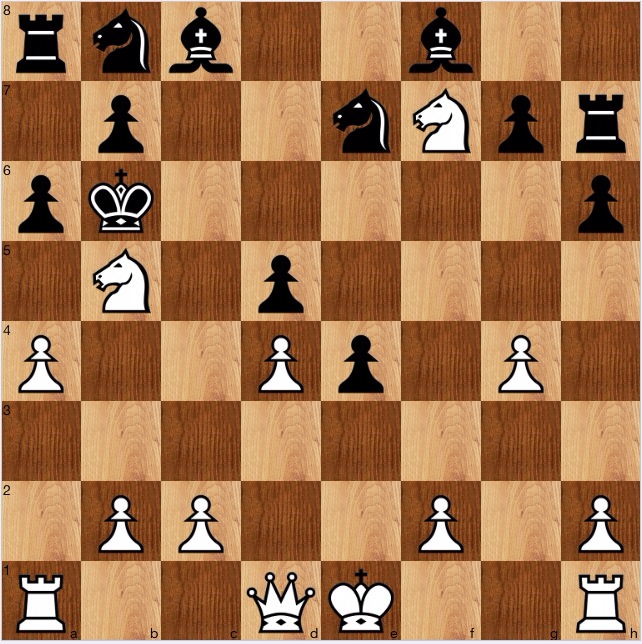
AN Rubinsztein v J Tsalicolgou, Cape Town Championship 1976
Solution
Reitstein asks the reader to find the most effective way to terminate the king hunt, and 1 a5+ is more or less obvious. (If it weren't, following Purdy's axioms would lead to it: examine all checks)). If..1…Kc6 then 2 Ne5+ when 2…Kb5 is forced, so it it clear that 1…Kb5 is the best try, but 2 Ne5! anyway, and 3c4+/4 Qa4+ follows.
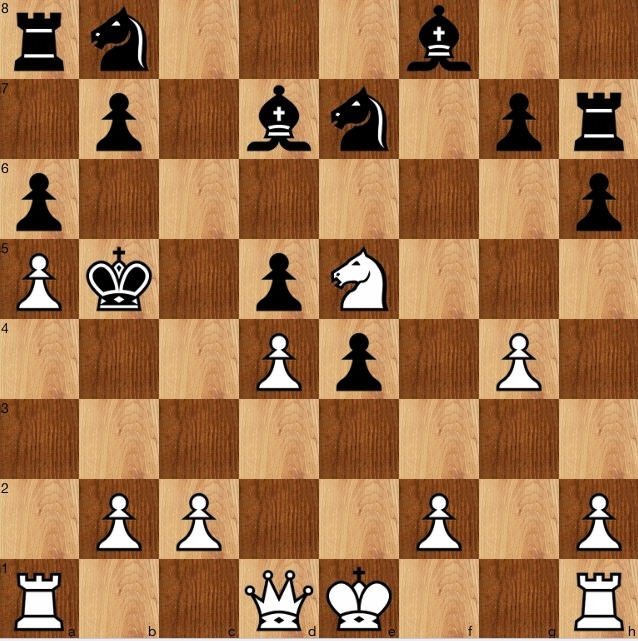
When I entered this position in my iPad app Stockfish, it told me that c3! was stronger than c4 (the move I planned, and which Reitstein gives in the solution, thought black resigned after 2 Ne5); and of course, Stockfish is correct, since c3! also threatens Qe2 mate.
This little 'puzzle' has caused me a fair bit of enjoyment, and it has pleased a few colleagues and daughter #2 (hopefully son #1, daughter #1 and wife #1 will read this blog, and enjoy the puzzle too). The puzzle isn't original, of course, but was seen in a tweet by QI Elves.
At work, I have a few colleagues who like me are mathematicians; some of whom I have shown this to. But on my last day before work I was reviewing some work with two colleagues, neither of whom were mathematically minded: the work was easy, it was the last day, we had time: I asked the more junior colleague to tell me something interesting from the client project (nothing: alas, it was entirely trivial): she gave as good as she was given, asked me to tell her something interesting, and got her own ready (she always comes to meeting with pen and notebook, to write interesting things down, or to write to do lists down); so I borrowed her notebook, and drew the following pizza.
What is the volume of a pizza, radius z, depth a?

(no, it is not a trick question, and no, it doesn't depend on whether it is deep pan or not).
The requirement is also to simplify the expression.
Answer
Most people, including I am pleased to say daughter #2, so private education has paid off) get to the answer fairly easily, sometimes having to scratch the depths of long forgotten maths lessons. The more mathematically minded struggle with it, thinking it is too easy, thinking there must be a catch.
The most common answer is π r^2 a, until I remind people that the radius is not r, but z. So most people get to π z^2 a, which is a good enough answer.
But of course, the question was to simplify it. z^2 can be rewritten as zz, and π can be written as pi, so the expression simplifies to:
pizza : the volume of the pizza is pizza.
QED, as we say here in the Maldives. Now, what is for lunch?
A senior colleague I am fond of is having a tough perceived time at work.
Note the word perceived. It is important. What is more important is perceived by whom: not by himself, but by the managing partners. I can't remember whether he came to me for advice: I think not, and instead, when I heard of the bad space he was in, I think I offered to have a chat with him, which soon became two chats, and soon became me thinking a lot about what guidance I could usefully give him.
We discussed many things, some specific to the person, the firm, the personalities. But the issues are also quite general, as I have seen from my own career experiences, from my thinking about my own department has run over the years, from what I see at clients, and from my general reading and learning.
Back to perceived. Been thought of in a poor light knocks confidence, and it takes strength of character to survive it. Is there still self belief? I can't imagine how difficult it must be to come to work really doubting one's own abilities. I have been fortunate, doubly so. I would never have been good enough to be a professional chessplayer despite the lies I told myself about how good I was as a junior; but somehow my career wandered from a false start in engineering (great academically at Cambridge, but if ever there was a square peg in a round hole, that was me for it as career- in fact, a better analogy would be three pin plug in a two hole socket, since despite getting a top first and specialising in electronics, I couldn't even wire a plug [I can now]; from a false start in engineering, through an invaluable learning period in audit, to the happy land of tax advising which is actually a different form of chess or maths or logic puzzles. So the first aspect we discussed was his self confidence and belief in himself.
This led on to my recommending that he should find some uninterrupted distraction free time and invest an evening in watching Randy Pausch's last lecture. Of course, being British, this late Professor's first name causes a giggle or a question about what type of video I am recommending (odds of 750,000 to 1 given that none or the babies born in the UK in 2013 were called Randy), but his lecture is one of the most profound and moving that I have witnessed: if you include all the books I have read, teachers who have taught me, colleagues or clients I have learned from, Randy's last lecture is one of the most influential and instructive in my life. I asked my friend to watch the lecture and try to really understand bricks so that he can identify them now, and work out how he wishes to address them.
A third aspect was telling him how I saw him: and how I knew others saw him. And to do this, I used one of my favourite mental tools, a two by two matrix.
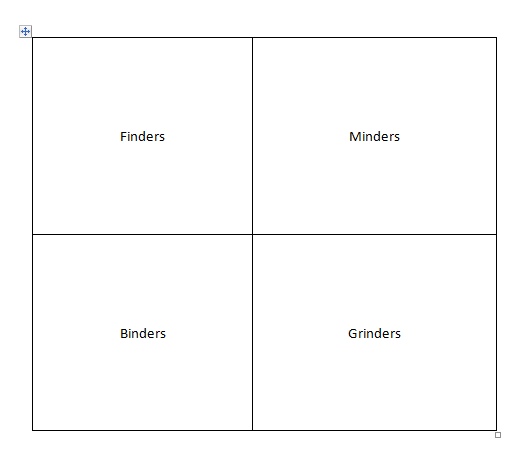
I think in diagrams: whether it be chessboards, corporate group structures, family trees; if I am addressing difficult problems, discussing typical issues which come up daily in my professional work, I will draw things out, even if only in + and – lists: and Donald Rumsfeld will always have my sympathy, for being pilloried about unknown unknowns, but he was right, and knowns and unknowns can be shown in a two by two matrix. But here, there are four kinds of partner, four kinds of partner skills, four kinds of board director skills, four kinds of senior clinician skills.
Finders, minders, binders and grinders was a concept I read about in a recent article by Mark Lee, who writes fairly frequently in my professional press, always in a refreshing and interesting way. My friend and I crudely classified many of our colleagues into their dominant quadrants. We could think of some colleagues who never won a client in their life, but who were excellent at day in, day out, producing high quality work and delivering big projects on time and to cost (as comparison, to show how universal this is: the academic who never won research funding for his department, but produced paper after paper): grinders. Colleagues who kept clients happy, where difficult or key times in projects were never fraught, who got repeat work because they were nice, easy or efficient to deal with: minders. Colleagues who kept colleagues happy and content: who organised social things; who kept the spirit of the department up; who baked cakes, or remembered people's birthdays, or knew the names of their colleagues' spouses, children, where they lived….binders. And colleagues who attracted new, significant projects, won clients from competitors: finders.
My friend is very strong on finding; very strong on minding; very strong on binding; and has a relative weakness on grinding. And all (not to demean it) that had happened was that his grinding weakness had come to the fore in management's eyes. But it was partly perception, and my core advice was for him to self audit, appreciate truly his great skills particularly in finding and binding, recognise the bricks he was facing, and decide whether to go over or round the wall. His grinding weakness needs to be managed, perhaps by ensuring he has staff working with him who are consummate grinders, partly by giving some more personal time to grinding.
The FMBG matrix can be extended into discussion of teams themselves. A team full of A* finders and E- grinders would fail; as would A* grinders, E- finders; as would a hospital department of A* brain surgeons, E- nurses: a composite, an amalgam, a blend of skills is needed in both individuals and teams.
For the last twenty or so years at work, maybe even longer, I have spent more time than others helping people with such discussions. It might be seen as being kindly, but is in fact selfish: since by discussing and thinking about others, I also think and try to help myself. Over the years, I have had colleagues who are pbricks, have met walls, and know that my FMBG matrix has not just weaknesses, like my friend has, but chasms. If the managing partners have good leadership skills, they will realise such things apply to us all, including themselves.
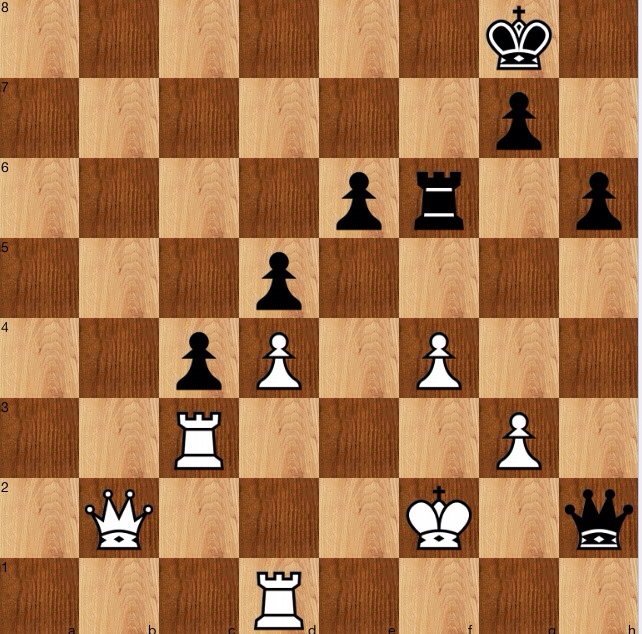
Black to play and win
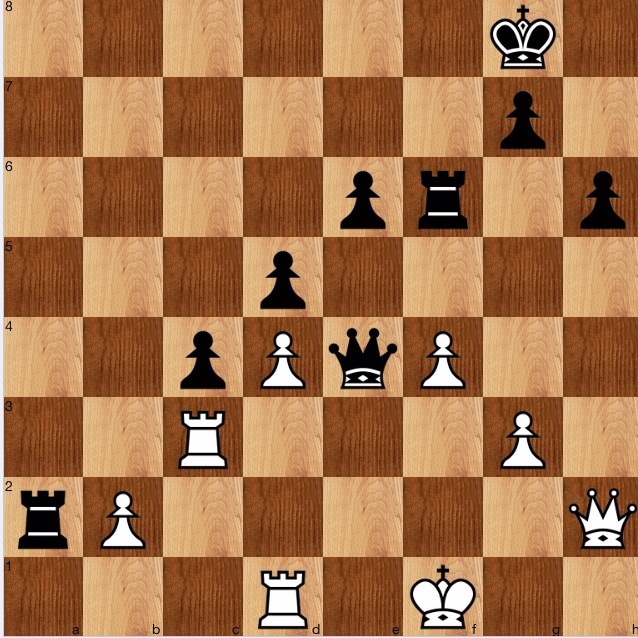
Ponelis-Savinson Johannesburg Open 1970
Solution
A common trick, often seen in rook endings, wins the game here. 1…Rb2! with the idea that 2 Qb2 Qh1+ 3 Kf2 Qh2+ skewers the king and LPDO queen.
Santa brought me Andrew Marr's new book, A short book about drawing.
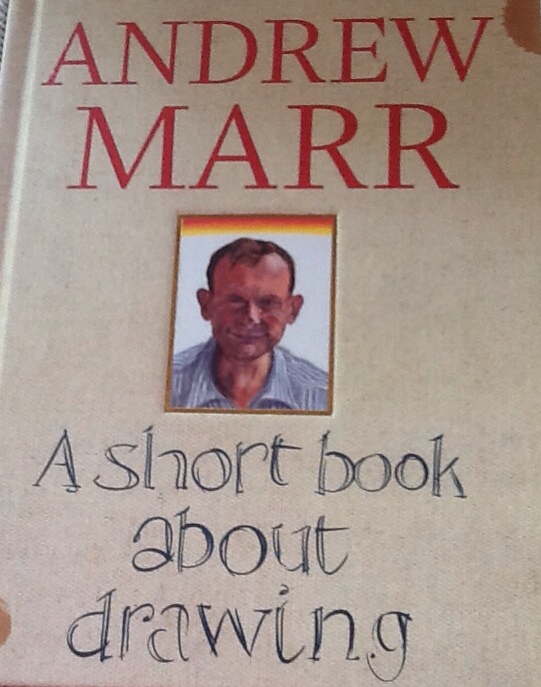
It is a loveable book. Last night, it beat my normal reading (Chess Today, Test your Chess, basically anything at all with the word chess in it) and I devoured the first two chapters, and today it will be book of choice for the beach here on the idyllic island of Maafushivaru, Maldives.
He writes movingly about the effects of his stroke, and about through it, he came to realise that drawing is a two handed activity- one to hold the pencil or brush, one to hold or angle the paper; and because of this, he has discovered the world or drawing through an iPad.
I don't think he recommends particular apps, and since I don't have an iPad stylus with me, but can only draw with my fingers, I downloaded the free Brushes, and here are my first two efforts.

Beach view, from outside our villa
Drawn over a photo, so the modern version of painting by numbers)
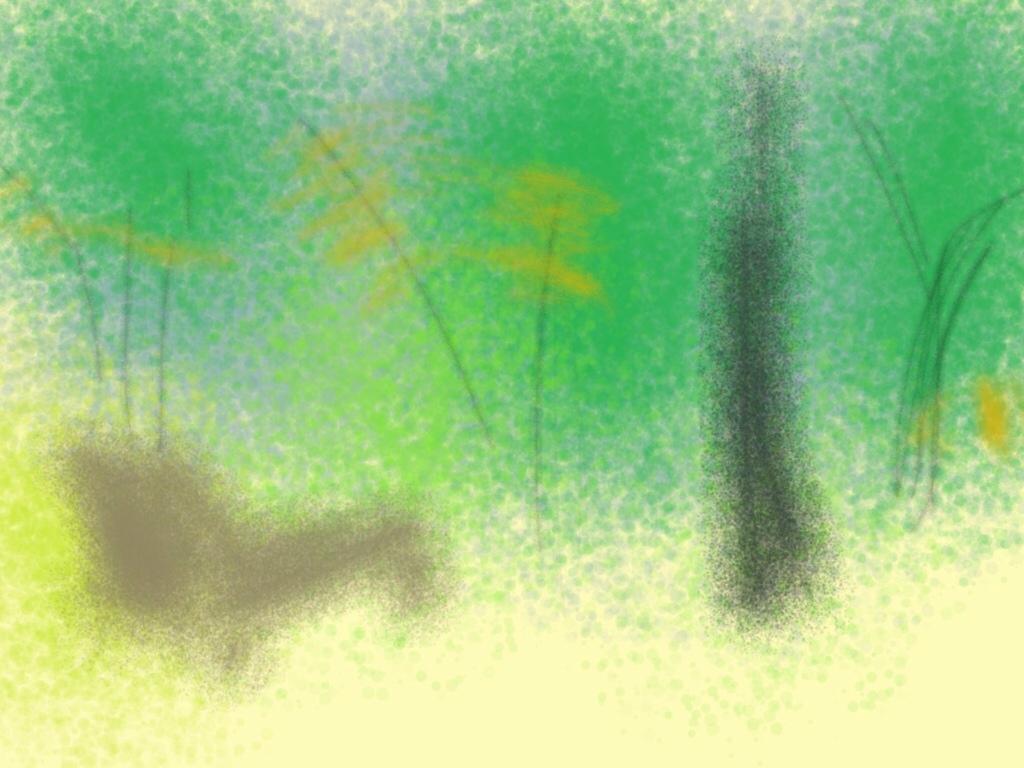
View from our verandah
My first true effort; so, a long way to go.
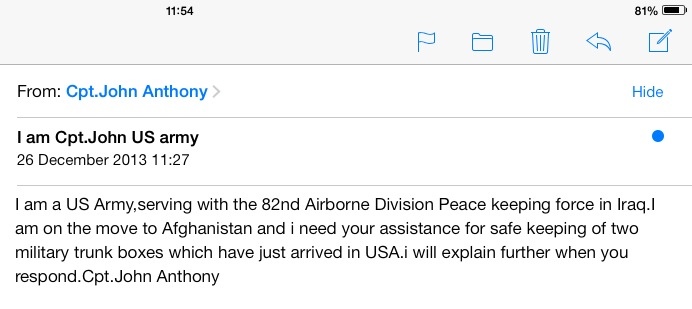
I have just had the following email. I am not planning to respond, but should I help our Allies' military efforts?
Bernard Cafferty kindly posted a comment on my blog, pointing out that he had written an article in the British Chess Magazine about The Next Move is. I wasn't aware of the article (my reading of the BCM has been fairly cursory in recent years, and indeed a year or so ago I stopped my subscription).
The article is posted here.
Bernard is very accurate in his critique of Cordingley's book. He says for instance that the puzzles were of variable quality, which they were, and often had solutions which were ten moves or longer.
The article looks at two games, as examples. One of these appealed in particular to me.
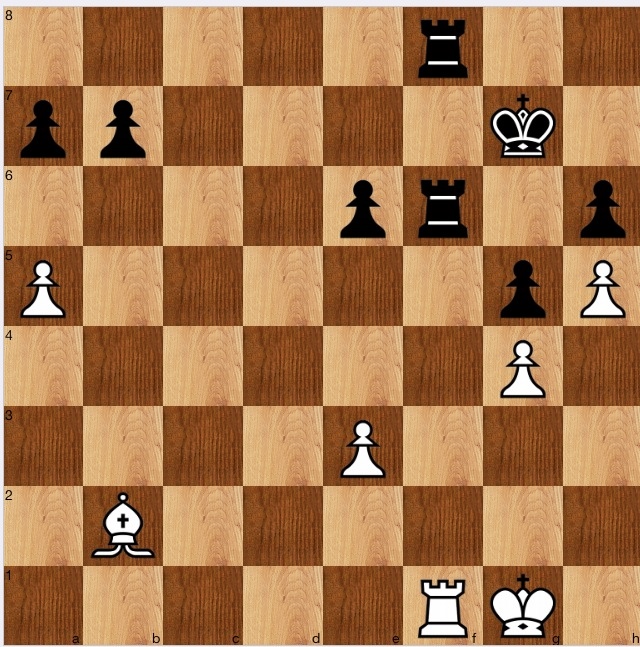
Rotlewi Bogoljubow, black to move
Bernard states that white wins by Be5-Rf3-K to d6. However, I think black can play 1…e5! and it is a draw…the same plan for white is countered by timely checks on d8, e8 etc. White is a tempo too short to win (he would of course win if it were his turn to move in the above position).
What result?
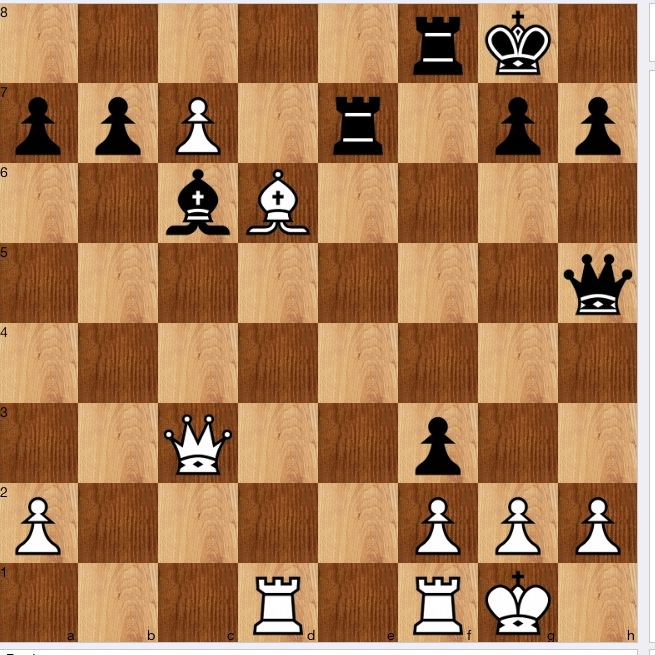
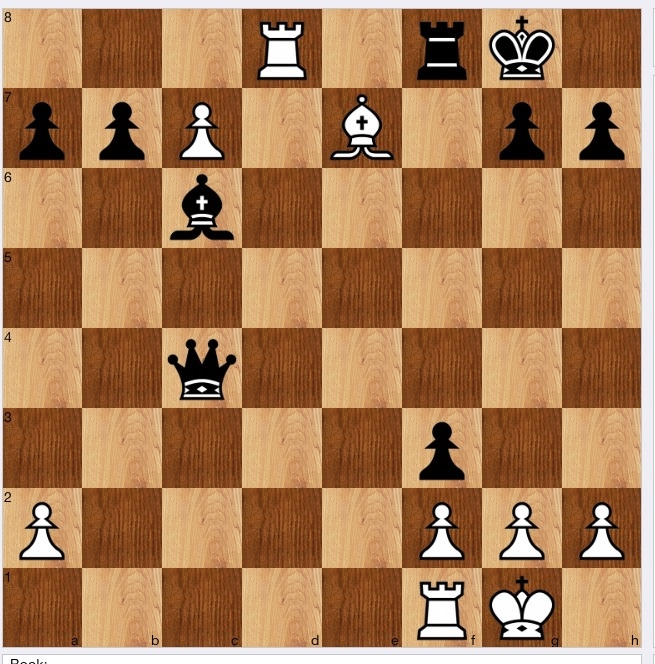
This position is from JH Clark v AJ Rivett, in the first, the 1892 South African championship. White played 1 Be7. Was this capture fatal greed or not?
Solution
I was tempted to think it was fatal greed, since 1…Qg4 threatening mate on g2 is obvious. But, perhaps partly because this is puzzle one of the book, I had to try harder, and quickly saw 2 Qc4+!! Qc4[] 3 Rd8 and white wins. White is at least a move too fast: eg 3…Re8 4 c8(Q), and black has no Qf1+ tricks
Before Christmas, I finished my daily text of solving and blogging about Cordingley's book. I then took a short break, deciding what to do next, whether to continue with daily puzzles from a book, or to write something else.
I more or less knew that I wanted to continue. It is an excellent discipline, having to blog each and every day, and also having to try harder: unlike say answering puzzles in magazines or in newsletters like Chess Today, where it is easy to come up with partially correct or wrong solutions, or to look too briefly at puzzles, since there ubiquity means they are less consequential.
Again my choice of puzzle book wasn't too hard, but my short listing was made easier by Nelson Mandela's recent death. He apparently passed some of the time away on Robben Island playing chess and draughts, as reported by Chessbase http://en.chessbase.com/post/nelson-mandela-a-man-for-the-ages. Some years back we visited Cape Town and of course Robben Island: here is his cell.

I don't recall how I got the first- I must have bought it in a second hand stall, but Have two puzzle books of positions from South African game, so the next series will be puzzles from Leonard Reinstein's Test your chess!. Having got the first volume, I wrote to Leonard, and he sent me a copy of his second of the two puzzle books: so that will probably be the next one to be blogged about.
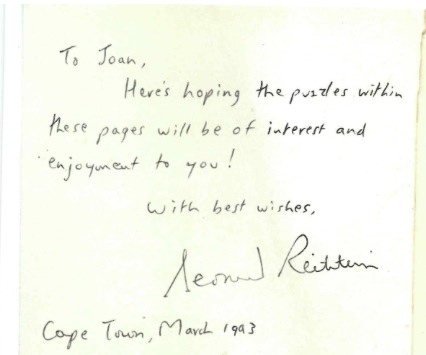
Like my copy of Cordingley, my copy of Reitstein also has some personalisation in the inside cover, this time by the author himself.
 allanbeardsworth