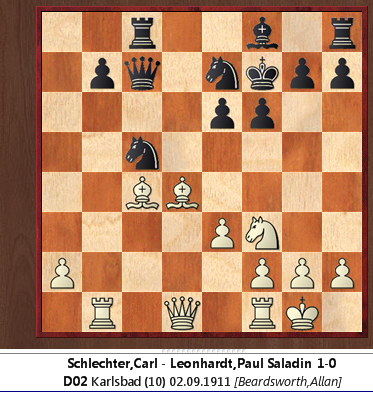
White to play and win
Solution
I enjoyed this puzzle. I fear that in a real game I might play some non-descript move, but, knowing it was a puzzle, I quickly landed on 1 Ne5! Of course, if as a mode of thinking I adopted Purdy's maxim to consider all smites then Ne5+ would have been looked at in game play too.
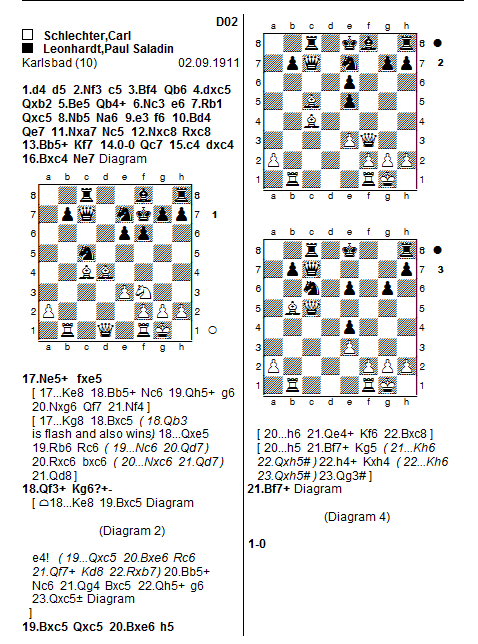
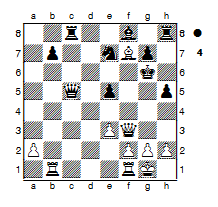
The capture of the knight is the main line I examined: 1… Kg8 is clearly bad, and 1…Ke8 gives at least a clear plus to white. So, 1…fe 2 Qf3+ and I thought the best defence was 2…Ke8, when 3 Bc5 Qc5 4 Be6 is lethal: one of those positions where black is unable to marshal a defence.
Switching on Houdini, it too prefers 2…Ke8, but inserts the zwischenzug 3…e4! to disrupt white: the net result being white is better, but not absolutely winning. I believe that one very common human trait, which I fall into time and time again, is to automatically recapture: engines aren't programmed that way, they look at everything: Houdini would never be surprised by a zwischenzug.
 Posted with Blogsy
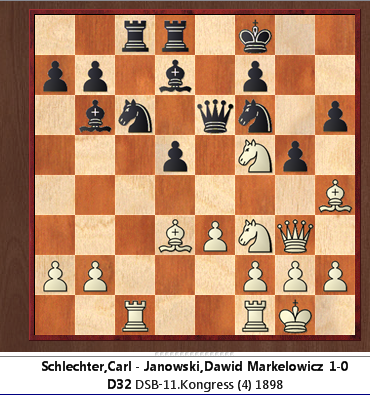
White to play and win
Solution
Fairly straightforward in a way: but difficult enough as to not be trivial.
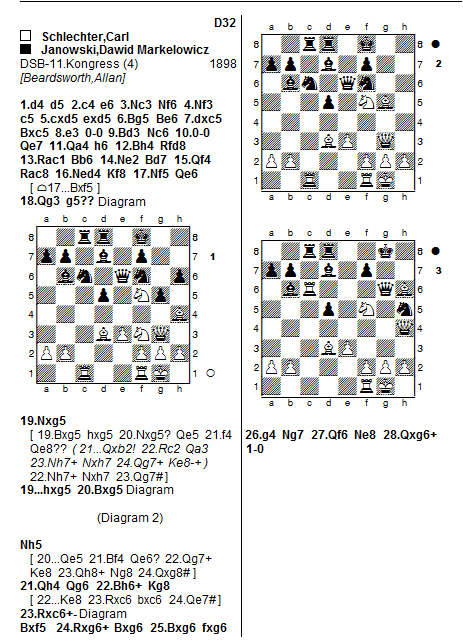
The choice is between which piece to take on g5. I liked the idea of 1 Bg5 hg 3 Ng5 which threatens in some lines Nh7+!- though in fact, in very few if any lines, because after N*h7 Qg7+ if black can go Ke8, then the Nh7 covers f8: so Nh7+! only works if black retreats his Q to e8 (after being biffed by f4). I quickly decided that black's queen can't be pushed to a bad square- f4 Qb2+ and if Rb1 Qa3, protecting f8.
So, instead, it has to be 1 Ng5 hg 2 Bg5 and this is where I more or less stopped precise calculation- it all depends on black's response, of which he has several, but in each case white's pieces and pawns will roll forward.
In fact, the solution is very similar to number 135- extremely and oddly similar, in fact.
One of my favourite websites is Dilbert.com, which has an uncanny knack of having very timely cartoons.
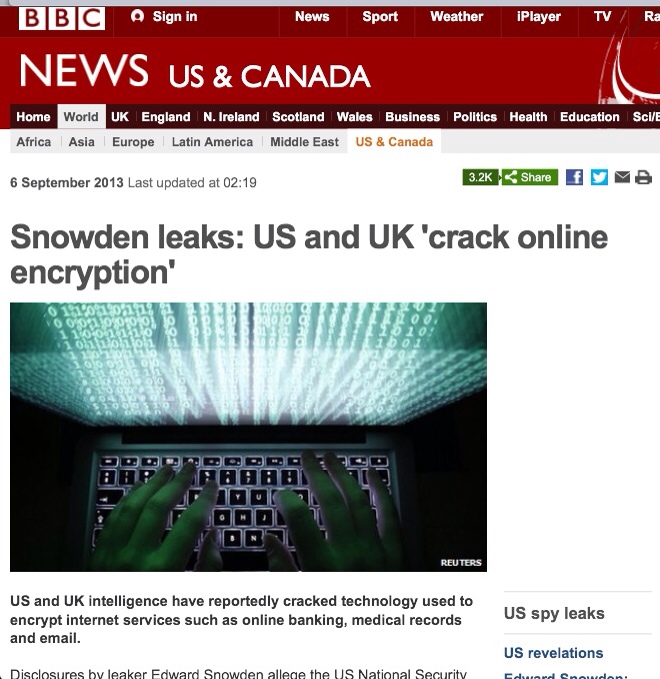
Today, there is news on the BBC that the US and UK intelligence services have cracked encryption coding (though the full article suggests maybe that they just spend enormous funds and employ significant resources to try to do so, rather than they have broken the prime number based algorithms)
Dilbert today is:

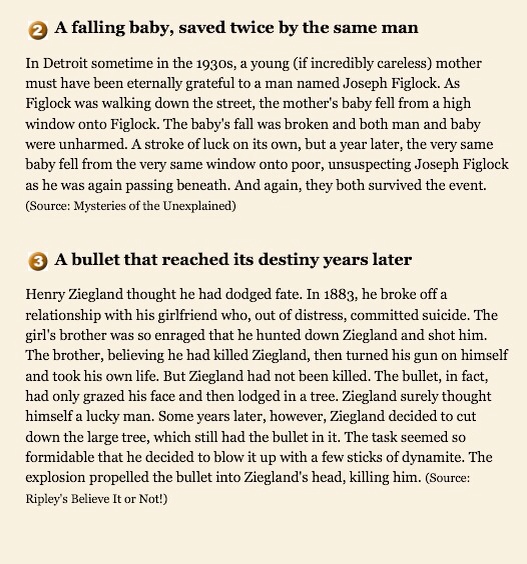
In working out what word to title this posting, I googled coincidence, a website I hadn't heard of, http://www.oddee.com (which seems to be a fun if weird place to waste some time) had a posting of ten extraordinary coincidences, of which these are two.
White to play and win
Solution
Oh dear, another cooked puzzle.
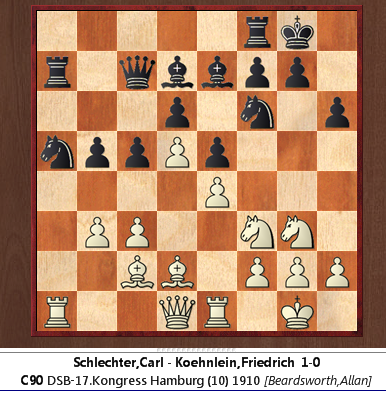
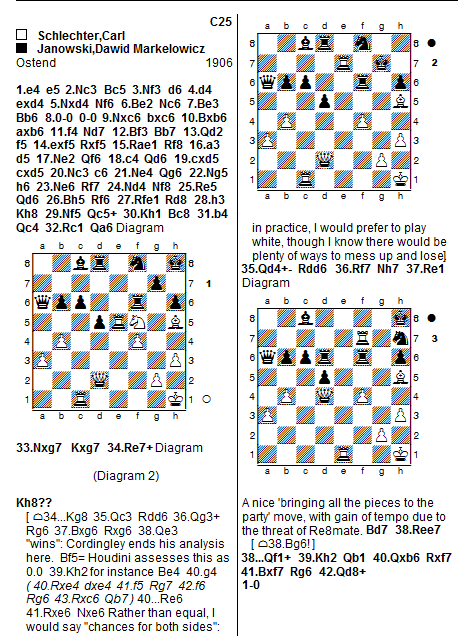
I was intrigued by this one: the position looks like a very standard Ruy Lopez, with still lots to play for. But since it was a puzzle, I thought I must be missing something. The Be7 is LPDO, and the Qc7 and Be7 are 'potassium cyanide' to the d5 pawn (see my previous blogs on Purdy), but I couldn't make anything on these, nor the somewhat looseness of the Ra7/Na5. So, it had to be the weakness created by h6, so I tried Bh6, couldn't make it work, and so set the pieces out on the board.
A bit of moving the pieces around confirmed that 1 Bh6 is no good: so, the move I would want to play, was 1 Nh4, and if 1…Nd5, then 2 Nhf5 and hope…but 1…Rfa8 or other solid moves mean there is plenty of play. I then turned to the solution and saw that black played the fairly weak 1…Nd5 and that Cordingley notes that Ra8 was better.

White to play and win
Solution
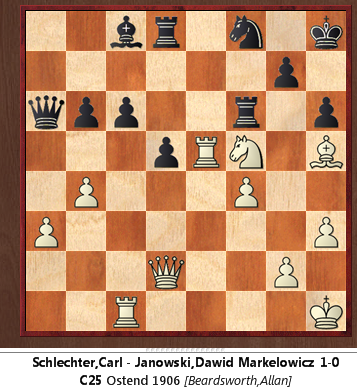
Another cooked one, or at least half cooked. After a short look round and finding nothing else, I decided 1 Ng7 had to be tried, and after 1…Kg7 2 Re7+ there might be something.
The choice is between 1…Kg8, which has the demerit of being on the open g file, so Qc3-g3 might be something, or 1…Kh8, when the Rf6 is pinned by 2 Qd4, and Rf7 follows. I found neither line easy to compute, but felt that Kh8 was the weaker, and then checked the solution: there is only so much depth I can go into.
Then, with Houdini on, it says Kg8 is more or less level, whilst Kh8 does indeed lose.
White to play and win

Solution
I enjoyed this one. The first move is fairly obvious, 1 Nd5, the hard thing is to calculate through the various defences, particularly 1…Bh5: for me, it was the right balance between 'hard' but not 'impossible'.


White to play and win
Solution
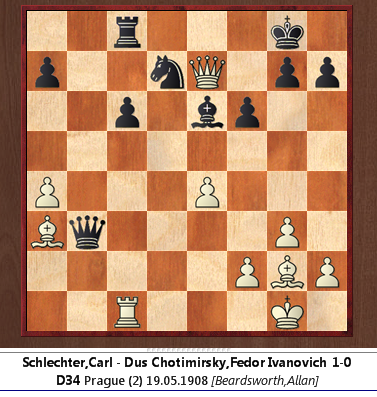
Relatively straight forward. I first looked at 'improving the worst placed piece', the Bg2, by 1 e5, but couldn't make anything if it. Then I noticed the risk of a back rank mate, quickly realising that the Rc8 is tied to the eighth rank, so that the Pc6 is LPDO, so 1 Rc6! with a double attack on the Rc8 and Be6. All that was then needed was to check that black hasn't got any first rank cheapos: he doesn't, so 1 Rc6! is game over.
White to play and win
Solution
Silicon beats carbon yet again.
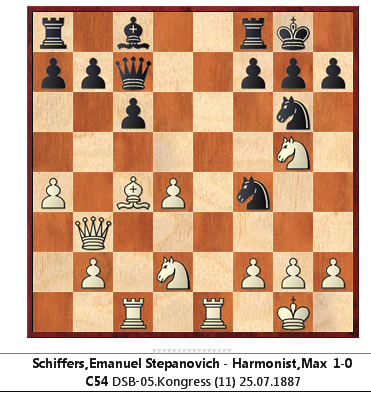
I struggled with this one. The 'move my hand wants to play' is 1 Nf7, hoping to take advantage of the pinned Rf7 and back rank after 1…Rf7 2 Re8+ Nf8; but I couldn't see what move to do.
Just before giving up, I found the 'solution', the move played in the game, 1 Re8, saw a few lines which seemed to be good for white, and checked the solution.
Alas, 1 Nf7! Is very strong indeed; as is 1 Bf7+!; and several other moves are better than 1 Re8.
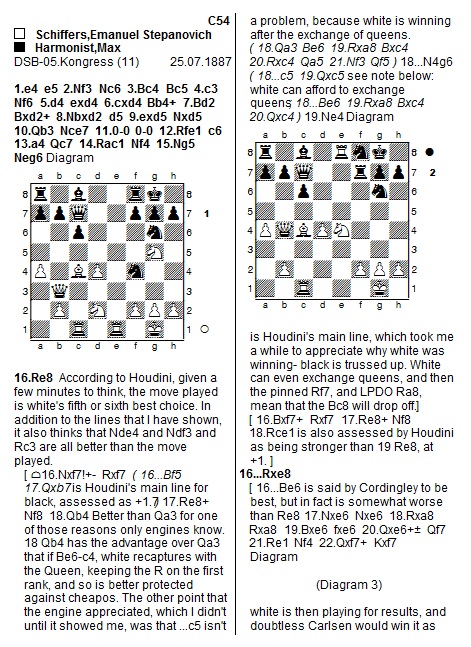
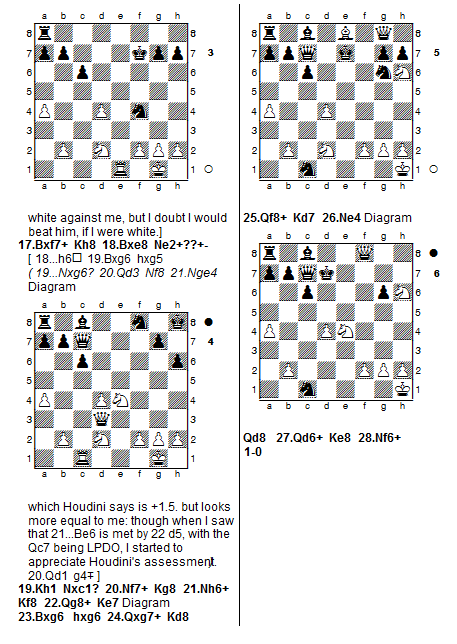
The reason why 1 Nf7! is very strong is too deep for me: by which I mean I could not see how trussed up black is after the main line 1…Rf7 2 Re8+ Nf8 3 Qb4 Ng6 4 Ne4; which once you see it, and spend time on it, can be seen to be really strong; I could also not readily see why 3 Qb4! is so much better than 3 Qa3, but it is, partly since 3…c5 isn't a threat.
Chess is a really deep game. In even simple positions like this one, there can be many depths. A good, challenging, puzzle, which I flunked.
During my holiday this year, one of the books I read was Genna Sosonko's The World Champions I knew. It made me think 'which world champions have I met'.
The first was the Armenian Tigran Petrosian (1929-1984) (world champion 1963-1969 between Botwinnik and Spassky) who I played in a simultaneous display he played against the England Junior Squad in London on 15th January 1978. I was fifteen, and had been playing chess for around six years.
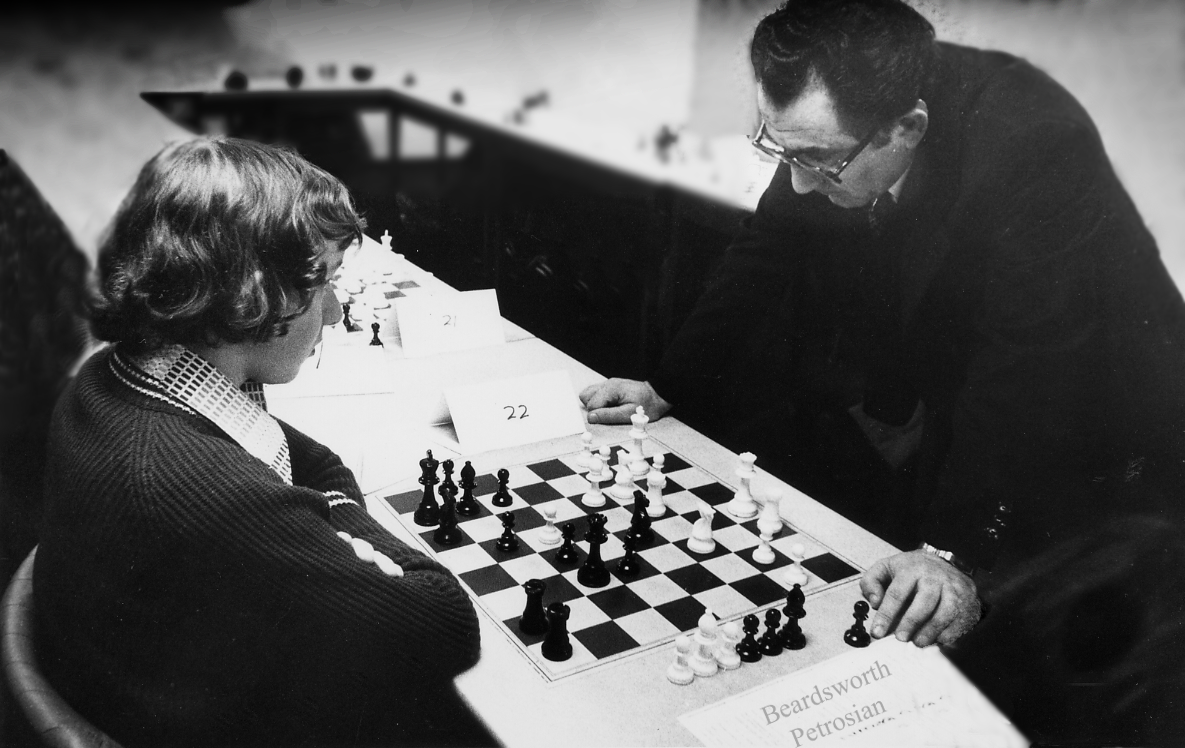
Remarkably, I had a head full of hair in those days. Equally remarkably, I had the better of a draw against him, having played the then very fashionable Benko Gambit against him. Even more remarkably, I can still clearly recall the smile he gave me when we shook hands to agree the draw: such things last a lifetime.
The event was held, if I recall correctly, at the YMCA in London. I can't picture the room, except that I can clearly recall that Tigran was accompanied by some burly, suited, men, and I can even picture one of them dictating with a finger direction which way, clockwise or anti-, he should go round the boards. Fantasy perhaps, from an over exaggerated childhood imagination, but would you put it past the KGB?
Looked at dispassionately from the distance of the best part of forty years, maybe I only had the slightest of advantages, if any: I have only relatively recently begun to appreciate the 'drawing margin', the tolerance or range within which advantages are not good enough to amount to anything. Or so I thought until today, thirty five years later, when I ran it through an engine for the first time, and- should I be happy or sad?- Houdini shows me that I was clearly winning.
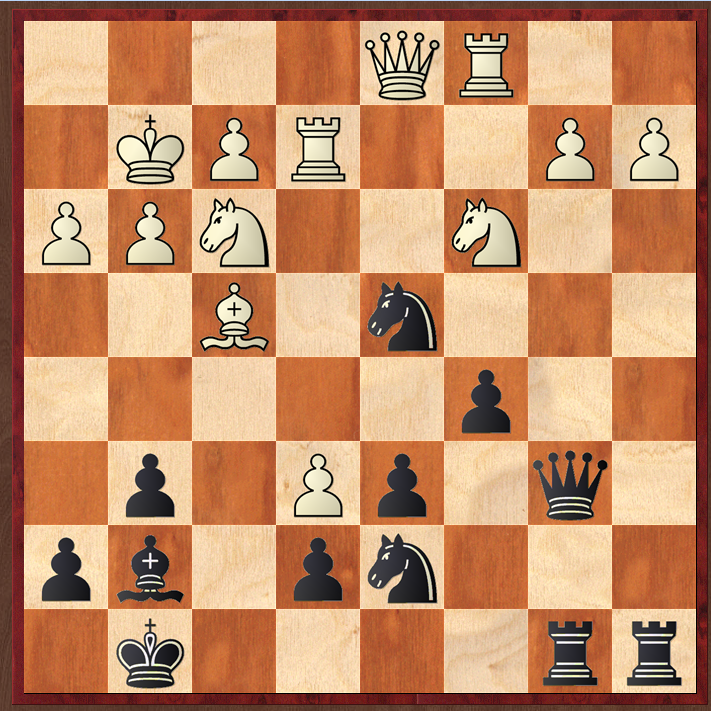
Around here the game became in my favour. Tigran had opened the position too hastily with Pe4-e5-e6: the opening was too my advantage, particularly since with the white squared bishops coming off in the opening (on f1: Ba6*f1) and white having played g3, the key diagonal is h1-a8.
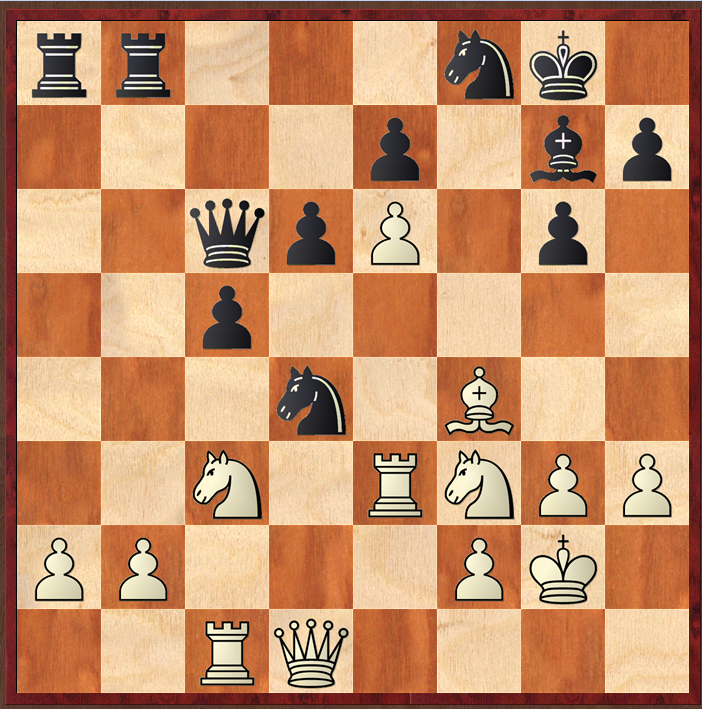
This is the position Tigran is contemplating in the photo: he is about to play Kg1, trying to ease the pressure on the long white diagonal. Alas, looking at myself thirty five years back, I wish I could say 'why are you staring at your opponent' 'concentrate on the board'. Of course. I was in awe of Petrosian and no doubt was hoping for magic rays of learning by staring.
Has this game a GM one I was watching in 2013 on Playchess.com or ICC, the merest of glances would give me the assessment 'black is much better'. I would realise now the long squared diagonal is under my control, the better placement of my rooks, the activity of my minor pieces. If I were playing now, such assessments would lead to 'keep the pressure on'. But I didn't know such things: didn't know Makagonov's worst placed piece principle , didn't know Aagaard's 'bring all pieces to the party', had never heard of a fortress…I did have some understanding of the tenets of Alexander Kotov's Think Like a Grandmaster, and had devoured Horowitz's and Mott-Smith's Point Count Chess, but I think my thinking was quite one dimensional, tactical, with an innate ability to place pieces on good squares…but not the technique to work hard and maximise positions.
So the game slipped away. Or, is that fair when I didn't know it was in my grasp?
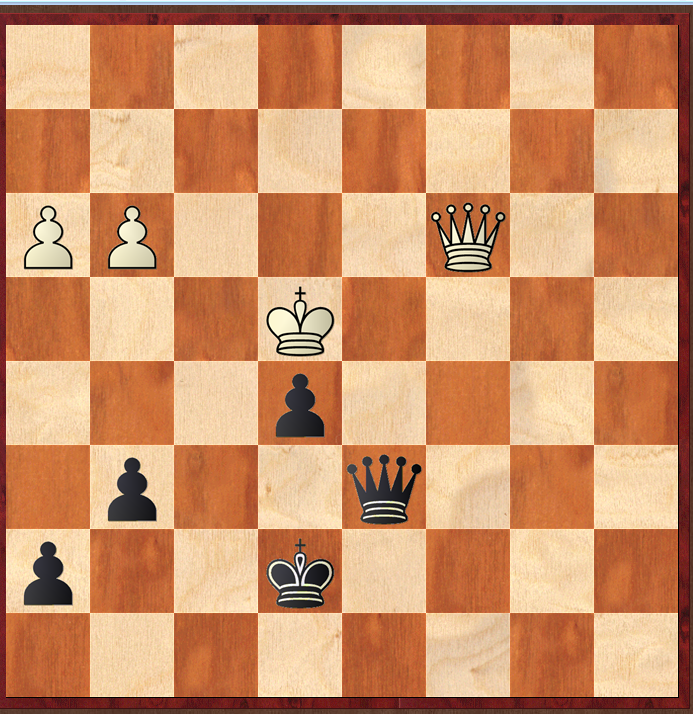
The attached PDF contains a lot of analysis, including showing how I could have maximised my pieces: with some fantastic silicon lines.
White to play and win
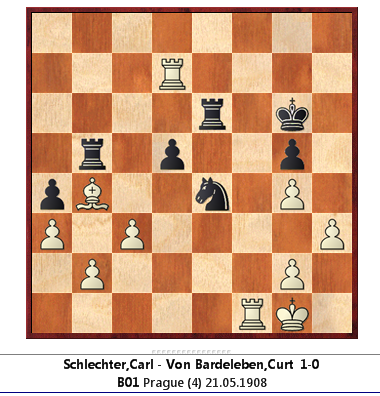
Solution
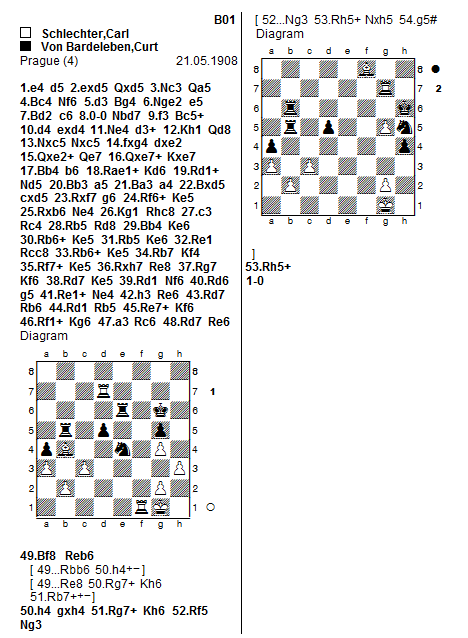
Black's king is in a 'net' and this makes the first move, 1 Bf8, easy. What follows then depends on black's defence. I presumed that black's best defence was 1…Re8, and lose the exchange, but there is little hope of survival. In the game, black protected his rooks, when the idea of h4 is either to advance to h5, tightening the net further, or if black captures, Rf5-h5 comes.
Nice.
 allanbeardsworth