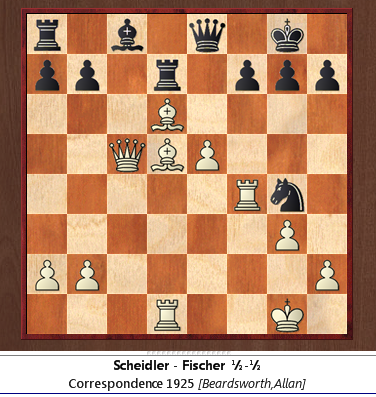
Black to play: e6 is threat
Solution
Oh dear. I spent a lot of time on this puzzle, presuming that there was something special, given that black appears to be in dire straits. Firstly, I hoped that maybe if black could get to play Qe3+ then there might be a perpetual, but I quickly saw that this would not be the case: for instance, the Bd5 blocks most attempts. Then, I looked at obvious tries like 1…Rd6 and 1…Nh6, saw that these failed, and realised the solution Had to be more imaginative. I set the position up on a board, and devoted some time to it. The move 'I'd like to play' is 1… Ne5, but the queen is LPDO after 2 Be5 Qe5 3 Bf7+, and biffing the Qc5 first with 1…b6 doesn't seem to help, and nor did the zwischenzug 2…b6: 3 Qc6 or even 3 Bf7+ seemed to win. The more fanciful 1…Ne3 loses simply to 2 Qe3 Rd6 3 Bf7+. So, in desperation, I struck upon 1…g5 and hoped that 2 Rg4 Rd6 might suffice: but the engine tells me that 3 e6! wins.
Alas, the problem is totally cooked. And Cordingley knew it, with him giving the game continuation and the comment 'Alas! It is not what it seemed'. Such puzzles and answers would never occur nowadays.
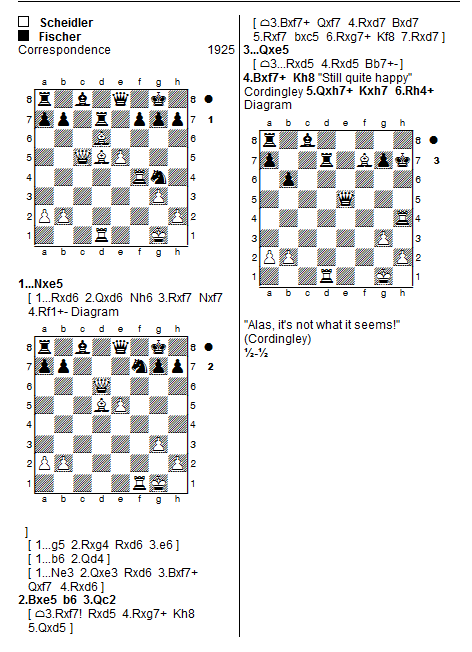
However, as an exercise, it was good. So the time spent was not totally wasted.
 Posted with Blogsy
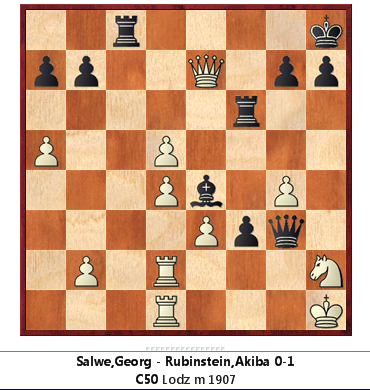
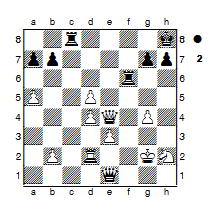
Black to play and win
Solution
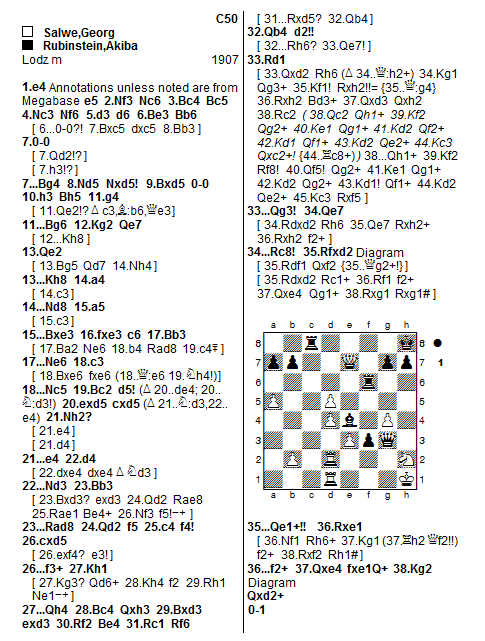
A lifetime of playing chess builds up a range of excuses: a player needs to be able to rationalise defeat by not feeling well, tired, opponent lucky, 'had to play for a win and so risk losing'..; in solving this puzzle I have an excuse: the diagram in the book was incorrect, with the g4 pawn shown instead as at f4.
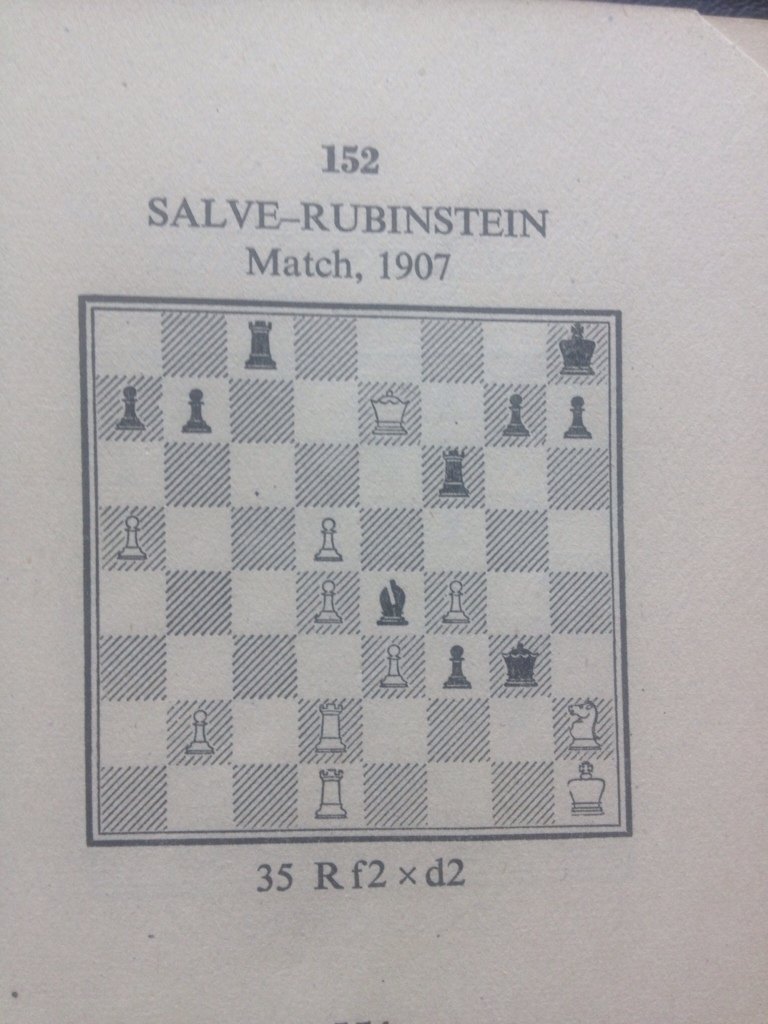
But, as with excuses for losing, my excuse here doesn't really wash: the same pretty solution exists in it too. In solving 'the book' position, I played 1…f2+ 2 Qe4 Rg6; and this does indeed win, or at least Houdini assesses it as -2.
Instead, Rubinstein finished off a classy game in style.
This is one which will annoy me: I should have been able to solve it.
Introduction A year or two back, my younger daughter gave me a present, 'Dear Dad, from you to me' , one of those gift shop gifts which are very well intentioned, but, alas, time is so short that they can often gather dust and never be completed. I decided a while ago that I wouldn't let this happen, and would aim to complete it for Sophie, Alice and Tom, so whenever they want to, they could find out a bit more about their Dad. So, I have set up a private blog, to which only family have access, and have been posting to it during and since our summer 2013 holidays. Many of these postings are personal, and best kept private for the family only, but those which are less private will also be posted on my main blog.
King Henry VIII knew my grandfather
Well, no he didn't. But my great-great-great-great-great-great-great-great-great-great-great-great-great-great-great-grandfather (thank you to the inventor of copy/paste), that's my G^15 grandfather, might have known him.
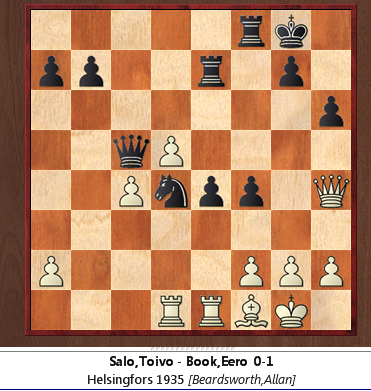
Black to play and win
Solution
I messed this one up, royally. I think I saw the first move of the solution, 1..e3, but rejected it, not seeing either 2…Nf5 nor 2…Nc2.
Instead, I flummoxed around. I liked the look of 1…Rf6 and 1…Re5, moves I would typically play in a game. They both aim to entrap the white queen and/or facilitate the advance of the king side pawns: but neither seem to be winning.
I presumed the solution had to be fancier, and so hit upon and chose 1…g5?? my idea being 2 Qh6 Rg7 when there are some nasty threats of e.g. g4 and Nf3+; but, alas, 3 Re4 and black is lost.
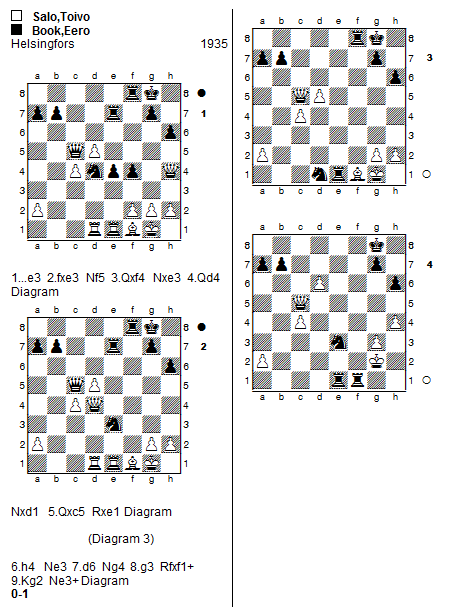
I have not found this game either in Megabase or via googling.
White to play and win
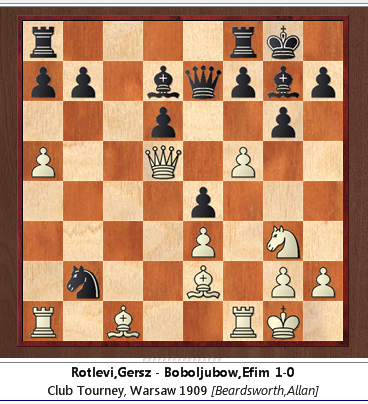
Solution
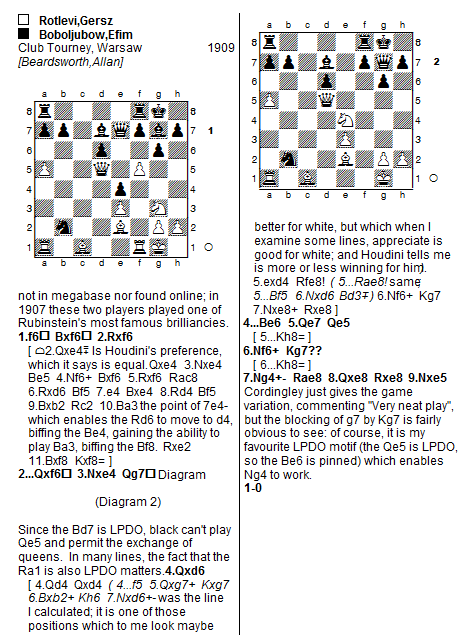
The eagle eyed will have noted that I have deleted the 'and win' because the problem is cooked. I spent a lot of time on it, including setting pieces up on the board and moving them around, trying to unearth what was escaping my grasp, to no avail. Only I had felt I had done what I could do, I checked the solution, found it somewhat wanting, and turned to Houdini.
My analyses are shown below. Whilst in practice I would have gone 'all in' with f6 and Rf6 as in the game, I would have done so out of desperation, in hope, and Houdini thinks that 1 Qe4 is slightly better, with a slight disadvantage.
White to play and win
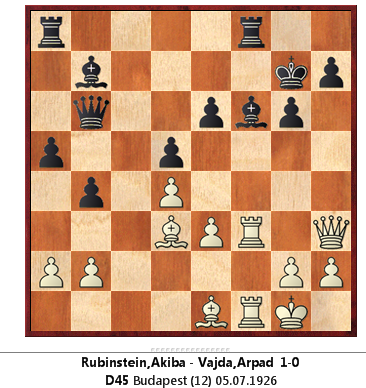
Solution
I enjoyed this one. After toying with 1 Qh7+?? and 1 Bg6??, and after mistakenly thinking that the piece on b2 was a bishop, and trying 1 e4?? (which wouldn't work even if the b2 piece were a bishop) I looked at the next most obvious move, 1 Rf6, and exchanging off the rooks: but then what? Fortunately I know enough to look one more half move than is easy, say 3 Qh7, which attacks g6, which can't be defended, and also has the threat of bringing the black squared bishop, which I now saw was on e1, to h4 with check. Game over.
One little detail is that the black queen is LPDO, and the fact that it is geometrically aligned with black's king, means that there is one tactical element: after 3 Qh7, the threatened Qg6+ would skewer king and queen. Yet another example of the importance of LPDO.
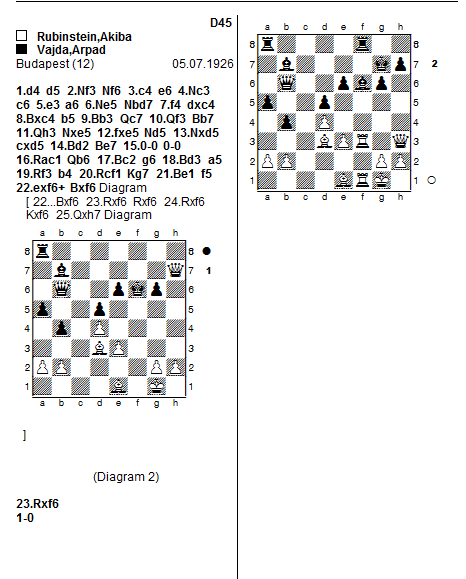
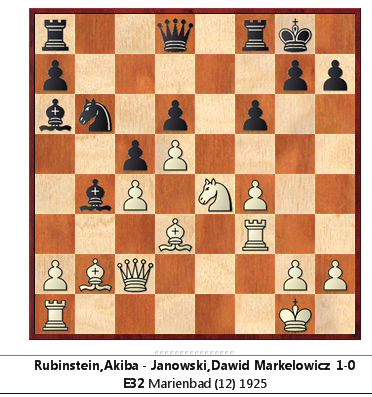
White to play and win
Solution
The first move is easy, though in fact Houdini tells me the position can be improved even further by first playing 1a3 Ba5; but 1 Ng5 is clearly strong: all that is needed is to compute the precise follow up. I quickly saw the idea of Bg7+! Qg6+ Bg8, but prefaced it by Rh3: the engine tells me that it is better just to play Bg7+, as in the game, with mate in seven.
A nice puzzle.
A recent article has caused mixed feelings in my family.
My son, cracked open the champagne:

My younger daughter's expression showed her feelings starkly:

My elder daughter was so distraught that she wouldn't be photgraphed.
The article?

White to play and win

Solution
I found this immediately, so I guess I would call it simple: the only hard part was finding the bishop manoeuvre. 1 Re5+ Qe5 2 Bf7+ exploits the pinned rook against the LPDO Qe5; so 2…Ke7 and 'where to put the bishop'? It didn't take long to see Bh5+ and Bg4+ which wins the house.
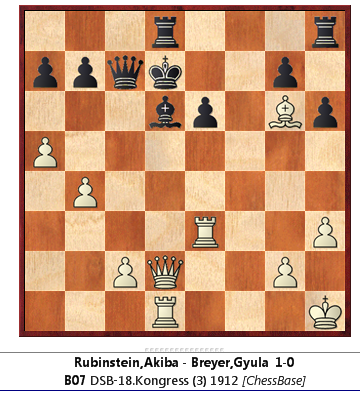
White to play and win
Solution
This puzzle took me a little while, partly because the layout of the book is such that the very next puzzle, 147, is clearly from a later position in the same game: so at first, I thought maybe it was one of those positions where the answer is to significantly improve white's position, rather than win outright.
So at first I tried 1 Rc3, but soon realised it doesn't do anything, after 1…Qb8; though I did wonder if 2 Qf4 was the idea. Eventually, I decided to ignore puzzle 147 and concentrate on the game in hand: a bit like the desire to look the more interesting game between your neighbours than your own dull game in a match.
Then, I realised that Rubinstein must have missed something, and more or less immediately I decided 1Re6 must be the idea: 1…Ke6 2 Qd5+ and then 2…Ke7 3 Qf7 mate; 2…Kd7 3Qf5+ Ke7 4 Qf7 mate are easy, but at first I couldn't solve 3…Kc6, before kicking myself when I saw 4b5 mate.
A nice puzzle.
 allanbeardsworth