White to play and win
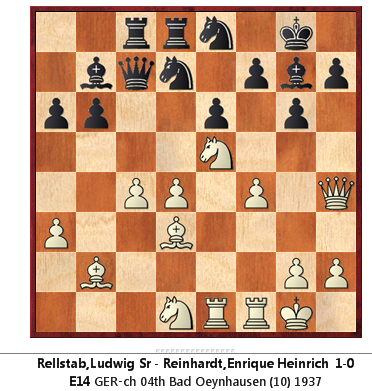
Solution
The first move is obvious, and it is really a question of seeing 'does it work'? So, 1 Nf7 Kf7 2 Qh7 Nf8 and all would be over except for 3 Bg6+! Ng6 4 f5!: once you see that, and it didn't take me more than a few moments, then you know you have the solution. It then became a question of checking and delving.
Of the main line, I couldn't see it all: all I could tell was that white had enough momentum, an open black king, that there should be a win, and even if there wasn't, white had enough pawns and a central majority. Of the minor lines, and in fact 2…Nef6 is shown to be the best defence, again I felt I had enough. When checking this with Houdini, it shows that most lines are at least +1 for white, but the line showed in the attached, with Ne3, is +3: this is one of those times when I certainly can't see my way through the thicket of variations, but can see that white has an overwhelming practical advantage.
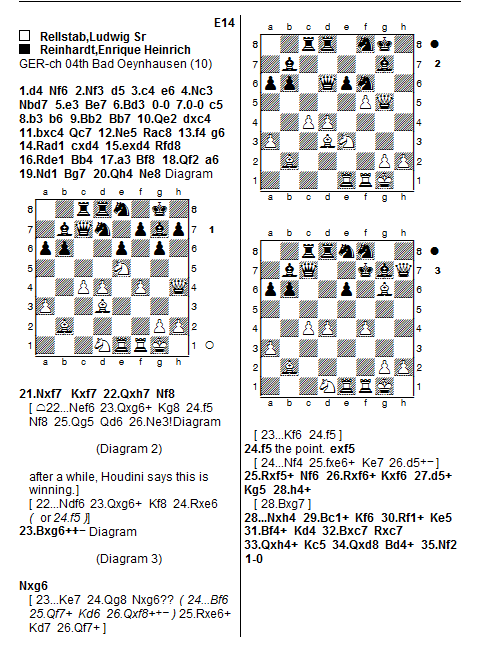
 Posted with Blogsy
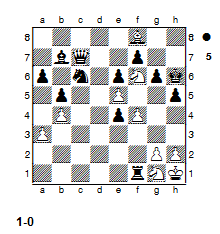
Black to play: how can Black best defend himself against the threatened attack, Qh4
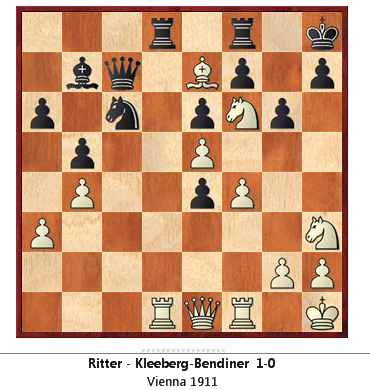
Solution
Fairly odd this one. This is the first puzzle in the book (and might be the only one) which isn't a 'play and win' one. Since it was unusual, I immediately realised the answer couldn't be 1…Rd1, the move played in the game, which loses. I saw that after black takes both rooks (1…Rd1 2 Qh4! Rf1+ 3 Ng1 h5 there was no mate, and that white had a fair amount of time, but didn't see (didn't look for) 4 Qg7 Kg7 5 Qh6+!! winning prettily.
Continuing the strangeness, Cordingley only gives the above game continuation. He does not give 1…Ne7 when black can defend: 2 Qh4 h5 3 Qg5 Nf5 or 3 Nh5 Nf5 and black survives, and then with ….e3 black has strong counter play.
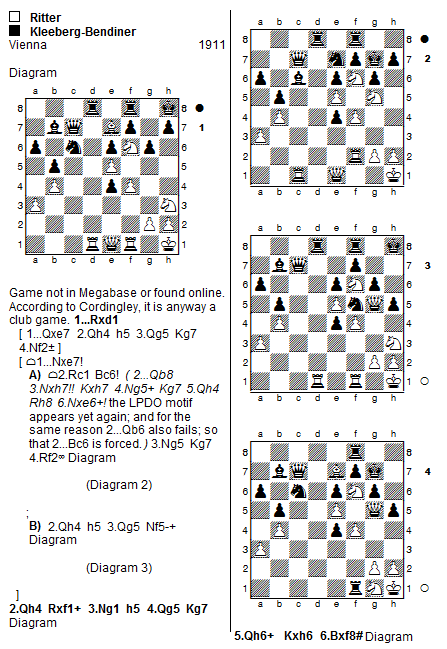
White to play and win
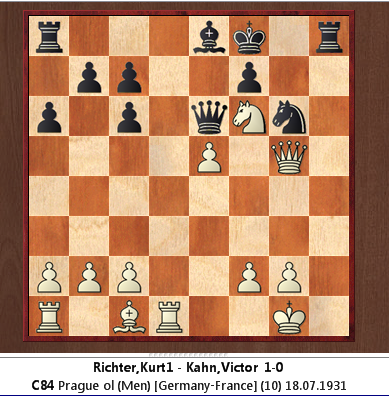
Solution
Not too hard, but pretty. The first move, 1 Qh6+ is fairly obvious, as is the consequences if black captures. It took me a bit longer to find the precise way to defeat 1…Ke7, but I found it without too much effort.
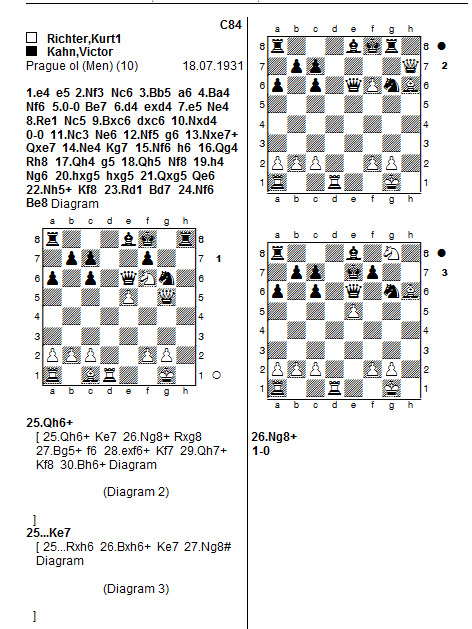
White to play and win
Solution
I messed this one up. Badly.
Look at the position, and give yourself 5 seconds to choose a move: 1 Nf7 or 1 Nh7; give yourself 1 second instead: 1 Nh7: 1 Nh7 is the move your hand wants to play. Give yourself a minute, and you look at 1 Nd5, 1 Nf5, 1 Rd7, 1 Qh4, before rejecting them, and deciding the Ng5 has to be sacrificed.
So, I looked at 1 Nh7 first, but couldn't defeat 1…Kh7 2 Qh4+ Kg8: noting that 3 Ng4 wasn't good enough, so I switched to 1 Nf7, found wins against 2…h6, and thought I had found a win against 2…h5. So, pleased with myself, I turned to the solution and was horrified.
I should have been more professional in my approach. Kasimdhanov would say 'have optimistic imagination'; Aagaard would say 'bring all pieces to the party' or 'revolution followed by evolution'. Any or all of these maxims, or just more thought, would have found the rook lift.
This one hurts me. I couldhaveshouldhave done better.
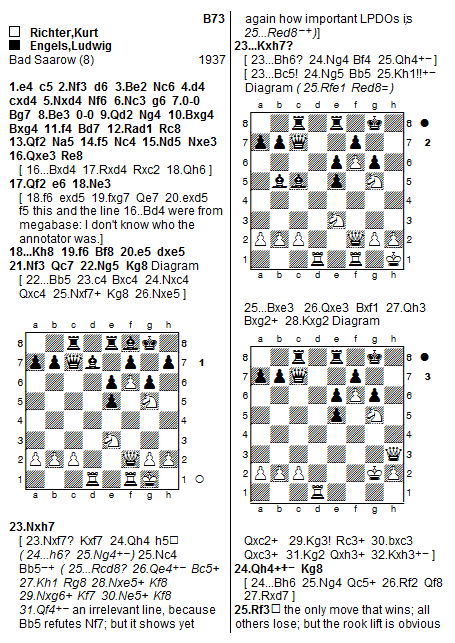
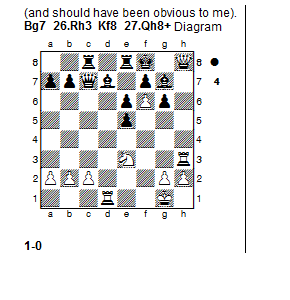
Still, using Houdini, I found that black missed a better defence: Bc5: then, there is only one narrow way to win, but a very pretty one. The attached lines are worth playing through.
Dare I say it, but a nice puzzle.
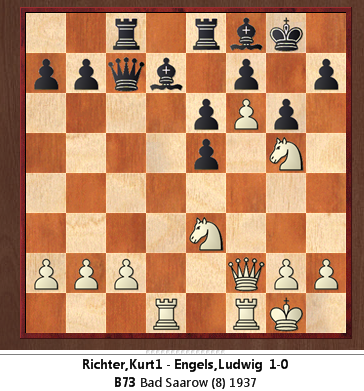
White to play and win
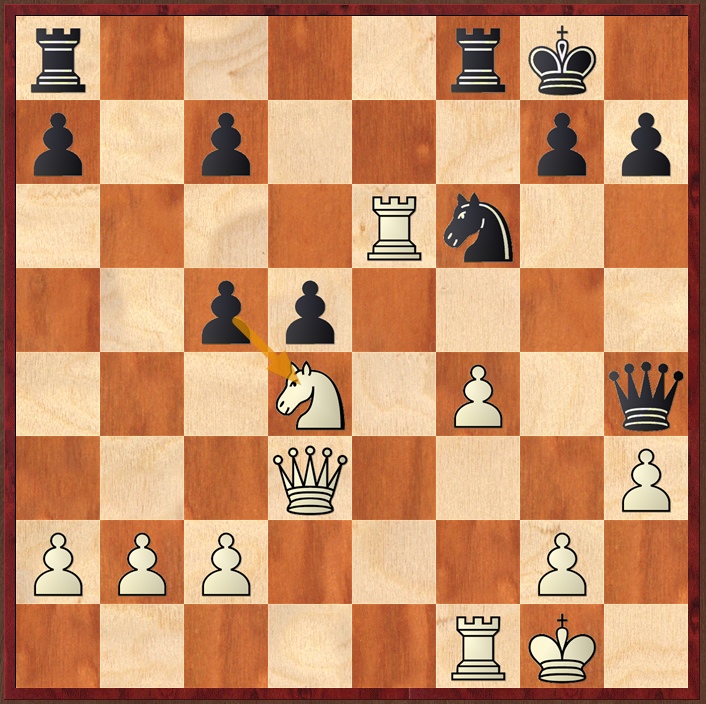
Solution
In Purdy language, black's queen is in a 'net' and with this in mind, the first move 1 Nf5 is obvious, forcing 1… Qh5. Then the sac 2 Rf6! Is fairly obvious: if 2…Rf6, then the LPDO Ra8 drops off after 3 Qd5+; so 2…gf , and then Qg3+Qg7+ g4 and mates.
A nice puzzle, but not a hard one.
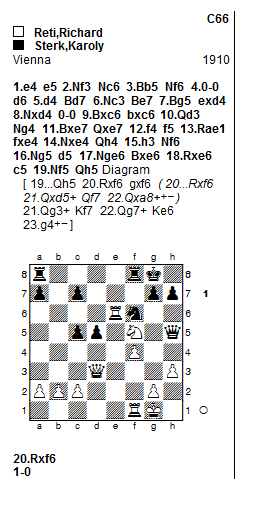
Right from the start of the series, there has been carping about the historical inaccuracies (”bricks weren't invented then” “clothes weren't as white”): but these ignore the fact that for some people, and I count myself as one, the series has been a spur to be interested in history.
My history teaching at school got me an A grade at O Level: but nothing else. It was pure fact memorisation, for me no concepts, linking, analysis. Maybe I missed such aspects.
Picking a photo not entirely at random from a recent episode:
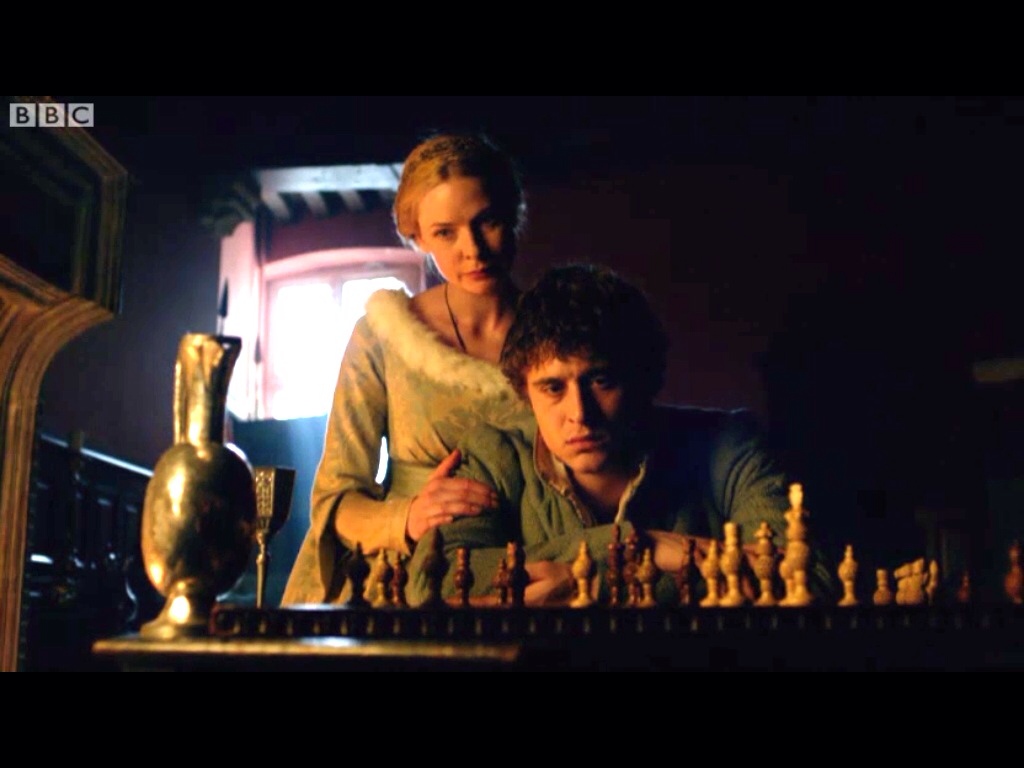
(When Elizabeth Woodville came to Edward IV, who was staring at his chess set, Edward's concentration on the game was broken. It's a good job Jane knows better than to interrupt me when I am playing blitz on ICC or Playchess).
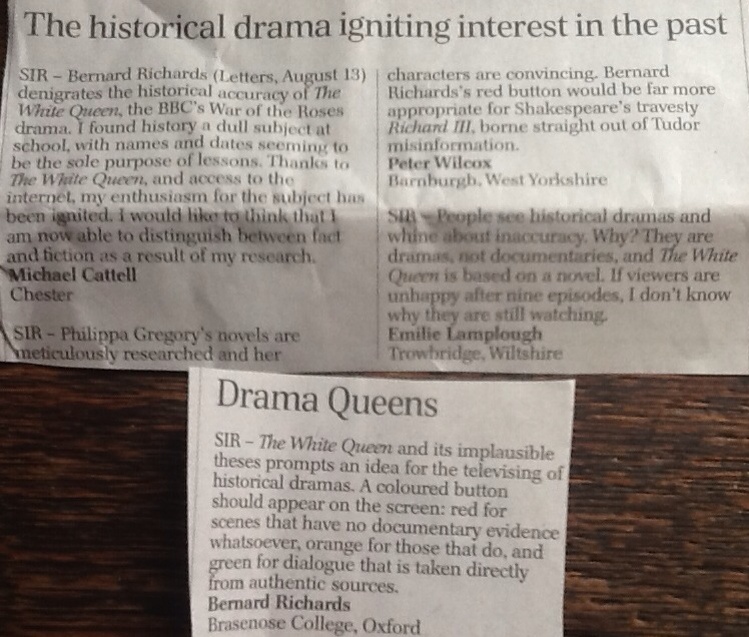
The topic has been the subject of some readers' letters to the Telegraph. I side with the majority, such as Michael Cattell's:
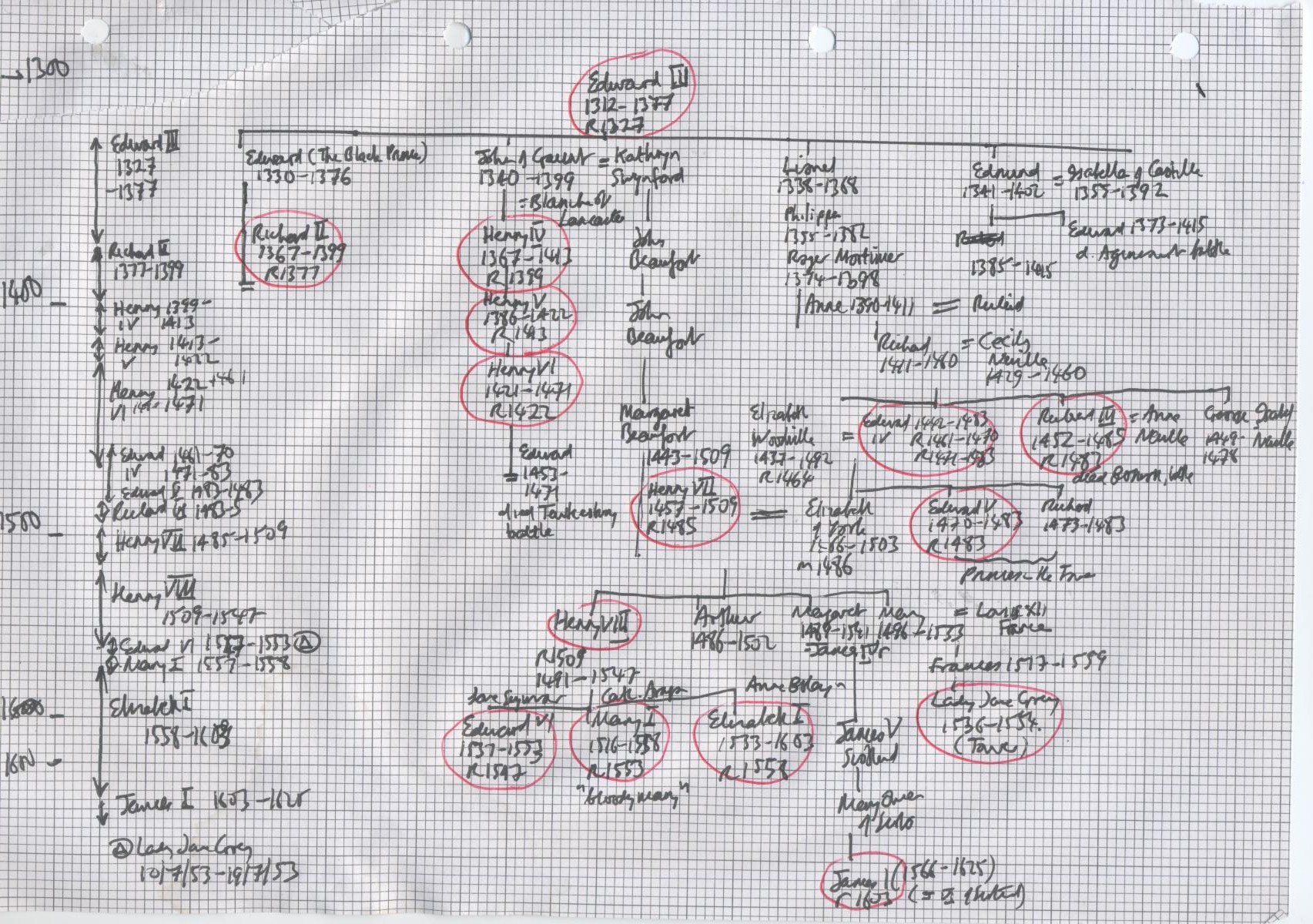
On holiday, to help piece together who-is-whom, who-bedded-whom, who-beheaded-whom, and so on, I spent a happy few hours creating their family tree. (H/t to Jane, who helped somewhat: she would say a lot).
White to play and win
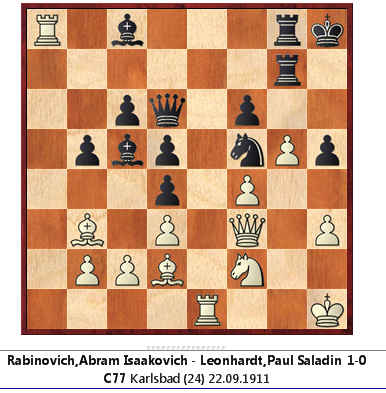
Solution
Oh dear: I got this one badly wrong; but so did white….
If I were given this position, and asked to choose which side I would want to play, I might choose black: white's two bishops aren't doing much, and haven't much opportunity; black's knight is domineering, and his rooks are threatening. Only if white can get to black's king would I say he is better.
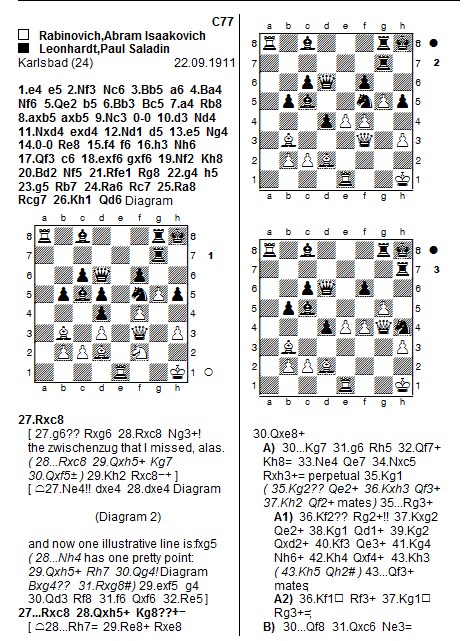
My thoughts were as follows: there are no LPDOs, but if the rook takes the Bc8, maybe there is a Qh5+ forking the knight and king; but after gf, Qf6 protects the knight, so this doesn't seem to be possible. Moves like c3 or c4 to try and get the bishops out where looked at, as was 1 Ne4, with the twin idea of improving the Bb3 and creating some central pawns: but likely not enough. I wasn't convinced by 1 Rc8 Rc8 2 Qh5+ Rh7 but then hit upon my solution 1 g6, with the idea of Rg6 2 Rc8 Rc8 3 Qh5+ Nh6 f5 picking up the knight: but checking with Houdini, 2…Ng3+ is a killing (and should have been obvious) zwischezug: 0-1.
The game instead went 1 Rc8, but as the analysis below shows, it is only good enough for equality. Cordingley doesn't give any variations, just the game moves, so I wonder if the players knew that white's concept was flawed.
Houdini instead shows that the move I considered, 1 Ne4!!, actually wins: though, truth be told, I personally can't see all its lines- to me, it just looks like a mess. The problem isn't cooked, but is Aagaardian- capable of a great deal more analysis,
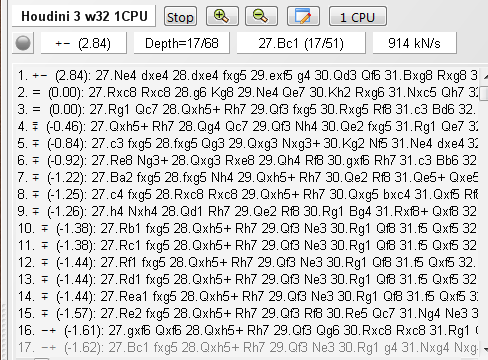
You know you have done something wrong when your move, 1g6, isn't even listed by Houdini.
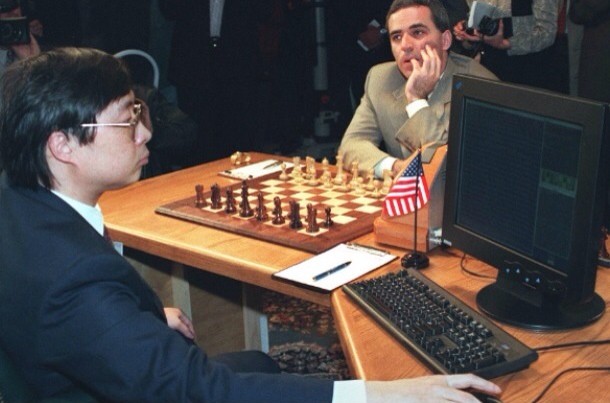
Chessbase have today published my review of this excellent play about Garry Kasparov's 1997 match against IBM's Deep Blue.
Below is a picture from the actual match, which I recently found when googling.
White to play and win
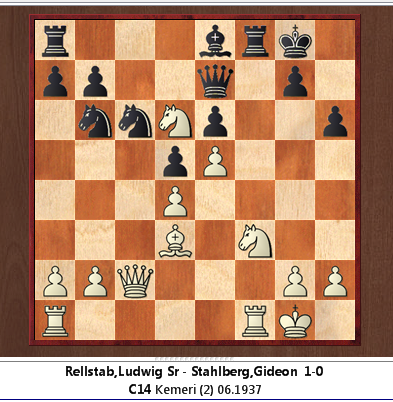
Solution
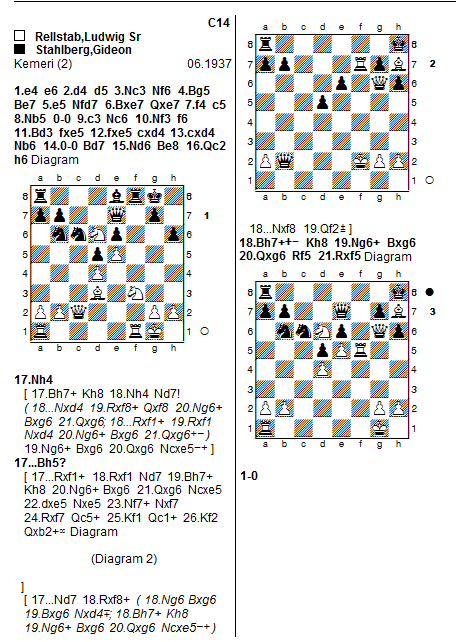
The problem is cooked. I devoted my time to 1 Bh7+ Kh8 2 Nh4, when black's best reply is Nbd7, when maybe white has a slight edge. Instead, in the game white played 1 Nh4, which probably transposes after best play: black's best is 1…Nd7.
As played in the game, white gets an overwhelming edge.
White to play and win
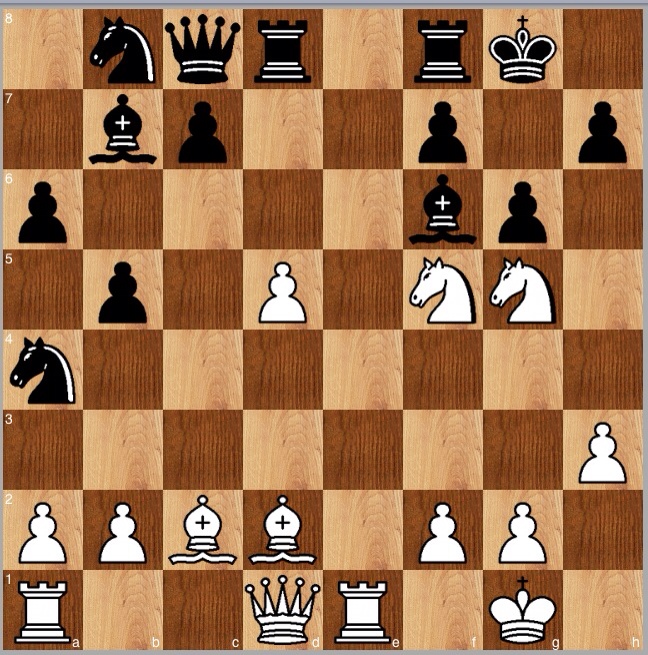
Gligoric, S. v Bidev, P. Belgrade 1946
(Source 9/12 BCM: I couldn't solve it at the time, so made a cutting, and have now solved).
Solution
1 Nh7! Kh7 2 Ne7! Be7 3 Qh5+ Kg8 4 Bg7! breaks through in style.
 allanbeardsworth