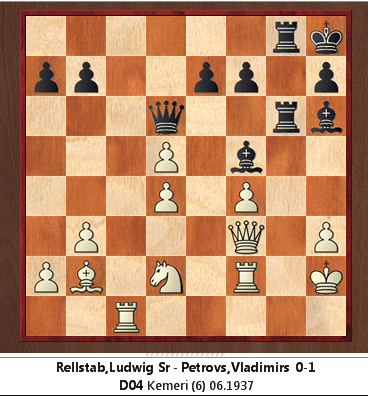
Black to play and win
Solution
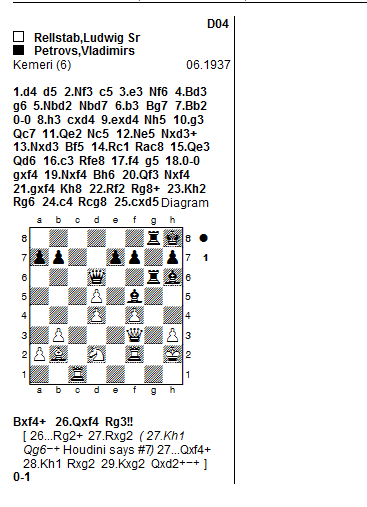
One more that I fluffed. I saw the initial move easily enough, but thought that 2…Rg2+ was the key, and it does win, but prosaically. The move actually played, 2…Rg3! is far nicer.
 Posted with Blogsy
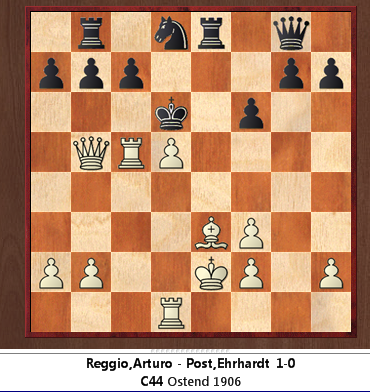
White to play and win
Solution
The second easiest puzzle in the book so far, I think (the easiest being yesterday's). I saw the winning move, 1 Rc7, threatening d6+ d7+, instantaneously, and there are hardly any side variations, and none worth worrying about.
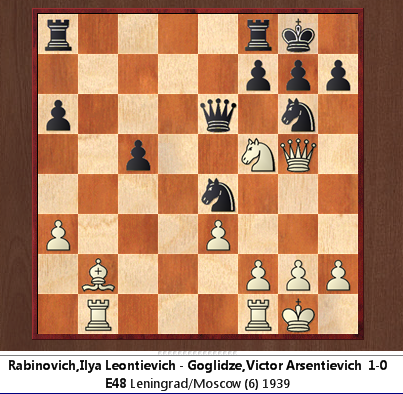
White to play and win
Solution
The easiest puzzle in the book so far: 1 Qh6 is obvious, and there are only easy variations to calculate.
A day off.
Jane and I have just been shopping for display plates to dress our new villa in Kas. (The house doesn't need them, but I have learnt by bitter experience it is pointless arguing on such domestic matters).
Instead, when you can't beat it, her, accept your fate: so we have learnt the approach of Jane choosing what she wants, then leaving the shop, so I can haggle. If Jane were to haggle, then the price will only go up (yes, that can happen: she will agree to buy more in order to get some slight per item reduction).
Today, I had a particularly successful negotiation: a price agreed for the plates we she wanted, and then a negotiation about cash or credit card, and could he throw in a beautiful backgammon set as well [ I have one client, just one client, born in this region of the world, who haggles in this way: we agree a fee, them he renegotiates it: so why can't I learn from him?]. Surprisingly, it wasn't too tough to get an agreement: the shop owner loves backgammon and when I told him I did too, he accepted a sizeable price adjustment if I were to have a game with him. He offered us glasses of Turkish tea, and battle began.
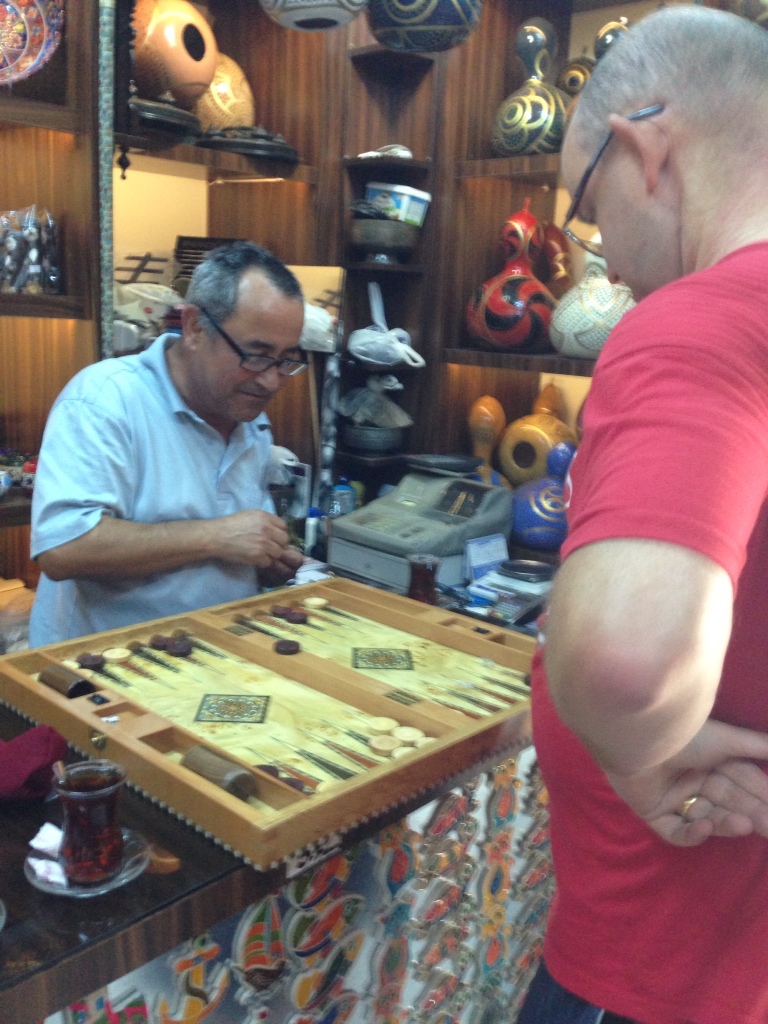
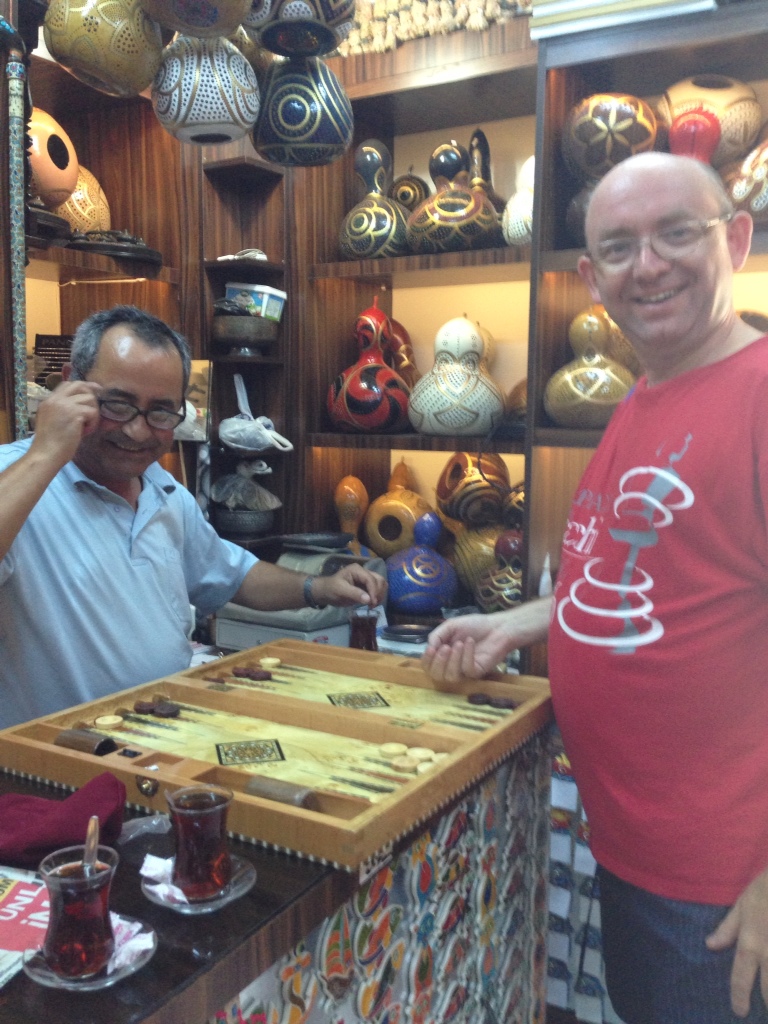
This blog doesn't have a happy ending: Ismail was lucky with the dice….as with chess, a backgammon player always needs excuses when he loses.
In fact, this blog does have a happy ending: Ismail invited me to always call in when again in Kas for tea and backgammon. I will make sure Jane isn't with me next time. And today, all three of us were happy: Jane got her plates without her husband moaning, he got his backgammon set, and Ismail got a lucky victory.
Distressing news: it may not be me.
When in doubt, make up a definition or complicate the matter. What do we mean by who is the strongest at chess? If we mean at blitz, or classical OTB, then the answer is I don't know. It could be me, if only because I have a fifteen year age advantage (yes, my children, if you happen to read this blog: you read that correctly: I am younger than someone).
But if you mean correspondence chess, then there is someone far stronger than me, the 16th World Correspondence Chess Champion, Tunç Hamarat.
Correspondence chess is a form of the game I have never got into. I did try briefly, in my mid-teens, but the two or three games I played were unsatisfying: the opponents were far weaker, and I just didn't like the 'waiting a week for a weak move' that was postal chess. Today, of course, it is server based, and maybe (and having met Tunç) I should give it a go; though now the game has been changed, since the use of engines is permitted.
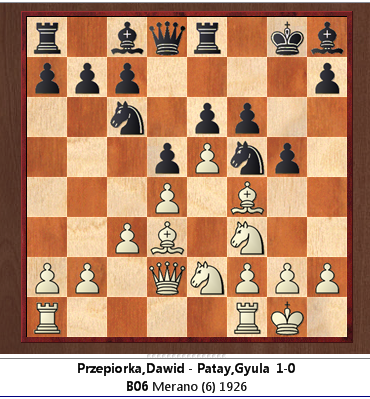
White to play and win
Solution
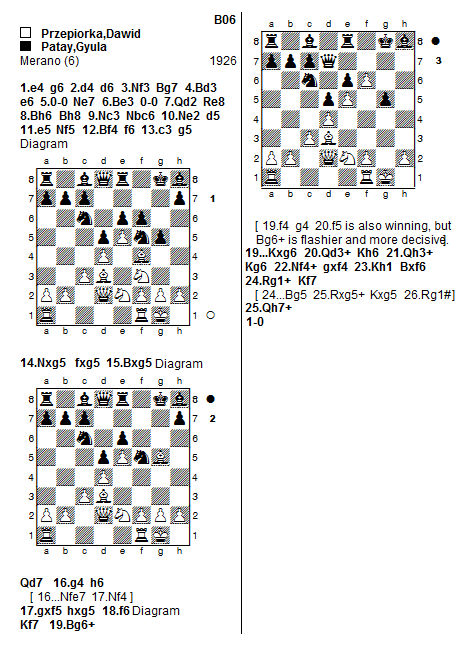
Not too hard this one, provided you (as I do) think here the solution is not to analyse every last variation, but to get to a position where the clear judgement is 'overwhelming': or, at least, likely to be so.
There are only two realistic possibilities, the capture on g5 by either the N or B, and the former seems natural to me, since the B will be a better piece to retain for the attack. And so it is: 1 Ng5 fg 2 Bg5 and then see what black does: Qd7 being natural, rather than self pinning with Ne7; and then g4, confident stare, and hope. (Or, as textbook say, 'and wins')
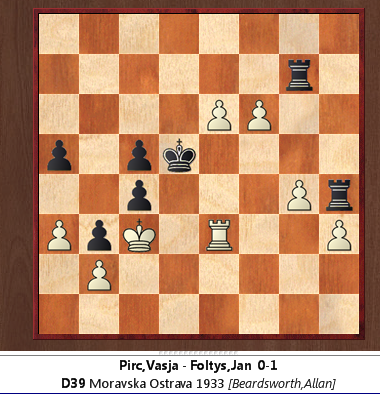
Black to play and win
Solution
Very pretty: I liked this one. White's king is in a net, and black just has enough resources to mate it. Not too hard, once you see that 1…Rgg4! is a possibility- I found it more out of desperation, since if black can't get through, white's pawns will queen.
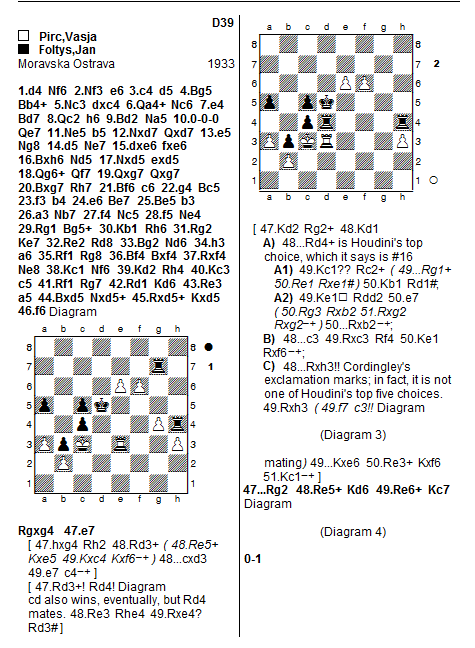
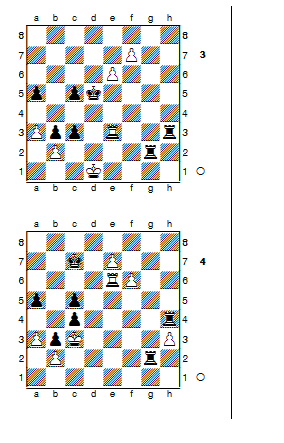
Yesterday was the first round of the Tromsø World Cup, a 128 player knock out tournament involving virtually all the top players. I will be rooting for Michael Adams, fresh from his Dortmund success, and also hoping Gawain Jones does well.
Last night and this morning I have played through some of the games, and one combination stood out. Screenprints from Chessbase.
Ray Robson 1-0 v Andrei Volikitin
From a standard Petrov, with typical manoeuvring, the following position was reached.
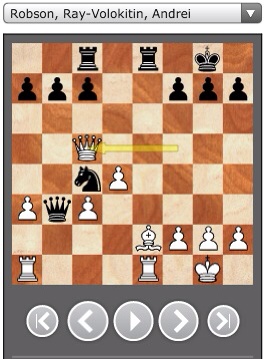
I haven't put the game through an engine, but here I thought white only had the smallest of edges: I missed the strength and effect of 24 Bg4, which causes black a lot of discomfort, and soon the board explodes.
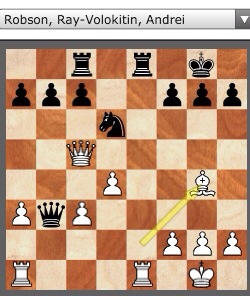
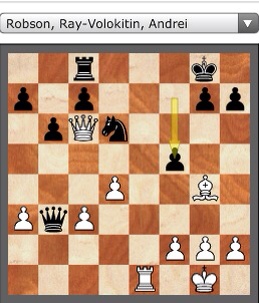
Here, Robson played a truly shocking move: shockingly good move. 27 Bf5, and after 27…Nf5, 28 Re8+ and the rook can't be captured because of 29 Qe8 mate, so the king is forced out, and 29 Qs7+ pushes it out into the wide open, whilst also hitting the LPDO Rc8.
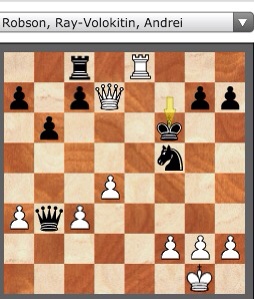
And here, Robson 'quietly' moved the rook back to e1, and black turns out to be helpless. The combination of the LPDO Rc8 and bringing more pieces to the party, with g4, overcome black's defences. 30g4?? itself wasn't possible because of 30…Qd1+ 0-1, but with black disorganised, there is time to play the lovely retreat 30 Re1.
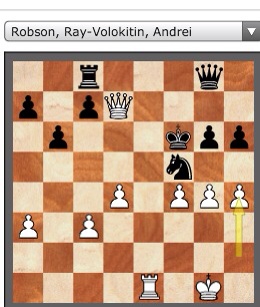
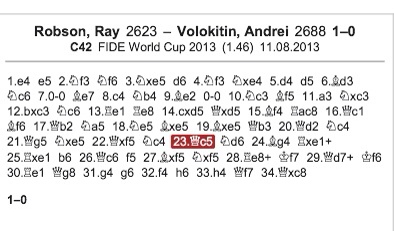
A wonderful combination.
Sometimes I wish I could switch off and not think about things; but I can't; I do though find that thinking about chess or maths or other things is the best way to forget about work, so there is some merit in my madness. A few weeks ago, Jane made a chance remark that despite how home in Stockport being only 100 miles or so (googling suggests it is 148km, of which more later), there was a noticeable difference in the length of daylight between it and our cottage in Borrowdale, near Keswick. (cue for random picture of the Lakes; better view than in Stockport)

We were driving home at the time, a Sunday evening, and I had not long before watched a BBC4 science programme, Precision, from which I had learnt that the kilometre was defined as being the length such that there was 10,000km from the North Pole to the Equator. (In fact, the measurements made proved to be imprecise, and apparently the distance is 10,042km, at least according to a quick google. (Though see footnote 1)
So, and harking back to my recent post about my liking for approximation rather than precision, I did some mental maths (along the lines 100 miles is about 1/100, so the angle is about 2°, and 180° is 12hours, which is 360 minutes, so 2° is about 4 minutes, and announced the guess that the difference in sunrise times might be around 4 minutes…a few minutes later, daughter #2 announced that she had googled the result and it was…4 minutes…so, a mathematician's glow of pride. Alas, that feeling lasted for all of a few miles since she then announced that the difference in sensets was around 13 minutes (if I recall correctly): unexplainable, and the estimate of sunrise was seen to be no more than a lucky guess.
It was a long rest of the journey home.
Since then, I have being giving the subject occasional thought, and have realised what a task I have taken on. It would be easier to tidy teenage daughter #1’s bedroom than to get to a full understanding. (cue picture, of said bedroom, were it not truly shocking).
After some initial thinking, I did some googling and was swept into a world of complex mathematics with long formulae with equally long names. That wasn't for me. I wanted to be roughly right or, if this proved to be impossible, at least to have some understanding of the factors involved. I realised, for instance, that I had ignored the tilt of the Earth's axis.
Mistake #1 was thinking about the subject in the first place;
Mistake #2 was making a rough calculation and being smug when it chanced to be right for sunrise;
Mistake #3 was in mentioning the problem to a colleague, who I knew from some chance remarks I had made in a training talk, was interested in physics. Poor Paul, he got afflicted with the same bug, and he has written to me extensively as we try to grapple with it. In my blogs on this subject, which I am writing having to solve the problem (hopefully not making mistake #4, that in writing it, it will all become clear, and instead hoping that an apple (or, since I am writing this in Kas, Turkey, a pomegranate) will fall on my head, I will take freely and extensively from Paul's insights: but the errors, and I think there will be plenty including some howlers, will be mine.
Hopefully a reader will be able to improve what I write (when it is written, this post is just setting the scene)
White to play and win

Solution
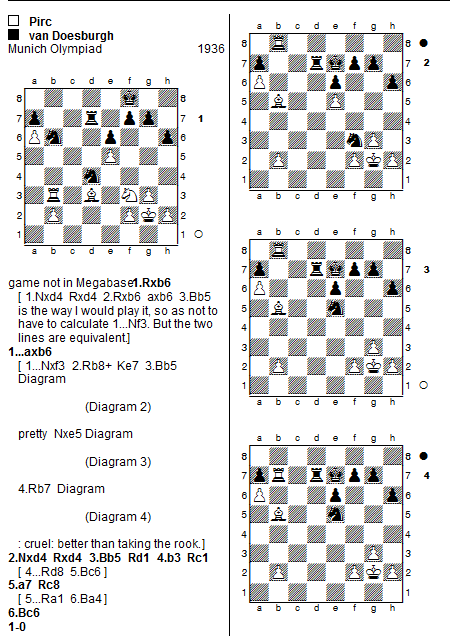
Somehow, on this page of the book, there were several easy enough puzzles. Here, the motif is self evident: sac on b6, and promote: using the B to deflect or prevent the R from defending. White can win in two essentially similar ways: 1 Rb6, as played, or 1 Nd4, as I preferred: they are more or less equivalent, save that 1 Rb6 gives more for white to calculate.
So, straightforward, but pretty.
 allanbeardsworth