Last night, I played through some of the games from the latest round of this year's British Championships. One game, or rather one ending, which caught my eye was being IM Jack Rudd and GM Danny Gormally.
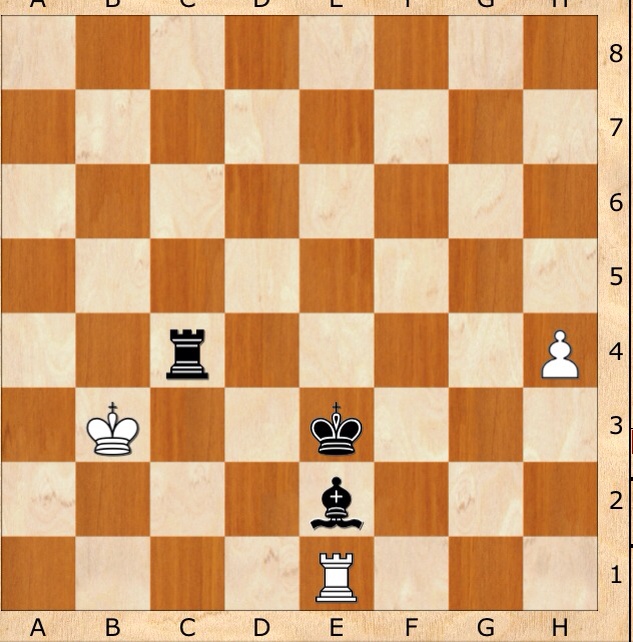
Black to move
I don't know Jack: I do know though that he plays incredibly fast, often having used up very little time in a whole game- in a unique, and somewhat perverse way, begging the question to me 'would he be even stronger if he thought for longer?. I do though know Danny, from when he played in the 2006 Olympiad for the team that I captained. As I saw this ending appear on the board, I felt fairly certain Danny would win- due to a combination of Danny's fighting spirit, Jack's speed, and the difficulty of defending this 'drawn' ending. [if I knew how to search Chessbase properly, no doubt statistics would be available: my guess is that the R+B player wins more than he draws].
The crucial position came up many moves later:
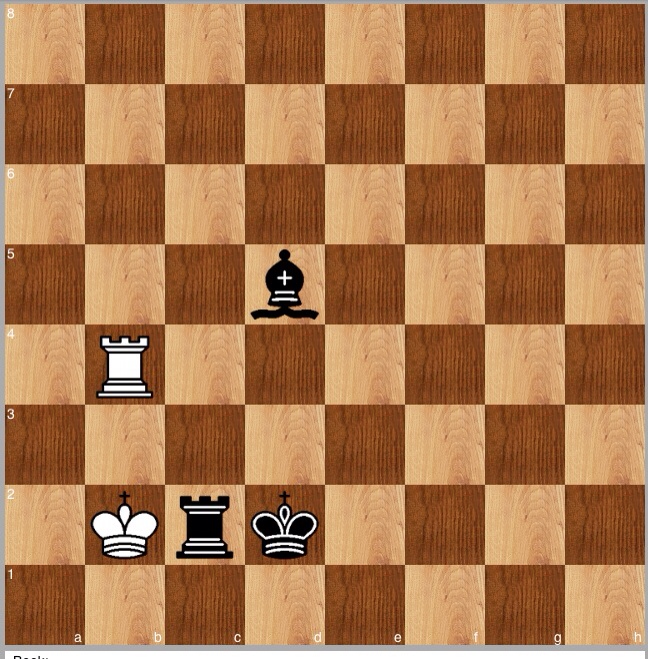
White clearly can't play 1 Ka3?? (1…Ra2 mate) so it is a choice between 1 Kb1 and 1 Ka1. Which to choose?
It is not at all obvious, at least to me, and Jack made the wrong choice. The solution is below.
(Readers might like to work out how to defend, and what is wrong with the other move)
Solution
2 Ka1 [] is necessary. After 2 Kb1 it is mate by 2…Kc3, Ba2+c4-d3- a typical pattern. The difference is that after 2 Ka1! Kc3 doesn't work because of 2 Rb2!! and a forced draw. Stalemate or repetition.
 Posted with Blogsy
Last night, I played through some of the games from the latest round of this year's British Championships. One game, or rather one ending, which caught my eye was being IM Jack Rudd and GM Danny Gormally.
Black to move
I don't know Jack: I do know though that he plays incredibly fast, often having used up very little time in a whole game- in a unique, and somewhat perverse way, begging the question to me 'would he be even stronger if he thought for longer?. I do though know Danny, from when he played in the 2006 Olympiad for the team that I captained. As I saw this ending appear on the board, I felt fairly certain Danny would win- due to a combination of Danny's fighting spirit, Jack's speed, and the difficulty of defending this 'drawn' ending. [if I knew how to search Chessbase properly, no doubt statistics would be available: my guess is that the R+B player wins more than he draws].
The crucial position came up many moves later:
White clearly can't play 1 Ka3?? (1…Ra2 mate) so it is a choice between 1 Kb1 and 1 Ka1. Which to choose?
It is not at all obvious, at least to me, and Jack made the wrong choice. The solution is below.
(Readers might like to work out how to defend, and what is wrong with the other move)
Solution
2 Ka1 [] is necessary. After 2 Kb1 it is mate by 2…Kc3, Ba2+c4-d3- a typical pattern. The difference is that after 2 Ka1! Kc3 doesn't work because of 2 Rb2!! and a forced draw. Stalemate or repetition.
H/t to Twitter (what would I do without Twitter? What did I do before Twitter) for pointing me to this excellent interview with ex World Champion (and one of my favourite players of the current elite) Vladimir Kramnik.
http://www.chessintranslation.com/2013/08/kramnik-intellectual-effort-gives-me-enormous-pleasure/
Firstly, on the 1997 Kasparov match vs Deep Blue, Vlad's comments are most interesting. In my previous blogs I had presumed that by 1997 machines were stronger even than Garry, but Vlad suggests otherwise, and it was a case of being spooked.
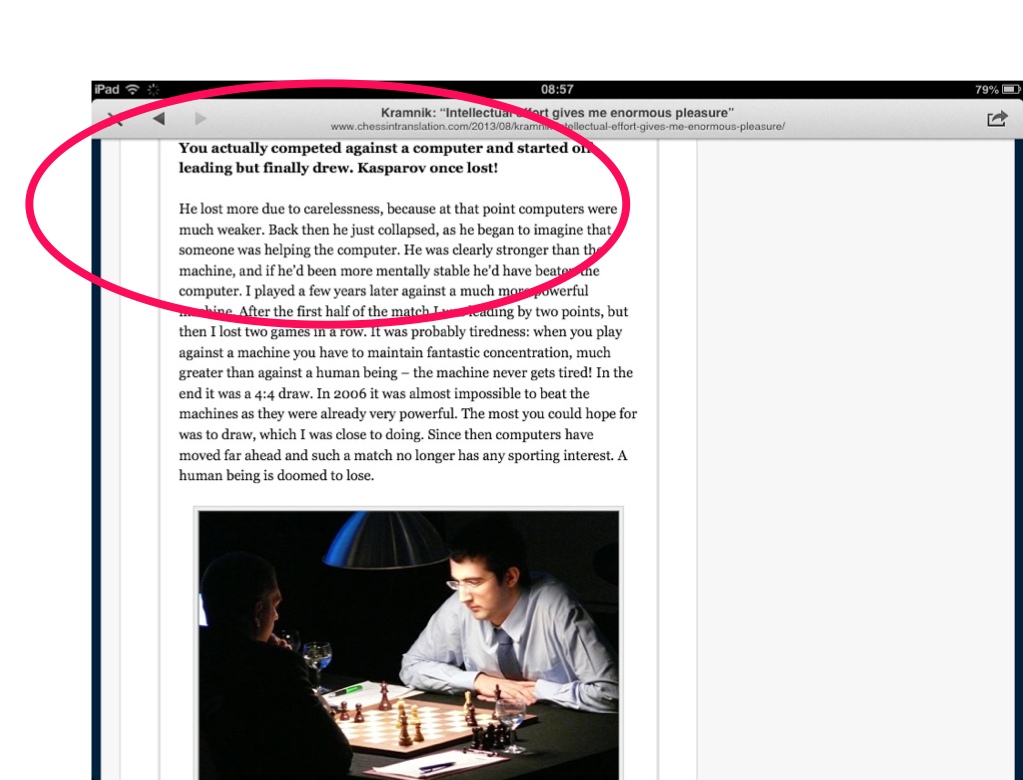
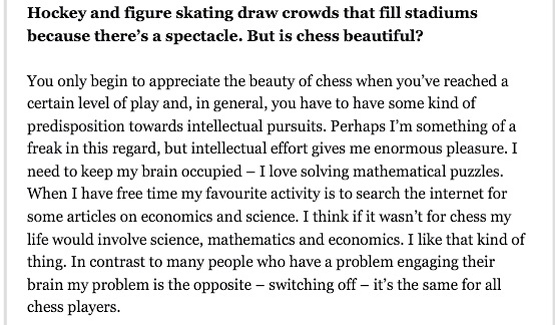
Secondly, his comments on can chess be beautiful – yes, incredibly so, once you reach a sufficient level- I find beauty and joy all the time in chess- and on how he relaxes. I think I am very like him- I switch off by thinking about precisely the same things.
I don't know Vladimir at all well, but in the few chats I have had with him over the years, I have always felt great warmth to him: he is charming and interesting. Now I have a better understanding of why: we share the same interests.
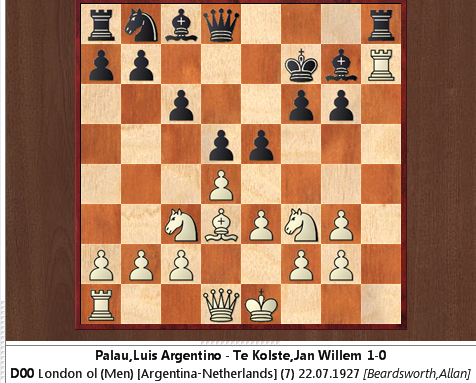
White to play and win
Solution
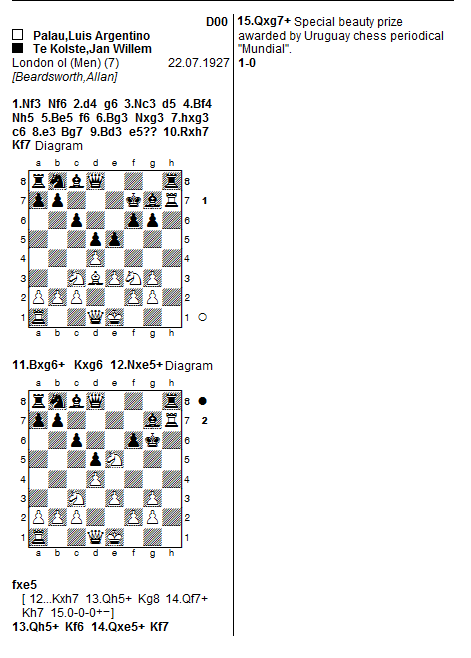
A nice puzzle, but not too hard.
My instant impression was 1 Bg6+, which I think is the natural first try, and after 1…Kg6, 2 Nh4+, which a after a quick calculation turned out to be insufficient; but it wasn't too hard to 'step on the gas' and try instead 2 Ne5+, and it was 'kind of obvious' – which means really that it is a familiar motif to check on h5, check on h7, and then long castle.
Enjoyable, pretty, but not too hard. In a word, nice.
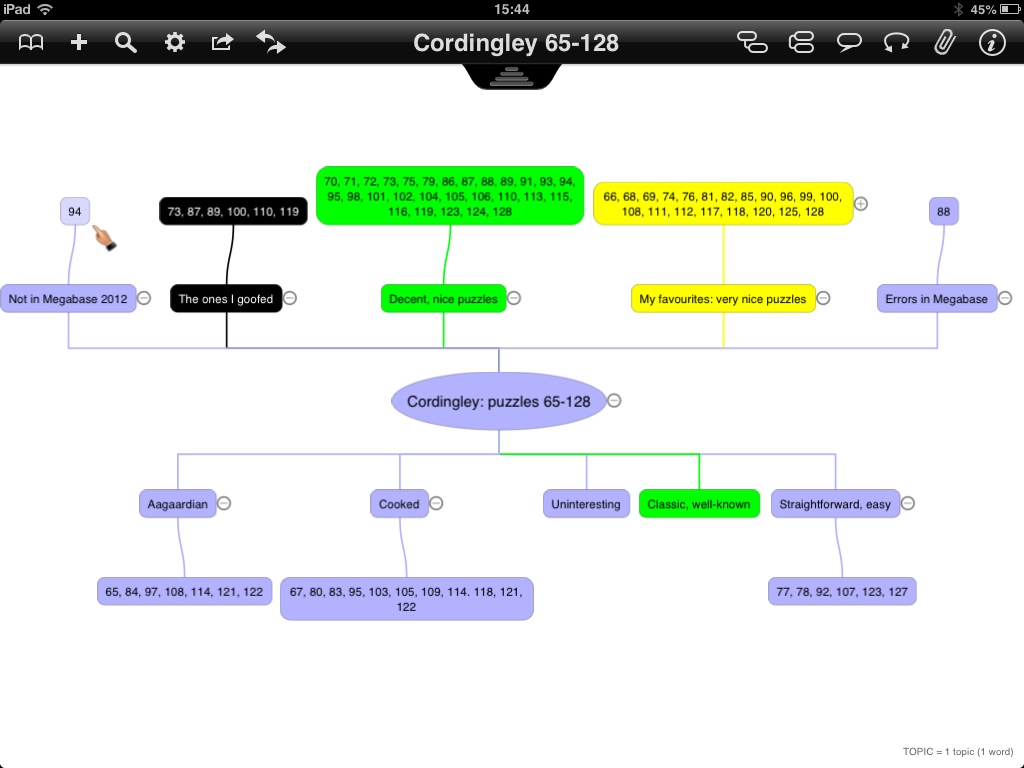
I am now over half way into my project, there being 250 puzzles in the book.
I published a summary of what I thought of the first 64 puzzles after puzzle 64. So, today, I am summarising the next batch of puzzles.
White to play and win

Solution
Not too hard, this one. Not much to say about it either, so I'll just post the solution.

I referred to one puzzle in this chesscafe.com article by Mark Dvortesky yesterday. The puzzles are really hard, or at least the majority are, and well worth cracking.
Below is the starting extract of Mark's article:

In short, find what the players missed.
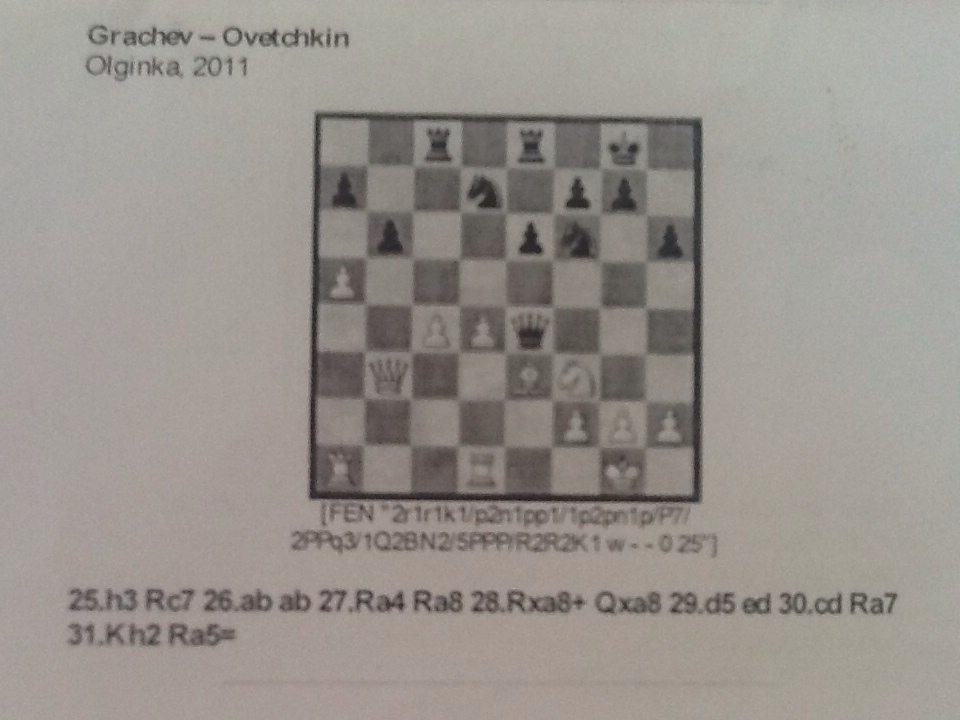
Purdy would have solved the this one; as would a reader of John Nunn.
Solution
The move Rc7 is key: on c7, the rook is LPDO. By looking out for LPDOs (Nunn) and imagining all moves that smite, no matter how ridiculous (Purdy), then 28 Nd2! Qc6 29 Ra8+ Qa8 30 Bh6!! wins a pawn because if 30…gh?? 31 Qg3+ is a double attack, picking up the LPDO rook.
The best time of day at our villa in Kas, Turkey, is early evening: it can't be a coincidence that the builders named it Sundown Villa. As a very broad rule of thumb, and whilst never staring directly at the Sun, it and the moon are typically a similar size: or, at least, the Sun is not massive compared with the Moon. Why?

I have recently got very interested in some aspects of the geometry of the Earth- blog warning: I will be doing some science blogs when I feel sufficiently confident that I am along the right lines. As a sneak preview, on a recent journey coming back from our cottage near Keswick, Lake District, to our home in Stockport, Jane remarked that there was a noticeable difference in time of sundown between the two towns, despite them not being much more than 150km apart: at spare moments, I have been giving some thought as to why this should be. That will be blogged about later when I am ready.
For now, though, I wondered recently why the moon is broadly a similar size to the sun, despite the fact that we know the Sun is huge and the moon small compared with the size of the Earth. Clearly, it is down to distance, but what are the maths?
When I started blogging in December 2012, I didn't know if I would enjoy it (I do, very therapeutic) and keep up with it (so far, so good) so didn't spend much time on the design, including in particular the heading: things that interest or amuse me. On reflection, I could have added 'and know something about, but not that much'. Part of the interest to me in blogging is to learn new things, find things out, think about things. On astronomy and the Earth, I do not even have 101 level knowledge: this is all new to me. I might regret some of these science blogs.
Why are the Sun and Moon broadly similar sizes?
Is it a fluke? I am sure it is, but the Sun is 389 times as far away as the Moon, and at the same time is 400 times larger. So basic math/perspective shows that on average, they are around the same size. To me, it is quite cool (warning- I have three teenage children so that word is used a lot) that the ratios are so close.
Astronomical data
I have started a note (h/t to Evernote, a great app, and to its sister app, Skitch) with some data; to be added or amended as I learn more.

I think I probably learnt a lot more than just one thing, but I would argue that the most important thing I learnt was the ability to approximate, and to feel confident working with approximations.
I suspect I do approximate calculations every working day of my life: maybe I am comparing 'by eye' whether a client's gross profit margin has gone up or down, what the revenue per person is (one of my favourite metrics), what a client's tax bill is, what the sum of a column of numbers is, roughly…sometimes accuracy is needed, but often it is not.
A case in point. I recently gave a lunchtime training session in which we had to calculate 36*45. Alas, my audience reached for their calculators, ready to tap away: it's about 1,600, I said to incredulity. I decided to ban the use of calculators for the remainder of my session: they get in the way of thinking.
36 can be rounded up to 40: it's pretty close, about 10% different; and so can 45, here by chance 10% different too, so 36*45 is probably pretty close to 1,600: and of course it is, 1,620. The error, 20, is about 1%, being roughly 10% of 10%. That's pretty close enough, and even if the example is quite a good selection, the ability to be roughly right is an important skill to learn.
Where are the customers yachts is the title of an investment book I bought 20+ years ago: an old book even though , but still relevant today.
John Kay has been one of my favourite writers on economics for many years. His articles, in the FT, tend to be ‘just right’ for me: hard, but not too hard, and with effort what he is saying can normally be grasped. Occasionally, his articles are too hard for me, at least to read during the pressure of the working year, and my habit for many years is to cut and keep such articles, for reading when there is more time, such as whilst on holiday.
I had faithfully kept since March 2008 the article which is pdfed below. Whilst I ‘sort of’ understood what John was getting it, and ‘knew’ the answer he came to was right- that the winner in the way management and performance fees are charged is the investment house, I wanted to try to prove the maths.
Starting with the 67 squared comment, here John is comparing 1.1^42 with 1.2^42. The latter can be rearranged to be (1.1 * 1.2/1.1)^42, and further rearranged to be 1.1^42* (1.2/1.1)^42. The fraction (1.2/1.1) is approximately 1.1, so the calculation becomes approximately (1.1^42)^2: QED.
For the 42 year compounding problem, I chose to build a spreadsheet to compute the returns over 42 years, so I could flex it in the way John does for different investment performances. Whilst John’s calculations (in the PDF, but not into FT article) use continuous compounding, my spreadsheet was somewhat less sophisticated, compounding annually. However, as he says, it doesn’t make much difference to the answers. For interest, at 20%, John’s 5/57 split equates to my 6/56; at 10%, 170/760 is 181/749, and at 5%, the calculations are the same.
What I most like about John’s article is his one sentence summary: over a sufficiently long time horizon, your investment manager will become richer than you.
 allanbeardsworth