No, I have not gone crazy. I am referring to CJS Purdy's potassium cyanide motif, which I first wrote about in May, and have mentioned on other occasions. It is a really useful mental tool.
https://allanbeardsworth.com/2013/05/07/cjs-purdy-my-favourite-chess-author/
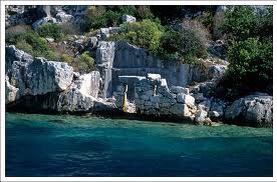
Yesterday, on a boat trip to the sunken city of Simena, I took with me an article from February by
Mark Dvortesky from chesscafe.com.
In the article, he cites several occasions where surprise tactics were missed. The first is shown below.
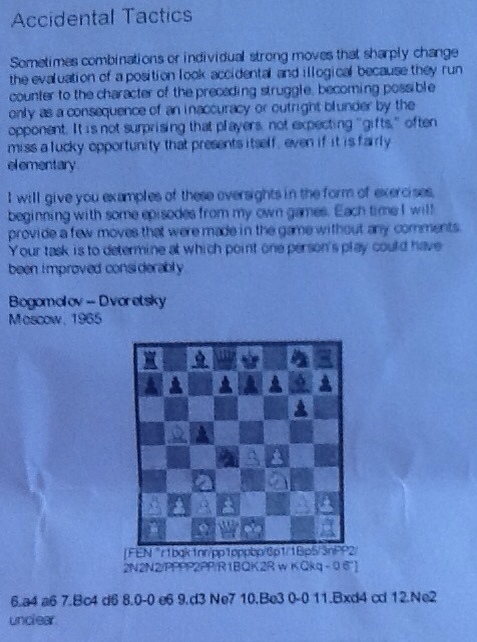
If you watch out for potassium cyanide, the solution to this one is easy.
Solution
10 Be3?? was a blunder, putting the Nc3 and Be3 in potassium cyanide juxtaposition. 10…d5! and a piece is lost.
Thank you, CJS.
 Posted with Blogsy
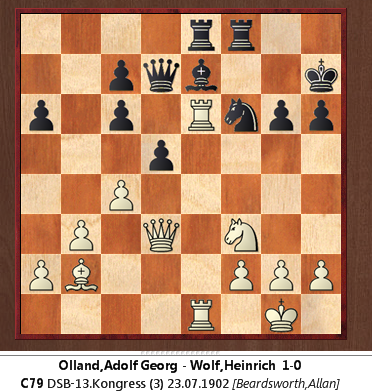
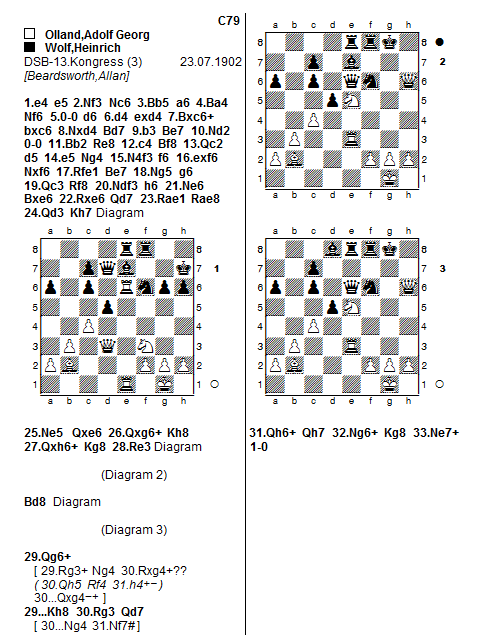
White to play and win
Solution
My first thought was 1 Nh4, to hit g6, but I more immediately realised that it might well be necessary to be more brutal, and and sacrifice with 1 Ne5: a quick look made me realise this had to be the line to look at.
Capturing the rook is mandatory, and on e6 the queen is LPDO, so the Nf6 is pinned once the queen gets to g6 or h6. The white knight is itself pinned, with white's rook being LPDO, but it is not too hard to decide that (after Qg6+ and Qh6+, the rook lift Re3 is the move: black is helpless, and just a modicum of care is needed. There is a nice mate, Nf7, which caused me to smile, in one of the lines below: one of the joys of chess are such surprise happy mates.
I occasionally listen to the Radio 4 programme, the Long View. It is a series where discussions are held round a theme, drawing parallels between current issues and the past.
The one I listened to recently was on Tax Avoidance, with Margaret Hodge MP, chair of the Public Accounts Committee, griller of Google, Amazon and the Big 4, amongst the participants, with occasional commentary from Andrew Wareham of Roehampton University (I wish Andrew had been given longer slots: he was most interesting).
Anyway, plus ça change, plus ça c'est la même chose. In 734 AD, the Venerable Bede wrote to the king asking for something to be done against tax avoiders.
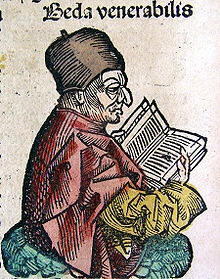
Monasteries were exempt from taxation, and so it became common for people to contend that their household was a place of worship, of monastic study, and therefore exempt. Bede said the practice was widespread and the breaches needed to be stopped: reforms were not made until 747.
In modern parlance, this would be tax evasion, not tax avoidance: saying your household is a monastery when it factually isn't, is vastly different from the actions of Amsterdam builders, when households were taxed on the width of their frontages- the narrow, thin, deep, Amsterdam houses can be seen today, or the bricking up of openings in British stately homes to minimise window tax.
In 790, the Vikings, after conquering Britain, had a clever way of ensuring their tax (the Danegeld) was paid: pay tax by the due time of the due date or, if someone else paid that tax because you were too late or avoided it, then whoever paid the tax became the lawful owner of the asset concerned, without redress.
Effectively, Danegeld said that all property was rented from the State: pay up or lose it. Confiscation of one's land might be thought of as being extreme in today's world, and yet there are still parallels, for instance the ability of Customs officers to seize goods.
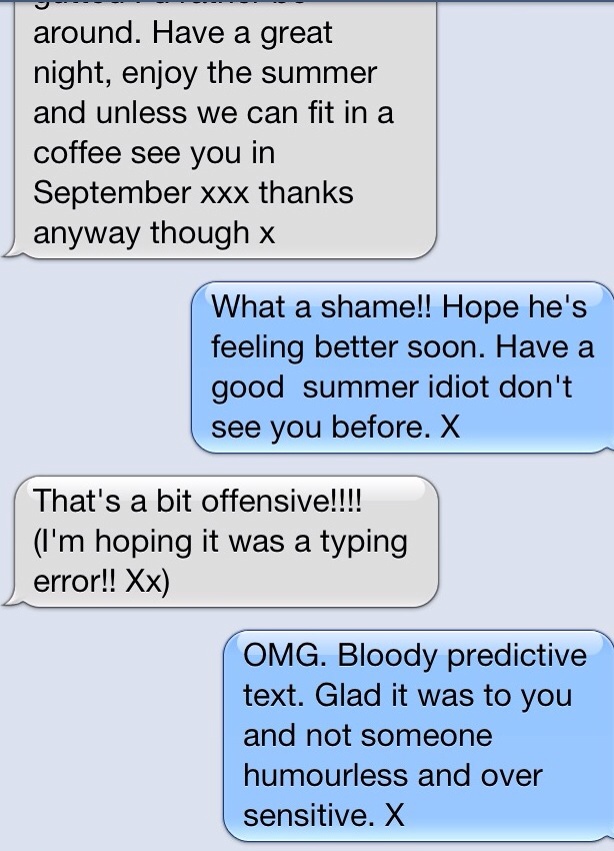
We've all suffered from auto-correct and predictive text errors. Who hasn't sent a text or an email too early, or to the wrong person?
Whilst everyone does, Jane is #1 in our family for this. Consider this recent one:
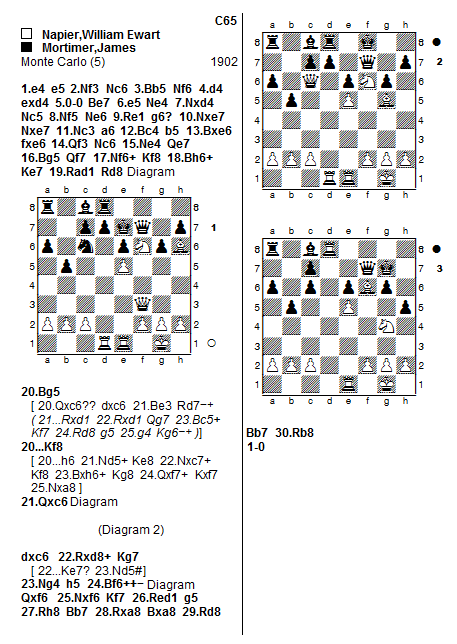
White to play and win
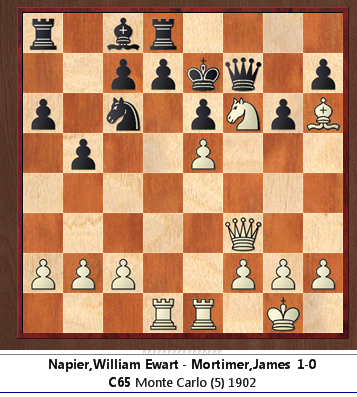
Solution
Not one of the harder ones, provided you see the main idea. In fact,when I checked the winning line with Houdini, most sensible white tries win eventually. For instance, the rook lift Re4-f4 is terminal; I liked the fct that Qe3-Qc5+ or Qa3+ b4 Qe3 Qc5+ also win, the nice point being ..d6 ed+ Kf6 Qg5 is mate. But sac-ing the queen on c6 is what you want to play.
The move I wanted to play, since 1 Bg5 is too boring, was 1 Qc6+, but, alas, it is not good enough. Black has just sufficient resources to squeeze out, and then he is winning. So the solution is 1 Bg5 Kf8 2 Qc6+! And now the Rd8 is LPDO.
Six short words, bar the brackets: a simple question, but not simple to answer. One of the children asked me yesterday whilst we were in the cave itself, at Meis, the Greek isle (Kastellorizo in Greek, Meis is the Turkish name for it) yesterday.
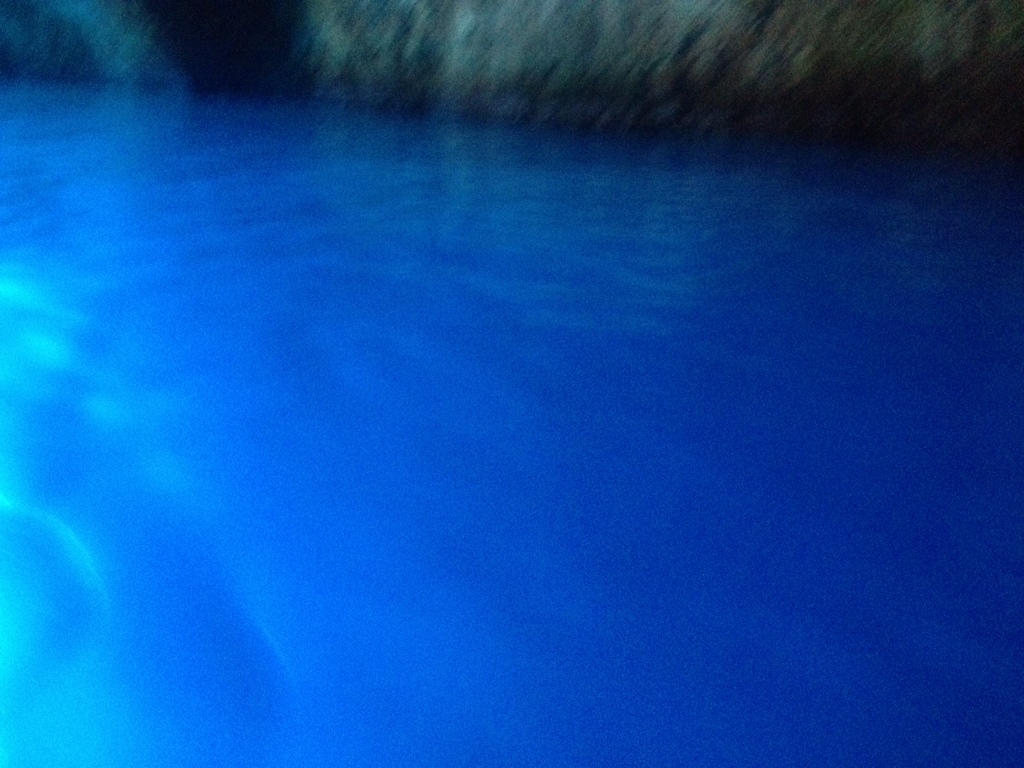
Whilst the short answer 'it is reflection/refraction' satisfied Beardsworth minor's question, it didn't satisfy me, I wanted to know more, and it gave me something to think about on the sunbed a Saint George's the islet we stopped off at on the way back to the main town.
I got thinking of rainbows.
Well not, in this way, but isn't it amazing what results googling produces?


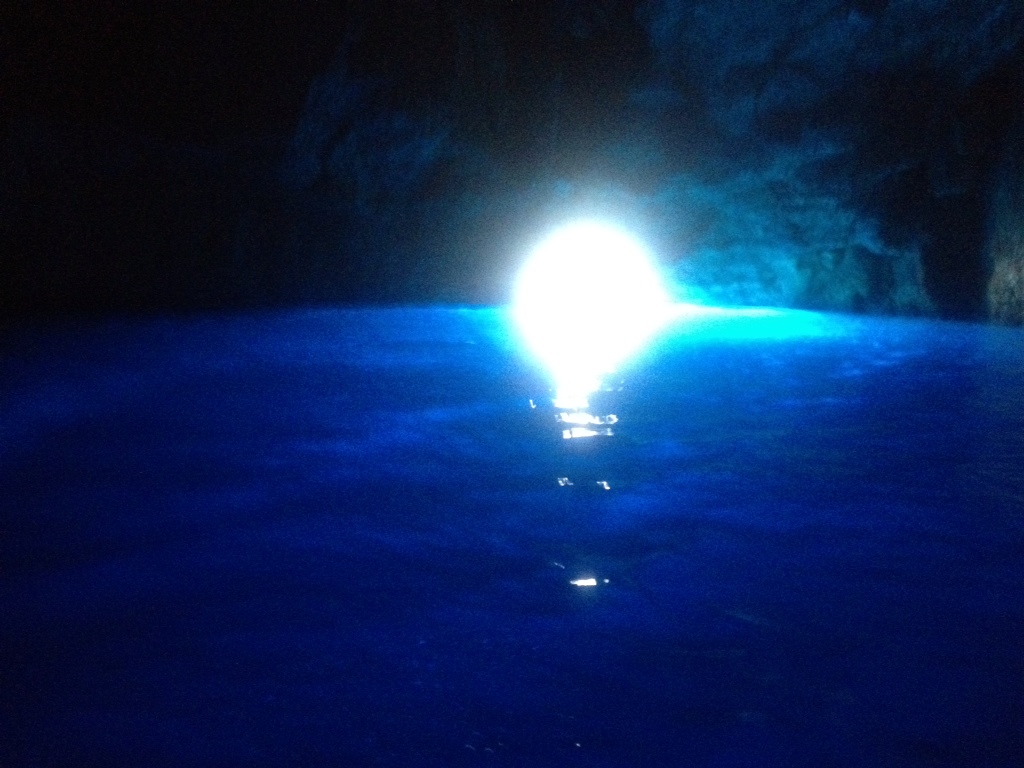
The white light comes in, in the main, horizontally. When the sun is highest in the sky, at noonish, I think the effect will be greatest: there will be less light coming in at an angle: whether the position of the sun has any practical effect I don't know, or whether the effect is minor, is something I will try to find out on another year.
The last element is the wall and ceiling– which, alas, I didn't look at, or focus on, for the few minutes we were in the cave. The shape of the wall will affect the effect. At the extreme, if the back wall was plain and vertical, then the effect would be lessened. Here, the cave's wall must be sloped, giving the light several occasions to reflect and refract, and the greater the number of refractions, the water will appear bluer.
Finally,I am intrigued by the highlighting – the sparkling nature-of some of the water. Repeating my first picture:
To the extreme left, there is some highlighting. I cannot remember where the boat was when I took the pictures- the captain kept moving the boat around, quite quickly, but I know that we weren't near the entrance: I am guessing, but I suspect the highlighting is because there will be other holes, not discernible to the tourist's eye, perhaps just cracks, perhaps just below the water line, which cause this underwater lighting effect. On the boat trip back, I stared a lot at the rocks, and think they are virtually all limestone: so probably porous, possibly cracked, and this helped me in my thinking about blueness.
Finally, googling has shown up surprisingly little about this: what I have found via google tends to be refraction/reflection/blue higher energy: all true, but I suspect the narrowness of the opening, the shape of the wall, and the rock being limestone all help cause the effect.
Five hundred words to explain six.
Yesterday, we went to the Greek island of Meis, or Kastellorizo, also known as Megisti…but let's call it Meis, the Turkish name for it.
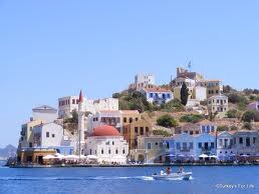
We love Meis. It is a lovely day trip. A little bit of Greece for a day.
For our family of five, we spend typically around €300 on the day: so if you are coming to stay at Sundown from the UK or other none eurozone currency, consider bringing some € with you: otherwise, you can get euros from ATMs in Kas.
Practicalities
There is one boat, the Meis ferry, each day. It leaves Kas harbour at 10am, and leaves Meis at 4pm, so you will be back in Kas by around 4.45pm, but must hang around until around 5.30pm to pick up your passports.
Best to go to the sales office, on the harbour, the day or night before, with your passports, and with € in cash. If you like bartering, as I do, ask how much it is per person, the answer being €25, then tell him how many are in your party, if it is a good number-in our case five- and ask him if he will give a discount- I get all ours for €100, with no trouble. You might be able to do better: he knows that you can buy Meis ferry tickets throughout cash, so he probably gives the other agents commission, so you need to be prepared to walk away, or pretend to be half interested…basic negotiation.
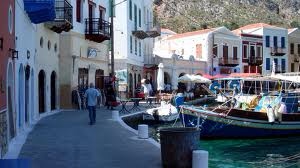
Anyway, they will keep your passports overnight and you will get them back on the boat, since there is passport control when you land in Meis. The advantage of handing in overnight is that you only need to be a the sales office for 9.45am; if you book on the day, you have to be there for 9am, which would be a real challenge for our family.
The day out
We love all aspects of the day out. The crossing is lovely: long enough to be a trip, short enough not to be tedious.
When you arrive, consider getting a water taxi (speed boat) to the blue cave. We were advised by Cuneyt to go straight after arrival in Meis, because by mid afternoon the waters can be too choppy to permit entry to the cave. If we were staying overnight or longer in Meis, I would actually like to test my theory that the water is bluest when the sun is at its highest, say noon to mid afternoon: but for a day trip, go as soon as you can. This will probably mean you are in the cave by 2pm, and it is well worth a visit. We did the trip last year without our daughter Alice, who was on a school trip, but this year we went back to the cave partly for her, partly because we wanted to see it again. And I hope to go next year, too.
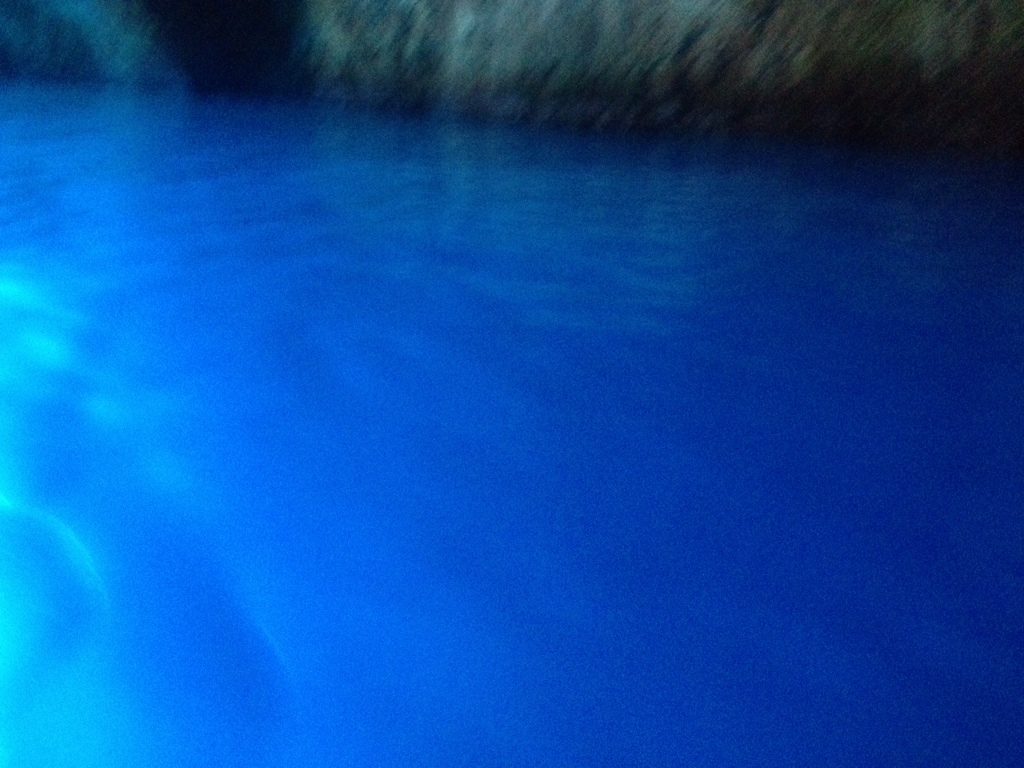
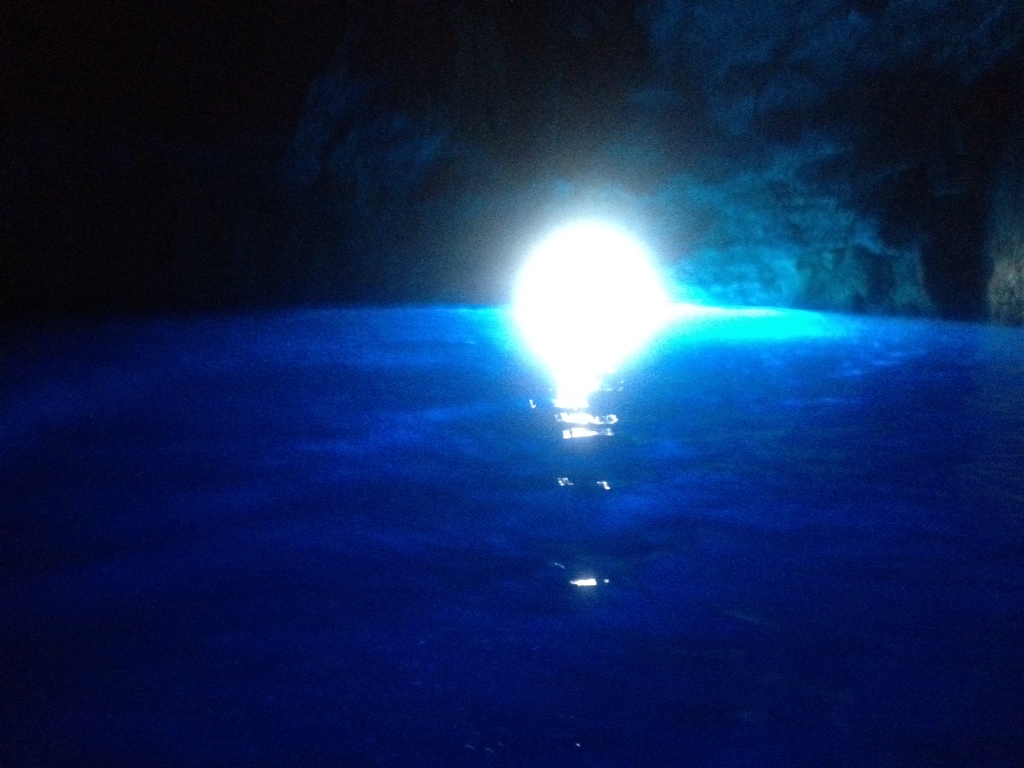
On the return journey, we ask the speedboat captain to drop us off at Saint George, a small islet: this is 'standard' for day-trippers. A lovely place to sun bathe and swim; then, after a couple of hours, by prior arrangement the captain comes back for us, takes us back to the main island for lunch.
Shame on us, but in two visits we haven't felt the energy or desire to climb up to the castle ruins. A drink at one of the numerous cafes is a preferred way for us to spend the final while on Meis.
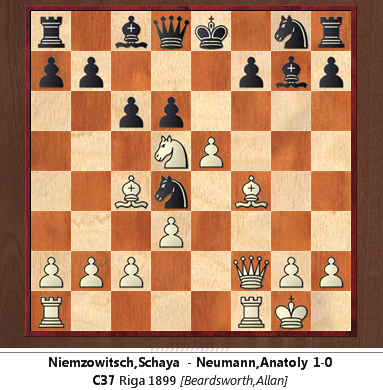
White to play and win
Solution
(Firstly, unless I am mistaken, white is not the famous player Aaron Nimzowitch; I haven't checked into it, and whether the two are related).
The motif is pretty obvious: get to f7, by fair means or foul. My first try was 1 Bh6, but it is terrible, 1…Nh6 is -+, so the next square to try to throw the bishop away at is g5: 1 Bg5. I then spent most time on 1….Qg5, though the move played in the game, 1…Qd7, was also nice to look at- there are various flashy mates- all much of a muchness. The better defence is 1….Qg5 and I suspect in practice I might then, playing white, chicken out and take a draw by perpetual: but Houdini assisted, the one and only way to win (first bring all the pieces to the party, by the obvious 1 Rae1) is to push the black queen by 1 h4!
In practice, I suspect most average or above club players would find 1 Bg5: and I would play it, knowing I had the comfort blanket of a perpetual check after 1…Qg5; and this is more or less as far as I got before checking the solution and switching on Houdini. It is a worthwhile Aagaardian calculation exercise to look forward and try to bottom all lines.
White to play and win
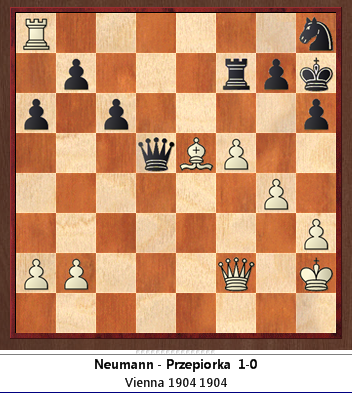
Solution
As I sometimes, do, I loaded the page (121-125) of puzzles from Megabase into my purpose built file for this Cordingley project: partly because I have to key in every fifth puzzle, which is given in FEN in the book. An 'advantage' of being fifty is that if take my spectacles off, there is no chance that I can by chance see any of the solutions: one has to count one's blessings.
Anyway, this particular game wasn't in Megabase, and nor did a google search find it, so I had to enter the pieces manually into a fresh Chessbase board. In doing so, I saw the solution- it just appeared to be a 'trick' position, and I saw that 1 Qe3 threatened a cheapo- perhaps a sign of too much blitz. So, 1… Re7 (other moves either lose the same way or prosaically) 2 Qh6+! Kh6 ( 2…gh 3 Rh8 mate) 3 Rh8+ and 4 Rh5 mate).
Simple enough.
Yesterday I was puzzled/amazed/in awe of Vladimir Kramnik for a combination he played against Peter
Leko. I was so puzzled that, rather than switch on an engine, I took several screen shots, and studied the position on the board. Still mystified, I have checked on Chessbase to see what they said, and, as I thought might be the case, Kramnik's combination was out of distress, not out of choice, and Peter was bluffed by not taking it.
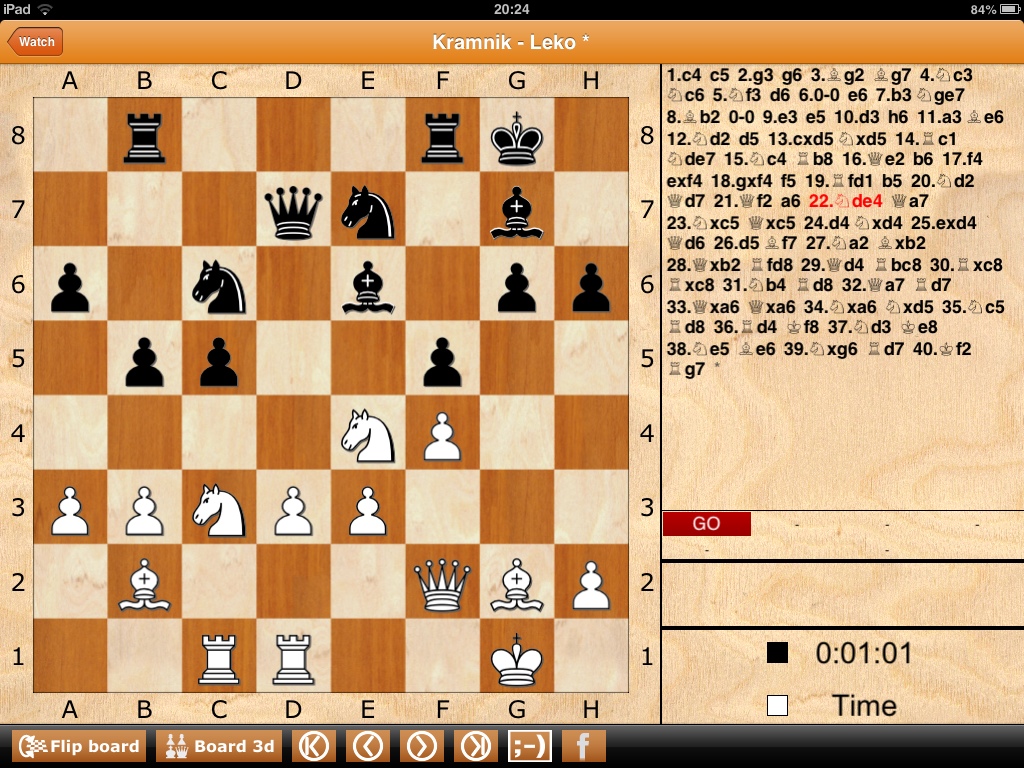
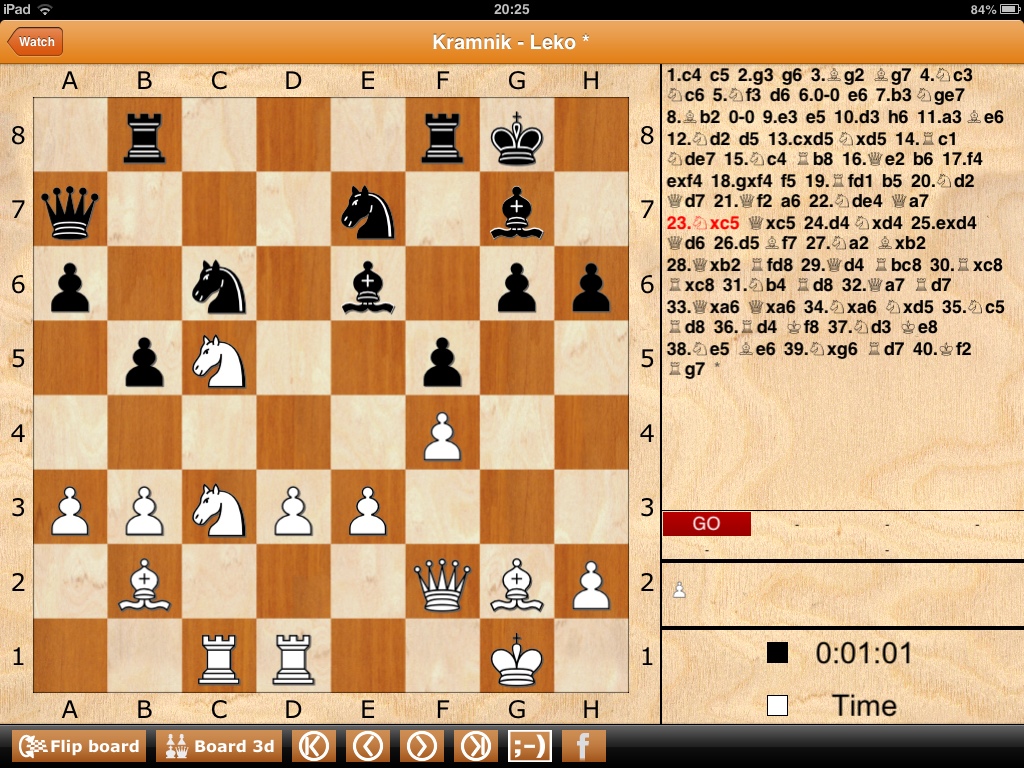
What is particularly nice for me is that the combination rests on Purdy's potassium cyanide placing a pawn fork apart of his Be6 and Nc6.
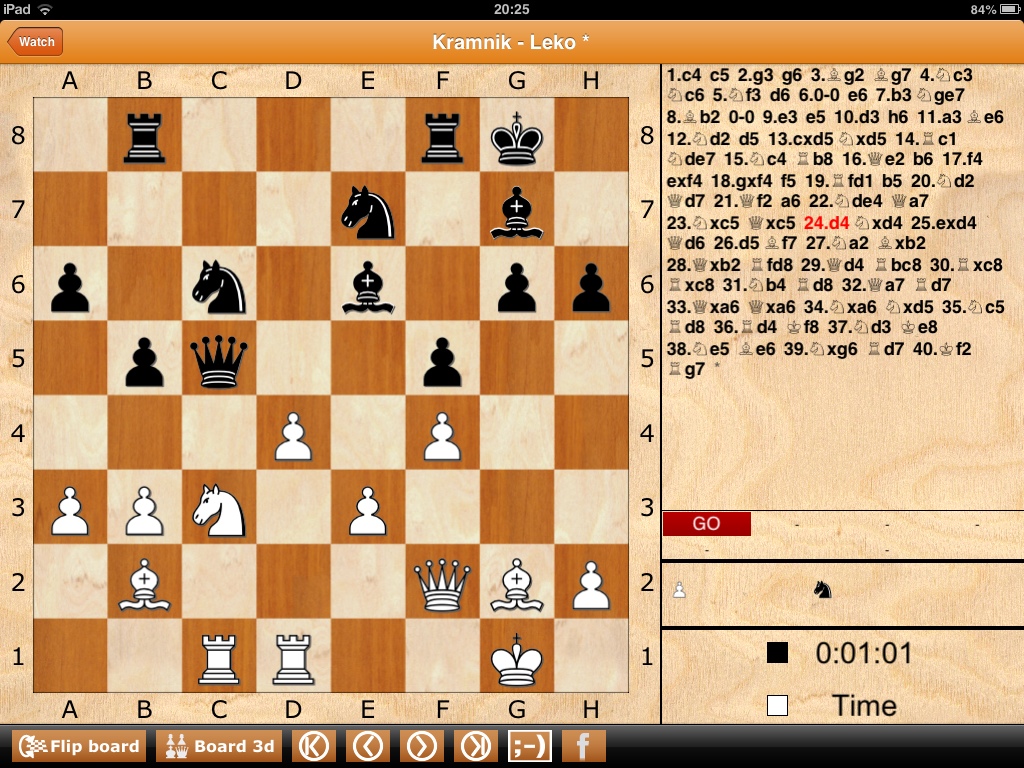
I always like it when Kramnik wins: there is something about his style of play, and also how he is in post mortems and with fans, which appeals to me. And yesterday I was also able to celebrate Mickey Adams' continued fine form in Dortmund.
 allanbeardsworth