The first book I have read on holiday (to the general derision of my family) was Genna Sosonko's The World Champions I knew, a series of mini-bios on several world chess champions (cue 'I had a boring life with no friends' quips from my chess widow wife, to much accompanying mirth from la famille).
The longest, and probably the warmest, is of Mikhail Tal. I am pleased to say that I have at least one thing in common with the Magician from Riga, namely a love of crosswords, brain teasers, and numbers (Sosonko, pg 170).
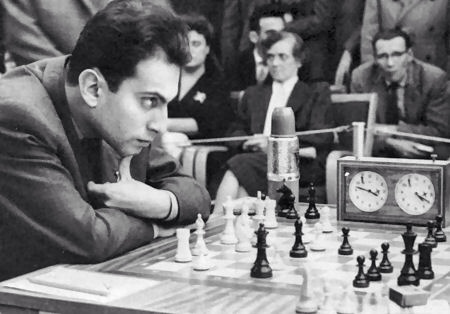
Genna writes that he learnt a game from Mikhail: out of four figures on the number plate of a car, make 21, using each figure only once. Sosonko writes 'in complicated situations he dealt with square roots, differentials, and integrals with a triumphant look on his face'.
Now I have no idea how differentials and integrals can be applied to numbers. So ignoring them, and instead making the rules:
- All the digits must be used, once and only once;
- The only operations are addition, subtraction, division, multiplication and squaring;
I tried it on our hire car number plate here in Kas, Turkey. The numbers are 5263 and…. alas, I can't do it.
A bit like not being able to solve most of Mikhail's fabulous combinations.
 Posted with Blogsy
Just for a change, since today's Cordingley puzzle is a let down, here is one seen in Chess Today which is a far better puzzle.
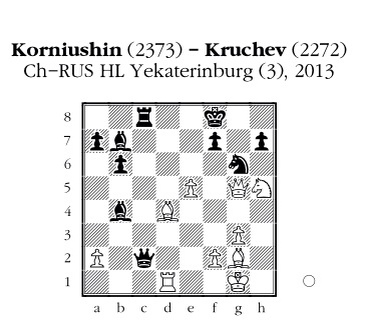
White to play and win
Solution
This took me a bit of a while to solve. I first followed- got entranced by- fanciful lines starting with 1 Bb7 Qd1+, putting my king first on g2, then h2, before drawing a blank.
So, re-start, and apply Purdy's principles. Three LPDOs: Rd1, Bb7, Bb4; black king in a bit of a net, but at first I tried to get to it via h6/g7; then jump-checks and jump-smites, and Rd8+ became apparent, jumping over the Bd4: then I instantly realised that the Nh5 prevents black's king's escape to g7, so the solution became apparent: the line clearing 1 Bc5+! followed by 2 Rd8+ Rd8 3 Qd8 mate.
Nice.
White to play and win
Solution
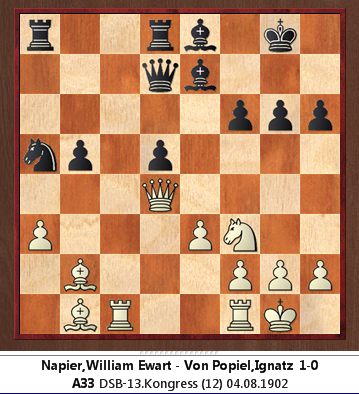
An interesting puzzle, but cooked: and the cooking instructions aren't too hard to follow.
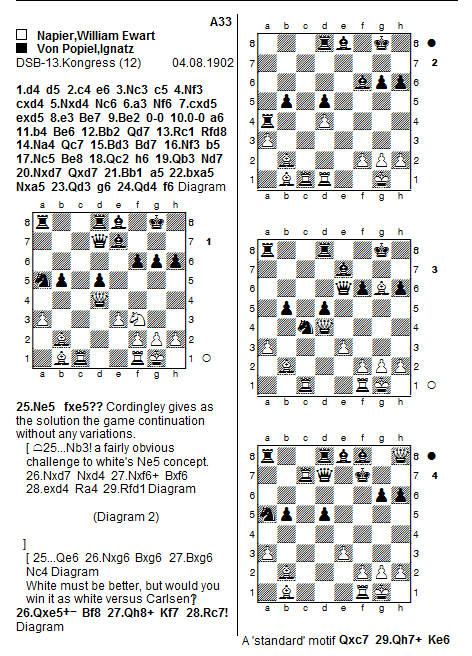
The 'solution' is the move I first thought of, 1 Ne5, which clearly intends to open up the long diagonal for the Queen-Bishop combination. So, first thing to check, is 'does it win' after black captures, and to answer this, you only have to see how to win if black plays Bf8 after Qh8+ Kf7, and it didn't take me long to spot the standard motif Rc7! decoying the queen to a square where it will be LPDO and skewered by Qh7+. The only other bishop move worth considering is Bd6, which prevents Rc7+, but then Qg7+ Kf7 Qf6 is mate.
So, capturing loses simply enough: though I did wonder whether this could be the puzzle which first employed the Rc7 skewering motif: there must alway be a first time?
But, what about the annoying non recapture? It is alway annoying, because often it is good for them, when opponent's refuse to play ball and capture your pieces or refuse to accept your sacrifices. So 1…Nb3! is a pretty natural nuisance try, and it is not to hard to see that after the string of captures, white is better, but black isn't dead lost.
Another thing to add is that white has nothing better than 1 Ne5: others such as 1Qh4 are no more than equal.
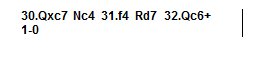
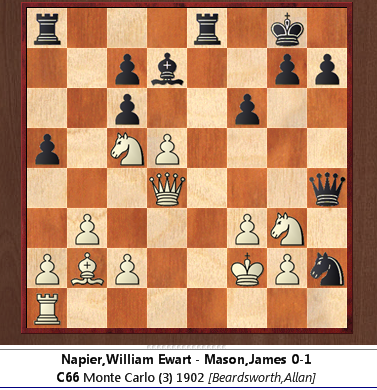
Black to play and win
Solution
I am not sure about this one. Not sure in the sense that I don't know if I solved it or not, or if there is a solution. Certainly I didn't for the moment consider the move played in the game; and, alas, I don't really see the point of it.
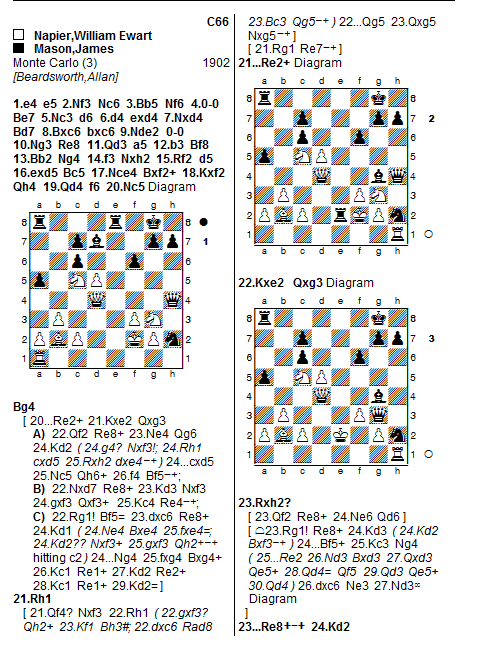
Firstly, an appraisal of the position. Black is the exchange up, white's king is a bit exposed, white has no LPDOs, the lack of a black squared black bishop means that the geometrical alignment of white's king and queen can't be exploited, and black's knight is dangerously offside. So, unbalanced, and all I could think of was drawing the king out, by 1…Re2+ when 2 Ke2 Qg3 is forced, and then white has a number of options, but 3 Qf2 is the most natural, when 3…Re8+ and then the position to me is 'unclear': but in practice I would doubt black is worse. That's about all I could see.
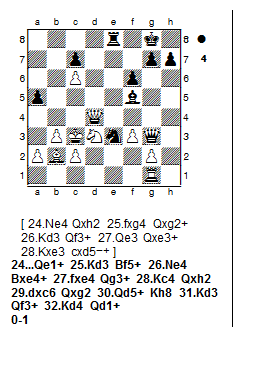
In the game, black played 1…Bg4 which I don't really get. The attached analysis shows that white could have defended better, and I think in all likelihood both my move and the game move are equivalent in value: Houdini, to the extent I have given it time to think, assesses the best line as level, though the evaluations swing.
On reflection , maybe the only point of 1…Bg4 is so it can't be captured by Nd7, and capturing by fg exposes the king after Ng4+. Maybe, but I am not sure.
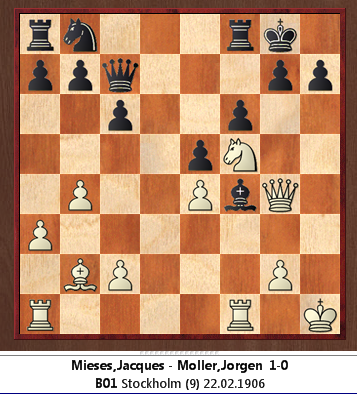
White to play and win
Solution
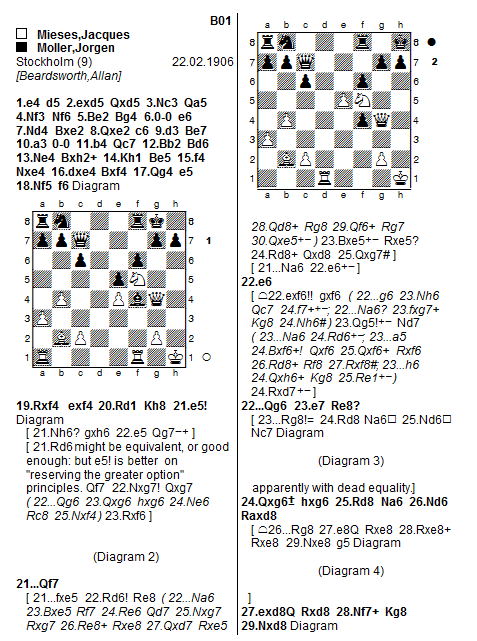
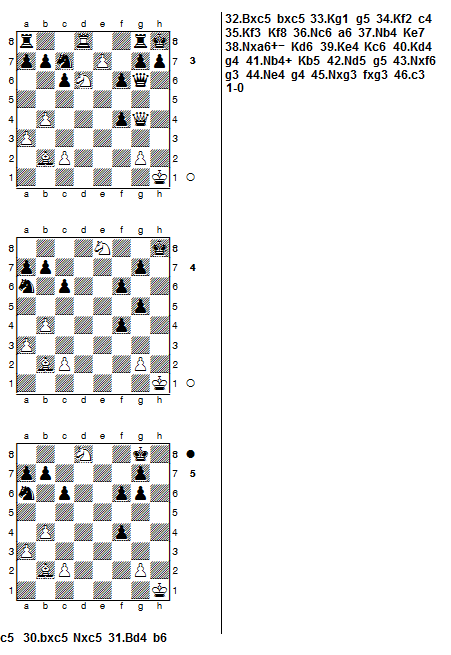
This puzzle is both easy and hard: it is also very enjoyable. The easy part is to guess the first two moves: take the bishop, 1 Rf4 ef, and bring the last piece to the party, 2 Rd1. I would play these in practice with not much thought, partly for want of anything better, i.e. if they are bad, then white's position is bad.
I should say I spent some time on 1 Rd1, wondering if the Bf4 needed to be taken, and noting that if black can get his pieces out, he won't be worse. However, Rf4 has two benefits: gets rid of the defender of h6, so Nh6+ can sometimes be on, and also enables the thrust e5!, weakening the a1-h8 diagonal.
Black has a lot of moves after 2 Rd1, with a key point that 2…Nd7 isn't one of them: 3 Rd7+! Qd7 4 Nh6+ 1-0. So a natural move is 2…Kh8 since black would far rather get his Knight to d7 than a6. After 2…Kh8 I noted that the Rf8 is now LPDO, and so back-tracked, looking at keeping the Rf1, where there is a jump check to the Rf8: but I couldn't bust open the f file, so reverted back to 1 Rf4. My analysis stopped at (2…Kh8) 3 e5, being the horizon of my thoughts: black has too many options that he may play. I also looked at 3 Nh6 which fails (why should it be good to put the knight offside?) and 3 Rd6 (which is good, but not as forcing as 3 e5).
I switched on Houdini and it showed me that the line to 3 e5 was played. Very instructively, it later shows that Mieses threw away his advantage, but that black did not capitalise on it: I wonder if Mieses ever knew that ef!! was far stronger than pushing the pawn forward: of course, I didn't find ef!!, Houdini did, and it took me a while, assisted by the engine, to see its full effects. It is quite telling how much can be made by a less in development: it shows that a sense of urgency is paramount, and also that precision is required.
A very nice and worthwhile puzzle.
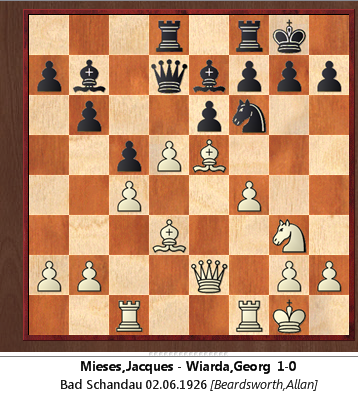
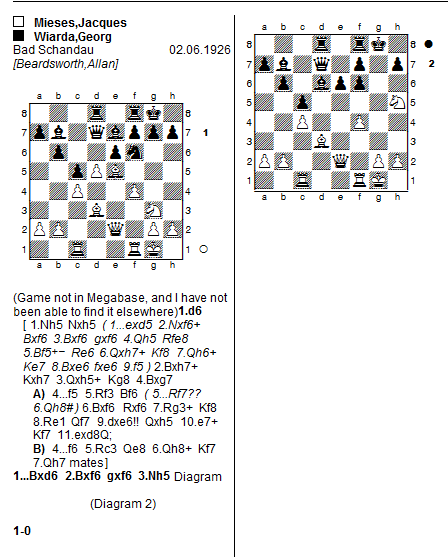
White to play and win
Solution
Oh dear, here I committed two faults:
#10 rushing: not treating the puzzle with the attention it deserves
#11 spotting a flashy, complex line, missing a far simpler one.
The case for the defence is that I instantly saw a solution, 1 Nh5 Nh5 2 Bh7+! 3 Qh5+ 4 Bg7+! 5 R-lift having played this series of moves, or slight variations, dozens of times: no, that is not exaggeration: for a long while, until I got bored with it, I opened my blitz games with the Colle variation with Bb2, and against a typical classical defence from black, often played Ne5, f4, and if, as often happened, black challenged the Ne5 with Nf6-d7, then the double bishop sac, queen in and rook lift combination often worked.
Here too, the attack-sac-check-sac-lift plan works, so I was pleased with myself, looked at the solution, and, ouch! had totally missed the very simple 1 d6, a move that I should not have missed. If I had not made mistake #10, and instead approached the puzzle professionally, I would for sure have found it. Excuses, excuses of course.
I am presently settling into the start of our holiday at our villa in Kas, Turkey. One of the books that I have brought with me is Genna Sosonko's The World Champions I knew, a collection of very enjoyable essays by a writer who is very easy to read.
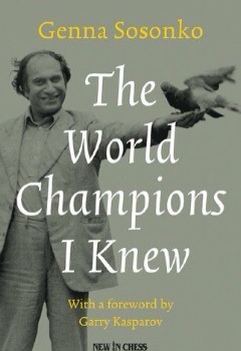
Because it looks like a paperback- it is a paperback-my chess widow wife doesn't know it is a chess book. And in a way, it isn't a chess book, but it is chessing, a verb I came across recently: no diagrams, no games, no analysis, just descriptions and player portraits.
I am half way through it, and Genna's chapter about Smyslov particularly appeals. This blog is because Smyslov credits his best game as being one he played as fourteen year old, against Gerasimov.
It is beautiful, and well worth solving. Finding the first move gave me a big smile: finding the main lines even more pleasure.
Black to play and win
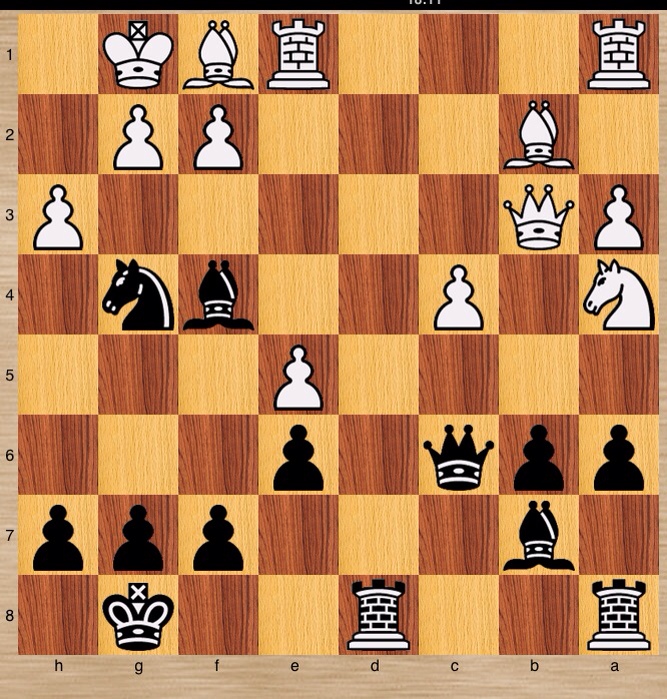
Solution
1..Rd3! when best is 2 Qb6, after which at first I exchanged queens, before realising that 2..Rh3!! wins. If white captures the queen, then there is smothered mate by Bh2+ and Nf2 mate; and if 3 Bd4 (say), black can windmill check with Bh2+ Be5+ Bh2+ Bc7+ winning the house.
Lovely
White to play and do something
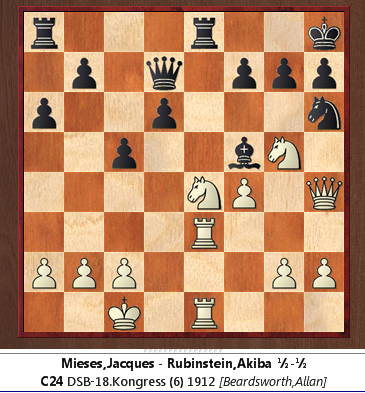
Solution
I thoroughly enjoyed this one. My first thought was 1 Nf6, but I didn't have great confidence in it, so I also looked at 1 Nc5, 1 Nd6 and even 1 Qh6, all to no avail. Since I loaded several games at once into my Chessbase file I am preparing for the Cordingley puzzles, I noticed that this game was drawn, so I was somewhat puzzled, but- I don't know why, it just did, the puzzle appealed to me.
I quickly returned to 1 Nf6 and tried to make it work, eventually seeing 1…gf 2 Qh6 fg 3 Qf6+ Kg8 4 Re7 and considered it to be very painful for black. I eventually saw that 4…Bg6 might not be losing, and 5 Rd7 Re1+ 6 Kd2 Rae8 was a position I couldn't properly evaluate, but I thought that white probably wasn't losing, and might be better by swapping a pair of rooks off with 6 Rd8. In fact, Houdini tells me this position is more or less equal.
Cordingley was double-wrong in his analysis. Firstly, he thinks the above line wins for white, only going as far as 4 Re7; instead, he prefers the game continuation, 2…Bg6 when after the obvious continuation 3 Nh7! Bh7 he gives 4 Rg3, when black can force a draw by perpetual, as in the game, but in fact white can improve by 4 f5!!, a move which Houdini found: it looks like white has an advantage in all lines, but I for one would find the variations impossible to fathom with confidence, and impossible to play with any precision. But, technically, this puzzle is double cooked: the drawing line doesn't draw, and the losing line doesn't lose.
In an effort to help residents lose weight local government officials in Saudi Arabia have announced a 30-day challenge in which it promises to pay participants a gram of gold for every kilogram of weight lost – worth the weight
I read about this in The Monday Briefing, written by Ian Stewart, my firm's Chief Economist in the UK, gives a personal view on topical financial and economic issues. In a world of too much information, this is one item I habitually make time to read, and recommend it to students, colleagues, clients who have an interest in the economy. It is subscribed (free) at
|
www.deloitte.co.uk/mondaybriefing. How much would I earn by losing some weight? Presuming that it would be in my interest to lose some weight, and assuming that I should lose a stone, and translating one stone into French, then I need to lose 6.35 kg (good job Jane doesn't read my blogs: she will snort and say I need to lose a lot more). The google price of 9ct gold is £ 10.08/kg, so I would stand to gain £64. Or, if it were 24ct gold, £26.87/kg, then £171. Should the state incentivise me in this way? I think there is some merit: the benefit to the health service for instance, though maybe there is an additional cost to the state in terms of longer term care needs: no doubt there is a wealth of good and bad statistical studies on the subject. There must be at least as much merit as many of the other tax incentives or benefits that are presently offered. Maybe I would even need to buy some new clothes, thereby boosting GDP? Government ministers, of all shapes and sizes, would have photo calls, at schools, workplaces and gyms. Interviews would be held with fat and thin people, and some would complain ’why should the overweight be paid for what they should do already?'. Someone is bound to object the system breaches Human Rights or is unfair, favouring males over females (or vice versa) or young over old; a claim would be sure to go to Europe. At least one restaurant chain would come out with a gold menu, promising low carbs. Of course, even before it is introduced, there would be tax planning opportunities, and a new industry would be borne. The well advised would eat gargantuantly before their first weight test, to which they arrive in their heaviest of clothes. Their next visit will be in Lycra, starving. Or it might be self assessment. And what if the weight is subsequently put back on? I suspect I should stop thinking about this, since I am now on holiday. Alas, Ian's next Monday email may well be his much awaited holiday reading list… |
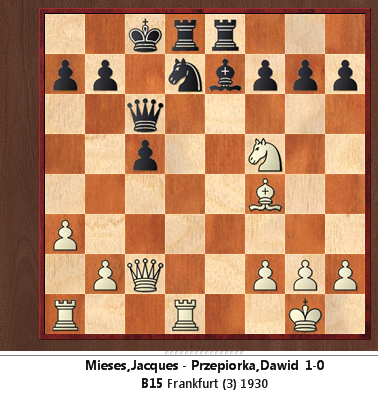
White to play and win
Solution
This one came to me fairly easily, because it is a typical problem first move: 1 Rd6! is the first move you think of, knowing it is a problem.
Trying to find more logic, the following features are apparent. Firstly, the powerful bishop and knight combination; second the alignment of the white queen and black king (the jump check in Purdy's parlance) and finally the limited space for black's queen – again, in Purdy's parlance, there is the chance of a 'net'.
This last feature is the key, so to quote CJS Purdy:
(Purdy on nets, pins and ties, Fine Art, vol 2, pg 205)
Some things are hooey,
and most others lies;
But forks you mustn't miss,
nor pins, nets, ties.
So 1 Rd6! Qb5 after which the line I had was 2 Nd4 Qa5 3 b4 Qc7 4 Nb5 Qb8 when I knew something must win, perhaps 5 Bg3 (Houdini tells me lots of moves win) but better is to reverse the move order and play 2 b4! threatening Nd4, which is impossible to meet.
I concentrated on 1…Qb5, not (alas) giving full attention to 1…Qc7, thinking it would be straighforward to defeat, but in so doing I missed the pretty game continuation.
 allanbeardsworth