White to play and win
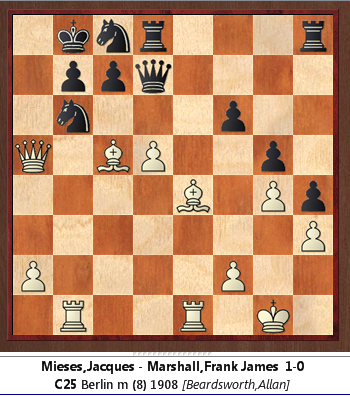
Solution
This one took me longer than it should have. I instantly saw the correct first move, 1 d6, but found the layout of the pieces hard to calculate through, even though I knew that I should be able to. Eventually, I calmed down, re-focussed, and saw enough: 1…Nd6 was the only move worth computing, and 2 Rb6 is a pretty natural follow up: what took me a while was to decide upon (after 3…cb) 3 Bb6 as being superior to 3 Qb6, but when I saw 3…Nc8 4 Bf5 I knew it was game over, especially since the Q is tied to the c7 square (4…Qd2 5 Bc7 mate). I only quickly checked 3…Nb5, reasoning that both 4 a4 and 4 Rb1 must be good enough. Checking with Houdini, it prefers 4 Rb1 as shown in the attached analysis.
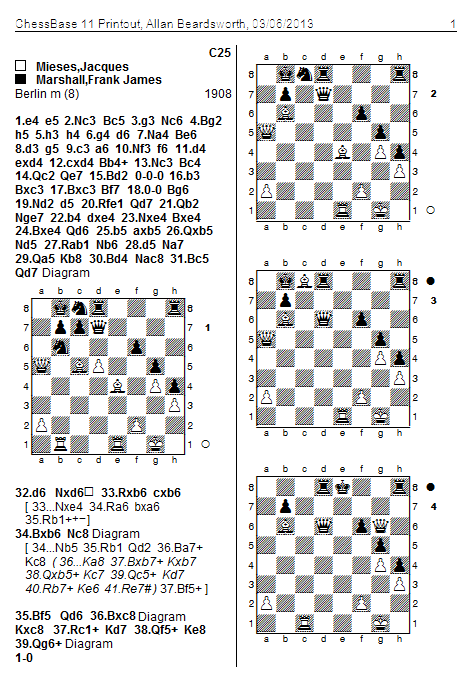
 Posted with Blogsy
White to play and win
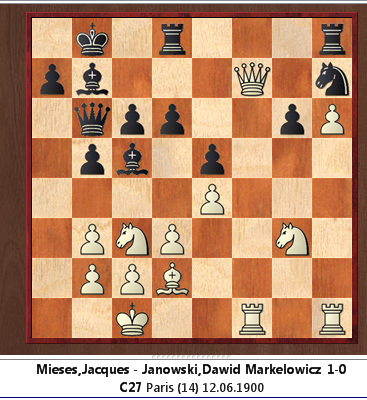
Solution
I enjoyed this one. In my initial appraisal, I saw no LPDOs; and also saw that black is far from threatening white, with, for instance, 1…Be3 2…Bd2+ 3…Qf2+ never a threat because of 4 Nge2, when the king is quite cozily protected by his knights and pawns. So clearly the motif is based on promoting the h pawn, and equally clearly, it is likely to be good enough to exchange the Queen, even for just R and N. So 1 Qg7 with the idea of 2 Rf7, or, and this is the solution, 1 Qg6, with the cute point that 1..Rdg8 is met by 2 Qg7!, and if the queen is taken, white gets R+N and a pawn on the seventh for it, and it doesn't take much to see that the pawn will queen, or else black will face ruin less loss.
I felt more or less confident about 1 Qg6 but know that in practice I might chicken out and play 1 Nce2, protecting the Ng3, preserving the threats, and if 1…Rdg8 then 2 b4 embarrasses the B, forcing (more or less) 2…Be3, when 3 Qe7 either wins the d6 pawn or gets a R to the seventh. This more boring, less tactical style is more mine, but I would also like the demoralising effect (on black) of 2 Qg7 after 1 Qg6 Rdg8.
Black to play and win
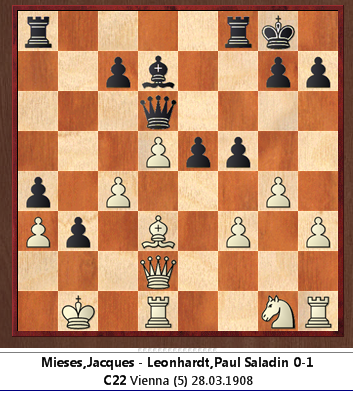
More an Aagaardian exercise in deep calculation than a 0-1 puzzle
Solution
I enjoyed this one, partly because I had plenty of time to give it, during a lovely, sunny walk in the Langstrath valley, near our home in Borrowdale.
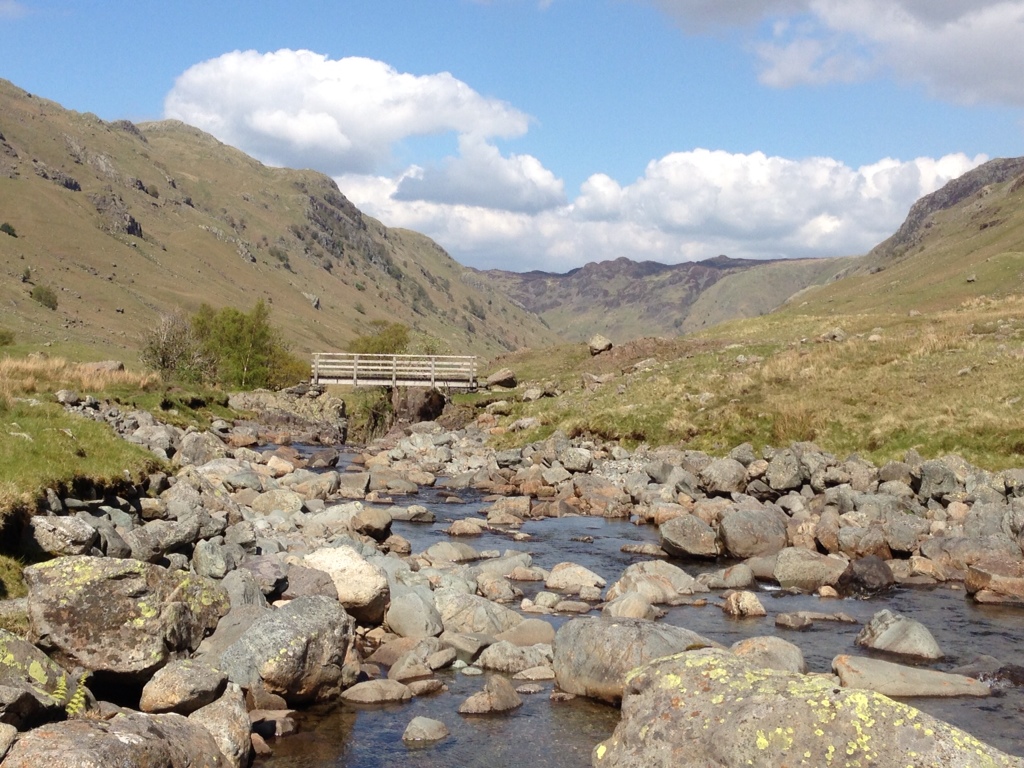
I had two other puzzles with me, but neither of them were a challenge, so my attention was devoted to this one.
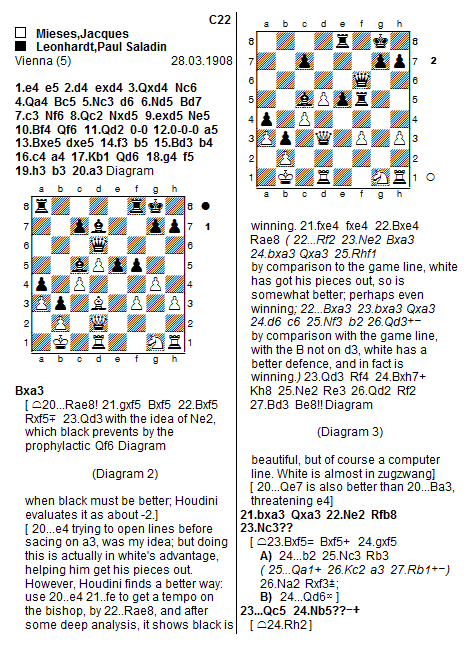
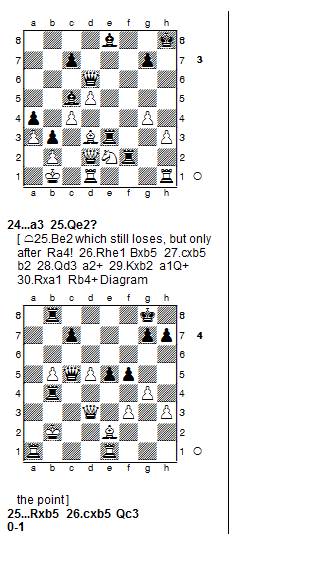
Firstly, of course, I tried to make 1..Qa3 work, but couldn't: I thought black needed just a bit more. Alas, I found a way, 1….e4, which was the right idea, but my execution of the follow up was inaccurate: I thought getting the Rf8 to f2 would be the necessary extra, but it isn't, and its activity is counterbalanced by white's greater luft, including Qd3. Houdini showed me the way, after it had quite a considerable amount of time to think: start with 1…e4, but use it to gain a tempo with Rae8, smiting the Be4: very instructive. Houdini also favours black after 1…Rae8 and also (somewhat) 1…Qe7: the former in particular improves one piece, whilst threatening to push the e4 pawn.
My analysis is attached. I suspect another engine, or Houdini given more time, would find further details. What seems clear is that the move black actually played, 1…Ba3, only works because of a mistake by white.
White to play and win
Solution
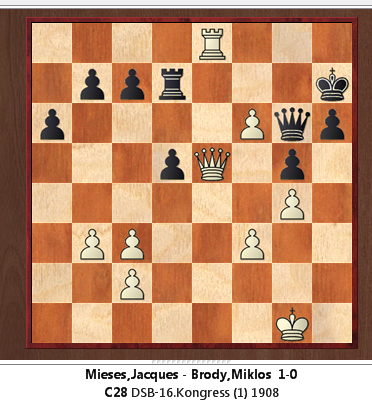
This was one I solved instantly: 1 Rh8+ is fairly routine, and even if it weren't, following Purdy's method of examining all checks would have found it. There is not much to say really, 3 f8(N)+ being a fairly obvious finish.
However, Houdini puts a small spanner in the works, but I can't say the problem is cooked: it tells me that 1 f7! Is even stronger, mate in 13, though it is not obvious: for what it is worth, and I don't think it is is worth much, the start is 1 f7 Qf7 2 Rh8+ Kg6 3 f4; but no-one would play like this, the chances of error in calculation are far too high, and simplicity is to be preferred.
I don't think so: no, they didn't cheat.
The notion that they may have cheated will always be around, will always be something that we will never really know for sure, unless against all odds, Joel Benjamin, the GM who supported the development of Deep Blue from August 1996 through to the match in 1997 admits it, or some other possible player comes forward: there are several names, including Karpov, who are mooted as might have having given support. To me, though, I would say the odds are 1000/1 against there having been support: it was just that Deep Blue represented a step change in playing abilities.
My interest has been sparked by watching The Machine, a play about the match, at the current Manchester International Festival. Several colleagues have gone to it, all thought highly of it…in fact the only criticism I have heard was that the weather being so hot, the atmosphere in the theatre was stifling. Soon enough, Manchester will be raining again.
So, yesterday I spent some time with my chess engines to see what I might find. I looked at three of the positions which have been most commented on, spending most time on the most commented one. The analysis was done on my soon-to-be-replaced fairly ancient PC, on which I set the engines to 1 CPU to prevent hogging of system resources: so not at full strength.
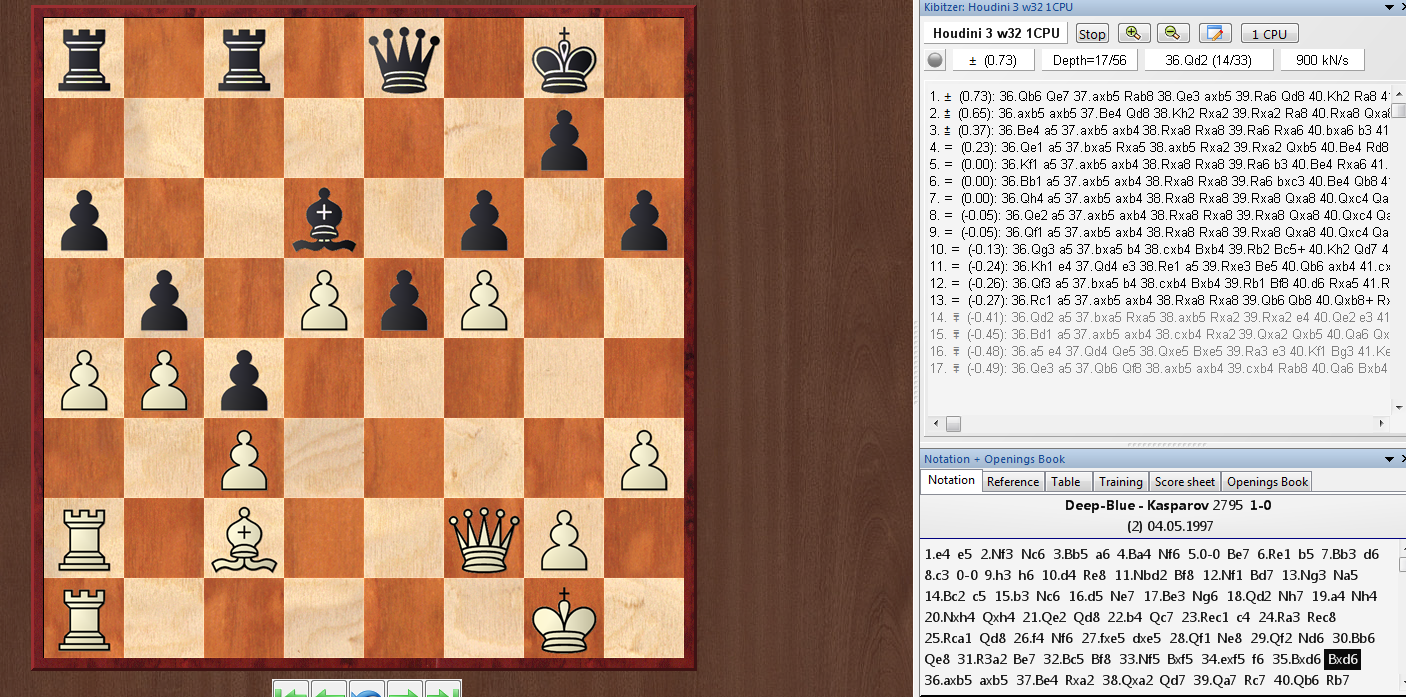
This is the least commented position, but my attention was drawn to it by the second item that I have highlighted in the screenshot below. (Arrows added by snitch, an app I have just downloaded which seems pretty handy)
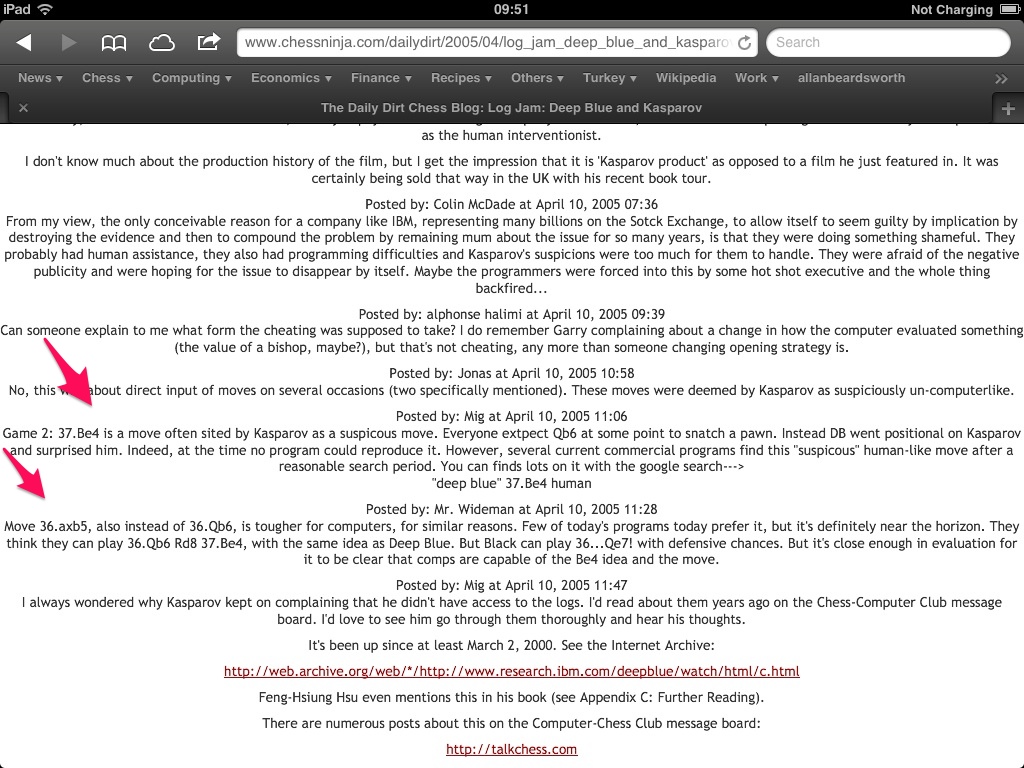
Any fairly strong human player would I think do what Deep Blue did, 36 ab; I also think that IBM wouldn't have needed a Benjamin or Karpov to then suggest 37 Be4, Beardsworth would have said to: it is patently natural to fence black in. What surprised me, and one point for the deepbluegate conspiracy theory, is that Houdini 3.0 doesn't consider 36 ab to be best, preferring the riskier 36 Qb6. Two points, perhaps, because none of the other engines that I tried preferred 36 ab.
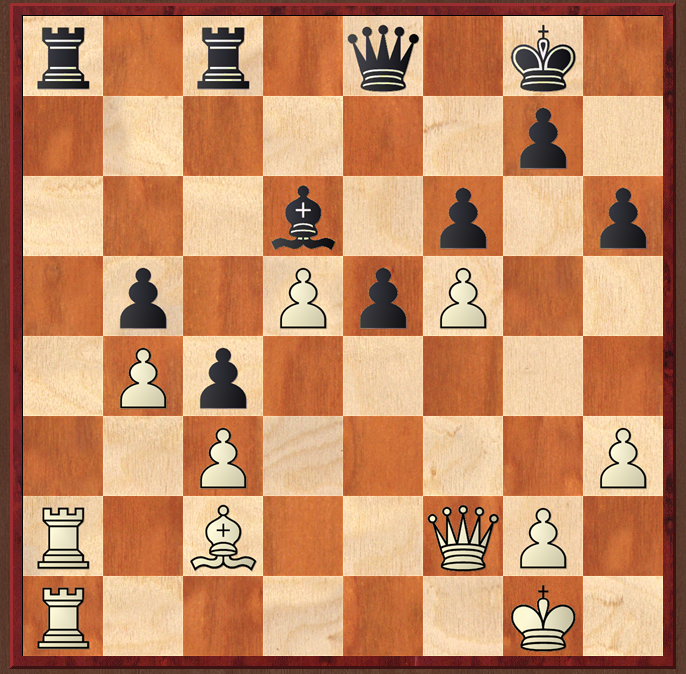
The above is the most commented position. Now that the a pawns are exchanged, black can't mess things up with …a5; and so it is only a question as to whether white can infiltrate with the queen whilst black's major pieces are tied to fighting for the only open line. So a strong white player would naturally look to see if there is an overwhelming advantage after Qb6, and, presuming none could be found, would quickly play the improving/stabilising move 37 Be4.
Initially, Houdini 3.0 preferred 37 Qb6, but after I left it for a standard British Unit of Time (i.e. I went away and made a cup of tea) its evaluation switched to preferring 37 Be4. Rybka 3.1 chose 37 Be4 slightly faster, only momentarility preferring 37 Qb6. The only other strong engine I tried was Crafty, which stuck with 37 Qb6.
The fact that Houdini and Rybka prefer Be4 is, to my mind, sufficient that in my judgment, it is best to conclude that there was no cheating: engines are now, and Deep Blue was then, now able to make judgements- they have better evaluation functions.
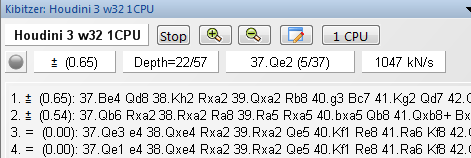
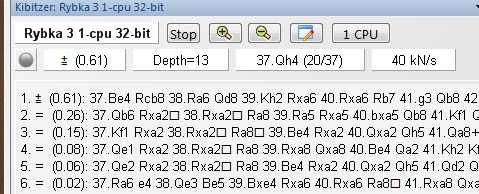
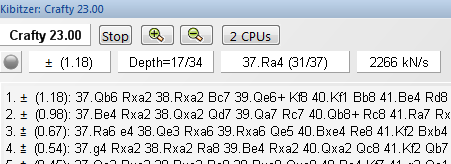
For pure amusement, I also put the position into Turing– something I should blog about one day.
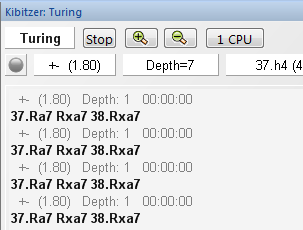
(As I write, there are some moves again to get Alan Turing posthumously pardoned: I hope I live to see that day).
My assessment is that Deep Blue didn't cheat. Whilst Houdini etc are far stronger than Deep Blue was, the hardware Deep Blue was running on would be infinitely faster and stronger than my effectively single CPU machine. (As I write this, I am reminded that when Tom was much younger, and in a video game phase, I once caught him 'buying' tanks as additional 'weapons' to break a siege of some Ancient Greek or Roman battle: Houdini is far stronger, but IBM’s mainframe more powerful)
I also looked at two more lines. Firstly, the game 1 position:
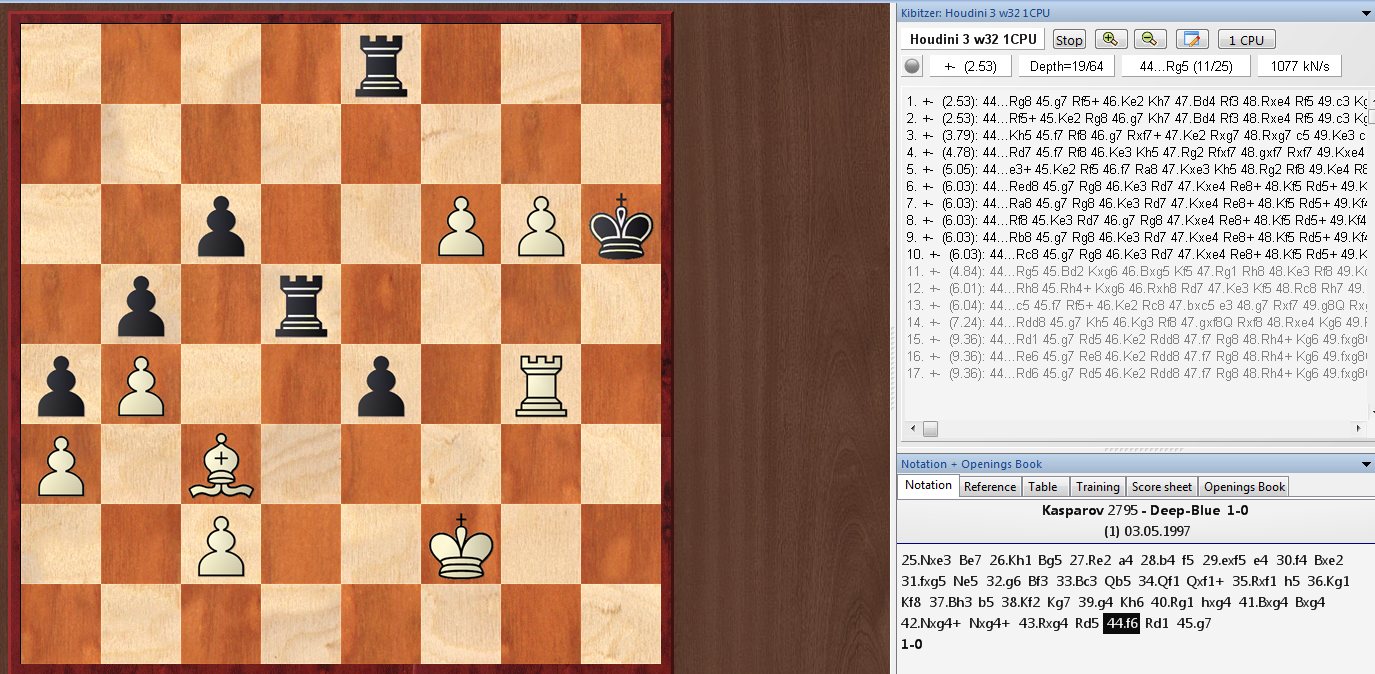
Here, black (Deep Blue) is busted, and played the utterly nonsensical 44…Rd1: I would give a point to the deepbluegate conspiracy theorists here, because there are far better moves, if there were a wish to prolong the game, but I accept the IBM defence that there was a programming blip so that in a hopeless situation, where nothing defends, something random was thrown out. I can though see Kasparov's claim that this single move spooked him badly as being true: this move, not 37 Be4 in the second game, might have been the decisive moment in the match: looking back, both moved show a more judgemental, human like, approach to chess.
Finally, I also looked at the allegation that Kasparov missed a draw in game 2, and that Deep Blue in turn made a slight slip permitting that draw. Neither is true: I am not the first to know this, it seems that by 2005 engines had gone that little deeper. Now, Houdini instantly shows both Kasparov's 'missed' drawing line and the way Deep Blue could still have won. Kasparov would have lost anyway, and his seconds in hindsight didn't do him any favours by telling him that he had missed a draw.
In conclusion, whilst there are legitimate reasons for thinking there was human support (Jane and I are still not entirely sure that man landed on the moon) I think the far, far, more likely position is that there was none: Deep Blue merely reflected a step increase in playing strength. Now, 16 years later, chess engines 'whip our butts': it is quite astonishing what progress has been made in the thirty or so years that machines have played chess.
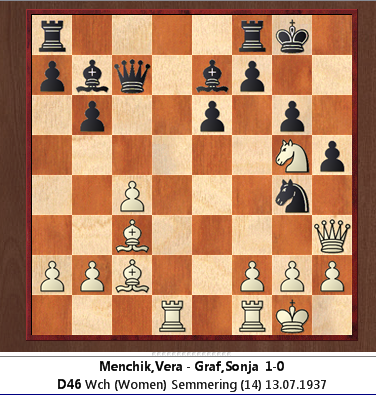
White to play and win
Solution
Intuitively, you want to play 1 Qh5, spotting 1…gh 2 Bh7 mate, and otherwise mate on either h7 or h8. But then you see 1…Qh2+ and queens come off, and it might then be level.
I then stumbled and bumbled around. I tried 1 Qh5 again, tried 1…Qh2+ again (alas, I do tend to repeat myself, hoping next time round will be better). Then I gave up, put the position aside, and left it.
Picking up the position again, 1 Rd7!! came to me in a flash. Game over. I would have liked to have said I followed Purdy's consider all smites maxim, or that I went through concepts such as decoy, but, no, I didn't, the answer came to me in a way more like Willy Hendrik's Move first, think later.
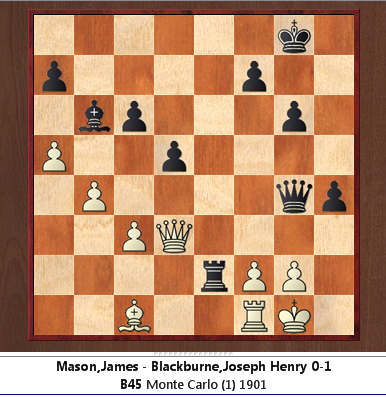
Black to play and win
Solution
I enjoyed solving this one, almost by method. The natural move is of course to move the Bb6, say to c7, and that certainly would be a natural bullet or blitz move: but clearly not the solution to a puzzle. ( I do suspect that this position is one which is far easier to solve knowing it is a puzzle, than it would be to spot in a game).
So, first thing noted is the Qd3 is LPDO. Next, the f2 pawn is pinned twice: once on the a7-g1 diagonal, so Qg3 is possible (not saying it is good, only that if Qg3, fg3 is impossible); and the pawn is also pinned because if it were to move, Qg2 would be mate; and the g2 pawn is also pinned, so that if …h3, gh3 is impossible.
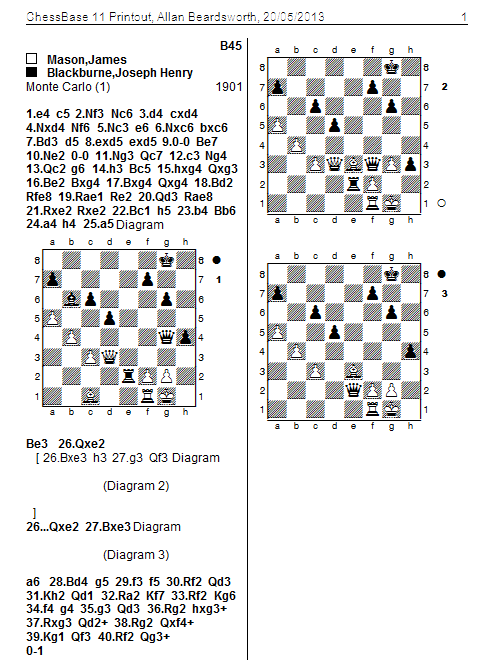
These factors made me fairly quickly land on 1…Be3!; if the bishop takes the bishop, then 2…h3 and mates, noting that white has no spite- or rescue- checks. If 2 Qe2, black's queen overpowers whites remaining pieces.
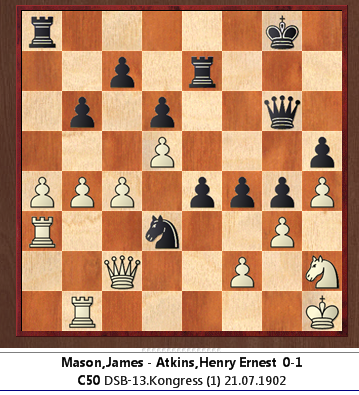
Black to play and win
Solution
I messed up this problem. Royally.
At such times, excuses are needed. I chose 1…Ra4, my rationale being that I knew it was a problem, so something special was needed. The Qc2 is LPDO, and if 2 Ra4, there are no harmful checks on a8; and similarly if 2 Qa4, the queen is well out of way. So, then, check 2 Rd3, see that black's attack is enough, look at the solution….and realise that I had been amateurish. To make this 'problem a day with a view to improvement' plan have any chance of success, I should be professional in my approach, including looking at all smites, and following processes such as 'if you find a good move, look for a better one'.
Whilst I saw 1…Nf2+, and knew that after 2 Qf2 e3 there was a double attack on two LPDOs, I lazily didn't bother to analyse how strong black's position was: preferring the fancy. In a game, I think I would have easily looked at 1…Nf2+ and not bothered risking 1…Ra4+.
Playing through this later on Houdini, it is even more galling: there are a dozen better moves than 1…Ra4, though, phew, Houdini confirms that it too is -+: just.
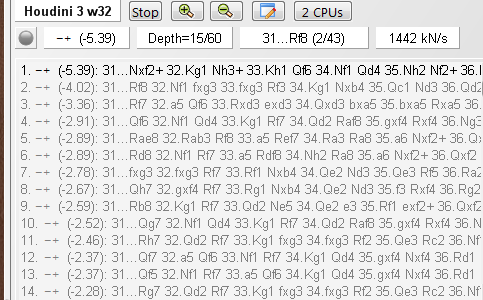
(Houdini after a minute or so of computation: the evaluations go up [more negative] as it is given time to think: if 1…Ra4 is played, and the position continued a few moves after either 2 Ra4, 2 Qa4, 2 Rd3, then a few moves in, it flicks to -2).
Note, though, how strong both 1…Rf7 and 1…Rf8 are- bringing more pieces to the party.
White to play and win
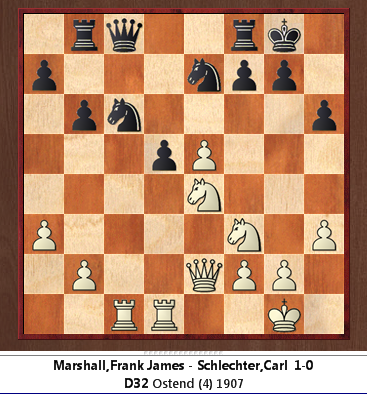
Solution
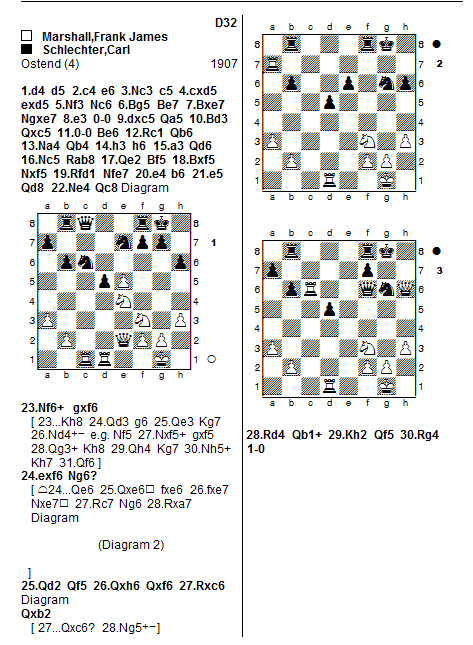
The first move is obvious, and Houdini confirms that 1 Nf6+ is best, and it certainly wins after 1…Kh8? or after 1…gf 2 ef Ng6. However, black has a tougher defence in 2…Qe6 when in the line I show below, white ends a pawn up, with a rook on the seventh to boot, but would I win it against Carlsen? Possibly, but possibly not, black has enough activity after exchanging the advanced white rook off, with some play perhaps against Pg2, so I would have clear capacity to mess up. Better yes, clearly; winning, yes, between equal grandmasters, but with chances for black at my level.
Black to play and win
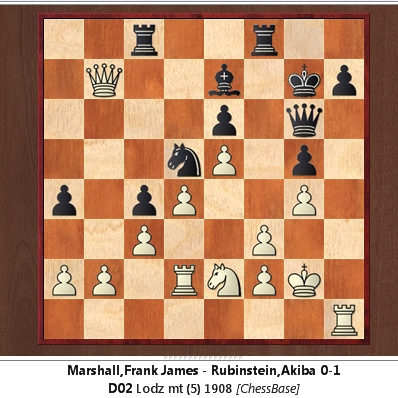
Warning: you could spend the rest of your life analysing this position to the end: there is a thicket of variations to uncover.
Solution
This is a famous position, and I sort of 'knew' that the solution was 1…Rf3, and had merely to work out why: it turns out that it is not actually the best move, but it was the move played.
I got only so far on this puzzle. I spent most of time on 2 Kf3 Rf8+ 3 Kg3 Qe4, and (without moving the pieces) couldn't see everything, but felt that black probably had enough. One factor is that the white Queen is in LPDO position and is vulnerable to a discovered attack with a check from the knight. I didn't doesn't much time on 2 Qc8 nor 3 Kg2, both of which are better moves. In particular, 3 Kg2 seems to be only a draw after best play.
The attached game file contains both Chessbase's annotations (from Megabase 2012) and my additional notes. I suspect that more analysis would alter some of the conclusions, but it does seem that inserting 1…a3!! Is important, weakening c3, a fact that is important in the otherwise drawing line after 3 Kg3. But to see such nuances is the stuff of dreams, or certainly not in my ability range.
 allanbeardsworth