White to play and win
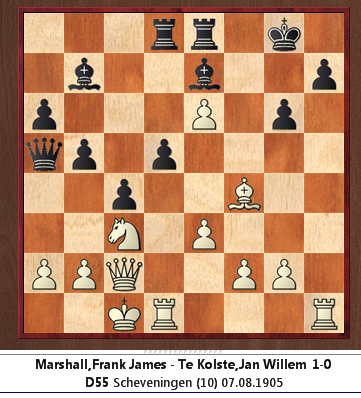
Solution
I think this one is straightforward. The first and second moves are obvious, 1 Rh7+ and 2 Rh1+; all that has to be seen is 3 Rh6, and it is game over: a quick check shows that black has no defences.
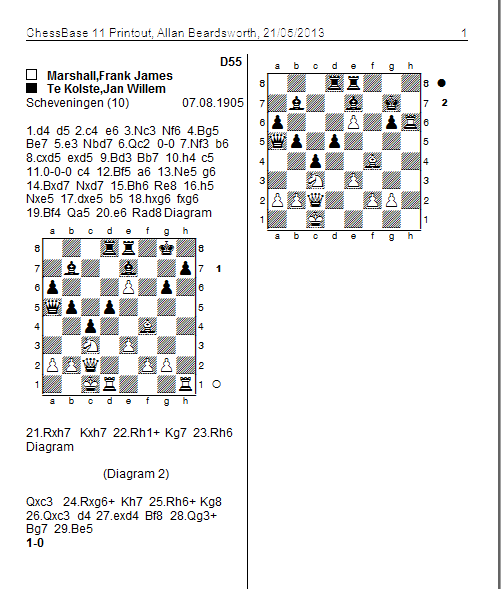
 Posted with Blogsy
I decided to have a look at who Olland, the player who beat Marshall was. Here is a wikipedia extract:
Black to play and win
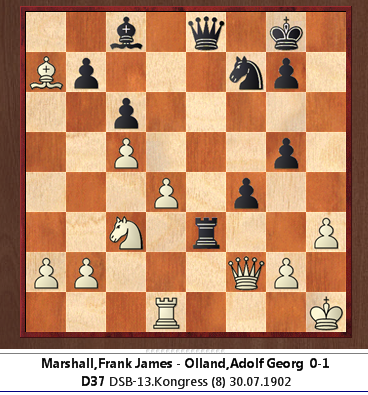
Solution
A good puzzle: fairly straightforward, but a good calculating exercise. Clearly, 1…Bh3 has to be evaluated, and it is not too hard to see that white is defenceless. There are various ways white can give up his queen for the rook, and then it is a hopeless ending.
I took this puzzle seriously, by which I mean that having found one good move, I looked for another, and in fact I eventually settled on 1…Nh6 planning to sacrifice later, the precise manner depending on how white defends. It turns out that 1…Nh6 is Houdini's slight preference, though that is really an overstatement, because both it and 1…Bh3 are more than -5, and, in essence, are basically the same line.
The attached analysis also gives a few notes to show where the great Frank Marshall went wrong.

Jane and I went to see The Machine which is on as part of the Manchester International Festival. I have written separately about the play from a theatrical performance perspective. This blog is about it from a chess perspective.
Overall, the director and cast have done very well from a chess perspective. They picked the key aspects from the match and made appropriate points about them. In game 2, Kasparov resigned in a drawn position and the play makes a point about the pressure it shows he was under, and also that Deep Blue permitted him to go into that line: from which there was an inference that maybe there was human GM interference because another King move would have won for Deep Blue and not given the chance of a draw away. I suspect instead it an engine horizon problem. The play makes the same point about possibility of human help when discussing Be4 rather than Qb6.
I was very impressed that the actors playing Garry and Hsu had clearly learned some of the moves of some of the games. For instance, they played correctly the first dozen or so moves of game 1, five or six moves of game 2, and all nineteen moves of the final game no. 6. It would be nice to know if the players know the moves of chess, and how they managed to memorise what to play.
There were though several areas for improvement.
- The commentary to game 2, at the point where it was a very standard early Closed Ruy Lopez, was simply wrong, implying advantage and novelty in a humdrum standard position;
- They get some of the opening names wrong. King's Indian Attack, rather than Reti opening in game 1, though I can see why they said KIA; and Sicilian attack; an odd pronunciation of Ruy in Ruy Lopez (though who is to say that my life long pronunciation, 'Roy' is correct: they said 'Roo-eee)'.
- The highest dramatic moment in the chess scenes was when Garry was contemplating the fateful …h6 which permitted the sacrifice Ne6. The commentator suggested that if black were instead to play …h5 he would take control of the game, the inference being that Garry would be near winning. From a theatrical perspective, this made eminent good sense, but from a chess viewpoint, is nonsense.
- The commentary to game 6 was excellent, and most of the moves which the commentator mentioned were those played by the actors and in the actual game. But on a few occasions- I think three or four- they got the moves wrong: a4 and Re1 were transposed, and I think there were at least two more errors. These don't matter, of course, unless the producer wants accuracy.
- One point I couldn't help but notice was that Hsu castled with two hands: the king in one, the rook in the other, swapping them round in a flourish. Whilst incorrect from a chess perspective, it was dramatically good, and perhaps also makes the subtle point that it wasn't necessary for the person who physically played the machine's moves to be a chess player.
- Then there are picky points. David Levy, the computer chess specialist who is referred to, is an IM and not a GM; I doubt that Joel Benjamin was picked to help Deep Blue purely because three years earlier he had drawn against Garry; the depiction of my friend Nigel Short played well to the audience (English gentleman buffoon, bald at that) whilst Joel Benjamin will for sure detest how he is depicted (vain, ignorant and amazed about why Garry offered him a draw in their match in the Credit Suisse Masters- but the endgame had simplified to R+3 v R+2, all same side, so drawn with best play-enthralled with Garry so much that he asked him to sign the scoresheet as a souvenir (whereas the players would have signed each others scoresheets as a routine protocol.
- Garry is played well: the actor looks sufficiently like him, at least facially- Garry is more stocky in real life, and has strong, bulky arms- his physical presence is part of his persona; the actor did well with Garry's facial contortions.
- Above all, and bravo for doing this, the production team knew how to lay the pieces out- including the often missed but galling 'h1 is a white square'. I see that the team has had support from international chess arbiter Stewart Reuben and from IM Malcolm Pein: it showed.
Overall, I would rate the production as 9/10 from a chess perspective: very high marks indeed.
On Friday, Jane and I went to watch The Machine, a new play about the 1997 rematch between Garry Kasparov and Deep Blue, which Garry lost narrowly and harrowingly. The match was the tipping point, the crossover: since then, engine supremacy has become undoubted.
I have written separately about the play from a chess perspective. This blog is about it as theatre. I have similar good things to say, rating it 10/10 as a night out.
Firstly, the venue is a great success. The Manchester International Festival have staged it in the Campfield Market Hall, an empty building, kitted out wonderfully for this event. The set looks like a TV studio, and right from the start, in fact before the start, the audience is given that impression.
Secondly, no knowledge of chess or the match is needed. Jane went along sceptical, but loved it. It was framed as a fight between two people, Garry and the chief programmer Hsu; about how programming took over Hsu's life; about how both people are used by big business: IBM refused Garry a rematch because their commercial aims had been fully met by their victory, so they has all to lose, and nothing to gain, from playing one further time.
The set is excellent. Lighting is strong, they use a 'railway track' on the floor for very good dramatic effect, and the chess scenes are well done: a mixture of some real moves, and then theatrical gestures and movement. The combined effect is very strong.
Finally, I couldn't fault the actors. They were well cast, and whilst Nigel Short and in particular Joel Benjamin won't like how they are portrayed, their portrayal makes for good theatre.
Overall, outstanding.
White to play and win
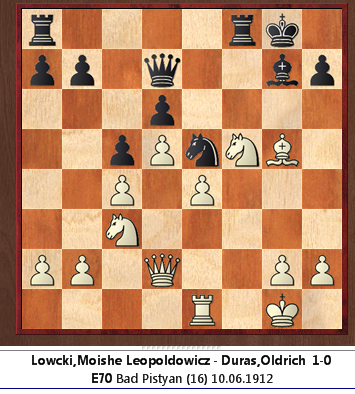
Solution
Oh dear. This problem isn't actually cooked, but neither is it prime steak either. I had the misfortune to spend a lot of time on it, taking it with me to think about on a Lake District walk.

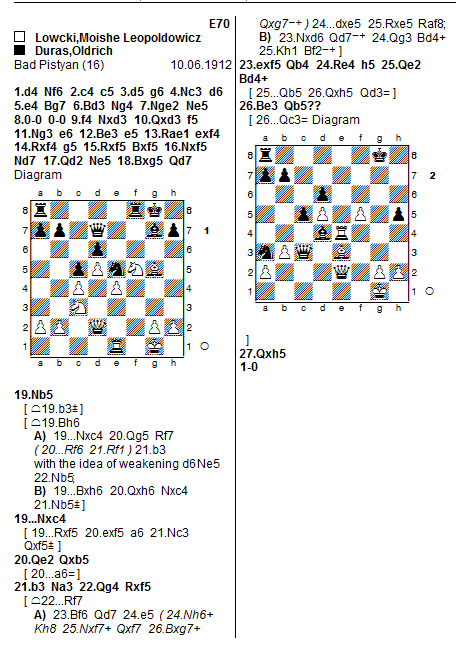
In a game, I would probably either play 1 b3, and hope to build up against black's slightly open king, or 1 Bh6, which is the move I plumped for in the end: thinking time was against white.
I didn't even consider the move played in the game, 1 Nb5: in fact, I didn't 'see' the weakness of the Pd6, perhaps because it is masked by the beautifully placed Ne5. Anyway, Houdini actually prefers 1 Bh6, but also likes both 1 b3 and 1 Nb5. In the game continuation, it shows black's error occurred right before the very end: otherwise the position is equal, with black having just sufficient counter play.
At least the walk was super.
Black to play and win
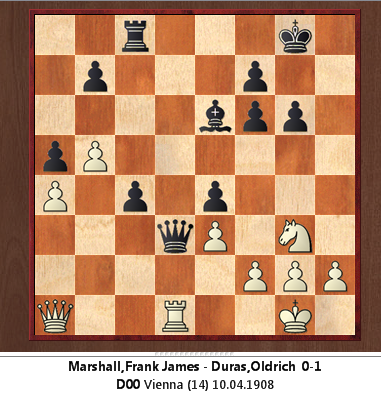
Solution
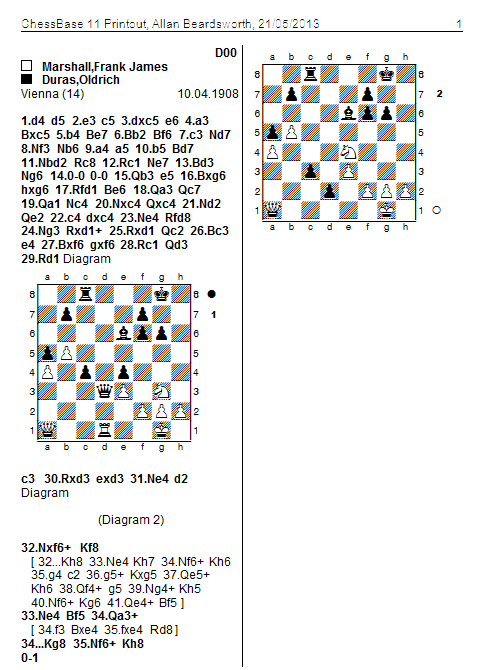
In some ways, not the hardest of problems. The first move of the solution, 1…c3, comes to mind more or less instantly. Then it is only two questions: can white stop the pawns?; does white have a perpetual (or, worse, a mate) with his queen and knight.
In my calculations, I could see that a pawn will queen: it was more judgement, than calculation to the end, that made me settle that the Q+N can't mate, and I felt I could wriggle out of any perpetual. In the attached, Houdini shows how to do so with precision- Kh8-gh7-h6 – but more or less any way is sufficient.
Tonight, Jane and I are looking forward to seeing The Machine, part of the Manchester International Festival.
My previous postings are here:
https://allanbeardsworth.com/2013/03/13/thrilling/
https://allanbeardsworth.com/2013/06/24/garry-v-the-machine-world-premiere/
I am looking forward to it for obvious reasons. Jane is too, because she can't lose. If it is awful, she will have another heap of poke-fun-at-Allan conversation, which will keep her going for another twenty years; if it is good, she has a choice. She can either be satisfied with a good night out or secretly like it, but tell everyone it was rubbish. So she wins either way.
Meanwhile, the Manchester Evening News says it is a must see. For the above reasons, Jane agrees.
White to play and win
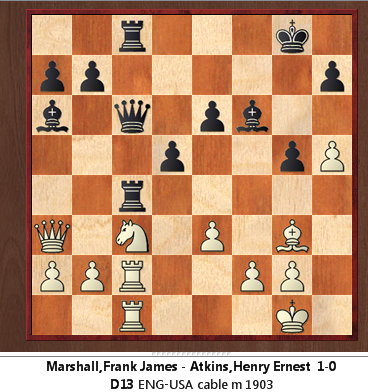
(Not the first time, the eagle eyed should note I have deleted 'and win', because this problem is cooked)
Solution
I wasn't able to attempt this puzzle properly during this daily exercise programme, since I had studied this position in some detail a few years ago when I bought Cordingley, and knew the position well.
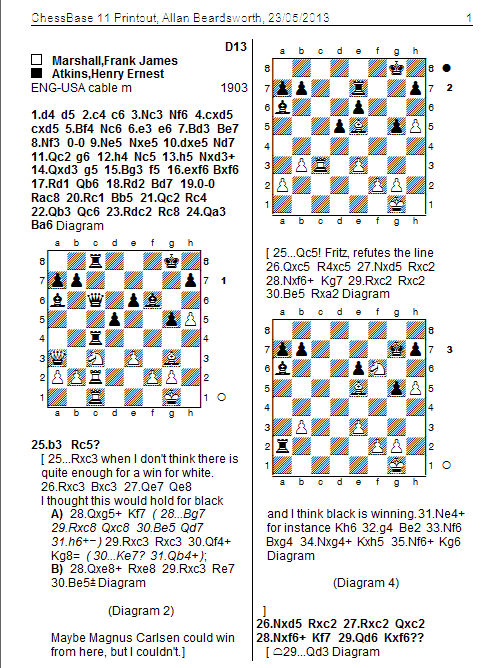
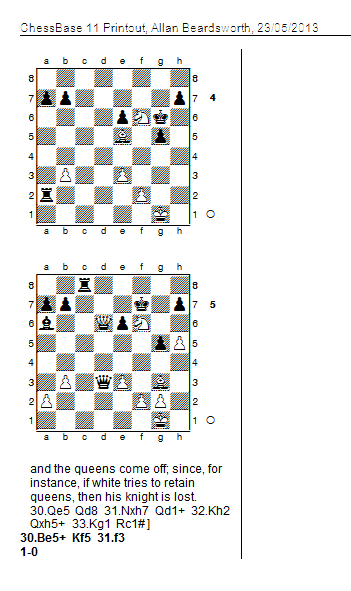
I recalled two things: firstly, that when I had tried to solve it, I had absolutely no ideas. Secondly, that when I looked at the solution, 1 b3, I found out that it was badly cooked. Cordingley's solution just gives the game score without any variations, but 1… Qc5! simply wins.
Now, armed with Houdini, a few further points. Firstly, it assesses the initial position as being somewhat in black's favour, suggesting 1 Qd6 as best, and this looks sensible, but any advantage there is must be for black. Secondly, 1…Qc5 isn't too hard to spot: the white Queen is LPDO after 1 b3, so 'considering all smites' as Purdy directs would find this move, the point of which is to keep white's queen out out of e7 or d6. Finally, even after the game continuation, it is only black's penultimate move, …Kf6, which loses: simply ..Qd3 is at least level, and again is not to hard to spot, since white is aiming to get his Queen to d7.
So, double cooked.
We had a departmental away day last Friday, and a colleague asked me in the bar afterwards whether I liked my job. The question was more about her, and she was seeking guidance about possible directions in which to pursue her career.
The joy of tax as a career is that it can take numerous directions. The subject is ever changing; was different thirty years ago when I started to what it is now; was different three years ago; and will be different again in three or thirty years time.
But some things stay the same, and I framed our subsequent discussion with the diagram below (alas, people who know me, know that I think in diagrams, think visually, think in chessboards and family trees….).
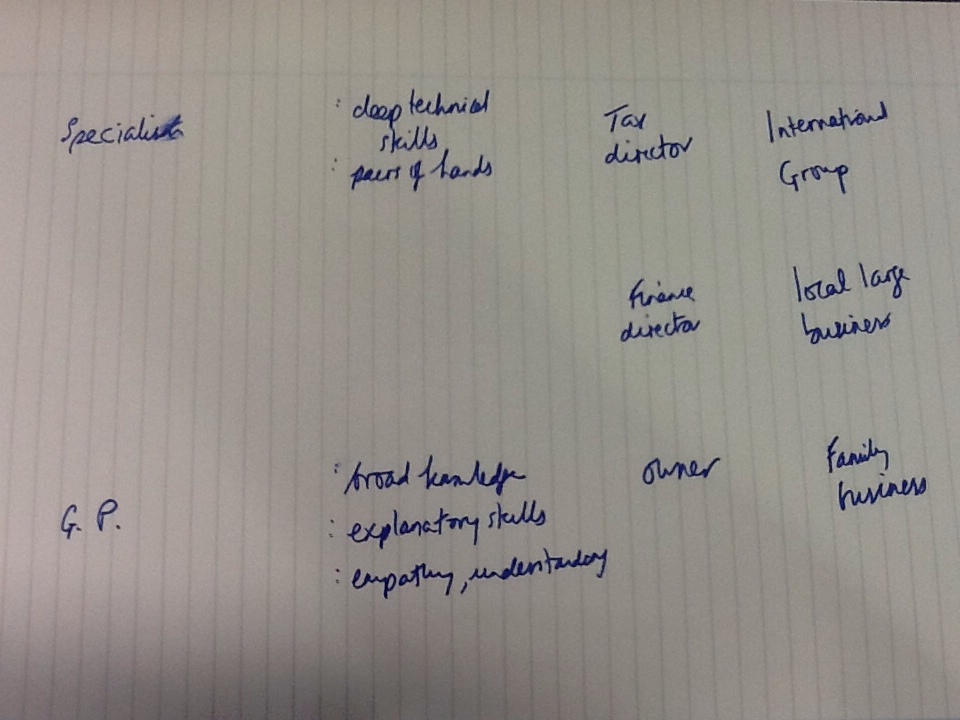
It's not a brilliant diagram (even if it were legible) and neither is it original: it stems from David Maister's 2*2 model of professionals- nurses, GPs, consultants, specialists- but I was basically giving the message 'what type of work do you like' 'what type of client do you like to work with'. The categorisation of client type is crude, but the skills needed, career challenges, interest and rewards are different when dealing with business owners or families from when providing services to fellow tax professionals. Neither is better, they are just different.
Some years back, whilst driving home on Upper Brook Street, I saw a billboard advert 'I —e my job', with a note below giving a phone number to call. Maybe it was the end of a long day and I was tired, because it took me a while to work out that it was a poster for a recruitment firm, and the missing letters were meant to be H-A-T; my instant reaction on seeing the advert had been L-O-V; being able to help owners and families address difficult matters has been a career long delight.
 allanbeardsworth