Black to play and win (possibly)
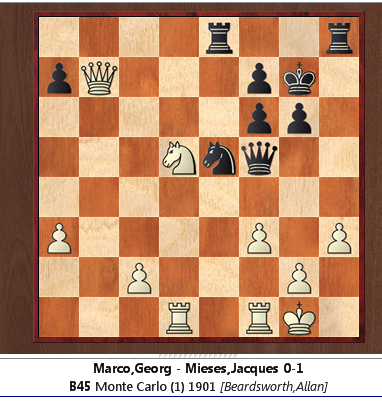
Solution
The first move, 1…Rh3, is obvious enough, though whether it works is not at all obvious. In my initial appraisal of the position, I noted that the Qb7 is LPDO and also that if the black queen gets to f3, as well it might, the Nd5 is pinned against the loose queen. These factors are very relevant for many lines.
So, firstly 1 Ne3 is met by 1…Qg5, and little more needs to be said. Hitting the queen with 2 f4 is met by 2…Qg3 and black is better.
Second, 2 g4 does nothing, so the next line to consider is 2 gh, where I quickly landed on 2…Nf3+, based on my initial assessment of the position's features, and this move turns out to be Houdini's strong favourite, even though the move played in the game, 2…Qg5+, also wins without question- though it needs some precise and I would say hard to find rook and queen moves in some lines. But 2….Nf3+ is straightforward, and the fact that after 3 Rf3 Qf3 the white Rd1 is LPDO is decisive: white can't regroup, and Re2 will follow.
All the above is very well- Cordingley only gives one or two lines after 2…Qg5+, but what about 2 Nc7! ? Smiting the Re8, defending f3, removing the qf3-Nd5-Qb7 pin are all good features. Houdini gives the position as 0.0 but I am not sure if this is a horizon effect mistake- my intuition is that it is not, and that 2 Nc7 might be a significant problem.
 Posted with Blogsy
Emailed received today. I suspect it is spam.
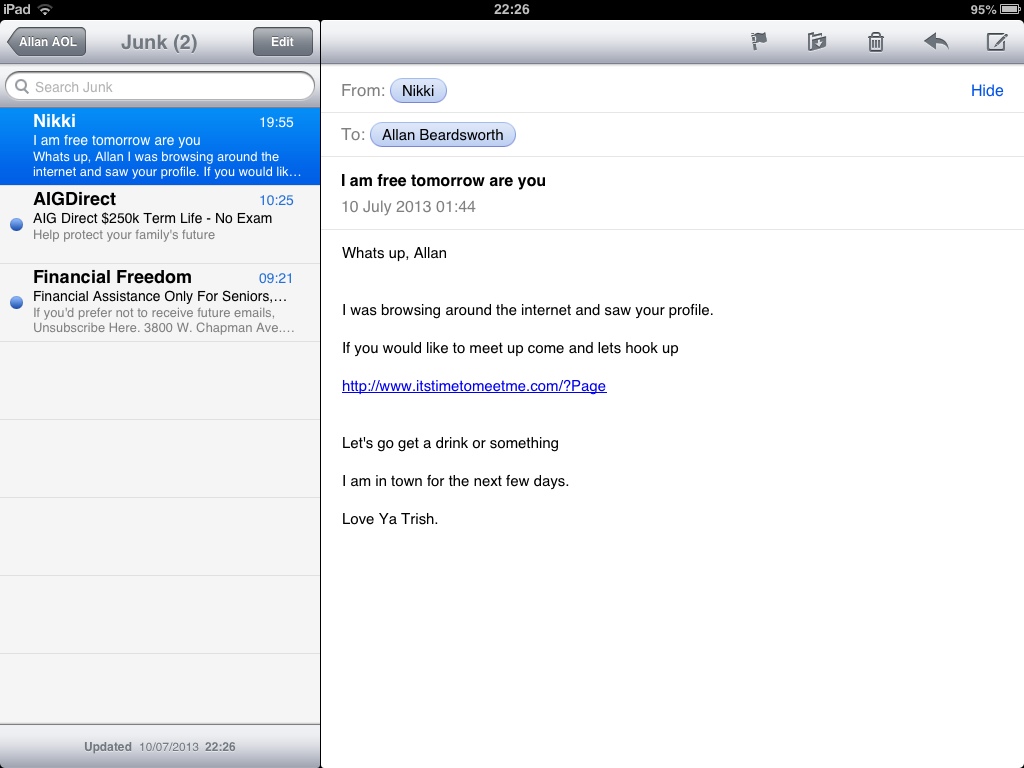
One reason for not contacting her, and there are other reasons (poor punctuation, for instance), is that I wouldn't know what to call her. Nikki or Trish?
I have never seen a sign like this before: seen in an inside toilet. An explanation is beyond me.


A lot of the work of a tax advisor involves correspondence with HMRC. Tax returns are filed, and HMRC rightfully make the enquiries they feel fit. And then the advisor replies.
Yesterday, two colleagues came to me for advice on some difficult correspondence. They only had part of the information needed to respond, and they weren't happy with their draft response, and wanted advice: it was good enough (in the sense accurate) to send, but was it good enough?
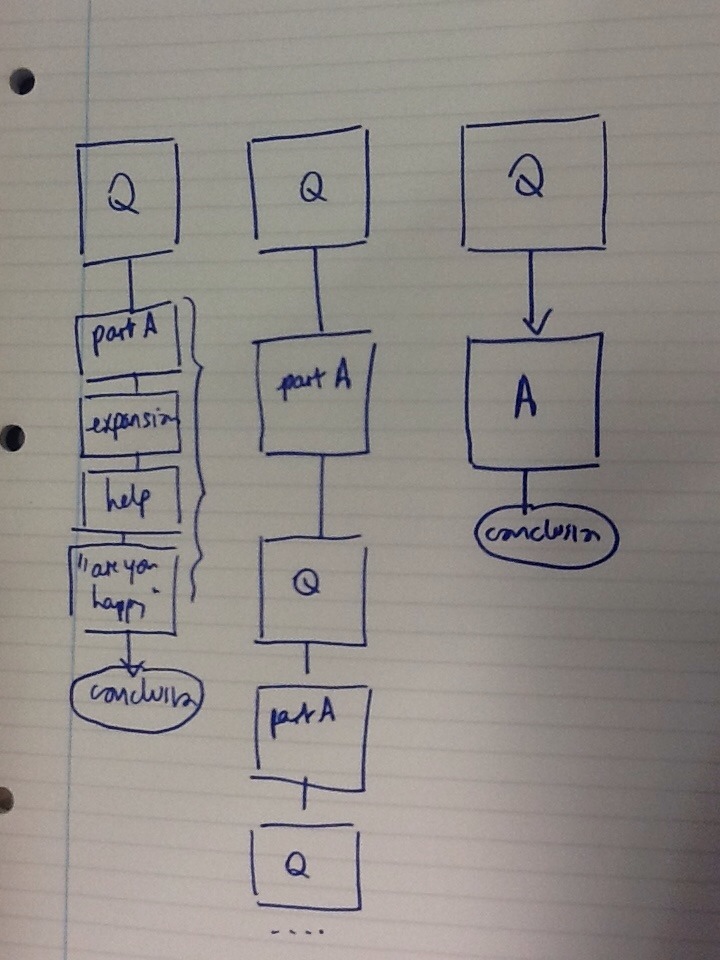
Once I had sufficient familiarity with the subject matter, I asked The Ultimate Question: 'if you were the intended recipient, the Inspector (who has made legitimate enquiries), would you be sufficiently happy with our response that you would close the case?' If not, then there may not be much merit in sending the proposed response: maybe it is out of necessity, but often there is a better way.
Similar questions to ask are 'if you were the Inspector, what would make you satisfied that the taxpayer's treatment was acceptable'; 'or, what would you wish to know to be satisfied'.
In the current instance, my advice was to work with the client and document in full the background to the matter, and set out, being frank about what is not known, the merits and reasons for the claim. This was fact specific, because from the facts which were known, the treatment seemed justified, but the gaps in information made the enquiry legitimate. Putting yourself in the recipient's shoes can be a very valuable technique to employ; the aim of replying is not to have a further round, but to narrow or close matters down.
First things first. Say what you want the recipient to do (approve something, give you information, or just read). Then give the detail.
The advantage of being fifty is that you can tell people what you mean without any fear. I have noted with increasing frequency the number of colleagues who write accurately but in an unstructured, or poorly structured way. Often slightly tweaking can have massive benefits.
Earlier this week I recommended some slight changes to one such draft, suggesting that the bottom be moved to the top, and then the email would go from grade E to A. That evening, this advice was on the following tweet from Tim Harford.
So how do we make our electronic missives so massively simple? Chances are that the point of action that you're trying to share feels a little murky when you first click on “compose,” so as inspired by Pixar's story-creating method, we previously devised a free-writing technique to get your message out of your head and sent to your recipient (and they can get back to you):
- Start by writing what you think you are trying to say
- Discover that the first few lines are wholehearted hogwash
- Rejoice in your determination to write something well
- Keep your hands on the keyboard, look for the conclusion when it appears
- THEN move that conclusion to the top of the message
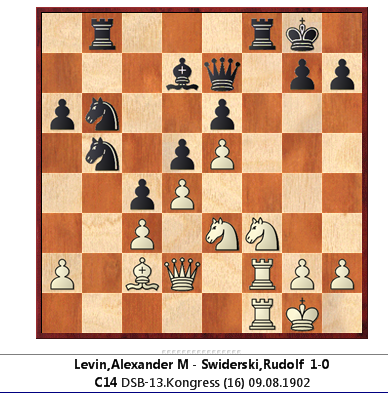
Black to play and win
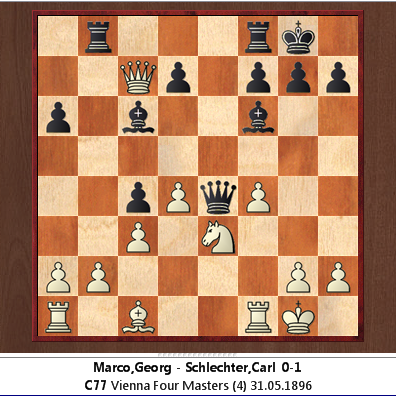
Solution
White's queen is off-side, and LPDO; black's queen and bishop battery pressurise g2, but the Ne3 is a good defender. The white queen is a bit limited in space ( in a potential net using Purdy's language) but instinct says that trapping the queen is unlikely to be the solution. So, instead, try to remove the Ne3: 1…Bd4 does nothing, so instead 1…Rb2! and once seen, it is clear this is the solution. All that needs to be seen are that if the bishop captures the rook, it is in LPDO position, so that Qe2 or Qd2 will double attack it and g2. Calculation of a few further lines, such as Bh4 hitting Rf2, with g3 opening the a8-h1 diagonal, is sufficient work.
Not too hard, but nice enough.
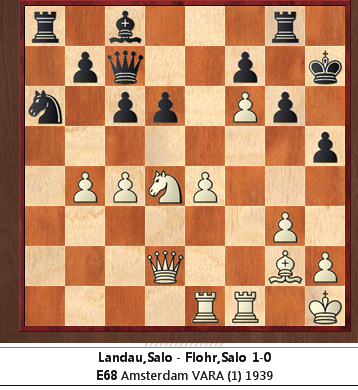
White to play and win
Solution
Oh dear: 100 being an important number, I wanted to do well on this one, and I flunked it badly. I got the first move immediately- and, after a lot of subsequent thinking, it remained my only idea- but I completely messed up including black's immediate response to it.
The initial move is 1 Ng5; no surprise there, it is a natural thrust. I spent all my time on 1…Qg5 after which I played 2 Bh7+ Kh7 3 Rf8 Rf8 4 Rf8, and tried to assess the position. Annoyingly, I didn't spot that I that position, the Qg5 is LPDO, so that there is a Nc4 tactic- not that it is too great, but it might have helped me as we shall see below. I think my assessment of the resultant position (after 4 Rf8) was about right: more or less equal, maybe advantage for white, but really any result can happen. So, in practice, having no other ideas, I think I would have plumped for 1 Ng5.
If this were a school exam question, I would deserve 2/10 for finding 1 Ng5; but missed the other three marks because 1…Qg5 loses to 2 Nd5!- it hardly deserves an exclamation mark, but is given one solely because I missed it: the Q is a LPDO on g5. Black's best is 2…Qh4 but he is clearly lost. Maybe I only deserve 1 mark for 1 Ng5.
In the game, black played the better defence, 1…Rf2 I hardly considered, since my principal task was to defeat the capture of the knight. Playing through the position after 1…Rf2 with Houdini is a revelation…seeing how much power there is in white's pieces, though probably this shouldn't be too much of a surprise because all white's pieces are lined up against the king, with the furthest away of them, the Ne3, quickly brought into the party with Ng4; and 1…h6 is similar.
The attached analysis file shows some precise, instructive attacking lines.
White to play and win
When you think you have found the solution, consider playing this as white against an engine: yes, white is winning in all lines, but black can put up resistance.
Solution
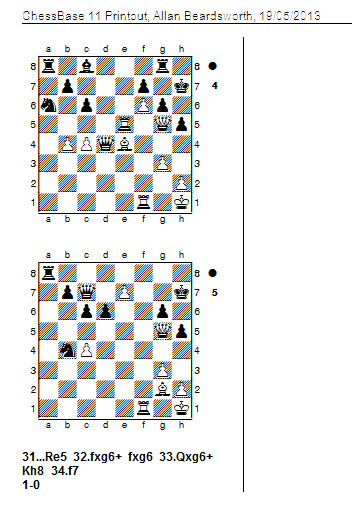
This is one of those puzzles where the solution was obvious to me: 1 Qg5, preventing any possibility of freeing by g5, followed by Nf5: and black's attempted defence was obvious too: Nb4, to try to get the N into the game: and so in the game.
Houdini shows there is more to it: 1…Bg4! with the point of defending h5, so that if 2 Nf5?? then gf. Houdini's solution to 1…Bg4! was a surprise to me- one of those moves which to me, only become obvious once you have been shown them- 2 e5!, the idea of which is, I think, simply to bring more pieces to the party.
I haven't fully explored 1…Bg4! yet: but intend to do so, but first just with pieces and board, rather than using an engine: I think there is understanding to be gained from researching this position first myself: after I have done so, I will post again.
The other nice problem was the following one:

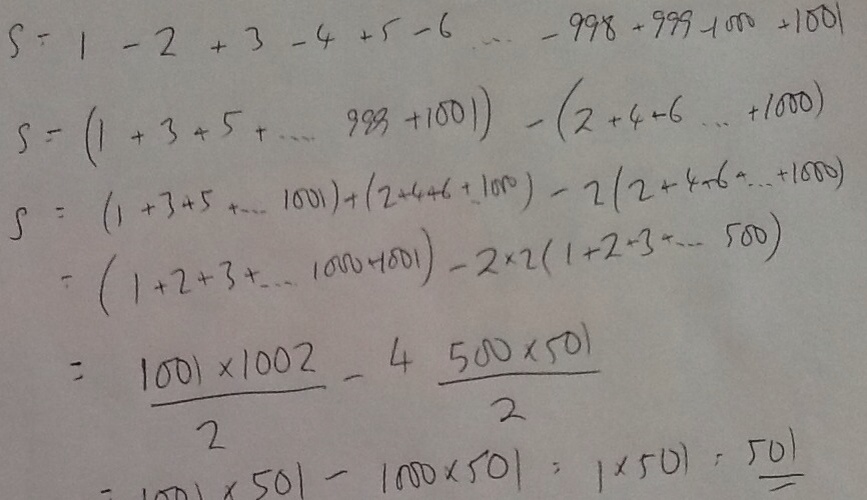
My first solution relied on knowing that the sum of the numbers 1 to n is n(n+1)/2; which I think is attribvuted to Gauss; then a bit of manipulation is needed to turn the above complex series into the difference between two sequences, and then apply Gauss's formula.
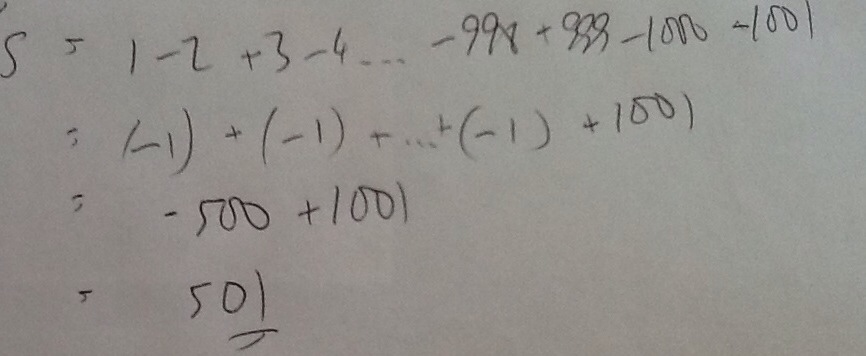
There is though a simpler way, instead spotting the alternative re-presentation that each of the pairs add up to -1: I.e. 1-2=-1; 3-4=-1; etc. Then, getting to the answer is simpler.
On Thursday, Alice and I were in Cambridge, at the University Open day. Towards the end of the day there was a students-only session, so I waited in the nearby buttery.
Daughter #2, the self-same daughter who had recently said the previously unuttered words 'that's cool' to a maths problem, had kindly given me a copy of her end of year maths quiz, and I took it with me on this visit. Many of them were fairly uninteresting, but two were nice. This blog is about the first of these.
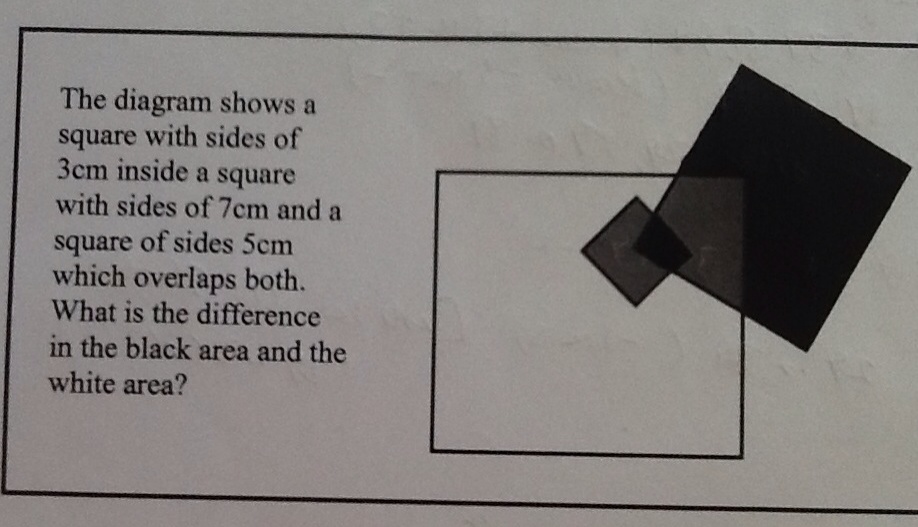
Putting to one side that the diagram is hopelessly out of scale, my first method of solving, after intuition failed (I tried first to find an 'obvious solution) was some algebra.
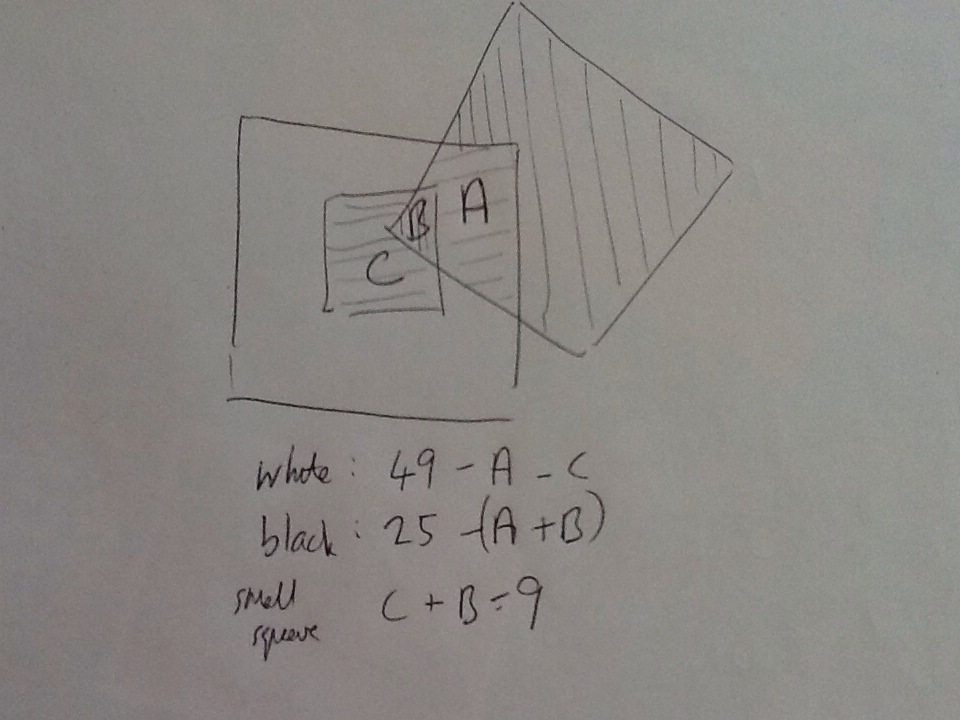
Subtracting white from black (since the difference in these areas is sought), is 24-(B+C), which solves to 15.
I then looked for a neater solution.
In the extreme, the 5*5 square can be moved around, covering less or more of the 7*7 square. Imagine if it were moved so that it overlapped the larger square: with no outside black: and put the 3*3 square neatly in the opposite corner:
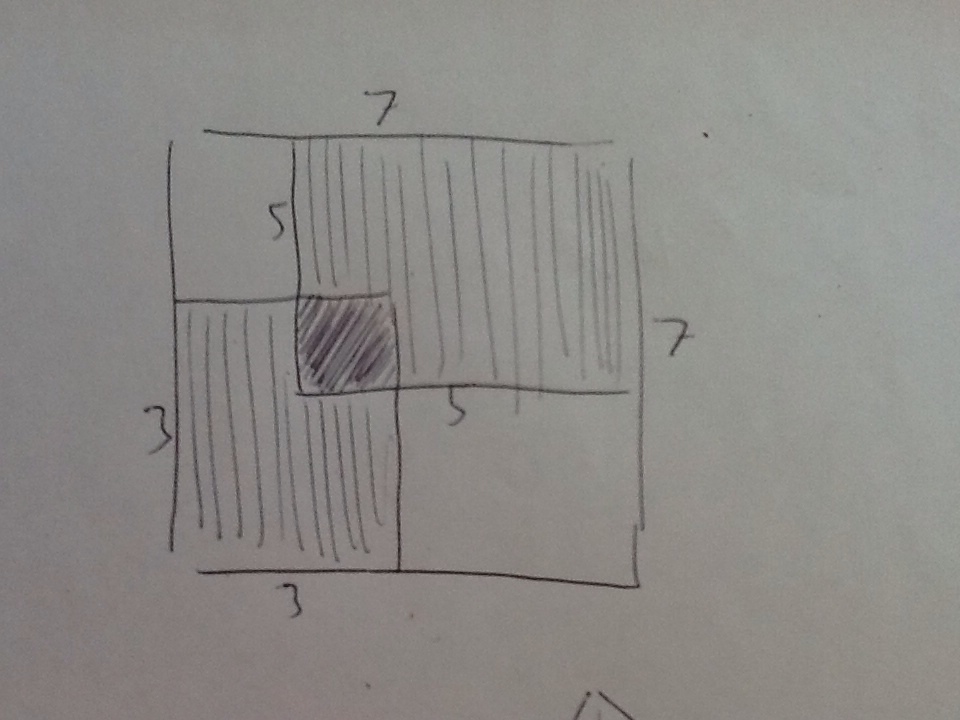
Then the difference between the white and black areas can seen simply to be 16-1, or 15: pretty.
 allanbeardsworth