White to play and win
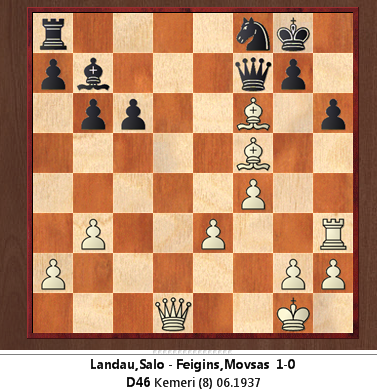
Solution
A calculation exercise: not easy, not hard. The first move is obvious, and then it is a question of defeating each of black's defences, with the move played in the game the one which provides most resistance: but it is fairly straightforward calculating if not to the end, then as far as necessary: i.e. to a position where white clearly has plenty and probably overwhelming advantage.
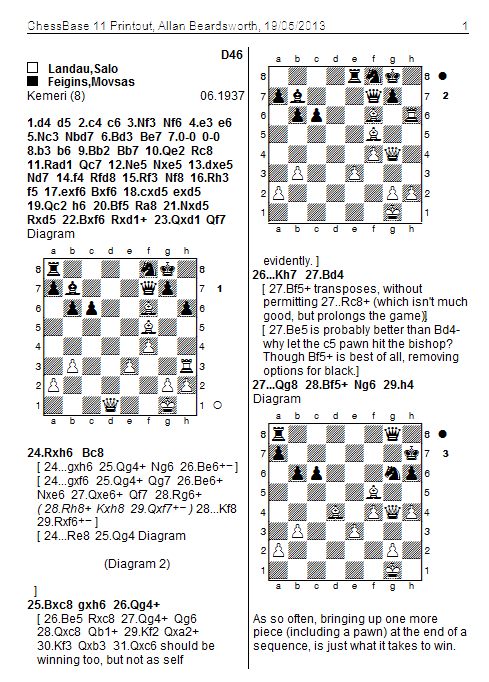
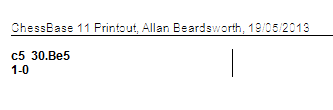
 Posted with Blogsy
Who was Florence Nightingale? I suspect this would be a £100 Who wants to be a millionaire question; and maybe for £2,000, what was she famous for? She was (b 1820 d 1910) a nurse made famous for serving in the Crimean War (1853-1856), best known as 'the Lady of the Lamp' after her habit of making rounds at night.
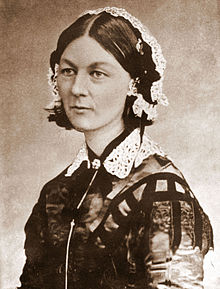
Less well known, though, was that she became, in 1859, the first female member of the Royal Statistics Society, being a pioneer in the presentation of information by pie charts and other means. Her most famous presentation was the Coxcomb diagram of causes of death in the Crimean war.
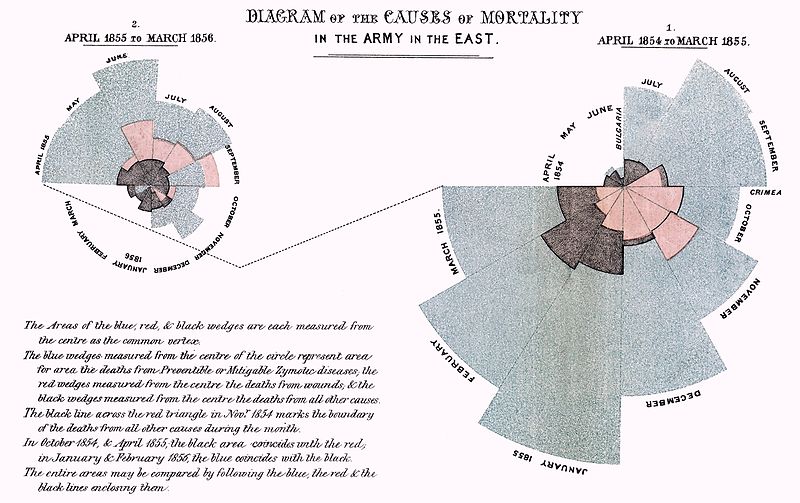
The words in the diagram below are rather too small to read, but the large blue-grey areas are the deaths from preventible or mitigable Zymotic diseases. (Zymotic being a term used in medicine from 1839 when there was less knowledge of infections etc).
Tim Harford, one of my favourite Tweeters, wrote an article at FT.com on misinformation. He ends it with:
Those beautiful Coxcomb diagrams are no exception. They show the causes of mortality in the Crimean war, and make a powerful case that better hygiene saved lives. But Hugh Small, a biographer of Nightingale, argues that she chose the Coxcomb diagram in order to make exactly this case. A simple bar chart would have been clearer: too clear for Nightingale’s purposes, because it suggested that winter was as much of a killer as poor hygiene was. Nightingale’s presentation of data was masterful. It was also designed not to inform but to persuade. When we look at modern data visualisations, we should remember that.
Quite right: the Coxcomb diagrams over-emphasise to our eyes what Florence wanted people to see. Perhaps she was the world's first spin-doctor?
White to play and win
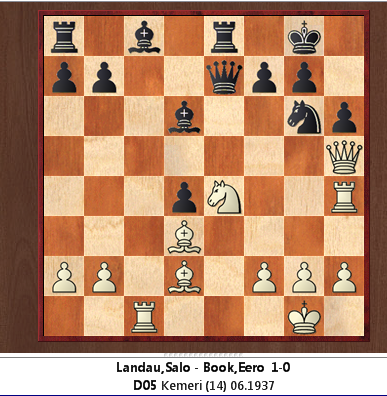
A worthwhile calculation exercise, but not, I think a clear win
Solution
I spent a lot of time on this one, because my initial impression was 'white can't be winning' 'white's position is about to fall apart' 'therefore must be something special'.
I tried all the captures, such as 1 Qg6, 1 Qh6, 1 Rc8, 1 Nd6, none of which are any good; noticed that black's only LPDO was his Ra8 which is safe provided black doesn't play ….b6; saw that white's Rh4 was in jeopardy and that, maybe, white would have his own back rank to protect; checked the only check, 1 Nf6, and then landed on the only other smite, 1 Bg5. This had to be the solution, and was the game continuation.
The bishop can't be taken by the h6 pawn, because 2 Qh7+ mates next move- effectively the h6 pawn is pinned because of the jump-check/ jump-mate, in Purdy language. So the queen has to move (since 1…f6 is ridiculous, though I didn't glance at it).
The most natural move is 1…Qe5, centralising the queen, and pinning the Bg5: not the strongest of pins, but maybe exchanging queens could provide relief. Then, having tried 2 Nf6+, 2 Qg6 etc etc, I realised the only move to continue the attack was 2 f4, to which the natural response is 2…Qd5, though I also considered 2…Qa5. After 2….Qd5, I saw there were tactics based on 3 Nf6+ and 4 Bg6, and decided that they had to be the line, in a sense because, using a poker term, white was 'all in' on the attack, and just had to throw everything in, hope to succeed, else he would fail.
The amount of calculation required was too great for me, at least without setting out the board and pieces. Black has other.defences, such as 1… Qe6, 1…Qf8, 2…Qe6 (this one is poor: 3 f5) but in practice I knew I would have to play 1 Bg5, see what black did, make a move, see what black did etc etc.
Houdini time.
Instantly it flashed up 1 Nd6 with a 0.0 assessment; and gave 1 Bg5 a -1.7 one; and, for around another ten initial moves for white, similar or worse negative scores. Interesting. So, I decided to give Houdini time to think, and, as is my wont, gave it one British Unit of Time (i.e. I made a cuppa), came back, and its assessments were still looking bad and volatile. So another BUT (i.e. made some toast) came back, and started to examine.
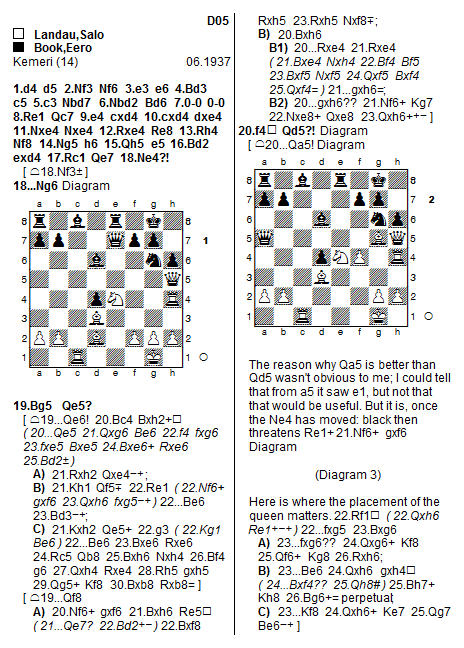
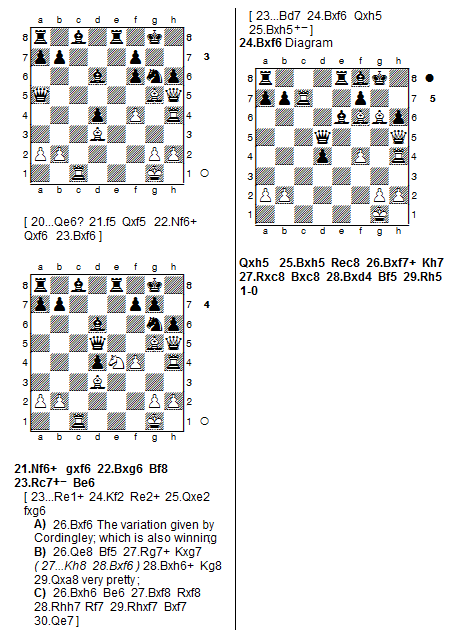
There is something of a horizon effect here: the lines are long and further into them the assessment can change. It turns out that 2…Qd5 is far worse than 2…Qa5!, for the non obvious reason that from a5 there it supports a check by the rook on e1.
My attached analysis goes some way into the depths of this position, but it is an Aagaardian one: capable of further analysis, more an exercise than a puzzle. My impression is that black is near winning, but is on a tight-rope, and the natural desire to keep the Q centralised with 2..Qd5 is a fall off from that tightrope.
Houdini shows that 1…Qe6 is a strong move, especially with the follow up 2..Bh2+!: both unnatural moves. One advantage of Qe6 over Qe5 is that f4 doesn't smite the queen: so a tempo saved: it also adds some control to g6.
In short, an interesting exercise, one which could repay further study: in some ways cooked as a puzzle.
Alice, my elder daughter, finished her schooling today. Last weekend, it finished on a high, with Alice before one of the four girl Withington team which won the Institute of Ideas National Debating Tournament.
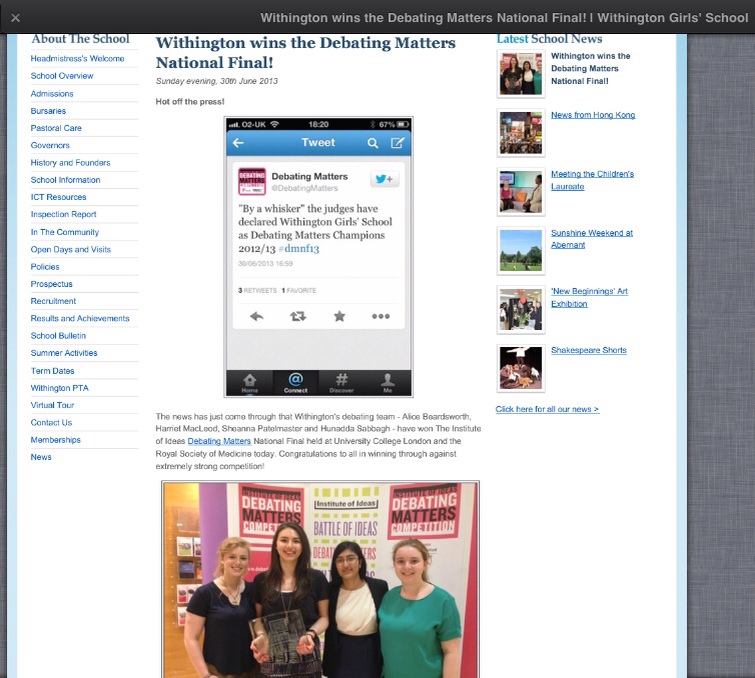
It is wonderful to see it when your children can do things that you could never have done. Hearing the news was a very special proud father moment.
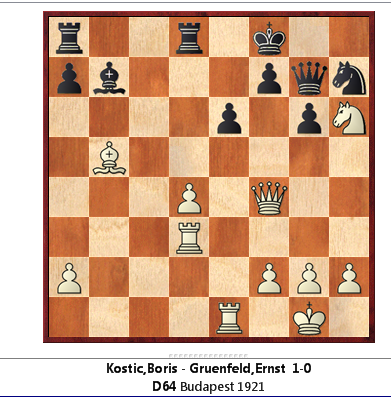
White to play and win
Solution
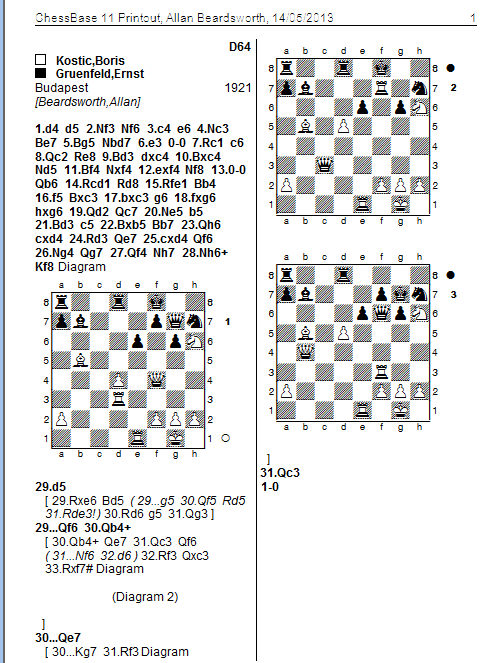
8 out of 10 for me, if this were a school test. I got the move played, 1 d5! instantly, by an immediate comparison with Cordingley puzzle 30 which I had spent a lot of time on, being awed by the computer's choice of 1 c5!, a line opening move of which the point is very deep- but is similar- to give a white queen on the fourth rank the ability to sweep over to the queenside. I am pleased that I remembered this motif.
Less pleasing, and hence my docking of two marks, is that I didn't even look at 1 Re6, which is also good enough to win, if prosaically. I think I was just pleased to have found a pretty solution, but I should have mirrored game conditions and followed the maxim of, once you have found a good move, look for an even better one.
Also, CJS Purdy would not be proud of me: examine all smites would have found Re6, as would look for ties (his word, encompassing pins such as the f7 pawn being pinned by the Queen, and also other things like requirements to defend back ranks, etc), and examine all jump checks would have found 1 Qb4.
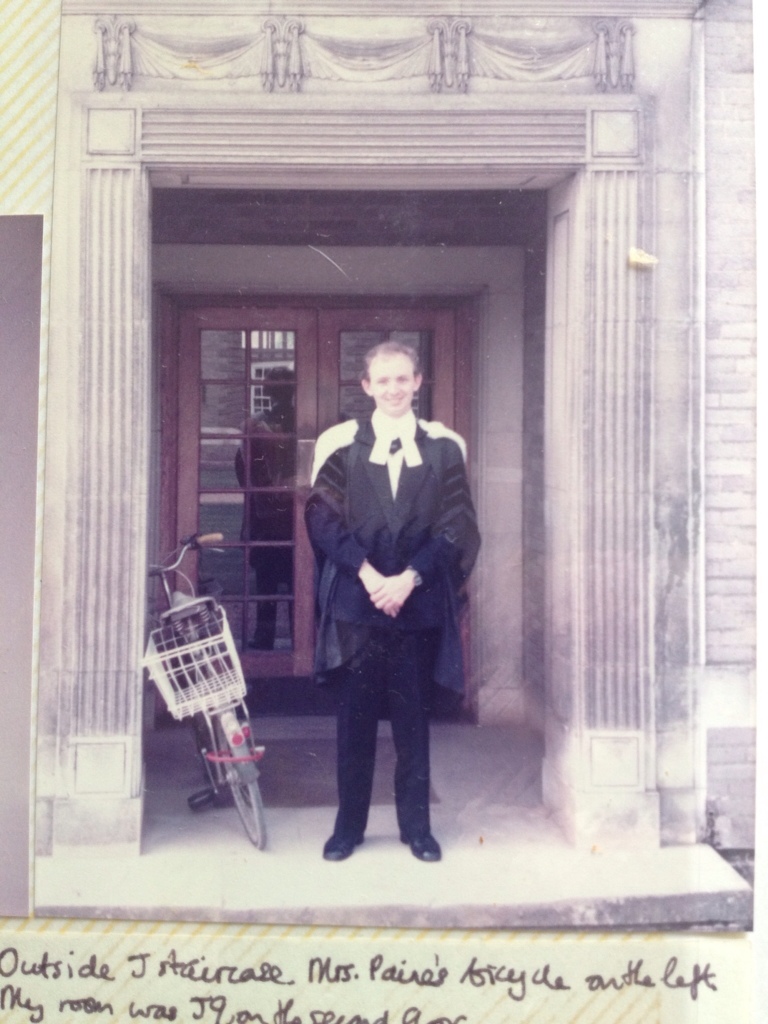
I am back home now, after a trip down memory lane. I left Cambridge almost thirty years ago, returned once or twice in the years after, but my last visit was nineteen years ago, to give away at marriage by closest friend, Ania, from university. Since then, there has never been a good enough reason to return.
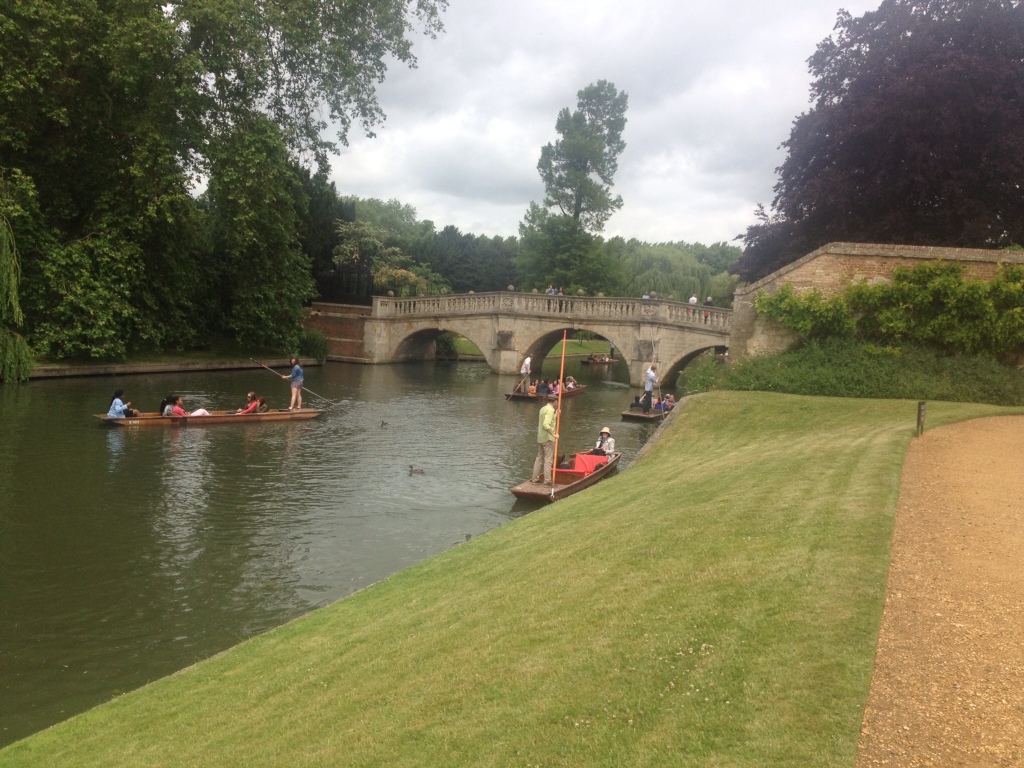
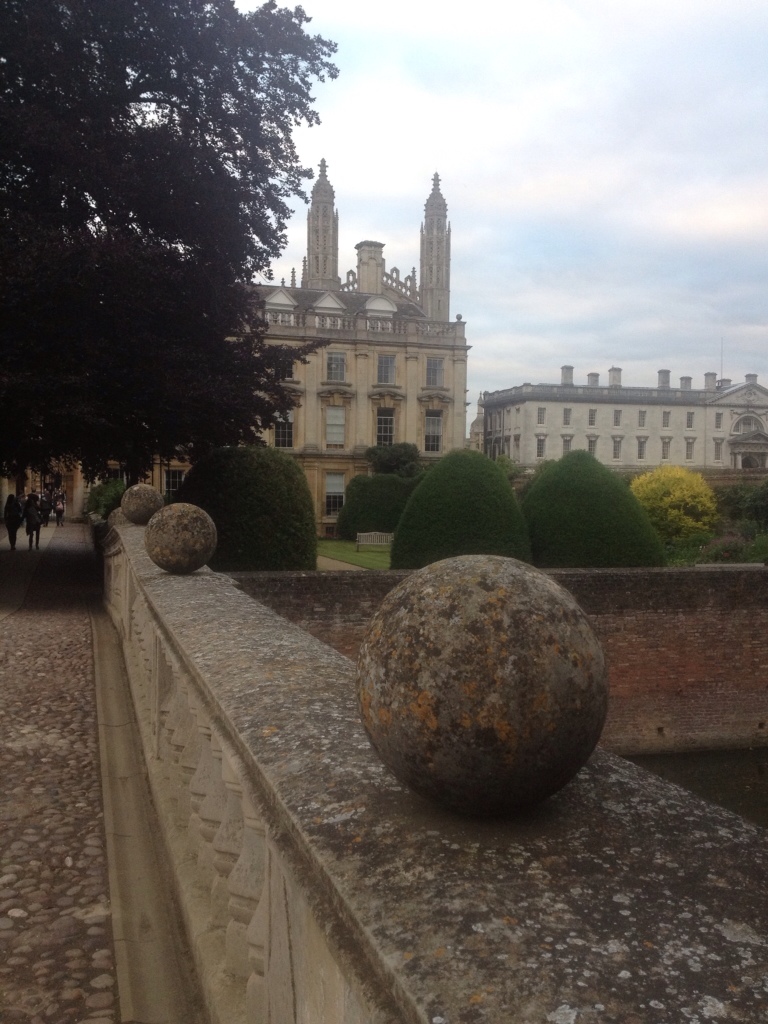
Alice and I had a lovely time visiting many of the colleges; Cambridge was at its best in glorious sunshine.
It was lovely to see old haunts; to see what has changed (a lot); and what has stayed the same (most things); and also to appreciate it as a visitor rather than resident.
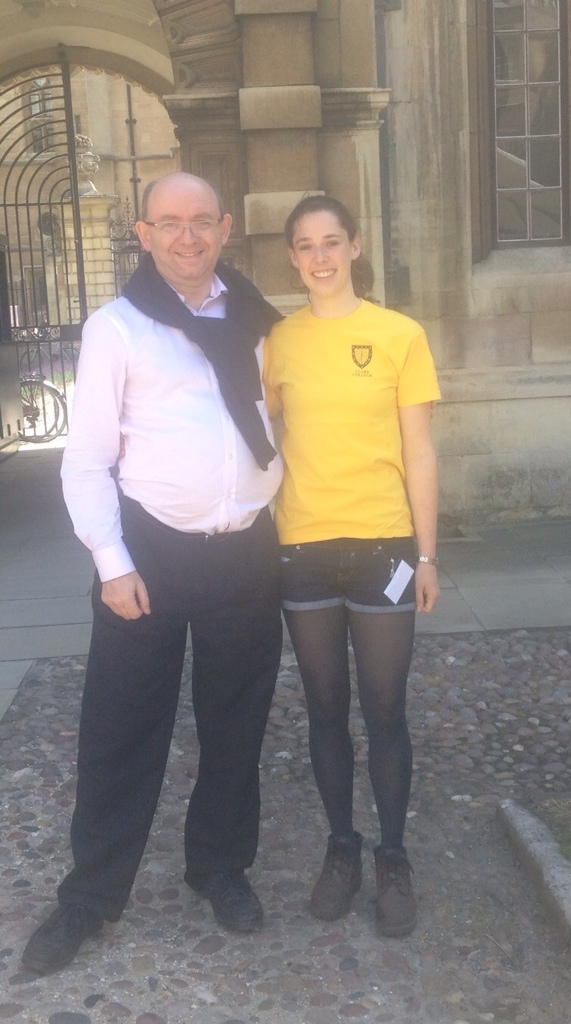
The best moment, though, by far, was visiting Clare and meeting Molly, the daughter of one our closest friends, who has just finished her first year studying medicine. We only had time for a quick chat, quick peak into one of the rooms, and a photo, but the abiding memory that I take away was that Molly radiated happiness at being at Clare.
Yesterday, Alice and I came down to Cambridge (or, as I used to say, up to Cambridge, because the 'in' thing to say is that Cambridge is up from everywhere), for the first time since August 1995, when Jane, Tom and I (and, as a zygote, Alice, born the following June) came for a wedding.
We had a brief walk round before dinner, our purpose for being here is tomorrow's Open Day. I am feeling quite joyful to be back, trying to remember the names of all the colleges (I know most, but some have taken a moment's reflection, looking to see what has changed, and what hasn't; I did feel a bit tearful when I saw the phone box outside Memorial Court, Clare College, from where I used to ring my mum.
We are hoping for a good day tomorrow.
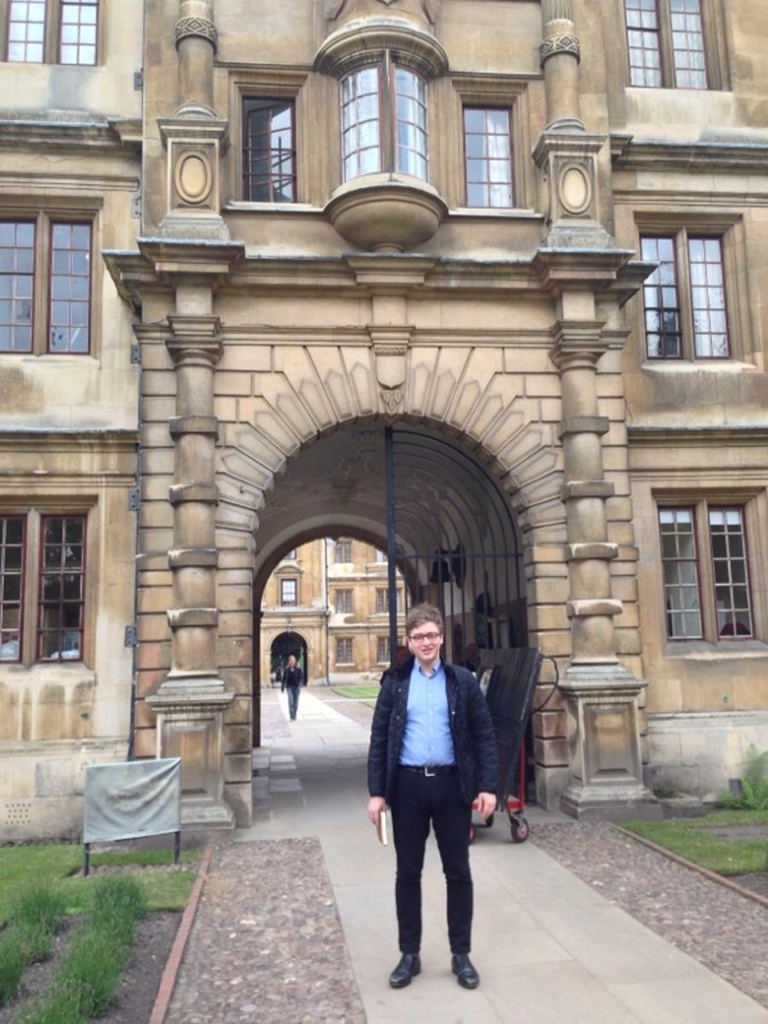
Tom had his first (actually, second) visit to Cambridge a few weeks ago and sent me this photo of him from Old Court, Clare, on my birthday. A nice touch from Tom, for me.
Compare and contrast:
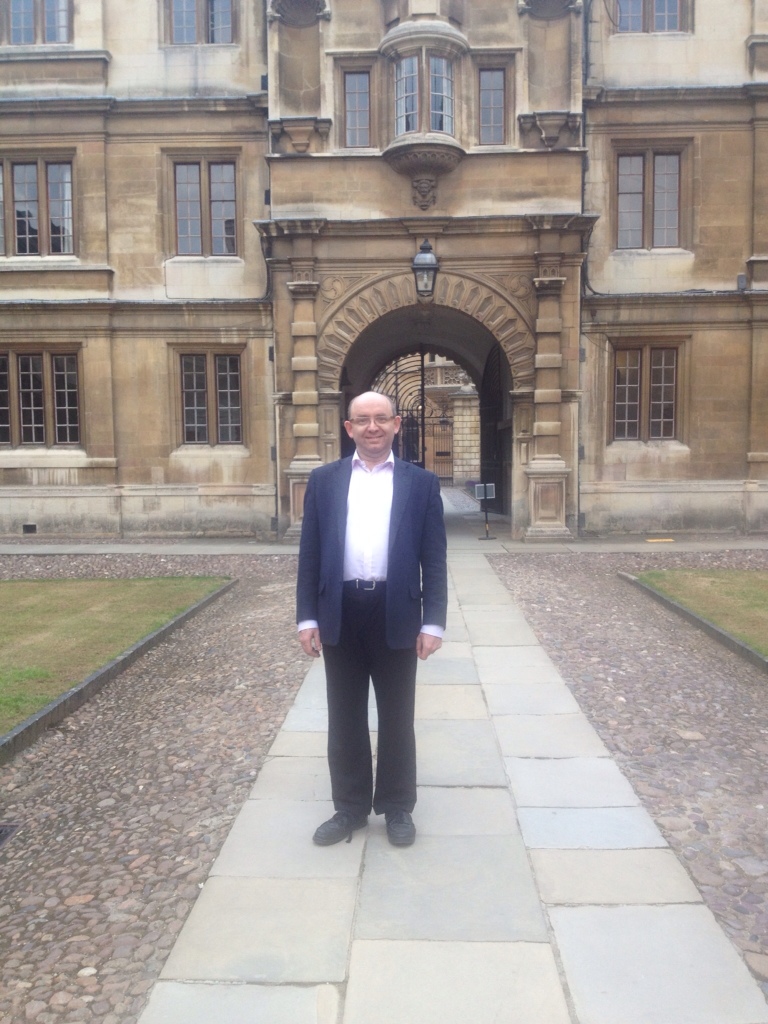
Past, present and future.
White to play and win
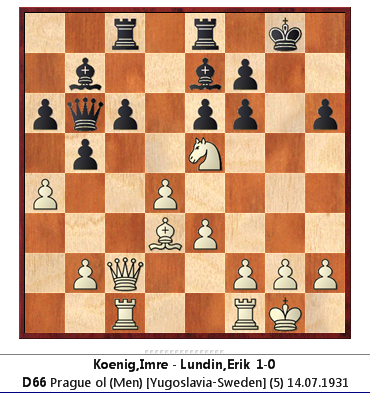
(The eagle eyed will note that I have dropped the 'and win': the problem is cooked, courtesy of Houdini)
Solution
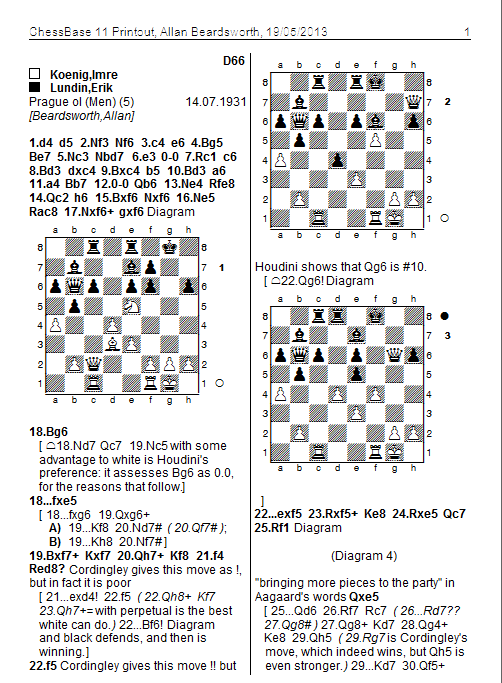
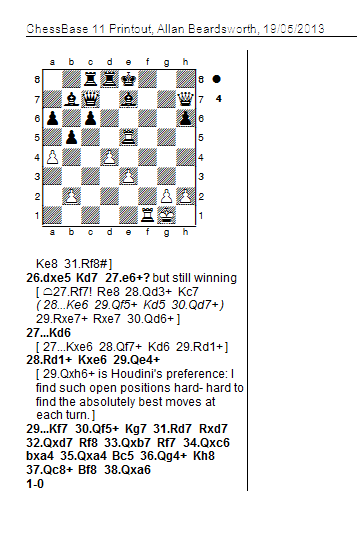
I enjoyed this one, both in working through and coming up with a solution, and then in understanding the position better with Houdini. The engine shows that black has just enough resources to stave off white's attack, so after the move played in the game, the result after best play is a perpetual.
The first move I thought of was 1 Nf7+; but found it insufficient after (after black captures) both Bg6 and Bh7. Then, I looked at trying to improve the move order by 1 Bh7+ but found it also just not good enough (after 1…Kg7 2 Nf7 f5! the best seems to be Qe2-h5, probably with a draw). In thinking these moves through, I hit on the move played in the game, Cordingley's solution, 1 Bg6. This is probably the move I would play in a game, in the hope that at least something would come up, by advancing the f pawn as fast as possible to get the rook(s) into the game. And this is basically what happened in the game.
The analysis below though shows Black could have defended- and, once he has repelled the attack, he is winning; so white should bail out for a draw by perpetual check.
Very nice.
Houdini appraises 1 Bg6 as 0.0, because with best play it is a perpetual. It prefers Nd7-c5 with some advantage to white.
White to play and win
Solution
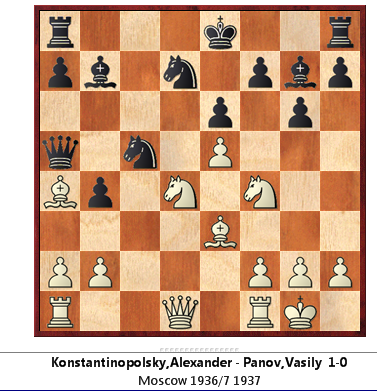
The initial move, 1 Nce6, came to me without thinking: rationalising it, the double attack on d7, and the need to act now, make it an obvious candidate. Firstly, if black captures the N, then 2 Bc5 as a minimum regains the piece, with the Nd7 now being undefended. So 1…Qa4, and now the Nc5 is overloaded. 2 Ng7+ Kf8 3 Bc5+ Nc5 4 Nge6+ and since the Nc5 is tied to the Qa4, the Ne6 can't be taken, and captures the Nc5 on the next move: game over.
Checking with Houdini, on this occasion there is nothing to add. 1 Nde6 is the only winning move, and there are only trivial diversions from the line played in the game.
White to play and win
Solution
Not the hardest of puzzles, though (i) I took some time to solve it; and (ii) see below for what Houdini found.
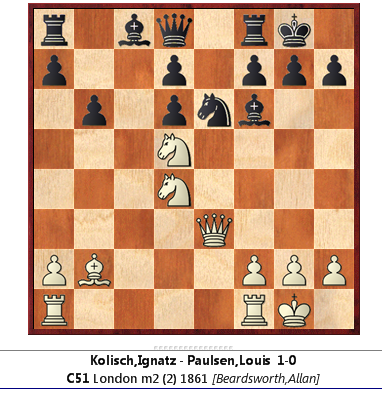
The first thing I noticed was of course the pressure on the a1-h8 diagonal, with the Bb2 and Nd5 focussing on it, and the queen well placed to join in the attack. I also noticed that the Ra8 was LPDO, and for a while this caused a mis-direction in my thinking: trying to get a double attack by Qf3 on a8 and f6: to no avail.
So, back to f6, and since Ne6 is clearly bad-fe- the desperado 1 Nc6! is the move; then 1…dc 2 Nf6+ gf (2..Kh8 then 3 Qh3 or probably better 3 Qd3) and all I had to do was find the right way to attack f6, and once I saw 3 Qh6! the game is over. Or so I thought, and so Cordingley thought.
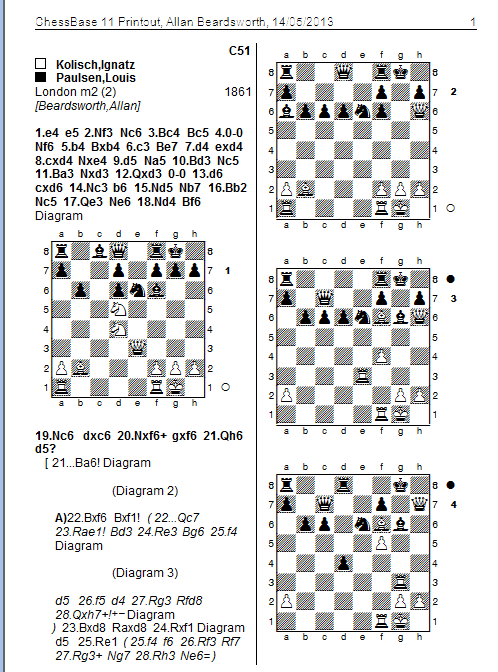
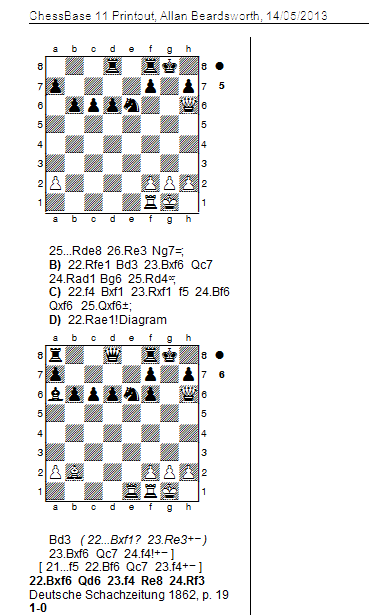
Houdini switched on, purrs away, and shows (after 3 Qh6) 3…Ba6 as best, – 3.8 and 3…d5 as +1.6. At first I thought ‘oh, Ba6 is the best defence’, almost moved on, and then saw that 3…Ba6 was minus 3.6: black wins. So I looked at if further, and indeed 3…Ba6 is the best defence, but Houdini’s evaluation changes deeper into the analysis with a few plausible moves: I think both 4 Rae1 and 4 f4 are sufficient for white to win, though 4 Rfe1 isn’t, or probably isn’t.
The attached analysis of 3…Ba6 isn’t exhaustive: to quote from Jon Ludwig Hammer, who yesterday beat Wang Hao in the Norway tournament, who in the post mortem news conference said ‘I was confident that my position was winning, but not that I would win it’. Quite so: if I were playing white, and black played 3…Ba6, there would be a fair chance I would make a mess of it.
 allanbeardsworth