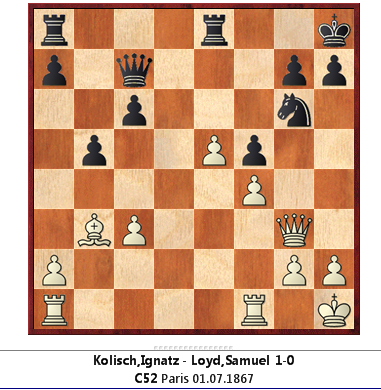
White to play and win
Solution
I think this is one of those positions which is far easier knowing it is a problem. You immediately think of 1 Qg6+ and see that if 1…hg the rook lift mates: so white wins a piece, and the win is trivial.
 Posted with Blogsy
This final posting (final of three articles in Chess magazine) is of my game on 9th December 2010 against Victor, the game of which I am proudest, even though it was in a simul.
The pleasure of victory, or rather the move or two before when I knew victory was mine, was one of the most intense moments of happiness in my life: total overwhelming pleasure, after five or more tense hours of fighting.
Korchnoi game article Feb 2011
Now that I am blogging, attached is an article which took me great pleasure to research and write; and after which I had a lovely message from the widow of the player I wrote about, Vic Knox.
Vic Knox tribute article Aug 2011
Very nice to see that Chess magazine have published my article about my Cordingley project.
Cordingley article July 2013 Chess magazine
Very nice to see that Chess magazine have published my article about my Cordingley project.
Cordingley article July 2013 Chess magazine
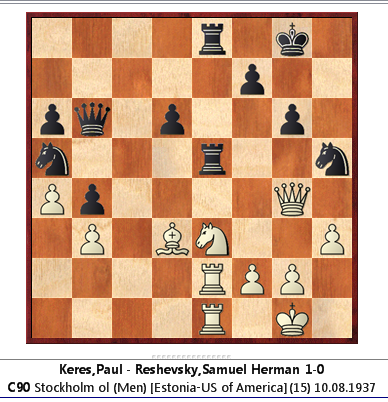
White to play and win
Solution
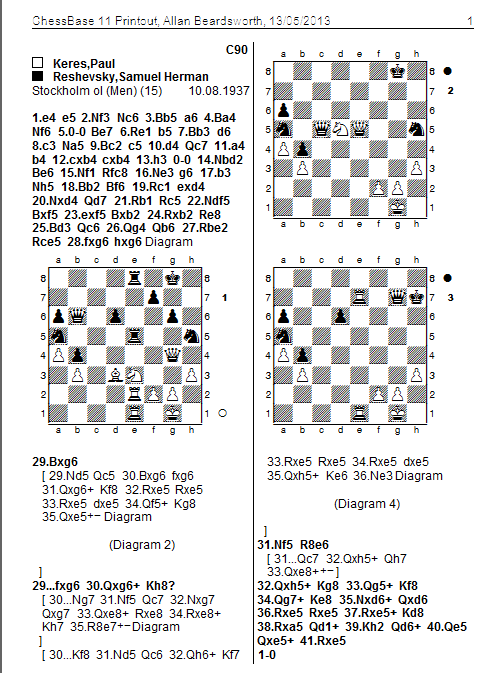
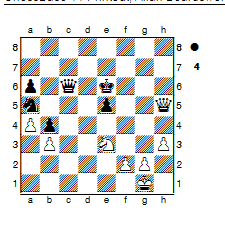
The first move that came to mind was 1 Bg6: an obvious move, the only question being does white have enough after 1…fg 2 Qg6+, since 1…Nf6? does nothing, in view of 2 Qg3 or 2 Qh4. After (1…fg 2 Qg6+) 2…Kf8 the best I could come up with was 3 Nd5 where I thought white probably had enough, with, after the exchange off of all the rooks, and the capture of the Nh5, with Q and N combining against the king: I felt it might be good enough, but couldn't be sure.
So I looked for alternatives, and found 1 Nd5 instead: essentially the same idea, just stops Nf6 and threatens Bg6; on balance I preferred this move order, but not for a strong reason: I perhaps felt that (1 Nd5 Re2 2 Re2 Qd8 3 Bg6+ was a better version of a similar attack.
Having found as much as I could, I looked at the answer, and found that Keres played 1 Bg6, but Reshevsky played 2..Kh8, which I thought was slightly weaker. Confused, I turned on Houdini, to see what was wrong with 1 Nd5, to only find that 1 Nd5 was its preference too, marginally. Its third choice move, which it also appraises as winning, was the surprising 1 Nc4: a different idea- once the knights are exchanged, replaced by a B on c4, the f7 pawn is pinned, so Qg6+ becomes available.
So, a nice enough puzzle. Neither 1 Bg6+ nor 1 Nd5 win absolutely, but have the same principles: 1 Nc4 was an interesting surprise, and shows (not for the first time) the advantages of bishop's changing diagonals.
“That's cool.”
Words I never thought that another Beardsworth would ever say about maths. But daughter number two did this week.
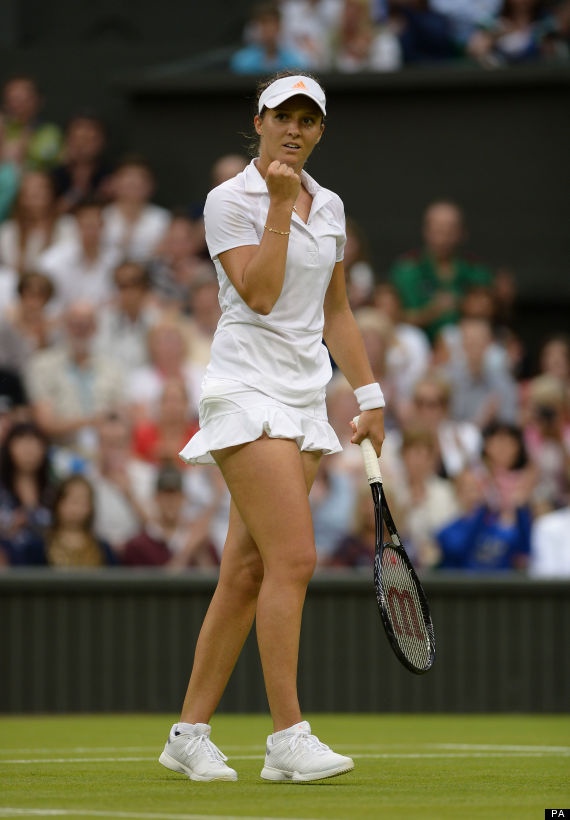
Laura Robson, who won today at Wimbledon
Driving home from school with daughter number two and two of her friends, Wimbledon was on the radio. One of them asked a question about whether Wimbledon was a knockout tournament, and this led to a maths puzzle.
“Imagine there are 64 players in the women's tournament. In the first round there are 32 matches: how many matches are there in total?”
Cue groans.
Cue ” I need a calculator.“
“No you don't”
Eventually one of the children worked out the answer, 63, by adding 32, 16, 8 etc.
“Now let's make it a bit harder, what's the number of games if there where 256 women in the tournament.”
“I'm not in maths set one.”
“You don't need to be.”
” There will be 255 games, one less than the total number of players. How ever many number of players there is only one person who wins and the rest lose. Since the total number of losers is known, the total number of games is one less than the total.”
“Cool,” said daughter number two.
White to play and win
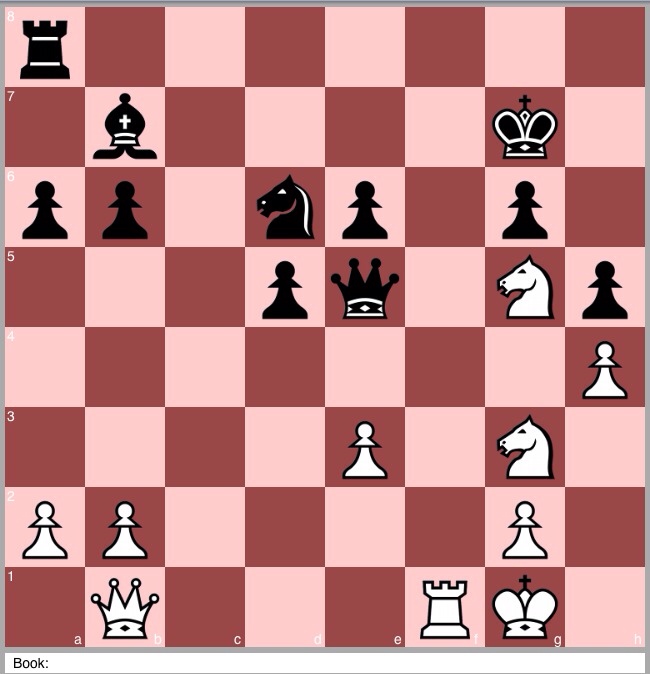
Keres-Smyslov Leningrad 1939
Solution
I enjoyed this one. In my initial examination of the position, I noted that the Qe5 is in forking distance of the Ng5, so certain squares are mined: Kh6, Kh8: but at present the Nd6 guards f7. So 1 Rf7+ was my first try, which works except for 1…Nf7 2 Nh5+ Kf8- the only move, but a winning one.
So, instead, 1 Nh5+ first, and dependent on how black defends, white wins through. 1…Kh6 (1…gh?? 2 Qh7mate ) 2 Nf6 threatens to fork on g4: black's best is to take on e3 with check, and then play Qd4, getting some control over f6 (else Rf6 double attack g6) and also hitting h4.
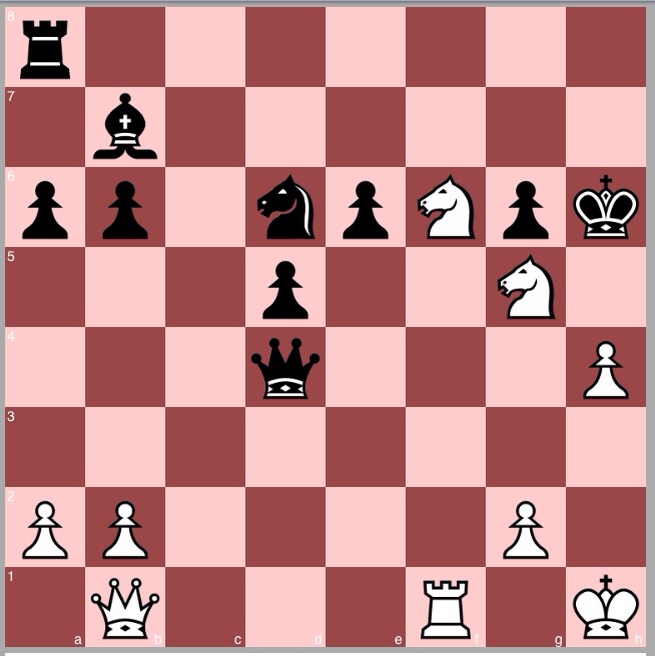
Here, I ended my analysis with 4 Ne6, noting that even if black takes on h4, as he did in the game, there is no perpetual, since the Ne6 also controls d4. So, afterwards, white puts his queen on c1 from whence it can if necessary go to c7, aiming at both g7 and h7.
Very nice.
The attached analysis includes some light comments on the earlier moves in the game, including a pretty Houdini improvement on move 19. Black's last move before the puzzle position, Ne8d6, was the decisive blunder.

White to play and win

Solution
Oh dear, another one on the same page in Cordingley's book (same page as puzzle 87) which I also goofed. I half suspected I hadn't got the answer, because my solution was nothing special, very prosaic.
Because it was a puzzle, I first looked at the flashy 1 Ne6, but it is rubbish, for at least the simple reason of 1…Rc1+; and moves like 1 Nd3 or 1 Na6 simply hang the Be4. I therefore had to make 1 Ba8 work (again, poor show: whilst 1 Ba8 is the solution, Houdini's second preference is 1 Bb7, which I didn't even consider). I got it to, at least to the extent of whatI think is an easily won ending, including ensuring that the remaining passer queens on a black square…felt my solution was the best that there was, and entirely missed the not-too-hard 2 Rc5!: I had of course noted that the Qe7 was LPDO.
Disappointed in myself here: coupled with position 87, it shows an amateurish approach to the project that I have set myself.

Daughter #1 is presently learning to drive. Her instructor has told her she is ready to go out with her parents; whether her parents, for which read her dad, are ready for this, is a moot point.
Anyway, it does give dad permission to bore daughter #1 when driving her to school. 'What's this sign'? ; 'what hazards can you see'; 'what would you do here'; 'what does this road sign mean?'. The beauty of this present shift in the daughter-dad power balance is that daughter #1 can't ignore/grunt a reply/be otherwise teenagelike since dad has the threat of not taking her out for lessons.
But, what, pray, does this sign, seen this morning, mean?

 allanbeardsworth