White to play and win
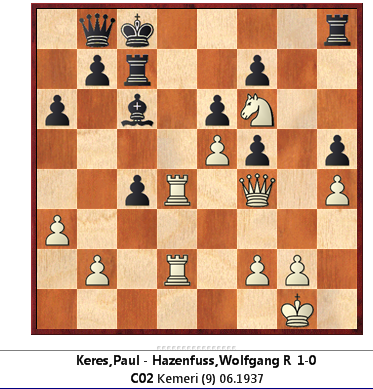
Solution
Clearly, the theme has to be back rank mate: and I more or less immediately spotted 1 Qh6! since the rook is tied to the 8th rank. The nice point is that after the only move 1… Re8, white has 2 Rd8+! which mates with 4 Qf8+.
Not too hard, but because of 2 Rd8+, quite pretty.
A small PS is that the above diagram is from Megabase; Cordingley's diagram has the Q at b6, which seems more natural. The solution is of course unchanged.
 Posted with Blogsy
White to play and win

Solution
I goofed this one. Badly. First move I thought of was 1 Bh6, with the idea 1…gh 2 Qd2; it didn't take much to see the follow up 2…Kh7 3 Bd3+ Ng6 4 h5, which I knew was good for white, and was the solution (though black played 1…Qa5+ in the game, requiring 3 Qc1! instead: however, I felt the position after 4h5 was 'just winning (in the long term) and so looked for something even better, and found something…much worse.
I chose 1 Rg7+, thereby committing at least mistake #8 (see my blog after puzzle 64 summarising my project so far)
#8 seeing an illusory brilliancy, and not checking it.
I think I also hurried too much, wanting to solve another puzzle. I should have been more disciplined, and either set the pieces out, or give the puzzle sufficient time, modelling a typical game approach. But I didn't, and chose the flashier option….a totally poor process. The fact that Houdini, who initially and for the first fee moves thinks 1 Rg7 loses, took several moves before its evaluation reversed – as Rg7-Kg7-Qd2-f5-Qh6+.. are played, the evaluation goes down from -1.9 to 0.0 and then jumps to +10- there was a big horizon effect here: it doesn't absolve me that my judgement was proved right ( Rg7 just wins) I handled the task very unprofessionally.


A screenshot showing how the appraisal changes deep into my 1 Rg7 line, after 22 0-0-0: before then, the assessment is white is losing to white is worse, then is switches to overwhelming advantage. Is it good luck, or good judgement?
White to play and win
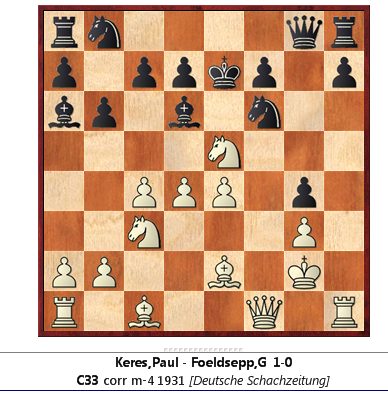
Solution
First, I was surprised to see that Keres has played correspondence chess, but this might just be showing my ignorance. Secondly, knowing it was a problem, the second move I thought of (the first was 1 Rh6, with the idea of 1…Qg7 2 Rf6 Qf6 3 Bg5 Qg5 4 Qf7+, but then I noticed the Nb8 defends d7, so the line is nothing) was 1 Qf6+!, and it didn't take long to see that this was the solution. After 1…Kf6 2 Nd5+ Kg7 3 Bh6mate, or 2…Ke6 3 Rh6+ Qg6 4 Bg4+ and mates.
Straightforward.
Yes, this letter, received in our mailbox today, is not, as they say, 'usual marketing material'; it is 'unusual marketing material' in the sense that it made me laugh.
I wonder if Mr & Mrs M exist? And if they do, if they wish to live in Carrwood Road? Two questions I shall never know the answer to, unless the Morris's, Metcalf's or Moxon's soon move in to our street.

(today, somebody who I am fond of questioned my literacy, writing that she thought that I was just a mathematician; it may well also be that I am a cynical one, if other's think the estate agent's customers exist and have expressed a genuine interest in our neighbourhood).
Our tickets arrived today for the Manchester International Festival's world première of The Machine, a dramatisation of Garry Kasparov's 1997 rematch versus Deep Blue.

Game 6 was the pivotal point: it marked the first time that a machine had beaten a top GM. Since then, one or two, top GMs played further matches, the finale being the 2005 trouncing of England #1 Mickey Adams by Deep Hydra, by 5.5-0.5; since then, humanity has accepted that people can't play machines.
Deep Hydra was far stronger than Deep Blue, and now, in 2013, Houdini 3.0, Rybka, Hiarcs, and many more can beat Deep Hydra: my iPhone or iPad could beat Deep Blue. It is beyond me how programmers have achieved this.
Game 6 actually shows that Garry was mentally defeated before playing the first move. I can only scarcely imagine the sheer enormity of the mental pressure of playing the previous five games in the full stare of the world: the match was on mainstream news channels.
Early on, in a Caro-Kann, Garry permitted the machine to play a speculative sacrifice.

When I keyed in the game into Chessbase yesterday, and ran through it quickly with Houdini, my engine chose Ne4 rather than Ne6: evaluating both as virtually equal, with a slight preference to caution. I intend to give this position to Houdini again with a longer time control, to see if it ever prefers the sacrifice: though, if I were a computer chess expert, I could probably tune the settings to enable it to play more aggresively, in high case it would no doubt find Ne6.
In 1997, Garry contended that there could have been human interference in Deep Blue's decisions: he felt that one of the moves played in game 1, and Ne6 in the final game, and maybe others, showed intuition, a human characteristic, and couldn't be decided upon by machines. With hindsight, I suspect this was justthe revealing moment when computers could assess positions with some judgement: it is not winning after 1 Ne6, the game is just unbalanced, is highly tactical, and we now know that such positions are impossible to play against machines: Garry knew that back in 1997 too: what he didn't know was that machines would play unclear sacrifices.
I have lightly annotated game 6 below.


White to play and win
(a nice one, to explore)

Solution
I enjoyed this one. The first move is obvious, 1 Ng5; but the second moves after black's two alternative defences are not. First, I quickly found (1…Nf8) 2 Nh7!; a motif I had seen before. Not immediately mating, but white gets an overwhelming advantage, and moves such as …Qc1 don't lead to unfortunate back rank mates, with Rge3 being both a defending and improving move. In the game, black played 1…Nf8.
Black's other defence, 1…h6, was a harder nut to crack. I kept looking at 2 Nf7 but I felt black could hold the end position after 2…Kf7 3 e6+ Kg8 4 ed Rd7. So, not for the first time, reverse the moves, playing 2 e6!; in fact, 'reverse the moves' was a rationalisation after I found it: instead, I used a maxim of CJS Purdy, the precise words of which I forget, but along the lines of 'ignore for a moment a threat;what would you rather do if the threat were ignored'. Here, the doubled rooks on the e file give white just enough to prosecute the attack but only to a draw (or so I thought) if (after 2 e6) black plays 2…hg: 3 ef+ Kf7 (Kf8 4 Qh8+ and 5 Re7+) 4 Re7+ Kg6 5 Rg7+! Kg7 6 Qg5+ perpetual. The threat of back rank mate prevents white from succeeding.
In fact, Houdini shows me that after 4…Kg6 5 Qd4!! is decisive- and is the only decisive move. Stockfish, on my iPad, couldn't find it (at least in the time I gave it to think). The position after 5 Qd4! is rich, and I plan to explore it further.
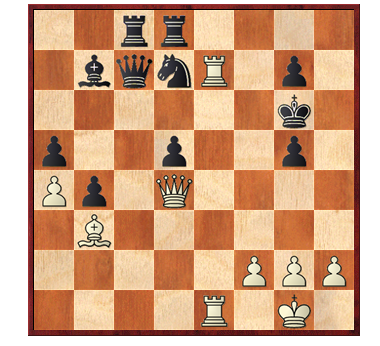
Cordingley gives 1…Nf8 as his main line, the move played, with his only mention of 1..h6 being ('Keres gives 2 e6 as the winning line against 1…h6', with no variations). In fact, Keres doesn't quite say this. I have a copy of his 'The Early Games of Paul Keres', translated by Harry Golombek, in which this game is included. He gives 1…Nf8 a ? saying that after 1…h6! 'Black could have still put up an obstinate resistance.' Keres finds 5 Qd4!! and the best line against it 5…Qc3!! 6 Bc2+!!; he shows a typical line which wins after 6 Bc2!! Keres prefers 4… Kg8, which I thought lost to 5 Qg5: his analysis, which I haven't checked yet, ends with 'White has some winning chances owing to his opponent's weakened king-side. From a glance at some of his lines, I suspect he is correct: black can hold on, and suffer.
I may well examine further this game, and blog about it separately, including improving the analysis posted below.

I recently took a colleague out to lunch: he had asked me for career guidance, and is hoping for promotion. I would lay good odds, better than evens, that he will get promoted not one step up the ladder, but several, to partner: since he has many of the core attributes that are needed. I was surprised, though, that he hadn't thought through what he needs to do is to play the promotion game.
People who know me, know that I often think by drawing: maybe it is the engineer in me, maybe the chess player in me, but I think in pictures, often trying to draw analogies. I imagine my firm is no different from countless other organisations: merit is by no means the sole requirement for promotion, and is no guarantee of promotion. It is a necessary but not sufficient condition.
During our lunch, my first thought, and the scribble I drew, was of Snakes and Ladders.
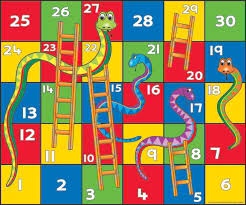
Doing the right things, impressing the right people, are ladders: but there are plenty of ways to slip on a snake. This game, is not though a good enough representation: there is no skill in snakes and ladders.
Instead, I think the nearest analogy is Trivial Pursuit.

This analogy shows that getting promotion is a trial, a quest, a journey. Luck is needed- the right dice have to be thrown, and poor numbers have to be avoided-it can often be a race-sometimes there can be only one person promoted- and various skills/attributes/cheeses have to be obtained.
So, what follows is the Trivial Pursuit guide to promotion.
Want to be promoted: no point playing TP when drunk, not concentrating on the questions: you may only have one chance; think about what cheeses you need to acquire; keep a notebook of your thoughts; record your successes; actively collate feedback, as if on a mission- 'as if' because you are on a mission, or should be;
Know the rules: you have to get all the cheeses, then go to the centre. Whilst the criteria for promotion will be fluffy, and vary by person and over time, there will be some core factors: financial, such as fees; people skills, both internal and external, business demand for particular services (no point in specialising now in capital transfer tax, that legislation went long ago: look to the future), attitude or cultural fit ('look the part')
Collect the right cheeses: work for the right partners, on the right projects; who will determine promotion? It is wrong to think that only one person can decide, it will almost certainly be a group decision; as with all group dynamics, there may not be equality in the decision making process, so make sure you garner support from sufficient quarters;
When you get chances, take them: there might be a seminar to speak at, an internal event to organise, an article to write (maybe in your own name, maybe co-authored with your boss, maybe in his name); some travelling to do: many such things you would rather not do, but chances to earn cheeses should be taken. It could be a long while before the dice give you another chance;
Avoid trick questions: avoid the traps: try to manage your client finances well, ensuring appropriate recoveries; avoid technical clangers, avoid falling into risk issues, play the gossip/politics game right. On the latter, there is a spectrum, as with all things, from being naive and out of touch, through aware and connected, through to busy body and gossip.
Collect all cheeses: points are earned by cross referring to other departments, by being known throughout the office, by being seen around, by helping more junior staff progress.
Decide the order of getting cheeses: better to be known as good in your current job, of being a good people developer, of being good with clients, before cultivating too many internal contacts.
Throw the right dice. Alas, luck plays a part in all aspects of life, and by no means everyone who deserves to be promoted will be. Someone else might throw a string of doubles: have a major client win, be in a discipline which is on the up, be ready for promotion just at the right time, e.g. a gap opens for him when his colleague leaves. In chess though, there is a saying about the more practice one does, the luckier one gets in practice. The same holds for Trivial Pursuit.
Get your set out, and start playing.
White to play and win
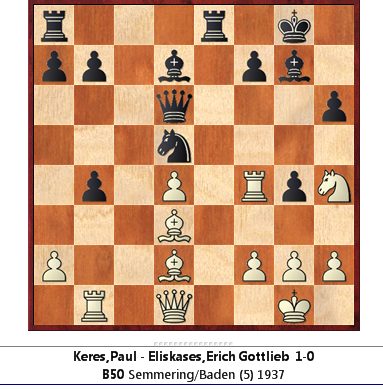
Note my deletion of and win: it is a slugfest, a position capable of great analysis, rather than a win for white
Solution
I could write chapters about this puzzle. I shall try to be brief.
I have spent more time on it, or more precisely on a position close to it, than any other puzzle in the book so far. Let me explain.
On my first sitting, 1 Rg4 is clearly the move you want to play, but I couldn't see enough after capturing, Qf6 to get some control on f5, and Kh8 to try to ease the pin. 'uncertain' I thought. So other moves, like 1 Rf5 and 1 Nf5 came to mind, both similarly uncertain. Of these, 1 Rg4 seemed most natural, but the others couldn't be ruled out.
Next, I have always had a liking for Paul Keres, the one who never made it to World Champion. I was an impressionable teenager (aren't we all) and I devoured two of the three volume autobiography books which were translated by Harry Golombek which my local library, in the village of Culcheth, Warrington, Chesire, had: they had very few chess books, the only game collections being two of that series- so I borrowed them repeatedly. I suspect some of my playing strength must have been gained from them, subconsciously. I also had the impression that he was a gentleman Russian– a nice guy, something hardto understand for a child of the Cold War sixties.
Thirty five plus years on, I now own all three of his books: treasured. Like many of my books, I haven't read them, just at best dipped into them, but this puzzle has made me look at The Early Games of Paul Keres, and I have thoroughly enjoyed it. The book is on my long list of books to take on holiday- around now, I start working out which books to take with me, knowing that there is a luggage allowance, knowing that in all probability I won't read as much as my good intentions make me want to believe.
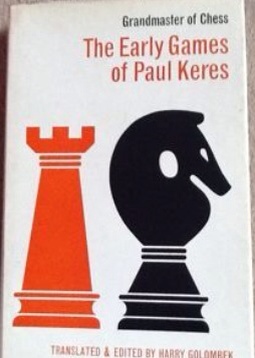
Reading his comments on the critical positions of this puzzle, reminds me, if reminder is needed, that there is a whole world of difference between cold calculation as leisure of a puzzle, and a whole universe of difference between playing a game and analysing it with Houdini. Things like stress, tournament position and tiredness make the game what it is.
Keres did indeed play I Rg4 and black did indeed play 1…Bg4? Keres' comments are priceless:
Now it is Black's turn to make a mistake, and this time one with the most serious consequences. Black should on no account give up his best defensive piece, not even for a Rook…
Keres goes on to say 1…Nc3 should have been preferred, with an unclear game: Houdini prefers the even stronger 1…Qf6! and black is better.
I have Megabase 2012, Correspondence 2011 and have used these to find the games in Cordingley; augmented by some google searching, and sites such as chessgames.com, 365chess.com, together with a few games collections in my library.
This blog lists the missing games from puzzles 1-64.
There are some missing games which it would be great to have for completeness; and if found, I would send them to Chessbase to add to their records.
5 Andreaschek-Goebl, match game at Olmuetz, 1900
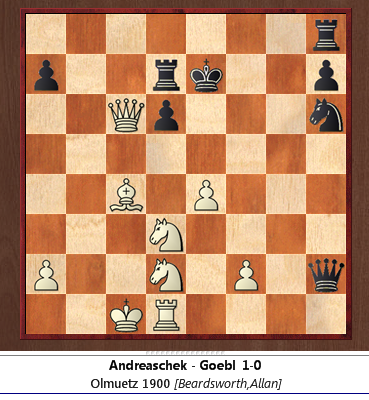
Megabase has two games by a Felix Goebl in 1920; I haven't found any games by white. My googling did though reveal that the moves 1 e4 c5 2 d4 cd 3 Nf3 e5 4 c3 is called the Sicilian Andreaschek gambit; and that white's first name was Karl.
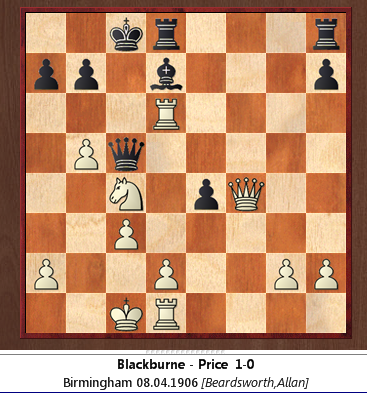
12 Blackburne-Price, Birmingham, 1906
36 Demuth-Mermagen, correspondence 1936/7
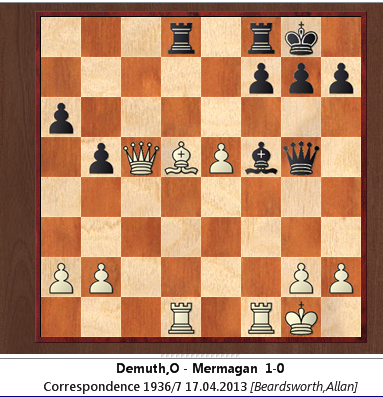
47 Engels-Zwetcoff, Munich 1936
(found when writing this blog – black's name spelt as Tsvetkov)
50 Elstner-Seeger, zone tourney, Berlin 1934
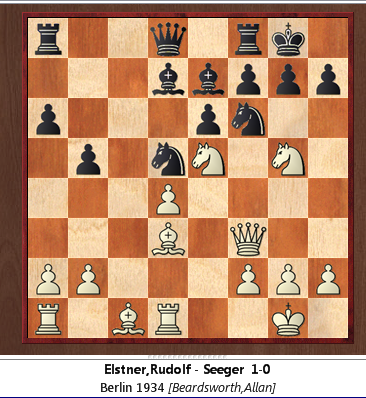
White was Rudolf Elstner. I haven't found any games by black.
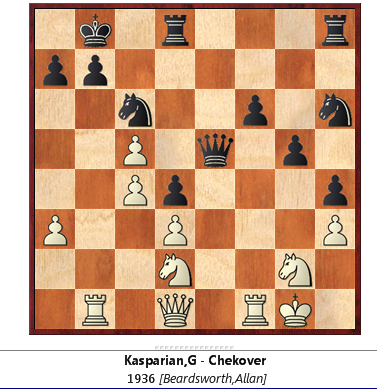
Black to play and win
Solution
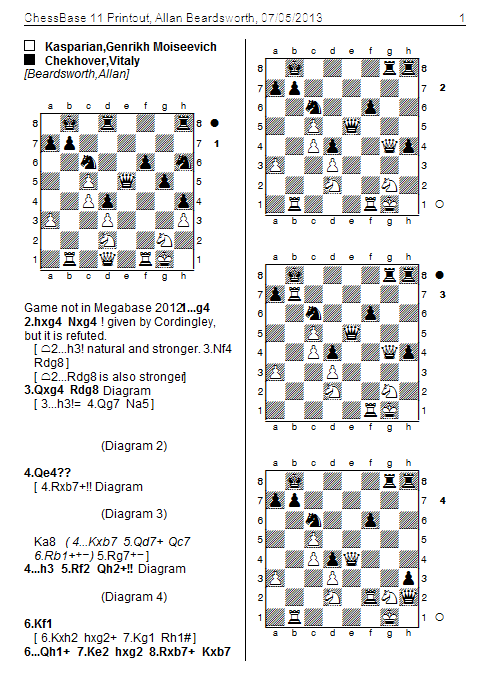
Another Houdini surprise. I felt the solution was fairly trivial, 1…g4 2 hg h3, noting that none of white's minor alternatives, such as 2 Re1 smiting the queen, do anything: white's space is cramped, his piece coordination poor, and black must simply be better.
I was surprised when I looked at Cordingley's solution, to learn that 2…Ng4, he says !, was played, and won. I felt it was a flashier-than-necessary approach. When keying the game (which is not in Megabase) into Chessbase, and checking with Houdini, I found that 2…Ng4 is in fact ?, flawed, by the wonderful 4 Rb7+!!. Who knows what the time factor was, because Rb7 is somewhat obvious- when I checked my 2…h3, I looked at how fast white's counter play was, with both 3 Rb7+ and 3 Qa4- not fast enough, but at least the concept of Rb7+ was in my head, and it comes with massive power once the R has move from d8, and the Queen can go to d7 from g4: examine all checks, examine all smites, as CJS Purdy says.
 allanbeardsworth