I have been troubled by what I did, or rather didn’t do, and what Jane did over the last few days.
We were on our way back to the car park having been out with our two girls for our eldest’s 18th. We were accosted by a beggar, and i did what i always do, politely said no, moved on, moved faster, and encouraged the others to hurry up too. Jane wanted to give him something, but moved on; and then we argued; and then she went back, and gave him a note or two, rather than loose change. Who was right?
In parenthesis, we have noticed a marked increase in the number of homeless and the number of beggars in Manchester: a week before, in the one mile or so from theatre to car park, we had been asked five times, always politely, but far far more than even a year ago: i wonder why that is; i suspect it is recession affected coupled with some change in local services provision.
Firstly, we know that we are in the very fortunate minority. We can afford everything we need, and most things that we want (but see my posting some months back on ‘how many handbags does a woman need?’
We are mindful of this good fortune, and therefore do give regularly and sizeably to charity. But does charity begin at home, and if so, does that include the homeless beggar?
i turned to google, and, naturally, there are thousands of articles on the subject. The one I looked at first was from the Oxford University philosophy department:
http://blog.practicalethics.ox.ac.uk/2012/09/dont-give-money-to-beggars/
This article appealed to me: it approaches the topic from an academic perspectve, which accords with me. Essentially it concludes ‘no’ since there are better ways to give, and also because some beggars will be more skilled than others at collecting gifts, so better (fairer) to pick the right efficient charity. However, just because it agrees wth my conclusion, doesn’t mean it is right.
Next, a fast skip over several of the miscellaneous postings which are on line: most respondents say ‘no’, many say NO, a lot say NO. Many are quite nasty; people should remember Warren Buffett’s comment that (misquoting) people in England won the lottery by not being born in Bangladesh.
I also had a look at a few charity websites, and some Christian ones. These tend to be ambivalent. I found this one well written http://christianpf.com/dont-give-to-the-poor
but it’s conclusion, to me as a non believer, is a fudge: whilst in general ‘don’t give’, there are times that you should give, and you will be guided by the Holy Spirit to know when such occasions arise.
The tricky thing about this is that we never know the whole situation and we have to be led by the Holy Spirit when making these decisions. After all, who are we to judge? God knows what is going on in the beggar’s life and what will help them the most.
Conclusion
I think where I get to is ‘normally don’t give’; but you can on occasion as an exception if you want to, for a case you think is deserving. I was wrong to try to dictate what Jane chose to do, but since she doesn’t read my blogs, she will never know. Except of course, she can read me, and she said in the car back that she knew that I knew i had done wrong; I think my mistake was not not-giving, but seeking to choose for her.
 Posted with Blogsy
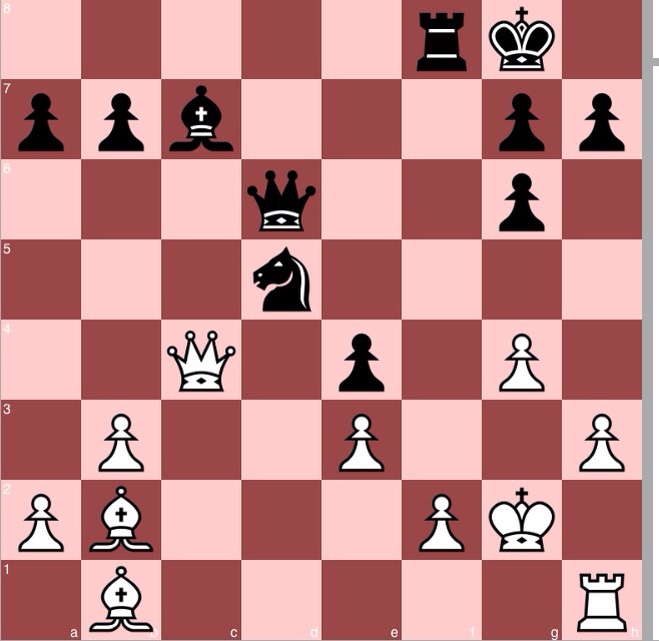
Black to play and win
Solution
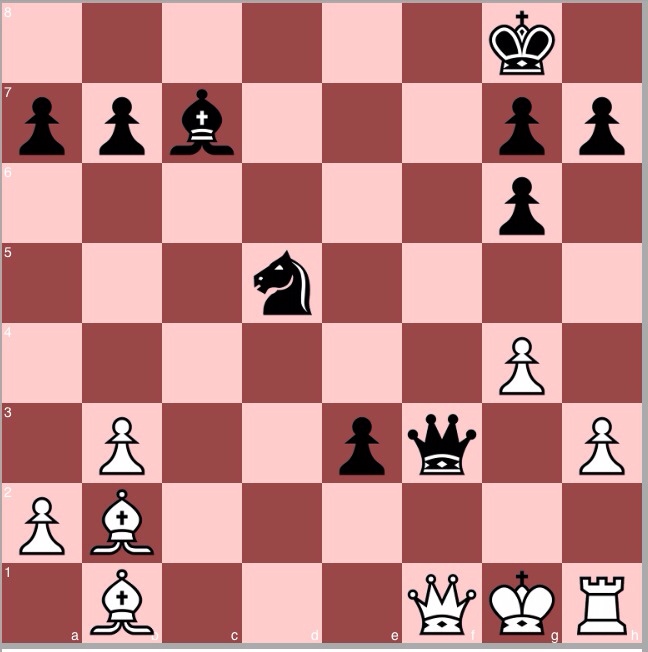
A nice, not too difficult, puzzle. Once you realise that the Nd5 is pinned, then the only practical check is 1…Rf2+, and after 2 Kf2 Qg3+ there is a moment to think. If the king goes for e1 (eg 3 Ke2) then black plays 3…Qf3+, and after either 4 Kd2 or 4 Ke1, 4…Ba5+ is game over. So instead, white must move to the king side, so a few checks, capture on e3, move the queen back to f3, so that it protects the Nd5 after …e3.
Then it is over. One nice line is Qf1 e2! 'sacrificing' the queen, but only temporarily: the pawn promotes, and then Ne3+ is game over.
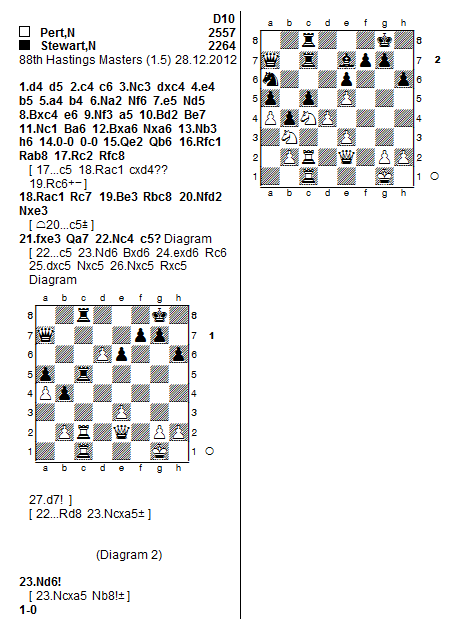
I have just come across this nice game played by my friend GM Nick Pert last December.
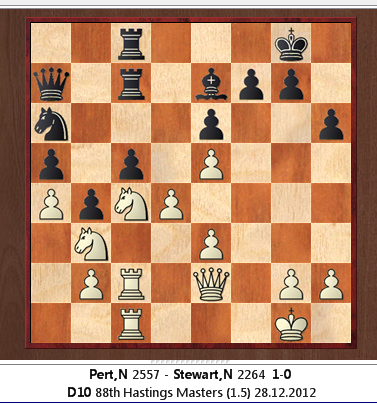
I think that I would have played 1 N4a5 which is good enough for some advantage. In my calculation, I looked at the move Nick played, and which caused black's instant resignation, but stopped calculation a move too early: I should had been more determined, 1 Nd6 being the move your 'hand wants to play' but I thought after the capture, and simplifications on c5, I thought black would be free, but the lethal d7! shows that the Rc8 is overloaded- in CJS Purdy language, I should have been able to spot it by identifying the Rc8 has been tied.
As Purdy writes:
Some things are hooey,
and most others lies;
But forks you mustn't miss,
nor pins, nets, ties.
I know blitz counts for nothing, but when it is nice, it is very nice. Today I felt I was in a slight mess, playing white against a Scandanavian defence (a slight variant, 1…Nc6, 2 ..Nf6. 3…d5) and in the position below, I had felt I was beginning to struggle.
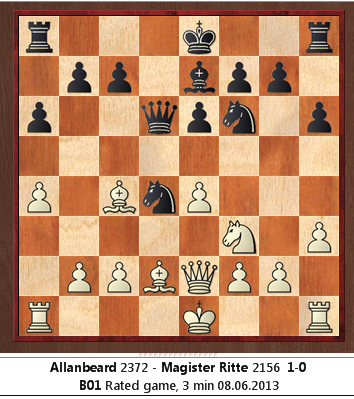
Black has just played 12….Nd4, and I was worrying about which of my b2 or e4 pawn to sacrifice, but felt neither was satisfactory. But then, Purdy's maxim about ignoring threats:
You must see all real threats. That means you must also see the unreality of real threats…. When in doubt, you can always save time by remembering it is really your move. Try then the following way of thinking:
Imagine the threat could not possibly be executed. Then what would be my best move? Try out each attractive move separately, considering each one as follows. Visualise the whole position as it would be after this move of yours, and then work out whether the opponent would gain by executing his 'threat'.
And also my favourite piece of Purdy, his potassium cyanide warning when two pieces are on the same rank two files apart- here the Qd6 and Nf6.
So, in a flash, 13 e5!, and…it was game over. Black resigned: his position is hopeless.
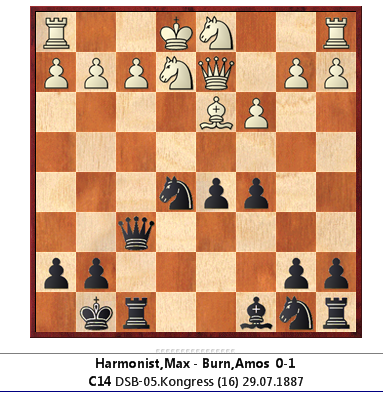
Black to play and win
Solution
The move I instantly thought of was 1…Qf3! Perhaps the reason that it was instant is that I have seen the position before, I don't know, since from time to time I have read things about Amos Burns; but also 1…Qf3 is not untypical: I am sure that I have seen the motif before.
A quick calculation- if white can castle (Cordingley doesn't say either way), and does, then 2 …Qd3, and black is a piece up. Or if 2 gf, then 2…Nf3+ 3 Kf1 and not my first thought, 3…Nd2+, but 3…Bh3 mate.
Satisfied, I turned to the answer, and it was 1….Bh3! (Exclamation mark for surprise, not value) and Cordingley didn't mention 1…Qf3! Burns move wins easily, of course- 2 Kf1 Bg2+ 3 Kg2 Qf3+ etc, but by no means as elegantly.
Earlier this year, I posted this blog https://allanbeardsworth.com/2013/04/15/walk-in-circles-like-an-egyptian/ on pi, and specifically about what I read about Eratosthenes calculating pi to a good degree of accuracy.
Or did he?
I have since, in random googling, found other comments that maybe he didn't, and maybe the Egyptians didn't know about pi to a good approximation.
This journey has shown me how little I really know. In Donald Rumsfeld's terms, I have numerous known unknowns:
How do you calculate any particular trig function, such as say sine 43 (43 chosen at random);
How were sine and other trig functions calculated?;
Alternatively, how did Eratosthenes calculate pi, if indeed he did?;
Are most trig functions irrational, and are there very few precisely accurate functions, such as sin30? –
Alas, I suspect I shall never know.
Perhaps I should have asked the person sitting at the next table to me earlier this week at Caffe Nero who had a screen saver of Euler's formula. One thing that I am sure of is that I have no practical change of understanding why e^i*pi+1=0; unless someone can help??
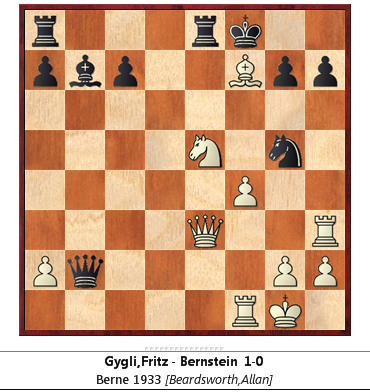
White to play and win
Solution
I enjoyed solving this puzzle, which, for a change, leads to a decisive result. My first try was 1 Nd7+ Kf7 2 fg+ when I think either 2…Kg8 or even 2…Kg6 (3 Qd3+ Be4) are sufficient, at least for the game to go on, because of black's threat of mate on g2. So I had to find something better.
Next try was 1 Ng6+ hg 2 Rh8+ Kf7 3 fg+ but this is spoilt by 1…Kf7 2 fg Kg6 (or Kg8) when black squeaks out, and ends up a piece up.
So, then what? Almost following a process, I looked at the third and final check (I also glanced at line-clearing/interference 1 Bd5, but it too is insufficient, and loses) 1 Qc5+ and saw that this was the solution. After the forced 1…Re7, 2 Ng6+ Kf7 ( 2….hg is mated in the same way, 3 Rh8+ Kf7 4 fg+ and mates) 3 fg+ Kg6 4 Qf5mate, revealing a second point about 1 Qc5+; or 3….Kg8, 4 Qc4+ and mates.
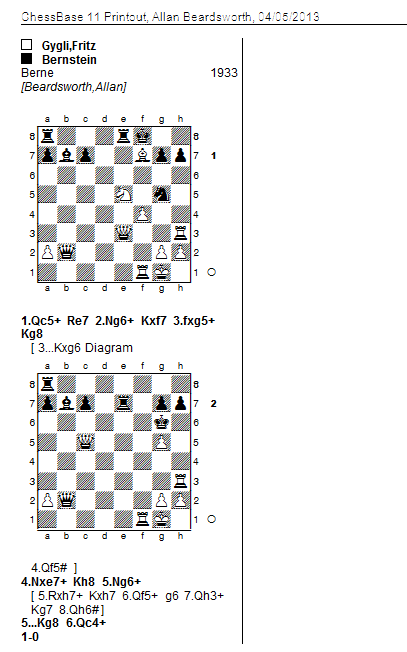
Nothing more to say, really: a nice puzzle, of reasonable difficulty.
Today, Jane and I have only one child left in our family, since our elder daughter Alice is 18 today.
What do you give an 18 year old girl? Well, when you have an internationally known silversmith and jeweller as your sister-in-law, you ask her, Vicki Ambery-Smith http://www.vickiamberysmith.co.uk/ to make a unique momento, a necklace with a map of Madagascar and its ubiquitous animal, a lemur: Alice spent several weeks trekking and volunteering there last year, time which has given her a lasting impression.

We hope Alice enjoys her birthday, if you can ignore the next couple of hours when she is doing one of her A levels; of course, tonight she will be able to sample alcohol for the first time, won't she?

White to play
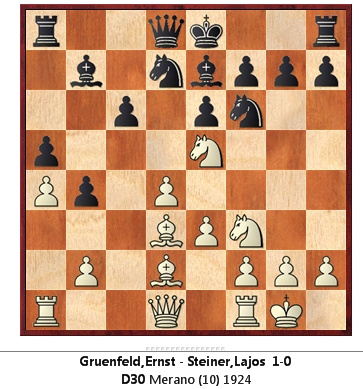
(note, slightly cooked, not a win, but a good advantage)
Solution
Again, no prizes for the first two moves, which I saw instantly. I judged that this was likely to be a puzzle where white gets a compelling advantage, if not an absolute knock out, and that proved to be the case. The combination of a few pawns, king in the centre, strong central pawns, disco-ordinated black pieces, give white a good plus: but not a winning advantage if black plays Qb6 rather than the Qc8 played in the game. (Winning advantage- if Carlsen, Kramnik, Topalov and any of the world's top hundred or so were white, I wouldn't fancy my chances as black; but if I were white, and one of them were black, don't stake your house on my success).
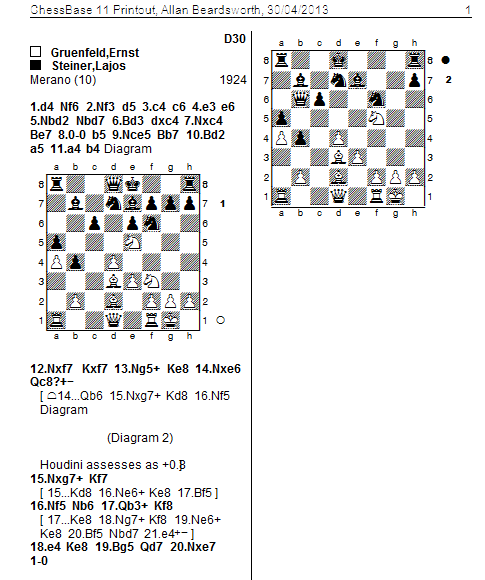
My home PC is now a dinosaur, and the default settings of Houdini 3 seriously slow it down, especially if other programs are running. With help from Steffen Giehring of Chessbase, I have created a new engine which only uses 1 of my machines 2 CPUs.
The way to do this is not intuitive, so details are given below.
If you want to reduce the number of CPUs to only one permanently you must „create a new UCI engine“.
Start the program and go to Engine – Create UCI Engine:

That will open a new dialog box.
Click the file search button on the top.
That will bring up a file select box. Select your Houdini 3 exe file from your hard disk and confirm with OK.
Now enter a new engine name like this {this screen print was from Steffen: in my machine, x64 is w32a}

Click on 'parameter' and change 'thread' to 1, and complete with „OK“.
Now you will have a Houdini 3 with 1 CPU engine right in your engine list!
I then clicked on file, options, selected the engines tab, clicked on Default Engine, and changed it to Houdini 3 w32 1 CPU.
Sorted!
Though, I am still hoping to soon sneak the purchase of a new modern spec high powered computer past Jane…
 allanbeardsworth