I have a bee in my bonnet at the moment, thinking that many of the 20 year- and 30-year olds at work haven't got the knack of writing clearly and succinctly. (Don't get me started about mental arithmetic). I suspect it is down to the informality and speed of email, texting and the like: the art of writing a letter or report is in danger of not being learnt.
Today, whilst doing some idle Internet browsing, I came across this well written piece about writing well:
There are thousands, perhaps millions of other suggestions available. I would add, for work writing, summarise at the start, explain what the report or email is about, say what you want the reader to do (read, for his info, reply, discuss…) and often what you conclude (there's a problem, there's not a problem, some work is needed…) to put the main body into context, so that the reader's mind is framed ready to read it.
 Posted with Blogsy
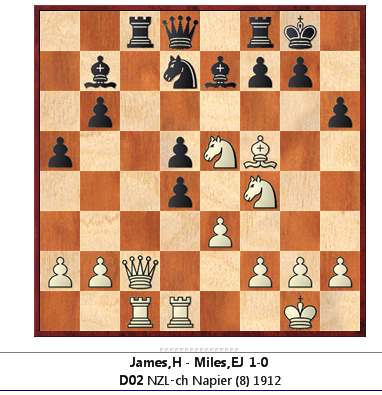
White to play and win
Solution
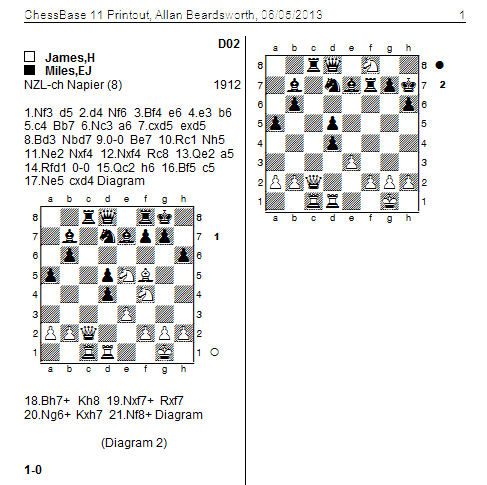
One of the most straightforward puzzles. The first move is obvious, or, if it were not, following the routine of 'examining all checks' would find it, since 1 Bh7+ is the only check. Then 2 Nf7+, 3 Ng6+, 4 Qh7+, and the only somewhat hard thing to do is to visualise that with his King on f8, Rf7, Be7, then 5 Qh8 is not check, but mate.
A single line, forced, combination.
White to play and win
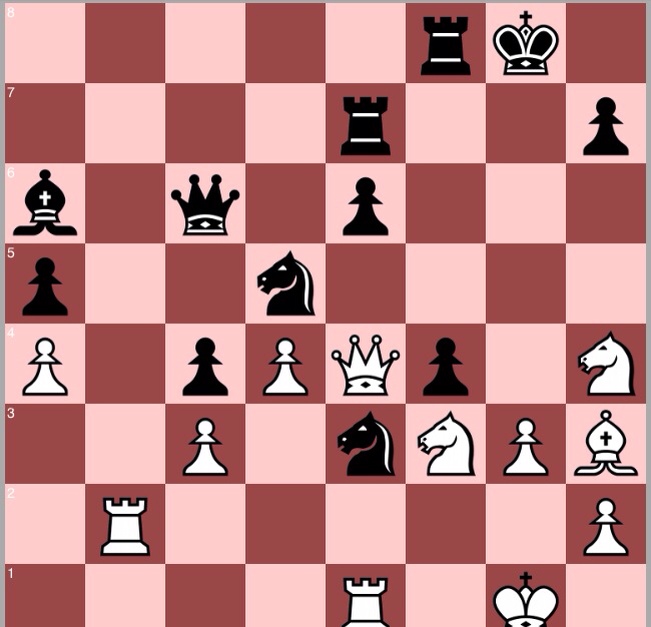
Jaffe-Spielmann, Carlsbad 1911
Solution
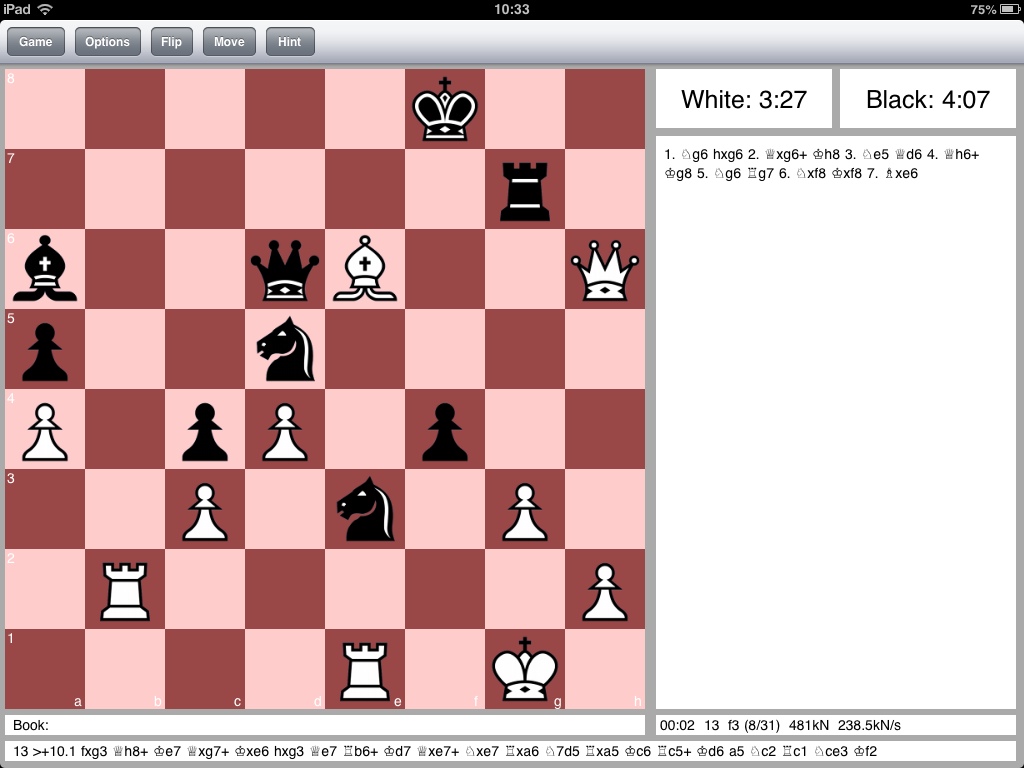
I found this puzzle fairly straightforward, first noting that the only LPDO piece is black's Qc6, based on which I first tried 1 Re3, using my worst placed piece, but it is insufficient. I therefore looked at the obvious smite 1 Ng6, noting that once the Queen is on g6 or h6, there is a horizontal pin on the Qc6, and the e6 pawn is double attacked.
Noting then that there is at least a perpetual (1 Ng6 hg 2 Qg6+ and if Rg7 3 Be6+ wins, or if 2…Rh7 3 Qh6+ the king must move back to g8 to protect the LPDO Rf8) I had confidence, a stepping stone, in which to see if there is a win. It didn't take long to think of 3 Ne5 when I thought the best defence was 3…Qe8, but this is defeated by 4 Qh6+ Rh7 5 Ng6+ Kg8 6 Be6+! overloading the Qe8: the same tactic, Be6, recurs against other defences too, such as against the move Spielmann played, 3…Qd6.
A nice puzzle.
Since it is my birthday, I have the right to choose a Game of the Day.
At present, the only top level GM tournament is the Tal Memorial. I have only had the briefest of time to look through the games: and there is one stand out game, Boris Gelfand's victory as black against Fabiano Caruana.
Two clear reasons it wins: firstly, Boris's attack was really powerful, his pieces flowed forward so that white was overrun. And secondly, with Boris only six years younger than me, and Fabiono only one year older than my son, it is a victory for the older generation.
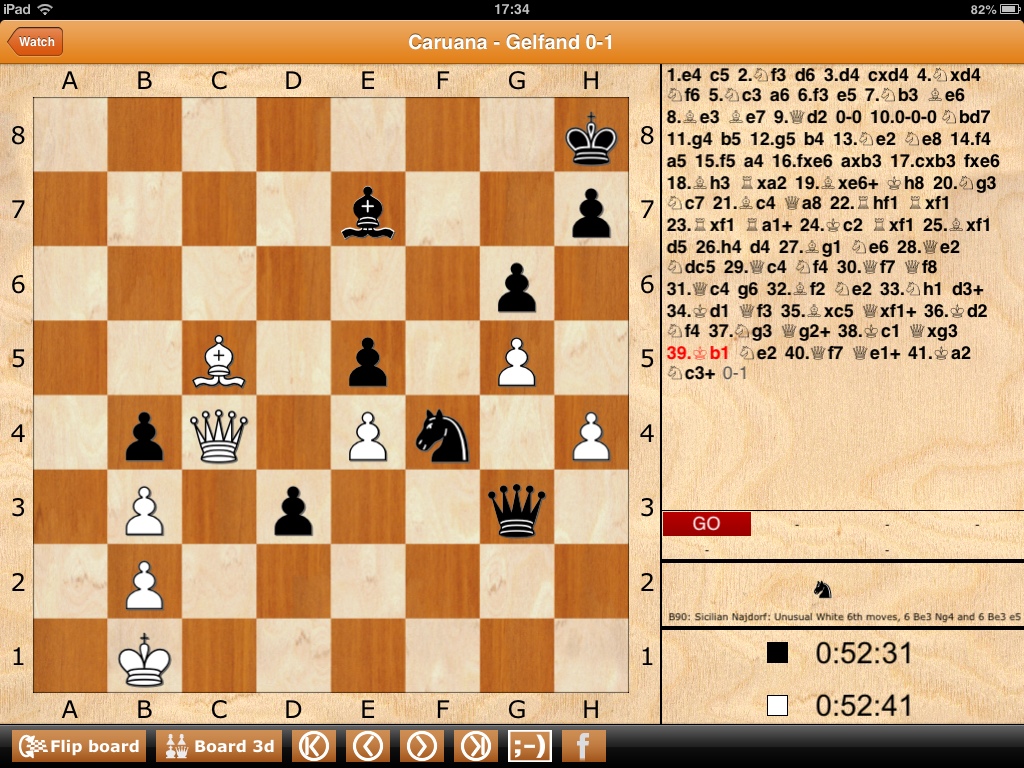
When I looked at the game at great rapidity, this position caught my eye. After 39…Ne2 I thought that 40 Qf7 isn't the natural move, 40 Be7 is, so at first I thought it was a classic move-forty blunder, but I doubted this could be the case, and instead spent a few moments working out what happens after 40 Be7.
At first I thought 40…Qe1+ Nc1+ or Nc3+, but couldn't get either to work, but eventually I found the answer, the slightly less natural, to me, at least, 40…Qg1+!. Black then does a few checks his knight, taking on b3- Nc1+ Nb3+ Nc1+ Ne2+, and then comes the point of Qg1, Qa7+! and the LPDO bishop on e7 drops off: 0-1.
These top players are truly incredible: to see such details, to see unnatural checks rather than be blinded by natural ones, is skill indeed.
Thank you, Boris, for providing this enjoyment and instruction on my birthday.
White to play and win

Solution
An exercise in calculation, but since the first moves are obvious, and the analysis tree, in Kotovian terms, is whatever the opposite of a thicket is (think long branchless tree, tall but smooth trunk, only a few leaves at the top), it is none too hard. All one has to do is see that white's queen can escape to safety via g4, and them see Re6+! to prosecute the attack to a mating conclusion.

I was pleased I could see it from the start to mate, though I missed 27 Nb7+, instead in the last diagram playing 27 Qg5+ Re7 28 Qg8+, a manoeuvre that I have seen before.
Exam period is upon us chez Beardsworth; daughter number 1 has just finished her A levels; D#2 her exams too, and on Sunday, I got an A* in the 2009 GCSE ICT paper. Let me explain.
We are lucky enough to back on to the lovely Bramall Park, so Charlie and I are constantly in there. I think I know every pathway and nook and cranny: you can't beat dog-walking for local knowledge. Alas, part of my make up is to pick up litter, and on Sunday I picked up the above GCSE paper, which someone had clearly tried to do (tried being the operative word).
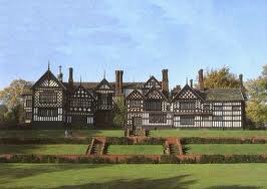
I couldn't help myself but have a look. Question one was half a dozen pictures, one mark each for identifying the items, monitor, keyboard, mouse, scanner (a toughie); question two, one mark each, was to say which were input devices, which output devices. And so it went on. I liked the unknown candidates answer to 'name two things other than name which you would put on an input questionnaire for a sports club database'. His or her answer was 'surname', leaving the second space blank. I suspect the exam standards board will come down hard on the examiner since 'name' did not say 'first and surname'.
Probably ten minutes later, perhaps less, I had my A*, 100%.
White to play and win

Solution
I enjoyed this one; it took me a while, but I got there in the end.
In my initial scan, of course I tried for back rank mates, but couldn't find any. And the black Rb8 is LPDO, but I couldn't find a move which exploited this with a double attack. I also looked at Qh3; Qh5, and even Nh7, all came to nought.
I then looked at 'improving my worst placed piece' and thought that something like 1 Rc2-e2 or 1 Re1 and Rce1 might be a move I would play in practice; in this 'worst placed piece' process I also wondered if the Ba2 should be re-routed to the b1-h7 diagonal.
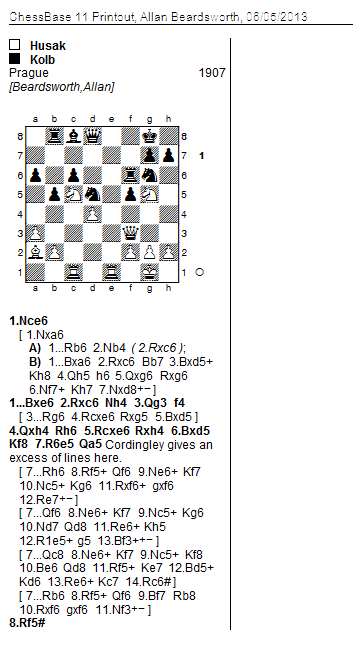
Then, inspiration struck: I looked for smites, even crazy ones, and came up with 1 Na6! from which I saw 2 Rc6! and it is game over. I didn't find it by looking at black's weaknesses, or how to undermine his lynch-pin piece, his Nd5: had I, I might have seen that the Nc5 can be sacrificed as a desperado. Similarly, whilst I looked at 1 Nce6, I immediately disregarded it, though it now undermines the Nd5.
Checking with Houdini, I was surprised to see that 1 Nce6 was played, but pleased to see that Houdini agrees that 1 Na6! is far stronger.
Black to play and win
(Worth looking a few moves deep)

Solution
I was disappointed with myself here, not giving this puzzle the effort it deserved. For a while, I was fixated on 1…Bf4, trying to make it work (I haven't checked with an engine to see if it does) before 'turning the order of moves round' and finding 1…e5! instead, which is clearly the best move.
Alas, I felt this was the solution, whereas it is deeper: I didn't even look at white's defence Qg4, but wish I had, because the continuation is very pretty.
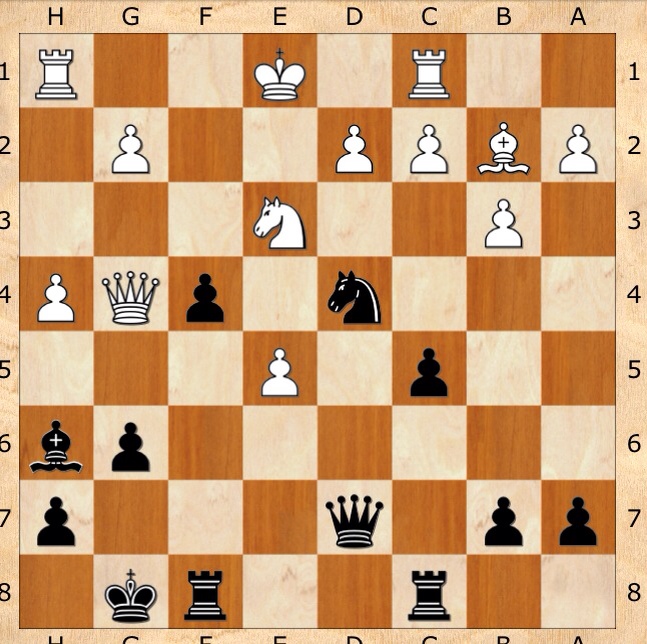
…fe! Is very nice, and not too hard: black gets a collection of pieces for the queen, and the white king is denuded from cover.
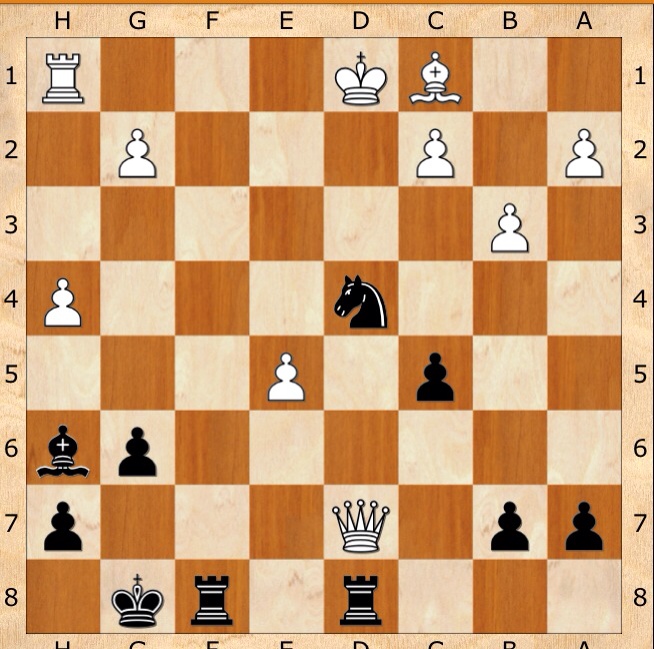
White to play and win
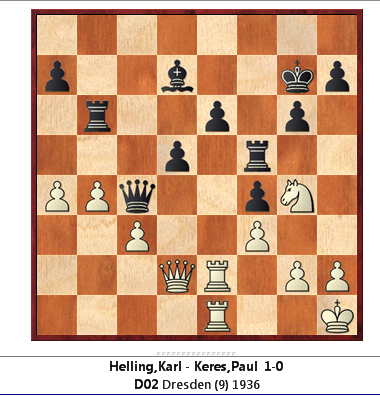
Solution
First, a digression: note who the player of the black pieces is. A quick google, and I see that in 1936 he was 20, and coming to full strength. His Wikipedia entry though does say (my emphasis added):
At Helsinki 1935, he placed 2nd behind Paulin Frydman with 6½/8 (+6 −1 =1). He won at Tallinn 1936 with 9/10 (+8 −0 =2). Keres' first major international success against top-level competition came at Bad Nauheim 1936, where he tied for first with Alexander Alekhine at 6½/9 (+4 −0 =5). He struggled at Dresden 1936, placing only 8–9th with (+2 −4 =3), but wrote that he learned an important lesson from this setback. Keres recovered at Zandvoort 1936 with a shared 3rd–4th place (+5 −3 =3). He then defended his Estonian title in 1936 by drawing a challenge match against Paul Felix Schmidt with (+3 −3 =1).[7]
This puzzle took me time to solve. There seemed nothing obvious, indeed no way to get the queen to the a1-h8 diagonal and start using the black squares; nor any way to get through on the e file. So I had to go through 'procedures. First thing I noticed was that the Bd7 was LPDO; and all black's other pieces were defended; second thing is that if I could get to e7, then Rf7 is impossible, because after exchanging rooks, Ne5+ forks king and queen: so, f7 is 'mined'.
Almost for want of anything else, I looked at 1 Re4, which turns out to be the winning move. I spent a lot of time on 1…Qc7 2 Qd4+ and thought white was then better, but as can be seen in the notes below, my calculations were imperfect. I looked at 1..de also, of course, and thought that white had enough to at least get his material back, and might still have an edge. Houdini then told me that white is in fact winning, by quite a neat LPDO.
A nice puzzle.
I also had a very quick look at the earlier moves, to see where Keres went astray: one of his earlier moves, and his opponent's reply, do seem very odd.
White to play and win
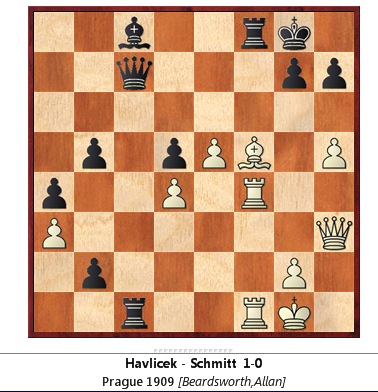
Solution
Fairly self evident, but a nice puzzle: one where it is possible to calculate fairly deeply.
The only move I looked at was 1 Be6+, and all that was needed was to check there was no ridiculous save: there isn't, as the lines below show. Houdini tells me that 1 Bh7+ also wins, but evaluates it less highly than 1 Be6+: whilst I noted 1 Bh7+, being the only other check, common sense says it is inferior to 1 Be6+
 allanbeardsworth