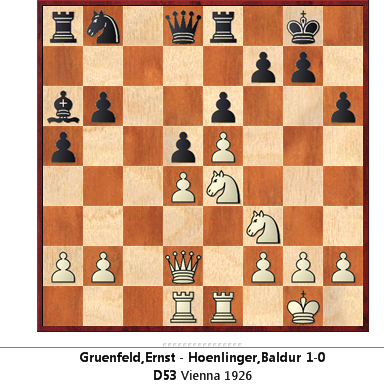
White to play and win
Solution
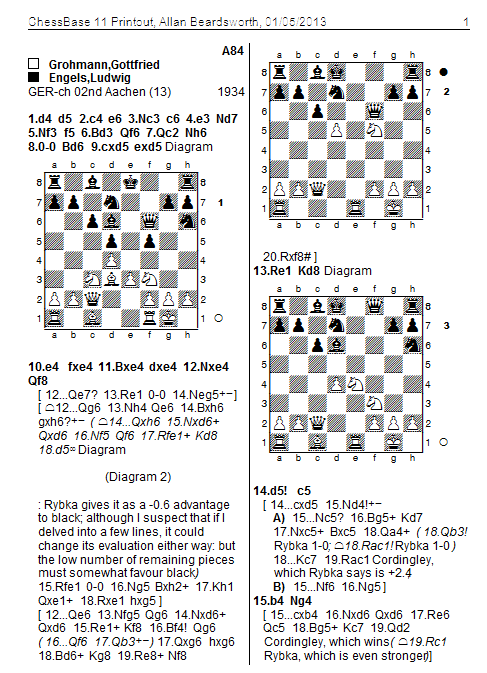
No prizes for finding the first move, nor the follow up. To that extent, it is a fairly trivial problem.
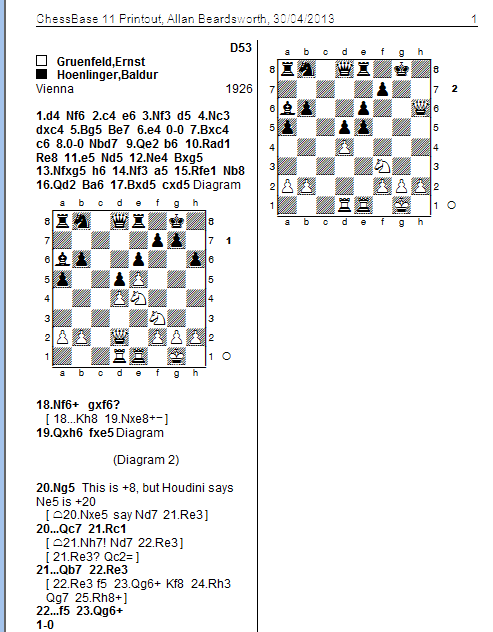
However, a few moves down, shows some subtleties. I chose the line played in the game, with Ng5 and, if Qc7, Rc1 to prevent the entry of the queen to c2; and thus enable the rook lift Re1-e3-g3.
Houdini showed me though that Ne5! is stronger. It still hits f7, and there is no Q and N mate anyway if the N moves to g5; so on e5 it makes the rook lift even stronger, coming with check. Very neat, and instructive.
 Posted with Blogsy
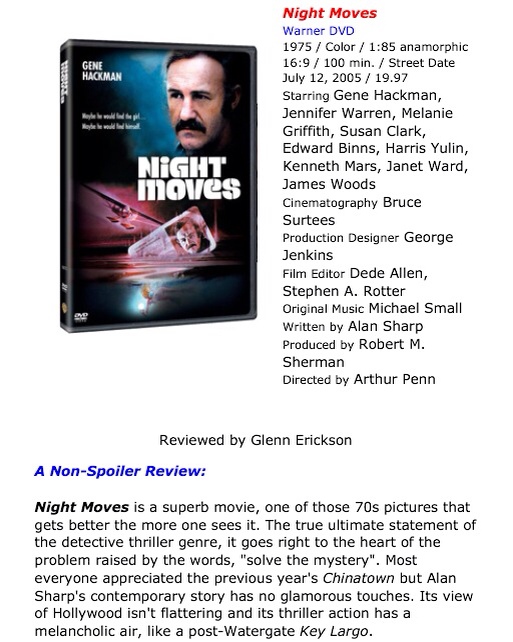
I will lay odds of 100:1 on that within the next 100 days I will have watched the 1975 film Night Moves starring Gene Hackman. Don't take my bet: I have already checked and it is available on iTunes.
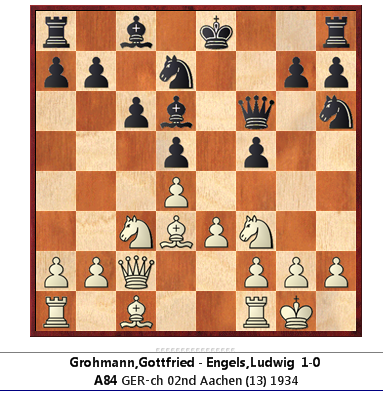
White to play and seek an advantage
(More of a calculation/ideas test than a how to win one)
Solution
For the eagle eyed, the puzzle isn't described as 'white to play and win', because the solution only creates good chances. By doing these puzzles as my daily diet, I am getting some sense of them: knowing when to stop, when I have found enough, or enough for me.
Here, I quickly landed on 1 e4, but my rationale wasn't strong. I quite like such positions for black, and black only needs time to castle, develop, and then has chances for an interesting game: with maybe an attack on white's king: so the solution has to be to break open the centre before black can develop. Clearly, the Nc3 is a better piece to retain than the bishop, so 2 Be4.
I quickly discounted 3…Qe6 and Qe7- can't make sense to be on the e file, and felt that 3…Qg6 had to be the best defence: if nothing else, it pins the Ne4 against the LPDO Qc2. I tried various lines then, and in looking at the three queen moves (3…Qe6, Qe7, and Qg6, also saw lines with d5! and Bf4, and the back rank mating ideas: but I was convinced that white might have something even against Qg6, but the best prosecution of the attack would, for me, have to wait until the move was on the board: there is only so much I can calculate.
When I checked the solution, I never even thought of 3…Qf8, but it is of course similar. But Rybka, which I used for a change rather than my usual Houdini, quickly agreed that 3…Qg6 was best, and from the time I gave it to think, it gave the evaluation of slightly better for black.
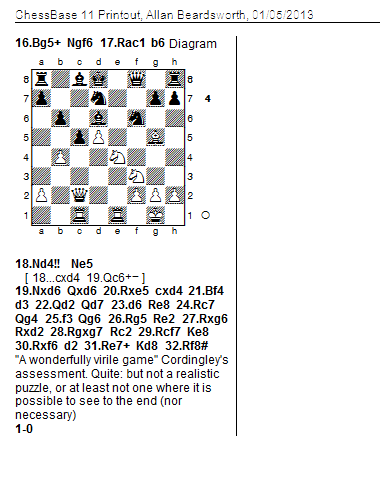
I am now two months into my daily diet, and thought it time to take a breather.
Summary
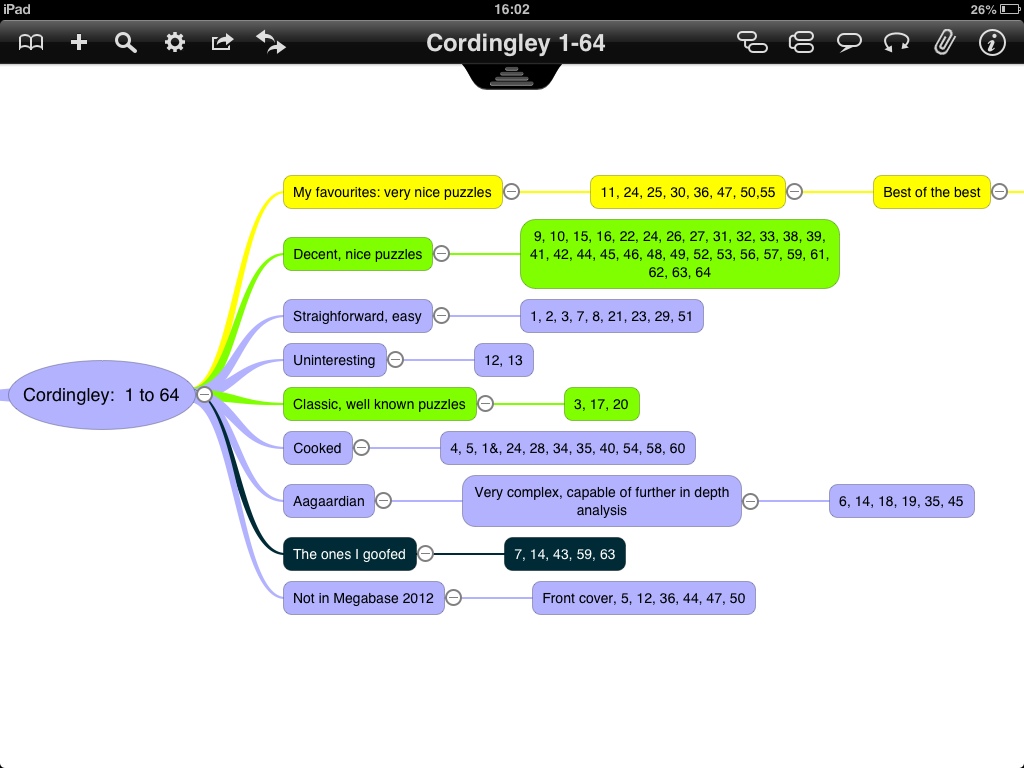
The above mind map is my assessment of the puzzles so far. Readers could help me (and I will both publicise on this blog, and pass to Chessbase) any of the games people can find which are not in Megabase. The front cover puzzle, in particular, would be great to confirm, and if anyone has the game score of Bondarevsky-Ufimstev, I will also pass it to Chess Notes.
Thinking mistakes
I have now characterised ten of my thinking mistakes:
#1 not seeing the winning idea at all, despite trying, especially when the solution, once revealed should have been obvious.
#2 not seeing the toughest defence.
#3 is spotting a good enough move, but not looking for an even better one.
#4 not seeing a backward defensive move.
#5 being on a high, seeing a pretty win, and missing a plain obvious defence.
#6 not bringing all the pieces to the party.
#7 not looking at the geometry, the lines and diagonals.
#8 seeing an illusory brilliancy, and not checking it.
#9 awful calculation and mis assessment.
#10 rushing: not treating the puzzle with the attention it deserves.
Best of the best
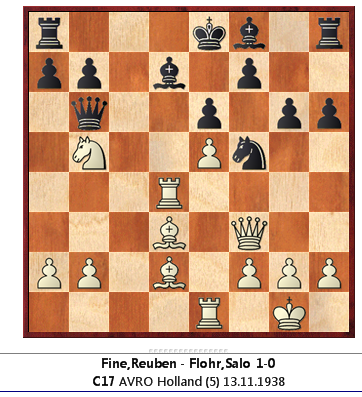
My favourite puzzle so far? I think it is number 55, white to play and win.
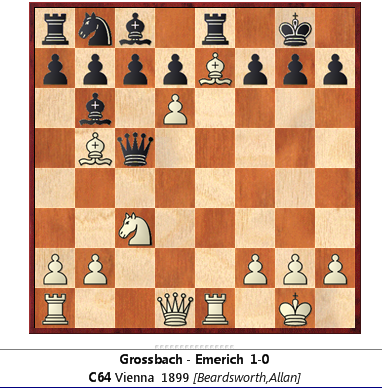
White to play and win
Solution
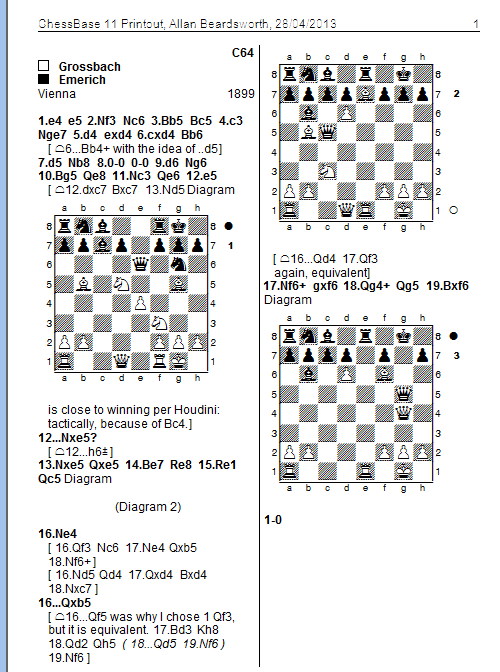
A decent puzzle, but not a great one. Clearly, the motif is back rank mate, with a discovery with the bishop; and white has some time, given his great lead in development, but must be at least on the look out to defend his f2.
I quickly landed on the move played in the game, 1 Ne4, seeing that the white squared bishop is unimportant, and seeing the pretty line actually played in the game. But I thought black had a better defence in 1…Qf5, when white merely has a great advantage: so in the end, I chose the equivalent first move, 1 Qf3: the same threat exists, and white wins either with the same combination or prosaically.
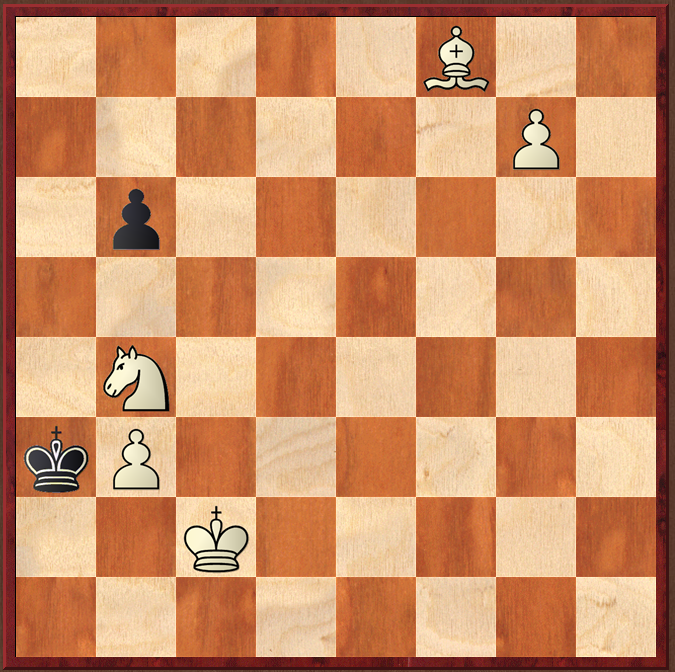
White to play and mate in three
Earlier today I posted this puzzle at the foot of my item about the forthcoming Gibraltar Junior Chess Festival. I thought I would re-post it, with the solution below.
Solution
The trick with this problem is to find a way of avoiding stalemate without releasing the king. I saw this puzzle in a shop window in Gibraltar; couldn't solve it at first, so took a photo with my iPhone, and walked around down the street. After a while, the solution came to me: 1 g8(N)! b5 2 Ne7 Kb4 3 Nc6 mate.
Very pretty,
Round 10 in the Thessaloniki Grand Prix is currently in play. Dominguez Perez has just drawn a wild King's Indian Defence as black against Grischuk, but an hour or so earlier, his co-leader Kamsky has crushed Morozevich after the latter took a poisoned b2 pawn in the closed Ruy Lopez.
The denouement of this game was 21 Ng7! a sacrifice which would have a rightful place in Cordingley or any other puzzle book collection. I loaded the game into Houdini to see precisely where Moro had gone wrong, thinking it was the unusual 20…Bd8. In a way, it was: the 'obvious' (to me, at least) 20…Ne5 is said by Houdini to be level, though I think that is in the sense 'anything can happen'): 20…Bd8 was the second losing move. The first losing move was missed by Kamsky: 17…Nb2?? should have been answered by the fabulous 18 Nd5!! which wins in all lines.
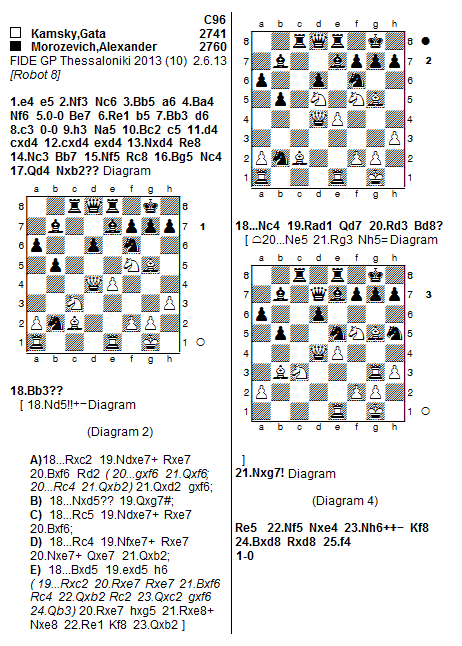
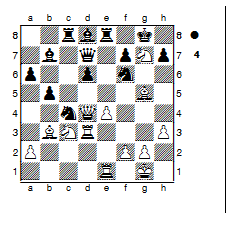
The lines are too numerous for me to visualise: too many loose pieces and too much complexity. But it appears that the threats against g7 are so strong, and black's forces so disorganised, with the Nb2 out of the action, that there is mate or ruinous loss in all lines.
Once an engine has shown you the lines, it becomes understandable. But if a player of Kamsky's standing couldn't see it, there is hope for us all: provided we are playing carbon to carbon matches.
I was lucky enough to be able to visit Gibraltar for work to coincide with a couple of days of their Chess Festival organised by Brian Callaghan OBE and directed by GM Stuart Conquest. I stayed at Brian's Caleta Hotel where the tournament is played, and had a few fabulous days, work in the morning, chess in the evening.
Alas, I wasn't able to go in 2013, but, who knows, maybe I shall in 2014 or beyond.
Meanwhile, Stuart tells me that he is running a junior tournament. The dates are August 15-20. If you know of any young players or families who might be interested, please let them know! The link to the Junior website (with full information) is here:
http://www.gibraltarchesscongress.com/junior/international2013.htm
The first day that I was in Gibraltar, the weather was gorgeous, and the main high street a pleasure to stroll down. Several of the shops had chess displays. One, displayed this mate in 3 puzzle which stumped me for a good while.
Gata Kamsky played what I consider to be the move of the Thessaloniki Grand Prix tournament in his game against Nakamura.
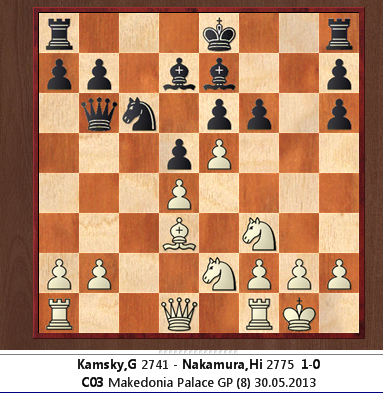
If I were playing white, by candidate moves would be 12 ef ; 12 Re1; 12 Rc1; 12 a3. I would never even consider the stunning move that Kamsky played.
His 12 b4!! could be my move of the year.
When I put the position into Houdini, it wasn't his first choice for a few seconds, but then after not too long, the engine's preferences change, to make 12 b4 clear first choice. It is also interesting to see where the move I would principally look at as my reply as black, 12…Nb4, comes in its evaluation:
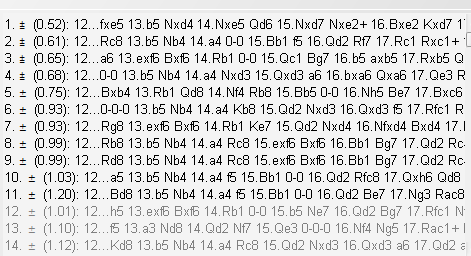
I.e. nowhere.
Of course I could see that 12…Nb4 13 Rb1 creates a nasty pin, forcing 13…Qa5, likely met by a further Qd2, but would start my thinking, if faced by 12 b4, that I should take the pawn and hope to survive.
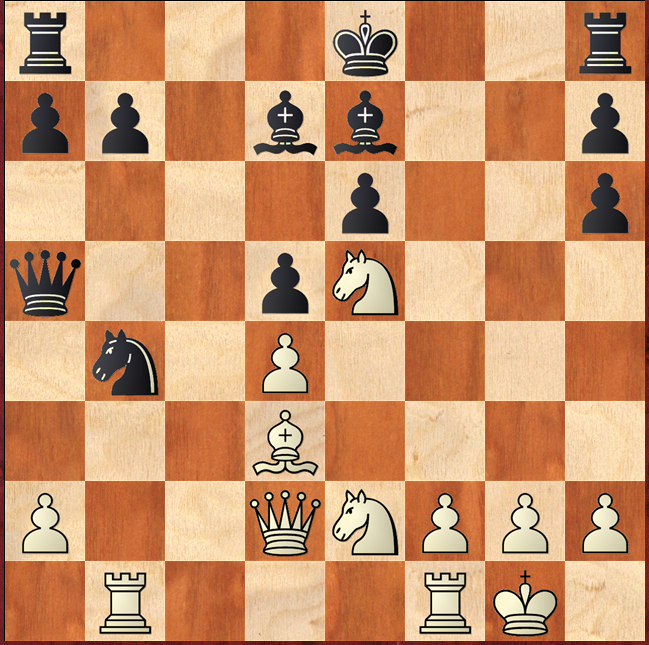
The opening of the b file means that b7 is weak, and if the Rook gets there, it is likely to be curtains for black. So …b6, and hope next move to bring the knight back to c6. But a little time looking at this position with Houdini shows me that white's position is lovely.

I wish I could know what thought processes lead to a GM playing b4.
I am going to ponder this.
I am enjoying playing through the games of the Cuban GM Leinier Dominguez Perez at the Grand Prix I Thessaloniki. With two rounds to to, he is jointly in the lead with Gata Kamsky. He is clearly having the tournament of his life.
The games which are played on workdays I can only flick through after they have finished. I liked his win against Morozevich. In my flick through, I was surprised that Moro resigned after the little move f4, assumed he had had enough, bowing to the inevitable, and I moved on. But, the move f4 nagged me and I decided to have another look. In my flick through, it would not have been obvious to insert f4 gf before playing c7.
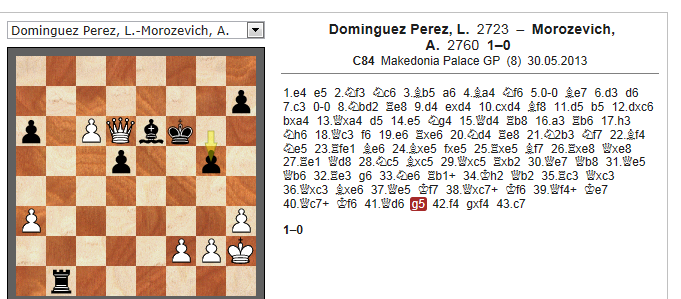
The reason for f4 came to me fairly quickly, and made me smile. It will be time to give up chess when it doesn't give smiles. 42 f4 was not attacking, or not mainly attacking, it was actually prophylactic: black intended to meet c7 with Rc1 but now, once the g5 pawn is on f4, Rc1 is prevented by Qf4+ with double attack on the LPDO rook.
Very neat.
 allanbeardsworth