Recently the Telegraph letter page has been having a 'theme' about toast and toast racks. Two extracts below (the series ran on for several days).


These letters reminded me about the blonde. (And, my blog about is it ok to cheat on your wife if there is a blonde involved, is by far and away my most read blog; somehow I doubt there will be many people searching for 'blonde' + 'toast').
Sarah and I have discussed toast and marmalade at length…from when she was staying with us, and, sans toast rack, how she propped up her toast to enable faster, efficient, even, cooling; and we also talked about marmalade (I'm a Robinson's lemon shred man, myself).
I suspect Mark Robert's credit card sized expanding toast holder is the luxury Sarah would ask for if she is on (when she is on) Desert Island Discs. If I ever come across one, I will buy her one, for sure.
Finally, I think in regards of toast, I am am a bitoastual: sometimes I like it hot, sometimes cold (but always white bread, and mid brown). What that says about my class, I don't know, but Sarah, his clearly a classy girl.
 Posted with Blogsy
I have had some time to look further at Teimour's resignation in his recent game against Kamsky. Not surprisingly, the Nalimov Tablebases do confirm that white is winning, and it is just my lack of knowledge which caused me to be interested. The fact that I have never systematically studied the endgame is thus highlighted.
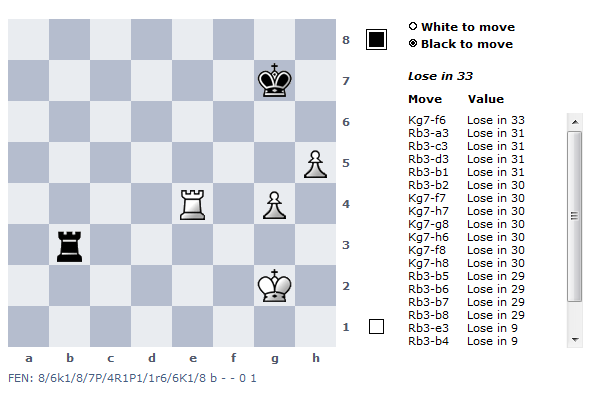
White's win comes in various stages: nothing unusual here, just technique. The first need is to improve the position of the rook, and bring black's king under control. So, after 1 Re4 Kf6, white plays Re8-g8-g6 and then sees what black does. Black's best is to have his king on g7/h7, where there are stalemate possibilities. In fact, there are considerable stalemate possibilities.


What I missed the other day, when playing Hiarcs, was how to improve further, and specifically the point of a subtle, mysterious move, Kf2. I eventually twigged. The idea is that with Ph6, Pg4, Re6, Kh8, white can play g5 without the pawn being biffed by Ra5 (or Rb5, or whichever file the rook is on): if the king is on g2, then after Ra5 g6 black has Rg2+! picking up the g pawn, and drawing. Neat.

There is more to study: Dvortesky's Endgame Manual, or van Perlo's 100 endings you must know, and no doubt countless other similar books, show some of the cases where two connected pawns don't win. I have played this ending out a few times now with Stockfish ( I will challenge Hiarcs when I have mastered the ending) and whilst I can get to positions similar to the above, since I know now the Kf2 side-step, alas!, I do sometimes fall into stalemate tricks: but I have at last beaten Stockfish twice.
Should Radjabov have resigned? He certainly shouldn't have resigned had he been playing a journeyman GM.
Black to play and win
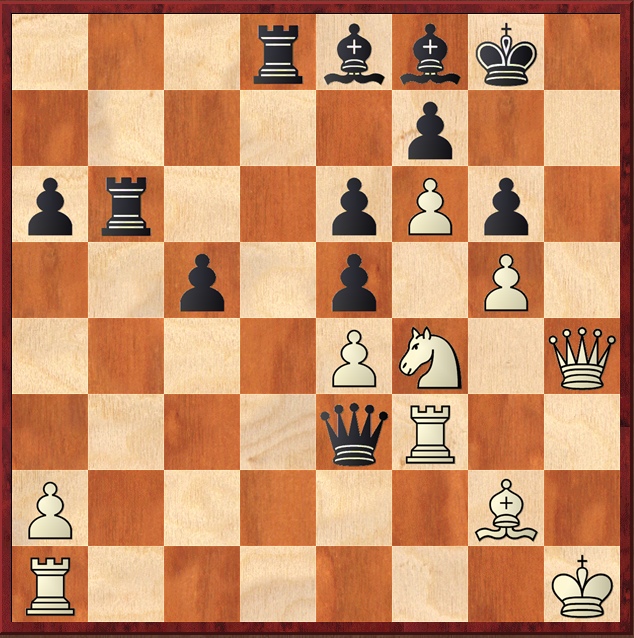
Solution
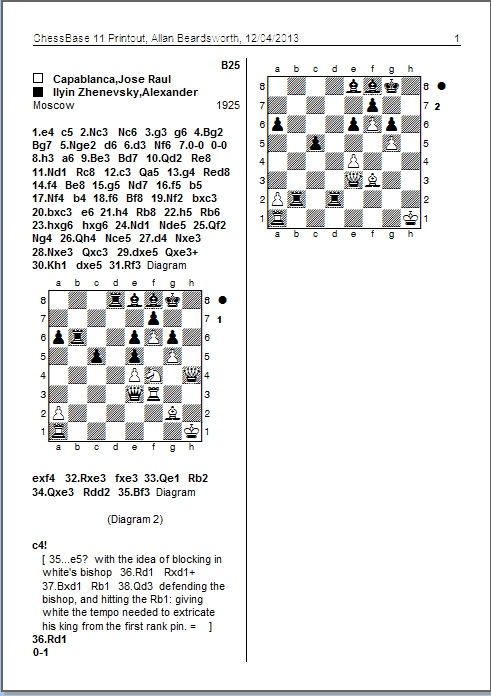
I think the first few moves are straightforward, perhaps for want of better options. Black is almost forced to play 1…ef, which I think is intuitively better than 1…Qf4, since it gives a passed pawn.
The neat point is 5…c4! – a necessary move, time is of the essence, and others enable white to wriggle out.
White to play and win

Solution
A nice puzzle; the first move is obvious, and then it is a matter of calculation: and Bf7+! is key. Once I found that, I was on the home straight with this puzzle.

I was intrigued by the ending of Kamsky-Radjabov on Tuesday (23/4/13, Grand Prix, Zug). Since it was a working day, I could only dip into the games now and then; fortunately, because of the time difference between Zug and Manchester, I can watch relatively more towards the end, when the games can be at peak interest level.
I looked at this particular game at this position, with Radjabov to move. Tiemour had six minutes left for his next nine moves, to the next (60 move) time control; Gata had almost an hour.
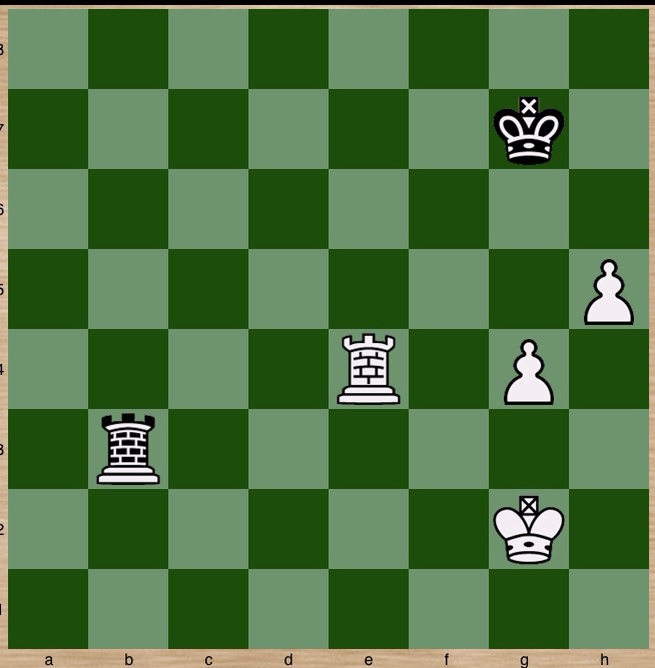
The arrow on the Playchess board showed Re6-e4; I thought it a bit odd, though when writing this blog, I see it was actually Re6 * e4, capturing black's last pawn. As I was thinking (not knowing that the pawn had been on e4) 'why didn't he play 1 h6+ or 1 Rg6+’, and wondering what black would do ( 1…Kf6-g5 seemed favourite, though 1…Kf6 2 h6 might be the move), Radjabov resigned! The exclamation mark and emphasis was because of my shock, not the objective merits of resigning.
Now I don't doubt at elite GM level, and probably far below it, this ending is trivial for white: but lower down in the foothills, where I am, things aren't so clear. I have played it once at 5min (for rest of the game) vs Hiarcs (rated 2925, on my iPad) and couldn't beat it: my lack of time and the threat of stalemate (king at h8, rook at g7, supported by h6 pawn) were too much. I have added this ending to my list of endings to understand…an ever growing, and never diminishing, list.
I have a lot to learn.
White to play and win
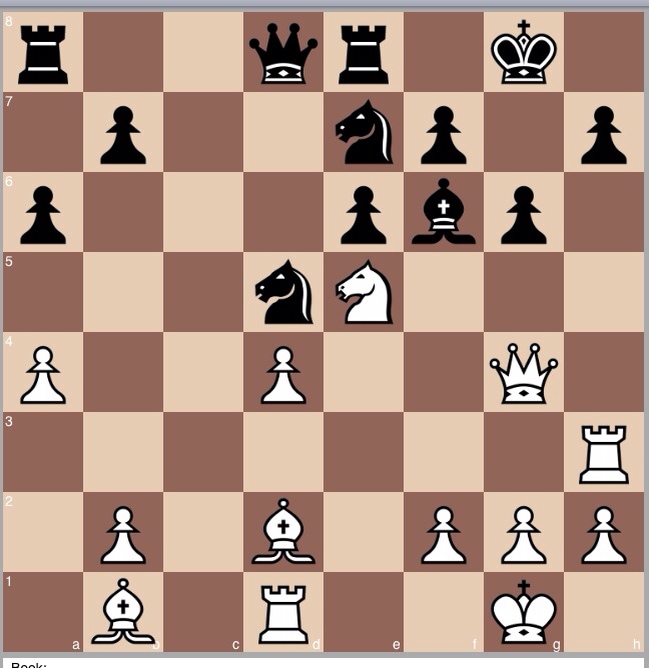
Burn-Johner, Ostend, 1906
Solution
Like puzzles 5,10, 15, 20 and so on, this puzzle was printed in FEN notation in the book. So I had to set up the pieces on the board, and in this case did it rank by rank, starting with the 8th. As soon as I had put the R on h3, I knew the white squared bishop would be on the b1-h7 diagonal, and so saw the solution by sight.
1 Nf7! destroys the king side, and after 1…Kf7, both the pawns on h7 and g6 fall: no need to calculate further: or so I thought, until I realised that after 2 Rh7+ Bg7! is a defence which has to be overcome (2…Kg8 loses trivially to 3 Bg6).
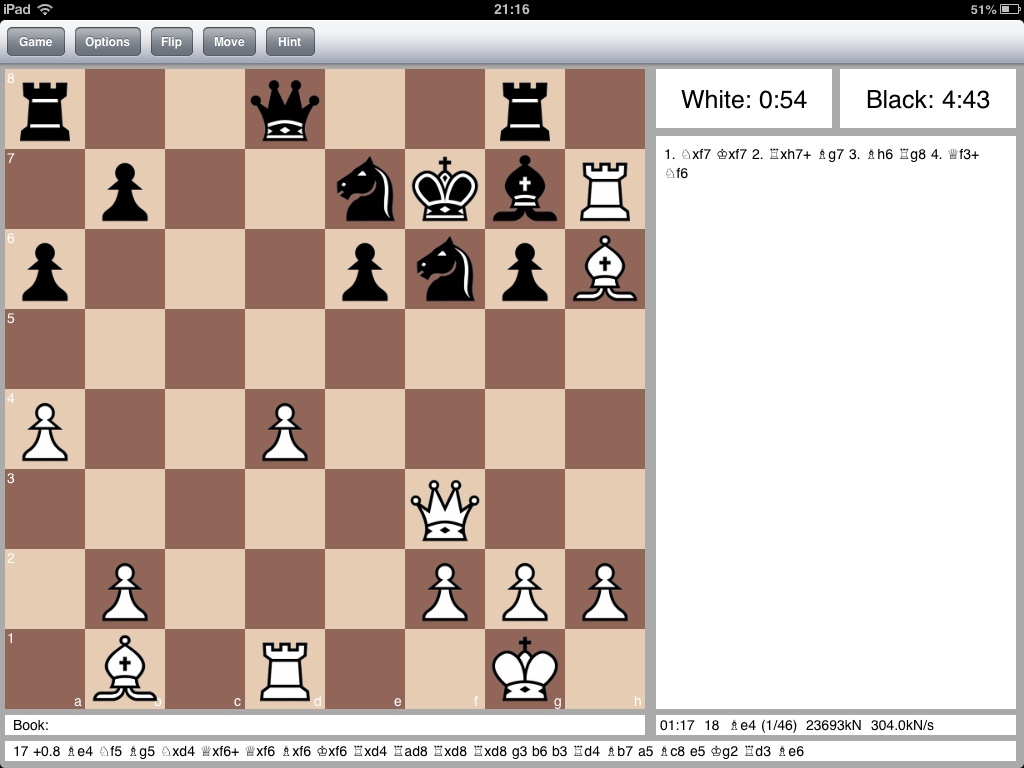
If I had played 1 Nf7 in haste, as well I might, I would start to panic by the time the following position had been reached: it is the type of good position which, at my level, it is fairly easy to fritter away, and peter out into a disappointing loss.
By contrast, if I had seen 2…Bg7, I might not have dared play 1 Nf7 in a classical time limit game, not being able to see to a conclusion the above position: a negative feature of my style of play is to be cowardly, to want certainty, to not have the courage to gamble. I suspect, here, in this specific starting position, I would have gambled with 1 Nf7; not with conviction, but for want of something better: white's position demands aggression on the kingside.
On reaching the second position, I hope I would have found 1 Ba2!, the move Burns played in the game. It threatens to take on g7 and then on e6, so clearly Ned7 is the only defence, when I would doubtless have played 2 g4, and hoped for the best. If I were to be honest with myself, I know I would be far from certain of the outcome. Burn, by a series of excellent moves, makes it clear: though Stockfish does have preferences on several occasions.
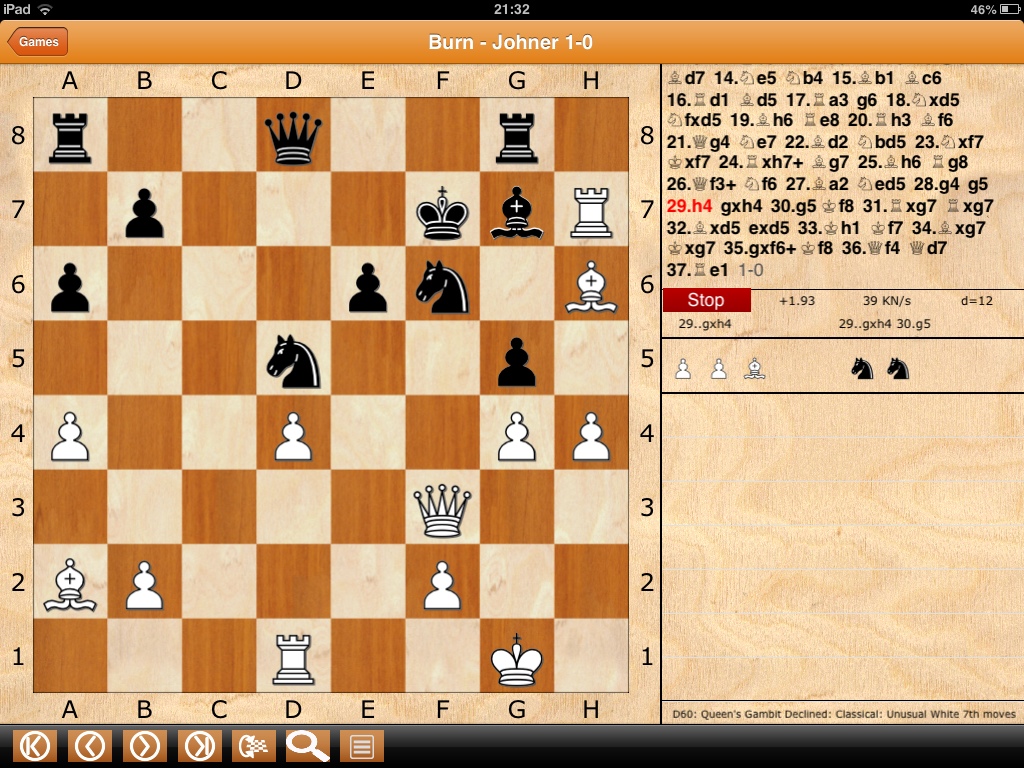
White to play and win
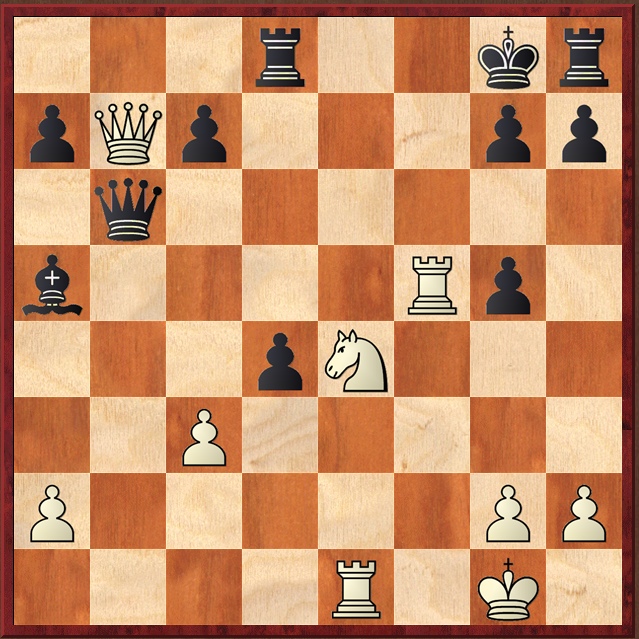
Or, find the win in the game, but also find the hidden flaw
Solution
An interesting puzzle, both for the position itself, but also because of a story behind it.
I am doing my blogs on my iPad, using the Blogsy app (which I am very impressed with, and the developer support is personal, responsive and helpful). Once solved, if I want to analyse the game further, for instance to check variations or write up some lines, I look the game up on Megabase (I have the 2012 version). I am not a heavy user of Megabase, but had assumed that it would have a very comprehensive coverage of older games, especially of the games of top players or the games which get into puzzle compilations. I have been mildly surprised to see the number of gaps. Some may be because of alternative spellings of players' names, but some seem real: and this game, isn't in the database. For some reason I decided to google this particular game- I was hoping I think to have the whole game score as a pgn file- and, lo and behold!- the game is called The Brazilian Immortal. João Caldas Vianna, born in Rio in 1862, was, from googling, the strongest South American player of his era; the game, an Evans Gambit, was called immortal because of the final combination.
I solved it, but also found the 'cook' or flaw: and kept on trying to find an even better solution, but I think there is none. When I looked at Cordingley's solution he too knew of the flaw, though the website where I found the pgn file didn't know of it.
I think I intuitively 'headed towards' 1 Nd6. It is helped by noting such themes as the threat of a bank rank mate; of white square weakness, particularly on the b3-g8 diagonal; and noting Purdy's 'jump check' Qf7mate, do that the c7pawn is pinned, so the Nd6 can't be taken by the pawn; or by the Re8 which has his hands full protecting the back rank. So 1 Nd6 is the natural move to play.
Nevertheless, the solution is pretty: and I was pleased with myself I particular to be able to properly analyse how to overcome black's second best defence, 1…h6, which was played in the game: it took me a while to crack it, until I hit on the idea of a queen check on d5, and a further centralisation of the queen setting up a discovered check battery. Then, the final hard move to find is the lovely Rf6!!: other moves, lead to white's loss- he only just has enough attack to pull through.
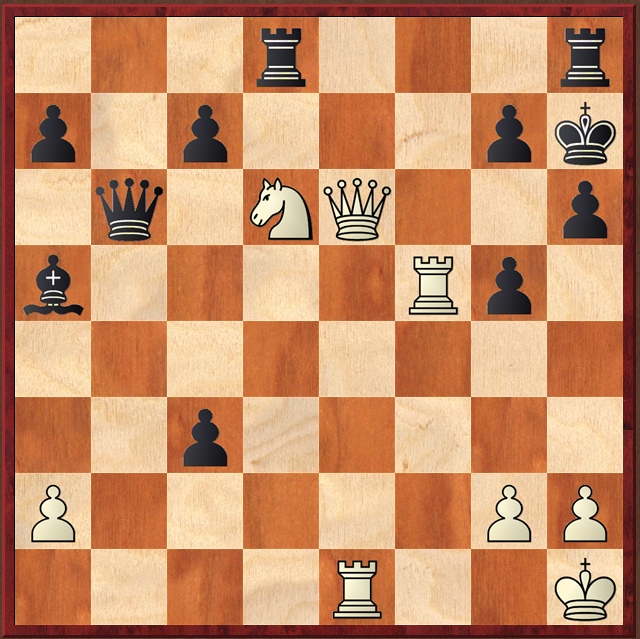
The position before the lovely finale Rf6!!: it threatens Rh6+ and Qf7mate.
The flaw
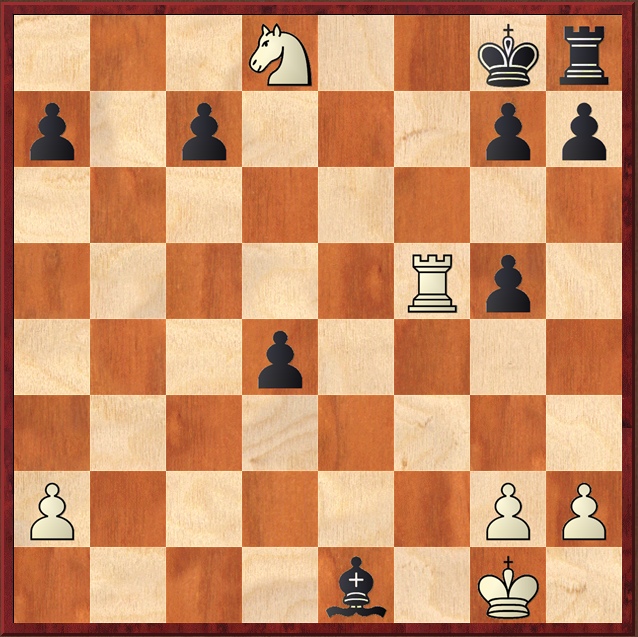
By exchanging queens, black can get to this position: and the best white can get to from here is a defensible rook and pawn ending, a pawn down.
The attached PDF includes both the analysis from the website where I found the pgn file, and my further annotations.
I should stop looking out for moves by the h pawn, but it has happened again, in today's game Topalov-Nakamura.
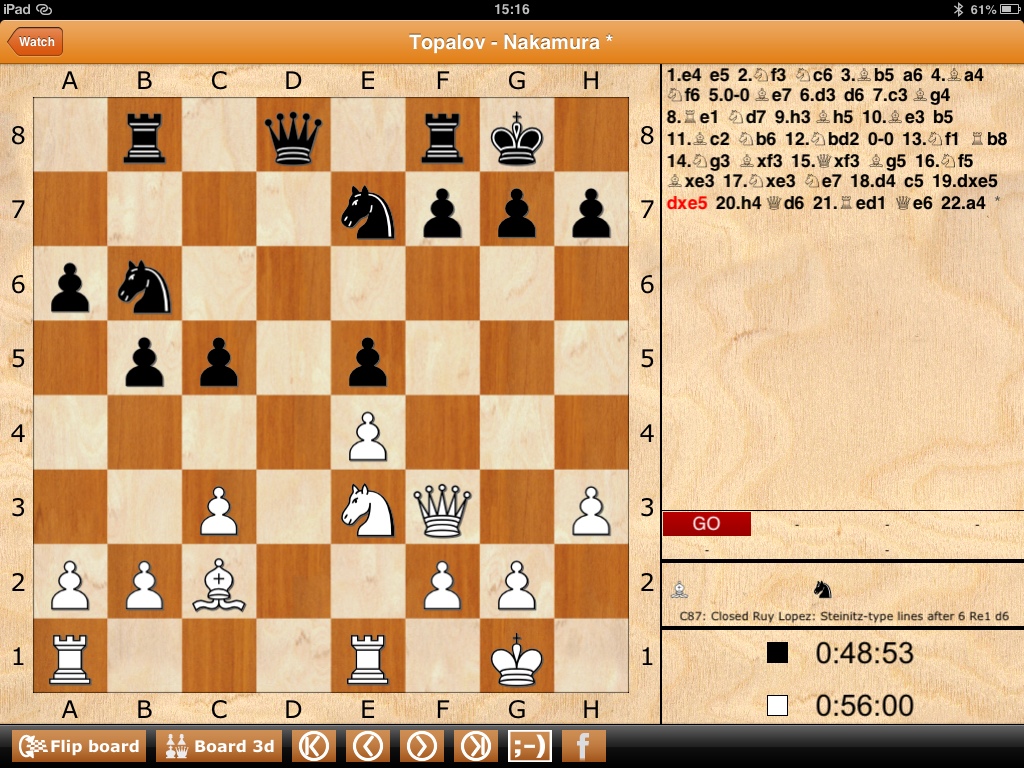
This was the position where Veselin advanced his h pawn. The move surprised me, but less so than in the games in my previous post, since I regarded it as either prophylaxis, discouraging Ng6, which would be met by g3; also noting that black can't possibly exploit the 'weakening' of g4, because of the position of his knights; and possibly, but least likely, I thought, to advance and weaken the king side.
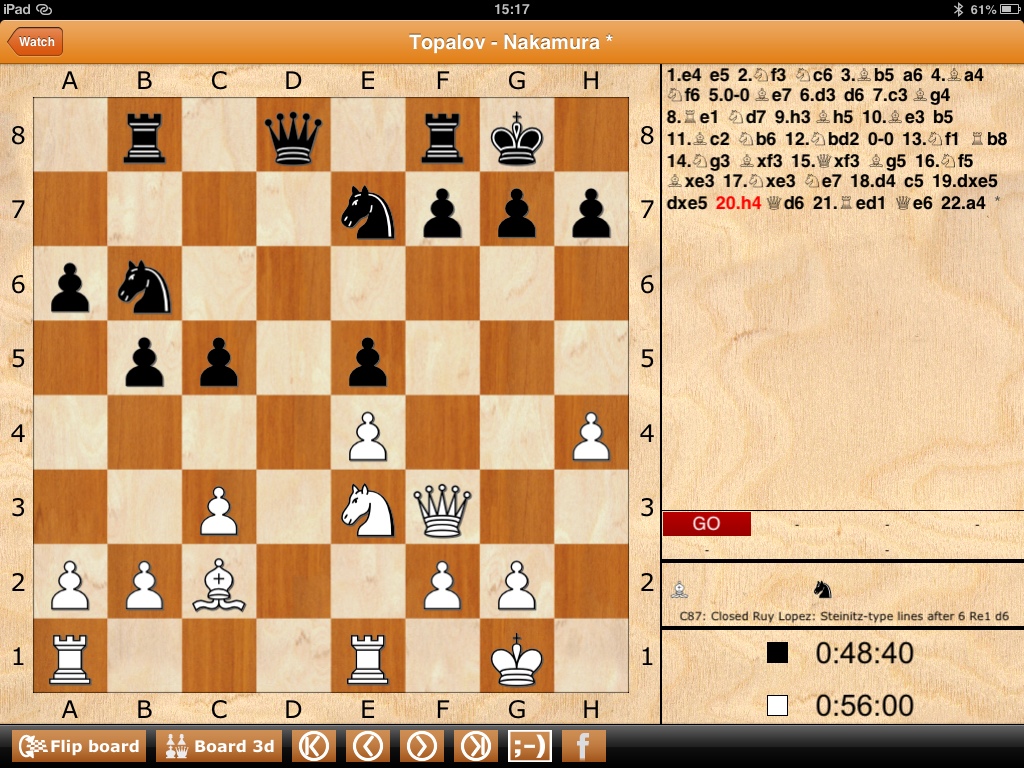
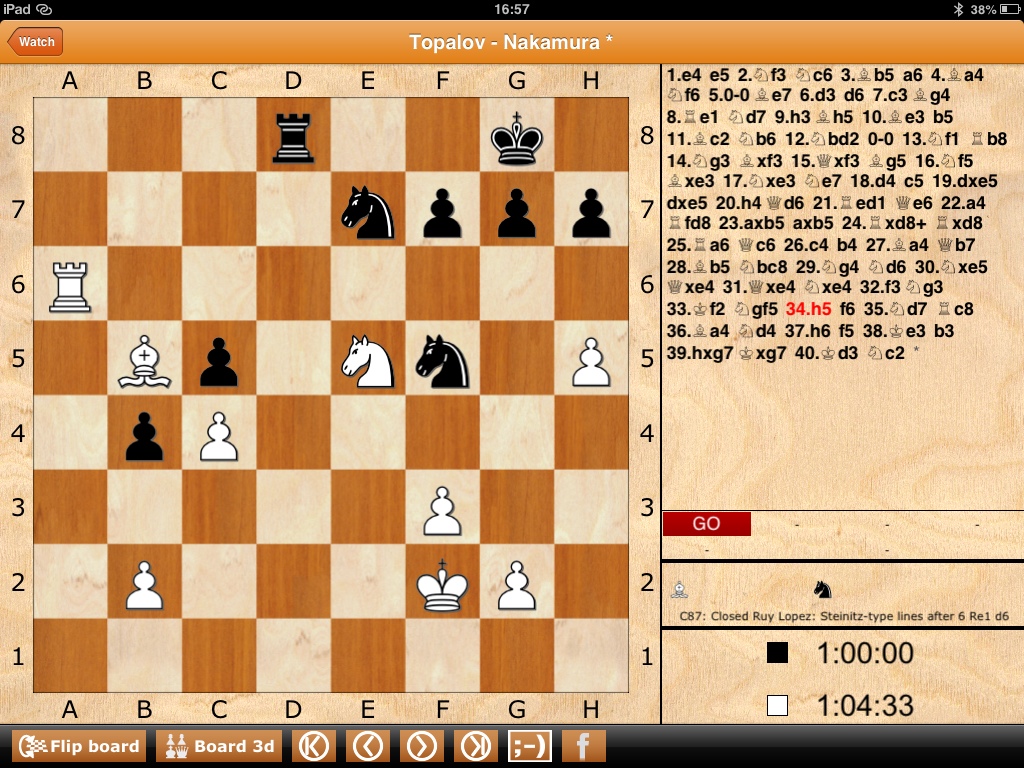
Helped by usage of the a file, in a similar way to Mickey Adam's beautiful Ruy Lopez yesterday versus Peter Svidler, the h pawn has advanced, and starts to cramp black.
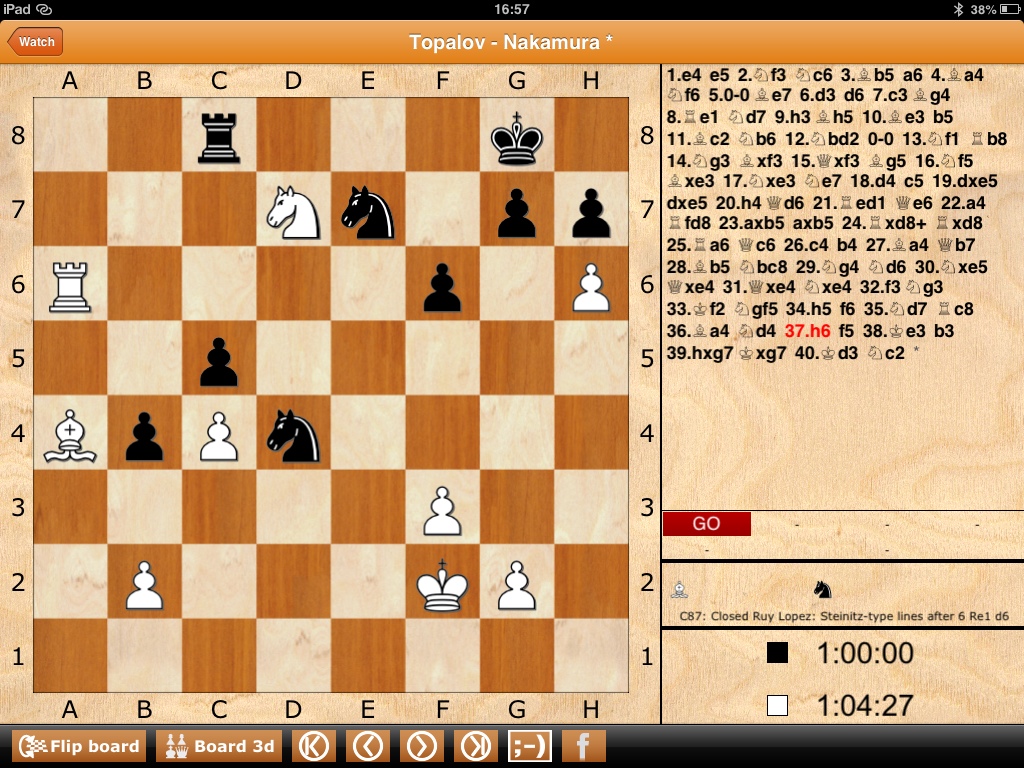
Here, it is now provoking weaknesses. The game is not over yet, and the present position, as I post this blog, is shown below. The h pawn has ruined black's king side structure, and I suspect in Hikaru's time pressure ( he had about 1 minute for his last half dozen moves, to Veselin's 10 minutes, I suspect his …b3 was a losing move ( in a very tough position).
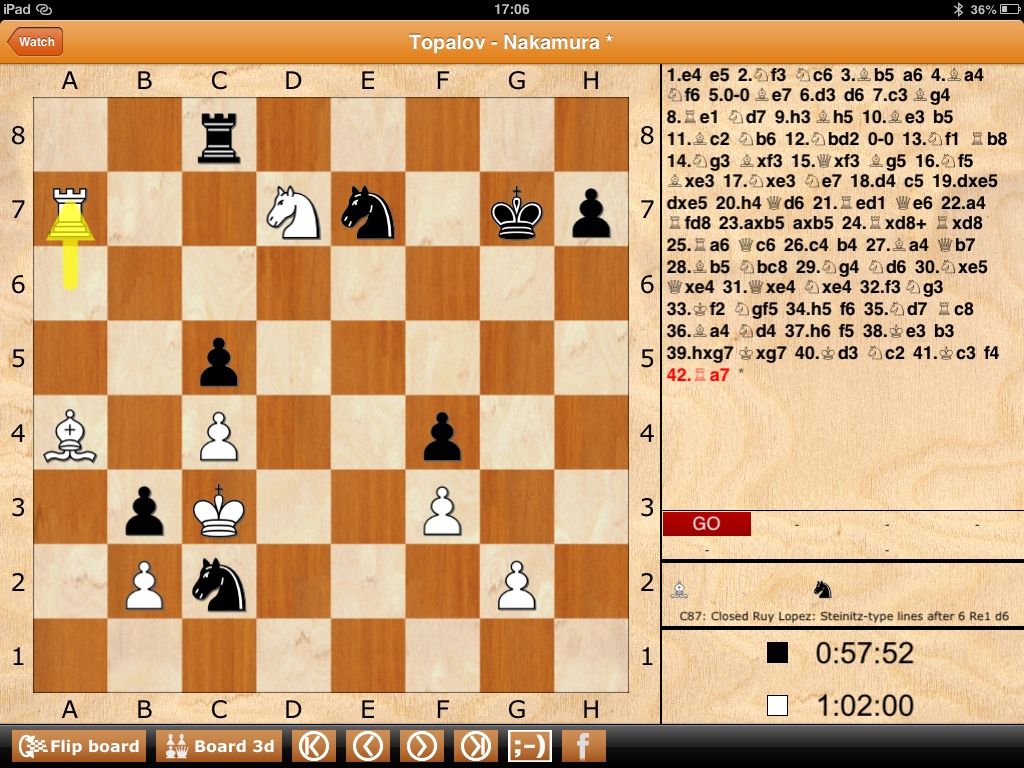
We shall see, and engines will reveal all, but my expectation is that today there will be a fine victory by Veselin: a player whose play I really admire, and who I regret we don't see more of.
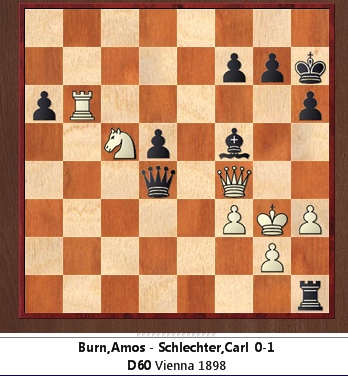
Black to play and win
Solution
Being a problem, this one is elementary: you know you have look for something, and 1…Rh3+ is obviously something you would look. In a game, if you follow the CJS Purdy protocol of examining all checks, again you would find it.
The easiest problem in the book so far.
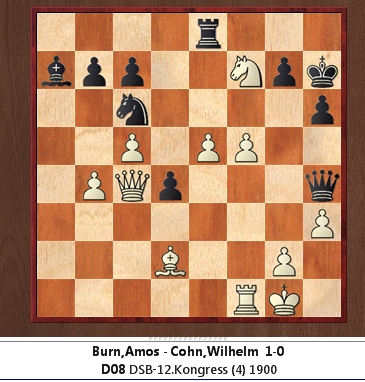
White to play and win
Solution
In a game, almost without hesitation I would play 1 f6, which turns out to be the solution, or at least the move played; and after 1…gf, 2 Ng5+ is not too hard to see, clearing the f7 square for the queen. The move 1f6 clearly opens lines, prising open the black king side.
So far, so good: but Houdini actually prefers 1 Qd3, an example of 'the threat is stronger than the execution'. Having said that, it gives 1f6 as +5, so still amply winning.
 allanbeardsworth