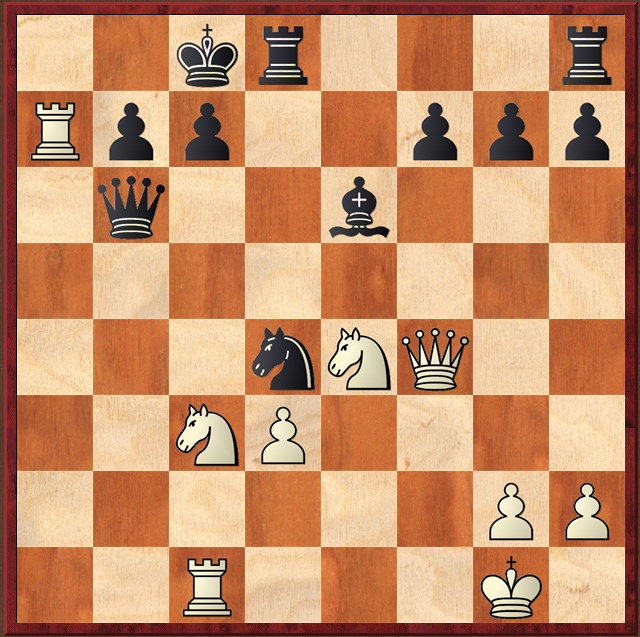
White to play and win
Solution
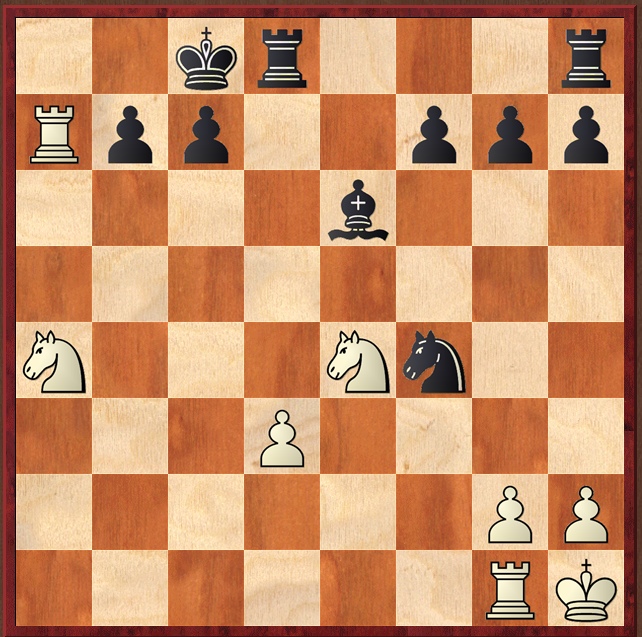
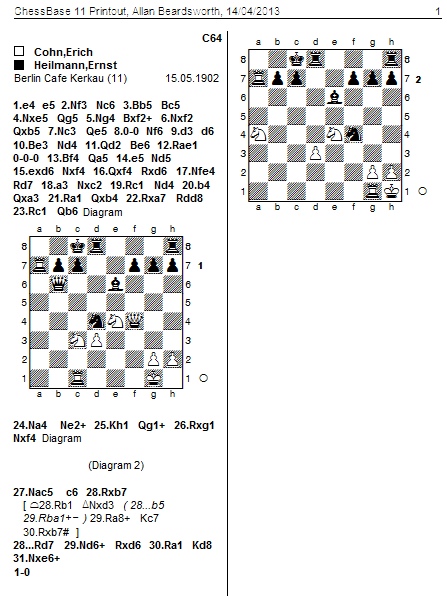
The initial move is fairly obvious: the black queen has to protect c7, so 1 Na4. Black's reply is fairly obvious too: double checking with Ne2+, and a pseudo sacrifice Qg1+: all that has to be seen is that white is winning at the end by Nac5.
Not the hardest of puzzles.
 Posted with Blogsy
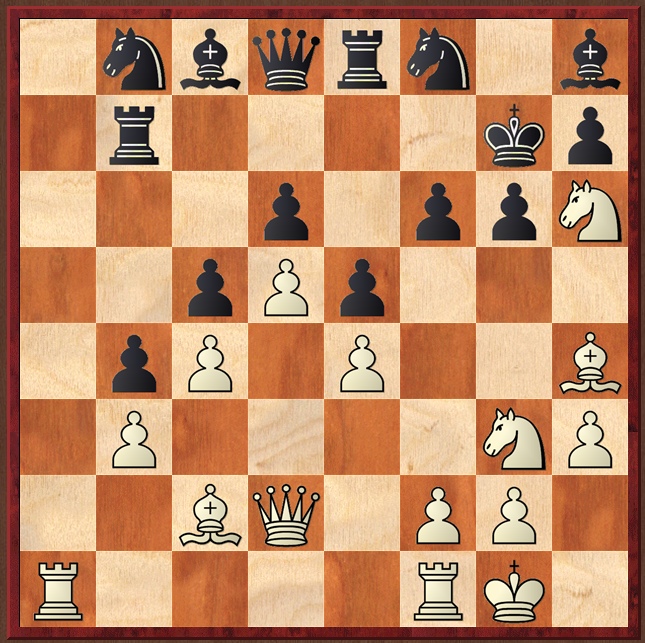
White to play and win
Solution
I didn't please myself here: I got the first move, it was the natural move, the move I would play at bullet, blitz or classical, 1. f4. If my mind could be examined, it wouldn't give this move an exclamation mark, let alone two; and the unclear symbol would also be unfair. No, if Chessbase had a 'fingers crossed' symbol, that is the one to use: I would play the move, and hope it works.
Does that mean I got the solution? Not really, because a few moves into my analysis, I fluffed it. Here my friend, Luke McShane (one of the world's top players, but alas, now, an amateur) told me in relation to another puzzle that things can be easier seen in practice, when the position is on the board. Here, I think what Luke says is true: there is maybe a fair chance that I would have found e6 rather than the weak ef? which I got to in my analysis: I wasn't convinced about it, but had got to the limit of my depth of vision.
I should also say that Houdini also likes 1 Bd1, which I also thought I might play (Aagaard's three questions…one of which is 'which is your worst placed piece'; it also likes 1 Ra8 a lot; but 1 f4 is its favourite, once it has had time think.
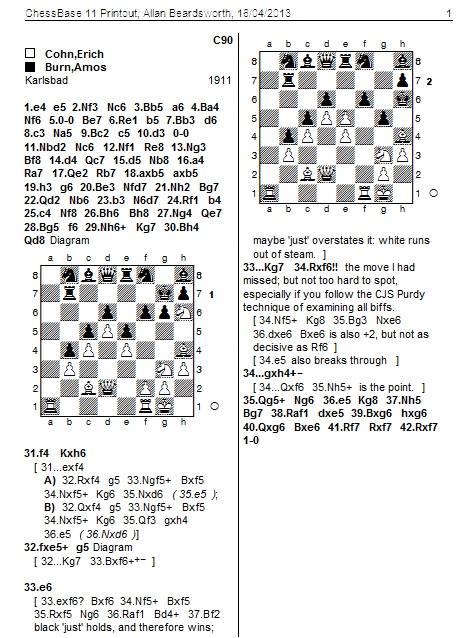
White to play and win
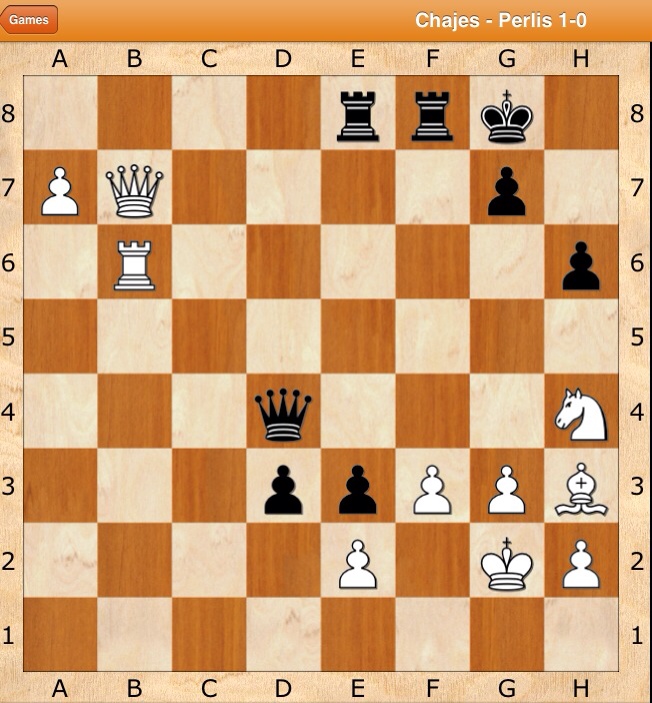
Solution
I was disappointed with myself here. First I looked at a8(Q), quickly rejecting it; then Nf5; and then landed on Be6+, which I then focussed on. Checking my solution with Houdini, it too prefers 1 Be6+, so my analysis was right, but the disappointing thing was my rejection of queening. The game continuation was pretty spectacular: I should have realised that queening distracts the Re8 from controlling e6, and looked at it further.
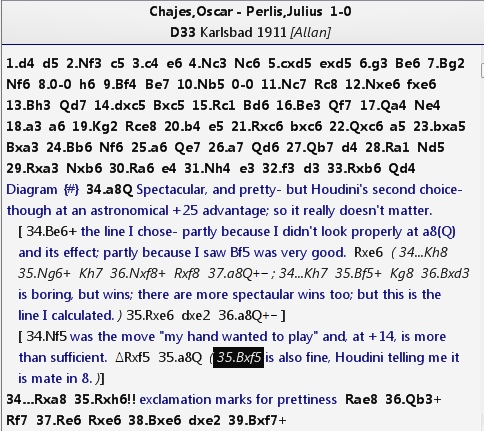
I should add that 1 Rh6+ gets Houdini's top evaluation, +19 for the first minute or so of its ruminations; then replaced by a8(Q) at +22, and Be6+ at +23- all ridiculously high assessments of course. The machine shows a sense of humour in also pointing out 1 a8(R).
White to play and win
(one worth studying and when you find a good line, find a better one)
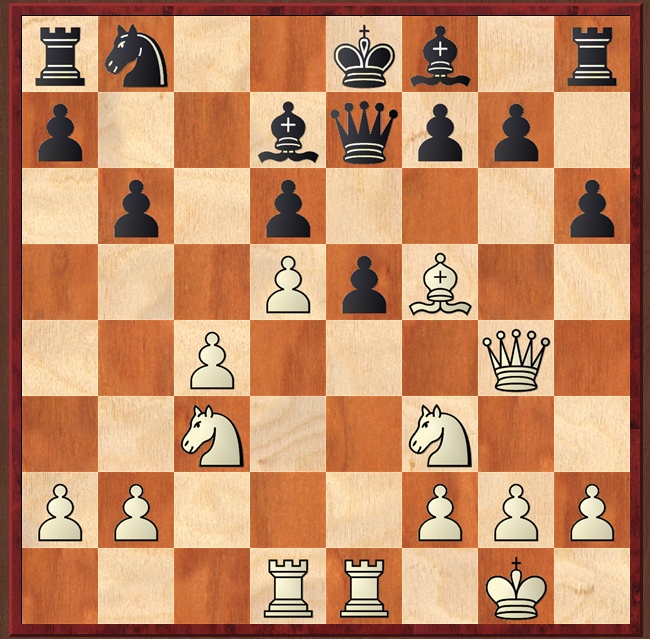
Solution
The first move I thought of, 1 Nd4, playing on the white squares, is sufficient for a good advantage. However, I quickly landed on 1 Ne5!, which was the move played in the game; and I was pleased with myself that I analysed it pretty well, including finding good lines against black’s various defences. The single exclamation mark is important, as we shall see below.
Once I felt I had explored enough I started to write it up in the Chessbase database that I have created for this project. It became a Kramnik-Leko moment (from the 8th game of their 2004 World Championship match, a Marshall, where Kramnik lost right from the opening, due to the same issue: leaving the engine on longer in his preparation would have flipped its evaluation from = to loss. Below is the evaluation after a short while of computation.
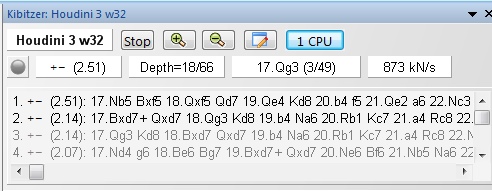
I decided to give Houdini, on my four year old PC, some more time to think. What better than to go and make a cup of tea, the traditional British way to permit time to pass: to see whether 17 Ne5! would appear, and if it didn’t, plan to understand why not. I also at this stage checked the game continuation, and it was indeed 17 Ne5!.
Tea cup in hand, this was now the evaluation:
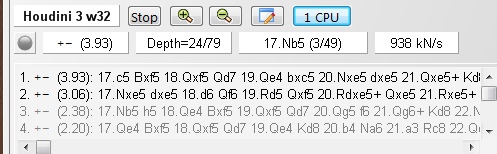
So, 17 Ne5! has appeared, and wins, but a totally new move, 17 c5!! is even stronger. I have written up some analysis in the attached PDF (and also included some light comments on the earlier parts of the game- white could have played even better a move or two before the diagram) and think the position is worthy of further self study and reflection.
I think the reason, of the reasons, why 17 c5!! is strong is quite deep and multi-faceted: and can be used as examples of several features of chess.
When you see a strong move (Ne5), look for an even better one.
Examine all biffs (CJS Purdy) – here Ne5
LPDO (Nunn)- it is clear from a cursory analysis that the Ra8 is in danger of LPDO; but the other rook is also in LPDO danger, and had I focussed on this, then I would realise that if ever black played …g6, biffing what was on f5, then a Ne5 and Qe5+ combination would win the rook
c5!! also creates a weakness on c5, once the b pawn has taken it, and after the following Ne5 combo; the Nc3 will come to e4 or a4 with force; and
c5!! also opens the fourth rank, for white’s queen to come over to a4, for the decisive pin in the main variation.
The last point is very deep, too deep for me to spot without an engine: maybe, stronger players would see it by looking generally at opening lines, for urgency, before black can develop.
The quickest test to see whether someone was born in the 1950s and 1960s is to ask 'who was the six million dollar man'? If they answer Lee Majors, then they were born in those decades; if not, they weren't.
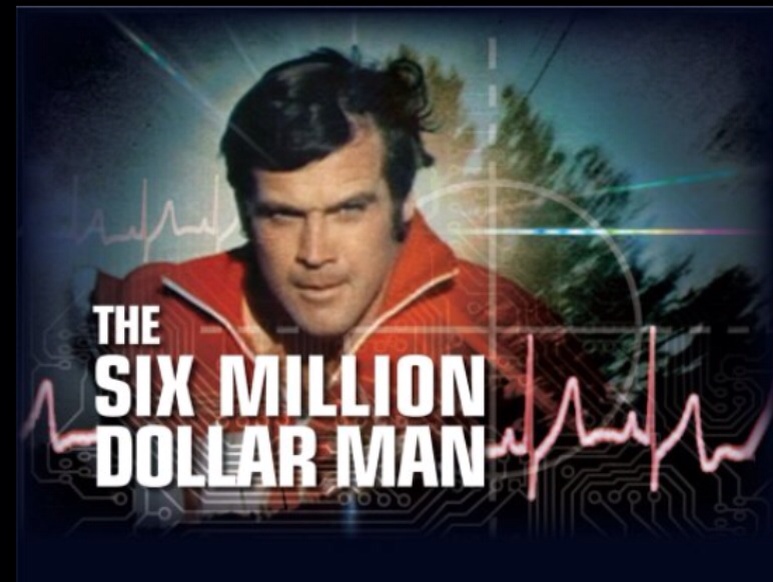
(A follow up question could be: who was he married to, the answer being Farrah Fawcett-Majors, of Charlie's Angel's fame: you now know two or my favourite programmes as a teenager).
Anyway, this blog came about due to this email received this morning, from my sister-in-law, Vicki, one of the UK's top gold- and silver- smiths:
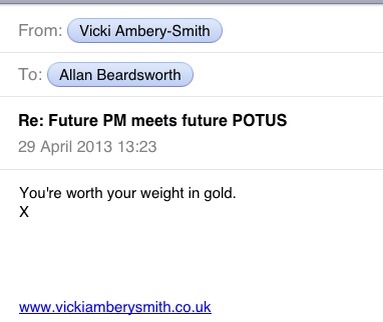
(It was the end of a humorous exchange about something else)
Vicki, with her knowledge of gold, but must know about such things, but I decided to work out 'what would my weight in gold be?'
Bathroom scales can lie, especially with my eyesight, but fortunately I have just had my annual medical, so more or less know my weight, and the gold price is now around $1,470/ounce.

So, a quick calculation, some rounding, and my weight in gold is $4.5million (£3.4million); Jane may not be as lucky as Farrah, but she is still a very lucky girl.
I am really enjoying Veselin Topalov's return to form. I have great memories of his victory on the 2005 FIDE World Championships in San Luis, Argentina, where he seemed to be 'at the top of the world', beating second place equals Anand and Svidler by a clear 1.5 points. That seemed to be his zenith, and Toiletgate in his 2006 match versus Vladimir Kramnik (which Vlad won after a blitz tie break) seemed to finish him: or maybe it was that he was (is) the victim of FIDE politics. I don't know, but great to see him playing so well in the Grand Prix in Zug, which I think he has won with a round to spare.
He deserves it, and one of his moves today, Ph7-h6, explains why.
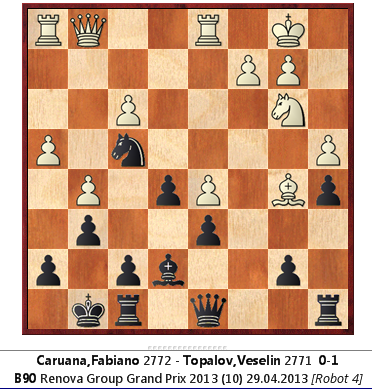
I would have played 1…Rc8 or 1…Qc7, trying to do something on the queen side, or at least improving my pieces; or 1…Kg7, looking to shore up defences before white's pawns advance. Houdini, left thinking whilst I made a cup of tea, likes all these moves, and assesses the position as more or less equal; a more in depth search might have altered the appraisal. But 1…h6! was not in its top six candidate moves.
If I were given the above position as a puzzle, and asked which moves would I not think of, 1…h6 would be one (and 1…h5, another): a move to rule out, because it opens up the king side. But watch:
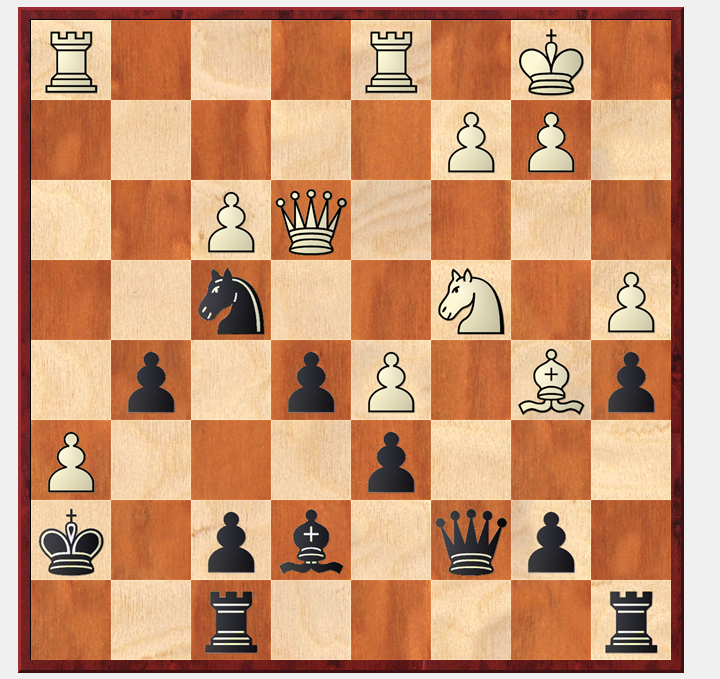
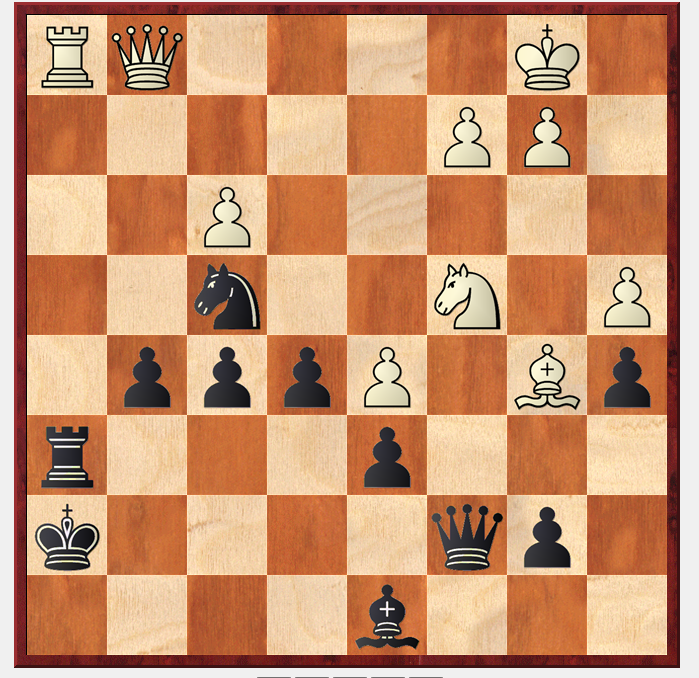
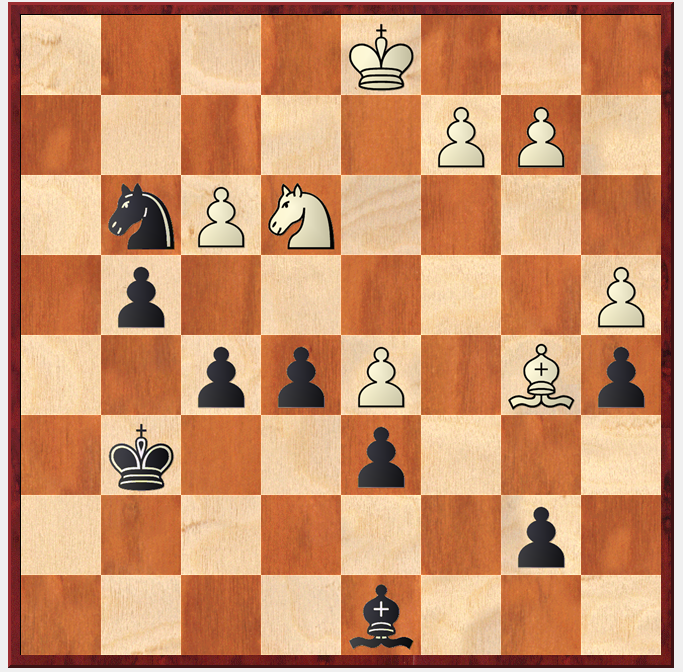
And 0-1 a few moves later. Brilliant: there is a saying that 'you never win a tournament without taking risks', and to me, at my level of play, 1…h6 is taking risks: but Topalov clearly assessed that the move was provocative, provoking the advance of the h pawn which would be unsuccessful in opening up the kingside, and instead would lead to black having a pawn majority and a pawn roller.
I very much hope that Veselin will be invited to further tournaments, and look forward to seeing move of his exciting style.
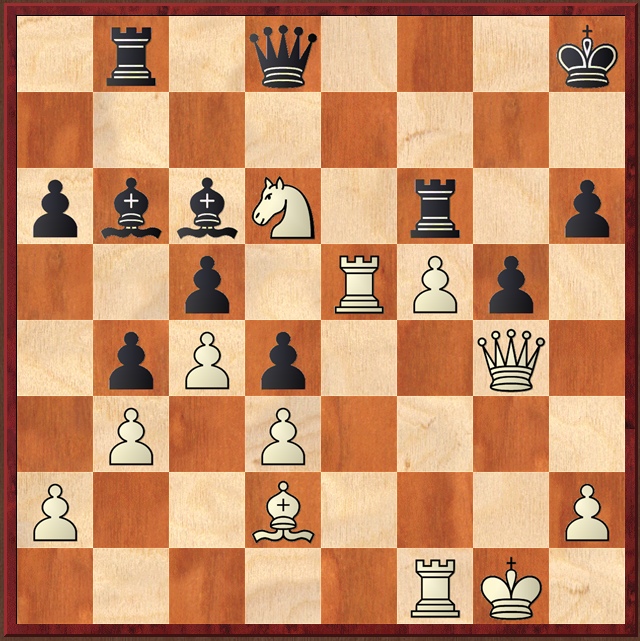
White to play and win
Solution
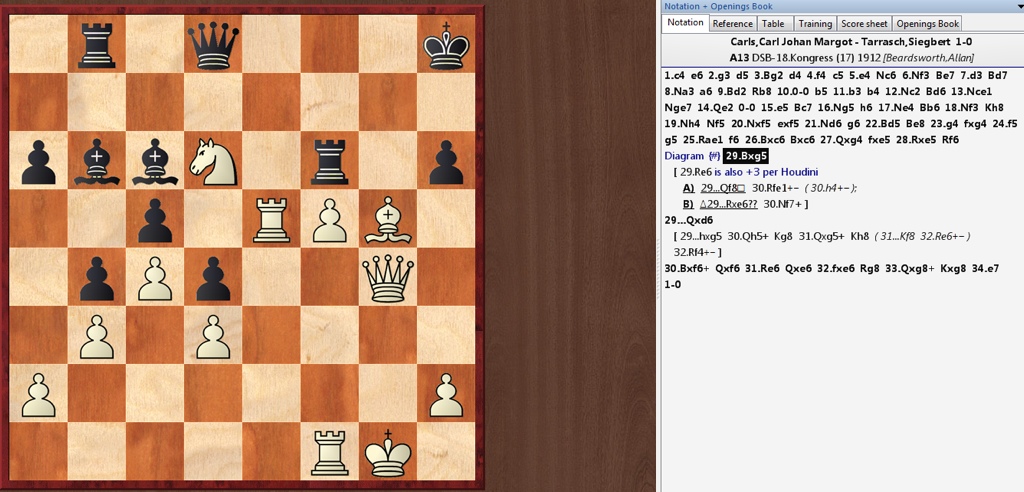
Straightforward: 1Bg5+ can be played with not much calculation; if 1…hg, then 2 Qh5+ wins a tempo before taking on g5. The line after 1…Qd6 is 'linear' (in Kotov's terms, there aren't any branches) and it is not too distant in the future therefore to see that black can't stop the e pawn queening.
For more years than I can remember, I have read the letters to the editor in the Daily Telegraph. Never all of them, never even most of them, but often just the humorous ones and especially those in the bottom right hand corner…that's the place to be.
If I recall correctly, I have written to the Editor about four times myself, during the course of thirty years, and had two letters published: I intend to try to find the other (yes, I will have kept it; no, I have no idea where) but the other day I stumbled across the one below, where I got…the bottom right hand corner spot.
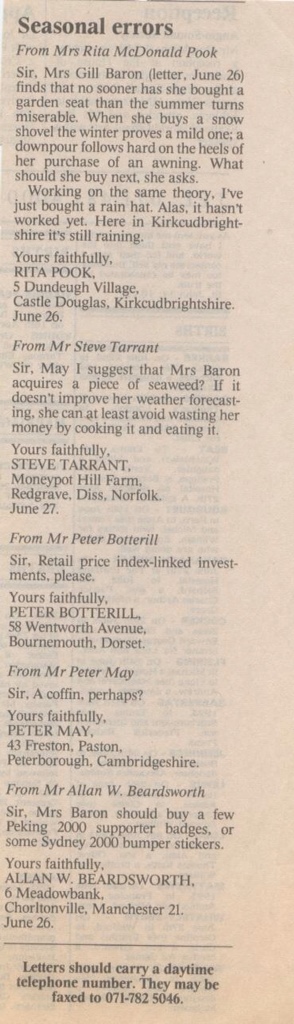
The theme was 'what would be useless' and my letter was written during the run up to the awarding of the Commonwealth games, which ended in being a competition between Sydney and Manchester.
I don't know why I signed my letters in those days with 'W'; it wasn't like, comparing with George W Bush, I was trying to distinguish myself from another Allan Beardsworth.
Writing this blog brings back to memory the fact that I got many calls and some notes from friends who had read the letter…it might even be that the bottom right hand corner is the most read section of the Telegraph.
Life's a lottery, in many senses, including the family you are born into. I hit the jackpot with my Uncle Allan (who I am named after, in case you didn't guess) and Auntie Ann; they are also my godparents, I am glad to say. Uncle Allan was a brilliant brother to my late mother, too, and Ann was in effect the sister my mum never had.
The idea which caused this blog came from dinner last week at my favourite restaurants, Wings, Lincoln Square: what better place to take such special people? Alas, I don't often get to see them, and so I passed round my iPad to show them some pictures of Jane and the children.
Uncle Allan got an iPad for his last birthday and since then has been a veritable silver surfer…never off it, according to Auntie Ann; he therefore knew how to swipe, and proceeded to do so.
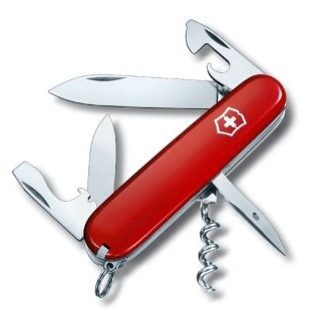
'Why have you got this picture on your iPad?', he asked. There then began a tale going back over forty years. My elder brother, John, had a friend, Lance Lomax, who gave John a Swiss Army knife when Lance returned from a holiday in Canada. If I recall, I got a cheap little tinny car- green, I think. For many years, I then wanted my very own Swiss Army Knife. (I now have several, but rarely use them)….then our conversation got onto other things I regret, and I think, I am pleased to say, there are very few of them, and none are important.
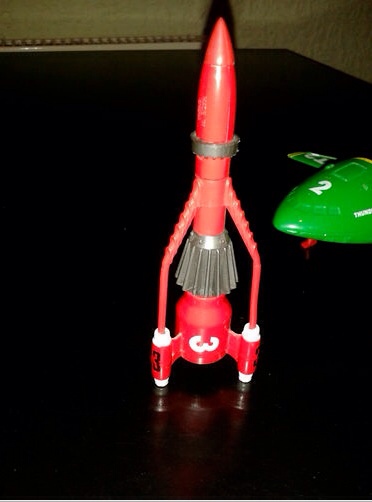
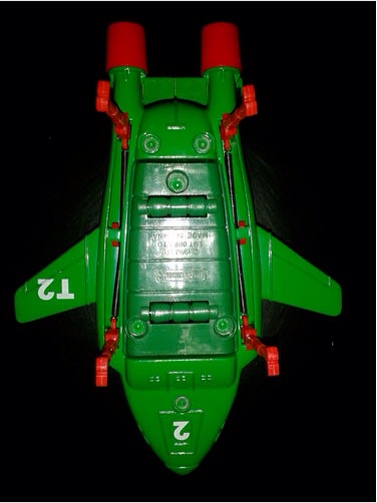
I suspect a Thunderbird 2 was one of my chief childhood regrets. I got a Airfix Thunderbird 3, but it did nothing: the metal T2 had cargo doors, and things could be put inside it. (Writing now, I wonder why I didn't save up and buy one or ask Santa for one).
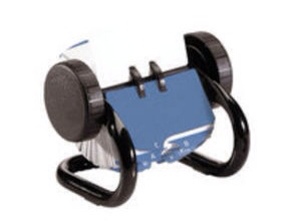
Much later, I wanted a Rolodex. They were de riguer in New York when I worked there in 1993: everyone had them; everyone bar me. When I came back to England, try as I might, I could not find them. It took me many years to eventually find one- I think it was in 1996, when on secondment to London, but it might have been much later . It now sits unused by our hall telephone…by the time I bought it, PDAs were coming in, and now it is truly obsolete.
I can't think of many more regrets (I will blog another time about one concerning a particular book, which has a happy ending). Looking back at the above list, they are all unimportant, and bring to mind one of my favourite songs, Edith Piaf's 'Non, je ne regrette rien'.
I think that that I can say this is pretty good. In fact, being 50 has been pretty good- it has affected me, but in a largely positive way. So far, there have only been two annoyances: the number of spam emails I get for products likely to be of interest to over fifty year olds, and the need to scroll down endlessly when filling in online forms:
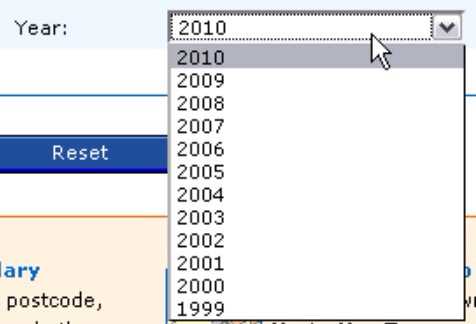
Since marketeers know my date of birth from the countless forms I have filled in over the years, and since cookies mean that many sites could smirk 'I know who you are', why can't they go one stage cleverer, so that the pop up box opens in the 1960s? Or, would that overstep the mark in terms of personal intrusion, such as the time a few years ago when Tesco Clubcard sent me a personal selection of vouchers including several for eczema creams and oils: I know that Tesco know what we buy, and whilst dog promotions for Charlie are clever targeting, telling me they know I have eczema felt intrusive.
Now, where are my Swiss Army Knifes?
White to play and win (sort of)
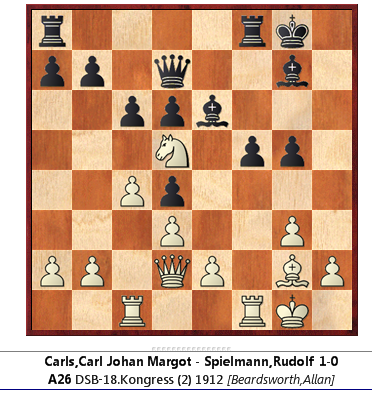
Solution
I doubt it is necessary to calculate far here. White takes the g5 pawn, but gathers enough pawns that little calculation is needed.
In the game, black defended weakly. Instead, Ra-e8 (or even Rfe8) and Re8-e5 puts up a stronger, and natural, defence. Houdini assesses the position as equal.
 allanbeardsworth