Black to play and win.
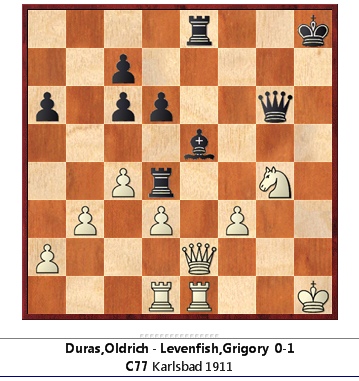
Solution
I think this is virtually self evident: the first move I thought of was really the only move, and all that was needed was some computation.
I remembered the maxim 'if you see a good move, look for a better one', and thought that 1…Qh5+ might be even better than 1…Rg4; but analysis showed it was no better, and in fact worse.
When I checked my analysis with Houdini, I found it odd that, at least until it had thought for a minute or so, it preferred (after 1…Rg4) 1…Qh7+ to 1… Qh6+; though after a while assesses them as precisely equivalent- which they must be, because the queen later comes down the h file. I fail to see why Houdini initially preferred h7.
I stopped my main line analysis at the position below, knowing that there would either be a quick finish, or more likely a long but inevitable endgame.
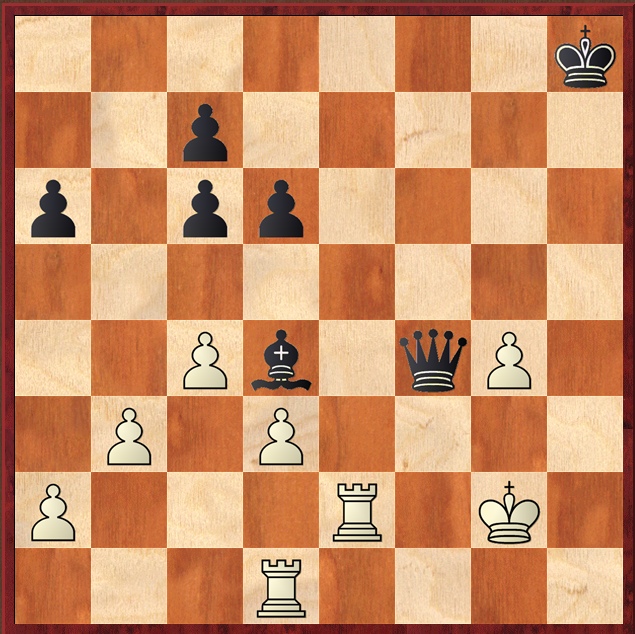
The game reached the above position, and then was a slow win.
https://allanbeardsworth.com/wp-content/uploads/2013/04/game37.pdf
 Posted with Blogsy
I think I have mentioned before in one of my blogs William Hartston's witticism that chess is a net contributor to human unhappiness, because the pain of defeat is far greater than the thrill of victory.
Perhaps so in classical chess, but not, I think, in blitz, but this probably belies the fact that blitz is almost entirely worthless (Jane, please don't read this blog). My opening of choice as white in blitz is the Sicilian, against which I throw my d and c pawns forward…the Morra. It is a fairly rubbishy opening, but that is part of its appeal. If Black declines, either with 3…d5 or 3…Nf6, then he is a coward; and if black accepts and wins, which he often does, well, then it is the Morra's fault, not mine; and if I win, great!
Fairly often, even better, the win can be quite stylish…even if often unsound. Then, there is a net contribution to human happiness, or is there?
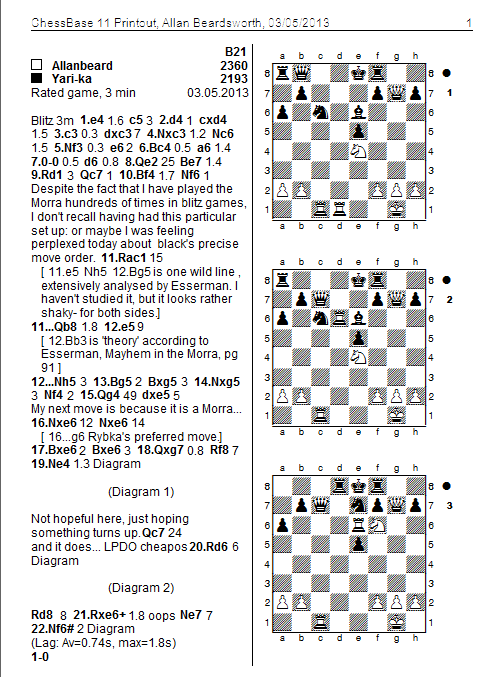
A nice, if undeserved, smothered mate.
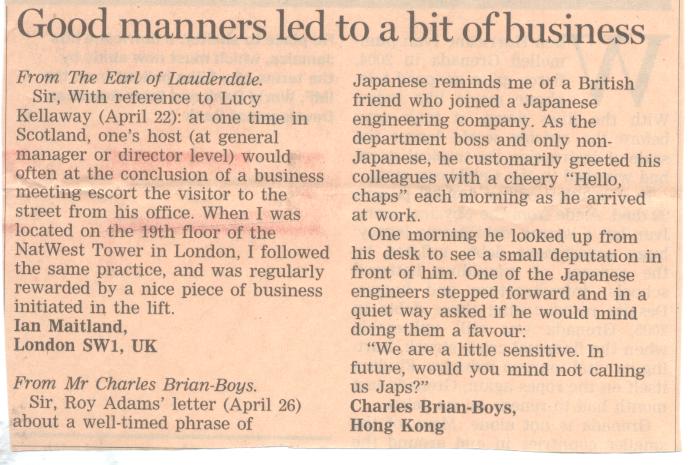
The first letter, from a recent Financial Times, appealed to me. It resonates with me, as something I have done countless times over the years. For the sake of a few minutes before, accompanying the client or visitor to the door, pointing him/her to the nearest taxi rank or where they are heading, or merely getting the chance for a relaxed change of tone pays dividends. Again and again.
Deals have been struck: I remember when, in around 1994, I had attended a very difficult negotiation meeting, where I was the note taker, and the meeting ended in deadlock. The senior member of the other side took us down in the small lift, and, in the descent, he and the senior partner did a deal, broke the impasse, and resolved what to do. I learnt a masterful lesson in that lift.
Similarly, and this isn't always possible, but being absolutely ready for visitors can be the essence of hospitality. We have all arrived at people's offices, on time or early, and then have to sit in reception past the allotted start time for the host to deign to join us. In a client-advisor relationship, where the client visits the advisor's offices, why should the client then have to wait?
Life isn't perfect of course, but I am sure Dale Carnegie would have taken his visitors to the entrance, and been on time for meetings at his offices.
I have long been a sucker for two-by-two matrices.
I suspect the first I came across was the Boston Consulting Group matrix:

One of my favourites, and one which I have used in my professional work, was Donald Rumsfeld's known/unknowns, for which he was ridiculed at the time: I think the ridicule was entirely misplaced.


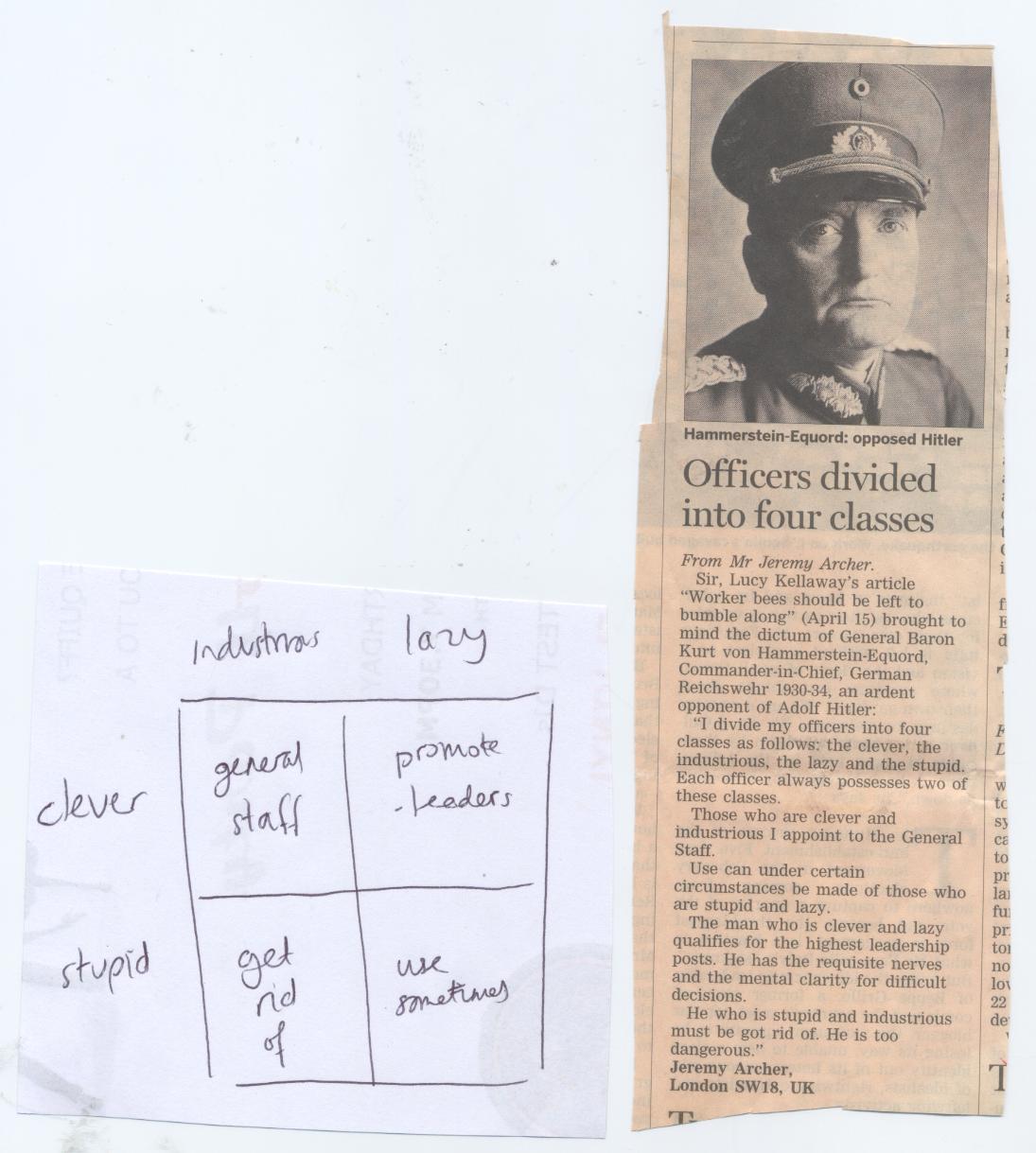
The latest I have come across was from this recent letter in the Financial Times: I converted the officer's classification into a two by two. I suspect, from my own experiences, that there is some truth in his views: for instance, the very highest echelons in business are typically taken by good delegators, aka 'lazy' people.
A colleague of mine told me that Friday, two days ago, was an anniversary, the first, she was not looking forward to. Such discussions remind me of my own feelings, and of what 8th November means to me: it was the day, in 2002, now ten years ago, when my mother died.
I remember her pondering with me, when she was terminally ill in hospital, 'would I remember her each day', just like she thought of her mum, my Nana, each and every day. Well yes, mum, I have thought of you every day since, sometimes more than others, sometimes just in the background. But in different ways to the first two and a bit years.
For those two years, until Spring, I had been hurting, suffering, hopeless: worried about myself, would I ever pull out of it. And yet one day, and I can remember precisely where I was at the time, on our driveway near our gate, I saw the first robin of the Spring, and things lifted.
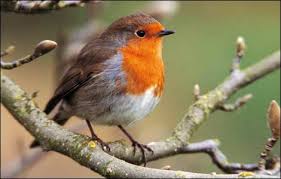
I always feel happy when seeing robin's now. I think they will always bring me happiness, and I can't see one, without thinking of happier times with mum.
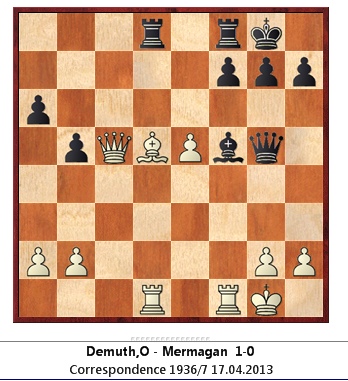
White to play and win
Solution
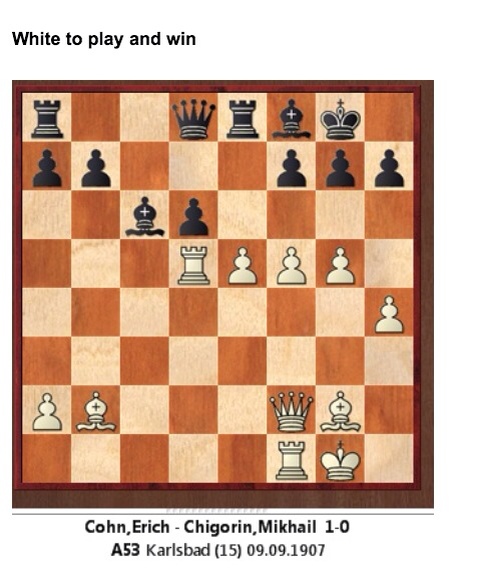
I enjoyed this one. I thought at first of 1 Bf7+, being almost the only check, but didn't think it worked, so looked elsewhere.
The other check, 1 Qf8+, was quickly ruled out. The geometrical alignment of the two LPDO queens was noticed, but 1 e6 is met by 1…Be6, winning for black. The only other biff, 1 Rf5+, achieves nothing.
Like Archimedes, the solution came to me in the bath. Combine e6 and Bf7, with in one line Rf5+.
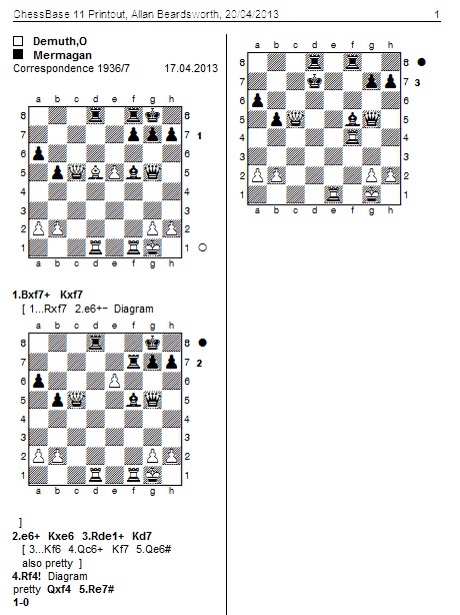
So 1 Bf7+! Rf7 2 e6!! when three of black's four pieces are en prise, and the fourth is LPDO…so something falls. 2…Rd1 3 ef+ and 4 Rd1 +-. After 1…Kf7 2 e6! leads to pretty finishes ( 2 Rf5+? Qf5 3 Rd1 is just equal, probably).
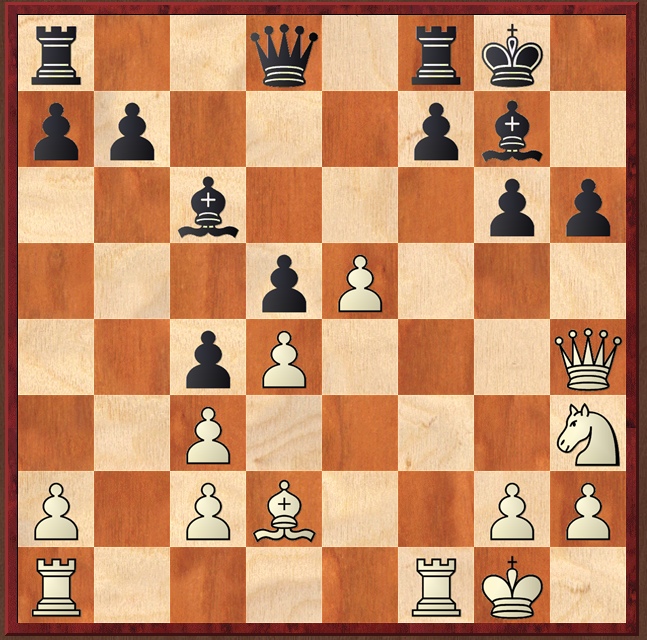
Hint: a calculation exercise, rather than a clear win: I tried this on several sittings, and when I had thought 'enough' looked at the solution, and found it wanting.
Clearly, the first move has to be a pawn break, and has to be either 1 e6 or 1 g6. If instead 1 f6, with some notion of h5-hg-queen to the h-file-and mate, then failure, because the centre is open, and after de, the queen will come to b6: far, far, too slow.
The move 'my hand wanted to play' is 1 e6; my head thought 1 g6 might open more lines, so there is no substitute but to do some analysis. I was torn, but eventually plumped for what perhaps is the weaker move, 1 g6, though I am not convinced.
The problem is Aagaardian, as mentioned in previous blogs: capable of endless deeper and deeper analysis. My instinct is that in practice, either side could win- certainly at my level- with ample room for blunders by both sides.
White to play and win
Solution
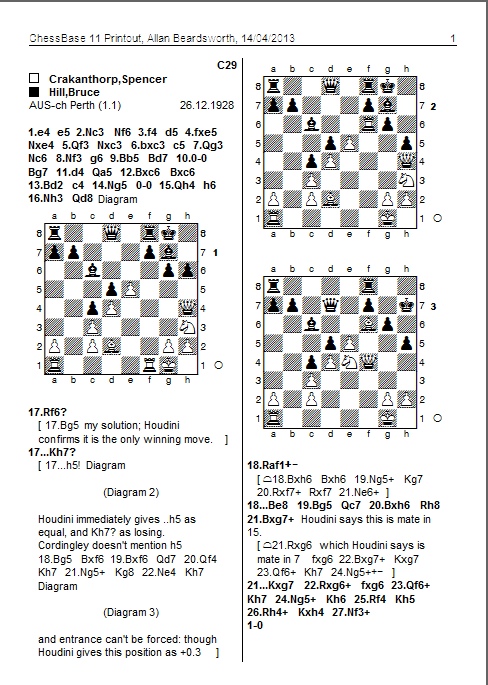
This one surprised me. The first move I thought of was 1 Bg5, and this turns out to be Houdini's strong preference, the only winning move. I didn't analyse much: it was clear the bishop couldn't be taken, because Ng5 mates (or wins the queen), so either f6, which the bishop can take, or queen moves, after which 2 Bh6 is game over.
The surprise was that white instead played 1 Rf6, to which Houdini gives 1…h5!, assessing it as more less equal. Cordingley just gave the game continuation, without any comment.
For years, I have clipped out cuttings from newspapers, scanned articles, saved snippets. Sometimes I send the clippings to clients or friends; often I keep them for myself, quite often I put them somewhere safe, forget where they are, and then one day happenchance upon them.
There is one article which I didn't keep, but wish I had. An article from Taxation magazine, if I recall, or maybe (and I think this might be the case) from its sister magazine, Tolley's Practical Tax, which I used to get twenty years ago.
It is an article which has been a foundation stone of my career. It taught me to also do VICIOUS tax planning, and for years I have told colleagues about it.
In writing about it, I don't need to fear Margaret Hodge. VICIOUS isn't aggressive, abusive or malevolent. It is an mnemonic, a tool to remind professionals to address problems from more angles than the specific one in the client's mind, or the specific one in your mind.
VICIOUS stands for:
VAT
Income Tax
Corporation Tax
Inheritance Tax
Other Taxes
Uniform Business Rates
Stamp Duty
UBR was a 'tax' which, when the article was written- I think in the 1980s, had to be born in mind. I vaguely recall that, for instance, intra-group transfers of trade, which might otherwise be the right thing to do, sometimes caused penal hikes in UBR-because of loss of reductions or reliefs. But the specific meanings of U, O, and others, is unimportant: VICIOUS is merely a tool to say 'don't just think of [say] corporation tax: given some thought to [say] VAT, stamp taxes…, look at matters in the round.
Time and time again, for more than two decades, VICIOUS has been useful to me. It is relevant to my work on a daily basis. Thank you, to the author, whoever you were.
Think VICIOUS.
Jane spotted this in yesterday's Independent.
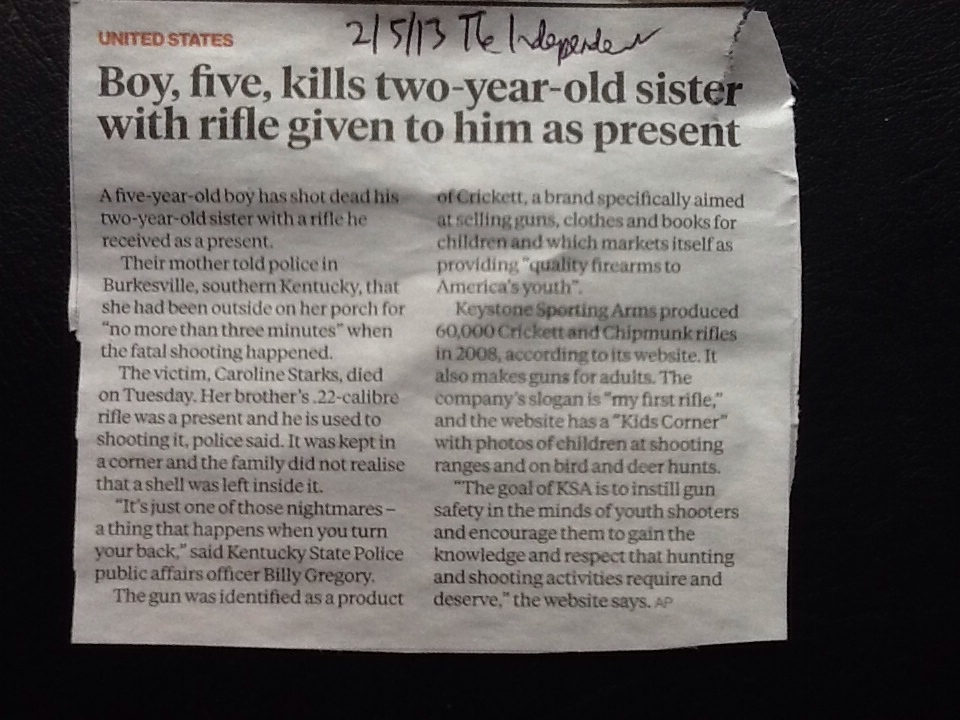
Were we stunned by the policeman's 'shrug off the shoulders' comment, that it is just something that happens? Or of 'my first rifle' or 'kid's corner'? No, alas, we weren't.
Alas, I think President Obama's desire to have some semblance of gun control debate and change is doomed to fail, with mind sets like the above.
 allanbeardsworth