Next year, I will have been at my firm for 30 years. The by-line for my blog is 'things that interest or amuse me' but if I could have a by-by-line, it would be 'but don't know much about'. That alas is true for maths, economics, and even chess….when I am compared with the top GMs. I stopped studying maths at A Level; have never studied economics, and haven't played classical chess properly for decades: but, h/t Internet, that doesn't stop me blogging about them.
And so to CVs. I have never written one. But my advice follows.
The only reason for reading on is that in my time I have seen hundreds of CVs. In recent years I have seen numerous ones for experienced people looking for jobs, whether in industry or in practice. Some are good, but most people present themselves poorly.
In brief, I recommend much of what is said in the following article.
In particular, most CVs I see could be vastly improved by having key messages, initial statements, headlines. The attached article begins with:
If you are a recent graduate, a 2-3 page CV is fine. It needs to be brief enough to read through quickly, but not so brief you cannot sell yourself in it. People believe human resources staff read a CV for ten seconds and then decide whether to interview the candidate or not. This is not true. They look at a CV for ten seconds and then decide whether or not to continue reading. If they do, they read for another 20 seconds, before deciding again whether to press on, until there is either enough interest to justify an interview or to toss you into the “no” pile.
I suspect that if CVs could simply have such key messages, then their improvement will pass the 80:20 rule. The rest doesn't matter too much.
 Posted with Blogsy
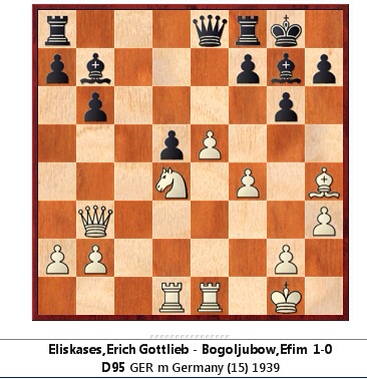
White to play and win
Solution
This was another which came to me more or less instantly. The first move, 1 Bf6, is obvious enough. One of the defences I tried was 1…Bh6, from which I saw 2 Nf5, biffing the bishop, and if the knight is captured, the queen swings over to g3: game over.
Black has alternative defences, such as Qc8, defending f5, but then the pawns break black's defences.
I will always remember my final dinner at Clare College, Cambridge. I am not proud of what happened; not ashamed either, just amused.
Our Master, Professor Robin Matthews was a distinguished economist. I had got to know him having been invited to tea at his lodge, because he was an ardent chess problemist: throughout my time at Clare we often corresponded, and I think I still have some of his letters to me. I even recall a particular opening he was enthralled by- Prof Matthews was a weak practical player, and his favourite line was nothing special. But the fact that we knew each other was relevant to what followed.
Prof Matthews gave a memorable graduation speech, installing the graduates with pride, ambition, and fellowship. The type of talk which is given year in, year out, at colleges worldwide, but, for me, one of the most memorable and moving speeches I have ever listened to.
He spoke to the audience: caused reactions. This year, in the sciences, the boys have done better than the girls. (Thunderous roar). Pause. But also, in the arts, this year, the boys have done better than the girls. (Even more stentorian rumbling). Pause. But, overall, the girls have done better than the boys. (Uproar, shrill laughter: I can picture the scene vividly now, thirty years later).
How could this be?
Sitting near me was Tom, a 'wrangler'. The term wrangler had dropped out of express usage by 1984, but everyone knew that Tom was one of the university's best mathematicians. (It was the existence of people such as Tom, who were incredibly gifted at maths, and who would get the firsts without seemingly doing much work, which made me decide to do engineering at university instead). I too had got one of the top four firsts that year in Engineering (if truth be told, I don't know this for absolute certainty- it was known that two of the three Clare students who got firsts were in the top four; the senior engineering tutor at Clare, hinted it, and my friend Andrew, who got one of them, believed he scraped a first, and it was accepted that Paul and I had got the top places). Anyway, people near us turned to Tom and I for an answer. Was it possible? No, we both decided.
I don't remember the rest of Prof Matthews' speech.
I do remember going up to him as soon as the dinner was over, and asking him had I heard it correctly, how could it be? His answer was perfect, coming from him knowing me: I am surprised at you, Allan. He then turned away.
Anyone who knows me will understand what I then did. Whilst everyone moved to the 'buttery', and I followed, I found a quietish area to go away and think about it. I don't know how long it took me, long enough, but not too long….but I found it. I then went to find Robin, told him with a smile 'Very nice', we laughed, and he wished me well for the future.
We never spoke again. I shall always remember Robin, and this problem.
Chessvibes.com and Chessbase.com have given 'game of the round' plaudits to Vishy Anand's great victory over Veselin Topalov, and I too am in awe of that game, which Vishy played to near perfection. It will be one of his top games for any future collection.
My 'move of the day' (which could have gone to Vishy's 35 Be6!!) goes instead to Magnus Carlsen's 10…b5, with the prize 'most humiliating or humbling move' because both Naka and Magnus thought the move as being nothing special whereas to me, it is a move which I wouldn't have even thought of. In fact, I also liked Magnus's whole way of defending against the Vienna: a quick Na5, hitting and exchanging the bishop, and then the c6-b5-d5! sacrifice to control the centre. Noteworthy. (PS- I wonder if I am right in thinking that Magnus has a preference for the two bishops?- it is the impression that I have gained, watching his games).
I think I have played such positions countless times: Closed Sicilian's, for instance, where white has an easy advance on the kingside, which Black has to forestall, meanwhile expanding on the queenside and hoping for something. So, 10..a6 11 a4, then maybe b6, Bb7…and see how far White gets.
The fact that both players felt it was forced I find very insightful. When I saw the move live, I assumed that after 11 cb black would recapture, and then we would have a type of Sicilian: my thinking being 12 Bg5, exchange off the Nf6, and NvB, control of d5 struggle. But no, Magnus sacrificed instead, and, once he had played these moves, they were 'obvious'…which to me means they weren't obvious at all.
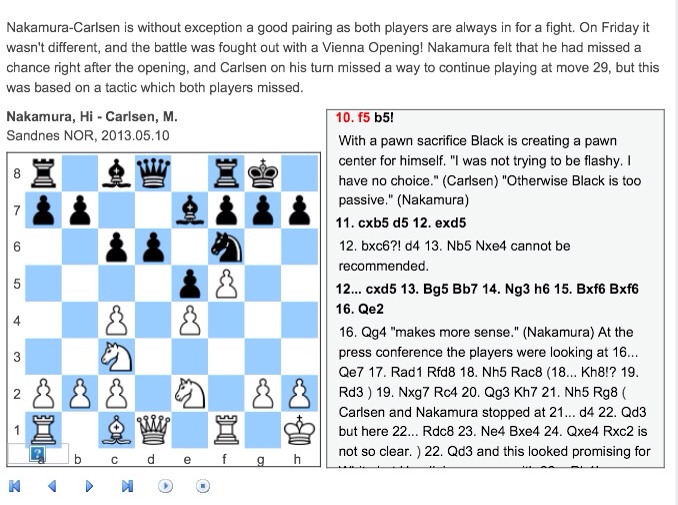
Having written this blog so far, I decided to see what Houdini comes up with. I gave it one British unit of time (time for me to make a cup of tea) and it rates the position as virtually level, its very slight first preference being 10…b6, following up with 11…Ba6 (to induce the weakening b3, or tieing the queen to d3); slight second choice 10..b5 11 cb d5; but also liking 10…h6, (prophylaxis against Bg5) 10…a6 and others. So, Houdini doesn't have the same feel for urgency as the Super GMs- I suspect the latter are right in their judgement.
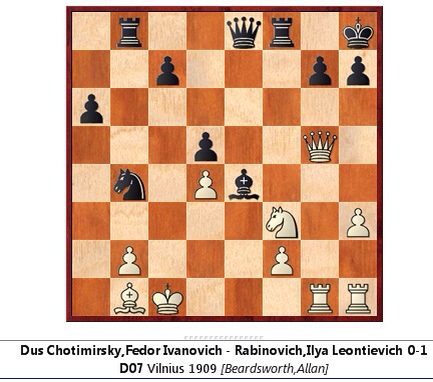
Black to play and win
Solution
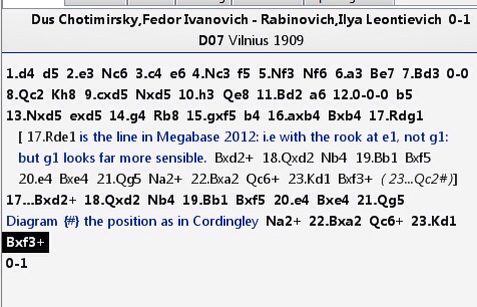
I thought this was straightforward. A quick calculation of the obvious check 1…Qc6+, shows it is insufficient. The second line I looked at was the solution, an initial decoding check, 1…Na2+. If white doesn't take, then either 2 Kd2 Rb2+ or 2 Kd1 Bf3+; and after 2 Ba2, Qc6+ comes with renewed force, now that the queen can come into c2. Not much more needs to be calculated.
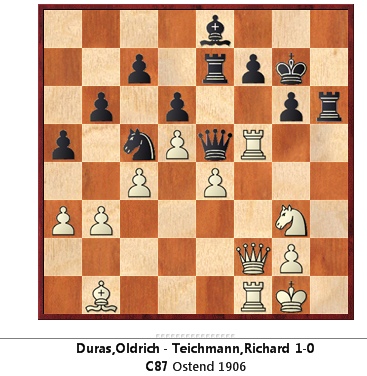
White to play and win (well no, actually)
Alas, this problem is badly cooked. It is still worth analysing, as an exercise.
Solution
I tried to solve this one, and, knowing it was a problem, knew that 1 Rf5 was the 'solution'…but felt white ran out of steam after 1…gf 2 Nf5+ Kh7 3 Nh6 Kh6. 4 Qh4+ Kg6 or Kg7. My first try was 5 Rf5+, smiting (to use a CJS Purdy word that I like) the Queen, but I soon saw that after Qd4+, black can then play f6. So instead I decided that Rf4 or Rf3 were the better rook lifts. However, having seen the idea of f6 after Rf5, and noting that f6 both protects g5 but also enables Bg6, I wondered (for which read doubted) that white had enough.
Of course, I also looked at 1…Qc3, with 2 e5 the obvious move, and stopped my analysis after 3 Rg5: my assessment was 'white had chances' with the Nf5 fork, and the LPDO Rf6 (the threat being Qf6+); but I couldn't see any further, and stopped, and checked Cordingley's solution.
Alas, there are several holes in it: some obvious to me, some Houdini assisted.
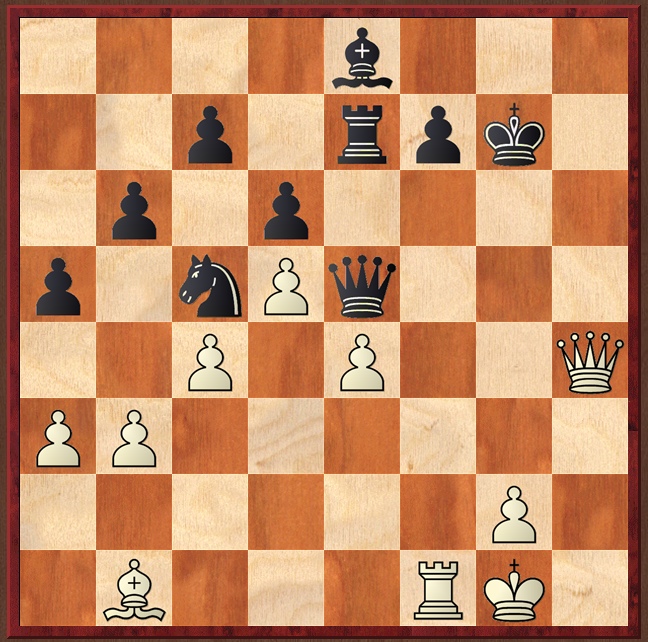
This is the position where I felt (correctly, as Houdini tells me) that white hasn't enough oomph to win: he will lose, once black has regrouped.
There is some pretty analysis in the attached PDF. Whilst the puzzle is flawed as a 'white to win' problem, it is a good Aagaardian exercise.
I haven't had time to look properly at all the games from yesterday's round one in the Norwegian tournament, but the game which appealed to me most was Peter Svidler's win against Jon Ludvig Hammer. Or, rather, it was the endgame which appealed to me most.
Peter squeezed something from nothing; or Jon made the slightest of slip ups, which turned out not to be slight at all, because of a pretty zugzwang.
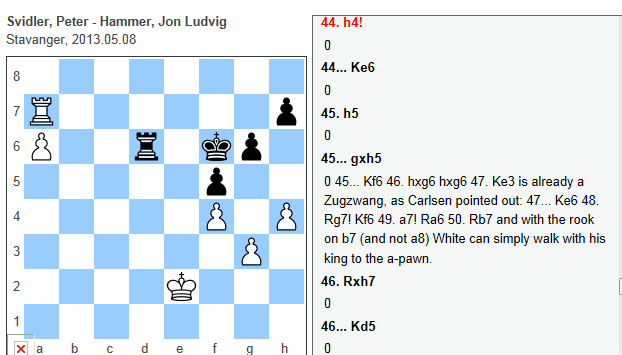
When I first saw this position (the annotations are from Chessvibes.com) I thought that black could draw by 44…h5, but, alas, the same trick works: 45 Ke3 Ke6 46 Rg7 Kf6 47 a7! (the move I had missed) and the rook must leave the d file, and the white king moves up to b8. 45 Ke3 is the endgame favourite, zugzwang.
The draw was earlier:
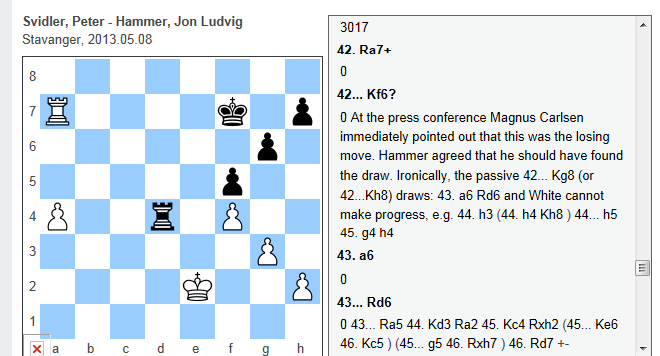
By being less 'active' with his king, white's rook is compelled to passivity: pawn on a7, rook on a8, black's king will oscillate between g7 and h7. Alex Yermolinsky did a fine video series on ICC in January 'endgames by method' on precisely this ending- this meaning pushing the pawn to the seventh, rook on the eighth, and how and when it is possible to win. It seems that Carlsen knows his endings.
Earlier, there was a nice piece of calculation:
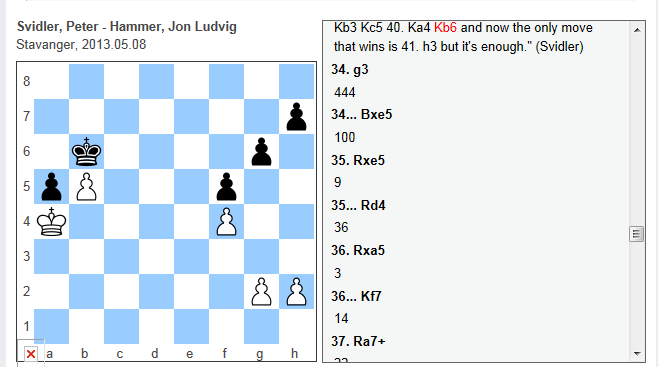
Quite nice to work out how 41 h3 wins, and also how white can scramble a draw if instead he played the 'automatic' 41 g3??. (I think it is a draw, after a series of only moves by both sides: 41 g3?? h6 42 h3 g5 43 fg hg 44 h4 gh 45 gh f4, both pawns queen, and white then has to defend the Q+K v Q+K+P ending (White Qh8, Ka4, Pb5; black Qf1, Kb6, Pa5, black to play and can capture Pb5: I presume this is a tablebase draw an probably a draw in practice too, especially given that black's pawn is an a pawn).
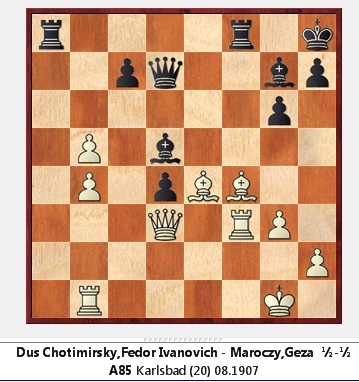
Black to play and win
Solution
The first move, 1…Ra3, is fairly obvious, and I suspect in practice most players would find it. White has a number of responses, and I wouldn't be able to calculate them all, but in my analysis I got to the key position , a couple of moves later. I took this as a stepping stone point, where I could more or less end my analysis. Whether I would have dared to play the winning move, 3…d3!, which I saw, or whether I would have chickened out and played the move actually played in the game, I don't know. This would have been better as a two part problem.
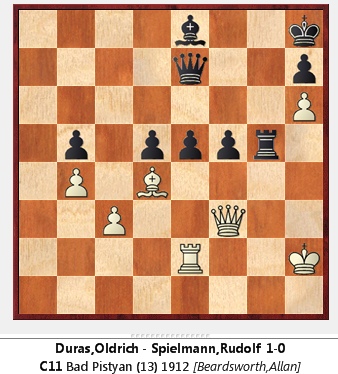
White to play and win
Solution
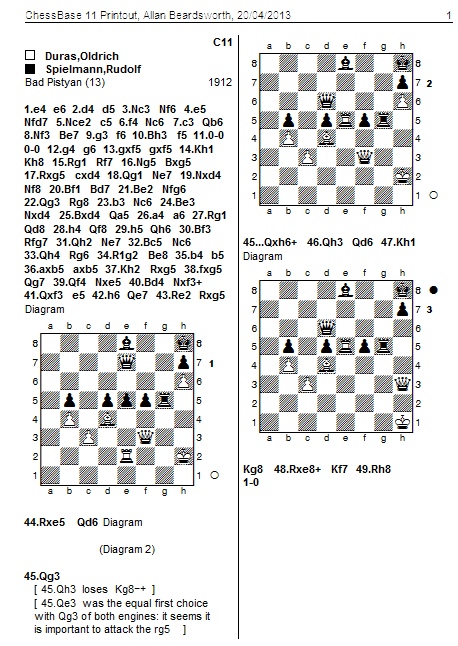
At bullet, anyone would play 1 Re5, and if black responded with his best move, 1…Qd6, white might well lose. At blitz perhaps the same, but at rapid or classical, white would realise that 1..Qd6 both defends, by pinning the rook to the king, and threatens mate, 2…Rh6+.
Once I saw the threat, I found it straightforward to counter with 2 Qg3. All I had to calculate was that black had nothing after 2…Qh6+ 3 Qh3, and he doesn't: 3…Rh5 is mated after 4 Re8+, whilst 3…Qd6 4 Kh1 and the skirmish is over: black loses a piece, since 4…Kg8+ is forced.
I found the geometry of pin and counter pin, mate and threat of counter mate, quite hard to see my way through, but got there without too much trouble.
 H
H
If I had to pick one author from all the books I have read on chess, then without a doubt I would choose CJS Purdy. It is a great regret of mine that I only came across his writings within the last ten years (I don't remember precisely why or when) and in particular that I did not know of his material as a teenager, when my thirst for chess knowledge, and rate of learning, was at its highest.

I whole heartedly recommend his books to aspiring players.
His book The Search for Chess Perfection II (I have the Thinkers' Press, 2006 edition) is one of the books I have learnt most from. I like both his style of writing (quirky, old fashioned, but warm) and what he says.
For instance, his concept of jump-checks, jump-captures has taught me a lot:
In any position that you are considering, present or future, look around for all possible checks (however absurd-looking); also all checks-and above all, mates-that would be possible if every piece could jump over anything in its way and could not be captured.
His advice to spend time ignoring threats is also invaluable:
Imagine the threat could not possibly be executed. Then what would be by best move? Try out each attractive move…visualise the whole position…after this move of yours, and then work out whether the opponent would gain by executing his 'threat'.
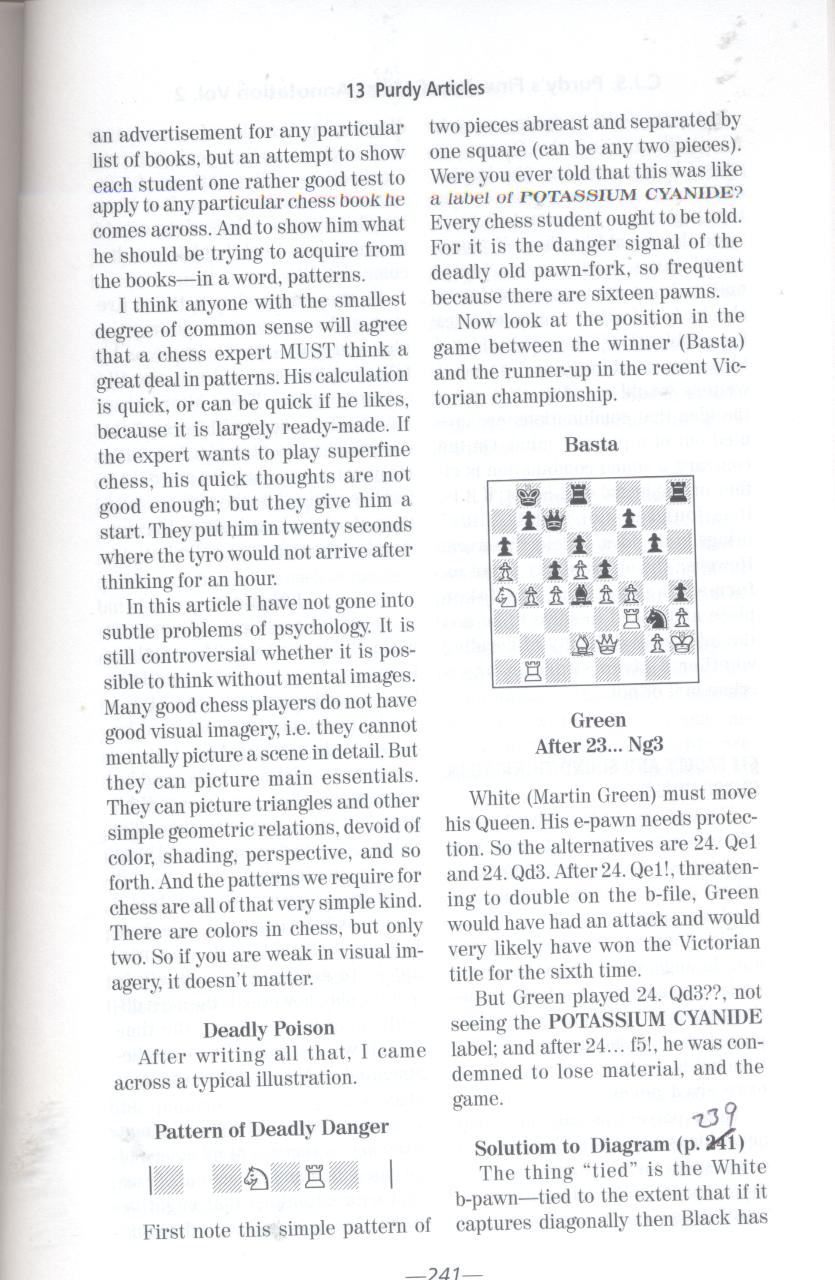
In one of my favourite of his books, CJS Purdy's Fine Art of Chess Annotation and Other Thoughts, Volume Two, he talks about patterns and imagery in a way which, when I first read it, was a revelation. It made me LOL (to use modern language) but the point he makes is profound. Whenever I manage to fork pieces in the way he describes, I give a nod and a smile to him, for teaching me Potassium Cyanide.
Potassium Cyanide
 allanbeardsworth