Yesterday I had my first ever chance to try out Dutching at the races, when I was at York for the Betfred Dante race meeting as a guest of Betfred.

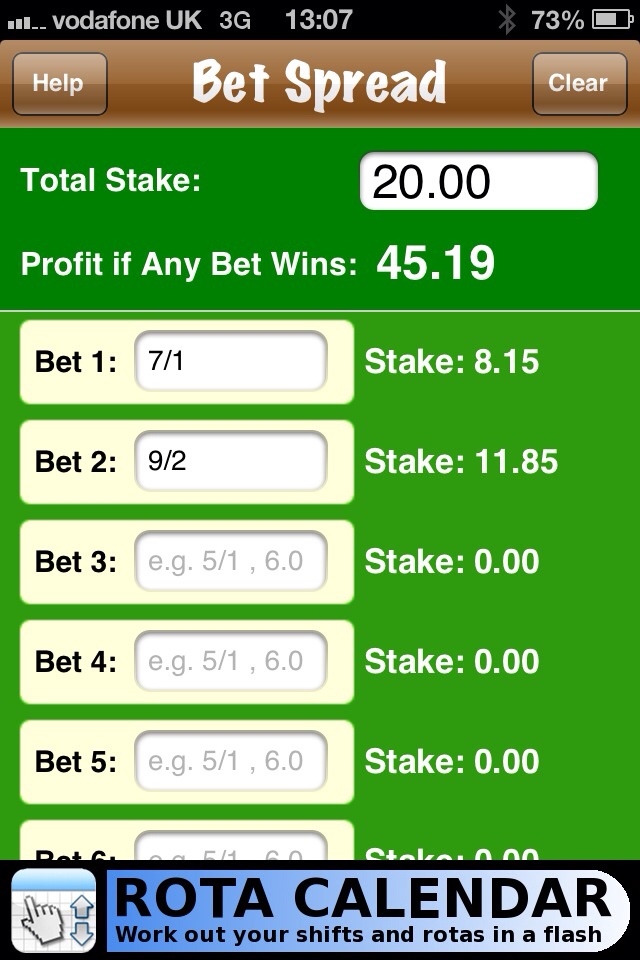
I have no idea whether it is unusual or not, but six of the seven races had odds which favoured Dutching, picking the favourite and second favourite. The fifth race had a favourite and two co-second-favourites: Dutching didn't work if these three horses were selected, but then one of the co-seconds became a NR ( non runner) and the remaining two could be Dutched.
Did it work? Yes, I made a 29% return on monies staked. Of course, I told Fred of my success the following day, and, without revealing the size of my bets, suffice to say Fred wasn't bothered with his advisor's gain at his client's expense.

Don't try this at home: in the long run, Dutching is bound to fail, like any such strategy; if I try it again and lose, I probably won't blog about it…
 Posted with Blogsy
A few days ago, my elder daughter had her last day at school, bar her A level exams days. At Withington, the girls dress up on their last day:

Yesterday, I was the guest of Betfred at York races. This member of the equine species wasn't running:

(Investec had some sponsorship at York)
White to play and win

Solution
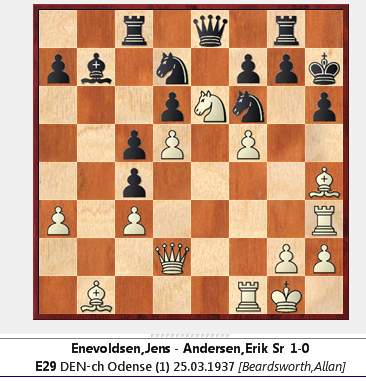
For a while, this stumped me. I tried things like 1 Nf7+, 1 Nf6, even 1 Qh5, then thought for a moment that, in a game, I might just play 1 c3: and felt I had no ideas.
I then looked for LPDO, noting the Queen is defended, but that the Be7 is not. Then, the solution came to me: 1 Nd7+, 1…Rd7 (forced) 2 Nf6+ gf 3 Bf6+! followed by Qh5 or Qe4, mating.
White to play and win
Solution
I found this one straightforward: the first line I looked at, 1 Ng7+, followed by 2 Qh6+, is the winning plan, with 3 Bf6+ to follow: and not many variations to follow.
One of the simpler problems, I think.
Wonderful to see that Magnus has won again today: it may well mean an incredible finish to this first ever super GM tournament in Norway. After Karjakin's 4/4 start, Magnus has either caught or, or will be half a point behind if Karjakin manages to defeat Nakamura. On this, since my previous post a short while ago, several moves have been played, but it is beyond me whether Karjakin knows how to win: I certainly would have no idea where I playing white. We shall see.
When I left work, I logged onto the Playchess app on my iPhone, to see Magnus's position:
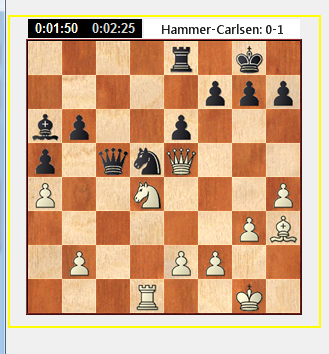
(The screenshot is taken after the game has finished, so ignore times and the 0-1 score: also, on my iPhone, I couldn't see clock times).
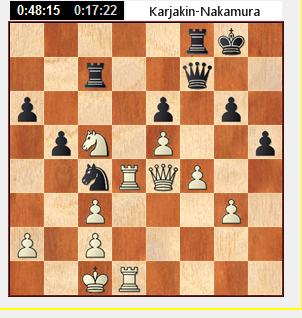
How's he going to win this one? I thought, especially given that had, as I logged on, Karjakin just played the stunning 29 Nb3c5!! against Nakamura, and my quick calculation was that black's position was about to collapse, and it was soon to be a 'can he survive question'.
A short while later, Carlsen's position was:
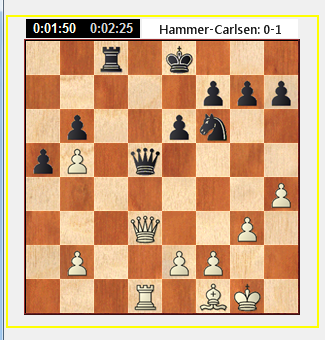
How's he going to win this one? I thought, especially since I was not too sure that his N was better than the bishop, and 1 e3 Qd3 2 Bd3 would protect c2: I then saw a sign of a glimmer, since maybe black could double attack the P on b5, with Rc5 and Nd5-c7 or Ne8-c7; noting the wisdom of Magnus's earlier Kf8, centralising the king in readiness for the endgame.
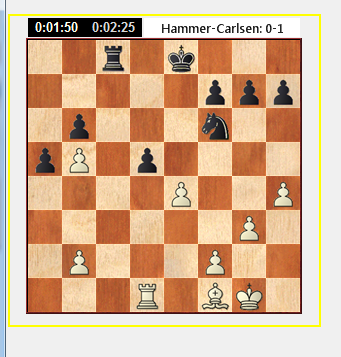
By this time I had got home, switched to Playchess.com on my PC, so could see the clock times, which is part of the explanation- both players had a couple of minutes for their last half dozen moves- and was startled with how Hammer had played: letting in the Rc2; playing the thrust e4: of course, my assessments so far had been lightning glances.
Then, not too long later, Hammer resigned. Hammergate? Norwaygate?- no, simply Magnus's incredible talent for eking something out of nothing, of relentless pressure. Wonderful to see how he can get a win our of virtually any position.>
I look forward to what the stronger player's commentaries are overnight. Meanwhile, it is now move 59 in Karjakin's game, and I think Nakamura has blundered, and will resign fairly soon. So Sergey will still lead by 1/2 point with not many rounds to go.
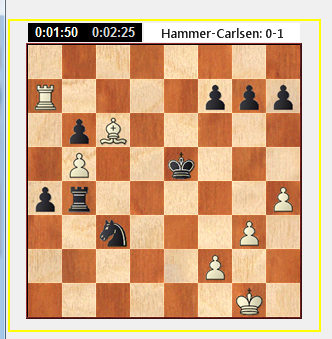
In my 7 May 2013 post CJS Purdy: my favourite author I mentioned several of the ideas that I had learned from him; with my favourite, because his expression amuses me is 'Potassium Cyanide' do describe the very common situation of two pieces of the same colour, same rank, one space apart.
As I write this, today's round in Norway is not overr, with Karjakin having a difficult task of beating Nakamura: Sergey no doubt should win, with Q+3p v R+N, with black's pieces uncoordinated, but two of white's pawns are doubled, so I can see this game going on for a further fifty moves. (On the other hand, Houdini is saying the position at move 52 is +6, so it could be over very soon).
Anyway, by the time I had got home from work, Vishy Anand has won a lovely game as black against Radjabov: I have only had time so far to flick rapidly through the moves, and look forward to understanding it better tonight or in the coming days. The final position appealed to me, being Potassium Cyanide with a twist:
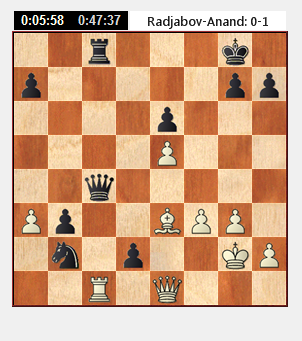
The d2 pawn forks the Rc1 and Qe1, so we have the motif: but one second glance, the d2 pawn is en pris, and on a further glance, en pris in two ways. The lovely point is that if 35 Bd2 then 36 Nd3! is curtains, with one aspect being that N*e1 would be check; and 35 Qd2 loses more prosaically to 35…Qc1 36 Qc1 Rc1 37 Bc1 Nd3, and the b pawn queens.
Great to see Vishy win two great games in this tournament: augurs well for a good world championship match in Chennai later this year.
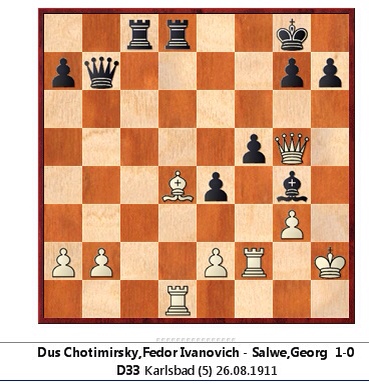
White to play and win
Solution
The first move, 1 Bg7, and black's reply, 1…Rd1 ( 1…Qg7? 2 Rd8+ is trivial), are obvious. White's second move is clearly a discovered check, but where to put the bishop? Ignoring (though checking) Bf8 and Bh8, Bh6+ is a draw by repetition after 2…Kh8 (not 2..Kf7?? because if 3Qg7+, and the LPDO Qb7 drops off; 2 Bf6+ blocks the f file, and since there is nothing clear after 2…Bf8, my attention turned to the three remaining moves, Be5, d4 and c3. In my initial appraisal, I also noted that the Rd1 is LPDO and that …e3 is a double attack, f2 and h1mate, which needs to be guarded against.
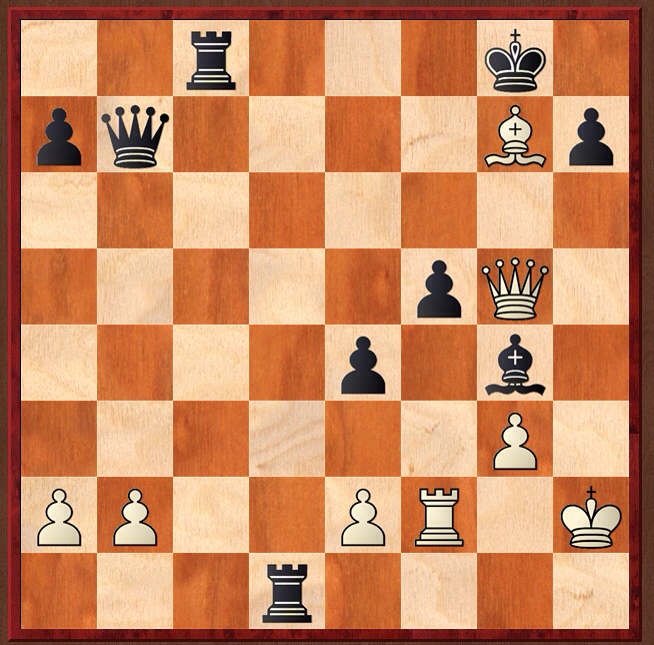
So 2 Bc3/d4/e5+, Kf8 (Kf7 the LPDO drops after being skewered by Qg-7+) 3 Rg4 and then what? Clearly white has compensation, but is it enough, say after 3 Rd7, protecting both LPDOs. Hence I landed on my choice of move 2 Bd4, liking the fact that it both hits c5 and blocks the d1 rook. I couldn't see the position through to the end, but my bones told me it was likely to be sufficient, so I plumped for it. Pleasingly, it is Houdini's preference too.
The move white played 2 Be5+, also wins, but maybe with more effort. I knew, and it proved to be the case, that Houdini would savage both my play, Cordingley's solution, and the game continuation. There are some pretty computer lines in the attached PDF. Houdini also told me that the move I least liked, 2 Bc3, is only =; the reason for my judgement was not deep analysis, but the fact that on c3, it doesn't do as much as on the other two squares; and Bb4+ is never possible, whilst the black queen guards the square. I should also add that I preferred 2 Bd4 to 2 Be5 partly because I couldn't analyse the latter sufficiently.
Finally, in a real game, as compared with leisurely home analysis, would I have dared play 2 Bd4, or would I have chickened out with 2 Bh6? Frankly, I don't know what I would have done: chickened out, probably. Certainly I wouldn't have been able to see to the end, so I might have been scared of sacrificing, in case it lost: a weakness of my playing approach.
Shami Chakrabarti was excellent on today's Woman's Hour. I liked much of what she said in her interview with Jane Garvey: including her honesty about the benefit of bumbling around- she had a couple of years after university working out what direction her life should take.
However, particularly I loved her motto 'I am anyone's equal, but no-one's superior'.
When Jane Garvey summed up the interview and segwayed into the next item, she picked up on this phrase.
I think the phrase is how I feel about myself: or at least I try to be anyone's equal…self doubt is a worry I was born, and will die with.
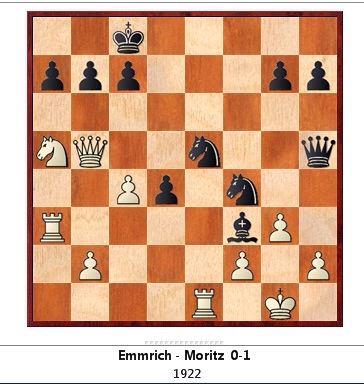
Black to play and win
Solution
After yesterday's disaster, this was a relief. I solved it instantly: my only surprise was that in the game, black played 1…Bd5, and lost ( I don't know how, the game isn't in Megabase 2012). Perhaps because I knew it was a puzzle, the first move I looked at was 1… Qh2+, and saw immediately this was a mate, without anys variations. 2…Ng4+, 3…Nh3+, 4…Nh2 mate: pretty, but straightforward.
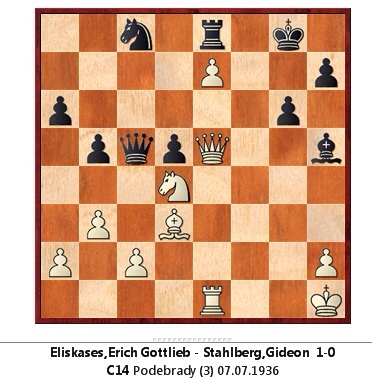
White to play and win
Solution
By contrast to the previous two puzzles, which I found straightforward, no 43 was an unmitigated disaster.
I failed to even see the move played in the game; and mis-calculated the slightly better one (in Houdini's eyes); and chose a move which I thought led to a winning ending, but, alas, leads to a level ending. In my slight defence, the winning line is quite hard to see, but I saw the geometry of the queens on the same rank, and that the black queen was LPDO; but didn't see 1 Be4; and I also looked at 1 Bf5, but didn't evaluate the position a few moves later properly.
Worse, I looked at this puzzle three years or so ago, and made a note to check my solution….the same insufficent solution as I came up with now. I don't know whether three years ago I looked at Cordingley's answer, but clearly I haven't learned a thing.
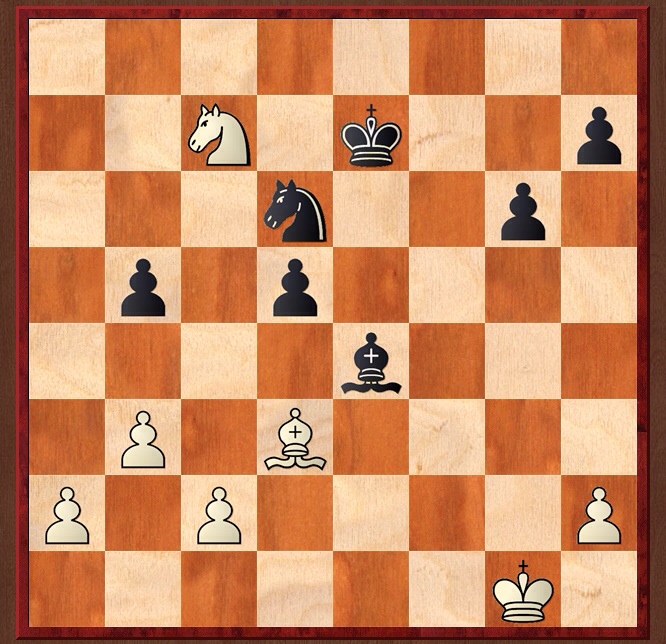
Better luck, I hope, with future ones. Below is the end position from the line I chose, where black has just enough activity to draw; and a PDF with my analysis, including the far stronger first moves.
 allanbeardsworth