Last month, I blogged about the Cheltenham Gold Cup, and the Dutching possibilities for that race.
Yesterday's US Masters in Augusta provided a similar chance.
If, before the last round, you felt that one of the leading three, Brandt Snedeker, 9/4, Adam Scott, 100/30, or Angel Cabrera 9/2 would win, then you could Dutch, as follows

If you felt that, if not one of these three, it might also be the fourth player, Tiger Woods, 6/1, who might win, then you could still Dutch, with a £32 return on £200 staked.
As it was, Adam Scott beat Angela Carbrera on the second play-off hole:

My interest is in the maths: I can intuitively often tell when Dutching is possible, and felt it was here, but haven't yet worked out how to reduce the calculations to a formula. Jane's only comment last night, of course, was 'why are you watching this rubbish'?
 Posted with Blogsy
(Explanation for people under 40….Walk like an Egyptian was a hit record in 1986 by the Bangles)
(Warning for Tom, Alice and Sophie…if you are with your parents at a party where this is played, get ready to be mightily embarrassed by said parents walking like Egyptians).
(Final preliminary diversion…the Wikipedia entry for the song says it was on a list of records to be avoided drawn up by the BBC during the 1990-91 Gulf War, along with ' Bang, Bang (My Baby Shot me Down), ' Boom Bang-a-Bang' and 'Sailing').
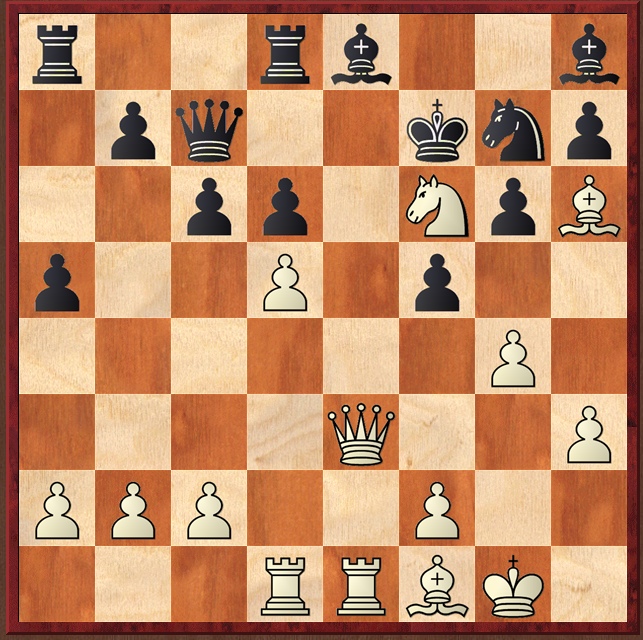
White to play and win
Solution
Alas, I failed with this one. I didn’t even consider the best line. I committed at least two mistakes:
#6 not bringing all the pieces to the party.
#7 not looking at the geometry, the lines and diagonals.
Or, to apply one of Jacob Aagaard’s three questions (which he suggests we use for positional considerations) ‘which is the worst placed piece‘: the answer being the Bf1; and its better home is c4.
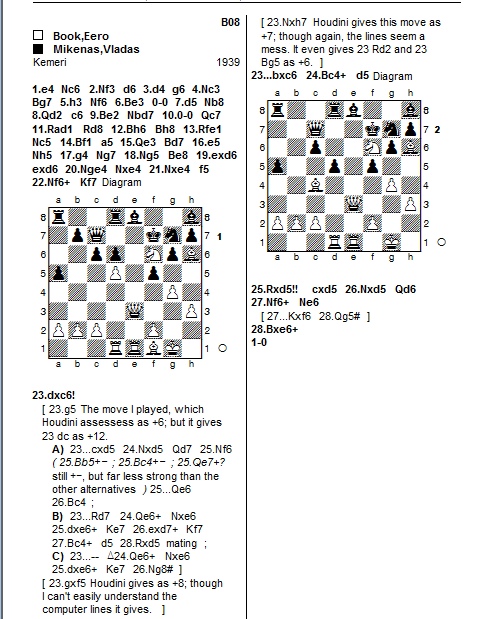
I played 1 g5 which wins (in fact, several moves win, Houdini tells me there are four or five +3 or higher moves, but 1 dc! is clearly best
.
I may well write further on this game, since something has caught my eye earlier in the game as worth my study.
I recently suggested to a friend that she tries to write a short story or other piece; she has a way with words, but her normal writing is for business. I did recall at the time keeping a clipping about the different bases for stories, but has no idea where it was.
This morning, I needed to find the food processor manual. I thought this was filed in the lever arch file that we keep such things in: P for processor, no; F for food, yes…and also the clipping. It shouldn't have been in there, but it was.
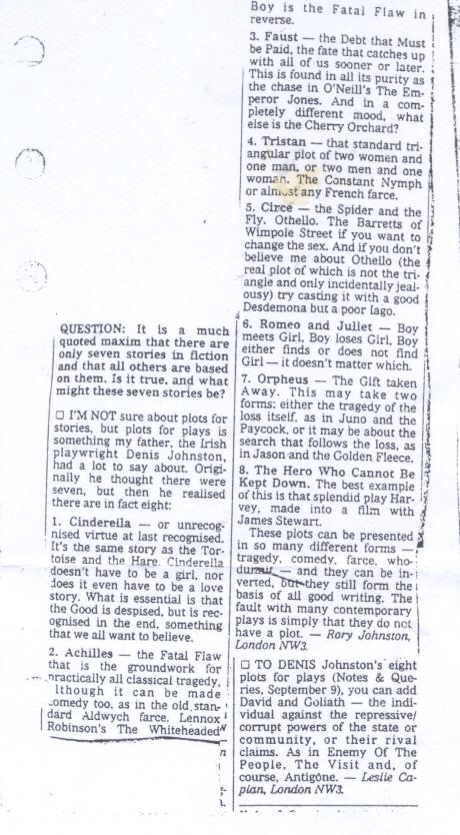
The punch holes reveal that this was something I used to keep in my Filofax. I suspect therefore it is more than 10 years, probably 20 years old. Why oh why should it suddenly turn up, all these years later, when I wanted it?
Serendipity.
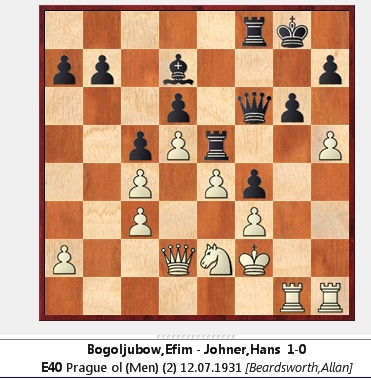
White to play and win
Solution
Quite satisfying to solve, if not too hard. It is clearly not wrong to start of by exchanging 1hg hg (though black's best defence, when there is still a game to be had, is 1…h5). I first looked at 2 Nf4?, noting that 2…Qf4 loses to the tactic 3 Rg6+ Kf7 4 Qf4; but then noted 2…Rg5!, and the pressure on f3 means the position is two-sided (I haven't looked at it further). So, a simple switch around, 2 Qf4!, is the key, with the same point that after Qf4, Rg6+, the king move to f7 is forced, and N*f4 projects the Rg6.
Checking this on Houdini, it suggests 2 Rh6! as being even stronger: not sure why, and the theme is the same, the dropping off of the f4 pawn: maybe Rh6 just first places white's pieces in better positions.
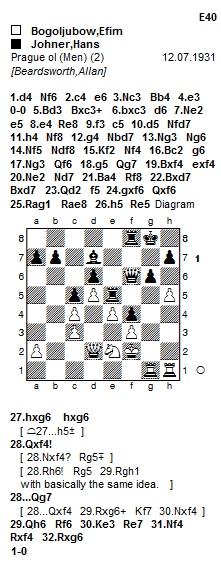
If you play the Sicilian against me at blitz, I will play the Morra.
I know it is rubbish, but that is part of its attraction. If I lose, I can put it down to the opening; and if I win, it sometimes can be in fine style, or at least in attacking style.
It is especially nice to play the Morra vs Grandmasters, most of whom feel honour obliged to capture. This week, I have beaten one, whose real name I don’t know, twice, in the same line.
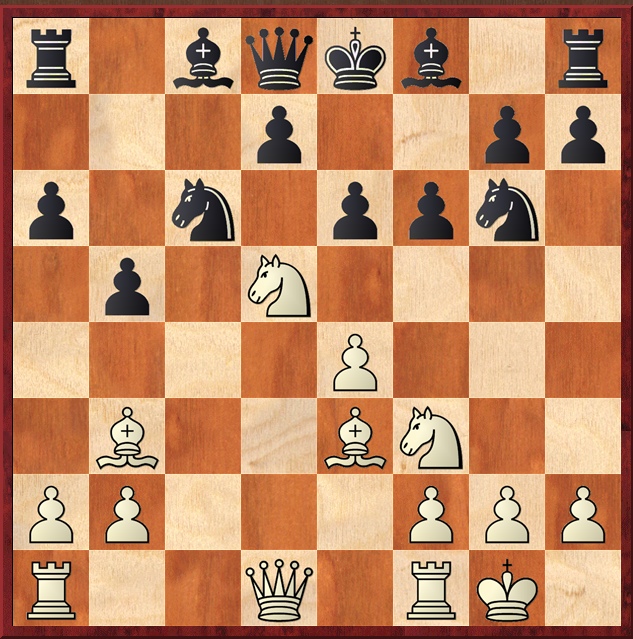
This is the position after the standard sacrifice, Nc3-d5. It was played by Marc Esserman, whose book Mayhem on the Morra I love, against Loek van Wely, whom he beat in swashbuckling style, at classical time limits.
Last week, my opponent blundered:
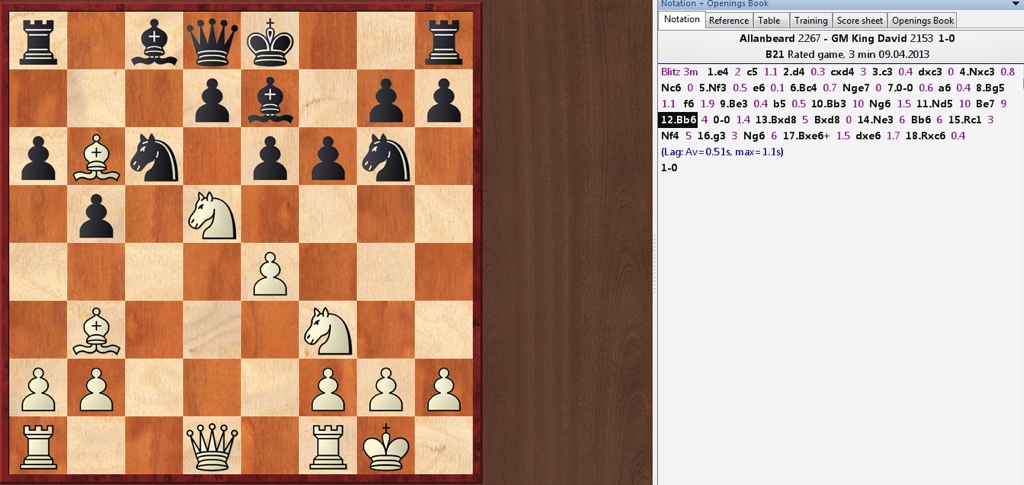
Today, he captured the piece, and an exciting game resulted. I didn’t play the best line, missing his queen side castling resource. He too missed the one and only defence; when I later looked at Esserman, I found he gives this defence. But it is a very narrow path indeed: however, on reflection, it is a logical one: black tries to counterattack hitting g2 with the Bb7-Qc6 battery. Prior to Houdini suggesting it, I would never have thought of it, instead, most likely, playing on the black squares, like my opponent did.
Of course, it is only blitz, and so trivial and unimportant, but it is still nice to beat a GM. The second time it will be time to give up chess is when beating a GM is no longer fun (the first time, as in my earlier blog, is when seeing a smothered mate doesn’t make you smile).
This should take you to an online playable copy of the game.
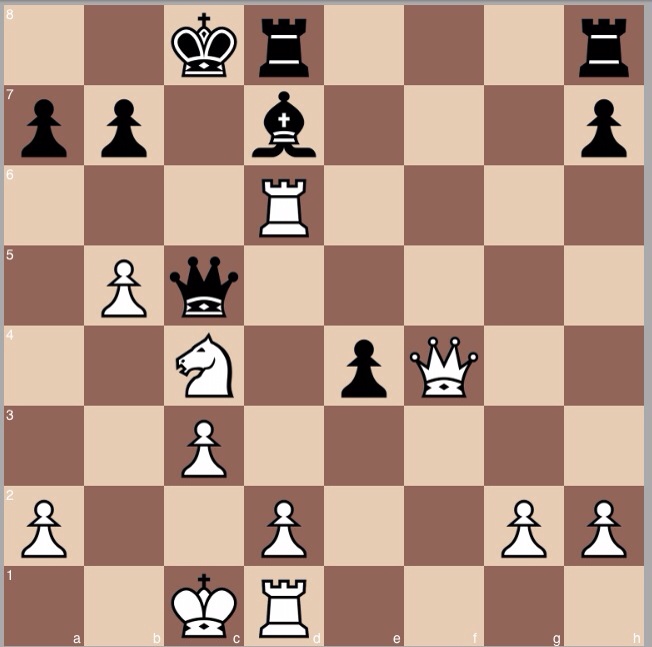
White to play and win
Blackburne-Price, Birmingham 1906
Hint: find the pretty line which was played; there are other, long winded ways to win, given the material position, but there is one nice variation to be found.
Solution
I spent too much time on this puzzle, not trying to solve it, but trying to find robust solutions to all lines. In other words, this puzzle would not have been included in a modern puzzle book, or I doubt it would be.
Since I am dealing with a puzzle book, I look for convincing wins. A simple pawn count, and a check that the knight isn't hanging, quickly convinced me that there was a prosaic win, and checking with Stockfish confirms that the simple 1 Qe4 doesn't hang anything, and has a winning advantage; and the slightly cuter 1Rd4 also protects the b5 pawn (because Bb5 would lead to Nd6+, winning the exchange, and there is no perpetual or worse for black). But neither of these moves would merit inclusion by Cordingley, so I had to look elsewhere: and clearly it had to be the black squares, and in particular the h2-b8 diagonal, and in particular c7…
So 1 b6! was the move played. All I had to do was understand how to defeat 1…Qc4, and I quickly came upon 1 ba! Qa4 (Qa2 is the same) and now 2 Ra6!! prevents any checking of white's queen but at the same time sets up mate on the h2-b8 diagonal, but on b8, not c7. Pretty, and the solution sought. Blackburne actually played 2 Rc6+ and 3 ba, which also wins, but drags the game out. What spoils the problem is that 1…a6 or 1…Rhf8 then require prosaic wins.
Roadkill T shirts has banner advertising on various sites I visit. (Their products must be aimed at nerds: they clearly target their marketing $ well). Many are funny, some are crude, and I thought this one was clever.

(1) White to play and win
(2) plus a bonus mark, and a guaranteed smile, for finding the pretty coup de grâce.
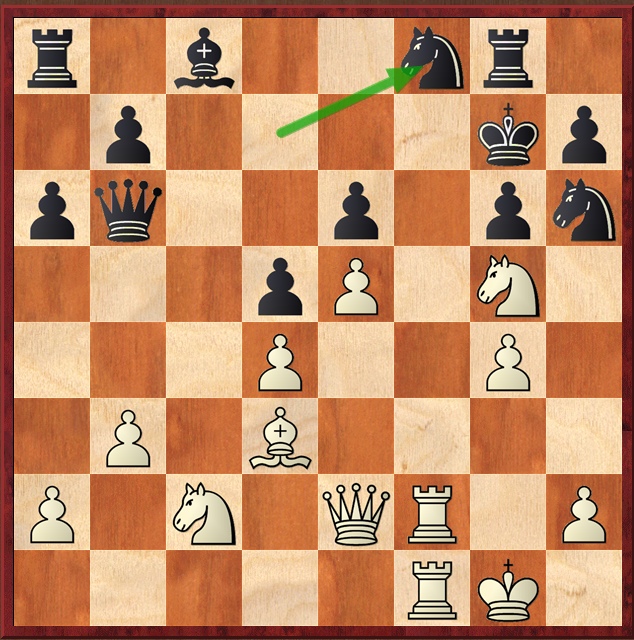
Bernstein-Cohn, 1902
Solution
This one took me time, but I got there in the end; or, at least, I found one of the winning lines; but didn’t find the pretty one.
I had to get the pieces and board out for this one, take me time over it. The first line I thought of proved to be the solution, but at first I couldn’t go deep enough to be satisfied that it was. It was only after I realised that time was on white’s side, that, in Aagaard’s terms, there was time for revolution and then evolution, that I got there: my analysis wasn’t Kotovian, as in the famous book Think Like a Grandmaster, that I read and believed as a child, but now suspect was a Soviet perceived model of supremacy. No, my process was haphazard: noting such things as my Nc2 is probably useless, as are his Ra8 and Bc8; that smashes like Bg6 or Nh7 don’t do anything, nor does the other check Ne6, and nor does the double exchange on f8- white ends up with two few pieces to finish the attack, though the position is a mess and white might just have enough to sustain a win. But on this meander, I saw the importance of the black squares, and the time factor, that white had sufficient time for one or two slow moves (evolution) after the sacrifice (revolution). So 1 Rf7+ Nf7 (not taking just loses trivially, 2 Rf8) 2 Rf7+ Kh8 (2…Kh6 3 Qe3 is lethal) and now the quiet move, 3 Qf2 wins. It is thematic that the win comes on the black squares. 3…Qd8 is forced, to protect f6: the question is, then what?
I played 4 Qh4, and this is sufficient. 4…Rg7 5 Qh6! wins the queen, for if 5…Qg5 6 Qg7 mate, rather than 6 Qg5 Rf7; or if 4…h5 5 gh, and the tactics work for white after 5…Qg5 6 Qg5 gh 7 Rf8 1-0. However, 4 Qf6+!! is far prettier, and decisive, with smothered mate in one of two ways. Lovely.
Less lovely is not seeing 4 Qf6+: the thinking or process mistake is to rule moves out without thinking; here, ruling out simplifying, and therefore not testing all checks. Had I been systematic in my approach, programmed to check biffs at each turn, then there is a fair chance the smothered mate would have been found.
When to give up chess: this puzzle has revealed to me the answer to this question: it is time to give up chess when you no longer get happiness from seeing a smothered mate, or no more smiles from surprises.
Jane found out last night about the blonde. https://allanbeardsworth.wordpress.com/2013/03/30/when-is-it-ok-to-lie-to-your-wife-when-there-is-a-blonde-involved/
What does a wife do when she finds out the other woman (and a younger one, in this case by 367 days)? Rant? Throw plates? Shout 'how could you?'.
No, not Jane: sure she criticised me, but 'why didn't you take a photo of how Sarah laid the fire before lighting it' was the extent of her anger.
Sometimes, I need to remind myself how lucky I am to be married to Jane.
 allanbeardsworth