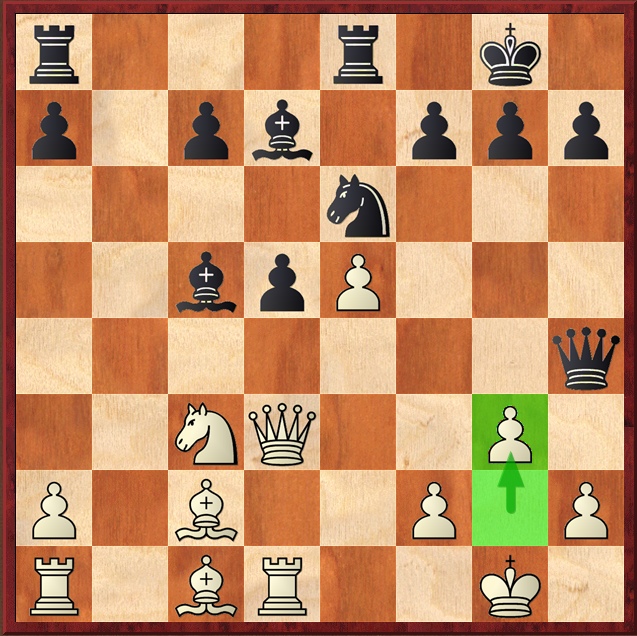
Black to play and win
Solution
I found this one fairly straightforward, though a big computational effort, with two lines to look at. The low risk one, because little is staked, is 1…Bf2+ (virtually a forced move- what else could black do than play this move, and hope his attack wins) 2 Kf2 Qh2+, when 3 Ke1 Nc5 doesn't require much calculation. A great deal more risky is 2 Kg2 Qh3+, a fairly obvious sacrifice of the queen, drawing the king into the line of fire. After 3 Kh3 (3 Nf3 Nd4+) Nf4+ 4 Kh4 I think 4…Ng6+ is obviously good enough (my iPad engine Stockfish rates it at +7) whilst in fact 4…Ng2+ is even stronger.
Not a hard puzzle, but a good test of longish calculation, though judgement dispenses with the need for much effort.
 Posted with Blogsy
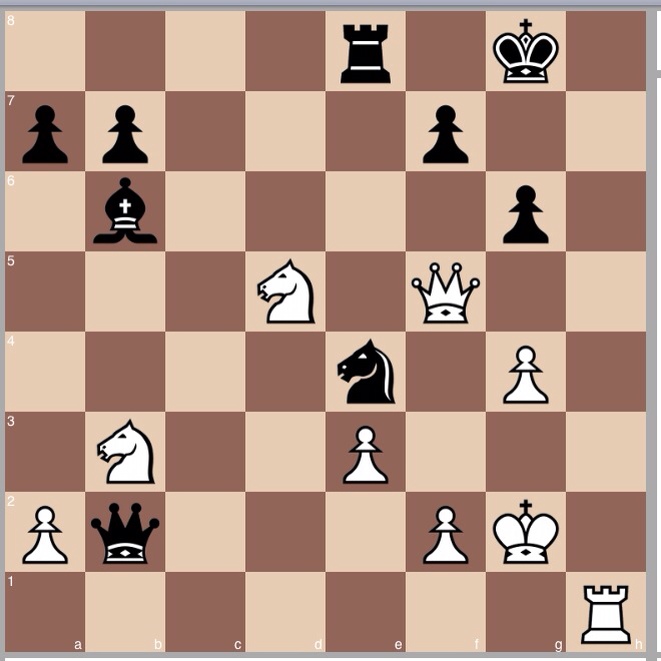
White to play and win
A nice puzzle, worth spending time on computing all the lines to the end.
Solution
I think the first move is fairly obvious, or, if it is not, can be found by the routine process of looking at all checks. As a slight discourse, one of my favourite authors is the former World Correspondence Chess Champion, the late CJS Purdy, whose books I whole heartedly recommend: I have learned a great deal from Purdy: in his thinking method, he extends checks to 'look at all biffs', biff being a daft word, meaning all moves which hit another piece, but one which teaches a sensible lesson. Purdy also recommends looking at all jump biffs, i.e. all captures which could have taken place where it not for example for pawns in the way, as a way of looking out for pinned pieces, or a way of understanding some of the geometry of the chess board. So 1 Ne7 biff is the first move, to which black has three responses.
The move to dispense with first is 1…Re7, biffing the knight, and that loses fairly straightforwardly to 2 Qc7+ Kg7 3 Qh8+, skewering the king and queen, which being LPDO, is biffed. Somewhat harder are the two king moves. Against 1.. Kg7, simply biffing the knight, 2 Qe4 wins, since there is a threat of a discovered check, and the Re8 is biffed. I found it hard, and failed to, properly compute 1…Kf8, but could see that it was strong, and would have played the right moved and taken a fresh look when the difficult position came up. 2 Ng6+ Kg7 and I don't know if in practice I would have found the follow up.
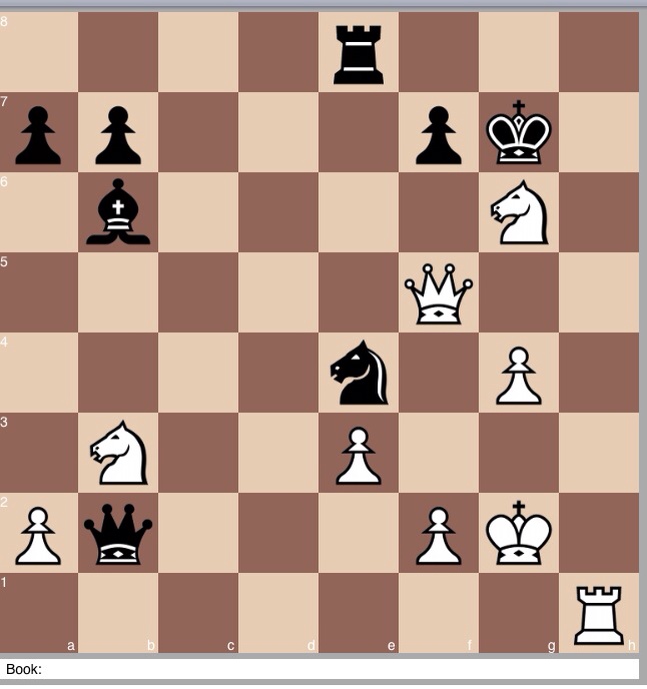
I think if I didn't have much time then my calculating power would have failed me, and I would have chickened out 3 Ne5, hoping that the ending after 3…Qf2+ was tenable. I would have looked at 3 Rh7+, but noted that after captures on h7 and f7, and then taking the rook on e8, black would have mated me after Qf2+: so panic. I think the forced mate after 3 Rh7+ Kh7 is hard to see- but instructive to see how the queen and knight combine well. It is an example of the maxim that queen and knight can combine well, often better than queen and bishop. 4 Ne5+ Kh6 (say, others are similar) 5 Qh5+ Kg7, 6 Qf7+ and mate on g6 next move.
If a line that loses can be nice, and I think it can, then 1…Kf8 2 Rh8+!? Kg7 ( 2…Qh8+ 3 Ng6+ +-) 3 Rh7+? ( would be nice if it were exclamation) 3…Kh7 4 Qf7+, would work except for the backward move 4…Qg7+, when black wins: if 5Qe8 then 5…Nf6 and the Ne7 drops off. The same idea (nice but failing) idea occurs after 1..Kg7+ 2 Rh7+, which also fails in the same way.
Jon Speelman’s excellent (for which read, his daily column has given me great pleasure over more years than I can remember) column in the Independent today caught my fancy.
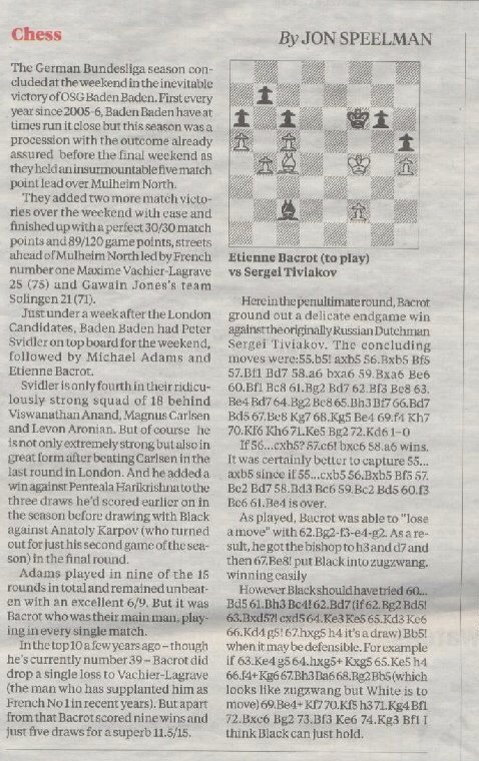
Bacrot’s 55b5! is one of the those moves which are surprising-until-you-see-them-and-then-obvious, the type of move that I like to deceive myself into thinking I would have played: the type I call ‘obvious’. The honest part of me knows I wouldn’t, and that I would be likely to have played Bf1 with the forelorn hope of getting to the h3-c8 diagonal; only if I had a good deal of time might I have understood that opening more lines was necessary. Bacrot’s move opens more lines (diagonals) so that by losing a tempo he has a chance of breaking through, as he does in the game.
I was also intrigued by Jon’s very last words: I think Black can just hold. I played through the game (on the Chessbase online app on my iPad) and indeed could see why Jon said this. I decided to use this position which had a bit of doubt in it to do my first test of the newly released Finalgen software.
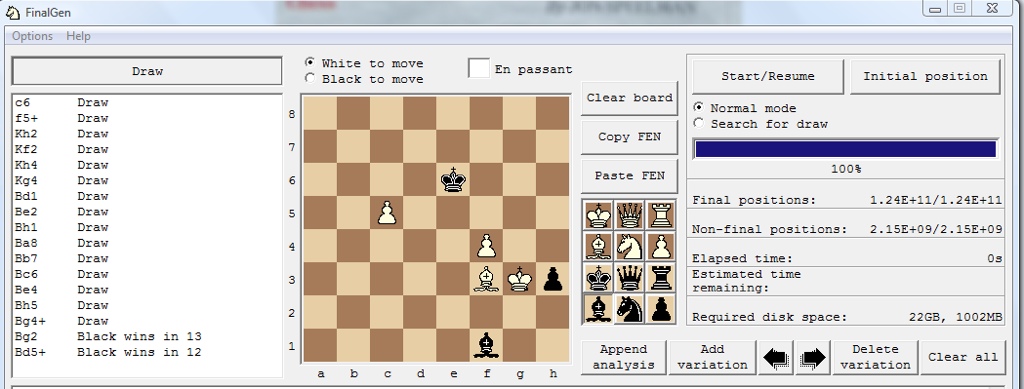
The result is indeed a draw: Jon was correct.
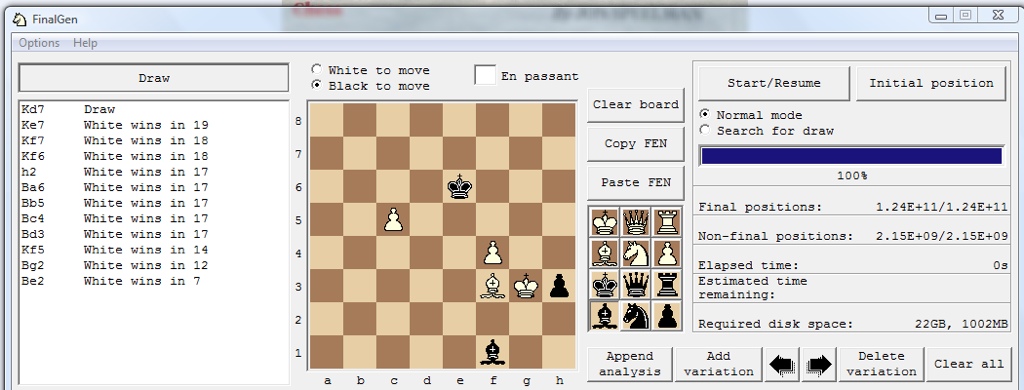
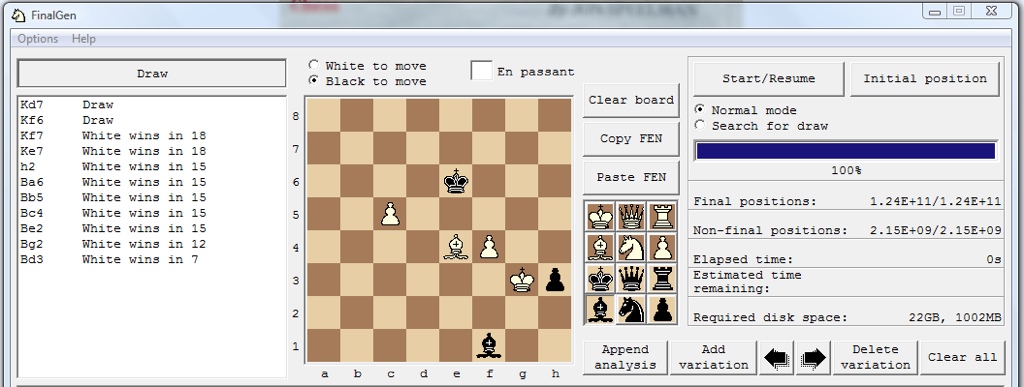
What intrigued me was that only two moves draw, the rest lose. So, I decided to explore the position a bit with Finalgen.
Firstly, this is the evaluation had it been black to move:
The water cooler talk in the office today is about Mrs Thatcher, who died yesterday.
It is a sign of how youthful my office is that a good minority of my colleagues were born after 28th November 1990 when she left office. I suspect that an even smaller number of staff were born before she became Prime Minister on 4 May 1979.
How old does that make me feel? I would rather use the word experienced.
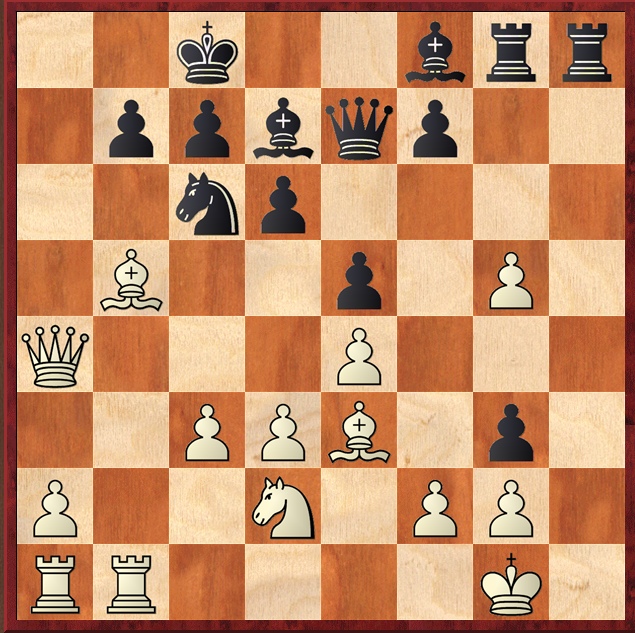
White to play and win
Solution
I suspect I have seen this one before, or puzzles very much like it. The solution came 'by inspection', and it was just a matter of calculation to check that the queen sacrifice 2 Qb7 was sufficient. Black's f8 bishop is helpfully placed, so that if after 3 Bd7+ black plays Ka8, then Rb8+; and if 3…Ka6 4Bc8+, 5 Nc4 and 6 Rb4 mate, ie. lots of white's pieces gang up on the defenceless lone black king.
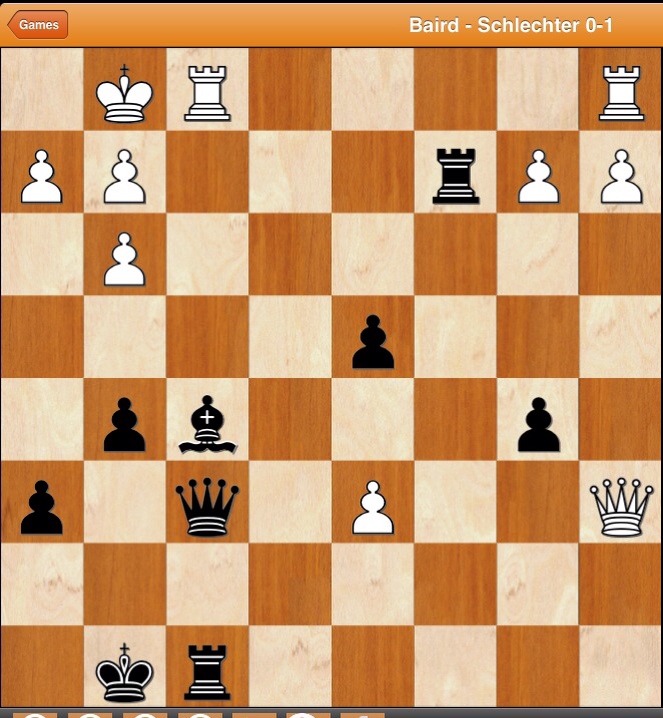
Black to win, after white’s last move f2*g3.
Solution
I think the solution is straightforward, though I goofed it. Part of my reason for starting on this daily puzzle blog is to try to learn what mistakes I make, in the hope of learning to make fewer of them. The most upsetting of the mistakes I have identified so far is #1: not seeing the winning idea at all, despite trying, especially when the solution, once revealed should have been obvious. Mistake #2 is not seeing the toughest defence, and #3 is spotting a good enough move, but not looking for an even better one.
Here, I made mistake #3 (by the way, I commit plenty of others, just that I haven’t enumerated them all yet). 1…Be4 was the second move I looked at (1…Rg2+ being the first, with the idea of then Be4+, but this is insufficient, so therefore I tried the standard, near automatic, technique of reversing the order of the moves, and it was clear that this was right….clear because the ‘sacrifice’ of the queen is a typical motif for inclusion in a puzzle book. My mistake was playing (after 2 Rf6) 2…Rg2+, and after 3 Kf1 (3 Kh1 Rg3+ mates next move) Rf6+ 4 Ke1 finding a move which wins, and checking that white’s checks don’t cause a LPDO or perpetual (they don’t, after 4…d3).
Alas, Schlechter avoided the need for such computation by 2…Rf6. The a8 and c8 checking squares are therefore controlled, as is the h1-a8 diagonal, so it will shortly be mate, with no difficulty.
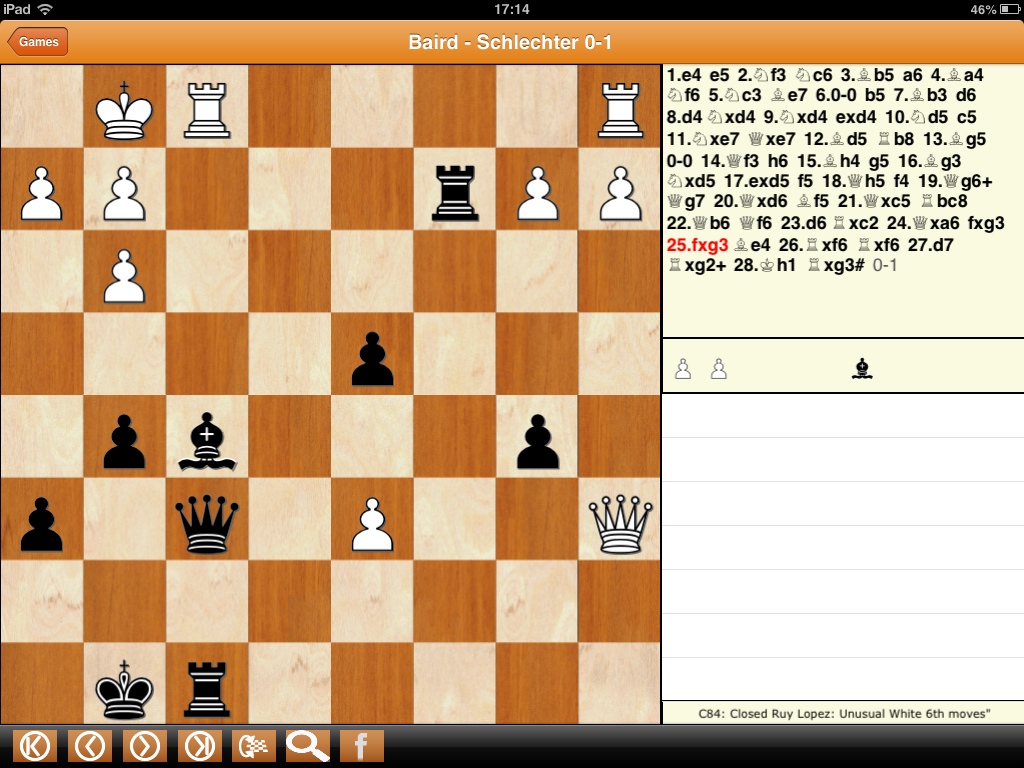
In an actual game, maybe I would have found 2…Rf6, especially if I had some time to think; but maybe I wouldn’t; hopefully I would have found 1…Be4.
As far as tax advisors are concerned, long live the weekend newspapers, particularly the personal finance pages. In my work helping businesses, the entrepreneurs and families behind them, and private clients generally, I have lost count of the number of times I have had a Monday morning call 'did you see the article in the Mail on Sunday about,,,,' (answer, no, but send me a copy). The 2013 translation is a Sunday morning email 'attached is a copy of/link to….'.
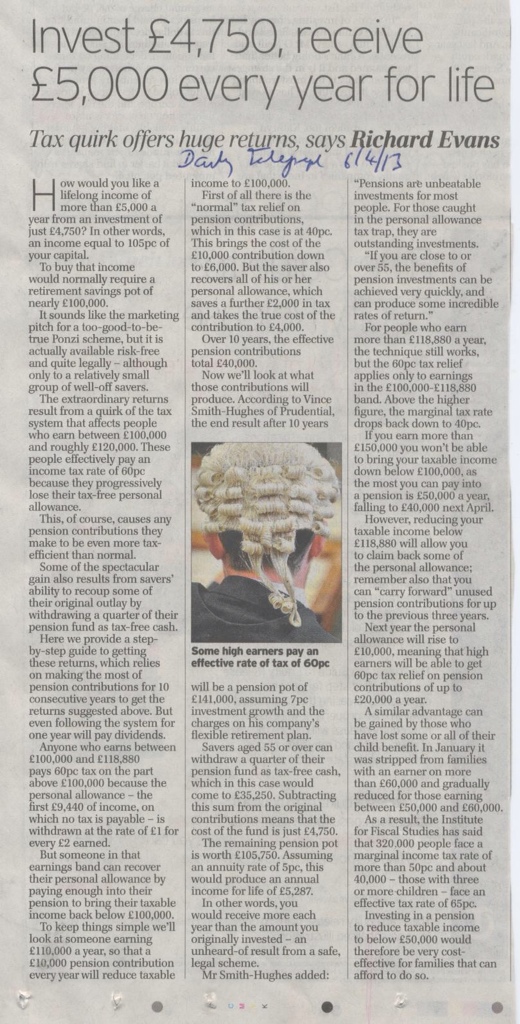
The attached in yesterday's Daily Telegraph was one: though the timing, the start of the new year, could have been improved on: the typical Telegraph reader, Colonel Jones from Surbiton, could have used the article last weekend or even earlier.
There is nothing new in the Telegraph article, except new illustrations: and the article is nicely written, and brings together several points well.
There are two reasons clients send me such articles: (I) is there a catch? (II) I don't understand (no matter how clear the journalists have written, or which smiling readers or celebrities are pictured having done whatever the article is about): and sometimes a third (III) should I do it? The most common answers to the third question are (I) no, it doesn't apply to you [insert sometimes self evident reason why not] (II) yes, but you have already done it. Answer (II) was the case in the instance which caused this blog; I suspect there is an element of just wanting reassurance.
Pensions: the maths
Using 2014/15 rates (when the personal allowance is £10,000), not current rates, when the allowance isn't a round number, but is £9,440, the topic is around:
Do you want to invest in pensions? Do you 'like' having a pension?;
Above the threshold of £100,000, your personal allowance is removed by £1 for every £2 of income. Since your marginal rate of tax would otherwise be 40%, the 50p in the £ removal of allowances makes your effective rate 60%.
So, on income of £110,000, decide to pay a gross contribution of £10,000, restoring the half of personal allowances that are lost at £10,000 above the threshold.
For a gross contribution of £10,000, you physically pay the pension provider £8,000; claim higher rate tax back on your tax return, and in addition your tax liability will be calculated after deducting the full £10,000 allowance: net result, you have a pension pot of £10,000 at a cost to you of only £4,000- 60% relief; but an initial outlay of £8,000, so the initial cash cost is fairly high.
Summary
The article then adds some embellishments, such as the ability to get £2,500 (25% of the fund) out tax free once over 55. But such things are niceties, extras: the key is to think whether you can afford to be £8,000 out of pocket initially, but ultimately (after tax has been reclaimed) £4,000 out of pocket, to get an investment of £10,000. Some with straightened budgets can't afford this, and there are risks, such as the occasionally mooted removal of the 25% tax free rule, which can spoil the maths.
Charity
Another rider I would add is that the same result, in terms of 60% relief, can be obtained by donating to charity.
Tom, Alice, Sophie: you can do whatever career that you wish, but please don't become astronauts, or, if you do, please decline the offer of the Mars trip.
Mars is a bit too far for mum and I to come to visit you.
This article, which I have just seen because it was tweeted by @timharford, accords with much of what I feel about giving and receiving feedback at work.
(As of April 2013, this item isn't blocked by a paywall). I recommend reading it for its many points, but in a nutshell, it talks about straightforwardness rather than fudge. The article concludes with:
But, again, if we look at feedback as an opportunity to make someone work better rather than feel better, we're more likely to do it successfully. As Professor Fishbach said, “We're probably unaware that people would like to know how to improve, and they deserve to know it. It's their right.”
I have given numerous career development talks to teams of my colleagues. When the sessions include either prior submitted questions, or there is a q&a forum at the end, it is very typical to be asked questions like 'what us the best piece of feedback you have ever received'. I will always know the answer to that, and can almost hear Philip Johnson, the partner who gave me it, 25 years ago. Philip's feedback fitted like a glove to Professor Fishbach's findings.
Of course, what would be really valuable would be if the same findings applied to giving feedback to one's spouse and teenage children…
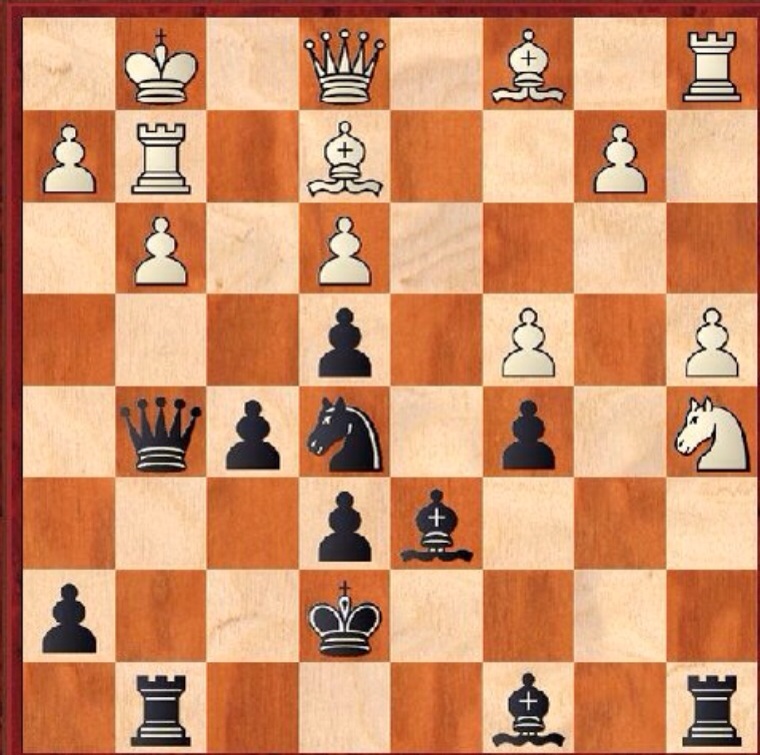
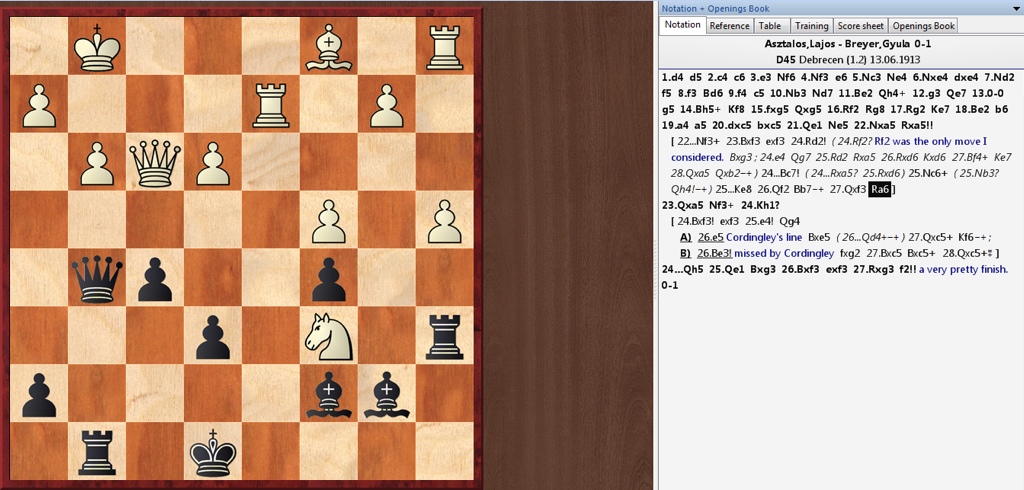
Black to play and win
White's last move was Nb3-a5.
Solution
This is more of a puzzle, though not a 'pure' one, where the win is fairly clear cut. Instead, I think it is more of a Jacob Aagaard position, by which I mean one capable of intensive analysis, to a depth; and then further analysis to an even greater depth. Jacob, the GM publisher of the first rate Quality Chess stable of books, has become synonymous for me with incredibly penetrating analysis.
I chose what for me was the most natural move, 1…Nf3+, and this turns out to be Houdini's favourite, rather than the game continuation 1…Qa5+. However, my reasoning was faulty, missing white's best defence. I assumed that after exchanging on f3 white would move his rook to f2, pressurising f3, blocking the f3 pawn, but allowing the fairly easy Bg3: white had a far better defence, Rd2, seeking counter attack against the Bd6. After the move played, white missed a defence after which Houdini only gives black a slight advantage. The defence, relies on activity, counter attack, rather than passivity, and there is probably a principle there of some general application.
Since the position is an Aagaard, I imagine the last word hasn't been said on the above position, and it would be a great test position to delve into further. Meanwhile, the actual game continuation resulted in a very pretty forcing sequence at the end, one which made me smile, and for that reason puzzle number 6 deserves a star.
 allanbeardsworth