Yes, we can: English people can take pleasure that the Germans were partly at fault in what is happening to Greece and Cyprus.
This blog tries to explain why. The idea of writing it came when Jane asked me the question, which had come up in a late night discussion with one of her brothers and his wife at a recent family gathering.
Shakespeare
Let's bring Shakespeare in: often a good start. In Hamlet, Polonius advises his son Laertes (with a summary first, which I have included since it helps explain to thine self be true, which I didn't appreciate fully at first).
A father's advice to his son how to conduct himself in the world: Don't tell all you think, or put into action thoughts out of harmony or proportion with the occasion. Be friendly, but not common; don't dull your palm by effusively shaking hands with every chance newcomer. Avoid quarrels if you can, but if they are forced on you, give a good account of yourself. Hear every man's censure (opinion), but express your own ideas to few. Dress well, but not ostentatiously. Neither borrow nor lend. And guarantee yourself against being false to others by setting up the high moral principle of being true to yourself.
Give thy thoughts no tongue,
Nor any unproportion'd thought his act.
Be thou familiar, but by no means vulgar;
The friends thou hast, and their adoption tried,
Grapple them to thy soul with hoops of steel;
But do not dull thy palm with entertainment
Of each new-hatch'd, unfledg'd comrade. Beware
Of entrance to a quarrel, but, being in,
Bear 't that th' opposed may beware of thee.
Give every man thine ear, but few thy voice;
Take each man's censure, but reserve thy judgment.
Costly thy habit as thy purse can buy,
But not express'd in fancy; rich, not gaudy;
For the apparel oft proclaims the man.
Neither a borrower, nor a lender be;
For loan oft loses both itself and friend,
And borrowing dulls the edge of husbandry.
This above all: to thine own self be true,
And it must follow, as the night the day,
Thou canst not then be false to any man.
William Shakespeare.
Extracting the key lines:
Neither a borrower, nor a lender be;
For loan oft loses both itself and friend,
And borrowing dulls the edge of husbandry
Two sides to an argument
Sometimes, there is only one side to the argument, though I can't think of when. Certainly, when I am trying to make a point on which I am right with Jane, she always has a different one. This human nature point is quite important: there will be many Cypriots blaming Germany for lending them too much: http://tinyurl.com/bosh5s6 is a nice article on the psychology of lending and borrowing. Or, I am alas on the chubby side: whose fault is that: well, mine clearly, for eating too much, eating the wrong things, and exercising too little. But it is also the manufacturer's and retailers fault for selling me sausage rolls, fish and chips, and chocolate; and Jane's fault, for having a well stocked fridge, and making things I like. But Jane opted for an easier life by providing food her husband prefers, and the retailers take their profit, and the Government takes its tax.
Or the parent-child example: the child doesn't get outside enough, preferring Nintendo, Facebook or Ant and Dec: but the parent could have limited Internet, TV or gaming hours, and encouraged or made the child go out: but the parent gained some peace and quiet from letting the child play indoors.
Germans
And so to the Germans. German manufacturers sold Mercedes and Porsches to Greeks, who borrowed from their banks to fund these purchases; or borrowed from the car companies themselves, on HP or lease terms. And the German Government or Central Banks lent to the Greek Government, to fund motorway improvements, agricultural investments, lazy civil servants, young pensioners.
Why did the Germans do this? Because it was in their interests to do this, or they thought it was: the sale of the car recorded a profit, which could result in a dividend paid out to Herr Schmidt of Dusseldorf; and Herr Schmidt's share portfolio and his pension plan rose whilst Porsche kept recording ever increasing sales. So when he read in the papers about Greece's pending debt problems, did he worry? Not early enough, the Greeks were paying good interest rates on their debt, and they hadn't defaulted before, at least in Herr Schmidt's memory. We tend to forget the things we don't want to remember: how many Brits remember that Britain has defaulted on its debts before now?
Summary
In summary, the Greeks and the Cypriots shouldn't have borrowed; should have taxed themselves more; should have spent less, and retired later. But other Governments, bankers and lenders generally permitted this, encouraged it, making good profits in the meantime: or so they thought: we now know they were unreserved, they should have realised that the chubby child of husband would me day be their even bigger problem, but it is human nature to ignore such future possibilities.
Shakespeare was right: everything is in Polonius's three lines.
 Posted with Blogsy
If I had to choose one game from my times as captain of the England team which had a deep impression on me, in my short list would certainly be Nigel Short's win over Liu, in Calvia, 2004. Nigel made a passing comment to me at the end that for a long part of the game he had effectively been a pawn up. I had not noticed it, mis-understanding the game, and thinking Nigel's advantage might be slight or nil.
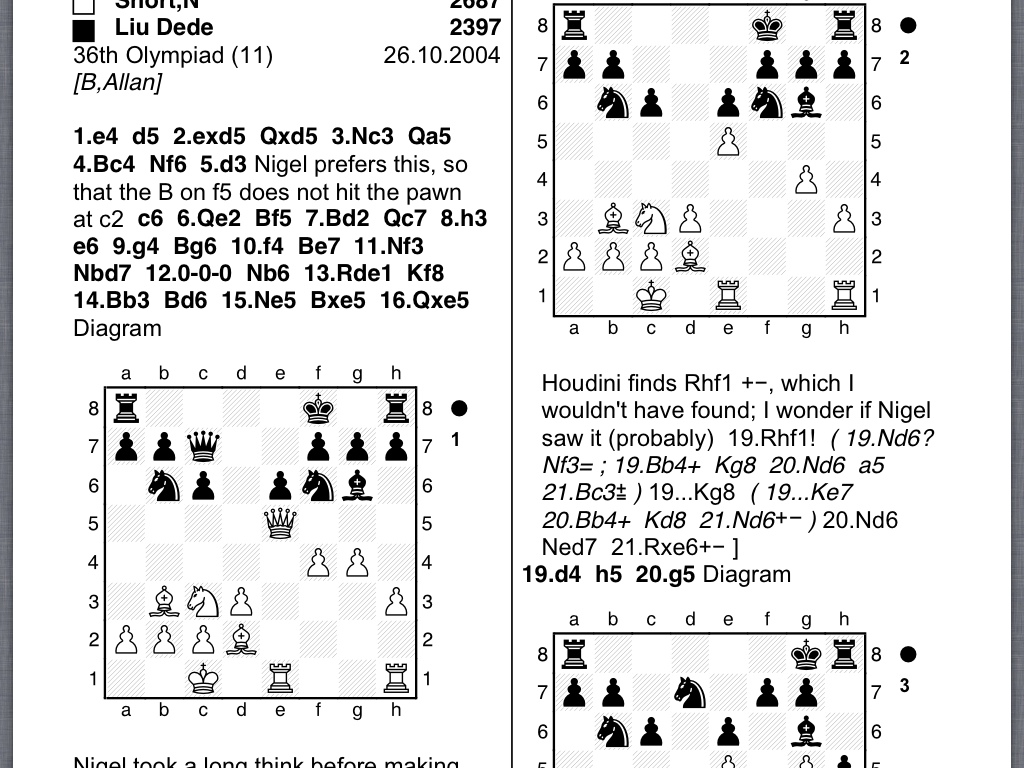
Aside from a trivial point that because of this game, and how Nigel explained his fifth move, I always play d3 and not d4 against Scandanavian systems; and with good results. There is less for black's pieces, especially his whit squared bishop, to bite on with the pawn only on d3.
However, it was Nigel's 16th move, and his comment that after exchange of queens he is effectively a pawn up on the king side, which struck me. Furthermore, he told me such consequences were common in Caro Kann systems: since he told me that, I have seen its truth numerous times. This is for me a clear example of the insight of such a great player as Nigel. The top right diagram shows it best, with 3 v 4 pawns.
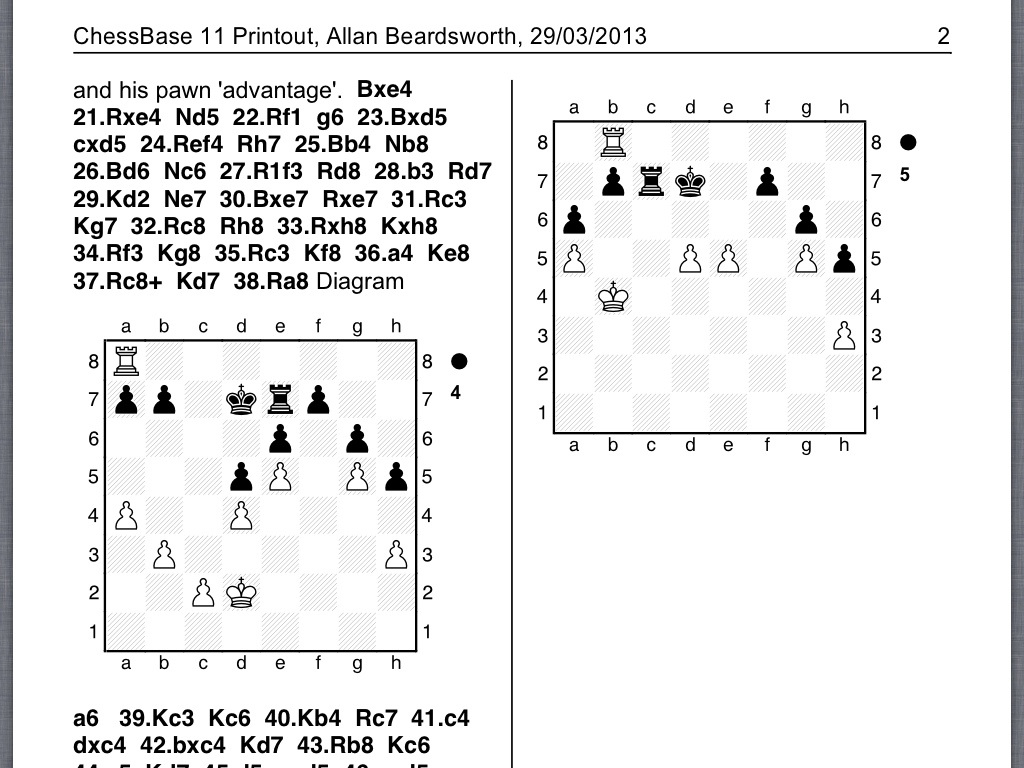
Nigel rattled off the rest of the game a tempo. I was surprised that he wasn't fussed about exchanging of the pieces, and his body language gave confidence: yet, I, as the watching captain, couldn't see much more Jan a slight plus for my player.
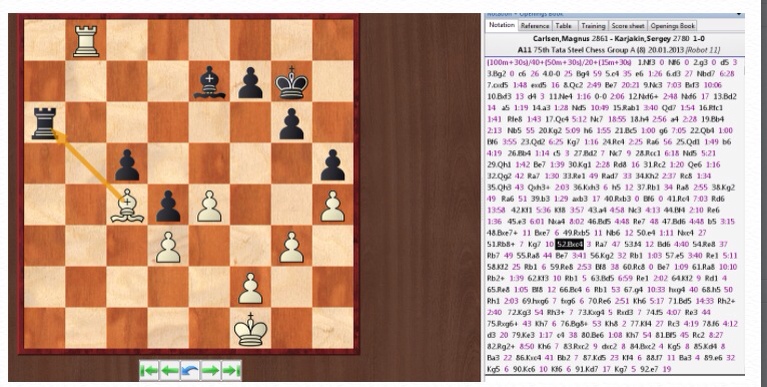
Hopefully I have learned the lesson. My most recent example was from Carlsen-Karjakin where the placement of the pawns, and anchoring of the white bishop gives white an effective pawn majority on the king side: advance, just like Nigel did, and [with Magnus, add a sprinkling of Nordic calculating genius] and 1-0.
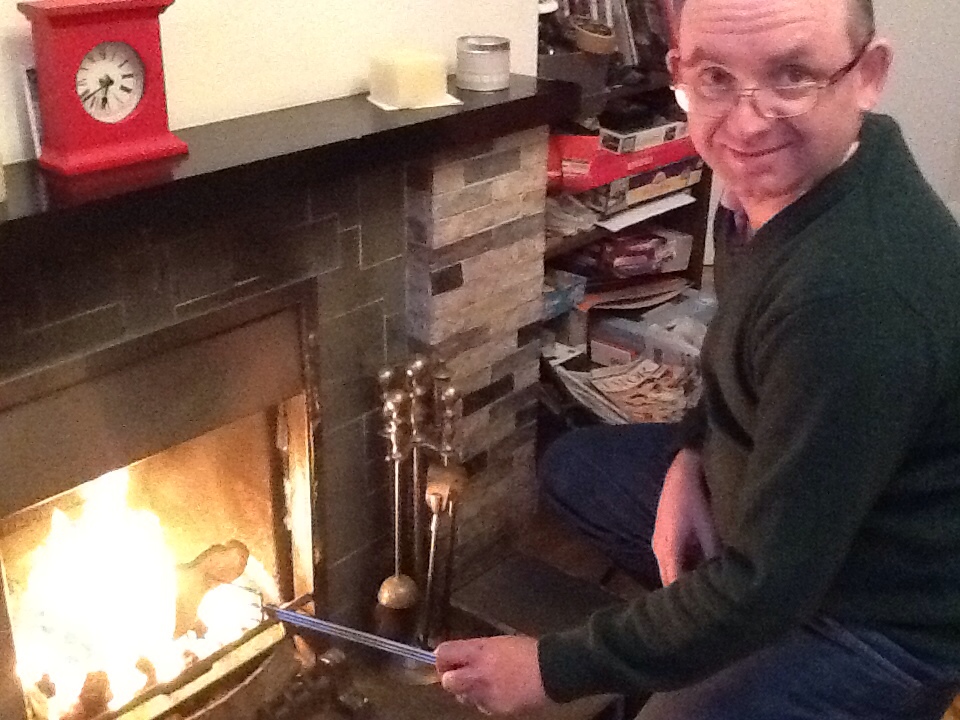
Well, I haven't actually lied to Jane. She hasn't asked the question, and I haven't given the answer. Let me explain: but toast and a coal fire are involved.
We arrived at our cottage in Rosthwaite, Borrowdale, Lake District, this evening: it was bitterly cold, with snow on the hills. So the usual pattern prevails: having been the driver, I have most excuse for a rest, but no , our girls find other things to do, such as check that wifi is working on their phones…so I make the majority of the journeys needed to unload the car. Cold is too warm a word for it: freezing.
So, unpacked, into the lounge, and I thought I would try to light our coal fire…having never managed before in all the years we have had the cottage. But, in this case, my sister in law Sarah, knowing that I can't light a fire (and yes, teenagers, I have watched some 'how to' videos on YouTube) had set the fire up for us at the end of her last visit, kinding and coal all neatly stacked, so all I had to do was strike a match.
Result, a great fire, and the chance for the first time in well over forty years to make toast on an open fire.
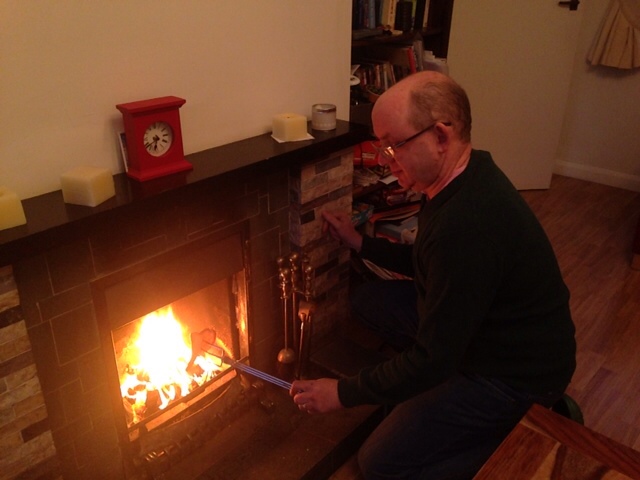
So, when I told Jane I had got the fire working, she believed me. Two good things about this: (I) every word I said to her is true; (II) she doesn't read my blogs.
Even better, the toast was excellent, though at this rate of open-fire-toasting, I will be 95 the next time.
29th March 2012: a year ago today. A client, who lives near us, came to my house for a breakfast time meeting. Afterwards, I drove into the office as normal, missing the rush hour traffic. Kingsway was clear, as was Upper Brook Street. It was just before 10am.
As I got near the crossing with Hathersage road, traffic lights on green, I had to pull out a bit because workmen had cordoned off a pot hole. In making this manoeuvre I noticed that I drove over two black things, a yard or so apart: 'litter', I thought. Fifty or so metres further ahead, I had to swerve again, pulling out quite a bit, thankfully there was no oncoming traffic…my first glance was that it looked like a human body, but on second glance it couldn't have been, since there was no head; to my shame, I decided that it was a cow's carcass, for that was what it looked like, and I then put two and two together, and assumed a refuse lorry or other vehicle had tipped some of its cargo, tutted, and drove on.
A hundred or so yards further on, I thought 'no, must ring the police, others may not be able to swere easily, it is dangerous' and so rang the police: on their non emergency number, which I have stored in my car phone [note for readers in 2023: I have more than one phone number, in fact several- car, mobile, home, office]. I got through, gave me location, and said that I has seen some rubbish in the road, which looked like a cow's carcass. The telephonist checked what I said, said thank you, and then I continued on my way to work, satisfied that I had done my job.
Early evening: left the office, driving on Upper Brook Street, and I can see ahead that the road is closed, cordoned off. Could it be what I saw in the morning? No, but called Jane, she checked the Internet, and…woman's body found on Upper Brook Street. Checked my car voicemail, and the police had been trying to call me; so rang them back, reported what I saw, and wrote a witness statement.
The above was the end of Sarwari Ashraf's life, but not the end of this story.
Firstly, the police told me that I was the only person who rang in to report the incident.
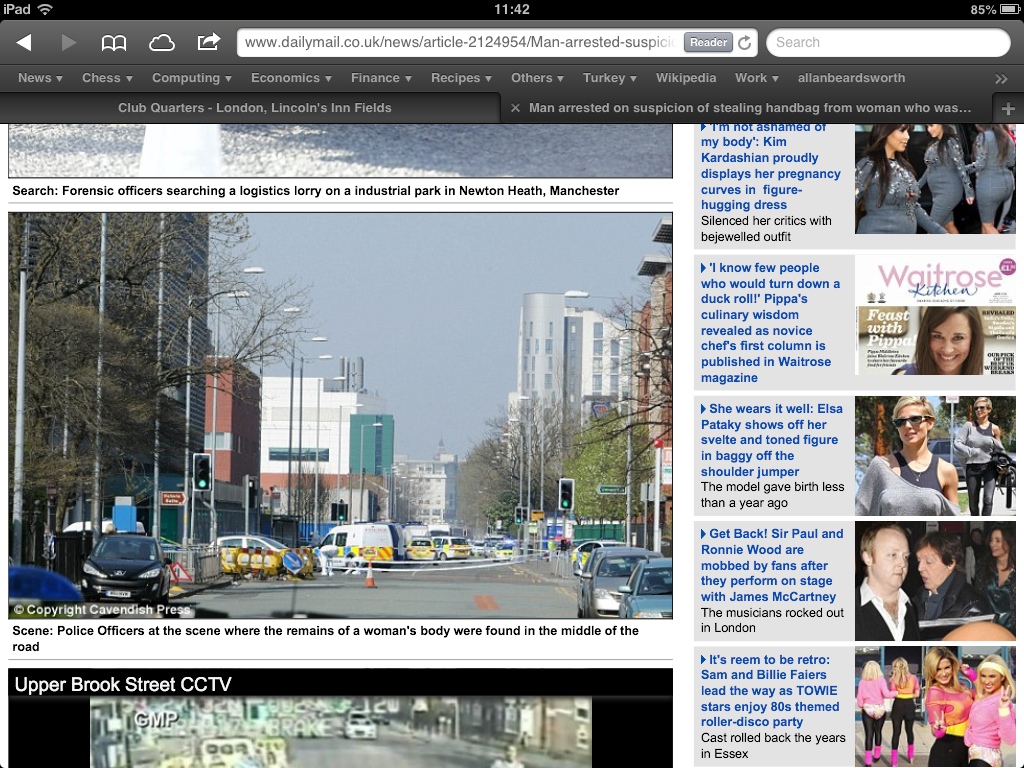
Secondly, two workman who were nearby took photos of the body and posted them on Twitter.
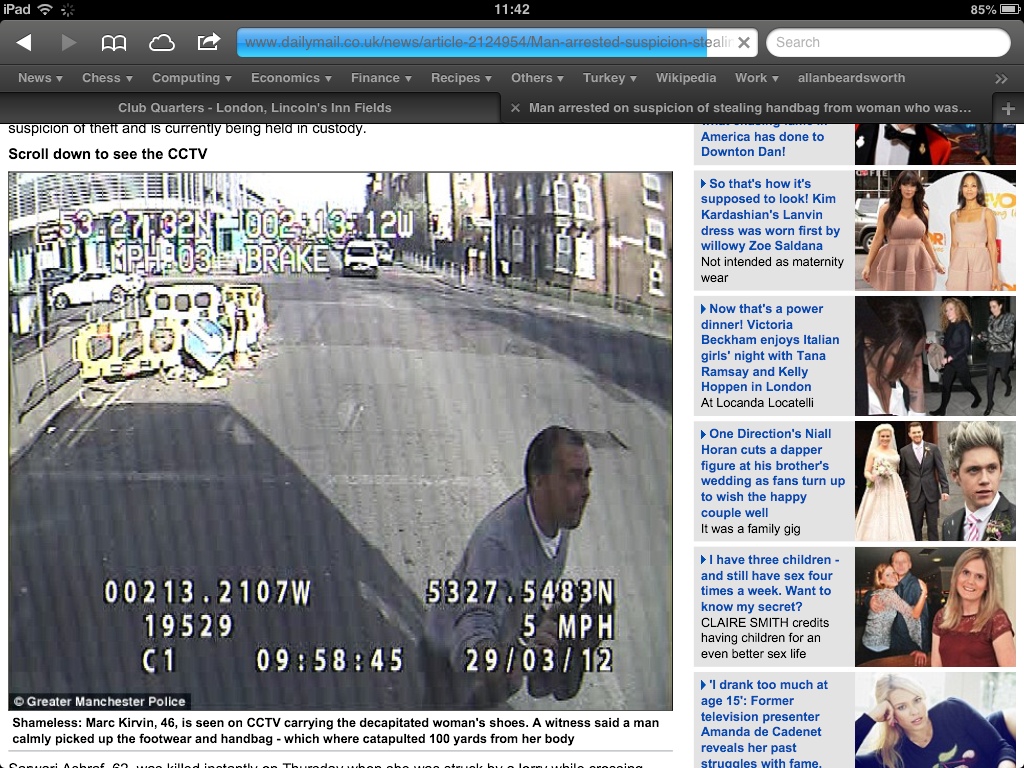
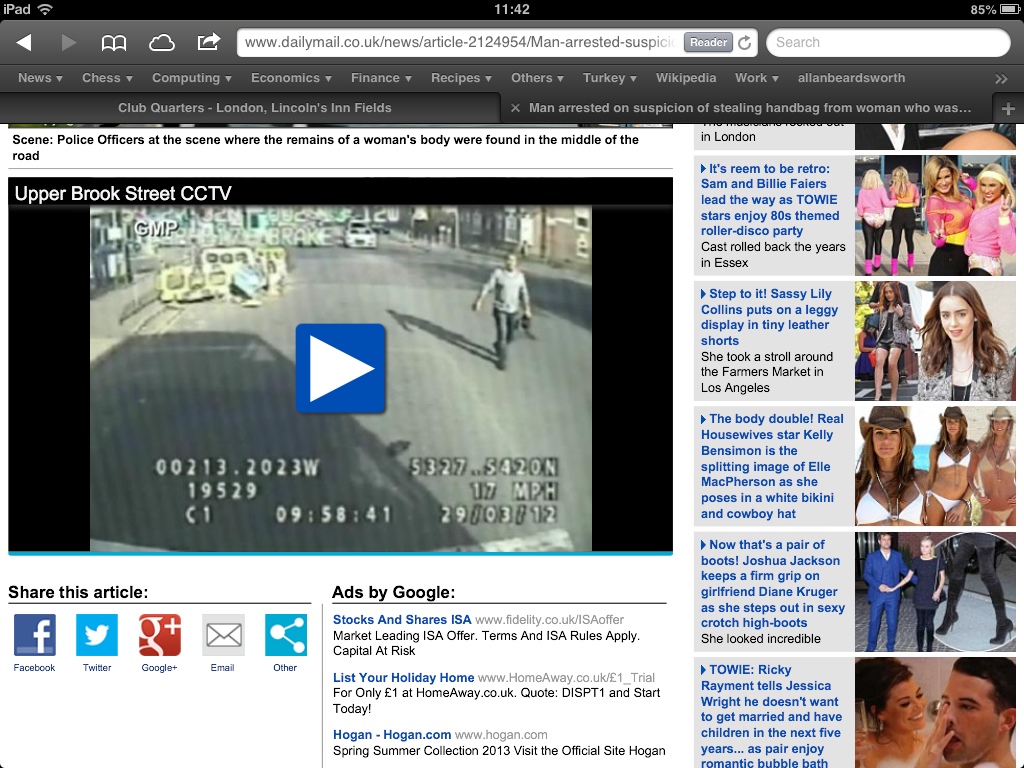
Finally, another person, Marc Kirvin, since arrested, was crossing the road, saw that one of the black objects was her handbag, stole it. Altrincham man charged with theft of Upper Brook Street hit and run victim's missing shoes and handbag | Mancunian Matters
RIP, Sarwari. I shall always remember you.
One of my younger partners told me the other day how much he had thought about something I had suggested to him some while back: something in fact I had forgotten telling him, but I have thought on numerous occasions is true.
The role of a partner is multi-dimensional. Clients, technical, marketing, people; often too much to do, in too little time, and competing pressures all the time. The same pressures as being a manager or director in business. Most of the issues have, as a fundamental, people; and in my experience, internally, there are two types of people.
The concept I gave to my partner is that we each come to work every day with a certain amount of energy within us, like a cup full of liquid. We will spend that energy during the day; in different ways, from one day to another. And our interactions with colleagues is one way in which the energy is used. Some people, and I have one colleague in mind, use energy: cold tea: they sap your strength; perhaps by negativity, perhaps by taking too much of your time, or by not deciding things they could decide, or by checking things which it is unnecessary to check. They are the sort of people you don't wish to work with.
Another type of person is like Red Bull: they give you energy, working with them tops up your energy tanks. These are rarer, but a delight, and again I have a colleague in mind when writing this. (I have no idea whether Red Bull or similar so called energy drinks work)
Cold tea people need to be more like red bulls; that is clear. What is less clear, is that red bulls need moderation too. But far better to work with red bulls: you want to spend time with them, develop their careers, and, surprise surprise, clients want to be be services by them too.
One of my clients uses a different formulation, but in essence the same: they score people by Mr Men characteristics. They want Mr Happy, Mr Confident, Mr Chatty to work for them: Mr Dull, Mr Quiet, can work for their competitors. It is no surprise to me that the particular client is a top performer in its area of business.
Another short game by Mickey Adams also appeals to me: in terms of its simplicity in his play, or should I say apparent simplicity. This game was from the 2013 Gibraltar Telecom tournament.
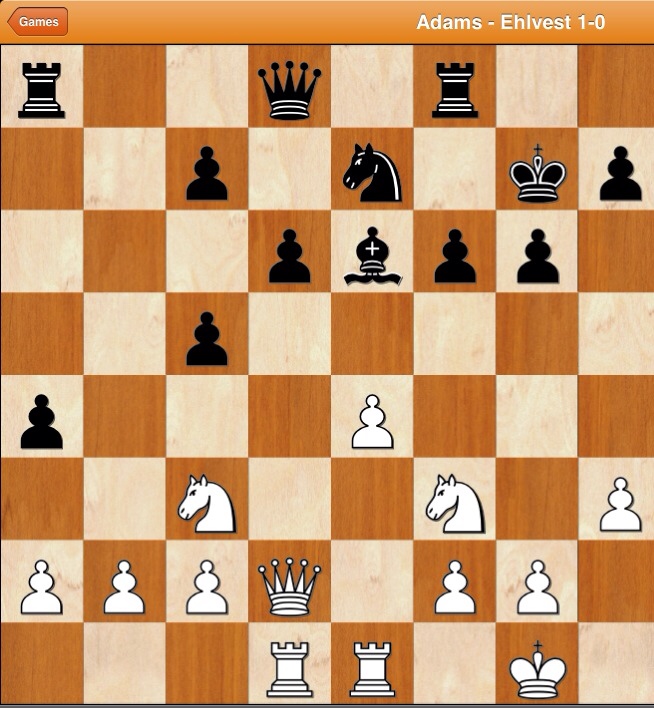
From a Steinitz Ruy Lopez, in the last few moves black has advanced his a pawn; Mickey ignored it, instead putting all his pieces in good positions.
In the above position, I would never have dreamt of playing the move Mickey did, e5!!: I wouldn't have noticed the looseness of the black minor pieces on the e file. It is another example of LPDO (see my post about Adams-Gurevich.
The tactics all work. Taking de is positionally horrible, and white regains the pawn by Qe3-c5. So instead 1…fe 2 Ne5! and if 2…de 3 Qe3!, and either the bishop or knight fall, leaving white with a won game.
The game didn't last much longer.
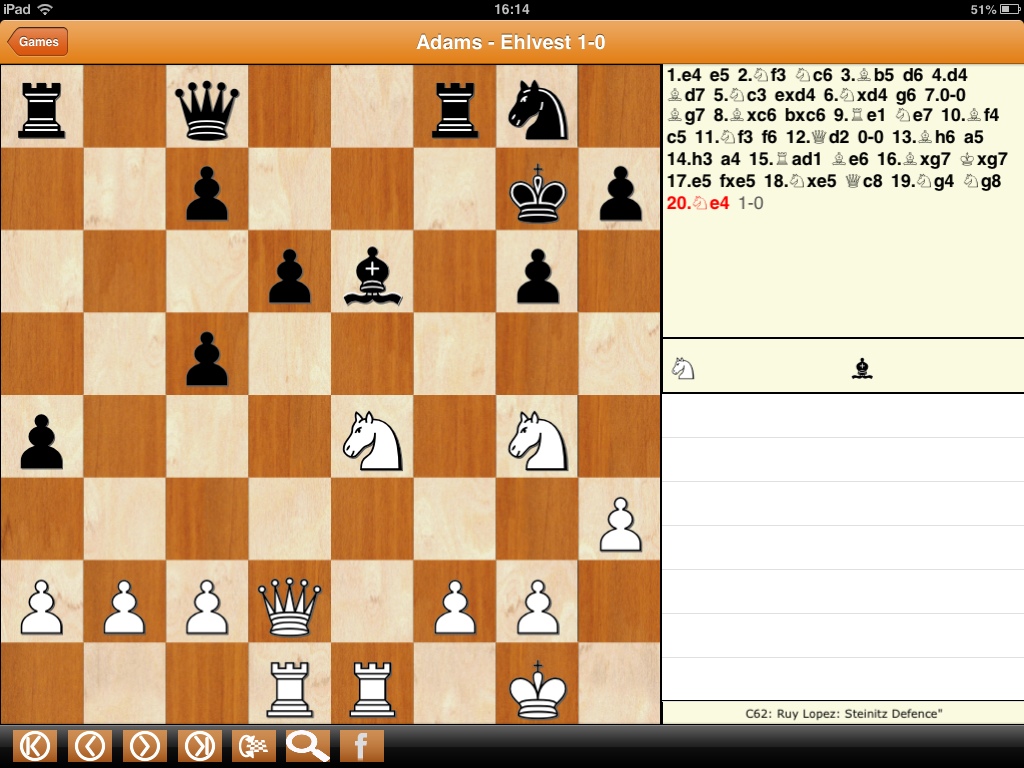
The engines say that Ehlvest resigned a tad too early, there is still some play, but (having been there myself) it is very much like a boxer punch drunk by a heavy stunner.
I will from time to time blog about some reflections on captaining England at the Calvia, Mallorca, 2004 and Turin, Italy, 2006 Olympiads.
One of my clearest memories was of this game:
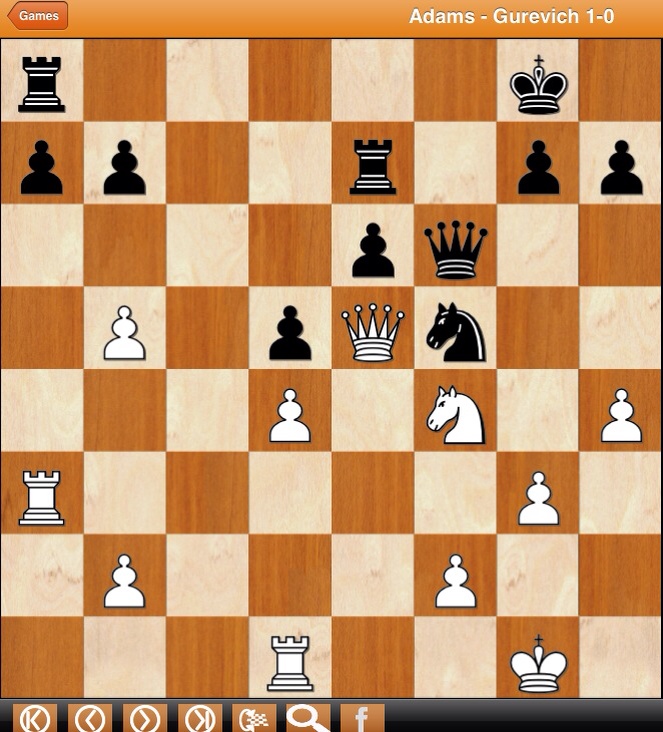
One of the duties I took upon myself was to get the teas or coffees whenever the players wanted them: I became adept at knowing the preferences of each of the six players, so a simple nod was sufficient, or in some cases I just knew when players wanted refreshment. Michael Adams, for instance, as part of his professional approach, never drank during his games, taking his fluids (and his diet) sensibly, to maximise his effectiveness at the board.
The above position, from Turin 2006, was one such occasion. I left the boards at this fairly early stage, to get a round in. When I came back, Mickey had gone, and the pieces re-set, with the white king on e4, black king on d5: the protocol for 'white has won'.
Consternation. How could Mickey Adams have won so quickly after the above position? I checked with the arbiter, who confirmed that it was 1-0 and that the kings weren't misplaced.
The arbiter found the copy scoresheet, and it turned out that Gurevich has blundered,
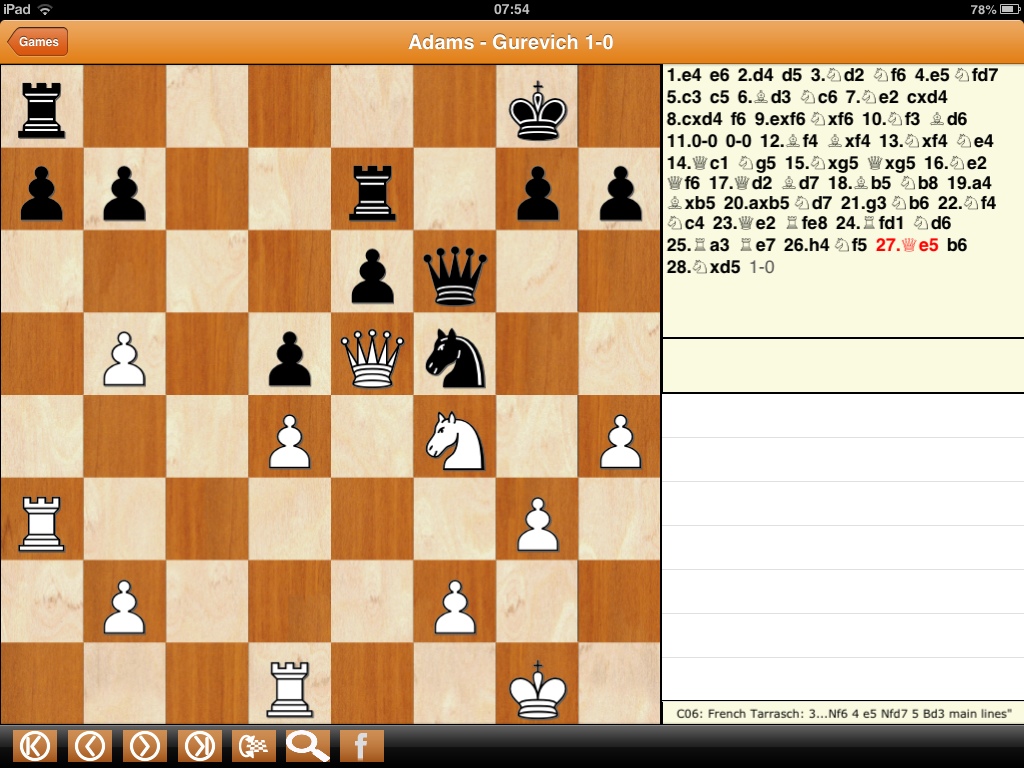
27…b6?? and, following John Nunn, LPDO: the undefended Ra8 falls after 28 Nd5!
Game over.
From the Daily Telegraph, 25/3/13
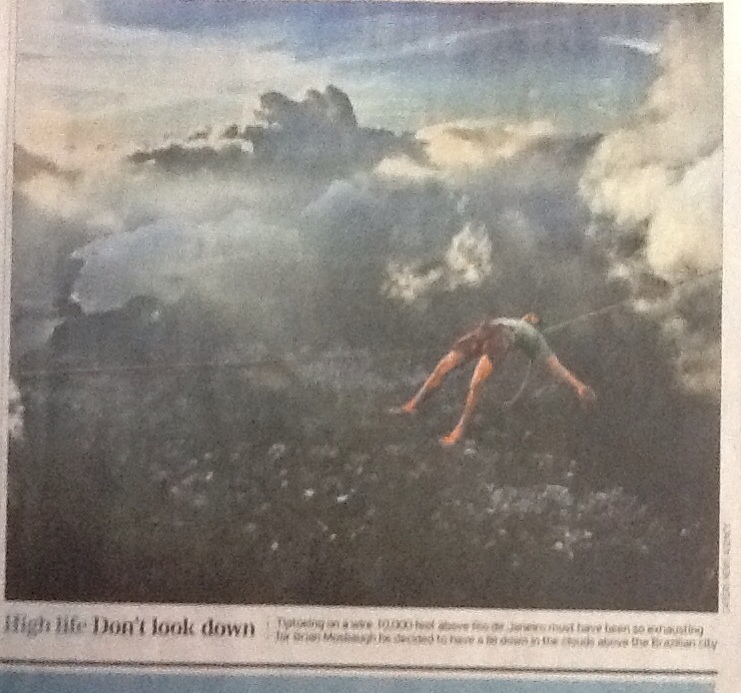
Brian Mosbaugh, 10,000 ft above Rio
The mathematician/physicist in me notes that Brian quite rightly spread his arms and legs out, so that any gusts of wind would spin him less (think skaters pirouetting- tall and narrow for speed, squat to slow down);
The worrier in me wonders 'how did he get from standing to lieing down; and how will he get back up?
The parent in me means (even if he were the right age) he is not marrying either of my daughters.
Some positions just fascinate me: in (almost) Vera Lynn's words, I don't know how, don't why, but they do.
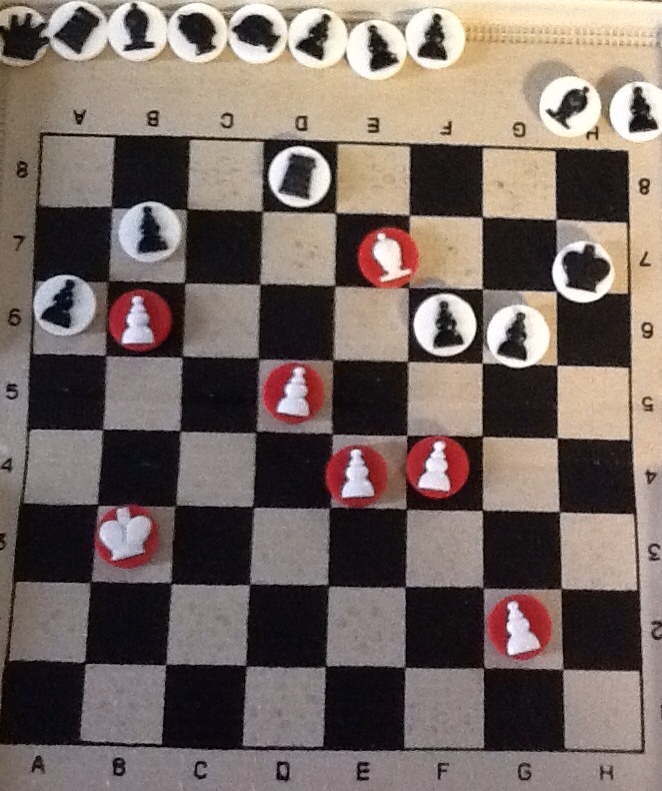
Take the following, the position being set out on my favourite, treasured, Russian travelling chess set, which is appropriate because the game was played between two Russians.
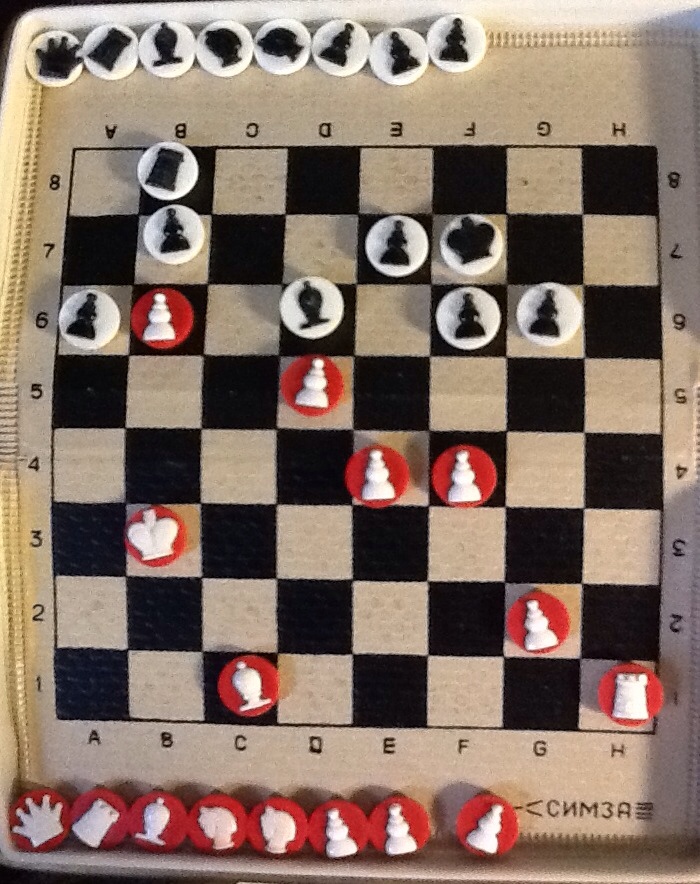
(Credit where it is due: photo cropped and rotated using PS Express, a free iPad app: I don't do any significant photo editing, unlike my professional photographer brother, so don't need the paid Photoshop app, but the Express version is great for what I need).
Why did Peter play 25…Kg6? The above position is after 25…hg instead. I dipped into this game on and off when it was happening, and throughout the ending I knew Vladimir was pushing, but I never felt he had much, and, truth be told, was scared that at any time the b6 pawn would fall, and white's game would soon be in tatters.
The Chessbase.com and Chessvibes.com analyses passed over move 25, as did Malcolm Pein's Telegraph article.
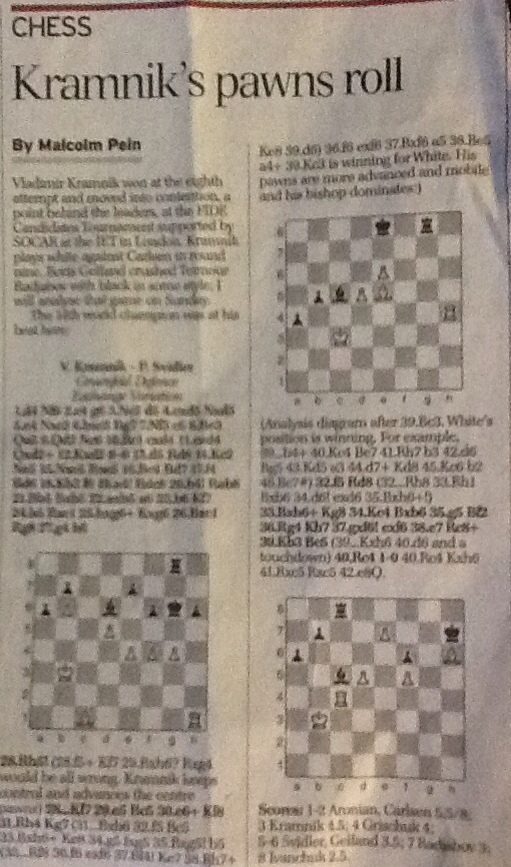
On the train down to London yesterday, I caught up a with a slight backlog of newspapers, and to my delight, saw that Jon Speelman had mentioned the very same move in his Independent article:
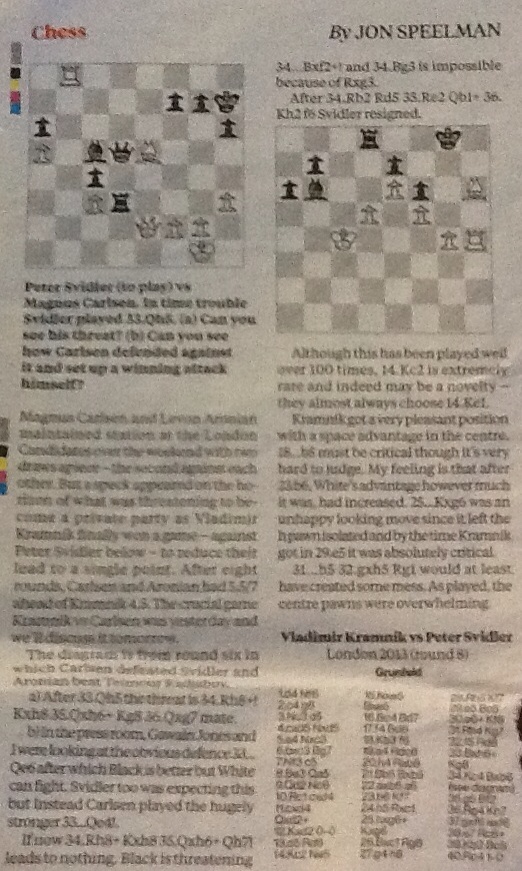
I thought I knew what Jon meant by '25…Kg6 was an unhappy looking move since it left the h pawn isolated' but wasn't sure whether Jon meant 'but it had to be played because …hg lost'. So yesterday I asked Jon, and he told me that Vladimir and Peter had told him, or maybe mentioned at the post game press conference, that hg lost, but Jon himself had wondered about it, and didn't know why: his unhappy word meaning it wasn't the sort of move that you wanted to play. I had assumed, trusting Svidler, that …Kg6 showed my lack of appreciation for king activity, but this trust seems to have been misplaced.
Neither do I, but I intend to try to attempt to find out, though suspect it might be too hard for me. I intend to avoid using silicon assistance, at least until I give up.
My present thought is that 26 Ba3 is the idea, though 26 g3 might transpose. If 26…Bf4 (after 26 Ba3), then Rh7+ and take the e7 pawn, after which I can believe white is winning: the d6 is a monster, and the black king will be out of play on g8, with f8 often being mined because of the threat of discovered check from the Ba3/Re7 pairing. So say 26….Rd8 instead, after which the best I can find at the moment is 27 Ka4 (with the idea of Bd6 and Ka5) 27…Ba3 28 Ka3 Rd8 29 Rb1 followed by Ka4-a5, releasing the rook from defensive duties, but I am not terribly convinced: black might be able to play a timely f5 (so maybe g4 to prevent it) or a timely e6 to get rid of the dangerous d5 pawn and give luft for black's rook.
One fantasy line of mine is 26 Ba3 Rd8 27 Rh7+ Kg8 (27…Kf8?? 28 Rh8+ 1-0) 28 Bd6 (28 Re7 has a similar idea, but in that line, the K is on g8, which is probably a better place than h7) 28…Kh7 29 Be7.
This looks winning, but I doubt I have got anywhere near the true analysis of the position after 25…hg. If this line is robust, then maybe black play's instead 26…Ba3 27 Ka3 Kg7 (27…Rc8 28 Rh7+ Ke8 (28…Kg8 29 Re7 +-; 28…Kf8?? 29 Rh8+ 1-0) when I doubt the pawn ending (after Rh8+ and swapping off rooks) is winning, but I am not sure about 29 Kb4 and say 29…Rc2 30 Rh8+ and 31 Rb8: might be winning, as might 29 Rg7): I don't know.
One more item for my long, for which read very long, improvement-before-I-am-too-old to do list.
Today, I visited for the first time the Candidates Tournament being held in London. I got the lunchtime train from Stockport, arriving in London mid afternoon, and in the taxi to the venue saw the opening moves of the round, including the rapid draw in Radjabov-Svidler, a Gruenfeld which I suspect is pretty much all theory; and my taxi analysis saw that Grischuk-Kramnik was a very typical Berlin Ruy Lopez, the line of which Kramnik is the master, and Aronian-Ivanchuk was, of all things, as Vassily is a man for all openings, a Budapest defence.
Vladimir won the Berlin ending after a horrible miscalculation by Alexander, who simplified from a drawn bishop v knight into a lost pawn ending: time trouble; and Vassily lost his fourth game of the tournament on time; but to me, the game of the round, was Magnus's victory over Boris Gelfand.
This was the position when I arrived at the venue.
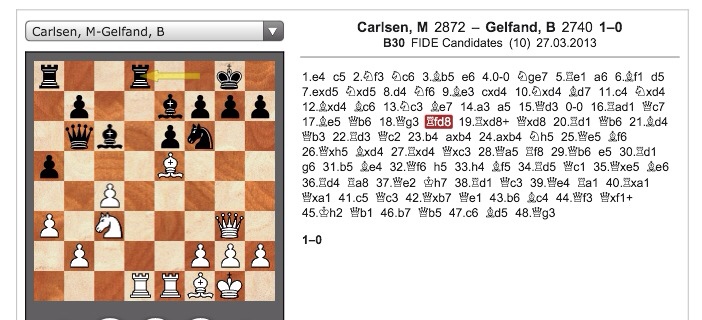
Not for the first time with Magnus's game, I totally mis evaluated this position. At first, I was worried for white, thinking he had no attack on the king side, and that the b pawn was weak, and Boris would have the advantage if all the rooks were to come off. Magnus thought for a good while in this position, and during this time I started to better appreciate the position. The pressure on g7 is real, and there are sometimes Nd5 tictacs to watch out for, so I eventually settled my appraisal as the position being equal, and if I were asked to take one side, I would take black. Wrong.
Whilst I was surprised that Boris took the Rd8 with his Q, thereby keeping a pair of rooks on, I was equally surprised with Magnus's rook lift Rd3, after which I started to appreciate the possibilities in white's position: to make something from 'nothing', and to keep 'something' as the position is simplified, is Magnus's genius.
I am really in awe as to how Magnus plays what I think are bold moves, like 23 b4, which turn out to be obvious once he has played them, and which rely on little tactics, here being the requirement for the Be7 to protect the Nf6: and also Magnus's ability to calculate through the complications after 24…Nh5. Played through rapidly, his games might not impress, might appear simple, but are anything but.
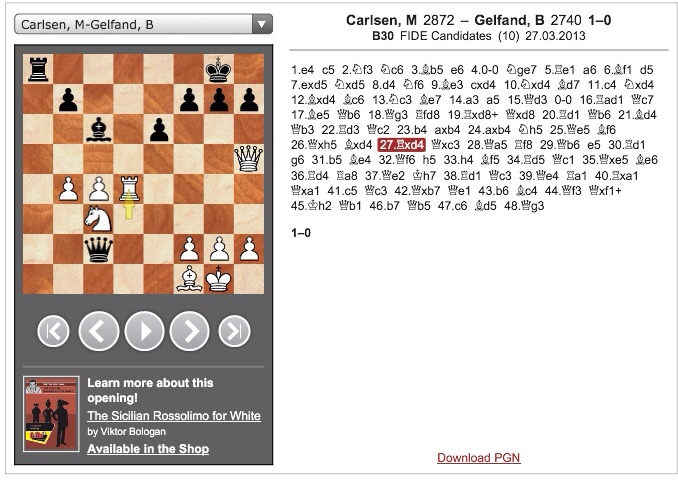
Lawrence Trent, in the commentary room, was impressed and extolled Boris's …e5, with Nigel Short explaining that Boris had chosen it instead of suffering: sacrificing a pawn to free his rook, and put pressure on white's back rank. It was interesting to note that both Nigel and Jon Speelman, who was standing next to me at this juncture, were calmer than Lawrence, with Jon just thinking, true to his style, that 'the game goes on', a phrase I learnt to appreciate from Jon when he was in the England team I captained in 2004: Jon taught me, if teaching was needed, that chess is still a game between two players.
Magnus managed to keep Boris's activity under control and soon we had yet another defeat by Magnus of a world class player. I should add that (I) I didn't look much at the game, since Aronian-Ivanchuk was far more exciting, especially given Vassily's horrendous time trouble (II) I am blogging before any of the sites I follow have any analysis up (I am trying to record my first impressions) (III) Nigel said he didn't like Qf6, thinking the Q was well placed on b6 (iv) Lawrence was saying that 41 Qe7 looked winning…. when I have more time, I intend to look into the last two points further.
Until then, with the first three seeds having each won today, all impressively, there is still all to play for, with four more rounds, with Magnus in front.
If I were to sum up what I feel watching these elite players, I would say: humbling; whilst I can beat a GM I an informal game (see my separate blog posted earlier) the way Magnus, Levon and Vladimir play is on a different planet.
 allanbeardsworth