I had a good day yesterday. Perhaps it is no coincidence that nice things happen if you help others.
I was in our Liverpool office, giving a talk about my career, and lessons from it, to the tax department, and taking questions at the end. I enjoy doing such things, and believe it is part of my role now at Deloitte to 'Pay it forward' http://en.wikipedia.org/wiki/Pay_it_forward.
Anyway, one of the questions, which I received in advance, and I covered at the end, was to ask me which three or four people, dead or alive, I would have as my ideal dinner party guests. Thinking this through over the last week or so gave me a lot of pleasure, in a similar way I am sure to choosing your Desert Island Discs http://www.bbc.co.uk/radio4/features/desert-island-discs records (though, what gave me less pleasure was that hardly any of the audience, mainly comprising 20 year olds, had heard of it).
After much fun, I narrowed my choices down, and one of my guests would be Sir Isaac Newton, so I could try to understand the basics of physics, hoping that he would be a good teacher of the principles. I do believe that a lot of my O level, A level and degree level science was sometimes cursory: give a concept a name, use it a bit, and then you believe you understand it. A big part of my view of science is that often we tease ourselves into conning ourselves into believing we know more than we do: and in this, I speak as someone who got a top first in engineering from Cambridge: there was lots I could do in practice without deeply, deeply, understanding matters.
Back now to my main point. One of my colleagues, Paul Farr, saw me afterwards, and asked me why I had chosen Sir Isaac over Richard Feynman: I had though of Richard, but ruled him out, but in reflection, Paul was right, Richard was an excellent teacher and his books are well worth reading [ note to self: read more of his work]. I could have added Eric Rogers, the writer of Physics for the Inquiring Mind, the best book on physics that I have ever read.
It turns out that Paul, now a VAT specialist, is also deeply interested in science, maths and engineering. He gave me a puzzle to solve, which I think is pretty neat.
Rolling ball
Imagine a small ball, perched at the apex of a large sphere. The gentlest of forces pushes the ball, so it rolls down the sphere: at what angle does it leave the surface?
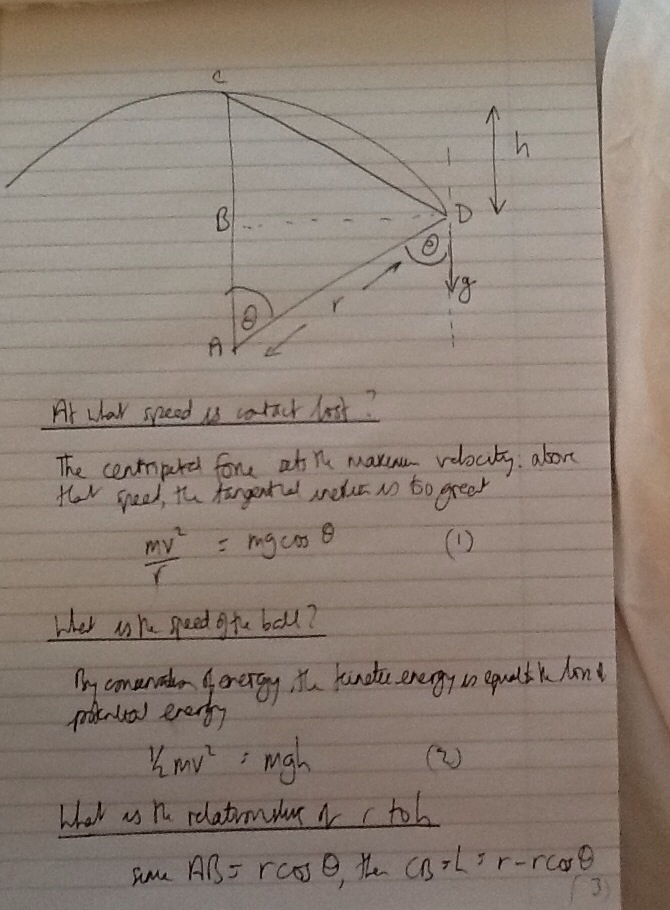
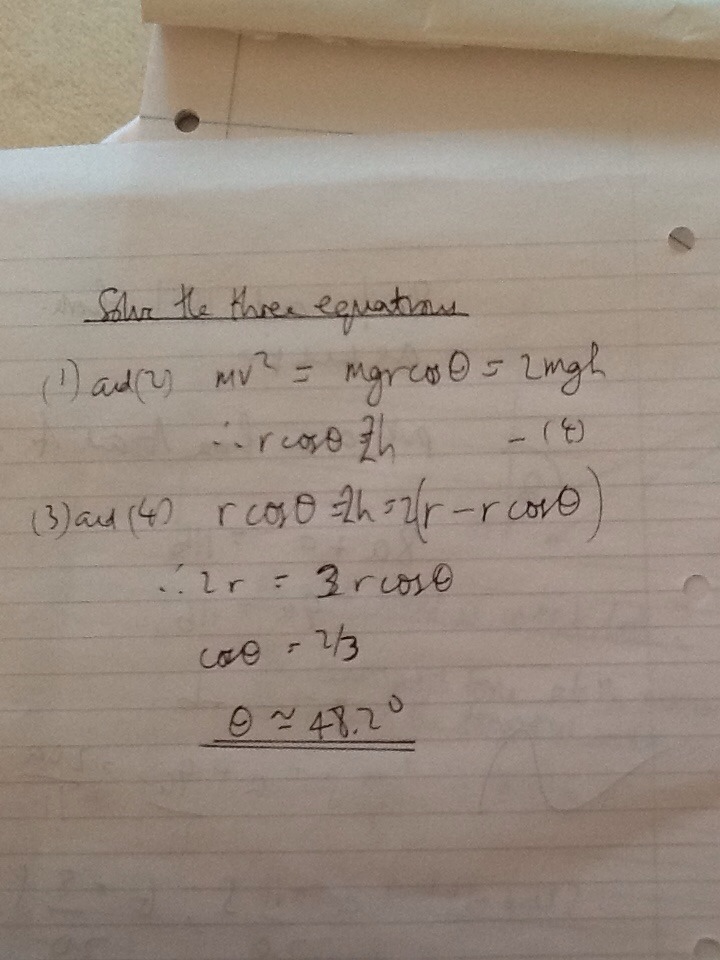
I am pleased to say I solved it fairly rapidly, but only by good fortune. Only recently had I been helping Sophie with her homework, and afterwards spent a lot of time trying to bolster my understanding of centripetal forces and why things really go round in circles. So I had one equation instantaneously to mind, working out the take off condition. The speed was slightly harder, but in our chat, Paul had given me the clue of looking at conservation of energy [Paul- that was a big clue] so all I had to do was some not too difficult geometry (though, rustiness meant it took me some while) following which there were three equations which could be solved easily. My solution is below.
Comments
1. The angle is somewhat less than I would have intuitively guessed- my a priori guess would have been 60 degrees; perhaps this is real world intuition, taking into account friction?
2. On (1), whilst I suggest friction is a reason for my intuition being wrong, I actually can't see how friction would increase the takeoff theta. Something else to mull over whilst walking Charlie. The real world effect might in fact be air resistance.
3. The initial nudge was incy-wincy-tiny: but were it not, and if instead it gave even the slightest initial velocity, then the departure angle reduces: the maximum velocity which the centripetal force can sustain is exceeded earlier in the slope.
4. Thank you, Paul, for taking an interest in what I had to say, for our discussion, and for giving me an interesting problem to solve.
 Posted with Blogsy
The other night, playing 3 minute blitz on Playchess.com, I had the opportunity to play a fairly standard motif. Not hard:
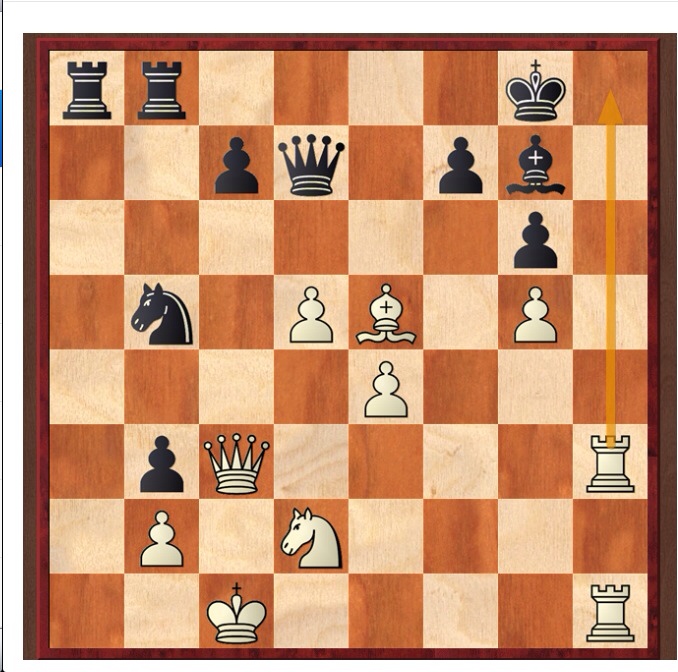
As far as I can recall, this was the first time I've played this well known 'reloader' h file motif. Very satisfying, if not too hard.
“Thrilling” was Jane’s instant reaction when I told her I’d like to go to a World Premiere performance as part of the Manchester International Festival.
What is she like?
Doesn’t the above like it might even surpass To Kill a Mocking Bird?
https://allanbeardsworth.wordpress.com/2013/03/10/to-kill-a-mocking-bird-at-the-royal-exchange/
My daughters were similarly unenchanted. Daughter #1 said ‘who is he, some chess player?”

Jane chipped in ‘you can go instead of me, if you want’, helpfully. Clearly on a roll, she added ‘or you can go by yourself, there will lots of other loners there as well’.
Clearly, my family (excluding Tom, who is away) have no cultural appreciation.
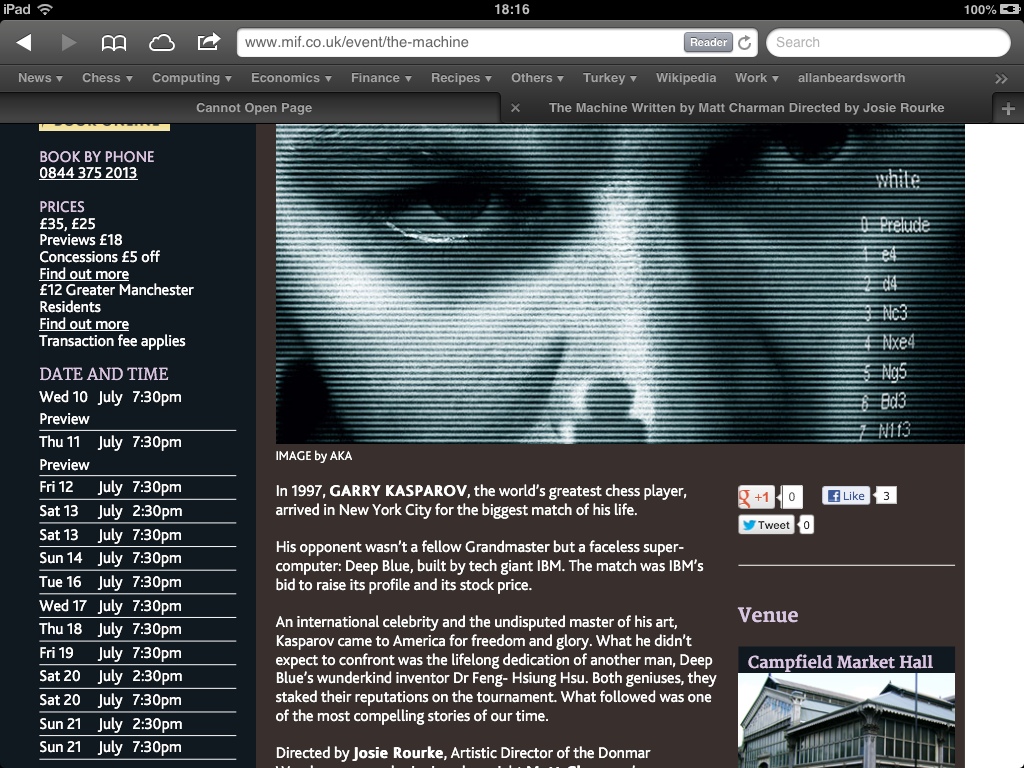
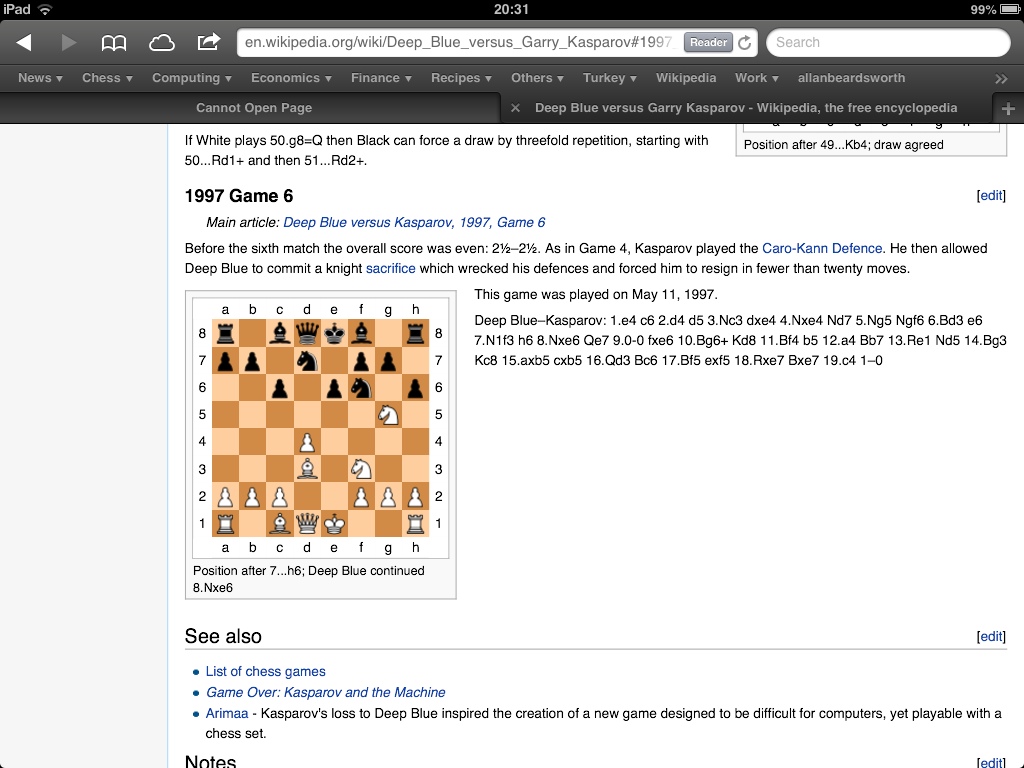
Now, my reaction to learning about this show….was must see it, wow, and….then look at the poster and immediately recognise the moves on the right hand side of the poster ( e4, d4, Nc3 etc) as the opening moves of Garry’s traumatic last game (game 6) 19 move loss in the 1997 rematch vs Deep Blue. The game is imprinted on my mind: it was the singular defining moment when computers became better than humans. Garry has never lost so quickly nor so badly: when I met him last July, I half wanted to ask him about playing Deep Blue, but decided not to, since I know how psychologically crushing it was for him to lose in such a way: and I know that game 6 was actually the sign of being mentally crushed by the sheer pressure of playing such a relentless opponent.
For a few years after 1997, other top GMs tried to play against the silicon monsters. I recall my friend and England #1 being crushed in 2005 by Deep Hydra- a machine which could have crushed Deep Blue, and now, in 2013, my iPhone, iPad, PC….can all beat the world’s top players: the gap is so much it is pointless to play against them.
Last I knew, Deep Blue is now being used for airline ticketing http://en.wikipedia.org/wiki/Deep_Blue_(chess_computer). Sic transit gloria mundi, even for computers.
Now, who will go with me?
I have now been blogging for a few months, and it has been a really fun experience; even if I am mainly writing for myself, for my own enjoyment.
Happily, though, I have had messages from many readers, and even have some followers (thank you). I also get fairly regular praise- often extremely high praise from 'bloggers' (note the italics) who after giving me their feedback, suggest I might like to read their blogs; they tend to be of subjects which would both make me blush and Jane frown. Such is the way of the Internet.
Today, though, I got 'positive' (again, note the comments) feedback from a real person, one of my colleagues. He sent me an email to say he was so engrossed in reading my blog that he missed his stop on the train into work.
That, to me, is a success; and to the partner, client or colleague who David let down by his lateness, sorry, but at least it was for a very worthwhile reason.
Currently, past Apprentice winner Stella English is in the news, in an Employment Tribunal case against Lord Alan Sugar. La famille Beardsworth have watched each series of the Apprentice (though, to be honest, our interest has far declined with recent series- the earliest ones had far more interesting, for which read outrageous, characters, and the formula was still novel.
The pictures below caught my attention:

Clearly, Stella is dressed for Court (but: style advice: points are lost for the sandwich bag), but, pray, why does she need such large handbags?
What, for example, would the Court entrance X-ray scanners, show that they contain? I think that no man will ever know the answer to such questions. Whilst I have solved the question of how many bags my wife needs, I shall never know what is the right size for each occasion.
Yesterday, it was Jane's birthday, and, what did she want?- yes, another handbag. And when Jane thinks handbag, I can expect a painful dent on my credit card.
This, and the newspaper article which caused my next post, started me thinking ’how many handbags does a woman need'? I am delighted to have solved this, and below is the mathematical equation.

Jane is a high coefficient of extravagance girl. Believe me.
Now, this formula might have other uses. It could be applied, mutatis mutandis, to the number of chess books a chessplayer needs. But there is a fundamental difference: chess books are useful.
Last night was a memorable evening. Timing couldn't be better: during the day, I had travelled to and from Oxford to pick Tom up, and it was Jane's birthday, let alone it being Mother's Day today, so we had three reasons to hope for a good night out.
And it certainly was.
Simply the best theatre production I can recall for many a year, ranking as an all time high. The staging was superlative, exploiting the Royal Exchange http://www.royalexchange.co.uk/page.aspx to its fullest. I liked both the dirt yard in the first half, and the court room in the second. The director used music well to help with scene changes.
Amongst several fine performances, I would single out Shannon Tarbet's http://en.wikipedia.org/wiki/Shannon_Tarbet portrayal of Scout. Her accent was brilliant, but the way she carried herself, portraying a nine year old (she is 21) and the 'life' she brought to the role, make her one to watch.
The show has left me simply buzzing, so much that I would like to see it again.
Of course, I normally blog about things that I know about, such as [some might say] the duller things in life, but the online reviews are universally the same (and similarly praise Shannon), as shown by the WordCloud below.

For more years than I can remember (probably more than 30 years) I have been enjoying the Daily Telegraph letters page- I have even had one or two letters published myself- but not in this Century.
I thought I would use this blog to post on occasion letters which appealed to me.

Tom, this is getting ridiculous. I blog yesterday about proud father moment's #2 and #3, making the pretend witty point that like buses PFMs come in threes, and, what do you do, text mum and I whilst we were at a party, to say that you had just head that you had become editor of Cherwell, the Oxford University student newspaper http://www.cherwell.org/.
I don't know what come in fours, (1) so will instead say something different: in fact what was more or less my first thought when we saw your the text last night. The receipt of the news was one of those occasions when I when I wish my mother was still alive: Nana would have been thrilled to be told of your success, Tom.
My mum once told me that she thought about her mother every day of her life; mum had asked me, wondered, whether her fate would be different: it hasn't; she has been in my thoughts every day these last ten years; but some days, she really comes to the fore. Last night, and writing this blog, is one such occasion. Well done, again, Tom.
(1) I have just googled 'what comes in fours': as with everything nowadays, that search comes up with numerous results. Nothing is safe from google.
PFMs (proud father moments) come along only now and then, but just like British buses, when they do, they come in threes.
PFM #2 was last night, when Tom was on the panel at his alma mater, Manchester Grammar School, for Question Time. As Jane noted, he was the only panellist without a Wikipedia or other weblink.
Afterwards, the five of us went to the Rusholme Curry Mile, to Spicy Hut, http://www.spicy-hut-rusholme.co.uk/ for an excellent meal. The food was great, as was the service and atmosphere. For me, the occasion was also added to by reading, on a plaque on the wall, that the owner received an award from http://mcwhirterfoundation.org/ for bravery in 2000, when he helped save policeman caught by a riotous mob. I hope that we will go it his restaurant again: I certainly hope so.
PFM#3 was around 10am today, when an email pinged into his inbox to say that he had won the 2013 Philip Geddes prize for the most promising journalist at Oxford University http://www.geddesprize.co.uk/. Philip was a student at St Edmund’s Hall who was killed at the age of 24 by an IRA bomb at Harrods: he had stayed in the danger area trying to get a story.
Of course, I have had many more PFMs, including a good number from each of my daugher’s, and will have plenty more to come from each, but since last night/this morning has been the first time Tom has come for a flying visit home during term time, it seems fair to blog about him.

 allanbeardsworth