Thanks to issue 4493 of Chess Today http://www.chesstoday.net/ , which showed the fairly well known position below, I have learnt of some useful freeware.
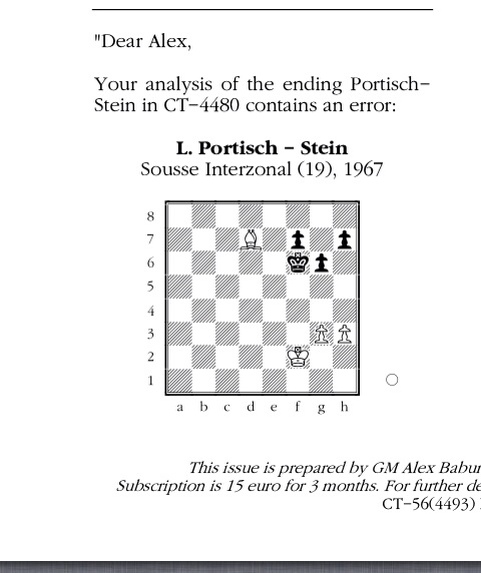
Finalgen FinalGen chess endgame tablebase generator is, as the link says, a tablebase generator. It says it can solve all endings with just pawns and with a maximum of one piece per side. As I write this blog, my machine is whirring away trying to solve this position. The writer of the Chess Today piece has similarly used it, showing the various ways that white can win.
Since I have something of an interest in king and pawn endings, I will now and then put Finalgen through its paces, but it looks like an excellent tool. On my slow (4 year old) PC, the program says it will take 2hrs 20min to solve Portisch-Stein. We shall see.
 Posted with Blogsy
This blog comes from a question my fifteen year old daughter, Sophie, asked me about her physics homework last week. The answer to it has taken about 35 years, so either find something else to do, or settle down for some maths, physics, and revelations about my psyche; and a bit of Latin thrown in for good measure.
First, praise where it is due to Wikipedia, which has helped me where Bolton School and Cambridge University didn’t – or maybe, I didn’t let them. A lot of what follows starts from reading various Wikipedia articles, together with thinking during an hour in the gym yesterday, and thinking during dog-walking. That is what comes from ‘helping with homework’. [Sophie just wanted the answer, as I did at her age].
Centripetal force
Why does the Moon orbit the Earth, a ball on a string circle, a car go round a roundabout? Inertia would make the body go in a straight line where it not something, be it gravity, tension or engine power which causes rotation- the centripetal (petere, to go to, or to seek, Latin) force.
I was also taught at school, and university (where I read Engineering) to think in terms of there also being a centrifugal (fugere, to flee, Latin) force pushing the object out; never quite explained why, never quite understood, but, and this is an important point, accepted and as a practical tool for analysis, very useful- I think during university I understood that centrifugal forces weren’t real, but were a mathematical trick to turn a dynamic problem into a statical one, but I also think there was some conning going on, the teachers or lecturers knowing it worked in practice for analysis…a sort of simplification. Perhaps sometimes it is not worth thinking too hard.
Now, in 2013, there are various pages on Wikipedia explaining that how circular motion is taught has moved on, and now (ignoring something different, the reactive centrifugal force in some motion) there is no attempt to pretend that centrifugal forces exist. I do like this honesty: maybe it is because the audience of Wikipedia is wide, comprising both readers who want an appreciation, to those who want a true understanding.
It is quite hard to show, but I think fairly understandable, that the centripetal force is mv^2/r, where m is the body’s mass, v it’s velocity, and r the radius of the circle. This is the maximum speed a car can go round a bend. If it were to go any faster, it would spin out of control, moving outwards…the centripetal force provided through the engine/traction/friction being overcome by inertia.
Normal force
Two touching bodies exert a so called normal force on each other: the reasons vary depending on circumstance: gravity being the most common. I am writing this blog on my iPad on the kitchen table. Gravity presses the iPad down onto the table, and the table exerts an upwards force on the iPad, stopping it falling: Newton’s third law.
With my iPad, and with a car banking on a flat road, the Earth’s normal force is vertically upwards, equalling the gravity and other forces pushing the car down (the other forces being the aerodynamic ones, which can push a car up or down, just like a plane’s lift).
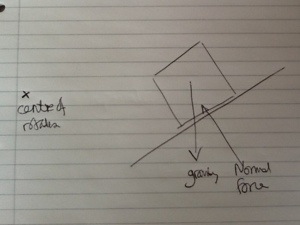
The diagram above shows an object, say a car, moving round on a sloped bank. Here, the normal force can be seen to push the car both upwards and leftwards, leftwards being towards the centre of rotation. This leftwards (horizontal) component of the normal force is an additional source of centripetal force (additional to that provided by the car’s engines through it’s tyre’s contact with the road) thereby increasing the maximum velocity.
Real life examples
A miscellany of things follow on from this, such as:
Cars with tyres with good tread can go faster round bends, since the better tread gives higher centripetal force, through traction/fraction;
Cars must go round icy bends slower, for the opposite reason;
Motorbikes or even cars can circle Walls of Death, providing they go fast enough. If you look at videos such as this one on YouTube, http://m.youtube.com/watch?v=fNM9GFV9adg I think it is no coincidence that they have thick tyres (please don’t try this at home, and no, I don’t want a Wall of Death experience voucher as a present, ever))The spinning ball on a roulette wheel goes round and round until friction and air resistance slow it down, after which the slope of the wheel means it collapses into its final resting place (I hope it is your number).
Maths
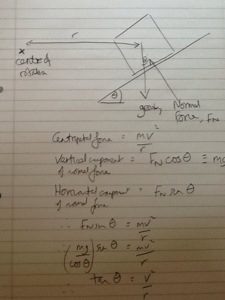
To end with a bit of maths, have a look at the second diagram below, which annotates my earlier diagram. The maths shows that v^2/rg=tan Θ. So, the maximum speed is independent of the mass of the object (which makes sense, ignoring things like air resistance), decreases with reduced radius (which is why ice skaters narrow themselves when spinning, to go ever faster, and then widen themselves out, to gracefully slow down), and really high speeds are needed to do the Wall of Death, since tan 90 is infinity.
Help with homework
Does this help with your homework, Sophie? Is there anything more that I can help you with please?
For a while, we used to watch 'Who wants to be a millionaire'; I don't recall ever applying to be on the show (I am too logical- I knew the chance of getting on was very low) but I do recall knowing the answer to one of the first £1m questions ”at which ground does Durham County cricket club play?”. The answer, Chester-le-Street, was known to me not for any knowledge of cricket but because around that time, there was a website chesterlestreet.co.uk (or something similar) which hijacked other busineses' domain names, trying to get money to release them: I think this practice more or less ceased after some legal cases, though maybe it continues.
Today, if I were in the seat, I would like the question to be “in which year was the Tom Hanks film Philadelphia released?”. I write this blog because I see that this film is on Sky Movies tomorrow (1).
Would I blurt out the answer straightaway? Would I freeze, get stage fright, and my mind go blank? Or would I play to the crowd, and waffle and pretend to struggle? I don't know what I would do (though, if made to guess, stage fright would be the bookies' favourite), but I do know that it was in 1993, and that I danced around the lounge holding Tom, to the Bruce Springsteen soundtrack (2)
Now, twenty years later, Aids seems something manageable, a 1990s phenomenon, something we were afraid of at that time. I hope that things we are afraid of now will in twenty years time seem similarly lower in importance.
(1) If reading this in 2033, then please note that in 2013 we were still tied somewhat to TV schedules
(2) Which, within a few seconds of posting this blog, will be on my iPad, thanks to iTunes. But no dancing around with Tom now.
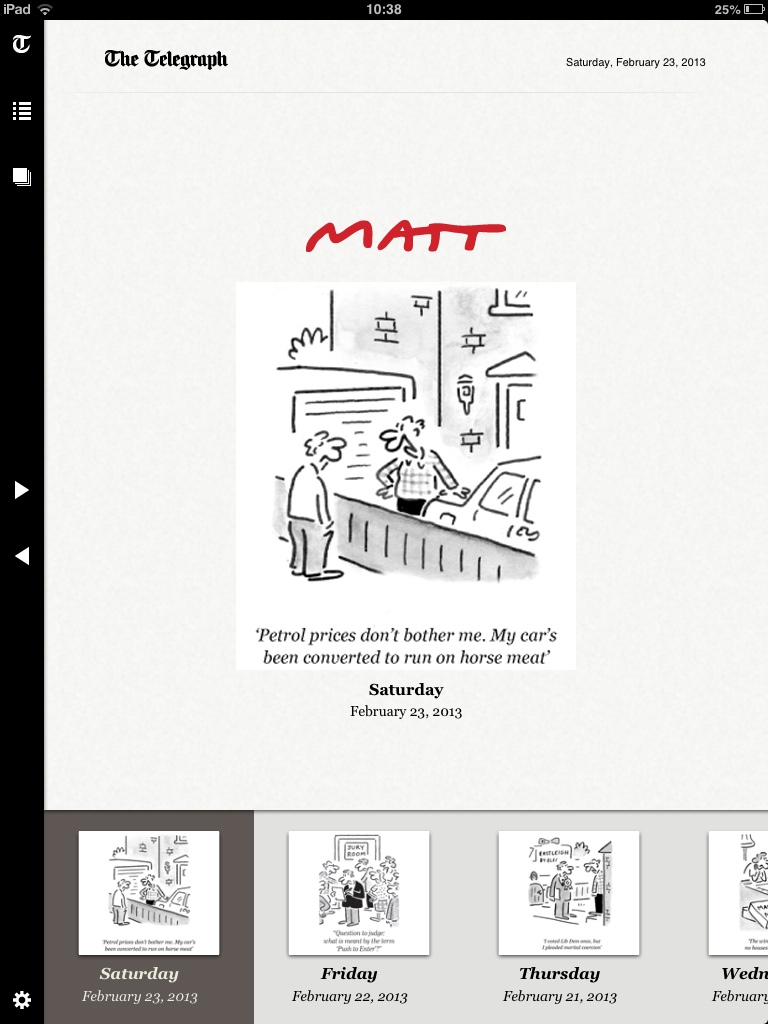
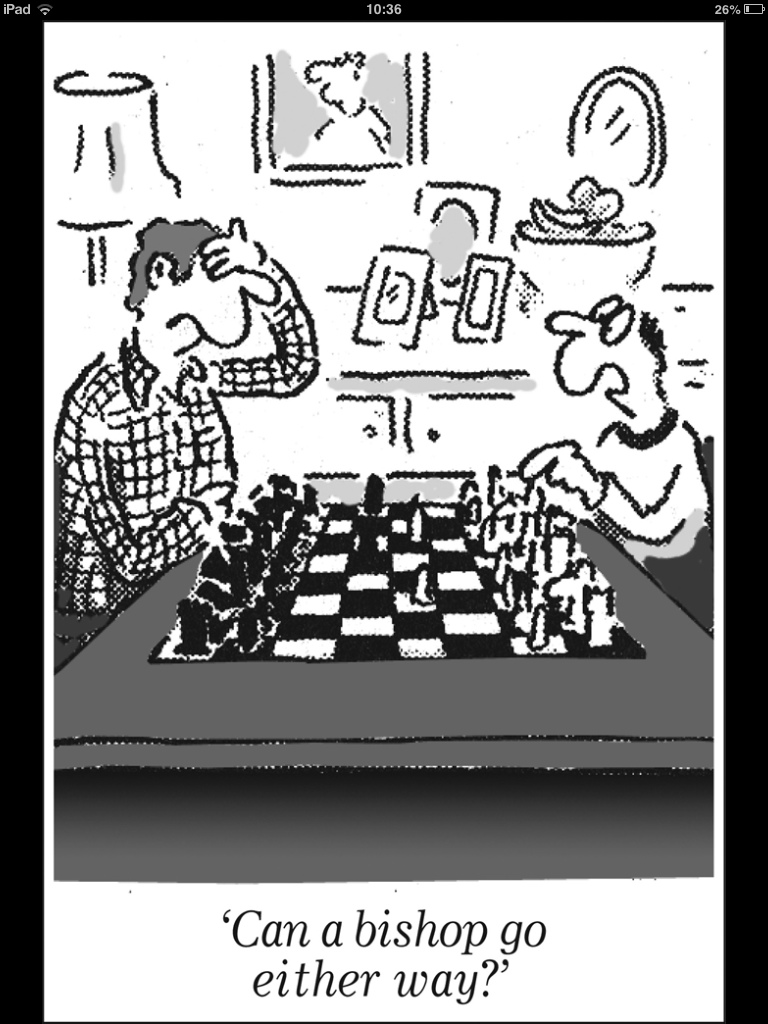
Yesterday the Daily Telegraph celebrated the 25th anniversary of their cartoonist, Matt. Since I have been reading the paper for more than 30 years (2), and since I always look at Matt, I have probably seen the vast majority of them.
Today's paper shows a dozen of the best. Below I show the two of the twelve which are on….chess. The first cartoon though is yesterday's cartoon.One regret (in my long list of regrets (1)) is that I wish I had taken copies of many of them, since so many were just perfect for what I was thinking or feeling, or what was otherwise current, at the time.

(1) I think I have a long list of regrets, but can't think of any which are other than trivial;
(2) First because of the chess column of the late Tony Miles, and for the last twenty or so years because of the chess column of my friend Malcolm Pein; and partly for the rest of its content.

I recently received a flyer in the postbox from one of the roadside recovery firms. In fact, had I not dropped the leaflet, I doubt I would have read it, being already covered, but did so, and something caught my eye.
(The picture above is not the flyer itself, but a screen print from their website containing the same details)
What interested me was: is the offer a good thing for customers? I am not saying it isn’t, but neither am I sure that it is: it all depends, in the same way as the ‘pizzas delivered to your door within half an hour or it is free’ offers (giving away our family use of takeaways) or NHS waiting list problems.
For example, Joe breaks down in some fairly remote area; and then another drive nearby. Who will get treated first, especially if it is touch and go that the breakdown vehicle will be able to reach the first driver within an hour. Far better for the company to treat the second, and let the first exceed the hour, give him £13.50 (on which more later); and similarly when the next car rings it, to should be treated before poor Joe. He can wait: even for hours.
Second, the ad gives some very reliable looking figures on average waiting times…what odds would I give that the average cited is the lower of the mean and median? If ten drivers are helped, with nine arrivals after 59.9 (say 60) min and one after 0.1min, is the average the median, 60, or is it the mean, 30? The skew of the distribution curve can make wonders to averages.
Finally, and I should emphasise that I have nothing against GreenFlag-their advert is no worse than many, I did like the small print that the rates quoted were only achieved by 10% of their online customers. Odds on then that Joe will receive far more than £13.50 for his wait…
One of the things that you have to face when you reach 50 is that your children's achievements start to surpass your own.
My son, Tom, is in his second year studying PPE at Brasenose College, Oxford. If you google him, then [as at February 2013] google auto-suggests 'posh girls dating' and also gives links to his various appearances in the national press.
Last week, he was, true to his journo self, in the front row when George Galloway refused to talk to an Israeli student. Tom wrote an article for Cherwell.org that evening http://www.tinyurl.com/a2nc9bo which Sky News picked up (as did all the papers)…resulting in them coming to Oxford to interview both the student and Tom http://tinyurl.com/azz3vte
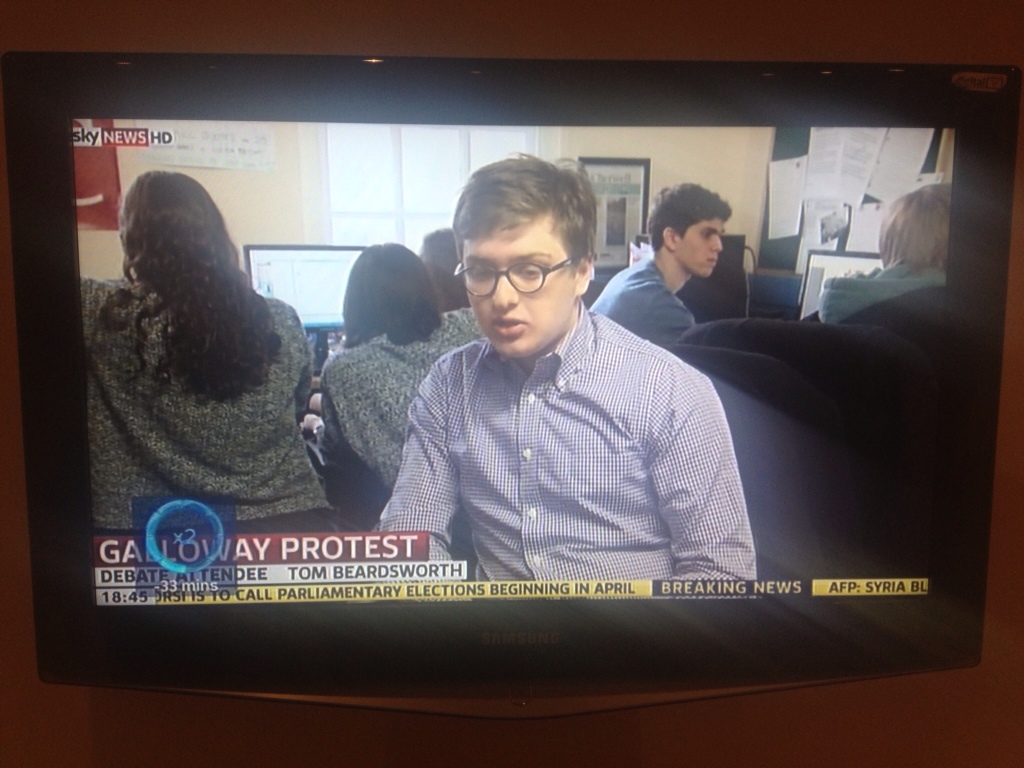
Several of our friends and my colleagues saw him on TV- helped, ahem, in most cases (for which read nearly all cases) by me drawing attention to it. Some of the feedback:
[Mark, client]. I thought Tom was great Allan. What a strange man George Galloway is. I'm sure a psychologist would have a field day with him!
[Sam, client]. …I did watch Sky and saw Tom. Nice coverage and I think the university boys came out on top.
[Colin, friend] Allan. I saw Tom on Sky news, a very discerning young man. Tell Tom well done.
[Brian, former colleague] Tom did well. A very impressive young man and a credit to you.
[Barry, friend and client] Family just watched Tom, came across very well…some same mannerisms as his dad!! Including the head tilt! Future newsreader!!
[Joanne, colleague] He's so like you!! It's the body language! (When I quizzed Joanne the next day, she told me I tilt my head)
[Debbie, close friend] Just seen Tom!! He looked like you! Same mannerisms! (When asked what mannerisms, Debbie replied) Finger on the lips.
[John, close friend] He did very well.
I had no idea that I tilt my head. If of course I do. But I am sure how proud I am of Tom.
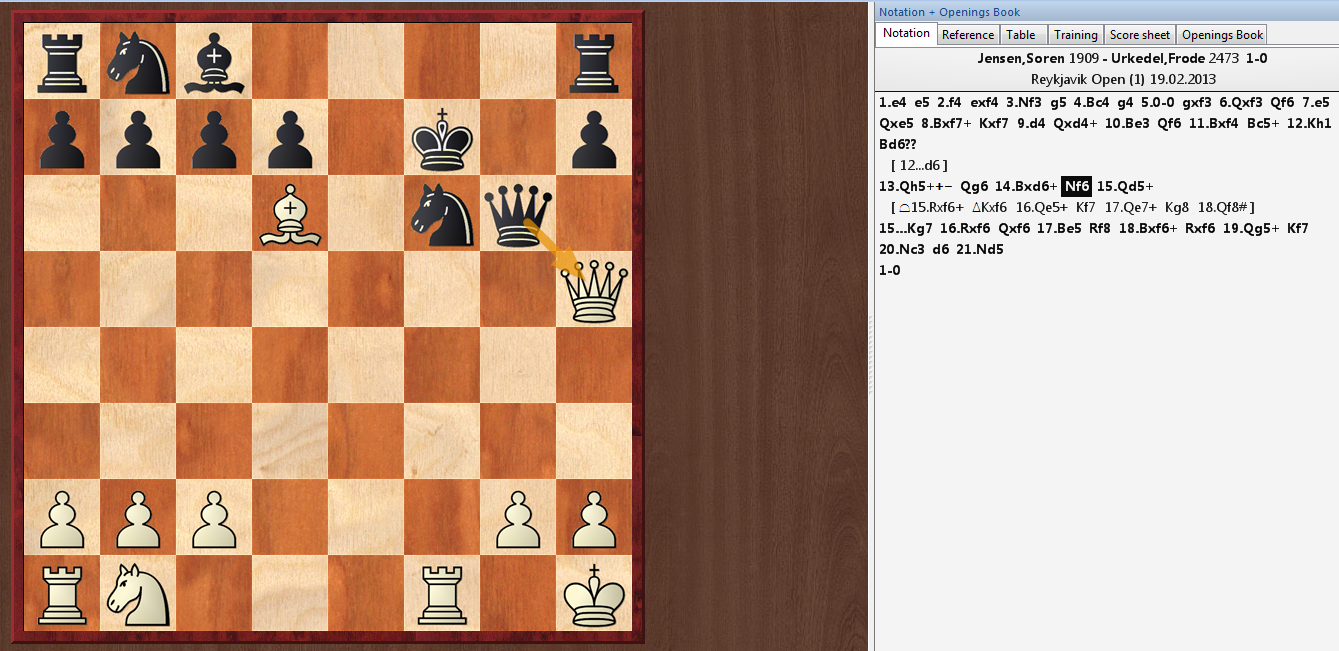
I suspect the game Jensen-Urkedel will do the rounds: a short, 21 moves, King’s Gambit, Muzio variation, in which a local Icelander beats a much higher rated opponent.
I saw the game on the tournament website- my visit to Reykjavik last year has given me a lifelong love for the place- and decided to play through the game. As so often happens, Houdini shows an even shorter win…damned machines.
I guess it is another example of the maxim “if you see a strong move, stop, and look for an even better one”.
Of course, the engine hates the Muzio, giving Black a winning advantage..but play any of several plausible moves, and the evaluation quickly changes; though I doubt many players would have thought of 12…Bd6, and I doubt it will be repeated.
I have just read an excellent paragraph on the above subject written by David Whiscombe of BKL Tax, in Tax Journal 8/2/13. His advice to someone thinking of tax as a career is:
Think very carefully. The complexity of the tax system and the constant change in the rules give for an incredible level of intellectual challenge and satisfaction: but can also be very wearing. Be sure you can Coe with constant change and lifelong training.
I think David's summary is very good: I would add the stimulus of being trusted and helping, of the ability to gain deep and close relationships, in the field I have specialised in, helping entrepreneurs and families. But the constant change and challenge are key aspects, as he emphasises.
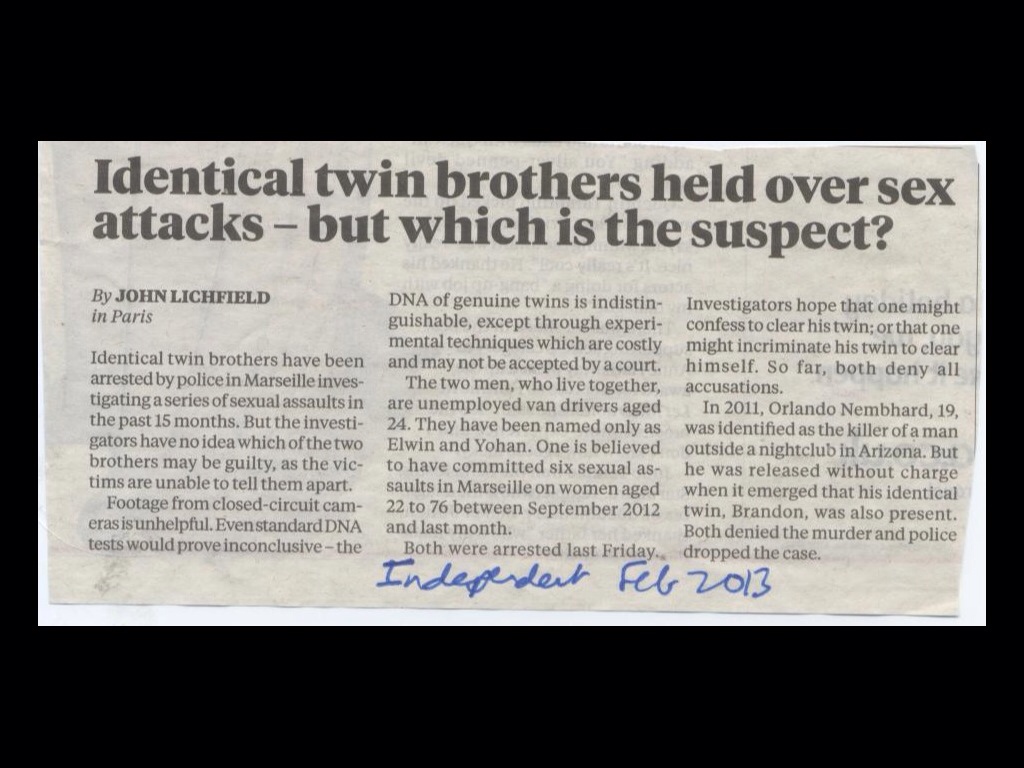
I would think it is odds on that someone will make a film based on this premise. Also, game theorists might see signs of the Prisoner's dilemma prisoner's dilemma – Google Search in this story.
I am presently reading Keith Devlin's 'The Language of Mathematics': or, if not reading, dipping into it, starting with the chapter on probability.
The book reminds me for how long probability was virgin territory, intractable and unknown to great mathematicians for centuries. Devlin suggests that this was perhaps due to the god-like nature of chance. Luca Pacioli, the father of double entry book-keeping which is the heart of my profession, posed the unfinished game problem, which took two centuries, for Pascal and Fermat to solve.
And yet, today, the problem seems fairly routine, almost obvious. It just shows how mental frameworks exist, how maths has been a stage by stage process.
Assume Nadal and Federer have played numerous times before, with precisely even scores, and no trends. They are now playing a five setter, when rain stops play, and, for special reasons, the tournament has to end, and the prize divided. Should it be split 2:1, or if not, how?
In fact, the prize should be split 3:1 to Nadal. For in only one of the four possible fourth and fifth set combinations does Federer win, and in the other three, Nadal gets the one further set he needs to win.
I suspect, though, in the real world, things have changed: in the fifteenth century, the dispute would have solved by a duel at dawn; and in the twenty first, I suspect the lawyers would have a field day.
 allanbeardsworth