One of the best things about being fifty, and having got to a position of some seniority in my chosen profession, is that younger colleagues ask me for advice. This gives me the chance to preach, to recommend things which I wouldn’t but should have done, and to sound wise. Three reasons to be thankful.
My first professional training was as an engineer, before changing tack completely and training instead to be an accountant; but engineering hasn’t left me, and colours a lot of thinking, including the use of models and diagrams. For years now, I have talked to colleagues about my Top Trumps model, which I intend to blog about sometime. More recently, I have started to use the picture of spices in my discussions.
We have all seen stalls looking like the following on our travels:

With today’s knowledge of DNA, we are starting to gain some understanding of the similarities and differences in how we are all made. In terms of talking to colleagues about strengths and weaknesses, developing, gaining new skills, alleviating or getting round weaknesses, spices can provide an image.
When I was made, the spice master got his mixing bowl, and clicked teaspoons of different spices into it: “we’ll make this one academically clever, good at passing exams; we’ll make him mathematical; we won’t give him any language spices, and for good measure we’ll put something fiery in, to make him speak too fast; we will skip past all the sporty spices, though to make him quirky, we will make him good at chess. We will give him the shyness spice, but we will also make him kind and a good listener, and trustworthy. We will give him the spice which makes him poor with alcohol, and we’ll give him the looks which will make him god’s gift to women [a fair degree of poetic licence here]. To be a bit unkind, we will give him travel sickness and eczema.
These were all mixed together, and made me. Fortunately my career wandered into giving taxation advice, to entrepreneurs and families, and for such work the ability to earn trust, and keep confidences, is paramount. In my 20s, I managed to learn to manage my shyness and gain some confidence, and I also started to appreciate which spices I had most of, and couldn’t be changed.
Colleagues are all different. Academically bright; commercially savvy; good looking; naturally smart in appearance; sporty; matey; quiet, determined; energetic, tall, short, fat, thin….I think part of career progression is having some understanding of the spices you are made of, of the spices people think you are made of, and making the best recipe you can.
Not easy, but can be delicious, and better than not knowing what’s in your food.
 Posted with Blogsy
My previous blog, this morning, was about Anand-Caruana. I have now seen the article about this round on Chessbase, and noticed that not only did Vishy voluntarily give back a pawn, for space, so did Fabiano.
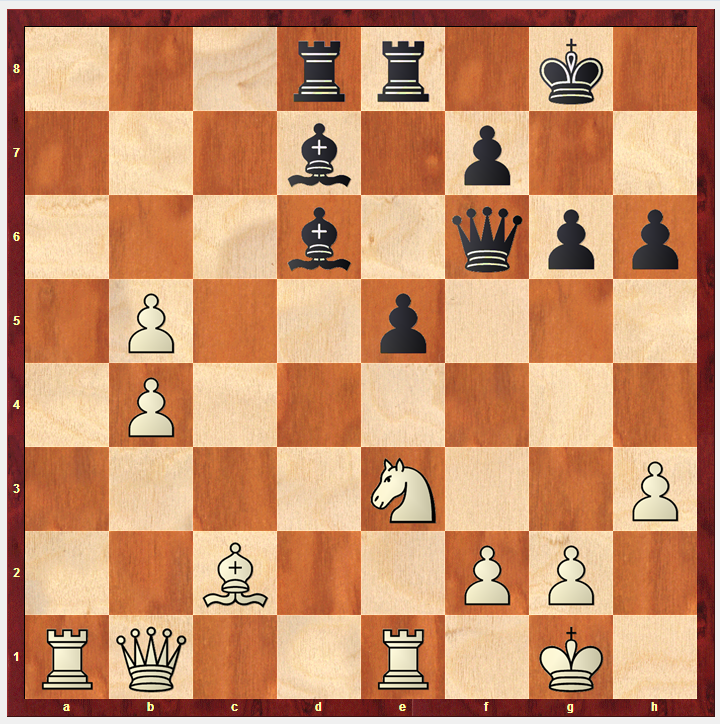
I very much doubt that I would have made that move either. I would have kept the pawn, and no doubt taken his on b5; but the problem is that then (after 28…Bb5) white plays 29 Ba4, exchanging off the white squared bishops, taking a lot of the steam out of black’s position. Fabiano’s pawn sacrifice keeps the play in the position, and when the B and Q line up on the b8-h2 diagonal, the fact that black has his white squared bishop can then enable B*Nf1.
Very insightful; two sacrifices I wouldn’t have considered.
Consider the following position, from yesterday's Anand-Caruana game.
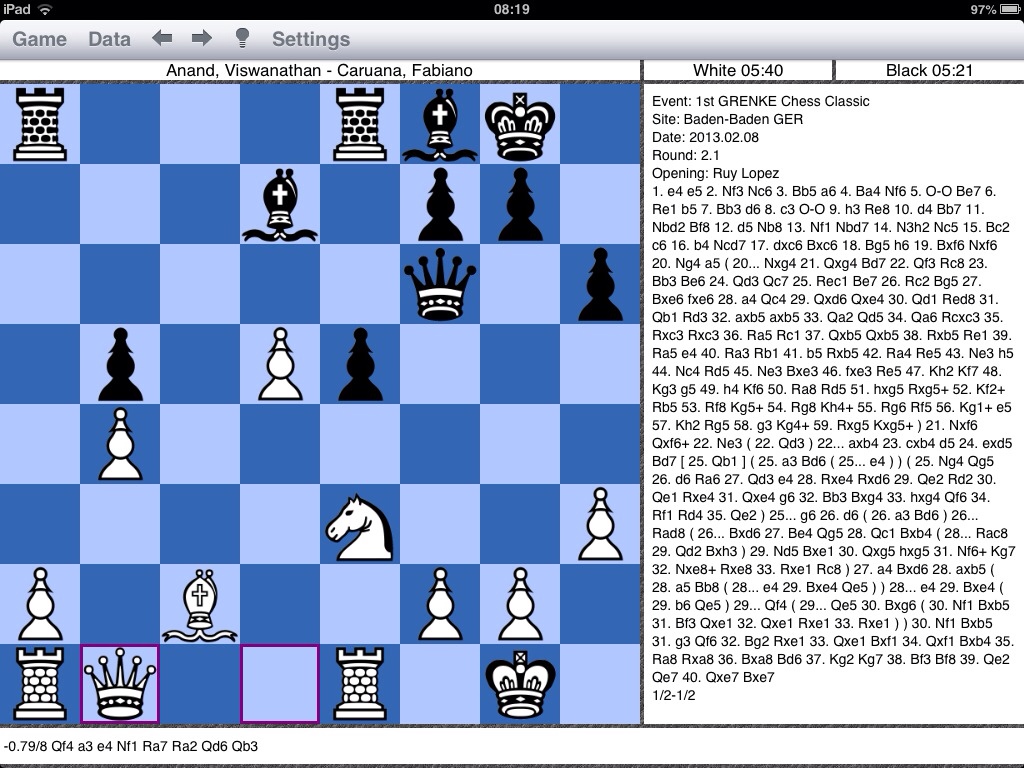
If you played through this game at speed, just going through the moves, you would quickly pass on. You would, or I would, think it not much of a game, with everything coming off fairly quickly, and a dead drawn ending.
However, I think there is more to the game, and the position above is key. Vishy shows a great sense of danger in returning the pawn with a move, d6! that I would never have considered (exclamation mark because of that fact).
I have spent twenty minutes or so since then looking at the game, and plan to spend more time when I have some. This is an 'iceberg' game…a lot more below the surface than can at first be seen.
I downloaded the pgn file to one of my iPad apps: it suggests a3 rather than d6, and I am pretty sure a3 is the move that I would have played. The App assesses it as +0.89, and again, I would have been pretty ok with white, over-assessing the extra pawn. However, when I play a few more possible moves, two things become clear. The d5 pawn blocks both the Ne3 and B; it also provides a lovely shield for the black bishop on d6. Then, the flow or momentum of the game is far easier for black: B on d6, Q say on g5, push forward to f5 and then either or both of e4 and f4….and my app quickly turns to -1 or beyond.
Vishy's d6! accomplishes a lot. Gives some possibilities to his minor pieces, and also allows his R or Q to pressurise the Bd6/Bd7, causing black some difficulties in pursuing his attack.
I have recently bought, but not yet started to read, Jacob Aagaard's latest book on Positional Play, in which he suggests three questions: 'what is your worst placed piece, what is your opponent threatening, where are the weaknesses'…I wonder if these would have helped me find d6 in practice? I think the second question just might…black's advantage of the two bishops and potential to expand on the king side/use the black squares is clear; I wouldn't though have guessed that Ne3 was my worst placed piece [Ra1] but again, it isn't doing much, and will be pushed back by the f pawn's advance.
Finally, on chess vibes.com:
Here in Baden-Baden Vladimir is accompanying Fabiano, and a repetition of the Wijk aan Zee scenario doesn’t seem to be on the cards. For the second day in a row Caruana demonstrated deep preparation and surprised the World Champion with 20…a5!?, a move Vladimir had recommended the night before instead of the previous grandmaster choice of 20…Nxg4. Vishy at first continued to play relatively quickly, but he lived to regret it – lamenting his “careless” 22.Ne3, which allowed Caruana to equalise with 23…d5! (Anand in the press conference: “I should have at least thought about this”)
http://www.chessvibes.com/reports/grenke-classic-naiditsch-beats-adams-in-almost-7-hour-battle
At least in Britain, the saying goes that you wait for a long time for a bus, and then three come along at once. That could be the first sentence about a blog about the maths of queues (and I could reminisce that in my Engineering degree at Cambridge, I did a thesis on the maths of cashpoint machines, ATMs, which were became commonplace in the UK from the mid70s); but no, this blog is instead about the fact that yesterday I had three virtually identical games in the Morra gambit.
I have been playing the Morra against the Sicilian in ICC blitz for the last several months, since buying Marc Esserman's quirky but fun book, Mayhem in the Morra! Nigel Short and I played the Morra in the 1970s; probably a good line for training teenagers in tactics; but also probably not much of an opening.
One of the least common defences to the Morra is what Marc calls the Siberian- it is partly a trappy line, with the standard Morra set up of Qe2 easily falling foul of a Ng4-Nd4 cheapo. However, yesterday I had three near identical short victories:
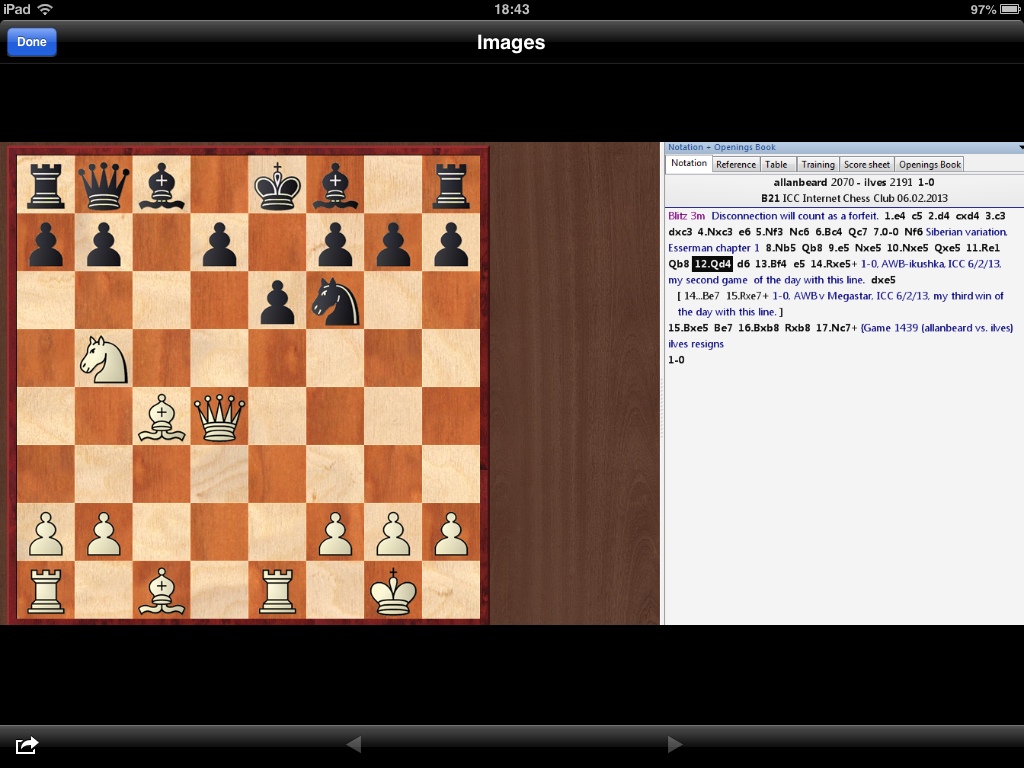
In the position above, Black's position is awkward or bad. Having not reached the above position before, how strange it is that it occurred three times yesterday.
Now, I wonder how long I shall have to wait until it turns up again?
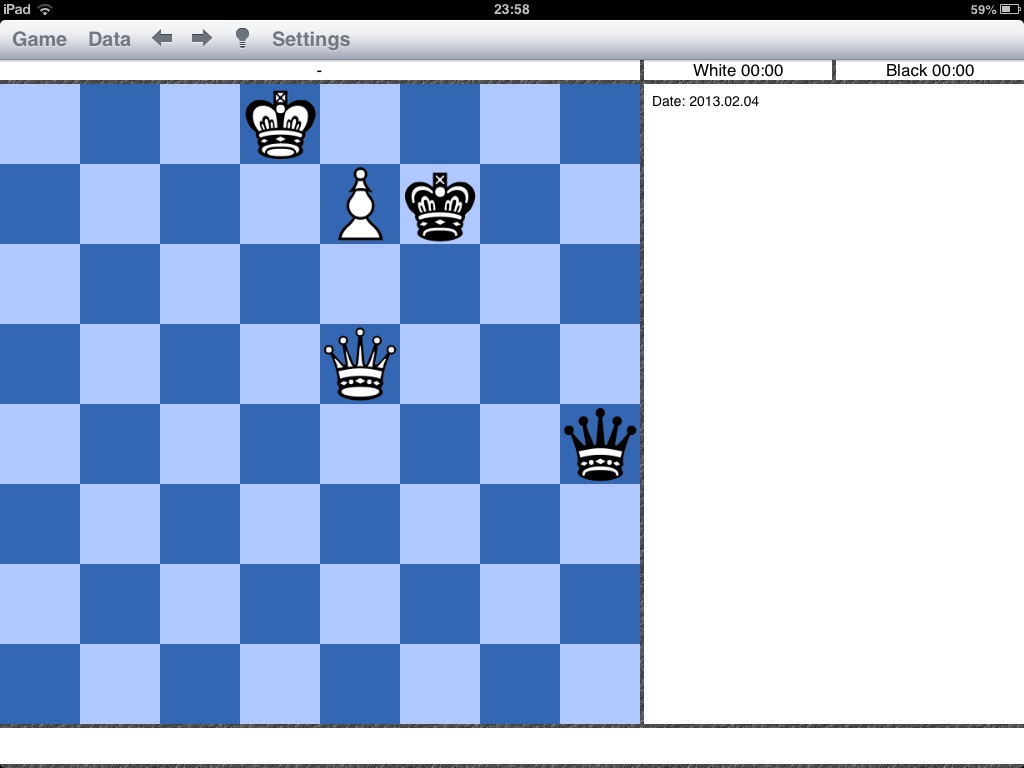
Try to solve this position first, before reading on.
This game was played in August 2008 in a blitz game Karjakin-Gelfand, Tal Memorial, Moscow. Later that year I was spectating at 50 Grandmasters battle for chess championship honour – Liverpool News – News – Liverpool Daily Post the EU individual championships. I showed this position to two friends: IM Jeff Horner, and GM Nigel Short.
Jeff solved it in around 30 seconds, with a twinkle in his eye- typical Jeff. Nigel studied it for over two minutes, and then gave up. When I showed Nigel the solution, we had a laugh together, about why Jeff could solve it, but Nigel couldn't. Jeff is an arch tactician, but Nigel knows far more about technique, and so missed 1 Qh5+ with the skewer e8(Q)+ to follow. Very pretty.
In the blitz game, Karjakin missed the winning move, and Gelfand drew.
(First seen in Chess Today 2858 http://www.chesstoday.net/)
Fortunately, I can solve the vast majority: Alex Baburin or his other editors tends to choose a good mix of staightforward, average and fiendish ones; the ones which are most annoying of those which look simple, but aren’t; and those which I can’t solve, despite several or many attempts.
Such as this one:
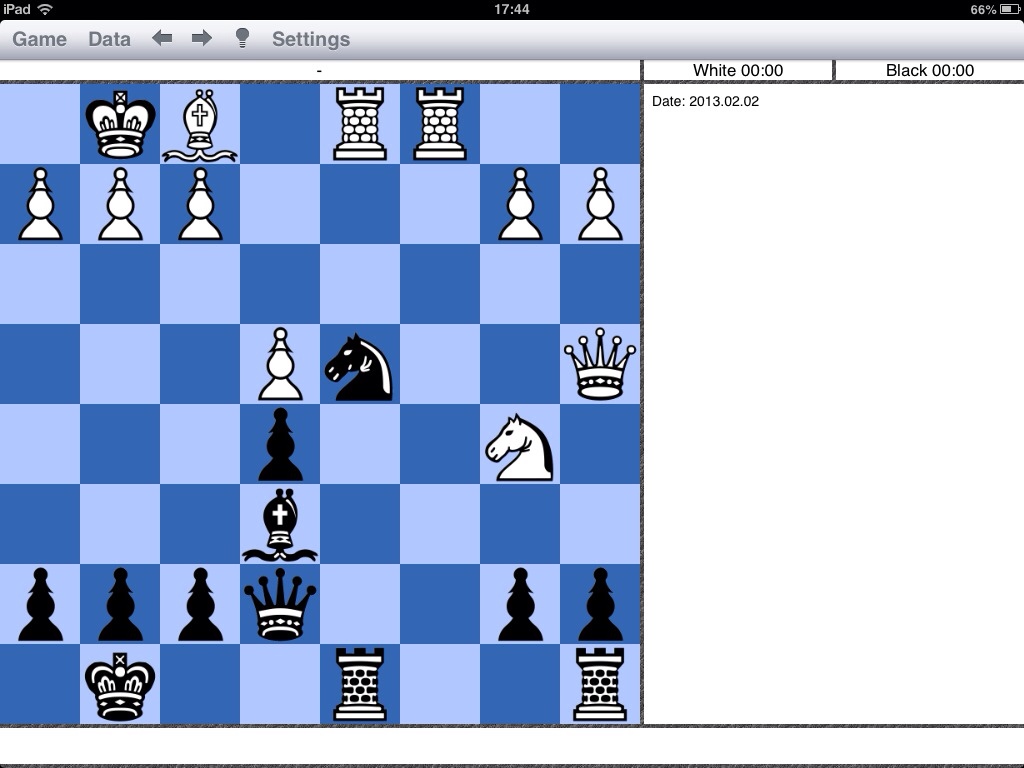
I have reversed the board, for this ‘black to play and win puzzle’. [Try to solve now, before reading further]
I tried to make the pin 1…Bd7 work, but couldn’t, with 2 Qa3 unpinning successfully; and there seemed nothing further in the position.
Failing, I looked at the solution, and stumbling with it, intrigued by it, I found the game in Chessbase. Looking now at the position a move before,
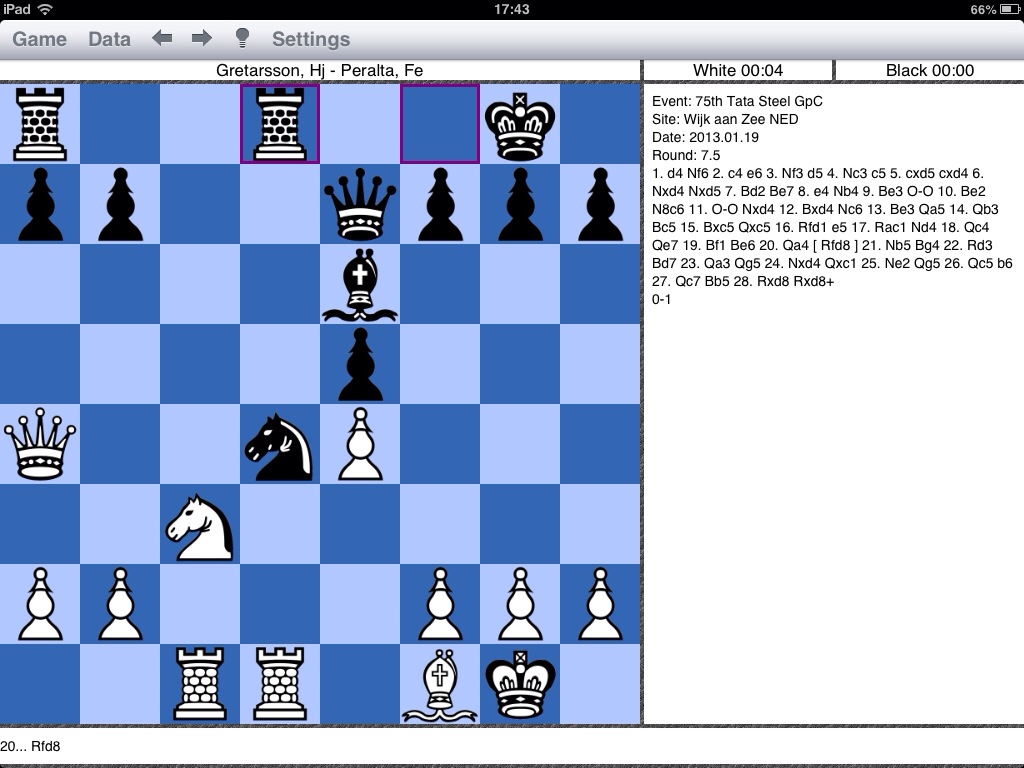
Here, white played Nb5. Now, thinking of excuses as to why I couldn’t solve the problem, if I were playing black, I would perhaps think that Nb5 moved the knight away from the kingside/away from protecting the R on d1, and then maybe turned my attention to ways of exploiting it, even of attacking the king. However, the solution does seem deep to me, and I have to admit that I think if I were playing black in a real game, I would have exchanged on b5 and presumed equality.
But, maybe, just maybe, I can use the excuse that with a problem, you can’t see the prior move)(s), so can’t see the flow of the game; and ignore the fact that engines don’t need to see the flow.
21…Bg4!! 22 Rd3 (22 Re1 Nf3+!! 23 gf Bf3 and the best white can do is 24 h3 Qg5+ 25 Kh2 Rd2! -+, with the difference being that when Bg4 encouraged the rook to leave the d file, it permitted Rd2: very nice, very hard to see) (22 f3 Nf3+ is easier to compute) Bd7 23 Qa3 Qg5! and now the deflection of the Rd1 to the third rank means that the Rc1 is unprotected, winning).
(position first seen in Chess Today 4456)
My son, @tombeardsworth, tweeted about this picture recently. His tweet said that something was wrong with the ad, and what he meant was the logical inconsistency of the argument about the effects of being in or out of Europe.

I knew he was alluding to this, but I saw a different point, where the ad misleads. It says that Scotland has double the trade with the rest of the UK than the rest of the World; and yet, because the illustration is of a container, doubling the length, has a more than double effect on volume….so the eye is deceived. I say more than double because they have used a square and a rectangle, not two squares, so the crime isn't gross, but still has been committed.
I am sometimes asked, mainly by people thinking of a career in accountancy, or by their parents, what level of maths ability is needed. My answer, based on my experience in the profession, is, ‘not much’.
A decent level of numeracy is essential. I should say that I have seen a reduction in the ability of my younger colleagues from estimating the total of a column or row of numbers ‘by eye’; or the ability to roughly guess results of calculations. I think a confidence with working with numbers is something which is needed to be a competent advisor.
Beyond that, not much. I can count on the fingers of one hand the times I have been required to do more complex calculations. This blog is about one, my first, and most memorable. I may blog separately about other occasions.
Christmas 1984: Band Aid’s ‘Do they Know it’s Christmas’ was number one, and I had been working for a few months. I had a full weekend in Stafford, along with numerous colleagues, on a stocktake, at B Limited. B was a manufacturer, and had a warehouse full of wire rods. Some with large diameter, say a few cms, easy to count; some with diameters down to millimetres, and as the rawest junior, I got to count those. They were stacked high, to a high ceiling, so that ladders were needed: and the method was to lie on the floor, chalk in hand, and count one by one, chalking off each rod; then getting up onto your knees, then standing, then using the ladder…one stack could take half a day or more, and my eyes went squinty, and it was easy to lose where you were in the count, and have to restart. So I learned methods of not having to do total recounts.
Two days of my life were spent counting such rods: I knew no better, and this was how it had always been done. The client closed down for a week, because prior to the audit check, the workforce had done a similar count, and it was our role to do spot checks, and, if there were differences, examine and resolve them.
Christmas 1985, and Shakin’ Stevens ‘Merry Christmas Everyone‘ was number one (though I would have preferred Whitney Houston’s ‘Saving all my love for you’ which Shakin’ ousted). I was more experienced then, and had started to get an appreciation of what auditing was, and started to think about my work, rather than just follow orders.
That year, I was counting larger diameter rods, as befitted my progress; and it was far easier, and I had time to think.
Then maths came to mind: what if we calculated the packing density, measured the height and width of the stack, and estimated the number of rods in the piles? So I worked out the approximate packing density, did the measuring, and….the results were near perfect. A 3 or 4 hour count could be reduced to 3 or 4 minutes. We did a sample, it was virtually precise, and had our weekend free again (free to study for our exams, no doubt).
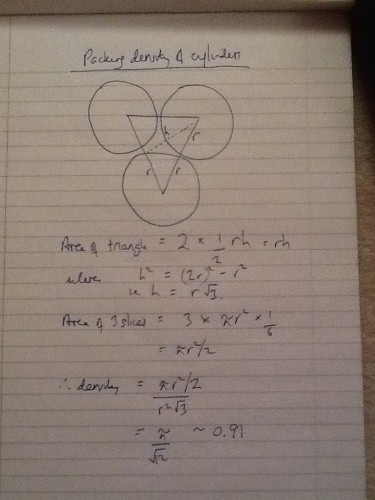
Furthermore, and this story doesn’t have a happy ending, due to the relative low value of the stockholding compared with the size of the company, we told our client that they, too, could avoid the week’s close down and overtime, calculate the holdings in the same way, and a small handful of us, rather than a large team, could again sample check.
Perfect, except as Billy Ocean would have told us in the spring of 1986, ‘when the going gets tough, the tough get going’….the unions threatened to go on strike if management changed the procedures, which would have stopped them earning double time.
Management relented, the warehouse shutdown each year so that the one-by-one count could continue (but we did our maths).
A few years later, B went bust; and the site is now a retail centre.
Nearly thirty years later, I still remember the practical lessons this taught me.
I was able to catch brief parts of yesterday's games at the Gibraltar congress. I saw Kamsky's fine victory, being impressed with his precision in turning a far better position into a quick win: a few less accurate moves might have made the game a long drawn out (though straightforward) endgame win.
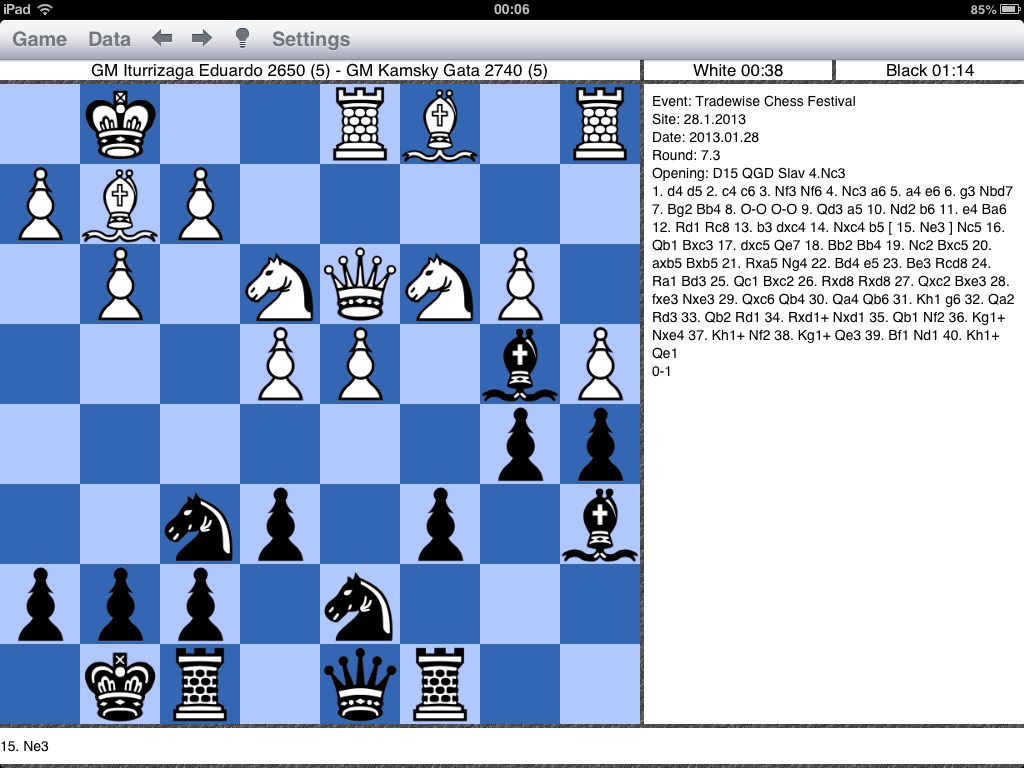
I was watching on Playchess, mainly concentrating on Nigel Short's game, and so had Gata's game with white playing up the board- ie. with normal default screen layout. When I saw his game was interesting, I flicked though the opening moves, and noted what I thought was a remarkable move in the position below.
At first, I couldn't see why it worked; and then wondered how on earth he could have found it. Then, I understood it, and appreciated it, and decided to blog about it. Turning the board upside down, it becomes easier to see, or maybe things are easier to see once you have seen them!
Anyway, still nice.
I should also add that Gata did an interesting lecture, available to watch online, a day or so ago- see Tradewise Gibraltar Chess 2013
(1…Nc5 and if 2 dc Qd3 3 Rd3 ba! hits the rook, which is the sole defender of the Nc3)
I made the mistake of mentioning to my wife 'JFK moments'. It turns out, if Jane is to believed (and, if you were offered the bet of whose memory to trust, take her side….my memory is a curious mix of accuracy, blanks and fiction).
Jane tells me I was not at JJB when the bomb happened, but were at home in Chorlton, a few miles from the City Centre. We were planning to go to JJB- or, rather, to the shopping area in Ancoats which then had JJB, Mothercare, and Children's World. We were actually taking Tom for a haircut at Children's World. Jane tells us we heard the blast even from a few miles away. Not long later, a neighbour arrived back, and told us that the noise was a bomb. In the afternoon, we did go as planned to Ancoats, but whilst we were there, the police also evacuated that area, because of rumours of further bombs.
Before you stake your bet totally on Jane's memory being faultless, she was sure the bomb was at lunchtime, telling me that 11am was too early. So, she has some fallibility, and I will leave it open for readers to decide where we were.
It was true, though, that my office window was blown to smithereens. That much at least is sure.
 allanbeardsworth