I was only one when JFK died; but the expression is meant to refer to those few moments in your life that you have to remember.If you asked me what day of the week 14 June 1962 was, I would reply Thursday, and I know this because it was the day I was born. Or if you ask me what day 15 June 1996 was, I would tell you it was a Saturday, because that was the day of the IRA Manchester bombing.My memory is poor, and if you asked me 'when was the Manchester bombing', I would have to think, and guess. But I would know it was mid to late 1990s and I would remember it was around my birthday, because I changed my plans that day.Despite it being a Saturday, I was going into work that day: I was on path for partnership, and putting in the hours. I also had to go to JJB to get some training shoes for my son, Tom, not yet 3 years old. I had originally planned to work in the morning, and go to JJB afterwards, but for some reason, I changed my plans, so that at 11.17am I was at JJB Sports in Ancoats. Despite it being a mile or two from the Royal Exchange, the building shook, and in writing this, I can still hear the boom. We did not know what it was. I don't believe that I had a mobile phone by then, and I think it was gossip round the store, maybe from the store radio, how the news filtered through. Of course, I went home straight away.My office building, Derby House, Booth Street, was damaged. My office, and the neighbouring office, had our windows blown out, with smithereens of glass scattered everywhere. Had I gone to the office first as planned, I might not have survived, or at least been badly injured.Derby House was a good half mile from the bomb: but the way the wind blew, like a wind tunnel, the explosion channeled down various roads, hitting my office full on.212 people were injured, but since the IRA gave a warning, no one fatally. The bomb was a spur for the redevelopment of Manchester and, in a perverse way, did the city some good. It is a day I shall always remember, one of my JFK moments.
(Our office was not where 'A' is marked, but follow that road down until it meets the corner of Booth Street: that was exactly where my office was; up to the left, you can see the Royal Exchange, where the bomb explored)

 Posted with Blogsy
I am presently watching round 11 of the Tata Wijk aan Zee tournament: taking advantage of the snow in Manchester, to come home early and watch the latter stages of this round.
Risk is defined as ‘blogging about the endgame before Karsten Müller has explained everything’ but here goes. I am staggered that Vishy Anand only drew his game against Hou Yifan from here:
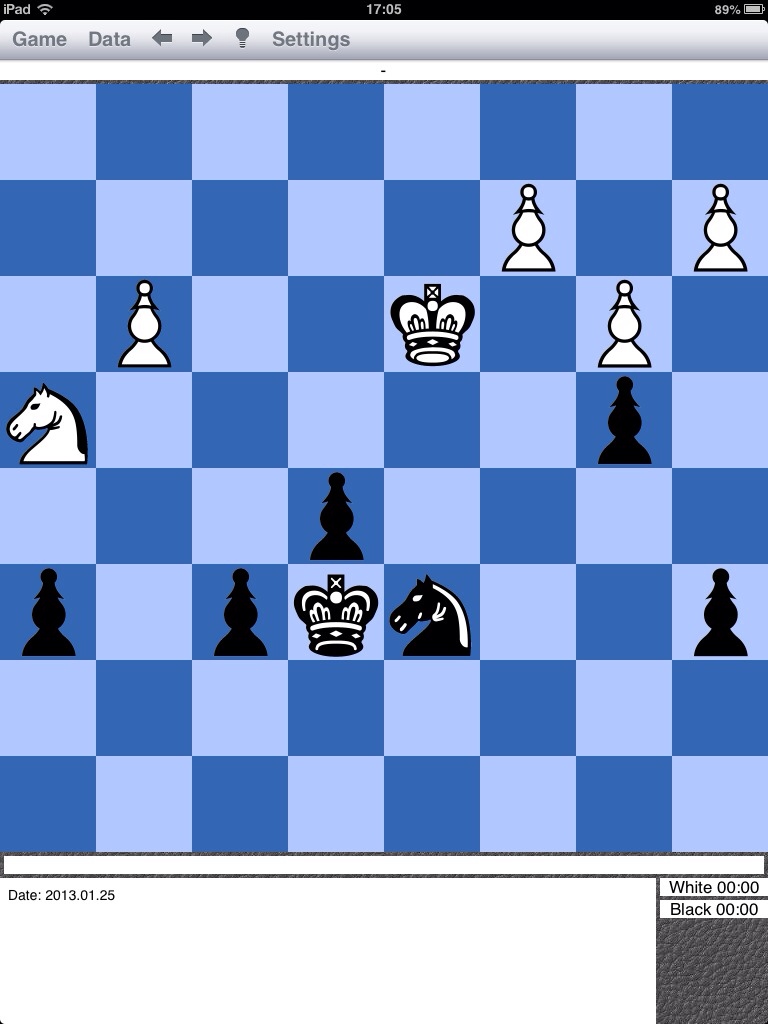
Vishy was playing fast. Two pairs of rooks had just come off, and he has played Kd8-e7-e6. These last moves were obvious, and would have been played ‘by hand’ by most players: improve the king.
I was assuming Kd5, further improving it, noting that Nf3 is impossible because of the e4+ fork. If Ng6, then e4+ making progress: or, in practice, I might have (after Ng6) moved by king back, and played h5 or f5 first- maybe one of these pawn moves is better than 1…Kd5 in fact. Either way, play slowly, leave the knights on for the moment, and push white back.
No, very quickly, Vishy played Nf5, knights were exchanged, 3.a4 Ke6 4 g4! and Yifan drew- still to my surprise, since I had assumed Vishy had calculated everything before swapping into the pawn endgame.
Full credit to Yifan: the pawn ending looked better for black, and when playing the world champion, there must be a tendency to think it is all over. But by playing b4 and a4, and then not pushing b5 until black had played e4, the pawn race is a dead heat, and if black tries too hard, he could easily lose.
A blow to Vishy: with two games left to play this weekend, I suspect this will take the wind out of him, and he will be disappointed that a tournament
which could have been great, and a return to form, may well end as just being good.
I recently came across something new (to me) but not (see below) new to google.
Consider four consecutive numbers, say 2,3,4 and 5. What is their product?- 120; or take 3,4,5,6…360. In both cases, the product is a square number less 1: 121, 11^2, and 361, 19^2.
It is fairly straightforward by algebra to prove that this result is always the case. I say straightforward, it is, if you know the answer you are looking for and can work back, factorising a quartic equation. How it was discovered, I don't know.
I like to solve such problems geometrically or intuitively, but have failed with this problem.
It is perhaps somehow related to the fact that, taking the first example, the product of the outside 2 is 1 less than 11, whilst the product of the inner two is 1 more- so a rectangle 10*12, ie with area 121; and this applies in all cases.
Or, perhaps it is somehow related to the fact that the products are always divisible by 24, since four numbers must have two even numbers and at least one number divisible by three: and 24 is one less than a square.
Or, it is not due to either of these. When I googled the problem, I found lots of pages of similar analysis, but nothing by way of illustration. Also, of course, I found out that eminent mathematicians like Euler had solved far more complex examples. The sums of n numbers are always 1 less than a square; and the product of n numbers is always divisible by n! ( n factorial)-as said, in the case of 4, by 24.
My recent blogs have lauded Magnus; it is only fair to put him in perspective: my lifetime score against him is +1:
My statement is accurate, but misleading. I like the accuracy aspect most.
Hikaru Nakamura played a wonderful tactic today at Wijk aan Zee. I couldn’t see how it worked at the time, and had to save the diagram, to study it later. It took me a good minute or so to see what his idea was, and I would never have played (imagine the position before, with black pawns on g5 and h4, and a white pawn on h3) 1…g4!! 2 hg h3!!
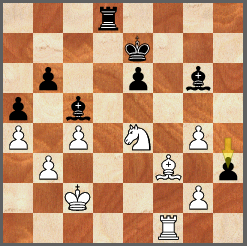
Simply superb imagination.
Question: how does black proceed after 3 gh? (note: answer below)
Caruana declined to take, playing 3 Rd1 Rf8 4 Kd3 h2 5 Rh1 Bg1, and with the rook imprisoned, it was soon over.
Answer: 3 gh Rf8 4 Kd3 Rf4! (zugzwang) threatening Be4+, to which there is no good reply. Beautiful.
Firstly, unless it isn't clear from my previous posts, I am star-struck by Magnus Carlsen. His play during the last year has gone to a new level, and in the current Tata Wijk aan Zee tournament he is playing simply wonderful chess.
Today he outplayed Erwin L'Ami in a very similar fashion to many of his recent games. I can now exclusively reveal how to play like Magnus Carlsen:
Develop your pieces, anywhere, and get an equal position;
Shuffle your pieces around;
Move them around again;
Exchange some pieces, for preference leaving yourself with the bishop pair;
Piece by piece, move your pieces to their optimal squares; your opponent will then crack, and
Simplify to an endgame, or to use GM Glenn Flear's word, a 'nuckie' or NQE [not quite an endgame];
Improve your pieces still further, including your king;
Put pressure on/attack/exploit your advantage on the clock;
Then, when it is obvious to your opponent that you have won, he will resign.
Simple.
As a refinement, and only for those players of a certain disposition, then, in the post mortem, explain to the awe struck audience that we you weren't very happy with your play today. That will set tomorrow's opponent. In the right state of mind.
Alas, after 30 years of being a chartered accountant, fifteen years of being a partner in a major accountancy firm, and after a life of being interested in economics and business, I still don't know the answer to the question 'what is money'.
Of course, at many levels I do, and my recent blog on the amount of money in the world is probably along the right lines. However, terms like 'money supply', 'GDP', and the niceties elude me. To understand something, I think you have to be able to explain it clearly to someone else, to an inquisitive child, to another adult, or to your dog.
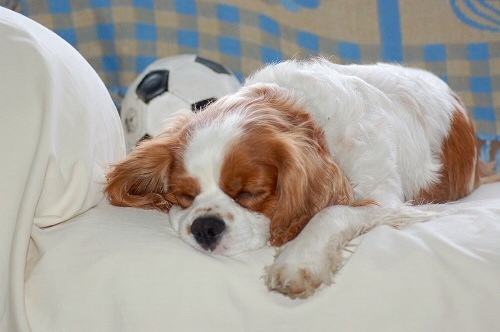
An excuse for putting a photo of Charlie on my blog
(Excuse for putting a picture of my dog, Charlie, on my blog)
The best definition of money I have ever come across is from Warren Buffett. It is the one I think is very useful for getting an understanding of economics. Money, he says, are 'claim checks on society'. The ability to call upon others to give you goods or services at some future date. So my savings or pension funds will one day be cheques I can cash to call upon for food, heat, pleasure, leisure, care. I hope society cashes my cheques, and those of all others; but the hope of being paid is really what money is.
[Warren's quote is shown below:
I don't have a problem with guilt about money. The way I see it is that my money represents
an enormous number of claim checks on society. It is like I have these little pieces of paper
that I can turn into consumption. If I wanted to, I could hire 10,000 people to do nothing but
paint my picture every day for the rest of my life. And the GNP would go up. But the utility of
the product would be zilch, and I would be keeping those 10,000 people from doing AIDS
research, or teaching, or nursing. I don't do that though. I don't use very many of those claim
checks. There's nothing material I want very much. And I'm going to give virtually all of those
claim checks to charity when my wife and I die.
Warren Buffett]
I wonder if there will now be, or even if there already has been, a trend of players playing particularly poorly against Magnus, through sheer fear of him?
I might be wrong, and haven't seen any of the analysis yet, but his game against former women's world champion, Hou Yifan, might be a case in point.
I dipped in and out of the game whilst it was being played, first seeing the position shown below, and wondering about 12e6, which I suspect is weak, and not a move she would normally have played.

Maybe the analysts or engines will prove me wrong, but I doubt that Magnus gave serious consideration to taking the pawn on move 12. Yifan would I assume have played 13 Ng5 fg 14 Qh5+ with a bit of a mess. Far simpler, and more in Carlsen's style, is the move he played, rounding up the pawn when it was safe to do so. Maybe I am underestimating white's compensation, or maybe she was uncomfortable with Nbd2 or Re1, but I suspect she would have played some such player without Carlsenphobia.
I think understanding the answer to my first question can help elucidate a lot of the issues which face the World's economy at present; and watching cartoon characters fall off cliffs provides an economics lesson, as well as entertainment.
In my view, the answer to my question should be known to everyone, it doesn't require estimates of GDP or populations or statistics, and the answer is the same in 2013 as it was in 1913 and on 1613: in fact, it is always the same answer, nil.
Why?
My wife and I have savings, an asset. That means that (say) Barclays Bank owes us that money, or, looking through the Bank, its shareholders do: the individuals who ultimately own Barclays, or the individuals who own the pension funds or institutions which own Barclays, owe us that money. Or Americans owe vast amounts of money to Chinese banks or their Government, but ultimately to the Chinese people or bank shareholders. In all cases, the sum of the assets is precisely equal to the sum of the liabilities. Always has been, always will be.
Luca Pacioli, Luca Pacioli – Wikipedia, the free encyclopedia, the father of double entry book keeping, could have told us that.
Once you realise that the money in the World is not £XXX Trillion or some other unfathomable sum, but is £nil, several consequences flow.
Firstly, it is a world of haves and have-nots, people who own, people who owe. To one extent, this is a generational thing, with (by and large) older people having, and younger people having the debts. The commitment of the UK Government to pay my old age pension is a (future) debt owed to me by younger taxpayers. So one possibility is a correction between old and young.
Similarly, the Germans own, and the Greeks owe: again, corrections may one day result, but still the sum will be £nil.
Corrections could be managed, controlled, sharp, sudden, dangerous: even war, which economically changes the who owes and who owed, could be a result.
I suspect that good parallels can be drawn to the cartoons we all saw as children, and thank you to google/YouTube for this link http://www.youtube.com/watch?v=_d8ROhH3_vs whereby a cartoon character runs and runs and runs, over a cliff edge, eventually realises there is no land beneath his feet, and plunges to the ground. Splat.
And so the economy: whilst the world had confidence, money flowed, owes and owed changed and increased, the owed lent more, knowing the owes could repay it until, splat, confidence ends, and then everyone doubts the recoverability of their assets, or the ability to pay their debts, and business dries up. The total money is still nil, but the swishing around becomes harder.
I suspect an academic economist- I have no training in the field- might find some or all of this blog risible, but I think it has some kernels of truth.
PS. if nothing else, researching this blog, by which I mean searching for a video of a cartoon character running off a cliff was fun, reminding me of Bugs Bunny, Dick Dastardly, and also coming up with videos of the Fiscal Cliff. Thanks be to google.
One nice thing about helping my children with their homework is that you can re-learn things, or learn new things.
Last night I was helping Sophie with maths, and a couple of the problems required quadratic equations to be factorised. I could do them 'by eye', just seeing them made me guess the solution, and after doing a couple, I noticed a pattern. I have no idea if this pattern is how solving is taught.
If the factors are (x+a), (x+b) [or change either or both + signs to -, it doesn't matter], then expanding these out gives x^2 + (a+b)x + ab. So, if presented with the problem of factorising x^2+cx+d, start by working out the factors of d, and then see which if any of the factors sum to c.
One example we had last night was x^2+13x+30. The factors of 30 include 5+6, 2+15, 3+10, the last of which sum to 13. So here, the solution is (x+3)(x+10).
Simple, but neat.
 allanbeardsworth